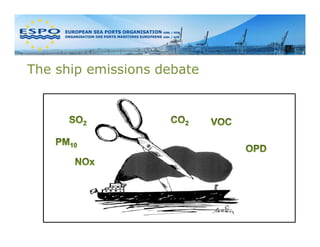
The ship emissions debate:
ESPO’s view and implications for ports


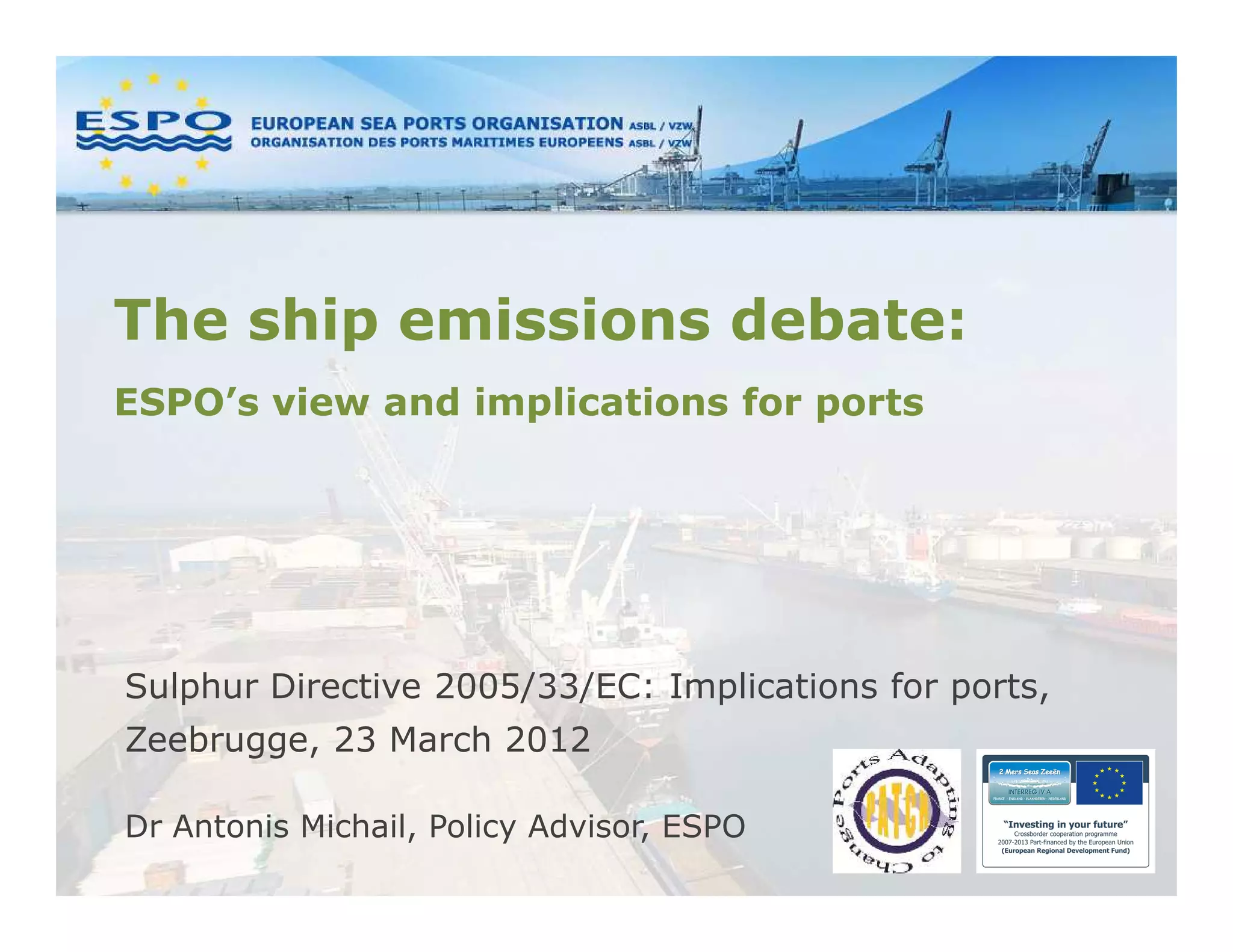
Sulphur Directive 2005/33/EC: Implications for ports,
Zeebrugge, 23 March 2012

Dr Antonis Michail, Policy Advisor, ESPO
Content

1.   ESPO and the environment

2.   The ship emissions debate

3.   Political process and ports’ response

4.   Way forward and conclusions
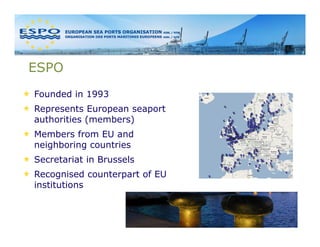
ESPO
Founded in 1993
Represents European seaport
authorities (members)
Members from EU and
neighboring countries
Secretariat in Brussels
Recognised counterpart of EU
institutions
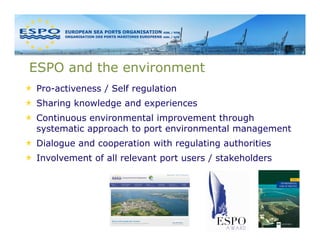
ESPO and the environment
Pro-activeness / Self regulation
Sharing knowledge and experiences
Continuous environmental improvement through
systematic approach to port environmental management
Dialogue and cooperation with regulating authorities
Involvement of all relevant port users / stakeholders
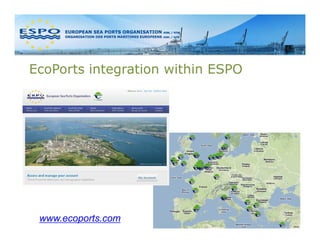
EcoPorts integration within ESPO


 www.ecoports.com
ESPO Green Guide - 5Es approach
Exemplify: Setting the good example towards the wider port
community

Enable: Providing infrastructural or operational conditions for port
users so that they can improve their environmental performance

Encourage: Providing incentives to port users in order to trigger
improved environmental performance

Engage: Engaging with port users and/or competent authorities in
sharing knowledge and skills towards joint projects

Enforce: Regulating behavior of port users and ensure compliance
Content

1.   ESPO and the environment

2.   The ship emissions debate

3.   Political process and ports’ response

4.   Way forward and conclusions
The ship emissions debate
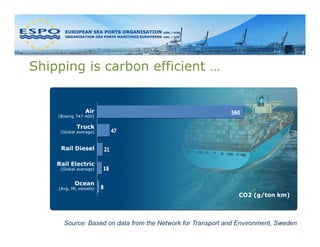
Shipping is carbon efficient …


                Air
    (Boeing 747-400)

            Truck
     (Global average)


     Rail Diesel

    Rail Electric
     (Global average)


           Ocean
    (Avg. ML vessels)
                                                               CO2 (g/ton km)


      Source: Based on data from the Network for Transport and Environment, Sweden
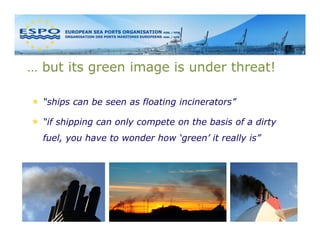
… but its green image is under threat!

  “ships can be seen as floating incinerators”

  “if shipping can only compete on the basis of a dirty
  fuel, you have to wonder how ‘green’ it really is”
Ports’ interest
  Maintaining / restoring the green image of shipping
  Maintaining its competitiveness
  Reducing impact on local air quality (SOx, NOx, PM)
  Maintaining good environmental condition in the port
  area (licence to operate and to grow)
Content

1.   ESPO and the environment

2.   The ship emissions debate

3.   Political process and ports’ response

4.   Way forward and conclusions
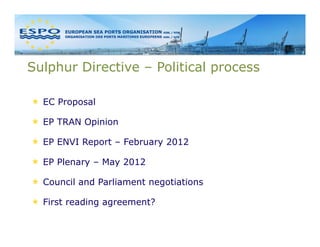
Sulphur Directive – Political process

  EC Proposal

  EP TRAN Opinion

  EP ENVI Report – February 2012

  EP Plenary – May 2012

  Council and Parliament negotiations

  First reading agreement?
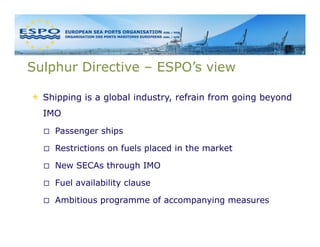
Sulphur Directive – ESPO’s view

  Shipping is a global industry, refrain from going beyond
  IMO
    Passenger ships

    Restrictions on fuels placed in the market

    New SECAs through IMO

    Fuel availability clause

    Ambitious programme of accompanying measures
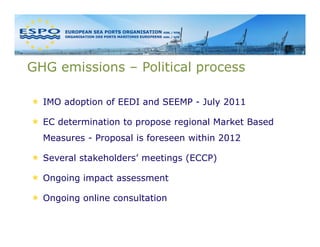
GHG emissions – Political process

  IMO adoption of EEDI and SEEMP - July 2011

  EC determination to propose regional Market Based
  Measures - Proposal is foreseen within 2012

  Several stakeholders’ meetings (ECCP)

  Ongoing impact assessment

  Ongoing online consultation
GHG emissions – Political process

  4 MMBs are being considered
    Compensation fund

    Mandatory emission reductions per ship

    Emission Trading Scheme

    Tax (on fuels or emissions)

  Scope
    All vessels arriving from the last port of call

    All vessels departing until the next port of call
GHG emissions – ESPO’s view

  It is counterproductive to tackle the contribution of a
  global industry to a global environmental issue on a
  regional basis!

  The risk of evading practices is of great concern for the
  ports especially in the Mediterranean and the Black Sea!

  Promote the use of voluntary initiatives at European
  level (e.g. WPCI, ESI, OPS, LNG, slow steaming)
Designation of NECAs – Process

  North Sea NECA consultation group
    Draft environmental and economic impact assessment
    arrive to the conclusion that a North Sea NECA is a
    socio-economic cost-efficient measure with benefits
    exceeding the costs

    Meeting 26-27 March

  Similar process in the Baltic Sea is ongoing
Designation of NECAs – ESPO view


 Each European region is free to examine whether a NECA
 designation is beneficial and to follow the IMO process

 But avoid the same mistakes as in the case of SECAs!

 Thorough impact assessment needed (including potential
 lack of level playing field related considerations)
Content

1.   ESPO and the environment

2.   The ship emissions debate

3.   Political process and ports’ response

4.   Way forward and conclusions
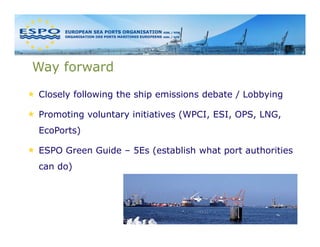
Way forward

Closely following the ship emissions debate / Lobbying

Promoting voluntary initiatives (WPCI, ESI, OPS, LNG,
EcoPorts)

ESPO Green Guide – 5Es (establish what port authorities
can do)
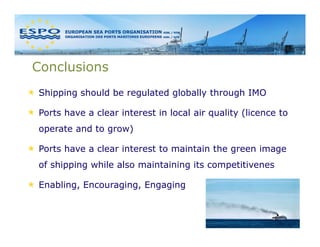
Conclusions
Shipping should be regulated globally through IMO

Ports have a clear interest in local air quality (licence to
operate and to grow)

Ports have a clear interest to maintain the green image
of shipping while also maintaining its competitivenes

Enabling, Encouraging, Engaging
Thank you for your attention!


Sulphur Directive 2005/33/EC: Implications for ports, Zeebrugge,
23 March 2012

Dr Antonis Michail, Policy Advisor, ESPO, antonis.michail@espo.be
www.espo.be / www.ecoports.com

Espo's view on ship emissions am

  • 1.
    The ship emissionsdebate: ESPO’s view and implications for ports Sulphur Directive 2005/33/EC: Implications for ports, Zeebrugge, 23 March 2012 Dr Antonis Michail, Policy Advisor, ESPO
  • 2.
    Content 1. ESPO and the environment 2. The ship emissions debate 3. Political process and ports’ response 4. Way forward and conclusions
  • 3.
    ESPO Founded in 1993 RepresentsEuropean seaport authorities (members) Members from EU and neighboring countries Secretariat in Brussels Recognised counterpart of EU institutions
  • 4.
    ESPO and theenvironment Pro-activeness / Self regulation Sharing knowledge and experiences Continuous environmental improvement through systematic approach to port environmental management Dialogue and cooperation with regulating authorities Involvement of all relevant port users / stakeholders
  • 5.
    EcoPorts integration withinESPO www.ecoports.com
  • 6.
    ESPO Green Guide- 5Es approach Exemplify: Setting the good example towards the wider port community Enable: Providing infrastructural or operational conditions for port users so that they can improve their environmental performance Encourage: Providing incentives to port users in order to trigger improved environmental performance Engage: Engaging with port users and/or competent authorities in sharing knowledge and skills towards joint projects Enforce: Regulating behavior of port users and ensure compliance
  • 7.
    Content 1. ESPO and the environment 2. The ship emissions debate 3. Political process and ports’ response 4. Way forward and conclusions
  • 8.
  • 9.
    Shipping is carbonefficient … Air (Boeing 747-400) Truck (Global average) Rail Diesel Rail Electric (Global average) Ocean (Avg. ML vessels) CO2 (g/ton km) Source: Based on data from the Network for Transport and Environment, Sweden
  • 10.
    … but itsgreen image is under threat! “ships can be seen as floating incinerators” “if shipping can only compete on the basis of a dirty fuel, you have to wonder how ‘green’ it really is”
  • 11.
    Ports’ interest Maintaining / restoring the green image of shipping Maintaining its competitiveness Reducing impact on local air quality (SOx, NOx, PM) Maintaining good environmental condition in the port area (licence to operate and to grow)
  • 12.
    Content 1. ESPO and the environment 2. The ship emissions debate 3. Political process and ports’ response 4. Way forward and conclusions
  • 13.
    Sulphur Directive –Political process EC Proposal EP TRAN Opinion EP ENVI Report – February 2012 EP Plenary – May 2012 Council and Parliament negotiations First reading agreement?
  • 14.
    Sulphur Directive –ESPO’s view Shipping is a global industry, refrain from going beyond IMO Passenger ships Restrictions on fuels placed in the market New SECAs through IMO Fuel availability clause Ambitious programme of accompanying measures
  • 15.
    GHG emissions –Political process IMO adoption of EEDI and SEEMP - July 2011 EC determination to propose regional Market Based Measures - Proposal is foreseen within 2012 Several stakeholders’ meetings (ECCP) Ongoing impact assessment Ongoing online consultation
  • 16.
    GHG emissions –Political process 4 MMBs are being considered Compensation fund Mandatory emission reductions per ship Emission Trading Scheme Tax (on fuels or emissions) Scope All vessels arriving from the last port of call All vessels departing until the next port of call
  • 17.
    GHG emissions –ESPO’s view It is counterproductive to tackle the contribution of a global industry to a global environmental issue on a regional basis! The risk of evading practices is of great concern for the ports especially in the Mediterranean and the Black Sea! Promote the use of voluntary initiatives at European level (e.g. WPCI, ESI, OPS, LNG, slow steaming)
  • 18.
    Designation of NECAs– Process North Sea NECA consultation group Draft environmental and economic impact assessment arrive to the conclusion that a North Sea NECA is a socio-economic cost-efficient measure with benefits exceeding the costs Meeting 26-27 March Similar process in the Baltic Sea is ongoing
  • 19.
    Designation of NECAs– ESPO view Each European region is free to examine whether a NECA designation is beneficial and to follow the IMO process But avoid the same mistakes as in the case of SECAs! Thorough impact assessment needed (including potential lack of level playing field related considerations)
  • 20.
    Content 1. ESPO and the environment 2. The ship emissions debate 3. Political process and ports’ response 4. Way forward and conclusions
  • 21.
    Way forward Closely followingthe ship emissions debate / Lobbying Promoting voluntary initiatives (WPCI, ESI, OPS, LNG, EcoPorts) ESPO Green Guide – 5Es (establish what port authorities can do)
  • 22.
    Conclusions Shipping should beregulated globally through IMO Ports have a clear interest in local air quality (licence to operate and to grow) Ports have a clear interest to maintain the green image of shipping while also maintaining its competitivenes Enabling, Encouraging, Engaging
  • 23.
    Thank you foryour attention! Sulphur Directive 2005/33/EC: Implications for ports, Zeebrugge, 23 March 2012 Dr Antonis Michail, Policy Advisor, ESPO, antonis.michail@espo.be www.espo.be / www.ecoports.com