ICT 2018e-Sides Ethical and Societal Implications of Data Sciences
Building the Privacy and Security
Research Agenda for Big Data
ICT 2018 Networking Session
December 5 2018, 16.30-17.15
@eSIDES_EU
#privacyinbigdata
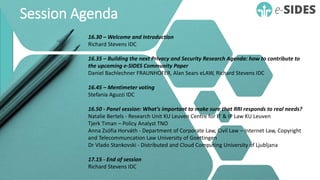
Session Agenda
16.30 – Welcome and Introduction
Richard Stevens IDC
16.35 – Building the next Privacy and Security Research Agenda: how to contribute to
the upcoming e-SIDES Community Paper
Daniel Bachlechner FRAUNHOFER, Alan Sears eLAW, Richard Stevens IDC
16.45 – Mentimeter voting
Stefania Aguzzi IDC
16.50 - Panel session: What’s important to make sure that RRI responds to real needs?
Natalie Bertels - Research Unit KU Leuven Centre for IT & IP Law KU Leuven
Tjerk Timan – Policy Analyst TNO
Anna Zsófia Horváth - Department of Corporate Law, Civil Law – Internet Law, Copyright
and Telecommuncation Law University of Goettingen
Dr Vlado Stankovski - Distributed and Cloud Computing University of Ljubljana
17.15 - End of session
Richard Stevens IDC
Project overview
3ICT 2018 – Vienna, 5 December 2018
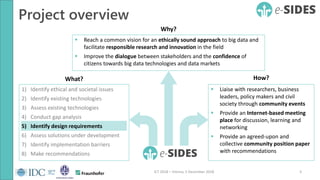
1) Identify ethical and societal issues
2) Identify existing technologies
3) Assess existing technologies
4) Conduct gap analysis
5) Identify design requirements
6) Assess solutions under development
7) Identify implementation barriers
8) Make recommendations
What?
 Liaise with researchers, business
leaders, policy makers and civil
society through community events
 Provide an Internet-based meeting
place for discussion, learning and
networking
 Provide an agreed-upon and
collective community position paper
with recommendations
How?
Why?
 Reach a common vision for an ethically sound approach to big data and
facilitate responsible research and innovation in the field
 Improve the dialogue between stakeholders and the confidence of
citizens towards big data technologies and data markets
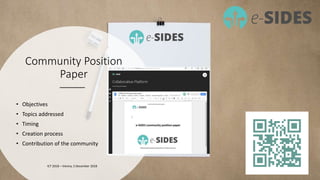
Community Position
Paper
• Objectives
• Topics addressed
• Timing
• Creation process
• Contribution of the community
ICT 2018 – Vienna, 5 December 2018
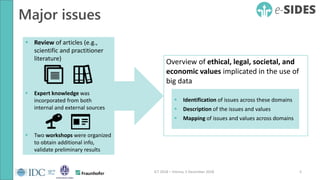
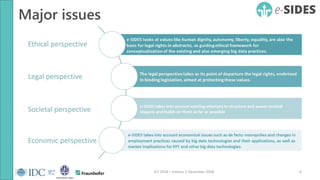
Major issues
5ICT 2018 – Vienna, 5 December 2018
 Review of articles (e.g.,
scientific and practitioner
literature)
 Expert knowledge was
incorporated from both
internal and external sources
 Two workshops were organized
to obtain additional info,
validate preliminary results
Overview of ethical, legal, societal, and
economic values implicated in the use of
big data
 Identification of issues across these domains
 Description of the issues and values
 Mapping of issues and values across domains
Major issues
6ICT 2018 – Vienna, 5 December 2018
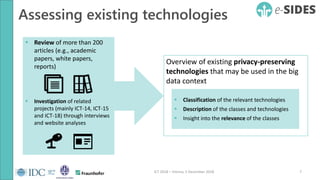
Assessing existing technologies
7ICT 2018 – Vienna, 5 December 2018
 Review of more than 200
articles (e.g., academic
papers, white papers,
reports)
 Investigation of related
projects (mainly ICT-14, ICT-15
and ICT-18) through interviews
and website analyses
Overview of existing privacy-preserving
technologies that may be used in the big
data context
 Classification of the relevant technologies
 Description of the classes and technologies
 Insight into the relevance of the classes
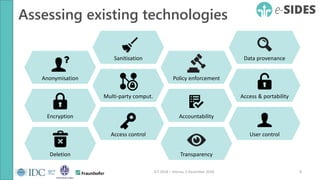
Assessing existing technologies
8ICT 2018 – Vienna, 5 December 2018
Anonymisation
Encryption
Deletion
Sanitisation
Multi-party comput.
Access control
Policy enforcement
Accountability
Transparency
Data provenance
Access & portability
User control
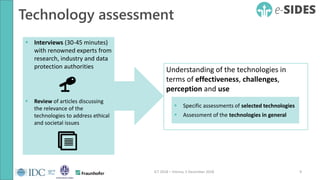
Technology assessment
9ICT 2018 – Vienna, 5 December 2018
 Interviews (30-45 minutes)
with renowned experts from
research, industry and data
protection authorities
 Review of articles discussing
the relevance of the
technologies to address ethical
and societal issues
Understanding of the technologies in
terms of effectiveness, challenges,
perception and use
 Specific assessments of selected technologies
 Assessment of the technologies in general
Technology assessment
10ICT 2018 – Vienna, 5 December 2018
Specific assessments General assessment
 Technologies are integrated very little into
today’s big data solutions
 There is low demand from the customer
side for technologies to protect privacy
 Regional differences have to be considered
 The combination of technical and non-
technical measures is essential
 The question of responsibility is not
always easy to answer in practice
 The set of classes of technologies is
comprehensive
 The classes of technologies need to be
combined to be effective
 The technologies pursue different aims
 A multidimensional measure for privacy
preservation is needed
 There is a fundamental tension between
the objectives of big data and privacy
Technology
assessment
Gap analysis
11ICT 2018 – Vienna, 5 December 2018
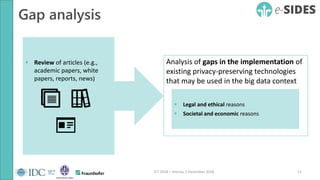
 Review of articles (e.g.,
academic papers, white
papers, reports, news)
Analysis of gaps in the implementation of
existing privacy-preserving technologies
that may be used in the big data context
 Legal and ethical reasons
 Societal and economic reasons
Gap analysis
12European Big Data Value Forum – Vienna, 13 November 2018
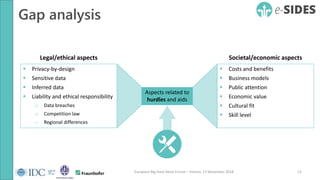
 Privacy-by-design
 Sensitive data
 Inferred data
 Liability and ethical responsibility
o Data breaches
o Competition law
o Regional differences
Legal/ethical aspects
 Costs and benefits
 Business models
 Public attention
 Economic value
 Cultural fit
 Skill level
Societal/economic aspects
Aspects related to
hurdles and aids
What’s next?
13ICT 2018 – Vienna, 5 December 2018
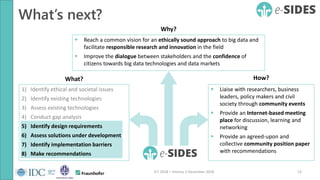
1) Identify ethical and societal issues
2) Identify existing technologies
3) Assess existing technologies
4) Conduct gap analysis
5) Identify design requirements
6) Assess solutions under development
7) Identify implementation barriers
8) Make recommendations
What?
 Liaise with researchers, business
leaders, policy makers and civil
society through community events
 Provide an Internet-based meeting
place for discussion, learning and
networking
 Provide an agreed-upon and
collective community position paper
with recommendations
How?
Why?
 Reach a common vision for an ethically sound approach to big data and
facilitate responsible research and innovation in the field
 Improve the dialogue between stakeholders and the confidence of
citizens towards big data technologies and data markets
Research agenda
14ICT 2018 – Vienna, 5 December 2018
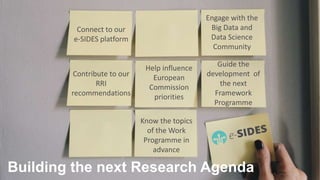
Relevance of the community position paper for the future research
agenda
Building the next Research Agenda
Connect to our
e-SIDES platform
Engage with the
Big Data and
Data Science
Community
Contribute to our
RRI
recommendations
Help influence
European
Commission
priorities
Guide the
development of
the next
Framework
Programme
Know the topics
of the Work
Programme in
advance
We want your input!
Panel Session
What’s important to make sure that RRI responds to real needs?
Natalie Bertels - Research Unit KU Leuven Centre for IT & IP Law KU Leuven
Tjerk Timan – Policy Analyst TNO
Anna Zsófia Horváth - Department of Corporate Law, Civil Law University of
Goettingen
Dr Vlado Stankovski - Distributed and Cloud Computing University of Ljubljana
Natalie Bertels - Research Unit KU Leuven
Centre for IT & IP Law KU Leuven
e-Sides Ethical and Societal Implications of Data Sciences 17
e-Sides Ethical and Societal Implications of Data Sciences 18
Tjerk Timan –TNO
e-Sides Ethical and Societal Implications of Data Sciences 19
e-Sides Ethical and Societal Implications of Data Sciences 20
e-Sides Ethical and Societal Implications of Data Sciences 21
e-Sides Ethical and Societal Implications of Data Sciences 22
e-Sides Ethical and Societal Implications of Data Sciences 23
Vlado Stankovski - University of Ljubljana
e-Sides Ethical and Societal Implications of Data Sciences 24
Thank you!
@eSIDES_EU
#privacyinbigdata
eSIDES_EU
info@esides.eu

e-SIDES workshop at ICT 2018, Vienna 5/12/2018

  • 1.
    ICT 2018e-Sides Ethicaland Societal Implications of Data Sciences Building the Privacy and Security Research Agenda for Big Data ICT 2018 Networking Session December 5 2018, 16.30-17.15 @eSIDES_EU #privacyinbigdata
  • 2.
    Session Agenda 16.30 –Welcome and Introduction Richard Stevens IDC 16.35 – Building the next Privacy and Security Research Agenda: how to contribute to the upcoming e-SIDES Community Paper Daniel Bachlechner FRAUNHOFER, Alan Sears eLAW, Richard Stevens IDC 16.45 – Mentimeter voting Stefania Aguzzi IDC 16.50 - Panel session: What’s important to make sure that RRI responds to real needs? Natalie Bertels - Research Unit KU Leuven Centre for IT & IP Law KU Leuven Tjerk Timan – Policy Analyst TNO Anna Zsófia Horváth - Department of Corporate Law, Civil Law – Internet Law, Copyright and Telecommuncation Law University of Goettingen Dr Vlado Stankovski - Distributed and Cloud Computing University of Ljubljana 17.15 - End of session Richard Stevens IDC
  • 3.
    Project overview 3ICT 2018– Vienna, 5 December 2018 1) Identify ethical and societal issues 2) Identify existing technologies 3) Assess existing technologies 4) Conduct gap analysis 5) Identify design requirements 6) Assess solutions under development 7) Identify implementation barriers 8) Make recommendations What?  Liaise with researchers, business leaders, policy makers and civil society through community events  Provide an Internet-based meeting place for discussion, learning and networking  Provide an agreed-upon and collective community position paper with recommendations How? Why?  Reach a common vision for an ethically sound approach to big data and facilitate responsible research and innovation in the field  Improve the dialogue between stakeholders and the confidence of citizens towards big data technologies and data markets
  • 4.
    Community Position Paper • Objectives •Topics addressed • Timing • Creation process • Contribution of the community ICT 2018 – Vienna, 5 December 2018
  • 5.
    Major issues 5ICT 2018– Vienna, 5 December 2018  Review of articles (e.g., scientific and practitioner literature)  Expert knowledge was incorporated from both internal and external sources  Two workshops were organized to obtain additional info, validate preliminary results Overview of ethical, legal, societal, and economic values implicated in the use of big data  Identification of issues across these domains  Description of the issues and values  Mapping of issues and values across domains
  • 6.
    Major issues 6ICT 2018– Vienna, 5 December 2018
  • 7.
    Assessing existing technologies 7ICT2018 – Vienna, 5 December 2018  Review of more than 200 articles (e.g., academic papers, white papers, reports)  Investigation of related projects (mainly ICT-14, ICT-15 and ICT-18) through interviews and website analyses Overview of existing privacy-preserving technologies that may be used in the big data context  Classification of the relevant technologies  Description of the classes and technologies  Insight into the relevance of the classes
  • 8.
    Assessing existing technologies 8ICT2018 – Vienna, 5 December 2018 Anonymisation Encryption Deletion Sanitisation Multi-party comput. Access control Policy enforcement Accountability Transparency Data provenance Access & portability User control
  • 9.
    Technology assessment 9ICT 2018– Vienna, 5 December 2018  Interviews (30-45 minutes) with renowned experts from research, industry and data protection authorities  Review of articles discussing the relevance of the technologies to address ethical and societal issues Understanding of the technologies in terms of effectiveness, challenges, perception and use  Specific assessments of selected technologies  Assessment of the technologies in general
  • 10.
    Technology assessment 10ICT 2018– Vienna, 5 December 2018 Specific assessments General assessment  Technologies are integrated very little into today’s big data solutions  There is low demand from the customer side for technologies to protect privacy  Regional differences have to be considered  The combination of technical and non- technical measures is essential  The question of responsibility is not always easy to answer in practice  The set of classes of technologies is comprehensive  The classes of technologies need to be combined to be effective  The technologies pursue different aims  A multidimensional measure for privacy preservation is needed  There is a fundamental tension between the objectives of big data and privacy Technology assessment
  • 11.
    Gap analysis 11ICT 2018– Vienna, 5 December 2018  Review of articles (e.g., academic papers, white papers, reports, news) Analysis of gaps in the implementation of existing privacy-preserving technologies that may be used in the big data context  Legal and ethical reasons  Societal and economic reasons
  • 12.
    Gap analysis 12European BigData Value Forum – Vienna, 13 November 2018  Privacy-by-design  Sensitive data  Inferred data  Liability and ethical responsibility o Data breaches o Competition law o Regional differences Legal/ethical aspects  Costs and benefits  Business models  Public attention  Economic value  Cultural fit  Skill level Societal/economic aspects Aspects related to hurdles and aids
  • 13.
    What’s next? 13ICT 2018– Vienna, 5 December 2018 1) Identify ethical and societal issues 2) Identify existing technologies 3) Assess existing technologies 4) Conduct gap analysis 5) Identify design requirements 6) Assess solutions under development 7) Identify implementation barriers 8) Make recommendations What?  Liaise with researchers, business leaders, policy makers and civil society through community events  Provide an Internet-based meeting place for discussion, learning and networking  Provide an agreed-upon and collective community position paper with recommendations How? Why?  Reach a common vision for an ethically sound approach to big data and facilitate responsible research and innovation in the field  Improve the dialogue between stakeholders and the confidence of citizens towards big data technologies and data markets
  • 14.
    Research agenda 14ICT 2018– Vienna, 5 December 2018 Relevance of the community position paper for the future research agenda Building the next Research Agenda Connect to our e-SIDES platform Engage with the Big Data and Data Science Community Contribute to our RRI recommendations Help influence European Commission priorities Guide the development of the next Framework Programme Know the topics of the Work Programme in advance
  • 15.
  • 16.
    Panel Session What’s importantto make sure that RRI responds to real needs? Natalie Bertels - Research Unit KU Leuven Centre for IT & IP Law KU Leuven Tjerk Timan – Policy Analyst TNO Anna Zsófia Horváth - Department of Corporate Law, Civil Law University of Goettingen Dr Vlado Stankovski - Distributed and Cloud Computing University of Ljubljana
  • 17.
    Natalie Bertels -Research Unit KU Leuven Centre for IT & IP Law KU Leuven e-Sides Ethical and Societal Implications of Data Sciences 17
  • 18.
    e-Sides Ethical andSocietal Implications of Data Sciences 18 Tjerk Timan –TNO
  • 19.
    e-Sides Ethical andSocietal Implications of Data Sciences 19
  • 20.
    e-Sides Ethical andSocietal Implications of Data Sciences 20
  • 21.
    e-Sides Ethical andSocietal Implications of Data Sciences 21
  • 22.
    e-Sides Ethical andSocietal Implications of Data Sciences 22
  • 23.
    e-Sides Ethical andSocietal Implications of Data Sciences 23 Vlado Stankovski - University of Ljubljana
  • 24.
    e-Sides Ethical andSocietal Implications of Data Sciences 24
  • 25.

Editor's Notes

  • #6 Desk research and review of literature, expert meetings CEPE/EthiComp 2017, Torino 23rd ICE/IEEE 2017, Madeira)
  • #7 Brief overview of key results D2.2 White paper: Emerging issues and real-life cases
  • #9 Brief overview of key results D3.1 White paper: Technologies preserving privacy and security
  • #13 Brief overview of key results D4.1 White paper: Integration of technologies into big data solutions (to be published soon) What are the main hurdles in implementing privacy-preserving technologies beyond the research domain, and how can we overcome these hurdles?