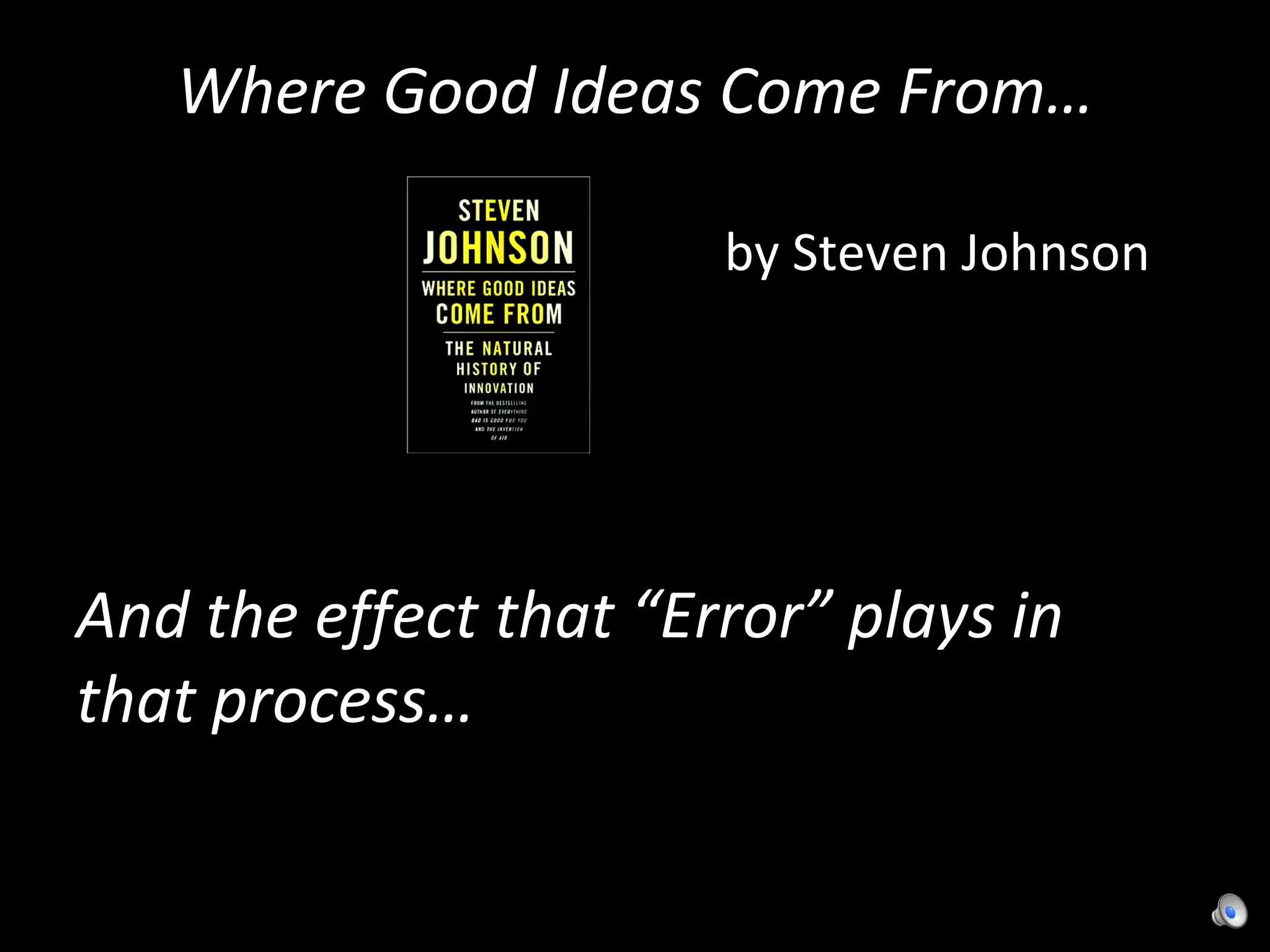
Where Good Ideas Come From…   by Steven Johnson And the effect that “Error” plays in that process…
Where DO good ideas come from? The Eureka moment  vs.  The 7 patterns of innovation
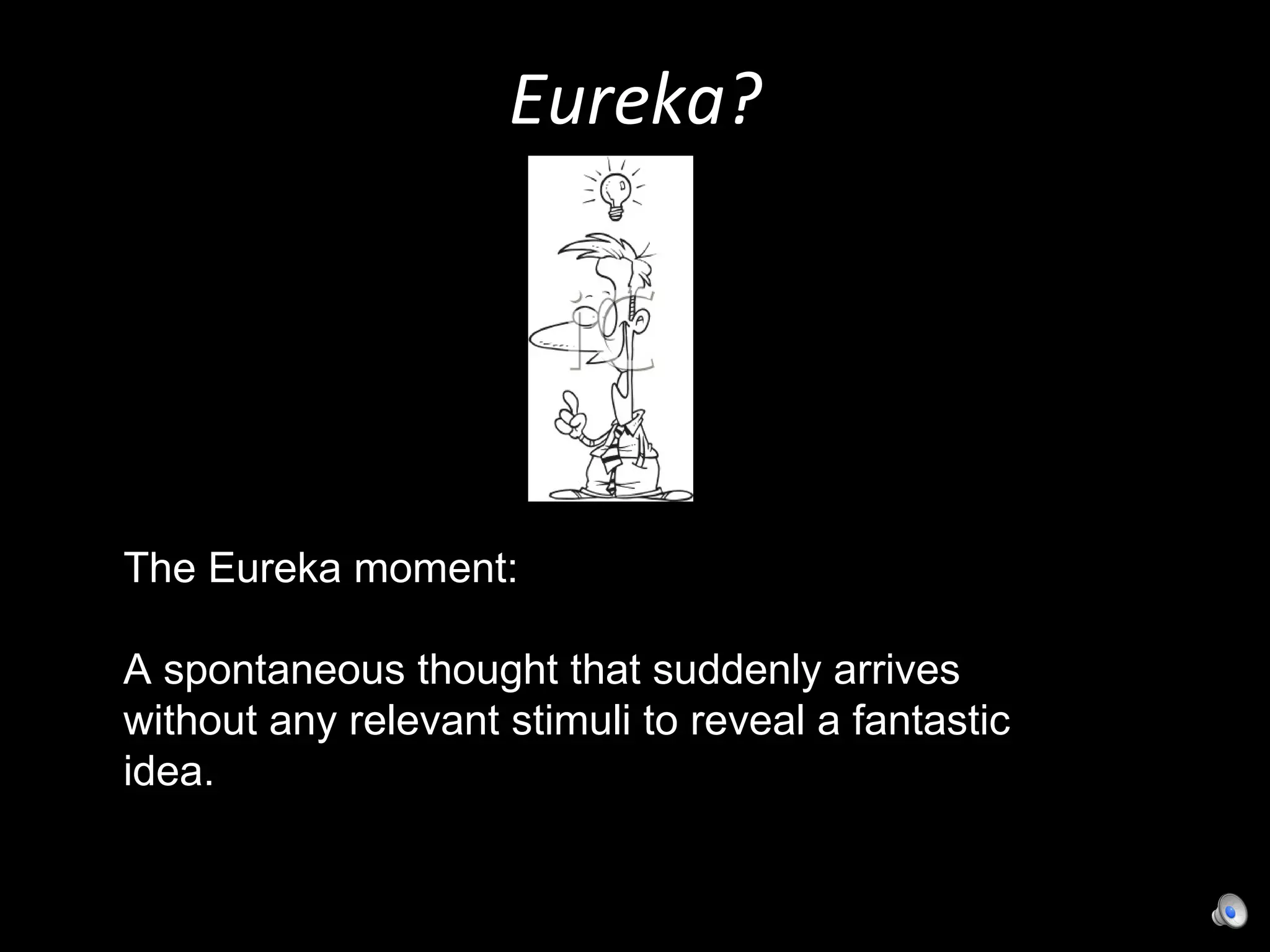
Eureka? The Eureka moment:  A spontaneous thought that suddenly arrives without any relevant stimuli to reveal a fantastic idea.
Patterns of Innovation Our thoughts are often shaped by our environment. Several shared patterns recur often in unusually fertile environments. Collectively, these patterns embraced-- increase our innovative abilities.
Error Error, not as a mistake to be immediately fixed,  but as a launching pad to something equal or quite often, greater. What does penicillin, Post-It notes, & chocolate chip cookies have in common?
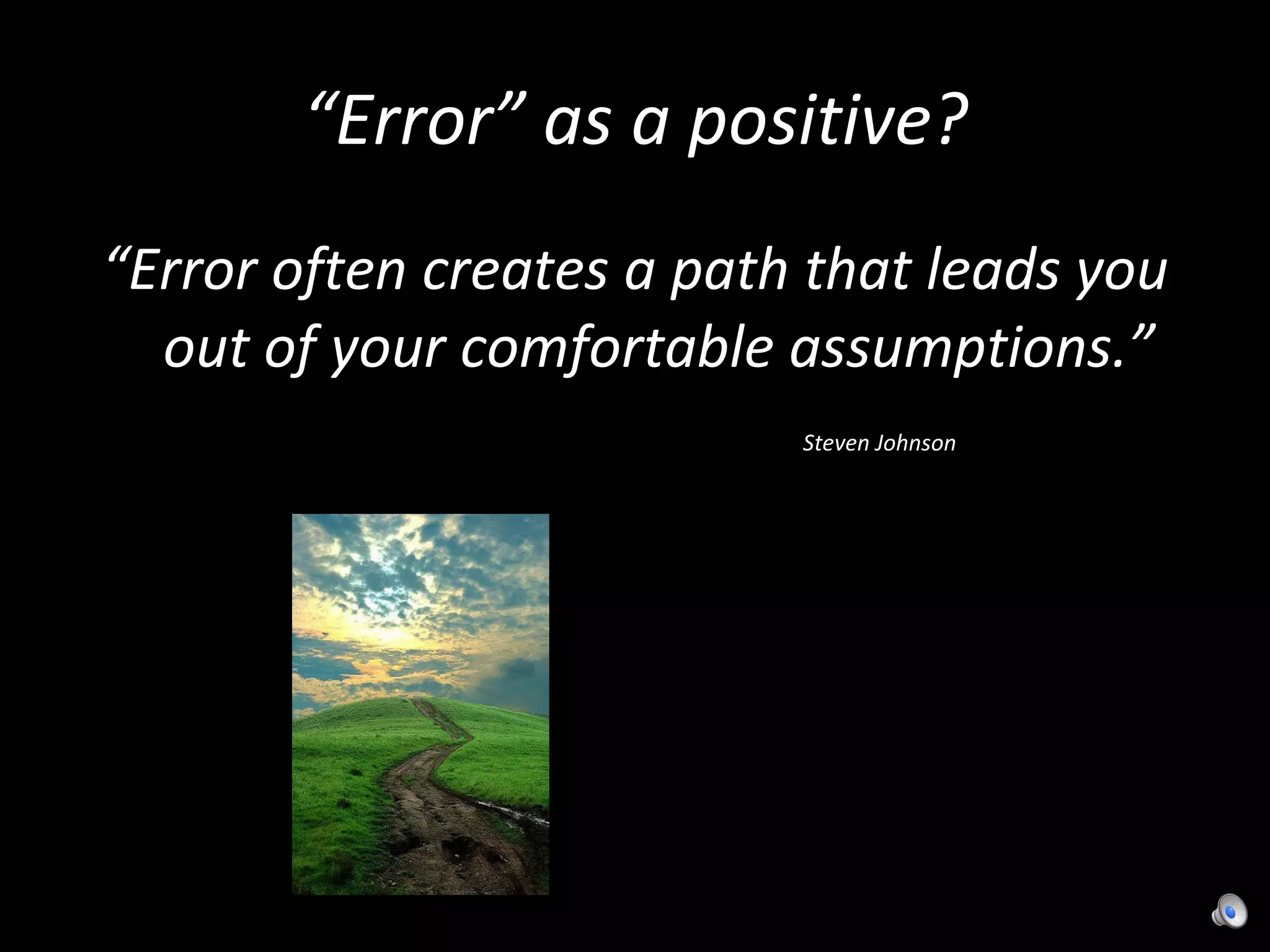
“ Error” as a positive? “ Error often creates a path that leads you out of your comfortable assumptions.” Steven Johnson
Positive Error It is unreasonable to assume that great ideas and discoveries are achieved by arriving at the truth immediately—without initial error. Instead, these errors can lead to that desired end result, or another one that never would have presented itself otherwise.
The impact of “Error” “ A shockingly large number of transformative ideas in the annals of science can be attributed to contaminated lab experiments.” Steven Johnson (Have you figured out yet what penicillin, Post-It notes & chocolate chip cookies have in common?)
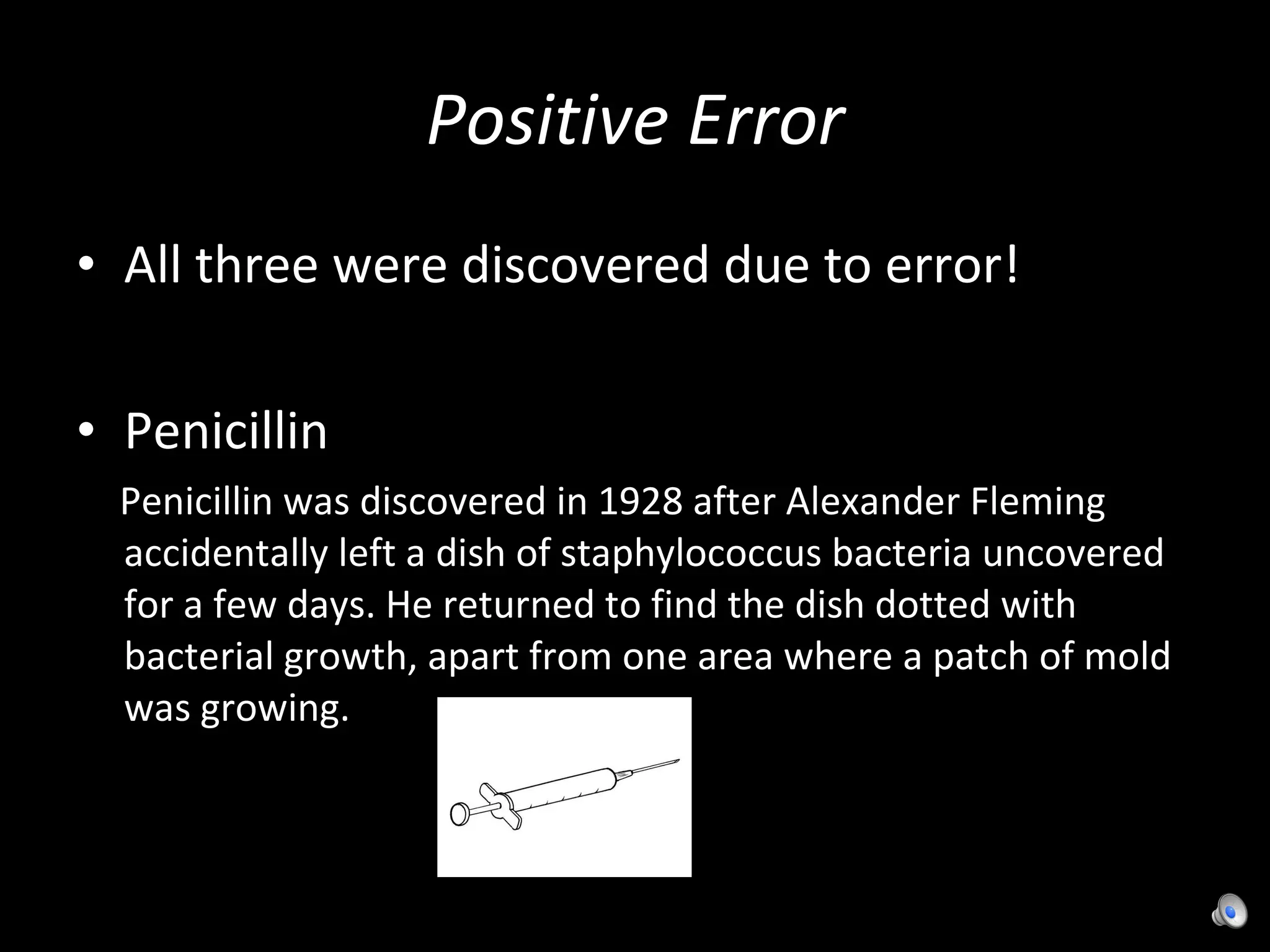
Positive Error All three were discovered due to error! Penicillin Penicillin was discovered in 1928 after Alexander Fleming accidentally left a dish of staphylococcus bacteria uncovered for a few days. He returned to find the dish dotted with bacterial growth, apart from one area where a patch of mold was growing.
Penicillin by mistake This mold produced a substance, named penicillin by Fleming, which inhibited bacterial growth and was later found to be effective against a wide range of harmful bacteria. Which makes more sense: That this was an accident caused by sloppy lab work or that this life-saving invention was the result of a capable scientist who took advantage of an unseen result rather than try to erase what he did not expect to find?
Post-It notes Those little self-stick notepapers that everyone uses wasn’t a planned thing that someone got the idea for and then invented. It was discovered due to ERROR! In 1970, Spencer Silver was working for 3M company trying to find a strong adhesive. The new adhesive Silver invented turned out to be weaker than anything they already made, instead of stronger.
Post-It notes About four years later another 3M scientist, Arthur Fry, needing something to keep his choir markers together remembered Silver’s weak glue and used it. The weak glue worked and the markers stayed in place. Ten years after Spencer Silver invented his super weak adhesive, 3M started selling the Post-it Notes nationwide in 1980.
Chocolate Chip Cookies In 1930, Ruth Wakefield invented chocolate chip cookies—by mistake!  While mixing a batch of cookies, she substituted small pieces of chocolate for baker’s chocolate in the cookie dough.  When she took out the pan from the oven, she was surprised to see that the chocolate had not melted into the dough, and her cookies were not chocolate cookies. The first chocolate chip cookies were witnessed.. But probably not for long!
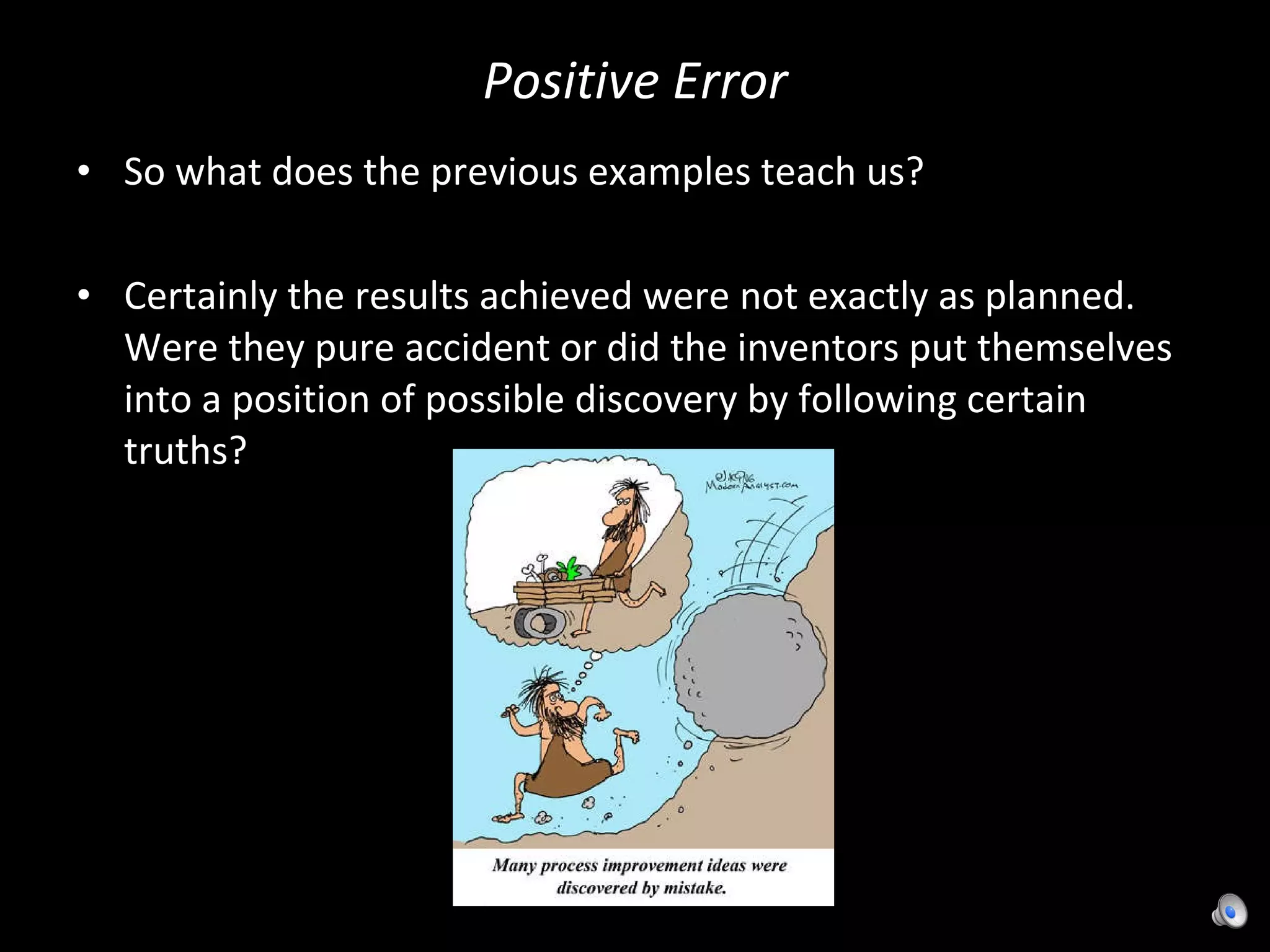
Positive Error So what does the previous examples teach us? Certainly the results achieved were not exactly as planned. Were they pure accident or did the inventors put themselves into a position of possible discovery by following certain truths?
Fertile Creative Environment Let’s take a look at the shared commonalities from these three examples: All three inventors were not acting randomly.  They were utilizing and integrating certain truths into their projects (ex- creating adhesive). Trial and Error was not avoided but embraced
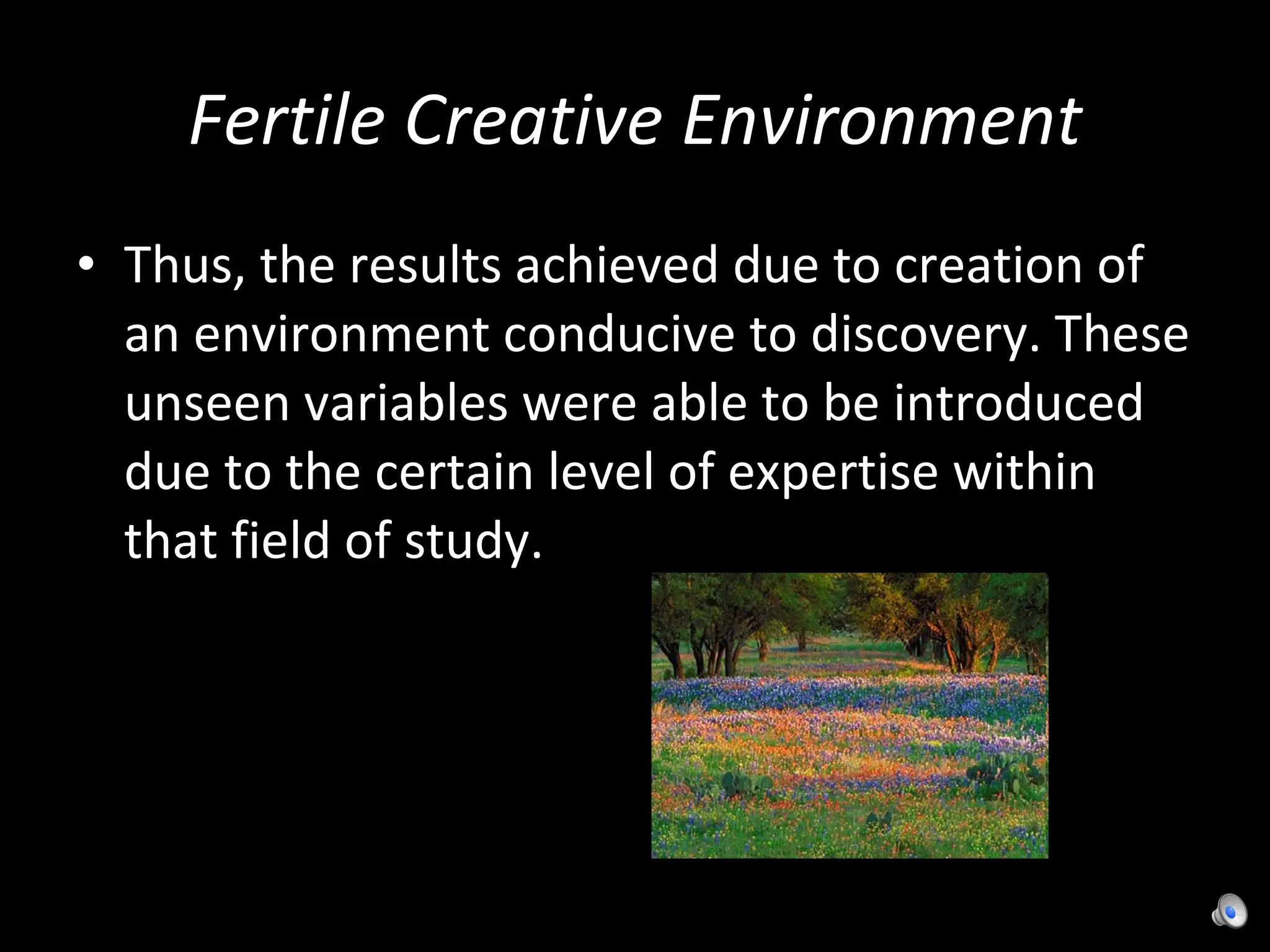
Fertile Creative Environment Thus, the results achieved due to creation of an environment conducive to discovery. These unseen variables were able to be introduced due to the certain level of expertise within that field of study.
Still not convinced? In 1492, Columbus sailed the ocean blue from Spain in search of a shorter trade route to the Indies. He landed instead in “The New World”. Had Columbus not been a knowledgeable and brave explorer, he never would have been put into a position to capitalize on his error, underestimating the circumference of the world, and finding “The New World”.
Learning from Error  There is much to learn from trial & error. Math and science problem-solving rely on it constantly. However, it can go beyond that to positively affect student’s critical thinking skills. Rather than lecture to students what is right vs. what is wrong, have them figure it out. Having them make decisions and weigh consequences in a safe environment, they are more informed and self-aware to make better choices outside the classroom.
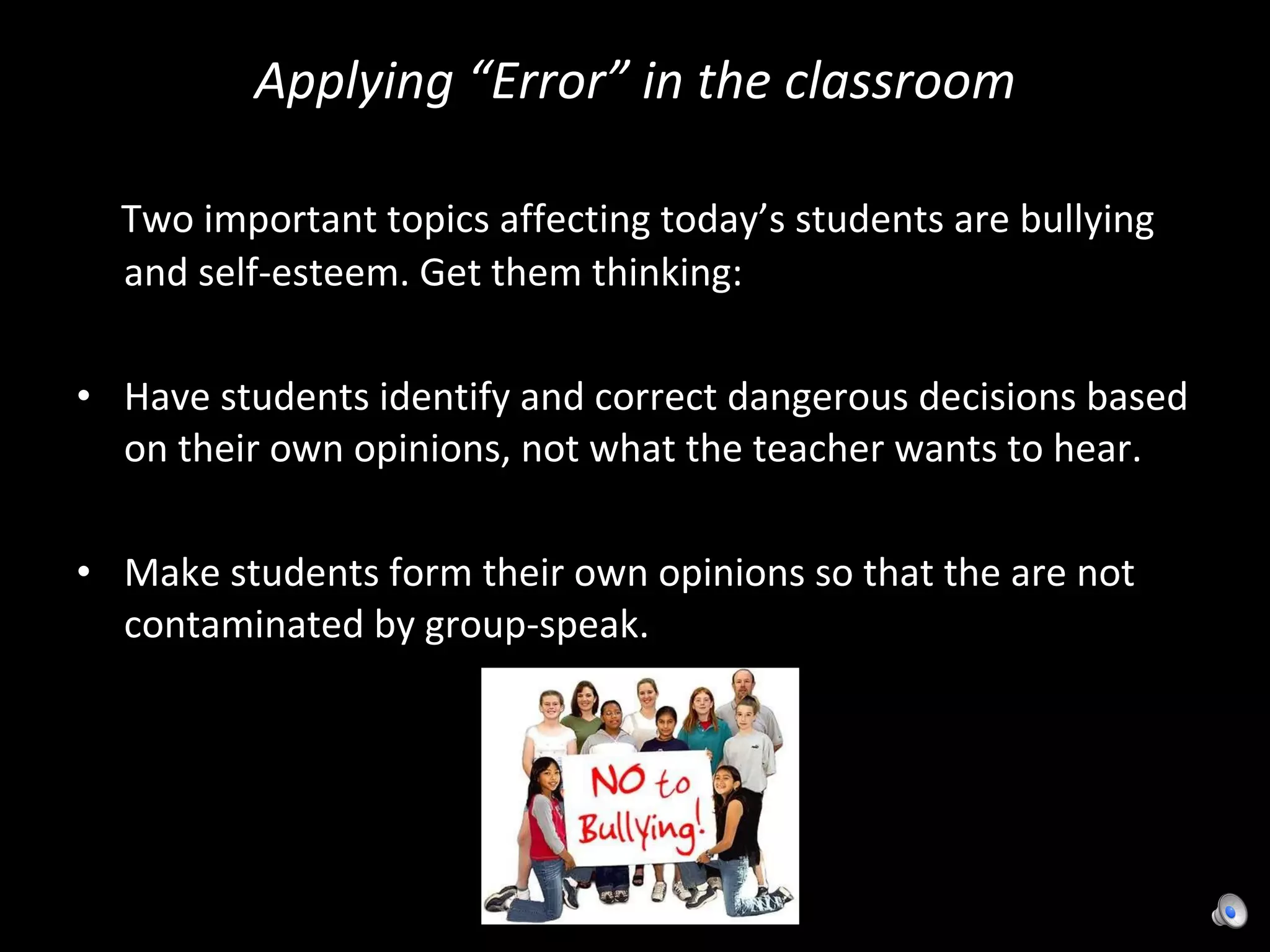
Applying “Error” in the classroom Two important topics affecting today’s students are bullying and self-esteem. Get them thinking: Have students identify and correct dangerous decisions based on their own opinions, not what the teacher wants to hear.  Make students form their own opinions so that the are not contaminated by group-speak.
Innovative Ideas “ Good ideas are more likely to form in environments that contain a certain amount of noise and error”. -Steven Johnson “ So keep trying, write down your thoughts, and don’t necessarily look to correct an error without knowing first, where that error will lead”.  -Tom Russo
References Johnson, S., (2010).  Where good ideas come from: The natural history of innovation.  New York:  Riverhead Books. Oracle ThinkQuest, (2001). Retrieved on 6/17/11 from  http://library.thinkquest.org/J0112389/mistakes_that_worked.htm .  The Great Idea Finder, (2006). Retrieved on 6/17/2011 from  http://www.ideafinder.com/history/inventors/fleming.htm .  Images:  “ Where Good ideas come from” book cover retrieved on 6/19/11 from  http://seattletimes.nwsource.com/html/books/2013030801_br03innovation.html  . “ Eureka moment” retrieved on 6/18/11 from  w ww.clipartoday.com/_thumbs/014/Idea_l_tnb.png . “ Grassy path” retrieved on 6/18/11 from  www.journeydeeper.org/blog/files/path0.jpg .  “ Syringe” retrieved on 6/18/11 from  mylifebeach.blogspot.com/2010_05_19_archive.html.  “ Caveman running downhill” retrieved on 6/17/11 from  http://www.modernanalyst.com/Resources/BusinessAnalystHumor/tabid/218/articleType/ArticleView/articleId/1473/Many_process_improvement_ideas_are_discovered_by_mistake.aspx .  “ Fertile field” retrieved on 6/18 from  www.stephenzades.typepad.com/ .  “ Say No to bullying” retrieved on 6/15/11 from  www.kidactivities.net/category/Bullying.aspx .

Error

  • 1.
    Where Good IdeasCome From… by Steven Johnson And the effect that “Error” plays in that process…
  • 2.
    Where DO goodideas come from? The Eureka moment vs. The 7 patterns of innovation
  • 3.
    Eureka? The Eurekamoment: A spontaneous thought that suddenly arrives without any relevant stimuli to reveal a fantastic idea.
  • 4.
    Patterns of InnovationOur thoughts are often shaped by our environment. Several shared patterns recur often in unusually fertile environments. Collectively, these patterns embraced-- increase our innovative abilities.
  • 5.
    Error Error, notas a mistake to be immediately fixed, but as a launching pad to something equal or quite often, greater. What does penicillin, Post-It notes, & chocolate chip cookies have in common?
  • 6.
    “ Error” asa positive? “ Error often creates a path that leads you out of your comfortable assumptions.” Steven Johnson
  • 7.
    Positive Error Itis unreasonable to assume that great ideas and discoveries are achieved by arriving at the truth immediately—without initial error. Instead, these errors can lead to that desired end result, or another one that never would have presented itself otherwise.
  • 8.
    The impact of“Error” “ A shockingly large number of transformative ideas in the annals of science can be attributed to contaminated lab experiments.” Steven Johnson (Have you figured out yet what penicillin, Post-It notes & chocolate chip cookies have in common?)
  • 9.
    Positive Error Allthree were discovered due to error! Penicillin Penicillin was discovered in 1928 after Alexander Fleming accidentally left a dish of staphylococcus bacteria uncovered for a few days. He returned to find the dish dotted with bacterial growth, apart from one area where a patch of mold was growing.
  • 10.
    Penicillin by mistakeThis mold produced a substance, named penicillin by Fleming, which inhibited bacterial growth and was later found to be effective against a wide range of harmful bacteria. Which makes more sense: That this was an accident caused by sloppy lab work or that this life-saving invention was the result of a capable scientist who took advantage of an unseen result rather than try to erase what he did not expect to find?
  • 11.
    Post-It notes Thoselittle self-stick notepapers that everyone uses wasn’t a planned thing that someone got the idea for and then invented. It was discovered due to ERROR! In 1970, Spencer Silver was working for 3M company trying to find a strong adhesive. The new adhesive Silver invented turned out to be weaker than anything they already made, instead of stronger.
  • 12.
    Post-It notes Aboutfour years later another 3M scientist, Arthur Fry, needing something to keep his choir markers together remembered Silver’s weak glue and used it. The weak glue worked and the markers stayed in place. Ten years after Spencer Silver invented his super weak adhesive, 3M started selling the Post-it Notes nationwide in 1980.
  • 13.
    Chocolate Chip CookiesIn 1930, Ruth Wakefield invented chocolate chip cookies—by mistake! While mixing a batch of cookies, she substituted small pieces of chocolate for baker’s chocolate in the cookie dough. When she took out the pan from the oven, she was surprised to see that the chocolate had not melted into the dough, and her cookies were not chocolate cookies. The first chocolate chip cookies were witnessed.. But probably not for long!
  • 14.
    Positive Error Sowhat does the previous examples teach us? Certainly the results achieved were not exactly as planned. Were they pure accident or did the inventors put themselves into a position of possible discovery by following certain truths?
  • 15.
    Fertile Creative EnvironmentLet’s take a look at the shared commonalities from these three examples: All three inventors were not acting randomly. They were utilizing and integrating certain truths into their projects (ex- creating adhesive). Trial and Error was not avoided but embraced
  • 16.
    Fertile Creative EnvironmentThus, the results achieved due to creation of an environment conducive to discovery. These unseen variables were able to be introduced due to the certain level of expertise within that field of study.
  • 17.
    Still not convinced?In 1492, Columbus sailed the ocean blue from Spain in search of a shorter trade route to the Indies. He landed instead in “The New World”. Had Columbus not been a knowledgeable and brave explorer, he never would have been put into a position to capitalize on his error, underestimating the circumference of the world, and finding “The New World”.
  • 18.
    Learning from Error There is much to learn from trial & error. Math and science problem-solving rely on it constantly. However, it can go beyond that to positively affect student’s critical thinking skills. Rather than lecture to students what is right vs. what is wrong, have them figure it out. Having them make decisions and weigh consequences in a safe environment, they are more informed and self-aware to make better choices outside the classroom.
  • 19.
    Applying “Error” inthe classroom Two important topics affecting today’s students are bullying and self-esteem. Get them thinking: Have students identify and correct dangerous decisions based on their own opinions, not what the teacher wants to hear. Make students form their own opinions so that the are not contaminated by group-speak.
  • 20.
    Innovative Ideas “Good ideas are more likely to form in environments that contain a certain amount of noise and error”. -Steven Johnson “ So keep trying, write down your thoughts, and don’t necessarily look to correct an error without knowing first, where that error will lead”. -Tom Russo
  • 21.
    References Johnson, S.,(2010). Where good ideas come from: The natural history of innovation. New York: Riverhead Books. Oracle ThinkQuest, (2001). Retrieved on 6/17/11 from http://library.thinkquest.org/J0112389/mistakes_that_worked.htm . The Great Idea Finder, (2006). Retrieved on 6/17/2011 from http://www.ideafinder.com/history/inventors/fleming.htm . Images: “ Where Good ideas come from” book cover retrieved on 6/19/11 from http://seattletimes.nwsource.com/html/books/2013030801_br03innovation.html . “ Eureka moment” retrieved on 6/18/11 from w ww.clipartoday.com/_thumbs/014/Idea_l_tnb.png . “ Grassy path” retrieved on 6/18/11 from www.journeydeeper.org/blog/files/path0.jpg . “ Syringe” retrieved on 6/18/11 from mylifebeach.blogspot.com/2010_05_19_archive.html. “ Caveman running downhill” retrieved on 6/17/11 from http://www.modernanalyst.com/Resources/BusinessAnalystHumor/tabid/218/articleType/ArticleView/articleId/1473/Many_process_improvement_ideas_are_discovered_by_mistake.aspx . “ Fertile field” retrieved on 6/18 from www.stephenzades.typepad.com/ . “ Say No to bullying” retrieved on 6/15/11 from www.kidactivities.net/category/Bullying.aspx .