EMPLOYEE RESOURCE
PLANNING
- using PYTHON
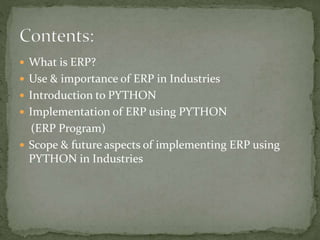
 What is ERP?
 Use & importance of ERP in Industries
 Introduction to PYTHON
 Implementation of ERP using PYTHON
(ERP Program)
 Scope & future aspects of implementing ERP using
PYTHON in Industries
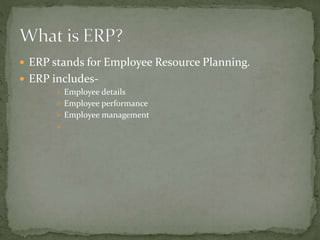
 ERP stands for Employee Resource Planning.
 ERP includes-
 Employee details
 Employee performance
 Employee management

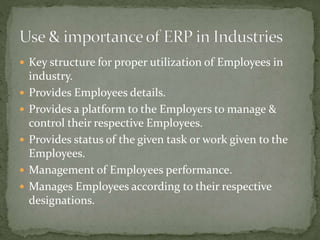
 Key structure for proper utilization of Employees in
industry.
 Provides Employees details.
 Provides a platform to the Employers to manage &
control their respective Employees.
 Provides status of the given task or work given to the
Employees.
 Management of Employees performance.
 Manages Employees according to their respective
designations.
 Python is a popular programming language. It was
created in 1991 by Guido van Rossum.
 It is used for:
 web development (server-side)
 software development
 mathematics
 system scripting
 What can Python do?
 Python can be used on a server to create web
applications.
 Python can be used alongside software to create
workflows.
 Python can connect to database systems. It can also read and
modify files.
 Python can be used to handle big data and perform complex
mathematics.
 Python can be used for rapid prototyping, or for production-
ready software development.
 Why Python?
 Python works on different platforms (Windows, Mac, Linux,
Raspberry Pi, etc).
 Python has a simple syntax similar to the English language.
 Python has syntax that allows developers to write programs
with fewer lines than some other programming languages.
 Python runs on an interpreter system, meaning that code can
be executed as soon as it is written. This means that
prototyping can be very quick.
 Python can be treated in a procedural way, an object-
orientated way or a functional way.
 Refer to Python file –
(ERP.py)
 Python supports both object-oriented programming
and structured programming.
 The language can also be embedded in existing
applications which require a programmable interface.
 Python is considered as a highly readable language.
 Python is characterized by an uncluttered visual layout
and makes frequent use of English keywords.
 Large applications such as ERP, CMS, AI, etc: are being
written exclusively with python.

Erp

  • 1.
  • 2.
     What isERP?  Use & importance of ERP in Industries  Introduction to PYTHON  Implementation of ERP using PYTHON (ERP Program)  Scope & future aspects of implementing ERP using PYTHON in Industries
  • 3.
     ERP standsfor Employee Resource Planning.  ERP includes-  Employee details  Employee performance  Employee management 
  • 4.
     Key structurefor proper utilization of Employees in industry.  Provides Employees details.  Provides a platform to the Employers to manage & control their respective Employees.  Provides status of the given task or work given to the Employees.  Management of Employees performance.  Manages Employees according to their respective designations.
  • 5.
     Python isa popular programming language. It was created in 1991 by Guido van Rossum.  It is used for:  web development (server-side)  software development  mathematics  system scripting  What can Python do?  Python can be used on a server to create web applications.  Python can be used alongside software to create workflows.
  • 6.
     Python canconnect to database systems. It can also read and modify files.  Python can be used to handle big data and perform complex mathematics.  Python can be used for rapid prototyping, or for production- ready software development.  Why Python?  Python works on different platforms (Windows, Mac, Linux, Raspberry Pi, etc).  Python has a simple syntax similar to the English language.  Python has syntax that allows developers to write programs with fewer lines than some other programming languages.  Python runs on an interpreter system, meaning that code can be executed as soon as it is written. This means that prototyping can be very quick.  Python can be treated in a procedural way, an object- orientated way or a functional way.
  • 7.
     Refer toPython file – (ERP.py)
  • 8.
     Python supportsboth object-oriented programming and structured programming.  The language can also be embedded in existing applications which require a programmable interface.  Python is considered as a highly readable language.  Python is characterized by an uncluttered visual layout and makes frequent use of English keywords.  Large applications such as ERP, CMS, AI, etc: are being written exclusively with python.