Sherin Rappai
Assistant Professor
Department of Computer Science
Kristu Jayanti College
Topic: ER Diagram
ER Model Introduction
• Entity Relationship Diagram – ER Diagram in DBMS
• An Entity–relationship model (ER model) describes the structure of a database with the help of a diagram,
which is known as Entity Relationship Diagram (ER Diagram). An ER model is a design or blueprint of a
database that can later be implemented as a database. The main components of E-R model are: entity set and
relationship set.
• What is an Entity Relationship Diagram (ER Diagram)?
• An ER diagram shows the relationship among entity sets. An entity set is a group of similar entities and these
entities can have attributes. In terms of DBMS, an entity is a table or attribute of a table in database, so by
showing relationship among tables and their attributes, ER diagram shows the complete logical structure of a
database.
• Facts about ER Diagram Model:
• ER model allows you to draw Database Design
• It is an easy to use graphical tool for modeling data
• Widely used in Database Design
• It is a GUI representation of the logical structure of a Database
• It helps you to identify the entities which exist in a system and the relationships between those entities
• Why use ER Diagrams?
• Here, are prime reasons for using the ER Diagram :
• Helps you to define terms related to entity relationship modeling
• Provide a preview of how all your tables should connect, what fields are going to
be on each table
• Helps to describe entities, attributes, relationships
• ER diagrams are translatable into relational tables which allows you to build
databases quickly
• ER diagrams can be used by database designers as a blueprint for implementing
data in specific software applications
• A simple ER Diagram:
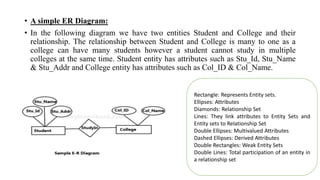
• In the following diagram we have two entities Student and College and their
relationship. The relationship between Student and College is many to one as a
college can have many students however a student cannot study in multiple
colleges at the same time. Student entity has attributes such as Stu_Id, Stu_Name
& Stu_Addr and College entity has attributes such as Col_ID & Col_Name.
Rectangle: Represents Entity sets.
Ellipses: Attributes
Diamonds: Relationship Set
Lines: They link attributes to Entity Sets and
Entity sets to Relationship Set
Double Ellipses: Multivalued Attributes
Dashed Ellipses: Derived Attributes
Double Rectangles: Weak Entity Sets
Double Lines: Total participation of an entity in
a relationship set
11/28/2023 5
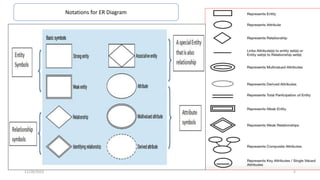
Notations for ER Diagram
Component of ER Diagram
As shown in the above diagram,
an ER diagram has three main
components:
1. Entity
2. 2. Attribute
3. 3. Relationship
Entity
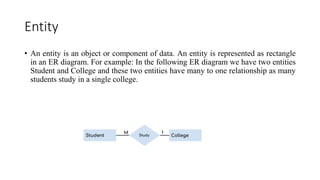
• An entity is an object or component of data. An entity is represented as rectangle
in an ER diagram. For example: In the following ER diagram we have two entities
Student and College and these two entities have many to one relationship as many
students study in a single college.
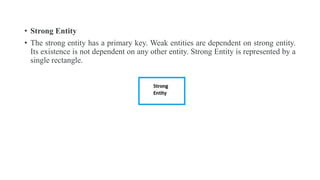
• Strong Entity
• The strong entity has a primary key. Weak entities are dependent on strong entity.
Its existence is not dependent on any other entity. Strong Entity is represented by a
single rectangle.
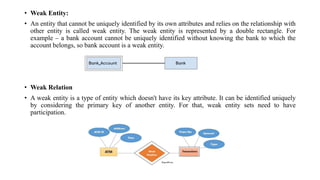
• Weak Entity:
• An entity that cannot be uniquely identified by its own attributes and relies on the relationship with
other entity is called weak entity. The weak entity is represented by a double rectangle. For
example – a bank account cannot be uniquely identified without knowing the bank to which the
account belongs, so bank account is a weak entity.
• Weak Relation
• A weak entity is a type of entity which doesn't have its key attribute. It can be identified uniquely
by considering the primary key of another entity. For that, weak entity sets need to have
participation.
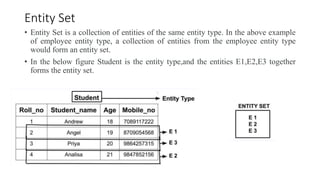
Entity Set
• Entity Set is a collection of entities of the same entity type. In the above example
of employee entity type, a collection of entities from the employee entity type
would form an entity set.
• In the below figure Student is the entity type,and the entities E1,E2,E3 together
forms the entity set.
Attribute
• An attribute describes the property of an entity. An attribute is represented as Oval
in an ER diagram.
• There are four types of attributes:
a. Key attribute
b. Composite attribute
c. Multivalued attribute
d. Single valued attribute
e. Derived attribute
f. Null values
g. Complex
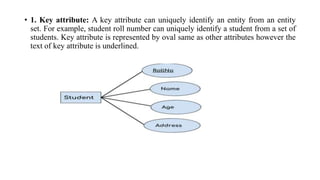
• 1. Key attribute: A key attribute can uniquely identify an entity from an entity
set. For example, student roll number can uniquely identify a student from a set of
students. Key attribute is represented by oval same as other attributes however the
text of key attribute is underlined.
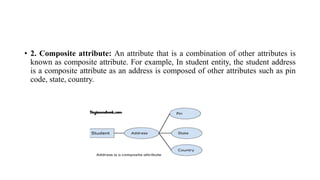
• 2. Composite attribute: An attribute that is a combination of other attributes is
known as composite attribute. For example, In student entity, the student address
is a composite attribute as an address is composed of other attributes such as pin
code, state, country.
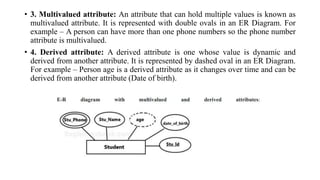
• 3. Multivalued attribute: An attribute that can hold multiple values is known as
multivalued attribute. It is represented with double ovals in an ER Diagram. For
example – A person can have more than one phone numbers so the phone number
attribute is multivalued.
• 4. Derived attribute: A derived attribute is one whose value is dynamic and
derived from another attribute. It is represented by dashed oval in an ER Diagram.
For example – Person age is a derived attribute as it changes over time and can be
derived from another attribute (Date of birth).
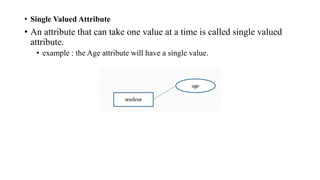
• Single Valued Attribute
• An attribute that can take one value at a time is called single valued
attribute.
• example : the Age attribute will have a single value.
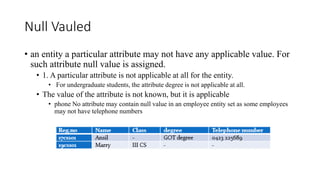
Null Vauled
• an entity a particular attribute may not have any applicable value. For
such attribute null value is assigned.
• 1. A particular attribute is not applicable at all for the entity.
• For undergraduate students, the attribute degree is not applicable at all.
• The value of the attribute is not known, but it is applicable
• phone No attribute may contain null value in an employee entity set as some employees
may not have telephone numbers
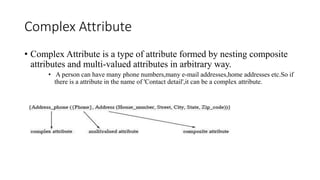
Complex Attribute
• Complex Attribute is a type of attribute formed by nesting composite
attributes and multi-valued attributes in arbitrary way.
• A person can have many phone numbers,many e-mail addresses,home addresses etc.So if
there is a attribute in the name of 'Contact detail',it can be a complex attribute.

ER-Diagram.pptx

  • 1.
    Sherin Rappai Assistant Professor Departmentof Computer Science Kristu Jayanti College Topic: ER Diagram
  • 2.
    ER Model Introduction •Entity Relationship Diagram – ER Diagram in DBMS • An Entity–relationship model (ER model) describes the structure of a database with the help of a diagram, which is known as Entity Relationship Diagram (ER Diagram). An ER model is a design or blueprint of a database that can later be implemented as a database. The main components of E-R model are: entity set and relationship set. • What is an Entity Relationship Diagram (ER Diagram)? • An ER diagram shows the relationship among entity sets. An entity set is a group of similar entities and these entities can have attributes. In terms of DBMS, an entity is a table or attribute of a table in database, so by showing relationship among tables and their attributes, ER diagram shows the complete logical structure of a database. • Facts about ER Diagram Model: • ER model allows you to draw Database Design • It is an easy to use graphical tool for modeling data • Widely used in Database Design • It is a GUI representation of the logical structure of a Database • It helps you to identify the entities which exist in a system and the relationships between those entities
  • 3.
    • Why useER Diagrams? • Here, are prime reasons for using the ER Diagram : • Helps you to define terms related to entity relationship modeling • Provide a preview of how all your tables should connect, what fields are going to be on each table • Helps to describe entities, attributes, relationships • ER diagrams are translatable into relational tables which allows you to build databases quickly • ER diagrams can be used by database designers as a blueprint for implementing data in specific software applications
  • 4.
    • A simpleER Diagram: • In the following diagram we have two entities Student and College and their relationship. The relationship between Student and College is many to one as a college can have many students however a student cannot study in multiple colleges at the same time. Student entity has attributes such as Stu_Id, Stu_Name & Stu_Addr and College entity has attributes such as Col_ID & Col_Name. Rectangle: Represents Entity sets. Ellipses: Attributes Diamonds: Relationship Set Lines: They link attributes to Entity Sets and Entity sets to Relationship Set Double Ellipses: Multivalued Attributes Dashed Ellipses: Derived Attributes Double Rectangles: Weak Entity Sets Double Lines: Total participation of an entity in a relationship set
  • 5.
  • 6.
    Component of ERDiagram As shown in the above diagram, an ER diagram has three main components: 1. Entity 2. 2. Attribute 3. 3. Relationship
  • 7.
    Entity • An entityis an object or component of data. An entity is represented as rectangle in an ER diagram. For example: In the following ER diagram we have two entities Student and College and these two entities have many to one relationship as many students study in a single college.
  • 8.
    • Strong Entity •The strong entity has a primary key. Weak entities are dependent on strong entity. Its existence is not dependent on any other entity. Strong Entity is represented by a single rectangle.
  • 9.
    • Weak Entity: •An entity that cannot be uniquely identified by its own attributes and relies on the relationship with other entity is called weak entity. The weak entity is represented by a double rectangle. For example – a bank account cannot be uniquely identified without knowing the bank to which the account belongs, so bank account is a weak entity. • Weak Relation • A weak entity is a type of entity which doesn't have its key attribute. It can be identified uniquely by considering the primary key of another entity. For that, weak entity sets need to have participation.
  • 11.
    Entity Set • EntitySet is a collection of entities of the same entity type. In the above example of employee entity type, a collection of entities from the employee entity type would form an entity set. • In the below figure Student is the entity type,and the entities E1,E2,E3 together forms the entity set.
  • 12.
    Attribute • An attributedescribes the property of an entity. An attribute is represented as Oval in an ER diagram. • There are four types of attributes: a. Key attribute b. Composite attribute c. Multivalued attribute d. Single valued attribute e. Derived attribute f. Null values g. Complex
  • 13.
    • 1. Keyattribute: A key attribute can uniquely identify an entity from an entity set. For example, student roll number can uniquely identify a student from a set of students. Key attribute is represented by oval same as other attributes however the text of key attribute is underlined.
  • 14.
    • 2. Compositeattribute: An attribute that is a combination of other attributes is known as composite attribute. For example, In student entity, the student address is a composite attribute as an address is composed of other attributes such as pin code, state, country.
  • 15.
    • 3. Multivaluedattribute: An attribute that can hold multiple values is known as multivalued attribute. It is represented with double ovals in an ER Diagram. For example – A person can have more than one phone numbers so the phone number attribute is multivalued. • 4. Derived attribute: A derived attribute is one whose value is dynamic and derived from another attribute. It is represented by dashed oval in an ER Diagram. For example – Person age is a derived attribute as it changes over time and can be derived from another attribute (Date of birth).
  • 16.
    • Single ValuedAttribute • An attribute that can take one value at a time is called single valued attribute. • example : the Age attribute will have a single value.
  • 17.
    Null Vauled • anentity a particular attribute may not have any applicable value. For such attribute null value is assigned. • 1. A particular attribute is not applicable at all for the entity. • For undergraduate students, the attribute degree is not applicable at all. • The value of the attribute is not known, but it is applicable • phone No attribute may contain null value in an employee entity set as some employees may not have telephone numbers
  • 18.
    Complex Attribute • ComplexAttribute is a type of attribute formed by nesting composite attributes and multi-valued attributes in arbitrary way. • A person can have many phone numbers,many e-mail addresses,home addresses etc.So if there is a attribute in the name of 'Contact detail',it can be a complex attribute.