The Equality Act 2010 25 June 2010
Equality Act 2010 2 main purposes of the Act: To harmonise discrimination law To strengthen the law to progress on equality ..resulting in general benefits to the economy [16 Parts, 28 Schedules, 218 Sections!]
In summary: New socio-economic duty (public bodies) Widens scope for voluntary positive actions Integrated equality duty – to include procurement activities Empower tribunals to make wider recommendations New PCs: gender reassignment and pregnancy/maternity Dual discrimination Widens scope of age discrimination Power to require gender pay gap reporting (private sector) Extends protection against harassment outside the workplace Equality Act 2010
Equality Act 2010 The new ‘socio-economic duty’ -  will it survive? Public bodies (not direct to front-line services) Strategic decisions To consider how decisions might help to reduce inequalities associated with socio-economic disadvantage Judicial review Examples
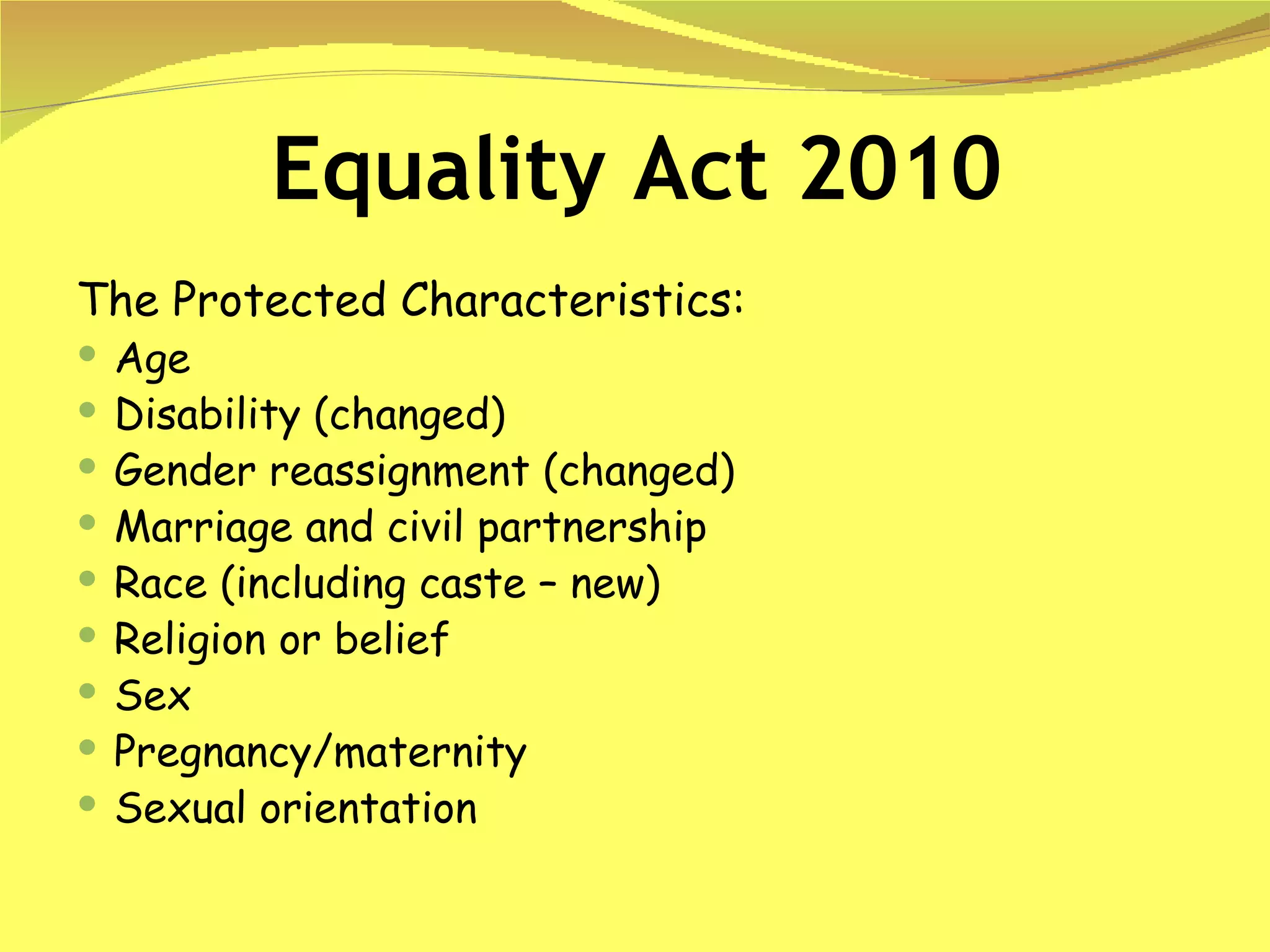
Equality Act 2010 The Protected Characteristics: Age  Disability (changed) Gender reassignment (changed) Marriage and civil partnership Race (including caste – new) Religion or belief Sex Pregnancy/maternity Sexual orientation
Equality Act 2010 Gender reassignment No longer required to be under medical supervision Where a person has proposed, started or completed a process to change sex Caste discrimination Power to add ‘caste’ to definition of ‘race’ Arguably already included National Institute of Economic and Social Research
Equality Act 2010 Pregnancy and maternity discrimination Extended to non-work cases: in relation to public functions, education and to associations Examples
Equality Act 2010 Simplifying & standardising definitions and concepts Direct discrimination: association and perception Uniform definition of indirect discrimination No need for comparator in all victimisation claims Extends protection from discrimination
Direct Discrimination - Association and Perception Occurs where A treats B less favourably than others ‘because of’ a protected characteristic Exception: in marital or civil partnership cases, the PC must be that of the complainant  Protection extended to apply in areas where it does not exist Harassment as well Equality Act 2010
Equality Act 2010 Definition of ‘Indirect Discrimination’ “ Where a policy disadvantages a group of people with a PC, a person in that group is indirectly discriminated against if they are put at that disadvantage unless policy can be justified…. ...i.e. if it is a proportionate means of achieving a legitimate aim” Harmonised Extended to disability and gender reassignment But not pregnancy/maternity
Equality Act 2010 Dual Discrimination Claims in relation to combination of two PCs Where single strand unlikely to succeed Not marriage and civil partnership or pregnancy/maternity discrimination Examples NB. Public sector equality duty: due regard to the need to eliminate unlawful dual discrimination
Equality Act 2010 Disability Discrimination Definition Pre-employment health enquiries Discrimination arising from disability … and indirect discrimination Reasonable adjustments
Equality Act 2010 Pre-employment health enquiries The rule: ban on making enquiries The 6 exceptions
Equality Act 2010 Discrimination arising from disability “ Where a disabled person is treated unfavourably because of something arising form, or in consequence of their disability, unless treatment can be justified… … i.e. if the treatment is a proportionate means of achieving a legitimate aim” Post- Malcolm No need for a comparator .. and disability covered by indirect discrimination.. Examples
Equality Act 2010 Reasonable adjustments Taking reasonable steps to provide auxiliary aids Including the provision of information in accessible format
Equality Act 2010 Equal Pay –  most in need of reform, but least reformed! Secrecy clauses - Not allowed to discuss pay with colleagues unless discussion aimed at establishing if discrimination (‘relevant pay disclosure’) Gender pay reporting –  which way will the Government go? Power to make regulations requiring private sector employers 250+ employees to publish information Compulsory pay audits or only when lose at ET?
Equality Act 2010 Positive Action Permits positive action in recruitment and promotion In specific situations – limited scope Voluntary Coalition Government’s approach?
Equality Act 2010 Public Sector Equality Duty New single equality duty All PCs except marriage and civil partnership Due regard to the need to advance equality of opportunity and foster good relations Provides significant rationalisation benefits..
Equality Act 2010 Territorial jurisdiction Employees employed in Great Britain at the time of dismissal Expatriate employees, e.g. foreign correspondents, or working in British enclave Narrower scope
Equality Act 2010 Enforcement and Remedies Tribunal can make recommendations to benefit wider workforce and help prevent discrimination Does not apply to equal pay claims ***** Burden of proof: employee has to establish prima facie case, then employer has to prove not guilty Drawing inferences
Contact: Sarah Pugh WH Law LLP Solicitors Finch House 28-30 Wolverhampton Street Dudley West Midlands DY1 1DB  Tel.: 01384 453383 Email: sepugh@whlawllp.co.uk

Equality Act 2010

  • 1.
    The Equality Act2010 25 June 2010
  • 2.
    Equality Act 20102 main purposes of the Act: To harmonise discrimination law To strengthen the law to progress on equality ..resulting in general benefits to the economy [16 Parts, 28 Schedules, 218 Sections!]
  • 3.
    In summary: Newsocio-economic duty (public bodies) Widens scope for voluntary positive actions Integrated equality duty – to include procurement activities Empower tribunals to make wider recommendations New PCs: gender reassignment and pregnancy/maternity Dual discrimination Widens scope of age discrimination Power to require gender pay gap reporting (private sector) Extends protection against harassment outside the workplace Equality Act 2010
  • 4.
    Equality Act 2010The new ‘socio-economic duty’ - will it survive? Public bodies (not direct to front-line services) Strategic decisions To consider how decisions might help to reduce inequalities associated with socio-economic disadvantage Judicial review Examples
  • 5.
    Equality Act 2010The Protected Characteristics: Age Disability (changed) Gender reassignment (changed) Marriage and civil partnership Race (including caste – new) Religion or belief Sex Pregnancy/maternity Sexual orientation
  • 6.
    Equality Act 2010Gender reassignment No longer required to be under medical supervision Where a person has proposed, started or completed a process to change sex Caste discrimination Power to add ‘caste’ to definition of ‘race’ Arguably already included National Institute of Economic and Social Research
  • 7.
    Equality Act 2010Pregnancy and maternity discrimination Extended to non-work cases: in relation to public functions, education and to associations Examples
  • 8.
    Equality Act 2010Simplifying & standardising definitions and concepts Direct discrimination: association and perception Uniform definition of indirect discrimination No need for comparator in all victimisation claims Extends protection from discrimination
  • 9.
    Direct Discrimination -Association and Perception Occurs where A treats B less favourably than others ‘because of’ a protected characteristic Exception: in marital or civil partnership cases, the PC must be that of the complainant Protection extended to apply in areas where it does not exist Harassment as well Equality Act 2010
  • 10.
    Equality Act 2010Definition of ‘Indirect Discrimination’ “ Where a policy disadvantages a group of people with a PC, a person in that group is indirectly discriminated against if they are put at that disadvantage unless policy can be justified…. ...i.e. if it is a proportionate means of achieving a legitimate aim” Harmonised Extended to disability and gender reassignment But not pregnancy/maternity
  • 11.
    Equality Act 2010Dual Discrimination Claims in relation to combination of two PCs Where single strand unlikely to succeed Not marriage and civil partnership or pregnancy/maternity discrimination Examples NB. Public sector equality duty: due regard to the need to eliminate unlawful dual discrimination
  • 12.
    Equality Act 2010Disability Discrimination Definition Pre-employment health enquiries Discrimination arising from disability … and indirect discrimination Reasonable adjustments
  • 13.
    Equality Act 2010Pre-employment health enquiries The rule: ban on making enquiries The 6 exceptions
  • 14.
    Equality Act 2010Discrimination arising from disability “ Where a disabled person is treated unfavourably because of something arising form, or in consequence of their disability, unless treatment can be justified… … i.e. if the treatment is a proportionate means of achieving a legitimate aim” Post- Malcolm No need for a comparator .. and disability covered by indirect discrimination.. Examples
  • 15.
    Equality Act 2010Reasonable adjustments Taking reasonable steps to provide auxiliary aids Including the provision of information in accessible format
  • 16.
    Equality Act 2010Equal Pay – most in need of reform, but least reformed! Secrecy clauses - Not allowed to discuss pay with colleagues unless discussion aimed at establishing if discrimination (‘relevant pay disclosure’) Gender pay reporting – which way will the Government go? Power to make regulations requiring private sector employers 250+ employees to publish information Compulsory pay audits or only when lose at ET?
  • 17.
    Equality Act 2010Positive Action Permits positive action in recruitment and promotion In specific situations – limited scope Voluntary Coalition Government’s approach?
  • 18.
    Equality Act 2010Public Sector Equality Duty New single equality duty All PCs except marriage and civil partnership Due regard to the need to advance equality of opportunity and foster good relations Provides significant rationalisation benefits..
  • 19.
    Equality Act 2010Territorial jurisdiction Employees employed in Great Britain at the time of dismissal Expatriate employees, e.g. foreign correspondents, or working in British enclave Narrower scope
  • 20.
    Equality Act 2010Enforcement and Remedies Tribunal can make recommendations to benefit wider workforce and help prevent discrimination Does not apply to equal pay claims ***** Burden of proof: employee has to establish prima facie case, then employer has to prove not guilty Drawing inferences
  • 21.
    Contact: Sarah PughWH Law LLP Solicitors Finch House 28-30 Wolverhampton Street Dudley West Midlands DY1 1DB Tel.: 01384 453383 Email: sepugh@whlawllp.co.uk