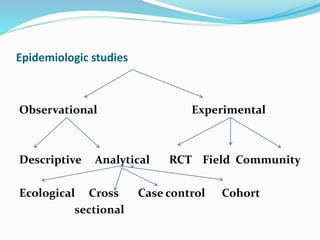
Epidemiologic studies
Observational Experimental
Descriptive Analytical RCT Field Community
Ecological Cross Case control Cohort
sectional
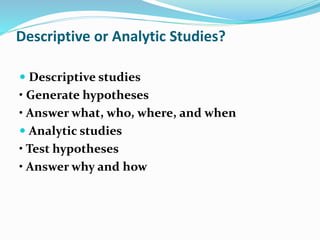
Descriptive or Analytic Studies?
 Descriptive studies
• Generate hypotheses
• Answer what, who, where, and when
 Analytic studies
• Test hypotheses
• Answer why and how
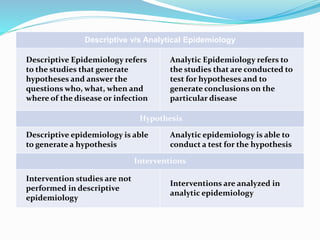
Descriptive v/s Analytical Epidemiology
Descriptive Epidemiology refers
to the studies that generate
hypotheses and answer the
questions who, what, when and
where of the disease or infection
Analytic Epidemiology refers to
the studies that are conducted to
test for hypotheses and to
generate conclusions on the
particular disease
Hypothesis
Descriptive epidemiology is able
to generate a hypothesis
Analytic epidemiology is able to
conduct a test for the hypothesis
Interventions
Intervention studies are not
performed in descriptive
epidemiology
Interventions are analyzed in
analytic epidemiology
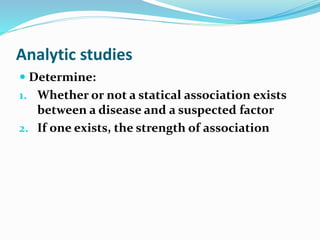
Analytic studies
 Determine:
1. Whether or not a statical association exists
between a disease and a suspected factor
2. If one exists, the strength of association
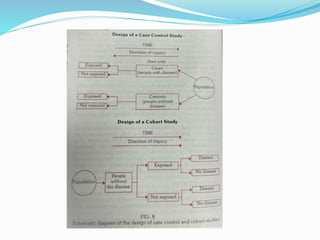
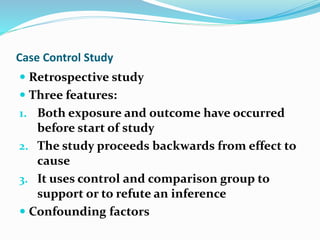
Case Control Study
 Retrospective study
 Three features:
1. Both exposure and outcome have occurred
before start of study
2. The study proceeds backwards from effect to
cause
3. It uses control and comparison group to
support or to refute an inference
 Confounding factors
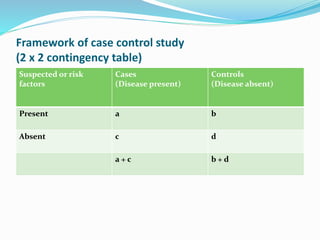
Framework of case control study
(2 x 2 contingency table)
Suspected or risk
factors
Cases
(Disease present)
Controls
(Disease absent)
Present a b
Absent c d
a + c b + d
Basic steps
1. Selection of cases and controls
2. Matching
3. Measurement of exposure
4. Analysis and interpretation
Selection of cases
 Definition of cases
1. Diagnostic criteria
2. Eligibility criteria
 Sources of cases
1. Hospitals
2. General population
Selection of controls
1. Hospital controls
2. Relatives
3. Neighbourhood controls
4. General population
Matching
 Process by which we select controls in such a
way that they are similar to cases with regards
to certain selected variables, which are known
to influence the disease And which, if not
adequately matched for comparability, could
distort or confound the result
Measurement of exposure
 Information about exposure should be
obtained in precisely the same manner for
both cases and controls
 Obtained by interviews, questionnaires or by
studying past records
Analysis
1. Exposure rates among cases and controls to
suspected factor
2. Estimation of disease risk associated with
exposure (ODDS ratio)
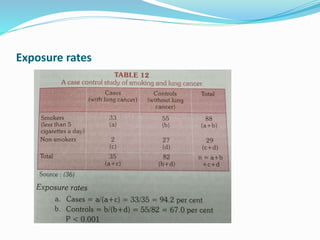
Exposure rates
 Frequency rate of lung cancer was definitely
higher among smokers than non smokers
 Next step to ascertain statistical association by
calculating p-value
 For discrete variable : Chi-square test
 For continuous variable : standard error of
difference between two means
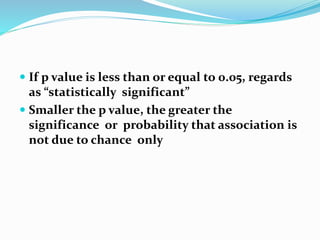
 If p value is less than or equal to 0.05, regards
as “statistically significant”
 Smaller the p value, the greater the
significance or probability that association is
not due to chance only
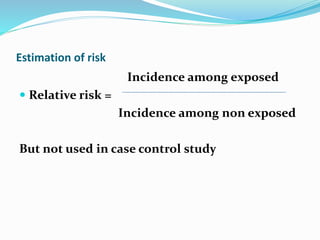
Estimation of risk
Incidence among exposed
 Relative risk =
Incidence among non exposed
But not used in case control study
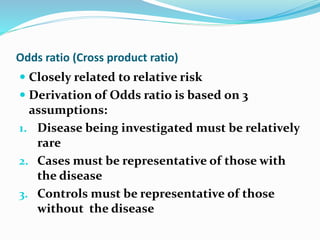
Odds ratio (Cross product ratio)
 Closely related to relative risk
 Derivation of Odds ratio is based on 3
assumptions:
1. Disease being investigated must be relatively
rare
2. Cases must be representative of those with
the disease
3. Controls must be representative of those
without the disease
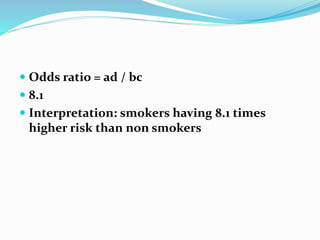
 Odds ratio = ad / bc
 8.1
 Interpretation: smokers having 8.1 times
higher risk than non smokers
Bias in case control studies
 Due to confounding: removed by matching
 Memory or recall bias
 Selection bias
 Berkesonian bias: arises because of the
different rates of admission to hospitals for
people with different diseases
 Interviewer bias: removed by double blinding
Epidemiologic methods.pptx

Epidemiologic methods.pptx

  • 2.
    Epidemiologic studies Observational Experimental DescriptiveAnalytical RCT Field Community Ecological Cross Case control Cohort sectional
  • 3.
    Descriptive or AnalyticStudies?  Descriptive studies • Generate hypotheses • Answer what, who, where, and when  Analytic studies • Test hypotheses • Answer why and how
  • 4.
    Descriptive v/s AnalyticalEpidemiology Descriptive Epidemiology refers to the studies that generate hypotheses and answer the questions who, what, when and where of the disease or infection Analytic Epidemiology refers to the studies that are conducted to test for hypotheses and to generate conclusions on the particular disease Hypothesis Descriptive epidemiology is able to generate a hypothesis Analytic epidemiology is able to conduct a test for the hypothesis Interventions Intervention studies are not performed in descriptive epidemiology Interventions are analyzed in analytic epidemiology
  • 5.
    Analytic studies  Determine: 1.Whether or not a statical association exists between a disease and a suspected factor 2. If one exists, the strength of association
  • 7.
    Case Control Study Retrospective study  Three features: 1. Both exposure and outcome have occurred before start of study 2. The study proceeds backwards from effect to cause 3. It uses control and comparison group to support or to refute an inference  Confounding factors
  • 8.
    Framework of casecontrol study (2 x 2 contingency table) Suspected or risk factors Cases (Disease present) Controls (Disease absent) Present a b Absent c d a + c b + d
  • 9.
    Basic steps 1. Selectionof cases and controls 2. Matching 3. Measurement of exposure 4. Analysis and interpretation
  • 10.
    Selection of cases Definition of cases 1. Diagnostic criteria 2. Eligibility criteria  Sources of cases 1. Hospitals 2. General population
  • 11.
    Selection of controls 1.Hospital controls 2. Relatives 3. Neighbourhood controls 4. General population
  • 12.
    Matching  Process bywhich we select controls in such a way that they are similar to cases with regards to certain selected variables, which are known to influence the disease And which, if not adequately matched for comparability, could distort or confound the result
  • 13.
    Measurement of exposure Information about exposure should be obtained in precisely the same manner for both cases and controls  Obtained by interviews, questionnaires or by studying past records
  • 14.
    Analysis 1. Exposure ratesamong cases and controls to suspected factor 2. Estimation of disease risk associated with exposure (ODDS ratio)
  • 15.
  • 16.
     Frequency rateof lung cancer was definitely higher among smokers than non smokers  Next step to ascertain statistical association by calculating p-value  For discrete variable : Chi-square test  For continuous variable : standard error of difference between two means
  • 17.
     If pvalue is less than or equal to 0.05, regards as “statistically significant”  Smaller the p value, the greater the significance or probability that association is not due to chance only
  • 18.
    Estimation of risk Incidenceamong exposed  Relative risk = Incidence among non exposed But not used in case control study
  • 19.
    Odds ratio (Crossproduct ratio)  Closely related to relative risk  Derivation of Odds ratio is based on 3 assumptions: 1. Disease being investigated must be relatively rare 2. Cases must be representative of those with the disease 3. Controls must be representative of those without the disease
  • 20.
     Odds ratio= ad / bc  8.1  Interpretation: smokers having 8.1 times higher risk than non smokers
  • 21.
    Bias in casecontrol studies  Due to confounding: removed by matching  Memory or recall bias  Selection bias  Berkesonian bias: arises because of the different rates of admission to hospitals for people with different diseases  Interviewer bias: removed by double blinding