1
Crisis Assessment and Home
Treatment – EPIC Audit
Dr Jo Nicholson
Clinical Psychologist
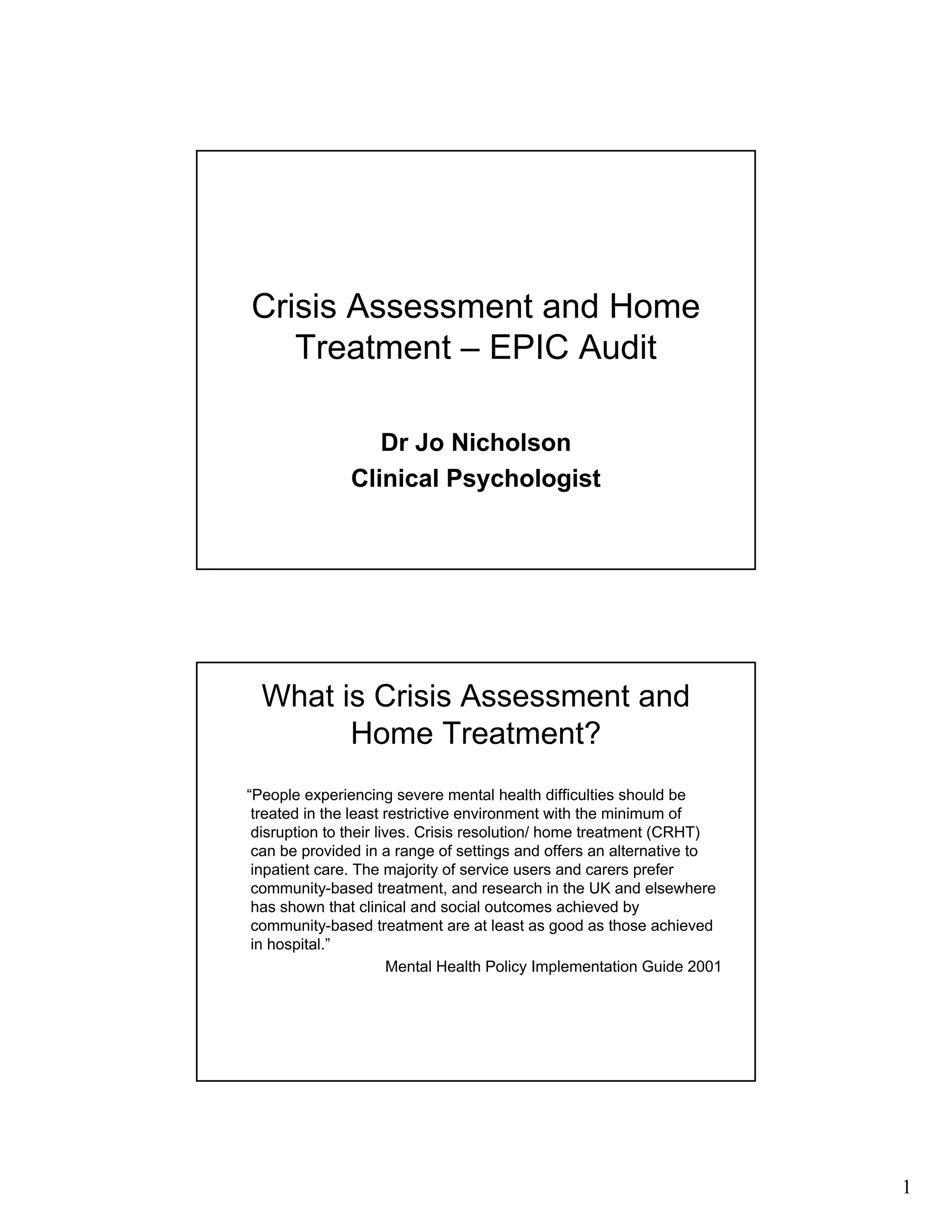
What is Crisis Assessment and
Home Treatment?
“People experiencing severe mental health difficulties should be
treated in the least restrictive environment with the minimum of
disruption to their lives. Crisis resolution/ home treatment (CRHT)
can be provided in a range of settings and offers an alternative to
inpatient care. The majority of service users and carers prefer
community-based treatment, and research in the UK and elsewhere
has shown that clinical and social outcomes achieved by
community-based treatment are at least as good as those achieved
in hospital.”
Mental Health Policy Implementation Guide 2001
2
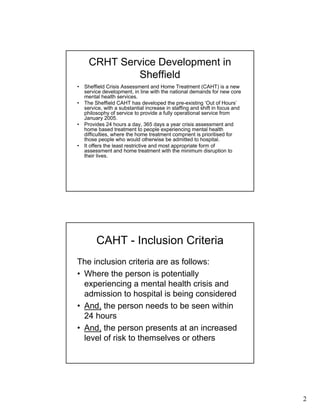
CRHT Service Development in
Sheffield
• Sheffield Crisis Assessment and Home Treatment (CAHT) is a new
service development, in line with the national demands for new core
mental health services.
• The Sheffield CAHT has developed the pre-existing ‘Out of Hours’
service, with a substantial increase in staffing and shift in focus and
philosophy of service to provide a fully operational service from
January 2005.
• Provides 24 hours a day, 365 days a year crisis assessment and
home based treatment to people experiencing mental health
difficulties, where the home treatment compnent is prioritised for
those people who would otherwise be admitted to hospital.
• It offers the least restrictive and most appropriate form of
assessment and home treatment with the minimum disruption to
their lives.
CAHT - Inclusion Criteria
The inclusion criteria are as follows:
• Where the person is potentially
experiencing a mental health crisis and
admission to hospital is being considered
• And, the person needs to be seen within
24 hours
• And, the person presents at an increased
level of risk to themselves or others
3
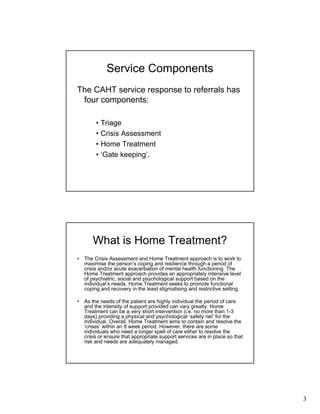
Service Components
The CAHT service response to referrals has
four components:
• Triage
• Crisis Assessment
• Home Treatment
• ‘Gate keeping’.
What is Home Treatment?
• The Crisis Assessment and Home Treatment approach is to work to
maximise the person’s coping and resilience through a period of
crisis and/or acute exacerbation of mental health functioning. The
Home Treatment approach provides an appropriately intensive level
of psychiatric, social and psychological support based on the
individual’s needs. Home Treatment seeks to promote functional
coping and recovery in the least stigmatising and restrictive setting.
• As the needs of the patient are highly individual the period of care
and the intensity of support provided can vary greatly. Home
Treatment can be a very short intervention (i.e. no more than 1-3
days) providing a physical and psychological ‘safety net’ for the
individual. Overall, Home Treatment aims to contain and resolve the
‘crises’ within an 8 week period. However, there are some
individuals who need a longer spell of care either to resolve the
crisis or ensure that appropriate support services are in place so that
risk and needs are adequately managed.
4
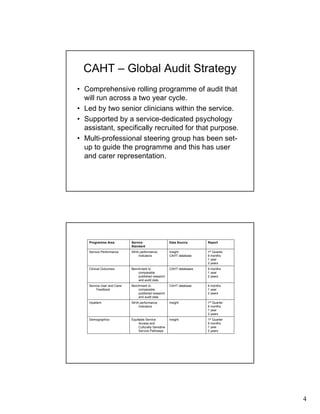
CAHT – Global Audit Strategy
• Comprehensive rolling programme of audit that
will run across a two year cycle.
• Led by two senior clinicians within the service.
• Supported by a service-dedicated psychology
assistant, specifically recruited for that purpose.
• Multi-professional steering group has been set-
up to guide the programme and this has user
and carer representation.
1st Quarter
6 months
1 year
2 years
InsightEquitable Service
Access and
Culturally Sensitive
Service Pathways
Demographics
1st Quarter
6 months
1 year
2 years
InsightStHA performance
indicators
Inpatient
6 months
1 year
2 years
CAHT databaseBenchmark to
comparable
published research
and audit data
Service User and Carer
Feedback
6 months
1 year
2 years
CAHT databasesBenchmark to
comparable
published research
and audit data
Clinical Outcomes
1st Quarter
6 months
1 year
2 years
Insight
CAHT database
StHA performance
indicators
Service Performance
ReportData SourceService
Standard
Programme Area
5
Databases
• The data presented within this audit is based upon a
number of database sources; including CAHT databases
and Insight.
• Through collaboration with the SCT Information
Department, data from Insight data also uploaded into
Excel and merged with the existing CAHT databases.
• The Excel databases were imported into SPSS. This
provided more flexibility in data interrogation than could
be provided through routine Insight reports.
• The CAHT service is currently working towards
developing a ‘live’ electronic recording system that will
rationalise the number of data sources in use.
EPIC Audit
Additional audit procedures need to be in
place to monitor the impact of EPIC
1. Monitor/Describe Components of
‘standard care pathway’
2. Monitor/decsribe culturally senstive care
pathway
6
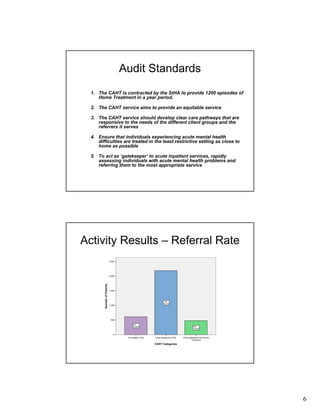
Audit Standards
1. The CAHT is contracted by the StHA to provide 1200 episodes of
Home Treatment in a year period.
2. The CAHT service aims to provide an equitable service
3. The CAHT service should develop clear care pathways that are
responsive to the needs of the different client groups and the
referrers it serves
4. Ensure that individuals experiencing acute mental health
difficulties are treated in the least restrictive setting as close to
home as possible
5. To act as ‘gatekeeper’ to acute inpatient services, rapidly
assessing individuals with acute mental health problems and
referring them to the most appropriate service
Activity Results – Referral Rate
Crisis Assessment and Home
Treatment
Crisis Assessment OnlyConsultation Only
CAHT Categories
2,500
2,000
1,500
1,000
500
0
NumberofPatients
478
14.59%
2,187
66.74%
612
18.68%
7
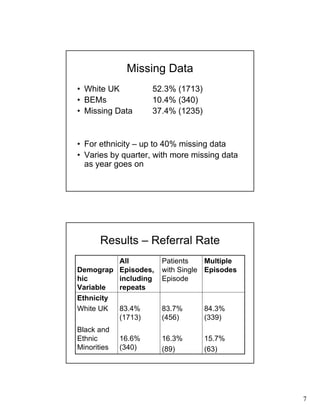
Missing Data
• White UK 52.3% (1713)
• BEMs 10.4% (340)
• Missing Data 37.4% (1235)
• For ethnicity – up to 40% missing data
• Varies by quarter, with more missing data
as year goes on
Results – Referral Rate
84.3%
(339)
15.7%
(63)
83.7%
(456)
16.3%
(89)
83.4%
(1713)
16.6%
(340)
Ethnicity
White UK
Black and
Ethnic
Minorities
Multiple
Episodes
Patients
with Single
Episode
All
Episodes,
including
repeats
Demograp
hic
Variable
8
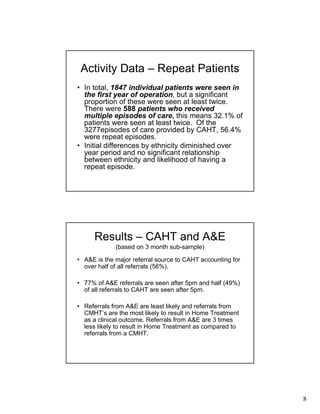
Activity Data – Repeat Patients
• In total, 1847 individual patients were seen in
the first year of operation, but a significant
proportion of these were seen at least twice.
There were 588 patients who received
multiple episodes of care, this means 32.1% of
patients were seen at least twice. Of the
3277episodes of care provided by CAHT, 56.4%
were repeat episodes.
• Initial differences by ethnicity diminished over
year period and no significant relationship
between ethnicity and likelihood of having a
repeat episode.
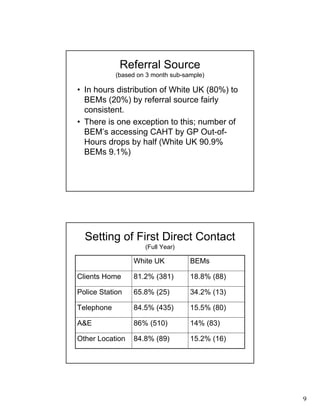
Results – CAHT and A&E
(based on 3 month sub-sample)
• A&E is the major referral source to CAHT accounting for
over half of all referrals (56%).
• 77% of A&E referrals are seen after 5pm and half (49%)
of all referrals to CAHT are seen after 5pm.
• Referrals from A&E are least likely and referrals from
CMHT’s are the most likely to result in Home Treatment
as a clinical outcome. Referrals from A&E are 3 times
less likely to result in Home Treatment as compared to
referrals from a CMHT.
9
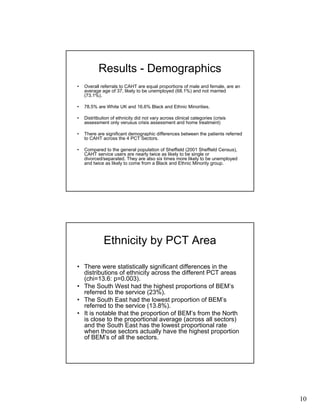
Referral Source
(based on 3 month sub-sample)
• In hours distribution of White UK (80%) to
BEMs (20%) by referral source fairly
consistent.
• There is one exception to this; number of
BEM’s accessing CAHT by GP Out-of-
Hours drops by half (White UK 90.9%
BEMs 9.1%)
Setting of First Direct Contact
(Full Year)
15.2% (16)84.8% (89)Other Location
14% (83)86% (510)A&E
15.5% (80)84.5% (435)Telephone
34.2% (13)65.8% (25)Police Station
18.8% (88)81.2% (381)Clients Home
BEMsWhite UK
10
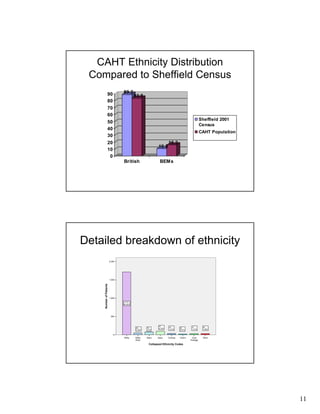
Results - Demographics
• Overall referrals to CAHT are equal proportions of male and female, are an
average age of 37, likely to be unemployed (68.1%) and not married
(73.1%).
• 78.5% are White UK and 16.6% Black and Ethnic Minorities.
• Distritbution of ethnicity did not vary across clinical categories (crisis
assessment only verusus crisis assessment and home treatment)
• There are significant demographic differences between the patients referred
to CAHT across the 4 PCT Sectors.
• Compared to the general population of Sheffield (2001 Sheffield Census),
CAHT service users are nearly twice as likely to be single or
divorced/separated. They are also six times more likely to be unemployed
and twice as likely to come from a Black and Ethnic Minority group.
Ethnicity by PCT Area
• There were statistically significant differences in the
distributions of ethnicity across the different PCT areas
(chi=13.6: p=0.003).
• The South West had the highest proportions of BEM’s
referred to the service (23%).
• The South East had the lowest proportion of BEM’s
referred to the service (13.8%).
• It is notable that the proportion of BEM’s from the North
is close to the proportional average (across all sectors)
and the South East has the lowest proportional rate
when those sectors actually have the highest proportion
of BEM’s of all the sectors.
11
CAHT Ethnicity Distribution
Compared to Sheffield Census
89.2
83.8
10.8
16.2
0
10
20
30
40
50
60
70
80
90
British BEMs
Sheffield 2001
Census
CAHT Population
Detailed breakdown of ethnicity
OtherDual
Heritage
YeminiChineseAsianBlackWhite
Other
White
Collapsed Ethnicity Codes
2,000
1,500
1,000
500
0
NumberofPatients
32
1.56%
31
1.51%
20
0.97%
33
1.61%
97
4.72%78
3.8%
49
2.39%
1,713
83.44%
12
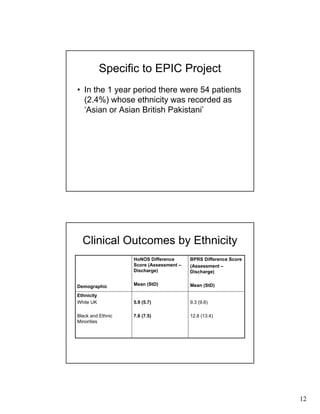
Specific to EPIC Project
• In the 1 year period there were 54 patients
(2.4%) whose ethnicity was recorded as
‘Asian or Asian British Pakistani’
Clinical Outcomes by Ethnicity
9.3 (9.6)
12.8 (13.4)
5.9 (5.7)
7.8 (7.5)
Ethnicity
White UK
Black and Ethnic
Minorities
BPRS Difference Score
(Assessment –
Discharge)
Mean (StD)
HoNOS Difference
Score (Assessment –
Discharge)
Mean (StD)Demographic
13
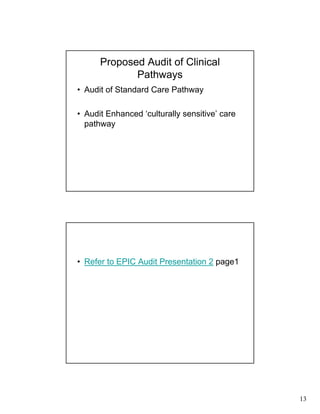
Proposed Audit of Clinical
Pathways
• Audit of Standard Care Pathway
• Audit Enhanced ‘culturally sensitive’ care
pathway
• Refer to EPIC Audit Presentation 2 page1
14
• Refer to audit present 2 page2
• Refer to audit present 2 page3
15
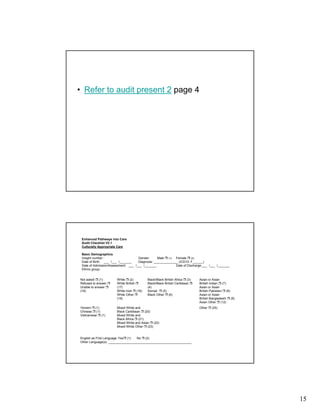
• Refer to audit present 2 page 4
Enhanced Pathways into Care
Audit Checklist V2.1
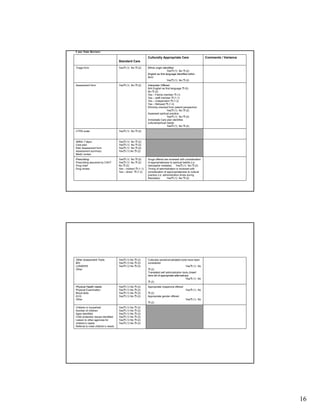
Culturally Appropriate Care
Basic Demographics
Insight number : Gender: Male (1) Female (2)
Date of Birth: ___ /___ /_______ Diagnosis: ______________ (ICD10: F______)
Date of Admission/Assessment: ___ /___ /_______ Date of Discharge:___ /___ /_______
Ethnic group:
Other (25)Mixed White and
Black Caribbean (20)
Mixed White and
Black Africa (21)
Mixed White and Asian (22)
Mixed White Other (23)
Yemeni (1)
Chinese (1)
Vietnamese (1)
Asian or Asian
British Indian (7)
Asian or Asian
British Pakistani (8)
Asian or Asian
British Bangladeshi (9)
Asian Other (12)
Black/Black British Africa (3)
Black/Black British Caribbean
(4)
Somali (5)
Black Other (6)
White (2)
White British
(17)
White Irish (18)
White Other
(19)
Not asked (1)
Refused to answer
Unable to answer
(16)
English as First Language: Yes (1) No (2)
Other Language(s): ________________________________________________
16
Case Note Review:
Drugs offered are reviewed with consideration
of appropriateness to spiritual beliefs (i.e.
olanzapine velotabs) Yes (1) No (2)
Timing of administration is reviewed with
consideration of apporopriateness to cultural
practice (i.e. administration times during
Ramadan) Yes (1) No (2)
Yes (1) No (2)
Yes (1) No (2)
No (2)
Yes – indirect (1.1)
Yes – direct (1.2)
Prescribing:
Prescribing assumed by CAHT
Drug chart
Drug review
Yes (1) No (2)
Yes (1) No (2)
Yes (1) No (2)
Yes (1) No (2)
Within 7 days:
Care plan
Risk Assessment form
Assessment summary
Medic review
Yes (1) No (2)CTRS scale
Interpreter Offered:
N/A English as first language (0)
No (2)
Yes – Family member (1)
Yes – staff member (1.1)
Yes – Independent (1.2)
Yes – Refused (1.3)
Ethnicity checked from pateint perspective:
Yes (1) No (2)
Assessed spiritual practice:
Yes (1) No (2)
Immediate Care plan identifies
cultural/spiritual needs:
Yes (1) No (2)
Yes (1) No (2)Assessment form
Ethnic origin identified:
Yes (1) No (2)
English as first language identified within
form:
Yes (1) No (2)
Yes (1) No (2)Triage form
Comments / VarianceCulturally Appropriate Care
Standard Care
Yes (1) No (2)
Yes (1) No (2)
Yes (1) No (2)
Yes (1) No (2)
Yes (1) No (2)
Yes (1) No (2)
Children in household
Number of children
Ages identified
Child protection issues identified
Liaison to other agencies for
children’s needs
Referral to meet children’s needs
Appropriate chaperone offered
Yes (1) No
(2)
Appropriate gender offered
Yes (1) No
(2)
Yes (1) No (2)
Yes (1) No (2)
Yes (1) No (2)
Yes (1) No (2)
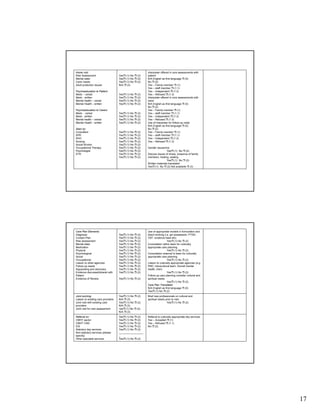
Physical Health needs:
Physical Examination
Blood tests
ECG
Other
Culturally sensitive/validated tools have been
considered
Yes (1) No
(2)
Translated self administration tools (insert
here list of appropriate alternatives)
Yes (1) No
(2)
Yes (1) No (2)
Yes (1) No (2)
Yes (1) No (2)
Other Assessment Tools:
BDI
LUNSERS
Other
17
Interpreter offered in core assessments with
patient:
N/A English as first language (0)
No (2)
Yes – Family member (1)
Yes – staff member (1.1)
Yes – Independent (1.2)
Yes – Refused (1.3)
Interpreter offered in core assessments with
carer:
N/A English as first language (0)
No (2)
Yes – Family member (1)
Yes – staff member (1.1)
Yes – Independent (1.2)
Yes – Refused (1.3)
Use of interpreter for follow-up visits:
N/A English as first language (0)
No (2)
Yes – Family member (1)
Yes – staff member (1.1)
Yes – Independent (1.2)
Yes – Refused (1.3)
Gender issues/mix
Yes (1) No (2)
Discuss issues of shoes, presence of family
members, hosting, seating
Yes (1) No (2)
Written materials translated
Yes (1) No (2) Not available (3)
Yes (1) No (2)
Yes (1) No (2)
Yes (1) No (2)
N/A (3)
Yes (1) No (2)
Yes (1) No (2)
Yes (1) No (2)
Yes (1) No (2)
Yes (1) No (2)
Yes (1) No (2)
Yes (1) No (2)
Yes (1) No (2)
Yes (1) No (2)
Yes (1) No (2)
Yes (1) No (2)
Yes (1) No (2)
Yes (1) No (2)
Yes (1) No (2)
Yes (1) No (2)
Yes (1) No (2)
Yes (1) No (2)
Home visit:
Risk Assessment
Mental state
Carer needs
Adult protection issues
Psychoeducation to Patient:
Meds - verbal
Meds - written
Mental health – verbal
Mental Health - written
Psychoeducation to Carers:
Meds - verbal
Meds - written
Mental health – verbal
Mental Health - written
Seen by:
Consultant
SPR
SHO
Nursing
Social Worker
Occupational Therapy
Psychologist
STR
Referral to culturally appropriate day services
Yes – Accepted (1)
Yes – Refused (1.1)
No (2)
Yes (1) No (2)
Yes (1) No (2)
Yes (1) No (2)
Yes (1) No (2)
Yes (1) No (2)
_________________
_
Yes (1) No (2)
Referral on:
CMHT sector
CMHT CNS
EIS
Statutory day services
Non-statutory services (please
specify)
Other specialist services
Brief new professionals on cultural and
spiritual needs prior to visit
Yes (1) No (2)
Yes (1) No (2)
N/A (3)
Yes (1) No (2)
N/A (3)
Yes (1) No (2)
N/A (3)
Joint working:
Liaison to existing care providers
Joint visit with existing care
providers
Joint visit for new assessment
Use of appropriate models in formulation and
direct working (i.e. gin possession, PTSD,
CBT, evidence base etc)
Yes (1) No (2)
Consultation within team for culturally
appropriate care planning
Yes (1) No (2)
Consultation external to team for culturally
appropriate care planning
Yes (1) No (2)
Liaison to culturally appropriate agencies (e.g.
PMC, transcultural team, Somali mental
health, Irish)
Yes (1) No (2)
Follow-up care planning consider cultural and
spiritual needs
Yes (1) No (2)
Care Plan Translated
N/A English as first language (0)
Yes (1) No (2)
Yes (1) No (2)
Yes (1) No (2)
Yes (1) No (2)
Yes (1) No (2)
Yes (1) No (2)
Yes (1) No (2)
Yes (1) No (2)
Yes (1) No (2)
Yes (1) No (2)
Yes (1) No (2)
Yes (1) No (2)
Yes (1) No (2)
Yes (1) No (2)
Yes (1) No (2)
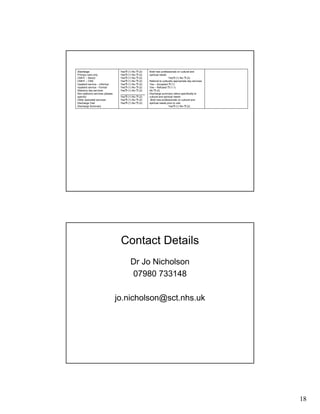
Care Plan Elements:
Diagnosis
Contact Plan
Risk assessment
Mental state
Medication
Physical
Psychological
Social
Occupational
Liaison to other agencies
Follow-up needs
Signposting and advocacy
Evidence discussed/shared with
Patient
Evidence of Review
18
Brief new professionals on cultural and
spiritual needs
Yes (1) No (2)
Referral to culturally appropriate day services
Yes – Accepted (1)
Yes – Refused (1.1)
No (2)
Discharge summary refers specifically to
cultural and spiritual needs
Brief new professionals on cultural and
spiritual needs prior to visit
Yes (1) No (2)
Yes (1) No (2)
Yes (1) No (2)
Yes (1) No (2)
Yes (1) No (2)
Yes (1) No (2)
Yes (1) No (2)
Yes (1) No (2)
_________________
Yes (1) No (2)
Yes (1) No (2)
Yes (1) No (2)
Discharge:
Primary care only
CMHT – Sector
CMHT – CNS
Inpatient service – Informal
Inpatient service - Formal
Statutory day services
Non-statutory services (please
specify)
Other specialist services
Discharge Visit
Discharge Summary
Contact Details
Dr Jo Nicholson
07980 733148
jo.nicholson@sct.nhs.uk

Epic audit presentation

  • 1.
    1 Crisis Assessment andHome Treatment – EPIC Audit Dr Jo Nicholson Clinical Psychologist What is Crisis Assessment and Home Treatment? “People experiencing severe mental health difficulties should be treated in the least restrictive environment with the minimum of disruption to their lives. Crisis resolution/ home treatment (CRHT) can be provided in a range of settings and offers an alternative to inpatient care. The majority of service users and carers prefer community-based treatment, and research in the UK and elsewhere has shown that clinical and social outcomes achieved by community-based treatment are at least as good as those achieved in hospital.” Mental Health Policy Implementation Guide 2001
  • 2.
    2 CRHT Service Developmentin Sheffield • Sheffield Crisis Assessment and Home Treatment (CAHT) is a new service development, in line with the national demands for new core mental health services. • The Sheffield CAHT has developed the pre-existing ‘Out of Hours’ service, with a substantial increase in staffing and shift in focus and philosophy of service to provide a fully operational service from January 2005. • Provides 24 hours a day, 365 days a year crisis assessment and home based treatment to people experiencing mental health difficulties, where the home treatment compnent is prioritised for those people who would otherwise be admitted to hospital. • It offers the least restrictive and most appropriate form of assessment and home treatment with the minimum disruption to their lives. CAHT - Inclusion Criteria The inclusion criteria are as follows: • Where the person is potentially experiencing a mental health crisis and admission to hospital is being considered • And, the person needs to be seen within 24 hours • And, the person presents at an increased level of risk to themselves or others
  • 3.
    3 Service Components The CAHTservice response to referrals has four components: • Triage • Crisis Assessment • Home Treatment • ‘Gate keeping’. What is Home Treatment? • The Crisis Assessment and Home Treatment approach is to work to maximise the person’s coping and resilience through a period of crisis and/or acute exacerbation of mental health functioning. The Home Treatment approach provides an appropriately intensive level of psychiatric, social and psychological support based on the individual’s needs. Home Treatment seeks to promote functional coping and recovery in the least stigmatising and restrictive setting. • As the needs of the patient are highly individual the period of care and the intensity of support provided can vary greatly. Home Treatment can be a very short intervention (i.e. no more than 1-3 days) providing a physical and psychological ‘safety net’ for the individual. Overall, Home Treatment aims to contain and resolve the ‘crises’ within an 8 week period. However, there are some individuals who need a longer spell of care either to resolve the crisis or ensure that appropriate support services are in place so that risk and needs are adequately managed.
  • 4.
    4 CAHT – GlobalAudit Strategy • Comprehensive rolling programme of audit that will run across a two year cycle. • Led by two senior clinicians within the service. • Supported by a service-dedicated psychology assistant, specifically recruited for that purpose. • Multi-professional steering group has been set- up to guide the programme and this has user and carer representation. 1st Quarter 6 months 1 year 2 years InsightEquitable Service Access and Culturally Sensitive Service Pathways Demographics 1st Quarter 6 months 1 year 2 years InsightStHA performance indicators Inpatient 6 months 1 year 2 years CAHT databaseBenchmark to comparable published research and audit data Service User and Carer Feedback 6 months 1 year 2 years CAHT databasesBenchmark to comparable published research and audit data Clinical Outcomes 1st Quarter 6 months 1 year 2 years Insight CAHT database StHA performance indicators Service Performance ReportData SourceService Standard Programme Area
  • 5.
    5 Databases • The datapresented within this audit is based upon a number of database sources; including CAHT databases and Insight. • Through collaboration with the SCT Information Department, data from Insight data also uploaded into Excel and merged with the existing CAHT databases. • The Excel databases were imported into SPSS. This provided more flexibility in data interrogation than could be provided through routine Insight reports. • The CAHT service is currently working towards developing a ‘live’ electronic recording system that will rationalise the number of data sources in use. EPIC Audit Additional audit procedures need to be in place to monitor the impact of EPIC 1. Monitor/Describe Components of ‘standard care pathway’ 2. Monitor/decsribe culturally senstive care pathway
  • 6.
    6 Audit Standards 1. TheCAHT is contracted by the StHA to provide 1200 episodes of Home Treatment in a year period. 2. The CAHT service aims to provide an equitable service 3. The CAHT service should develop clear care pathways that are responsive to the needs of the different client groups and the referrers it serves 4. Ensure that individuals experiencing acute mental health difficulties are treated in the least restrictive setting as close to home as possible 5. To act as ‘gatekeeper’ to acute inpatient services, rapidly assessing individuals with acute mental health problems and referring them to the most appropriate service Activity Results – Referral Rate Crisis Assessment and Home Treatment Crisis Assessment OnlyConsultation Only CAHT Categories 2,500 2,000 1,500 1,000 500 0 NumberofPatients 478 14.59% 2,187 66.74% 612 18.68%
  • 7.
    7 Missing Data • WhiteUK 52.3% (1713) • BEMs 10.4% (340) • Missing Data 37.4% (1235) • For ethnicity – up to 40% missing data • Varies by quarter, with more missing data as year goes on Results – Referral Rate 84.3% (339) 15.7% (63) 83.7% (456) 16.3% (89) 83.4% (1713) 16.6% (340) Ethnicity White UK Black and Ethnic Minorities Multiple Episodes Patients with Single Episode All Episodes, including repeats Demograp hic Variable
  • 8.
    8 Activity Data –Repeat Patients • In total, 1847 individual patients were seen in the first year of operation, but a significant proportion of these were seen at least twice. There were 588 patients who received multiple episodes of care, this means 32.1% of patients were seen at least twice. Of the 3277episodes of care provided by CAHT, 56.4% were repeat episodes. • Initial differences by ethnicity diminished over year period and no significant relationship between ethnicity and likelihood of having a repeat episode. Results – CAHT and A&E (based on 3 month sub-sample) • A&E is the major referral source to CAHT accounting for over half of all referrals (56%). • 77% of A&E referrals are seen after 5pm and half (49%) of all referrals to CAHT are seen after 5pm. • Referrals from A&E are least likely and referrals from CMHT’s are the most likely to result in Home Treatment as a clinical outcome. Referrals from A&E are 3 times less likely to result in Home Treatment as compared to referrals from a CMHT.
  • 9.
    9 Referral Source (based on3 month sub-sample) • In hours distribution of White UK (80%) to BEMs (20%) by referral source fairly consistent. • There is one exception to this; number of BEM’s accessing CAHT by GP Out-of- Hours drops by half (White UK 90.9% BEMs 9.1%) Setting of First Direct Contact (Full Year) 15.2% (16)84.8% (89)Other Location 14% (83)86% (510)A&E 15.5% (80)84.5% (435)Telephone 34.2% (13)65.8% (25)Police Station 18.8% (88)81.2% (381)Clients Home BEMsWhite UK
  • 10.
    10 Results - Demographics •Overall referrals to CAHT are equal proportions of male and female, are an average age of 37, likely to be unemployed (68.1%) and not married (73.1%). • 78.5% are White UK and 16.6% Black and Ethnic Minorities. • Distritbution of ethnicity did not vary across clinical categories (crisis assessment only verusus crisis assessment and home treatment) • There are significant demographic differences between the patients referred to CAHT across the 4 PCT Sectors. • Compared to the general population of Sheffield (2001 Sheffield Census), CAHT service users are nearly twice as likely to be single or divorced/separated. They are also six times more likely to be unemployed and twice as likely to come from a Black and Ethnic Minority group. Ethnicity by PCT Area • There were statistically significant differences in the distributions of ethnicity across the different PCT areas (chi=13.6: p=0.003). • The South West had the highest proportions of BEM’s referred to the service (23%). • The South East had the lowest proportion of BEM’s referred to the service (13.8%). • It is notable that the proportion of BEM’s from the North is close to the proportional average (across all sectors) and the South East has the lowest proportional rate when those sectors actually have the highest proportion of BEM’s of all the sectors.
  • 11.
    11 CAHT Ethnicity Distribution Comparedto Sheffield Census 89.2 83.8 10.8 16.2 0 10 20 30 40 50 60 70 80 90 British BEMs Sheffield 2001 Census CAHT Population Detailed breakdown of ethnicity OtherDual Heritage YeminiChineseAsianBlackWhite Other White Collapsed Ethnicity Codes 2,000 1,500 1,000 500 0 NumberofPatients 32 1.56% 31 1.51% 20 0.97% 33 1.61% 97 4.72%78 3.8% 49 2.39% 1,713 83.44%
  • 12.
    12 Specific to EPICProject • In the 1 year period there were 54 patients (2.4%) whose ethnicity was recorded as ‘Asian or Asian British Pakistani’ Clinical Outcomes by Ethnicity 9.3 (9.6) 12.8 (13.4) 5.9 (5.7) 7.8 (7.5) Ethnicity White UK Black and Ethnic Minorities BPRS Difference Score (Assessment – Discharge) Mean (StD) HoNOS Difference Score (Assessment – Discharge) Mean (StD)Demographic
  • 13.
    13 Proposed Audit ofClinical Pathways • Audit of Standard Care Pathway • Audit Enhanced ‘culturally sensitive’ care pathway • Refer to EPIC Audit Presentation 2 page1
  • 14.
    14 • Refer toaudit present 2 page2 • Refer to audit present 2 page3
  • 15.
    15 • Refer toaudit present 2 page 4 Enhanced Pathways into Care Audit Checklist V2.1 Culturally Appropriate Care Basic Demographics Insight number : Gender: Male (1) Female (2) Date of Birth: ___ /___ /_______ Diagnosis: ______________ (ICD10: F______) Date of Admission/Assessment: ___ /___ /_______ Date of Discharge:___ /___ /_______ Ethnic group: Other (25)Mixed White and Black Caribbean (20) Mixed White and Black Africa (21) Mixed White and Asian (22) Mixed White Other (23) Yemeni (1) Chinese (1) Vietnamese (1) Asian or Asian British Indian (7) Asian or Asian British Pakistani (8) Asian or Asian British Bangladeshi (9) Asian Other (12) Black/Black British Africa (3) Black/Black British Caribbean (4) Somali (5) Black Other (6) White (2) White British (17) White Irish (18) White Other (19) Not asked (1) Refused to answer Unable to answer (16) English as First Language: Yes (1) No (2) Other Language(s): ________________________________________________
  • 16.
    16 Case Note Review: Drugsoffered are reviewed with consideration of appropriateness to spiritual beliefs (i.e. olanzapine velotabs) Yes (1) No (2) Timing of administration is reviewed with consideration of apporopriateness to cultural practice (i.e. administration times during Ramadan) Yes (1) No (2) Yes (1) No (2) Yes (1) No (2) No (2) Yes – indirect (1.1) Yes – direct (1.2) Prescribing: Prescribing assumed by CAHT Drug chart Drug review Yes (1) No (2) Yes (1) No (2) Yes (1) No (2) Yes (1) No (2) Within 7 days: Care plan Risk Assessment form Assessment summary Medic review Yes (1) No (2)CTRS scale Interpreter Offered: N/A English as first language (0) No (2) Yes – Family member (1) Yes – staff member (1.1) Yes – Independent (1.2) Yes – Refused (1.3) Ethnicity checked from pateint perspective: Yes (1) No (2) Assessed spiritual practice: Yes (1) No (2) Immediate Care plan identifies cultural/spiritual needs: Yes (1) No (2) Yes (1) No (2)Assessment form Ethnic origin identified: Yes (1) No (2) English as first language identified within form: Yes (1) No (2) Yes (1) No (2)Triage form Comments / VarianceCulturally Appropriate Care Standard Care Yes (1) No (2) Yes (1) No (2) Yes (1) No (2) Yes (1) No (2) Yes (1) No (2) Yes (1) No (2) Children in household Number of children Ages identified Child protection issues identified Liaison to other agencies for children’s needs Referral to meet children’s needs Appropriate chaperone offered Yes (1) No (2) Appropriate gender offered Yes (1) No (2) Yes (1) No (2) Yes (1) No (2) Yes (1) No (2) Yes (1) No (2) Physical Health needs: Physical Examination Blood tests ECG Other Culturally sensitive/validated tools have been considered Yes (1) No (2) Translated self administration tools (insert here list of appropriate alternatives) Yes (1) No (2) Yes (1) No (2) Yes (1) No (2) Yes (1) No (2) Other Assessment Tools: BDI LUNSERS Other
  • 17.
    17 Interpreter offered incore assessments with patient: N/A English as first language (0) No (2) Yes – Family member (1) Yes – staff member (1.1) Yes – Independent (1.2) Yes – Refused (1.3) Interpreter offered in core assessments with carer: N/A English as first language (0) No (2) Yes – Family member (1) Yes – staff member (1.1) Yes – Independent (1.2) Yes – Refused (1.3) Use of interpreter for follow-up visits: N/A English as first language (0) No (2) Yes – Family member (1) Yes – staff member (1.1) Yes – Independent (1.2) Yes – Refused (1.3) Gender issues/mix Yes (1) No (2) Discuss issues of shoes, presence of family members, hosting, seating Yes (1) No (2) Written materials translated Yes (1) No (2) Not available (3) Yes (1) No (2) Yes (1) No (2) Yes (1) No (2) N/A (3) Yes (1) No (2) Yes (1) No (2) Yes (1) No (2) Yes (1) No (2) Yes (1) No (2) Yes (1) No (2) Yes (1) No (2) Yes (1) No (2) Yes (1) No (2) Yes (1) No (2) Yes (1) No (2) Yes (1) No (2) Yes (1) No (2) Yes (1) No (2) Yes (1) No (2) Yes (1) No (2) Yes (1) No (2) Home visit: Risk Assessment Mental state Carer needs Adult protection issues Psychoeducation to Patient: Meds - verbal Meds - written Mental health – verbal Mental Health - written Psychoeducation to Carers: Meds - verbal Meds - written Mental health – verbal Mental Health - written Seen by: Consultant SPR SHO Nursing Social Worker Occupational Therapy Psychologist STR Referral to culturally appropriate day services Yes – Accepted (1) Yes – Refused (1.1) No (2) Yes (1) No (2) Yes (1) No (2) Yes (1) No (2) Yes (1) No (2) Yes (1) No (2) _________________ _ Yes (1) No (2) Referral on: CMHT sector CMHT CNS EIS Statutory day services Non-statutory services (please specify) Other specialist services Brief new professionals on cultural and spiritual needs prior to visit Yes (1) No (2) Yes (1) No (2) N/A (3) Yes (1) No (2) N/A (3) Yes (1) No (2) N/A (3) Joint working: Liaison to existing care providers Joint visit with existing care providers Joint visit for new assessment Use of appropriate models in formulation and direct working (i.e. gin possession, PTSD, CBT, evidence base etc) Yes (1) No (2) Consultation within team for culturally appropriate care planning Yes (1) No (2) Consultation external to team for culturally appropriate care planning Yes (1) No (2) Liaison to culturally appropriate agencies (e.g. PMC, transcultural team, Somali mental health, Irish) Yes (1) No (2) Follow-up care planning consider cultural and spiritual needs Yes (1) No (2) Care Plan Translated N/A English as first language (0) Yes (1) No (2) Yes (1) No (2) Yes (1) No (2) Yes (1) No (2) Yes (1) No (2) Yes (1) No (2) Yes (1) No (2) Yes (1) No (2) Yes (1) No (2) Yes (1) No (2) Yes (1) No (2) Yes (1) No (2) Yes (1) No (2) Yes (1) No (2) Yes (1) No (2) Care Plan Elements: Diagnosis Contact Plan Risk assessment Mental state Medication Physical Psychological Social Occupational Liaison to other agencies Follow-up needs Signposting and advocacy Evidence discussed/shared with Patient Evidence of Review
  • 18.
    18 Brief new professionalson cultural and spiritual needs Yes (1) No (2) Referral to culturally appropriate day services Yes – Accepted (1) Yes – Refused (1.1) No (2) Discharge summary refers specifically to cultural and spiritual needs Brief new professionals on cultural and spiritual needs prior to visit Yes (1) No (2) Yes (1) No (2) Yes (1) No (2) Yes (1) No (2) Yes (1) No (2) Yes (1) No (2) Yes (1) No (2) Yes (1) No (2) _________________ Yes (1) No (2) Yes (1) No (2) Yes (1) No (2) Discharge: Primary care only CMHT – Sector CMHT – CNS Inpatient service – Informal Inpatient service - Formal Statutory day services Non-statutory services (please specify) Other specialist services Discharge Visit Discharge Summary Contact Details Dr Jo Nicholson 07980 733148 jo.nicholson@sct.nhs.uk