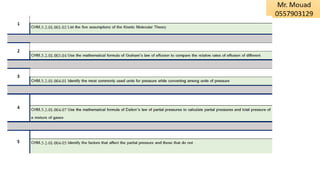
EoT3 Chemistry Coverage
Grade 10 Adv
2024-2025
Mr. Mouad ‫معاذ‬ ‫استاذ‬
0557903129
EoT3 Chemistry Coverage
Grade 10 Adv
Part-1
Q1 to Q9
2024-2025
Mr. Mouad ‫معاذ‬ ‫استاذ‬
0557903129
Assumption = ‫فرضية‬
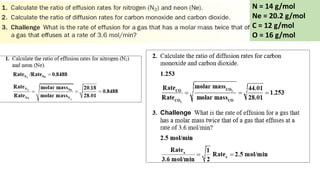
Collision =‫تصادم‬
Elastic = ‫مرن‬
Consist = ‫تتكون‬
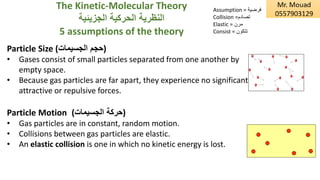
Particle Size (‫الجسيمات‬ ‫)حجم‬
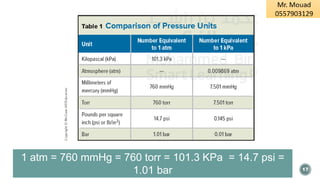
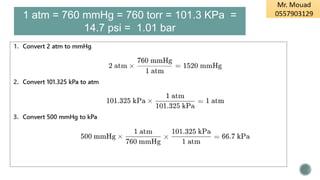
• Gases consist of small particles separated from one another by
empty space.
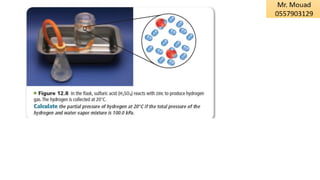
• Because gas particles are far apart, they experience no significant
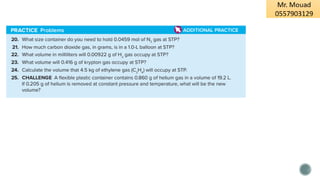
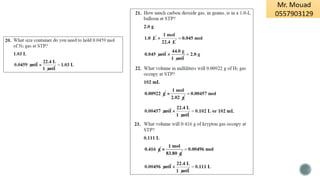
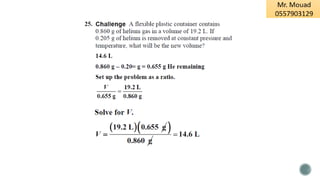
attractive or repulsive forces.
Particle Motion (‫الجسيمات‬ ‫)حركة‬
• Gas particles are in constant, random motion.
• Collisions between gas particles are elastic.
• An elastic collision is one in which no kinetic energy is lost.
The Kinetic-Molecular Theory
‫الجزيئية‬ ‫الحركية‬ ‫النظرية‬
5 assumptions of the theory
The Kinetic-Molecular Theory
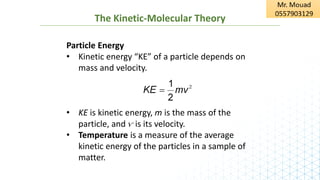
Particle Energy
• Kinetic energy “KE” of a particle depends on
mass and velocity.
• KE is kinetic energy, m is the mass of the
particle, and ⱱ is its velocity.
• Temperature is a measure of the average
kinetic energy of the particles in a sample of
matter.
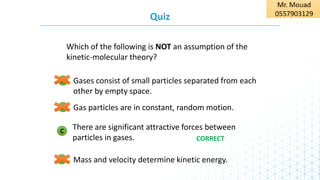
B
Quiz
Mass and velocity determine kinetic energy.
D
There are significant attractive forces between
particles in gases.
C
Gas particles are in constant, random motion.
Gases consist of small particles separated from each
other by empty space.
A
Which of the following is NOT an assumption of the
kinetic-molecular theory?
CORRECT
Quiz
Which of the following is an assumption of the
kinetic-molecular theory?
4- The Kinetic Energy doesn’t depend on the
mass and velocity.
3- There are significant attractive forces between
particles in gases.
2- Gas particles are in constant, random motion.
1- Gases consist of big particles separated from each
other by empty space.
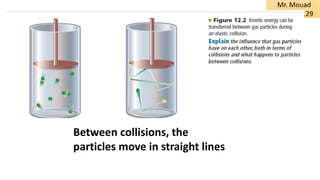
Between collisions, the
particles move in straight lines
Explaining the Behavior of Gases
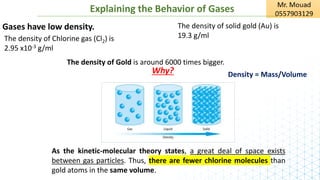
Gases have low density.
The density of Chlorine gas (Cl2) is
2.95 x10⁻³ g/ml
The density of solid gold (Au) is
19.3 g/ml
The density of Gold is around 6000 times bigger.
Why?
As the kinetic-molecular theory states, a great deal of space exists
between gas particles. Thus, there are fewer chlorine molecules than
gold atoms in the same volume.
Density = Mass/Volume
Continue: Explaining the Behavior of Gases
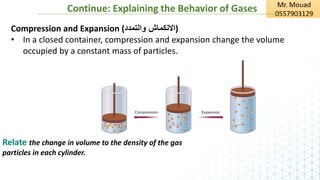
Compression and Expansion (‫والتمدد‬ ‫)االنكماش‬
• In a closed container, compression and expansion change the volume
occupied by a constant mass of particles.
Relate the change in volume to the density of the gas
particles in each cylinder.
Explaining the Behavior of Gases
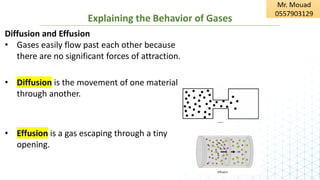
Diffusion and Effusion
• Gases easily flow past each other because
there are no significant forces of attraction.
• Diffusion is the movement of one material
through another.
• Effusion is a gas escaping through a tiny
opening.
Explaining the Behavior of Gases
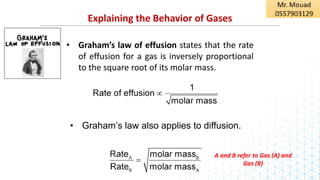
• Graham’s law of effusion states that the rate
of effusion for a gas is inversely proportional
to the square root of its molar mass.
A and B refer to Gas (A) and
Gas (B)
• Graham’s law also applies to diffusion.
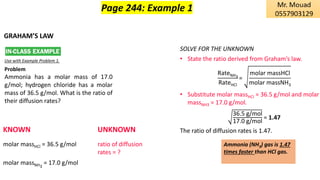
GRAHAM’S LAW
Use with Example Problem 1.
Problem
Ammonia has a molar mass of 17.0
g/mol; hydrogen chloride has a molar
mass of 36.5 g/mol. What is the ratio of
their diffusion rates?
KNOWN UNKNOWN
molar massHCl = 36.5 g/mol ratio of diffusion
rates = ?
molar massNH3
= 17.0 g/mol
SOLVE FOR THE UNKNOWN
• State the ratio derived from Graham’s law.
RateNH3
RateHCl
=
molar massHCl
molar massNH3
• Substitute molar massHCl = 36.5 g/mol and molar
massNH3 = 17.0 g/mol.
36.5 g/mol
17.0 g/mol
= 1.47
The ratio of diffusion rates is 1.47.
Page 244: Example 1
Ammonia (NH3) gas is 1.47
times faster than HCl gas.
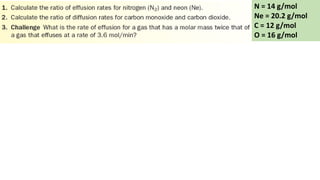
N = 14 g/mol
Ne = 20.2 g/mol
C = 12 g/mol
O = 16 g/mol
N = 14 g/mol
Ne = 20.2 g/mol
C = 12 g/mol
O = 16 g/mol
17
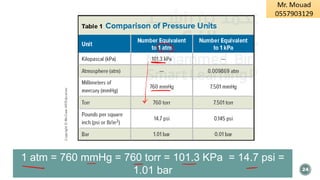
1 atm = 760 mmHg = 760 torr = 101.3 KPa = 14.7 psi =
1.01 bar
1 atm = 760 mmHg = 760 torr = 101.3 KPa =
14.7 psi = 1.01 bar
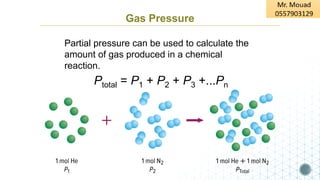
Gas Pressure
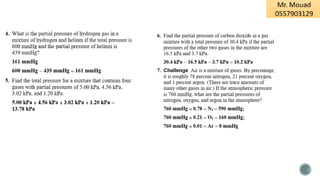
Partial pressure can be used to calculate the
amount of gas produced in a chemical
reaction.
Ptotal = P1 + P2 + P3 +...Pn
20
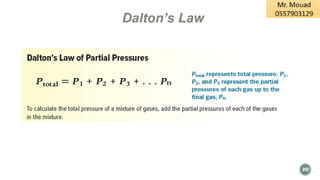
Dalton’s Law
21
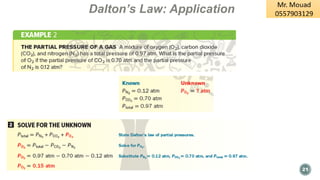
Dalton’s Law: Application
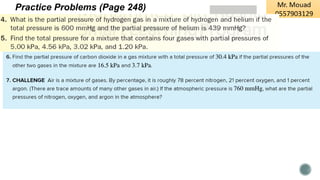
Practice Problems (Page 248)
24
1 atm = 760 mmHg = 760 torr = 101.3 KPa = 14.7 psi =
1.01 bar
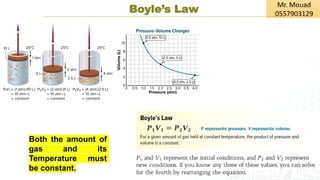
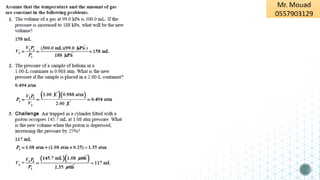
Boyle’s Law:
There is an inverse relationship between Pressure and
Volume when the temperature is constant.
If the pressure goes down, the volume goes up, and
vice versa
Boyle’s Law
Both the amount of
gas and its
Temperature must
be constant.
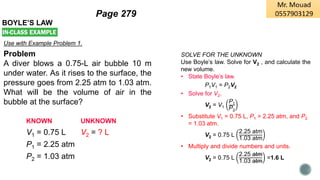
BOYLE’S LAW
Use with Example Problem 1.
Problem
A diver blows a 0.75-L air bubble 10 m
under water. As it rises to the surface, the
pressure goes from 2.25 atm to 1.03 atm.
What will be the volume of air in the
bubble at the surface?
KNOWN UNKNOWN
V1 = 0.75 L V2 = ? L
P1 = 2.25 atm
P2 = 1.03 atm
SOLVE FOR THE UNKNOWN
Use Boyle’s law. Solve for V2 , and calculate the
new volume.
• State Boyle’s law.
P1V1 = P2V2
• Solve for V2.
V2 = V1
P1
P2
• Substitute V1 = 0.75 L, P1 = 2.25 atm, and P2
= 1.03 atm.
V2 = 0.75 L
2.25 atm
1.03 atm
• Multiply and divide numbers and units.
V2 = 0.75 L
2.25 atm
1.03 atm
=1.6 L
Page 279
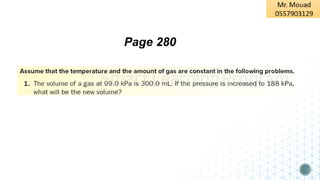
Page 280
There is an inverse relationship between
Pressure and Volume when the
temperature is constant.
If the pressure is constant, what will be the
relationship between temperature and
volume?
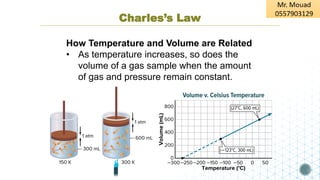
Charles’s Law
How Temperature and Volume are Related
• As temperature increases, so does the
volume of a gas sample when the amount
of gas and pressure remain constant.
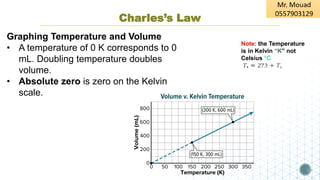
Charles’s Law
Graphing Temperature and Volume
• A temperature of 0 K corresponds to 0
mL. Doubling temperature doubles
volume.
• Absolute zero is zero on the Kelvin
scale.
Note: the Temperature
is in Kelvin “K” not
Celsius °C
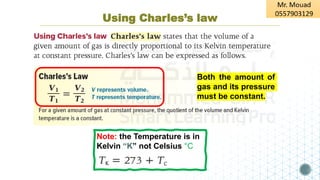
Using Charles’s law
Note: the Temperature is in
Kelvin “K” not Celsius °C
Both the amount of
gas and its pressure
must be constant.
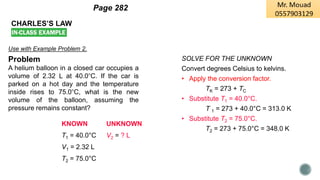
CHARLES’S LAW
Use with Example Problem 2.
Problem
A helium balloon in a closed car occupies a
volume of 2.32 L at 40.0°C. If the car is
parked on a hot day and the temperature
inside rises to 75.0°C, what is the new
volume of the balloon, assuming the
pressure remains constant?
KNOWN UNKNOWN
T1 = 40.0°C V2 = ? L
V1 = 2.32 L
T2 = 75.0°C
SOLVE FOR THE UNKNOWN
Convert degrees Celsius to kelvins.
• Apply the conversion factor.
TK = 273 + TC
• Substitute T1 = 40.0°C.
T 1 = 273 + 40.0°C = 313.0 K
• Substitute T2 = 75.0°C.
T2 = 273 + 75.0°C = 348.0 K
Page 282
CHARLES’S LAW
Use with Example Problem 2.
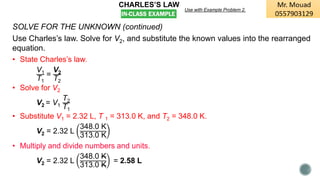
SOLVE FOR THE UNKNOWN (continued)
Use Charles’s law. Solve for V2, and substitute the known values into the rearranged
equation.
• State Charles’s law.
V1
T1
=
V2
T2
• Solve for V2
V2 = V1
T2
T1
• Substitute V1 = 2.32 L, T 1 = 313.0 K, and T2 = 348.0 K.
V2 = 2.32 L
348.0 K
313.0 K
• Multiply and divide numbers and units.
V2 = 2.32 L
348.0 K
313.0 K
= 2.58 L
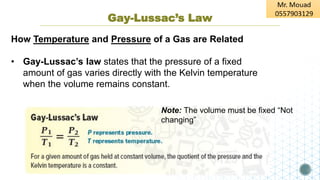
Gay-Lussac’s Law
How Temperature and Pressure of a Gas are Related
• Gay-Lussac’s law states that the pressure of a fixed
amount of gas varies directly with the Kelvin temperature
when the volume remains constant.
Note: The volume must be fixed “Not
changing”
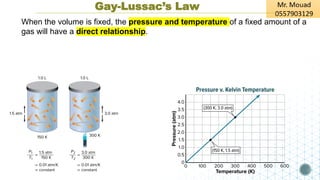
Gay-Lussac’s Law
When the volume is fixed, the pressure and temperature of a fixed amount of a
gas will have a direct relationship.
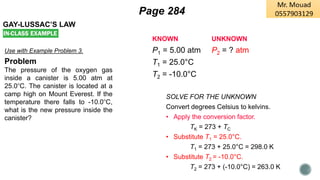
GAY-LUSSAC’S LAW
Use with Example Problem 3.
Problem
The pressure of the oxygen gas
inside a canister is 5.00 atm at
25.0°C. The canister is located at a
camp high on Mount Everest. If the
temperature there falls to -10.0°C,
what is the new pressure inside the
canister?
KNOWN UNKNOWN
P1 = 5.00 atm P2 = ? atm
T1 = 25.0°C
T2 = -10.0°C
SOLVE FOR THE UNKNOWN
Convert degrees Celsius to kelvins.
• Apply the conversion factor.
TK = 273 + TC
• Substitute T1 = 25.0°C.
T1 = 273 + 25.0°C = 298.0 K
• Substitute T2 = -10.0°C.
T2 = 273 + (-10.0°C) = 263.0 K
Page 284
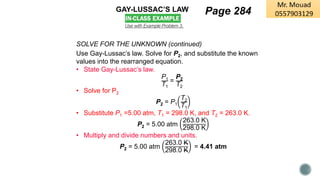
GAY-LUSSAC’S LAW
Use with Example Problem 3.
SOLVE FOR THE UNKNOWN (continued)
Use Gay-Lussac’s law. Solve for P2, and substitute the known
values into the rearranged equation.
• State Gay-Lussac’s law.
P1
T1
=
P2
T2
• Solve for P2
P2 = P1
T2
T1
• Substitute P1 =5.00 atm, T1 = 298.0 K, and T2 = 263.0 K.
P2 = 5.00 atm
263.0 K
298.0 K
• Multiply and divide numbers and units.
P2 = 5.00 atm
263.0 K
298.0 K
= 4.41 atm
Page 284
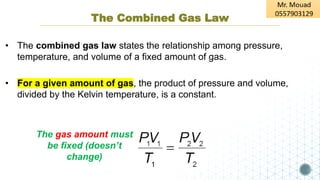
The Combined Gas Law
• The combined gas law states the relationship among pressure,
temperature, and volume of a fixed amount of gas.
• For a given amount of gas, the product of pressure and volume,
divided by the Kelvin temperature, is a constant.
The gas amount must
be fixed (doesn’t
change)
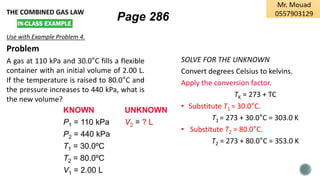
THE COMBINED GAS LAW
Use with Example Problem 4.
Problem
A gas at 110 kPa and 30.0°C fills a flexible
container with an initial volume of 2.00 L.
If the temperature is raised to 80.0°C and
the pressure increases to 440 kPa, what is
the new volume?
KNOWN UNKNOWN
P1 = 110 kPa V2 = ? L
P2 = 440 kPa
T1 = 30.0ºC
T2 = 80.0ºC
V1 = 2.00 L
SOLVE FOR THE UNKNOWN
Convert degrees Celsius to kelvins.
Apply the conversion factor.
TK = 273 + TC
• Substitute T1 = 30.0°C.
T1 = 273 + 30.0°C = 303.0 K
• Substitute T2 = 80.0°C.
T2 = 273 + 80.0°C = 353.0 K
Page 286
THE COMBINED GAS LAW
Use with Example Problem 4.
SOLVE FOR THE UNKNOWN (continued)
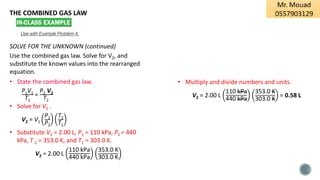
Use the combined gas law. Solve for V2, and
substitute the known values into the rearranged
equation.
• State the combined gas law.
P1V1
T1
=
P2 V2
T2
• Solve for V2 .
V2 = V1
P1
P2
T2
T1
• Substitute V1 = 2.00 L, P1 = 110 kPa, P2 = 440
kPa, T 2 = 353.0 K, and T1 = 303.0 K.
V2 = 2.00 L
110 kPa
440 kPa
353.0 K
303.0 K
• Multiply and divide numbers and units.
V2 = 2.00 L
110 kPa
440 kPa
353.0 K
303.0 K
= 0.58 L
49
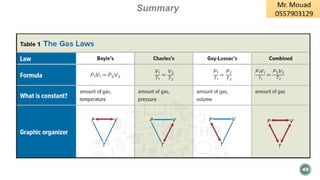
Summary
EoT3 Chemistry Coverage
Grade 10 Adv
Part-2
Q10 to Q25
2024-2025 Mr. Mouad ‫معاذ‬ ‫استاذ‬
0557903129
54
Avogadro’s Principle
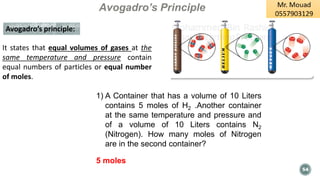
Avogadro’s principle:
It states that equal volumes of gases at the
same temperature and pressure contain
equal numbers of particles or equal number
of moles.
1) A Container that has a volume of 10 Liters
contains 5 moles of H2 .Another container
at the same temperature and pressure and
of a volume of 10 Liters contains N2
(Nitrogen). How many moles of Nitrogen
are in the second container?
5 moles
55
The Molar Volume of gases
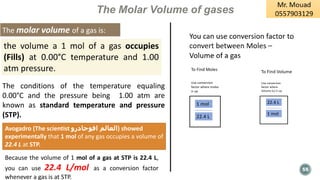
The molar volume of a gas is:
The conditions of the temperature equaling
0.00°C and the pressure being 1.00 atm are
known as standard temperature and pressure
(STP).
Avogadro (The scientist ‫افوجادرو‬ ‫)العالم‬ showed
experimentally that 1 mol of any gas occupies a volume of
22.4 L at STP.
the volume a 1 mol of a gas occupies
(Fills) at 0.00°C temperature and 1.00
atm pressure.
Because the volume of 1 mol of a gas at STP is 22.4 L,
you can use 22.4 L/mol as a conversion factor
whenever a gas is at STP.
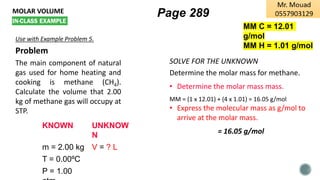
MOLAR VOLUME
Use with Example Problem 5.
Problem
The main component of natural
gas used for home heating and
cooking is methane (CH4).
Calculate the volume that 2.00
kg of methane gas will occupy at
STP.
KNOWN UNKNOW
N
m = 2.00 kg V = ? L
T = 0.00ºC
P = 1.00
SOLVE FOR THE UNKNOWN
Determine the molar mass for methane.
• Determine the molar mass mass.
MM = (1 x 12.01) + (4 x 1.01) = 16.05 g/mol
• Express the molecular mass as g/mol to
arrive at the molar mass.
= 16.05 g/mol
Page 289
MM C = 12.01
g/mol
MM H = 1.01 g/mol
MOLAR VOLUME
SOLVE FOR THE UNKNOWN (continued)
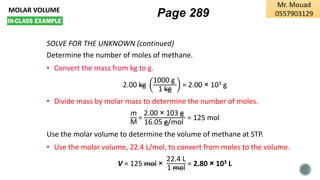
Determine the number of moles of methane.
• Convert the mass from kg to g.
2.00 kg
1000 g
1 kg
= 2.00 × 10³ g
• Divide mass by molar mass to determine the number of moles.
m
M
=
2.00 × 10³ g
16.05 g/mol
= 125 mol
Use the molar volume to determine the volume of methane at STP.
• Use the molar volume, 22.4 L/mol, to convert from moles to the volume.
V = 125 mol ×
22.4 L
1 mol
= 2.80 × 10³ L
Page 289
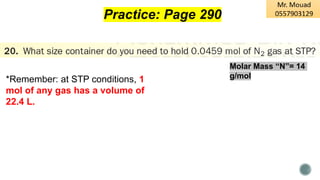
Practice: Page 290
*Remember: at STP conditions, 1
mol of any gas has a volume of
22.4 L.
Molar Mass “N”= 14
g/mol
64
64
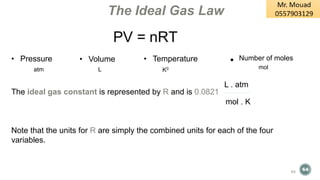
The Ideal Gas Law
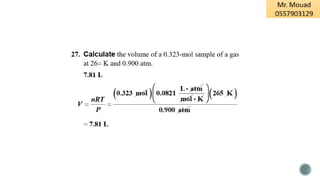
The ideal gas constant is represented by R and is 0.0821
L . atm
mol . K
Note that the units for R are simply the combined units for each of the four
variables.
• Pressure • Volume • Temperature • Number of moles
K0
L
atm mol
65
65
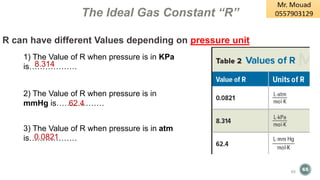
R can have different Values depending on pressure unit
1) The Value of R when pressure is in KPa
is………………
2) The Value of R when pressure is in
mmHg is………………
3) The Value of R when pressure is in atm
is………………
8.314
0.0821
62.4
The Ideal Gas Constant “R”
66
66
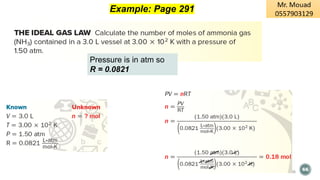
Pressure is in atm so
R = 0.0821
Example: Page 291
67
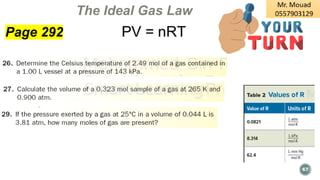
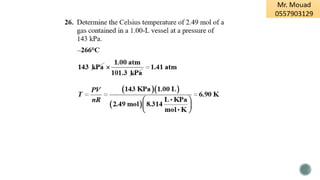
The Ideal Gas Law
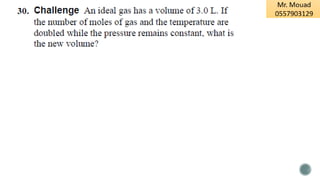
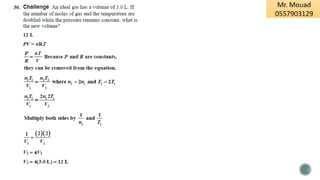
Page 292
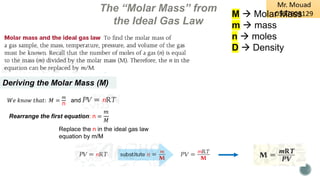
The “Molar Mass” from
the Ideal Gas Law
𝑊𝑒 𝑘𝑛𝑜𝑤 𝑡ℎ𝑎𝑡: 𝑀 =
𝑚
n
and
Deriving the Molar Mass (M)
Rearrange the first equation: n =
𝑚
𝑀
Replace the n in the ideal gas law
equation by m/M
M → Molar Mass
m → mass
n → moles
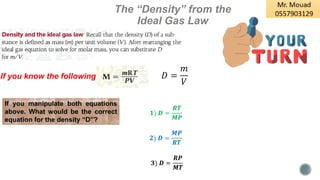
D → Density
The “Density” from the
Ideal Gas Law
If you know the following: 𝐷 =
𝑚
𝑉
If you manipulate both equations
above. What would be the correct
equation for the density “D”?
𝟐) 𝑫 =
𝑴𝑷
𝑹𝑻
𝟏) 𝑫 =
𝑹𝑻
𝑴𝑷
𝟑) 𝑫 =
𝑹𝑷
𝑴𝑻
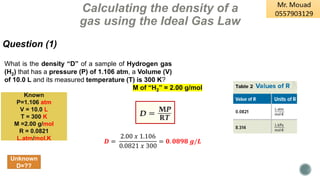
Calculating the density of a
gas using the Ideal Gas Law
Question (1)
M of “H2” = 2.00 g/mol
What is the density “D” of a sample of Hydrogen gas
(H2) that has a pressure (P) of 1.106 atm, a Volume (V)
of 10.0 L and its measured temperature (T) is 300 K?
𝑫 =
2.00 𝑥 1.106
0.0821 𝑥 300
= 𝟎. 𝟎𝟖𝟗𝟖 𝒈/𝑳
Known
P=1.106 atm
V = 10.0 L
T = 300 K
M =2.00 g/mol
R = 0.0821
L.atm/mol.K
Unknown
D=??
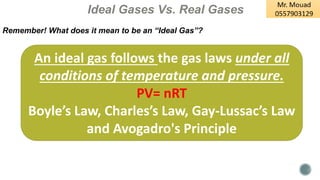
Ideal Gases Vs. Real Gases
Remember! What does it mean to be an “Ideal Gas”?
An ideal gas follows the gas laws under all
conditions of temperature and pressure.
PV= nRT
Boyle’s Law, Charles’s Law, Gay-Lussac’s Law
and Avogadro's Principle
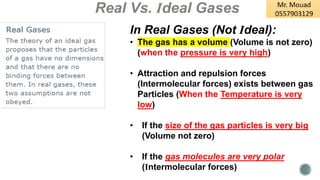
Real Vs. Ideal Gases
In Real Gases (Not Ideal):
• The gas has a volume (Volume is not zero)
(when the pressure is very high)
• Attraction and repulsion forces
(Intermolecular forces) exists between gas
Particles (When the Temperature is very
low)
• If the size of the gas particles is very big
(Volume not zero)
• If the gas molecules are very polar
(Intermolecular forces)
The nature of the particles making up a gas also affects how ideally
the gas behaves. For example, polar gas molecules, such as water
vapor, generally have larger attractive forces between their particles
than nonpolar gases, such as helium. The oppositely charged ends of
polar molecules are pulled together through electrostatic forces, as
shown in Figure 13.9.
Therefore, polar gases do not behave as ideal gases. Also, the
particles of gases composed of larger nonpolar molecules, such as
butane ( C 4 H 10 ), occupy more actual volume than an equal number
of smaller gas particles in gases such as
helium (He).
Therefore, larger gas particles tend to exhibit a greater
departure from ideal behavior than do smaller gas particles.
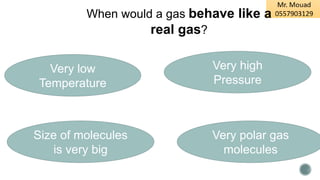
When would a gas behave like a
real gas?
Very low
Temperature
Very high
Pressure
Size of molecules
is very big
Very polar gas
molecules
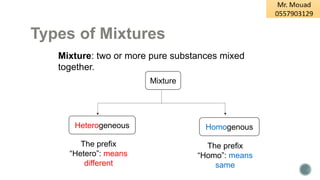
Types of Mixtures
Mixture: two or more pure substances mixed
together.
Mixture
Homogenous
Heterogeneous
The prefix
“Hetero”: means
different
The prefix
“Homo”: means
same
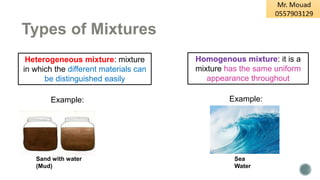
Types of Mixtures
Heterogeneous mixture: mixture
in which the different materials can
be distinguished easily
Example:
Homogenous mixture: it is a
mixture has the same uniform
appearance throughout
Example:
Sea
Water
Sand with water
(Mud)
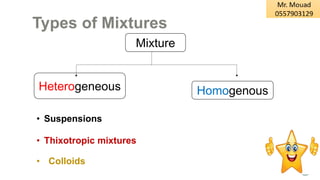
Types of Mixtures
Mixture
Homogenous
Heterogeneous
• Suspensions
• Thixotropic mixtures
• Colloids
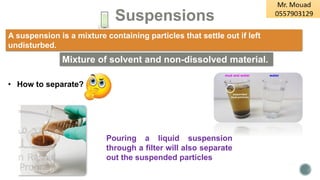
Suspensions
Pouring a liquid suspension
through a filter will also separate
out the suspended particles
• How to separate?
A suspension is a mixture containing particles that settle out if left
undisturbed.
Mixture of solvent and non-dissolved material.
Thixotropic
Mixtures
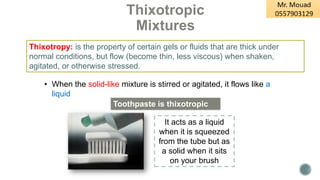
• When the solid-like mixture is stirred or agitated, it flows like a
liquid
Thixotropy: is the property of certain gels or fluids that are thick under
normal conditions, but flow (become thin, less viscous) when shaken,
agitated, or otherwise stressed.
Toothpaste is thixotropic
It acts as a liquid
when it is squeezed
from the tube but as
a solid when it sits
on your brush
Thixotropy mixtures:
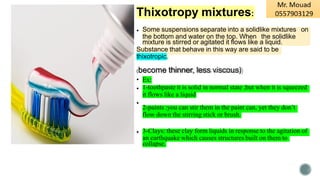
• Some suspensions separate into a solidlike mixtures on
the bottom and water on the top. When the solidlike
mixture is stirred or agitated it flows like a liquid.
Substance that behave in this way are said to be
thixotropic.
(become thinner, less viscous)
• Ex:
• 1-toothpaste it is solid in normal state ,but when it is squeezed
it flows like a liquid
•
2-paints :you can stir them in the paint can, yet they don’t
flow down the stirring stick or brush.
• 3-Clays: these clay form liquids in response to the agitation of
an earthquake which causes structures built on them to
collapse.
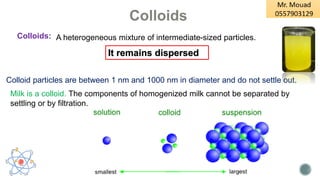
A heterogeneous mixture of intermediate-sized particles.
Colloids:
Colloid particles are between 1 nm and 1000 nm in diameter and do not settle out.
It remains dispersed
Colloids
Milk is a colloid. The components of homogenized milk cannot be separated by
settling or by filtration.
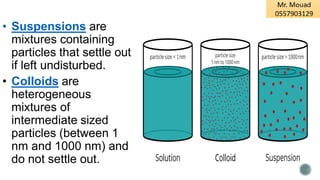
• Suspensions are
mixtures containing
particles that settle out
if left undisturbed.
• Colloids are
heterogeneous
mixtures of
intermediate sized
particles (between 1
nm and 1000 nm) and
do not settle out.
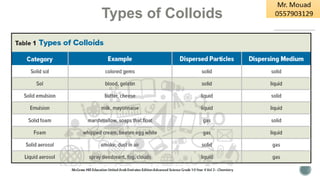
Types of Colloids
It remains dispersed
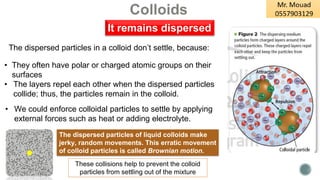
Colloids
The dispersed particles in a colloid don’t settle, because:
• They often have polar or charged atomic groups on their
surfaces
• The layers repel each other when the dispersed particles
collide; thus, the particles remain in the colloid.
• We could enforce colloidal particles to settle by applying
external forces such as heat or adding electrolyte.
The dispersed particles of liquid colloids make
jerky, random movements. This erratic movement
of colloid particles is called Brownian motion.
These collisions help to prevent the colloid
particles from settling out of the mixture
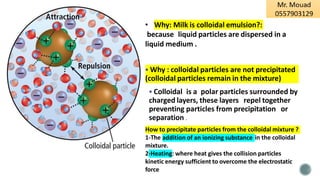
▪ Why : colloidal particles are not precipitated
(colloidal particles remain in the mixture)
▪ Colloidal is a polar particles surrounded by
charged layers, these layers repel together
preventing particles from precipitation or
separation .
How to precipitate particles from the colloidal mixture ?
addition of an ionizing substance
1-The in the colloidal
mixture.
2-Heating: where heat gives the collision particles
kinetic energy sufficient to overcome the electrostatic
force
• Why: Milk is colloidal emulsion?:
because liquid particles are dispersed in a
liquid medium .
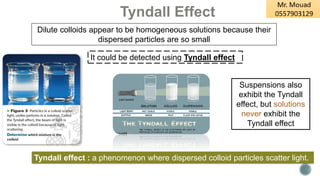
Tyndall Effect
Suspensions also
exhibit the Tyndall
effect, but solutions
never exhibit the
Tyndall effect
Dilute colloids appear to be homogeneous solutions because their
dispersed particles are so small
Tyndall effect : a phenomenon where dispersed colloid particles scatter light.
It could be detected using Tyndall effect
Homogeneous
Mixtures
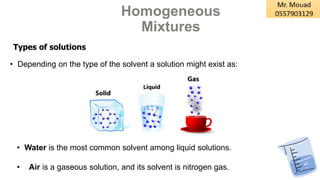
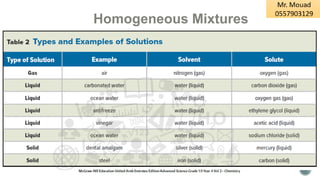
Types of solutions
• Air is a gaseous solution, and its solvent is nitrogen gas.
• Water is the most common solvent among liquid solutions.
• Depending on the type of the solvent a solution might exist as:
Homogeneous Mixtures
Forming Solutions
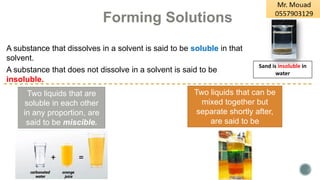
A substance that dissolves in a solvent is said to be soluble in that
solvent.
Two liquids that are
soluble in each other
in any proportion, are
said to be miscible.
A substance that does not dissolve in a solvent is said to be
insoluble.
Sand is insoluble in
water
Two liquids that can be
mixed together but
separate shortly after,
are said to be
immiscible.
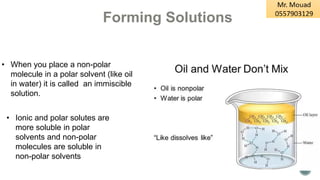
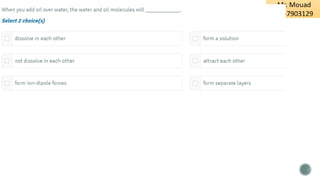
• When you place a non-polar
molecule in a polar solvent (like oil
in water) it is called an immiscible
solution.
• Ionic and polar solutes are
more soluble in polar
solvents and non-polar
molecules are soluble in
non-polar solvents
Forming Solutions
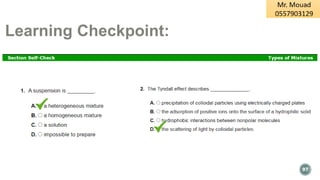
Learning Checkpoint:
97
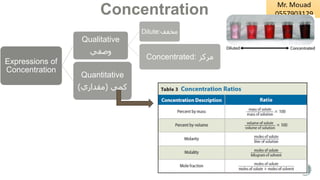
Concentration
Expressions of
Concentration
Qualitative
‫وصفي‬
Dilute:‫مخفف‬
Concentrated: ‫مركز‬
Quantitative
‫كمي‬
(
‫مقداري‬
)
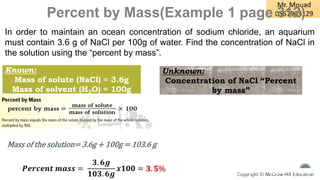
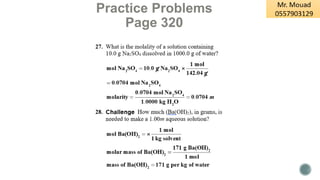
Percent by Mass(Example 1 page 312)
In order to maintain an ocean concentration of sodium chloride, an aquarium
must contain 3.6 g of NaCl per 100g of water. Find the concentration of NaCl in
the solution using the “percent by mass”.
Mass of the solution= 3.6g + 100g = 103.6 g
𝑷𝒆𝒓𝒄𝒆𝒏𝒕 𝒎𝒂𝒔𝒔 =
𝟑. 𝟔𝒈
𝟏𝟎𝟑. 𝟔𝒈
𝒙𝟏𝟎𝟎 = 𝟑. 𝟓%
Known:
Mass of solute (NaCl) = 3.6g
Mass of solvent (H2O) = 100g
Unknown:
Concentration of NaCl “Percent
by mass”
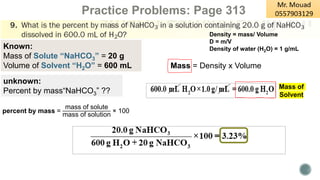
Practice Problems: Page 313
Density = mass/ Volume
D = m/V
Density of water (H2O) = 1 g/mL
Known:
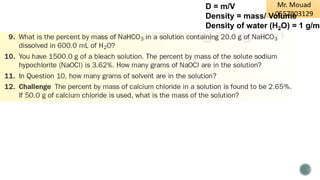
Mass of Solute “NaHCO3” = 20 g
Volume of Solvent “H2O” = 600 mL
unknown:
Percent by mass“NaHCO3” ??
Mass = Density x Volume
percent by mass =
mass of solute
mass of solution
× 100
Mass of
Solvent
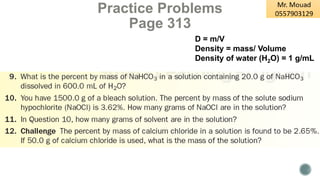
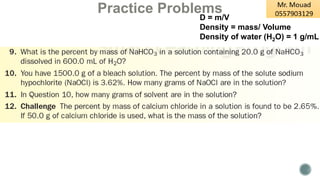
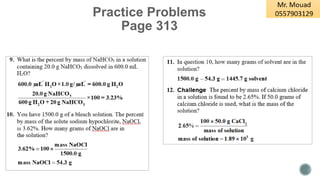
Practice Problems
Page 313
D = m/V
Density = mass/ Volume
Density of water (H2O) = 1 g/mL
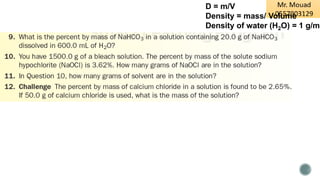
D = m/V
Density = mass/ Volume
Density of water (H2O) = 1 g/mL
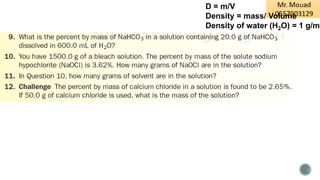
D = m/V
Density = mass/ Volume
Density of water (H2O) = 1 g/mL
D = m/V
Density = mass/ Volume
Density of water (H2O) = 1 g/mL
Practice Problems
D = m/V
Density = mass/ Volume
Density of water (H2O) = 1 g/mL
Practice Problems
Page 313
Molarity
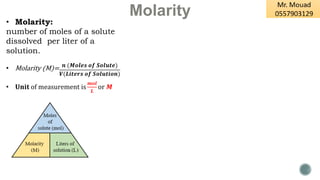
• Molarity:
number of moles of a solute
dissolved per liter of a
solution.
• Molarity (M)=
• 𝐔𝐧𝐢𝐭 of measurement is
𝒎𝒐𝒍
𝑳
or 𝑴
𝒏 (𝑴𝒐𝒍𝒆𝒔 𝒐𝒇 𝑺𝒐𝒍𝒖𝒕𝒆)
𝑽(𝑳𝒊𝒕𝒆𝒓𝒔 𝒐𝒇 𝑺𝒐𝒍𝒖𝒕𝒊𝒐𝒏)
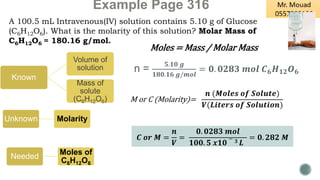
Example Page 316
A 100.5 mL Intravenous(IV) solution contains 5.10 g of Glucose
(C6H12O6). What is the molarity of this solution? Molar Mass of
C6H12O6 = 180.16 g/mol.
Unknown Molarity
Known
Volume of
solution
Mass of
solute
(C6H12O6) M or C (Molarity)=
𝒏 (𝑴𝒐𝒍𝒆𝒔 𝒐𝒇 𝑺𝒐𝒍𝒖𝒕𝒆)
𝑽(𝑳𝒊𝒕𝒆𝒓𝒔 𝒐𝒇 𝑺𝒐𝒍𝒖𝒕𝒊𝒐𝒏)
Moles = Mass / Molar Mass
Needed
Moles of
C6H12O6
n =
𝟓.𝟏𝟎 𝒈
𝟏𝟖𝟎.𝟏𝟔 𝒈/𝒎𝒐𝒍
= 𝟎. 𝟎𝟐𝟖𝟑 𝒎𝒐𝒍 𝑪𝟔𝑯𝟏𝟐𝑶𝟔
𝑪 𝒐𝒓 𝑴 =
𝒏
𝑽
=
𝟎. 𝟎𝟐𝟖𝟑 𝒎𝒐𝒍
𝟏𝟎𝟎. 𝟓 𝒙𝟏𝟎
− 𝟑 𝑳
= 𝟎. 𝟐𝟖𝟐 𝑴
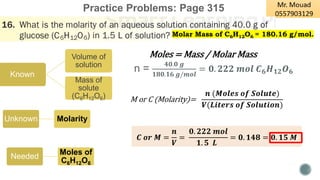
Practice Problems: Page 315
Unknown Molarity
Known
Volume of
solution
Mass of
solute
(C6H12O6) M or C (Molarity)=
𝒏 (𝑴𝒐𝒍𝒆𝒔 𝒐𝒇 𝑺𝒐𝒍𝒖𝒕𝒆)
𝑽(𝑳𝒊𝒕𝒆𝒓𝒔 𝒐𝒇 𝑺𝒐𝒍𝒖𝒕𝒊𝒐𝒏)
Moles = Mass / Molar Mass
Needed
Moles of
C6H12O6
𝑪 𝒐𝒓 𝑴 =
𝒏
𝑽
=
𝟎. 𝟐𝟐𝟐 𝒎𝒐𝒍
𝟏. 𝟓 𝑳
= 𝟎. 𝟏𝟒𝟖 = 𝟎. 𝟏𝟓 𝑴
n =
𝟒𝟎.𝟎 𝒈
𝟏𝟖𝟎.𝟏𝟔 𝒈/𝒎𝒐𝒍
= 𝟎. 𝟐𝟐𝟐 𝒎𝒐𝒍 𝑪𝟔𝑯𝟏𝟐𝑶𝟔
Molar Mass of C6H12O6 = 180.16 g/mol.
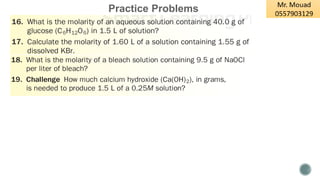
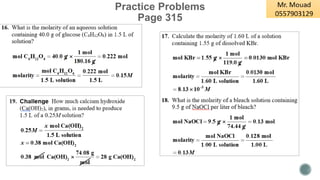
Practice Problems
Page 315
Practice Problems
Page 315
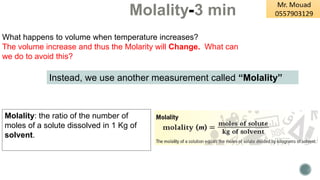
Molality-3 min
Molality: the ratio of the number of
moles of a solute dissolved in 1 Kg of
solvent.
What happens to volume when temperature increases?
The volume increase and thus the Molarity will Change. What can
we do to avoid this?
Instead, we use another measurement called “Molality”
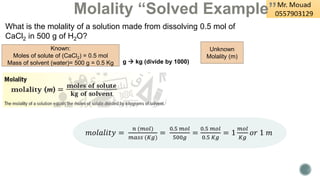
Molality “Solved Example”
What is the molality of a solution made from dissolving 0.5 mol of
CaCl2 in 500 g of H2O?
Known:
Moles of solute of (CaCl2) = 0.5 mol
Mass of solvent (water)= 500 g = 0.5 Kg
Unknown
Molality (m)
𝑚𝑜𝑙𝑎𝑙𝑖𝑡𝑦 =
𝑛 (𝑚𝑜𝑙)
𝑚𝑎𝑠𝑠 (𝐾𝑔)
=
0.5 𝑚𝑜𝑙
500𝑔
=
0.5 𝑚𝑜𝑙
0.5 𝐾𝑔
= 1
𝑚𝑜𝑙
𝐾𝑔
𝑜𝑟 1 𝑚
g → kg (divide by 1000)
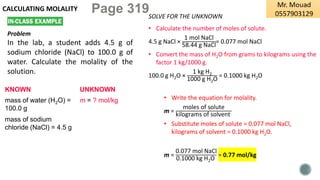
CALCULATING MOLALITY
Problem
In the lab, a student adds 4.5 g of
sodium chloride (NaCl) to 100.0 g of
water. Calculate the molality of the
solution.
KNOWN UNKNOWN
mass of water (H2O) =
100.0 g
m = ? mol/kg
mass of sodium
chloride (NaCl) = 4.5 g
SOLVE FOR THE UNKNOWN
• Calculate the number of moles of solute.
4.5 g NaCl ×
1 mol NaCl
58.44 g NaCl
= 0.077 mol NaCl
• Convert the mass of H2O from grams to kilograms using the
factor 1 kg/1000 g.
100.0 g H2O ×
1 kg H2
1000 g H2O
= 0.1000 kg H2O
• Write the equation for molality.
m =
moles of solute
kilograms of solvent
• Substitute moles of solute = 0.077 mol NaCl,
kilograms of solvent = 0.1000 kg H2O.
m =
0.077 mol NaCl
0.1000 kg H2O
= 0.77 mol/kg
Page 319
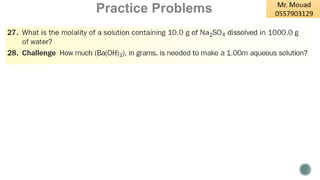
Practice Problems
Practice Problems
Page 320
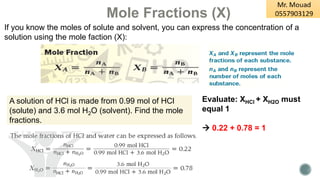
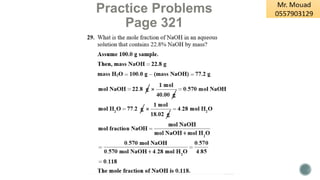
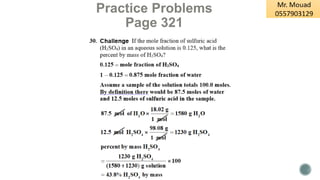
Mole Fractions (X)
If you know the moles of solute and solvent, you can express the concentration of a
solution using the mole faction (X):
A solution of HCl is made from 0.99 mol of HCl
(solute) and 3.6 mol H2O (solvent). Find the mole
fractions.
Evaluate: XHCl + XH2O must
equal 1
→ 0.22 + 0.78 = 1
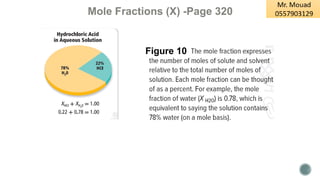
Figure 10
Mole Fractions (X) -Page 320
Practice Problems
Page 321
Practice Problems
Page 321
Practice Problems
Page 321
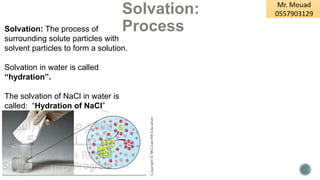
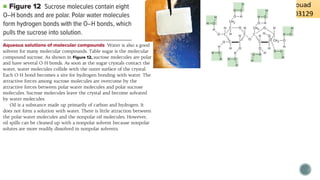
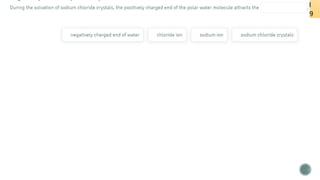
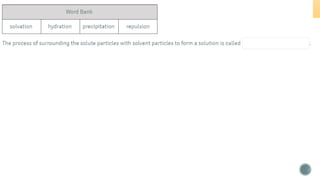
Solvation:
Process
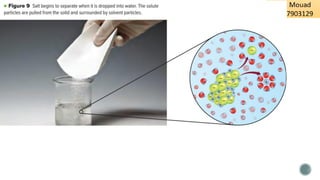
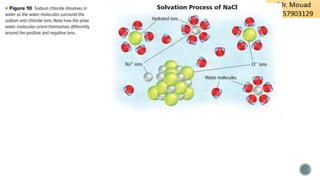
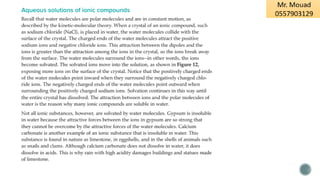
Solvation: The process of
surrounding solute particles with
solvent particles to form a solution.
Solvation in water is called
“hydration”.
The solvation of NaCl in water is
called: “Hydration of NaCl”
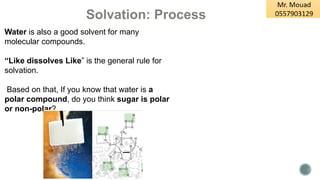
Solvation: Process
Water is also a good solvent for many
molecular compounds.
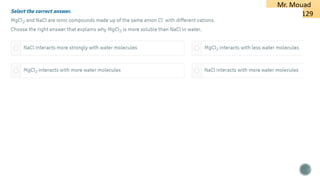
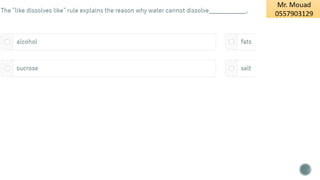
“Like dissolves Like” is the general rule for
solvation.
Based on that, If you know that water is a
polar compound, do you think sugar is polar
or non-polar?
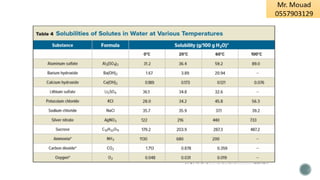
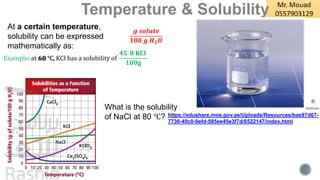
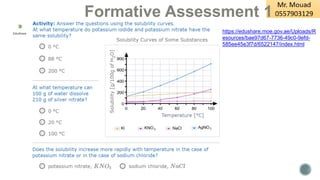
Temperature & Solubility
At a certain temperature,
solubility can be expressed
mathematically as:
Example: at 𝟔𝟎 ℃, KCl has a solubility of
𝟒𝟓. 𝟖 𝐊𝐂𝐥
𝟏𝟎𝟎𝐠
What is the solubility
of NaCl at 80 ℃?
𝒈 𝒔𝒐𝒍𝒖𝒕𝒆
𝟏𝟎𝟎 𝒈 𝑯𝟐𝑶
https://edushare.moe.gov.ae/Uploads/Resources/bae97d67-
7736-49c0-9efd-585ee45e3f7d/6522147/index.html
Formative Assessment 1
https://edushare.moe.gov.ae/Uploads/R
esources/bae97d67-7736-49c0-9efd-
585ee45e3f7d/6522147/index.html
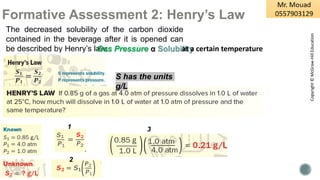
Formative Assessment 2: Henry’s Law
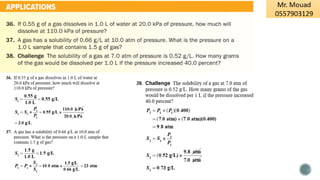
The decreased solubility of the carbon dioxide
contained in the beverage after it is opened can
be described by Henry’s law:
Gas Pressure α Solubility
at a certain temperature
S has the units
g/L
1
2
3
Copyright
©
McGraw-Hill
Education
The End
With my best wishes Dear Students
☺

Eot chem.pdf for grade 10 advanced:)))))

  • 1.
    EoT3 Chemistry Coverage Grade10 Adv 2024-2025 Mr. Mouad ‫معاذ‬ ‫استاذ‬ 0557903129
  • 2.
    EoT3 Chemistry Coverage Grade10 Adv Part-1 Q1 to Q9 2024-2025 Mr. Mouad ‫معاذ‬ ‫استاذ‬ 0557903129
  • 4.
    Assumption = ‫فرضية‬ Collision=‫تصادم‬ Elastic = ‫مرن‬ Consist = ‫تتكون‬ Particle Size (‫الجسيمات‬ ‫)حجم‬ • Gases consist of small particles separated from one another by empty space. • Because gas particles are far apart, they experience no significant attractive or repulsive forces. Particle Motion (‫الجسيمات‬ ‫)حركة‬ • Gas particles are in constant, random motion. • Collisions between gas particles are elastic. • An elastic collision is one in which no kinetic energy is lost. The Kinetic-Molecular Theory ‫الجزيئية‬ ‫الحركية‬ ‫النظرية‬ 5 assumptions of the theory
  • 5.
    The Kinetic-Molecular Theory ParticleEnergy • Kinetic energy “KE” of a particle depends on mass and velocity. • KE is kinetic energy, m is the mass of the particle, and ⱱ is its velocity. • Temperature is a measure of the average kinetic energy of the particles in a sample of matter.
  • 6.
    B Quiz Mass and velocitydetermine kinetic energy. D There are significant attractive forces between particles in gases. C Gas particles are in constant, random motion. Gases consist of small particles separated from each other by empty space. A Which of the following is NOT an assumption of the kinetic-molecular theory? CORRECT
  • 7.
    Quiz Which of thefollowing is an assumption of the kinetic-molecular theory? 4- The Kinetic Energy doesn’t depend on the mass and velocity. 3- There are significant attractive forces between particles in gases. 2- Gas particles are in constant, random motion. 1- Gases consist of big particles separated from each other by empty space.
  • 8.
    Between collisions, the particlesmove in straight lines
  • 9.
    Explaining the Behaviorof Gases Gases have low density. The density of Chlorine gas (Cl2) is 2.95 x10⁻³ g/ml The density of solid gold (Au) is 19.3 g/ml The density of Gold is around 6000 times bigger. Why? As the kinetic-molecular theory states, a great deal of space exists between gas particles. Thus, there are fewer chlorine molecules than gold atoms in the same volume. Density = Mass/Volume
  • 10.
    Continue: Explaining theBehavior of Gases Compression and Expansion (‫والتمدد‬ ‫)االنكماش‬ • In a closed container, compression and expansion change the volume occupied by a constant mass of particles. Relate the change in volume to the density of the gas particles in each cylinder.
  • 11.
    Explaining the Behaviorof Gases Diffusion and Effusion • Gases easily flow past each other because there are no significant forces of attraction. • Diffusion is the movement of one material through another. • Effusion is a gas escaping through a tiny opening.
  • 12.
    Explaining the Behaviorof Gases • Graham’s law of effusion states that the rate of effusion for a gas is inversely proportional to the square root of its molar mass. A and B refer to Gas (A) and Gas (B) • Graham’s law also applies to diffusion.
  • 13.
    GRAHAM’S LAW Use withExample Problem 1. Problem Ammonia has a molar mass of 17.0 g/mol; hydrogen chloride has a molar mass of 36.5 g/mol. What is the ratio of their diffusion rates? KNOWN UNKNOWN molar massHCl = 36.5 g/mol ratio of diffusion rates = ? molar massNH3 = 17.0 g/mol SOLVE FOR THE UNKNOWN • State the ratio derived from Graham’s law. RateNH3 RateHCl = molar massHCl molar massNH3 • Substitute molar massHCl = 36.5 g/mol and molar massNH3 = 17.0 g/mol. 36.5 g/mol 17.0 g/mol = 1.47 The ratio of diffusion rates is 1.47. Page 244: Example 1 Ammonia (NH3) gas is 1.47 times faster than HCl gas.
  • 14.
    N = 14g/mol Ne = 20.2 g/mol C = 12 g/mol O = 16 g/mol
  • 15.
    N = 14g/mol Ne = 20.2 g/mol C = 12 g/mol O = 16 g/mol
  • 17.
    17 1 atm =760 mmHg = 760 torr = 101.3 KPa = 14.7 psi = 1.01 bar
  • 18.
    1 atm =760 mmHg = 760 torr = 101.3 KPa = 14.7 psi = 1.01 bar
  • 19.
    Gas Pressure Partial pressurecan be used to calculate the amount of gas produced in a chemical reaction. Ptotal = P1 + P2 + P3 +...Pn
  • 20.
  • 21.
  • 22.
  • 24.
    24 1 atm =760 mmHg = 760 torr = 101.3 KPa = 14.7 psi = 1.01 bar
  • 26.
    Boyle’s Law: There isan inverse relationship between Pressure and Volume when the temperature is constant. If the pressure goes down, the volume goes up, and vice versa
  • 27.
    Boyle’s Law Both theamount of gas and its Temperature must be constant.
  • 28.
    BOYLE’S LAW Use withExample Problem 1. Problem A diver blows a 0.75-L air bubble 10 m under water. As it rises to the surface, the pressure goes from 2.25 atm to 1.03 atm. What will be the volume of air in the bubble at the surface? KNOWN UNKNOWN V1 = 0.75 L V2 = ? L P1 = 2.25 atm P2 = 1.03 atm SOLVE FOR THE UNKNOWN Use Boyle’s law. Solve for V2 , and calculate the new volume. • State Boyle’s law. P1V1 = P2V2 • Solve for V2. V2 = V1 P1 P2 • Substitute V1 = 0.75 L, P1 = 2.25 atm, and P2 = 1.03 atm. V2 = 0.75 L 2.25 atm 1.03 atm • Multiply and divide numbers and units. V2 = 0.75 L 2.25 atm 1.03 atm =1.6 L Page 279
  • 29.
  • 32.
    There is aninverse relationship between Pressure and Volume when the temperature is constant. If the pressure is constant, what will be the relationship between temperature and volume?
  • 33.
    Charles’s Law How Temperatureand Volume are Related • As temperature increases, so does the volume of a gas sample when the amount of gas and pressure remain constant.
  • 34.
    Charles’s Law Graphing Temperatureand Volume • A temperature of 0 K corresponds to 0 mL. Doubling temperature doubles volume. • Absolute zero is zero on the Kelvin scale. Note: the Temperature is in Kelvin “K” not Celsius °C
  • 35.
    Using Charles’s law Note:the Temperature is in Kelvin “K” not Celsius °C Both the amount of gas and its pressure must be constant.
  • 36.
    CHARLES’S LAW Use withExample Problem 2. Problem A helium balloon in a closed car occupies a volume of 2.32 L at 40.0°C. If the car is parked on a hot day and the temperature inside rises to 75.0°C, what is the new volume of the balloon, assuming the pressure remains constant? KNOWN UNKNOWN T1 = 40.0°C V2 = ? L V1 = 2.32 L T2 = 75.0°C SOLVE FOR THE UNKNOWN Convert degrees Celsius to kelvins. • Apply the conversion factor. TK = 273 + TC • Substitute T1 = 40.0°C. T 1 = 273 + 40.0°C = 313.0 K • Substitute T2 = 75.0°C. T2 = 273 + 75.0°C = 348.0 K Page 282
  • 37.
    CHARLES’S LAW Use withExample Problem 2. SOLVE FOR THE UNKNOWN (continued) Use Charles’s law. Solve for V2, and substitute the known values into the rearranged equation. • State Charles’s law. V1 T1 = V2 T2 • Solve for V2 V2 = V1 T2 T1 • Substitute V1 = 2.32 L, T 1 = 313.0 K, and T2 = 348.0 K. V2 = 2.32 L 348.0 K 313.0 K • Multiply and divide numbers and units. V2 = 2.32 L 348.0 K 313.0 K = 2.58 L
  • 40.
    Gay-Lussac’s Law How Temperatureand Pressure of a Gas are Related • Gay-Lussac’s law states that the pressure of a fixed amount of gas varies directly with the Kelvin temperature when the volume remains constant. Note: The volume must be fixed “Not changing”
  • 41.
    Gay-Lussac’s Law When thevolume is fixed, the pressure and temperature of a fixed amount of a gas will have a direct relationship.
  • 42.
    GAY-LUSSAC’S LAW Use withExample Problem 3. Problem The pressure of the oxygen gas inside a canister is 5.00 atm at 25.0°C. The canister is located at a camp high on Mount Everest. If the temperature there falls to -10.0°C, what is the new pressure inside the canister? KNOWN UNKNOWN P1 = 5.00 atm P2 = ? atm T1 = 25.0°C T2 = -10.0°C SOLVE FOR THE UNKNOWN Convert degrees Celsius to kelvins. • Apply the conversion factor. TK = 273 + TC • Substitute T1 = 25.0°C. T1 = 273 + 25.0°C = 298.0 K • Substitute T2 = -10.0°C. T2 = 273 + (-10.0°C) = 263.0 K Page 284
  • 43.
    GAY-LUSSAC’S LAW Use withExample Problem 3. SOLVE FOR THE UNKNOWN (continued) Use Gay-Lussac’s law. Solve for P2, and substitute the known values into the rearranged equation. • State Gay-Lussac’s law. P1 T1 = P2 T2 • Solve for P2 P2 = P1 T2 T1 • Substitute P1 =5.00 atm, T1 = 298.0 K, and T2 = 263.0 K. P2 = 5.00 atm 263.0 K 298.0 K • Multiply and divide numbers and units. P2 = 5.00 atm 263.0 K 298.0 K = 4.41 atm Page 284
  • 46.
    The Combined GasLaw • The combined gas law states the relationship among pressure, temperature, and volume of a fixed amount of gas. • For a given amount of gas, the product of pressure and volume, divided by the Kelvin temperature, is a constant. The gas amount must be fixed (doesn’t change)
  • 47.
    THE COMBINED GASLAW Use with Example Problem 4. Problem A gas at 110 kPa and 30.0°C fills a flexible container with an initial volume of 2.00 L. If the temperature is raised to 80.0°C and the pressure increases to 440 kPa, what is the new volume? KNOWN UNKNOWN P1 = 110 kPa V2 = ? L P2 = 440 kPa T1 = 30.0ºC T2 = 80.0ºC V1 = 2.00 L SOLVE FOR THE UNKNOWN Convert degrees Celsius to kelvins. Apply the conversion factor. TK = 273 + TC • Substitute T1 = 30.0°C. T1 = 273 + 30.0°C = 303.0 K • Substitute T2 = 80.0°C. T2 = 273 + 80.0°C = 353.0 K Page 286
  • 48.
    THE COMBINED GASLAW Use with Example Problem 4. SOLVE FOR THE UNKNOWN (continued) Use the combined gas law. Solve for V2, and substitute the known values into the rearranged equation. • State the combined gas law. P1V1 T1 = P2 V2 T2 • Solve for V2 . V2 = V1 P1 P2 T2 T1 • Substitute V1 = 2.00 L, P1 = 110 kPa, P2 = 440 kPa, T 2 = 353.0 K, and T1 = 303.0 K. V2 = 2.00 L 110 kPa 440 kPa 353.0 K 303.0 K • Multiply and divide numbers and units. V2 = 2.00 L 110 kPa 440 kPa 353.0 K 303.0 K = 0.58 L
  • 49.
  • 52.
    EoT3 Chemistry Coverage Grade10 Adv Part-2 Q10 to Q25 2024-2025 Mr. Mouad ‫معاذ‬ ‫استاذ‬ 0557903129
  • 54.
    54 Avogadro’s Principle Avogadro’s principle: Itstates that equal volumes of gases at the same temperature and pressure contain equal numbers of particles or equal number of moles. 1) A Container that has a volume of 10 Liters contains 5 moles of H2 .Another container at the same temperature and pressure and of a volume of 10 Liters contains N2 (Nitrogen). How many moles of Nitrogen are in the second container? 5 moles
  • 55.
    55 The Molar Volumeof gases The molar volume of a gas is: The conditions of the temperature equaling 0.00°C and the pressure being 1.00 atm are known as standard temperature and pressure (STP). Avogadro (The scientist ‫افوجادرو‬ ‫)العالم‬ showed experimentally that 1 mol of any gas occupies a volume of 22.4 L at STP. the volume a 1 mol of a gas occupies (Fills) at 0.00°C temperature and 1.00 atm pressure. Because the volume of 1 mol of a gas at STP is 22.4 L, you can use 22.4 L/mol as a conversion factor whenever a gas is at STP.
  • 56.
    MOLAR VOLUME Use withExample Problem 5. Problem The main component of natural gas used for home heating and cooking is methane (CH4). Calculate the volume that 2.00 kg of methane gas will occupy at STP. KNOWN UNKNOW N m = 2.00 kg V = ? L T = 0.00ºC P = 1.00 SOLVE FOR THE UNKNOWN Determine the molar mass for methane. • Determine the molar mass mass. MM = (1 x 12.01) + (4 x 1.01) = 16.05 g/mol • Express the molecular mass as g/mol to arrive at the molar mass. = 16.05 g/mol Page 289 MM C = 12.01 g/mol MM H = 1.01 g/mol
  • 57.
    MOLAR VOLUME SOLVE FORTHE UNKNOWN (continued) Determine the number of moles of methane. • Convert the mass from kg to g. 2.00 kg 1000 g 1 kg = 2.00 × 10³ g • Divide mass by molar mass to determine the number of moles. m M = 2.00 × 10³ g 16.05 g/mol = 125 mol Use the molar volume to determine the volume of methane at STP. • Use the molar volume, 22.4 L/mol, to convert from moles to the volume. V = 125 mol × 22.4 L 1 mol = 2.80 × 10³ L Page 289
  • 58.
    Practice: Page 290 *Remember:at STP conditions, 1 mol of any gas has a volume of 22.4 L. Molar Mass “N”= 14 g/mol
  • 64.
    64 64 The Ideal GasLaw The ideal gas constant is represented by R and is 0.0821 L . atm mol . K Note that the units for R are simply the combined units for each of the four variables. • Pressure • Volume • Temperature • Number of moles K0 L atm mol
  • 65.
    65 65 R can havedifferent Values depending on pressure unit 1) The Value of R when pressure is in KPa is……………… 2) The Value of R when pressure is in mmHg is……………… 3) The Value of R when pressure is in atm is……………… 8.314 0.0821 62.4 The Ideal Gas Constant “R”
  • 66.
    66 66 Pressure is inatm so R = 0.0821 Example: Page 291
  • 67.
    67 The Ideal GasLaw Page 292
  • 72.
    The “Molar Mass”from the Ideal Gas Law 𝑊𝑒 𝑘𝑛𝑜𝑤 𝑡ℎ𝑎𝑡: 𝑀 = 𝑚 n and Deriving the Molar Mass (M) Rearrange the first equation: n = 𝑚 𝑀 Replace the n in the ideal gas law equation by m/M M → Molar Mass m → mass n → moles D → Density
  • 73.
    The “Density” fromthe Ideal Gas Law If you know the following: 𝐷 = 𝑚 𝑉 If you manipulate both equations above. What would be the correct equation for the density “D”? 𝟐) 𝑫 = 𝑴𝑷 𝑹𝑻 𝟏) 𝑫 = 𝑹𝑻 𝑴𝑷 𝟑) 𝑫 = 𝑹𝑷 𝑴𝑻
  • 74.
    Calculating the densityof a gas using the Ideal Gas Law Question (1) M of “H2” = 2.00 g/mol What is the density “D” of a sample of Hydrogen gas (H2) that has a pressure (P) of 1.106 atm, a Volume (V) of 10.0 L and its measured temperature (T) is 300 K? 𝑫 = 2.00 𝑥 1.106 0.0821 𝑥 300 = 𝟎. 𝟎𝟖𝟗𝟖 𝒈/𝑳 Known P=1.106 atm V = 10.0 L T = 300 K M =2.00 g/mol R = 0.0821 L.atm/mol.K Unknown D=??
  • 76.
    Ideal Gases Vs.Real Gases Remember! What does it mean to be an “Ideal Gas”? An ideal gas follows the gas laws under all conditions of temperature and pressure. PV= nRT Boyle’s Law, Charles’s Law, Gay-Lussac’s Law and Avogadro's Principle
  • 77.
    Real Vs. IdealGases In Real Gases (Not Ideal): • The gas has a volume (Volume is not zero) (when the pressure is very high) • Attraction and repulsion forces (Intermolecular forces) exists between gas Particles (When the Temperature is very low) • If the size of the gas particles is very big (Volume not zero) • If the gas molecules are very polar (Intermolecular forces)
  • 78.
    The nature ofthe particles making up a gas also affects how ideally the gas behaves. For example, polar gas molecules, such as water vapor, generally have larger attractive forces between their particles than nonpolar gases, such as helium. The oppositely charged ends of polar molecules are pulled together through electrostatic forces, as shown in Figure 13.9. Therefore, polar gases do not behave as ideal gases. Also, the particles of gases composed of larger nonpolar molecules, such as butane ( C 4 H 10 ), occupy more actual volume than an equal number of smaller gas particles in gases such as helium (He). Therefore, larger gas particles tend to exhibit a greater departure from ideal behavior than do smaller gas particles.
  • 79.
    When would agas behave like a real gas? Very low Temperature Very high Pressure Size of molecules is very big Very polar gas molecules
  • 81.
    Types of Mixtures Mixture:two or more pure substances mixed together. Mixture Homogenous Heterogeneous The prefix “Hetero”: means different The prefix “Homo”: means same
  • 82.
    Types of Mixtures Heterogeneousmixture: mixture in which the different materials can be distinguished easily Example: Homogenous mixture: it is a mixture has the same uniform appearance throughout Example: Sea Water Sand with water (Mud)
  • 83.
    Types of Mixtures Mixture Homogenous Heterogeneous •Suspensions • Thixotropic mixtures • Colloids
  • 84.
    Suspensions Pouring a liquidsuspension through a filter will also separate out the suspended particles • How to separate? A suspension is a mixture containing particles that settle out if left undisturbed. Mixture of solvent and non-dissolved material.
  • 85.
    Thixotropic Mixtures • When thesolid-like mixture is stirred or agitated, it flows like a liquid Thixotropy: is the property of certain gels or fluids that are thick under normal conditions, but flow (become thin, less viscous) when shaken, agitated, or otherwise stressed. Toothpaste is thixotropic It acts as a liquid when it is squeezed from the tube but as a solid when it sits on your brush
  • 86.
    Thixotropy mixtures: • Somesuspensions separate into a solidlike mixtures on the bottom and water on the top. When the solidlike mixture is stirred or agitated it flows like a liquid. Substance that behave in this way are said to be thixotropic. (become thinner, less viscous) • Ex: • 1-toothpaste it is solid in normal state ,but when it is squeezed it flows like a liquid • 2-paints :you can stir them in the paint can, yet they don’t flow down the stirring stick or brush. • 3-Clays: these clay form liquids in response to the agitation of an earthquake which causes structures built on them to collapse.
  • 87.
    A heterogeneous mixtureof intermediate-sized particles. Colloids: Colloid particles are between 1 nm and 1000 nm in diameter and do not settle out. It remains dispersed Colloids Milk is a colloid. The components of homogenized milk cannot be separated by settling or by filtration.
  • 88.
    • Suspensions are mixturescontaining particles that settle out if left undisturbed. • Colloids are heterogeneous mixtures of intermediate sized particles (between 1 nm and 1000 nm) and do not settle out.
  • 89.
  • 90.
    It remains dispersed Colloids Thedispersed particles in a colloid don’t settle, because: • They often have polar or charged atomic groups on their surfaces • The layers repel each other when the dispersed particles collide; thus, the particles remain in the colloid. • We could enforce colloidal particles to settle by applying external forces such as heat or adding electrolyte. The dispersed particles of liquid colloids make jerky, random movements. This erratic movement of colloid particles is called Brownian motion. These collisions help to prevent the colloid particles from settling out of the mixture
  • 91.
    ▪ Why :colloidal particles are not precipitated (colloidal particles remain in the mixture) ▪ Colloidal is a polar particles surrounded by charged layers, these layers repel together preventing particles from precipitation or separation . How to precipitate particles from the colloidal mixture ? addition of an ionizing substance 1-The in the colloidal mixture. 2-Heating: where heat gives the collision particles kinetic energy sufficient to overcome the electrostatic force • Why: Milk is colloidal emulsion?: because liquid particles are dispersed in a liquid medium .
  • 92.
    Tyndall Effect Suspensions also exhibitthe Tyndall effect, but solutions never exhibit the Tyndall effect Dilute colloids appear to be homogeneous solutions because their dispersed particles are so small Tyndall effect : a phenomenon where dispersed colloid particles scatter light. It could be detected using Tyndall effect
  • 93.
    Homogeneous Mixtures Types of solutions •Air is a gaseous solution, and its solvent is nitrogen gas. • Water is the most common solvent among liquid solutions. • Depending on the type of the solvent a solution might exist as:
  • 94.
  • 95.
    Forming Solutions A substancethat dissolves in a solvent is said to be soluble in that solvent. Two liquids that are soluble in each other in any proportion, are said to be miscible. A substance that does not dissolve in a solvent is said to be insoluble. Sand is insoluble in water Two liquids that can be mixed together but separate shortly after, are said to be immiscible.
  • 96.
    • When youplace a non-polar molecule in a polar solvent (like oil in water) it is called an immiscible solution. • Ionic and polar solutes are more soluble in polar solvents and non-polar molecules are soluble in non-polar solvents Forming Solutions
  • 97.
  • 99.
  • 100.
    Percent by Mass(Example1 page 312) In order to maintain an ocean concentration of sodium chloride, an aquarium must contain 3.6 g of NaCl per 100g of water. Find the concentration of NaCl in the solution using the “percent by mass”. Mass of the solution= 3.6g + 100g = 103.6 g 𝑷𝒆𝒓𝒄𝒆𝒏𝒕 𝒎𝒂𝒔𝒔 = 𝟑. 𝟔𝒈 𝟏𝟎𝟑. 𝟔𝒈 𝒙𝟏𝟎𝟎 = 𝟑. 𝟓% Known: Mass of solute (NaCl) = 3.6g Mass of solvent (H2O) = 100g Unknown: Concentration of NaCl “Percent by mass”
  • 101.
    Practice Problems: Page313 Density = mass/ Volume D = m/V Density of water (H2O) = 1 g/mL Known: Mass of Solute “NaHCO3” = 20 g Volume of Solvent “H2O” = 600 mL unknown: Percent by mass“NaHCO3” ?? Mass = Density x Volume percent by mass = mass of solute mass of solution × 100 Mass of Solvent
  • 102.
    Practice Problems Page 313 D= m/V Density = mass/ Volume Density of water (H2O) = 1 g/mL
  • 103.
    D = m/V Density= mass/ Volume Density of water (H2O) = 1 g/mL
  • 104.
    D = m/V Density= mass/ Volume Density of water (H2O) = 1 g/mL
  • 105.
    D = m/V Density= mass/ Volume Density of water (H2O) = 1 g/mL
  • 106.
    Practice Problems D =m/V Density = mass/ Volume Density of water (H2O) = 1 g/mL
  • 107.
  • 108.
    Molarity • Molarity: number ofmoles of a solute dissolved per liter of a solution. • Molarity (M)= • 𝐔𝐧𝐢𝐭 of measurement is 𝒎𝒐𝒍 𝑳 or 𝑴 𝒏 (𝑴𝒐𝒍𝒆𝒔 𝒐𝒇 𝑺𝒐𝒍𝒖𝒕𝒆) 𝑽(𝑳𝒊𝒕𝒆𝒓𝒔 𝒐𝒇 𝑺𝒐𝒍𝒖𝒕𝒊𝒐𝒏)
  • 109.
    Example Page 316 A100.5 mL Intravenous(IV) solution contains 5.10 g of Glucose (C6H12O6). What is the molarity of this solution? Molar Mass of C6H12O6 = 180.16 g/mol. Unknown Molarity Known Volume of solution Mass of solute (C6H12O6) M or C (Molarity)= 𝒏 (𝑴𝒐𝒍𝒆𝒔 𝒐𝒇 𝑺𝒐𝒍𝒖𝒕𝒆) 𝑽(𝑳𝒊𝒕𝒆𝒓𝒔 𝒐𝒇 𝑺𝒐𝒍𝒖𝒕𝒊𝒐𝒏) Moles = Mass / Molar Mass Needed Moles of C6H12O6 n = 𝟓.𝟏𝟎 𝒈 𝟏𝟖𝟎.𝟏𝟔 𝒈/𝒎𝒐𝒍 = 𝟎. 𝟎𝟐𝟖𝟑 𝒎𝒐𝒍 𝑪𝟔𝑯𝟏𝟐𝑶𝟔 𝑪 𝒐𝒓 𝑴 = 𝒏 𝑽 = 𝟎. 𝟎𝟐𝟖𝟑 𝒎𝒐𝒍 𝟏𝟎𝟎. 𝟓 𝒙𝟏𝟎 − 𝟑 𝑳 = 𝟎. 𝟐𝟖𝟐 𝑴
  • 110.
    Practice Problems: Page315 Unknown Molarity Known Volume of solution Mass of solute (C6H12O6) M or C (Molarity)= 𝒏 (𝑴𝒐𝒍𝒆𝒔 𝒐𝒇 𝑺𝒐𝒍𝒖𝒕𝒆) 𝑽(𝑳𝒊𝒕𝒆𝒓𝒔 𝒐𝒇 𝑺𝒐𝒍𝒖𝒕𝒊𝒐𝒏) Moles = Mass / Molar Mass Needed Moles of C6H12O6 𝑪 𝒐𝒓 𝑴 = 𝒏 𝑽 = 𝟎. 𝟐𝟐𝟐 𝒎𝒐𝒍 𝟏. 𝟓 𝑳 = 𝟎. 𝟏𝟒𝟖 = 𝟎. 𝟏𝟓 𝑴 n = 𝟒𝟎.𝟎 𝒈 𝟏𝟖𝟎.𝟏𝟔 𝒈/𝒎𝒐𝒍 = 𝟎. 𝟐𝟐𝟐 𝒎𝒐𝒍 𝑪𝟔𝑯𝟏𝟐𝑶𝟔 Molar Mass of C6H12O6 = 180.16 g/mol.
  • 111.
  • 112.
  • 113.
    Molality-3 min Molality: theratio of the number of moles of a solute dissolved in 1 Kg of solvent. What happens to volume when temperature increases? The volume increase and thus the Molarity will Change. What can we do to avoid this? Instead, we use another measurement called “Molality”
  • 114.
    Molality “Solved Example” Whatis the molality of a solution made from dissolving 0.5 mol of CaCl2 in 500 g of H2O? Known: Moles of solute of (CaCl2) = 0.5 mol Mass of solvent (water)= 500 g = 0.5 Kg Unknown Molality (m) 𝑚𝑜𝑙𝑎𝑙𝑖𝑡𝑦 = 𝑛 (𝑚𝑜𝑙) 𝑚𝑎𝑠𝑠 (𝐾𝑔) = 0.5 𝑚𝑜𝑙 500𝑔 = 0.5 𝑚𝑜𝑙 0.5 𝐾𝑔 = 1 𝑚𝑜𝑙 𝐾𝑔 𝑜𝑟 1 𝑚 g → kg (divide by 1000)
  • 115.
    CALCULATING MOLALITY Problem In thelab, a student adds 4.5 g of sodium chloride (NaCl) to 100.0 g of water. Calculate the molality of the solution. KNOWN UNKNOWN mass of water (H2O) = 100.0 g m = ? mol/kg mass of sodium chloride (NaCl) = 4.5 g SOLVE FOR THE UNKNOWN • Calculate the number of moles of solute. 4.5 g NaCl × 1 mol NaCl 58.44 g NaCl = 0.077 mol NaCl • Convert the mass of H2O from grams to kilograms using the factor 1 kg/1000 g. 100.0 g H2O × 1 kg H2 1000 g H2O = 0.1000 kg H2O • Write the equation for molality. m = moles of solute kilograms of solvent • Substitute moles of solute = 0.077 mol NaCl, kilograms of solvent = 0.1000 kg H2O. m = 0.077 mol NaCl 0.1000 kg H2O = 0.77 mol/kg Page 319
  • 116.
  • 117.
  • 118.
    Mole Fractions (X) Ifyou know the moles of solute and solvent, you can express the concentration of a solution using the mole faction (X): A solution of HCl is made from 0.99 mol of HCl (solute) and 3.6 mol H2O (solvent). Find the mole fractions. Evaluate: XHCl + XH2O must equal 1 → 0.22 + 0.78 = 1
  • 119.
  • 120.
  • 121.
  • 122.
  • 124.
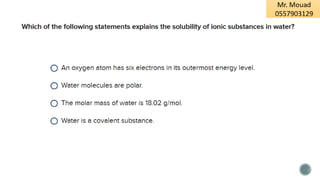
    Solvation: Process Solvation: The processof surrounding solute particles with solvent particles to form a solution. Solvation in water is called “hydration”. The solvation of NaCl in water is called: “Hydration of NaCl”
  • 128.
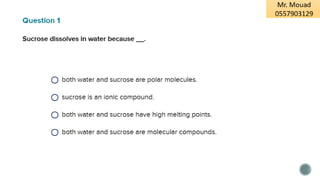
    Solvation: Process Water isalso a good solvent for many molecular compounds. “Like dissolves Like” is the general rule for solvation. Based on that, If you know that water is a polar compound, do you think sugar is polar or non-polar?
  • 140.
    Temperature & Solubility Ata certain temperature, solubility can be expressed mathematically as: Example: at 𝟔𝟎 ℃, KCl has a solubility of 𝟒𝟓. 𝟖 𝐊𝐂𝐥 𝟏𝟎𝟎𝐠 What is the solubility of NaCl at 80 ℃? 𝒈 𝒔𝒐𝒍𝒖𝒕𝒆 𝟏𝟎𝟎 𝒈 𝑯𝟐𝑶 https://edushare.moe.gov.ae/Uploads/Resources/bae97d67- 7736-49c0-9efd-585ee45e3f7d/6522147/index.html

  • 141.
  • 144.
    Formative Assessment 2:Henry’s Law The decreased solubility of the carbon dioxide contained in the beverage after it is opened can be described by Henry’s law: Gas Pressure α Solubility at a certain temperature S has the units g/L 1 2 3 Copyright © McGraw-Hill Education
  • 146.
    The End With mybest wishes Dear Students ☺