Environmental
Physiotherapy
Matthew Low, Joost van Wijchen,
Danielle Munford, (Kathryn
Donohue, Jessie Frost), Filip Maric
A Transformative Ecological Movement
Toward Planetary Health
CSP Congress 2024
Introduction
Filip Maric (PhD)
Associate Professor, UiT The Arctic University of Norway
Founder and Executive Chair of the Environmental Physiotherapy Association
filip.maric@uit.no
The fundamental question of environmental PT
What does the environment have to do with PT?
What do health, environment and society have to do with each other, and how does this play out in PT?
What do you think the
environment has to do with
PT?
Sustainability x Health is everywhere
An inquiry into the philosophical
foundations of Environmental
Physiotherapy
Matthew Low
Consultant Physiotherapist
matthew.low@uhd.nhs.uk
A typical clinical day…
Why do we practice
Physiotherapy in the ways we
do?
The origins of our assumptions…
BIAS
Basic
Implicit
Assumptions about
Science
PHILOSOPHY
How the world is (ontology)?
What we can know about it
(epistemology)?
How Science ought to be practiced
(norms and ethics)
(Anderson, Anjum and Rocca,
2019)
Philosophical Assumptions Norms Methods Practice
(BIAS)
e.g. Body-Mind divide Bio/Psycho Reductionism
Biomedicalism
The importance of Philosophy (Anjum, Copeland and Rocca,
2020)
The Enlightenment and the division between
Nature and Culture in Western Healthcare
Nature
Trees, woodland, sea, lakes, sand, insects, birds, atoms, particles, waves …
Science: Natural laws - linear, predictable…methods - standardisation
CONTROL, MANIPULATE AND USE AS RESOURCE
Culture
Humans, societies, houses, communities, technology, human thought,
creativity, innovation…
Humanities and Art: Human expression, anthropocentrism
FREEDOM AND EMANCIPATION
(Maric and Nicholls, 2022)
Scientific Progress: Reductionism,
objectivity, and value neutrality
Alliance with medicine
Legitimacy and social capital
Power and hierarchy
The persuasion of reductionism
Objectivity - The SOAP note
Value neutrality - Evidence based practice
Anthropocentrism
(Nicholls,
2022)
(Nicholls and Gibson, 2010)
The Body and Physiotherapy
There are many ways to conceive of bodies
A particular focus of the body as machine has dominated
Euro-Western thought and healthcare
Illness within the body
Abstraction of human away from the environment
The environment as a extrinsic variable to be reasoned,
managed or manipulated for the benefit of human
sovereignty
BUT…
It does not have to be that way!
Movements from Theory to Practice: From the
body as machine toward ecological practices
(Nicholls and Vieira, 2023)
If we did not divide Nature and
Culture, what possible Physiotherapy
practices could emerge?
Let’s catch up at the network session!
Putting EPT into practice:
education and future workforce
Danielle Munford
Physiotherapy Lecturer
danielle.munford@plymouth.ac.uk
What does this
mean to us?
Sustainable clinical practice / low carbon care models of care
1. care needs are high and complex
2. care is delivered inefficiently and inappropriately
3. the care delivery and treatment is resource and carbon
intensive
The rationale Every care component has an associated carbon footprint (from outpatient appointments,
investigations, treatment, through to the equipment we use and food we serve.)
The carbon impact of the
care we deliver will
therefore increase if;
Models
of care
Reducing inefficient and
inappropriate care delivery
This involves:
• Evidence-based best clinical
practice (incl. low carbon care
guidelines)
• Efficient and lean pathways
• Optimising care location
• Digitally-enabled care
Reducing the carbon and resource
intensity of care and care settings
This involves:
• Low carbon treatment
• Supply chain decarbonisation
• Circular economy principles
• Efficient energy use
• Low carbon travel and transport
Ensuring this is embedded as
business as usual
This involves:
• Workforce training and development
• Embedded into governance structures,
policies and standards
• Emissions oversight and reporting
• Leveraging the role and responsibilities
of the integrated care system (ICS)
Reducing care needs and the burden
of disease through
This involves:
• Disease prevention
• Health promotion and optimisation
• Personalised care (enabling self-
management and shared decision
making)
Keeping People
Healthy
Right Care, Right
Place, Right Time
Clinical Leadership,
Systems &
Workforce
Low Carbon
Treatments & Care
Settings
NHS Low
Carbon
Models of
Care
Sustainable clinical practice / low
carbon models of care Framework
Models
of care
What and who are already out there?
Education & training
Education for sustainable
healthcare within UK pre-
registration curricula for allied
health professions
Jessie Frost
Chief Sustainability Officer’s Senior Clinical Fellow 23/24
Cambridgeshire & Peterborough ICS / Greener NHS
Chief Sustainability Officer's Clinical Fellow: 22/23
CAHPO/HEE/OHID/Greener NHS
England
N
Ireland
Wal
es
Scotla
nd
Sustainable Healthcare Education in practice
How do you or will you support
Physiotherapy students and
graduates to consider the
environment in their clinical
practice?
At the intersections of justice,
equity, and the environment
Joost Van Wijchen
Head of Programme HVL / Principal Lecturer HAN
Joost.Van.Wijchen@hvl.no/ joost.vanwijchen@han.nl
Navigating Ambiguities
● Action vs. Reflection
● Global Impact vs. Local Choices
● Personal Responsibility vs.
Collective Responsibility
● Professional Duty vs.
Environmental Ethics
● Short-Term Needs vs. Long-Term
Sustainability
HEQED; An operationalization of health equity
Health equity is a dynamic, action-oriented pursuit
that fosters fair opportunities for all to achieve their full health potential
by addressing social & environmental determinants, promoting individual agency,
and embracing a holistic, sustainable approach that integrates human and planetary well-
being.
Focus on capabilities or functionings?
The Capability Approach is defined by its choice of focus upon the moral
significance of individuals' capability of achieving the kind of lives they have
reason to value. Amartya Sen
“Health is a meta-capability, a foundational component for the
realization of other capabilities.
Without health, individuals are less able to pursue other goals and
opportunities,
limiting their freedom and potential for flourishing.”
— Sridhar Venkatapuram, Health Justice: An Argument from the Capabilities Approach
Environmental Justice and Sustainability for Capabilities
Capabilities are constrained by environmental injustice
and safeguarded by sustainability.
Environmental Justice: Ensuring equitable access to clean air, water,
and safe spaces.
Structural Inequalities: Marginalized communities face greater risks,
limiting their health capabilities.
Sustainability: Protecting capabilities for future generations through
responsible stewardship.
Equity, Justice, and Passive Injustice
“Inaction in the face of harm is complicity.”
Passive Injustice
Equity and Justice:
Environmental health is foundational to
health equity.
When marginalized communities bear the
brunt of environmental neglect,
their health and capabilities are
restricted.
Vulnerability and Capability Constraints
Climate Vulnerability: Environmental degradation
restricts essential capabilities: safety, health, and
access to resources.
Resilient Systems: Resilience and adaptation are
vital for sustaining human capabilities in a changing
environment.
Justice - Who do we want to be?
Justice as Active Engagement:
Justice isn’t passive. It’s the
commitment to act in ways that
promote fairness, equity, and
sustainability—for people and the
planet.
A Question of Identity:
In our roles as health
physiotherapists and health
professionals, who do we want to
be in the face of these challenges?
Can I, as a physiotherapist, separate
my obligation to support patients'
health from the health of the planet?
Where do we stand with ‘do no harm’?
Conclusion(s)
Reviewing the question from
the Intro: What are your
thoughts now, about what PT
has to do with the
environment?
Active transport =
physical activity + environmental
benefits
Foregrounding indigenous knowledges
Reviewing implementation of the ICF in PT
Every single aspect of PT has
something to do with the
environment.
Join us for our networking
session this afternoon at 1.30pm

Environmental Physiotherapy: A Transformative Ecological Movement Toward Planetary Health

  • 1.
    Environmental Physiotherapy Matthew Low, Joostvan Wijchen, Danielle Munford, (Kathryn Donohue, Jessie Frost), Filip Maric A Transformative Ecological Movement Toward Planetary Health CSP Congress 2024
  • 2.
    Introduction Filip Maric (PhD) AssociateProfessor, UiT The Arctic University of Norway Founder and Executive Chair of the Environmental Physiotherapy Association filip.maric@uit.no
  • 6.
    The fundamental questionof environmental PT What does the environment have to do with PT? What do health, environment and society have to do with each other, and how does this play out in PT?
  • 7.
    What do youthink the environment has to do with PT?
  • 10.
  • 12.
    An inquiry intothe philosophical foundations of Environmental Physiotherapy Matthew Low Consultant Physiotherapist matthew.low@uhd.nhs.uk
  • 13.
  • 14.
    Why do wepractice Physiotherapy in the ways we do?
  • 15.
    The origins ofour assumptions… BIAS Basic Implicit Assumptions about Science PHILOSOPHY How the world is (ontology)? What we can know about it (epistemology)? How Science ought to be practiced (norms and ethics) (Anderson, Anjum and Rocca, 2019)
  • 16.
    Philosophical Assumptions NormsMethods Practice (BIAS) e.g. Body-Mind divide Bio/Psycho Reductionism Biomedicalism The importance of Philosophy (Anjum, Copeland and Rocca, 2020)
  • 17.
    The Enlightenment andthe division between Nature and Culture in Western Healthcare Nature Trees, woodland, sea, lakes, sand, insects, birds, atoms, particles, waves … Science: Natural laws - linear, predictable…methods - standardisation CONTROL, MANIPULATE AND USE AS RESOURCE Culture Humans, societies, houses, communities, technology, human thought, creativity, innovation… Humanities and Art: Human expression, anthropocentrism FREEDOM AND EMANCIPATION (Maric and Nicholls, 2022)
  • 18.
    Scientific Progress: Reductionism, objectivity,and value neutrality Alliance with medicine Legitimacy and social capital Power and hierarchy The persuasion of reductionism Objectivity - The SOAP note Value neutrality - Evidence based practice Anthropocentrism (Nicholls, 2022)
  • 19.
    (Nicholls and Gibson,2010) The Body and Physiotherapy There are many ways to conceive of bodies A particular focus of the body as machine has dominated Euro-Western thought and healthcare Illness within the body Abstraction of human away from the environment The environment as a extrinsic variable to be reasoned, managed or manipulated for the benefit of human sovereignty BUT… It does not have to be that way!
  • 20.
    Movements from Theoryto Practice: From the body as machine toward ecological practices (Nicholls and Vieira, 2023)
  • 21.
    If we didnot divide Nature and Culture, what possible Physiotherapy practices could emerge? Let’s catch up at the network session!
  • 22.
    Putting EPT intopractice: education and future workforce Danielle Munford Physiotherapy Lecturer danielle.munford@plymouth.ac.uk
  • 23.
  • 24.
    Sustainable clinical practice/ low carbon care models of care 1. care needs are high and complex 2. care is delivered inefficiently and inappropriately 3. the care delivery and treatment is resource and carbon intensive The rationale Every care component has an associated carbon footprint (from outpatient appointments, investigations, treatment, through to the equipment we use and food we serve.) The carbon impact of the care we deliver will therefore increase if; Models of care
  • 25.
    Reducing inefficient and inappropriatecare delivery This involves: • Evidence-based best clinical practice (incl. low carbon care guidelines) • Efficient and lean pathways • Optimising care location • Digitally-enabled care Reducing the carbon and resource intensity of care and care settings This involves: • Low carbon treatment • Supply chain decarbonisation • Circular economy principles • Efficient energy use • Low carbon travel and transport Ensuring this is embedded as business as usual This involves: • Workforce training and development • Embedded into governance structures, policies and standards • Emissions oversight and reporting • Leveraging the role and responsibilities of the integrated care system (ICS) Reducing care needs and the burden of disease through This involves: • Disease prevention • Health promotion and optimisation • Personalised care (enabling self- management and shared decision making) Keeping People Healthy Right Care, Right Place, Right Time Clinical Leadership, Systems & Workforce Low Carbon Treatments & Care Settings NHS Low Carbon Models of Care Sustainable clinical practice / low carbon models of care Framework Models of care
  • 26.
    What and whoare already out there?
  • 27.
  • 28.
    Education for sustainable healthcarewithin UK pre- registration curricula for allied health professions Jessie Frost Chief Sustainability Officer’s Senior Clinical Fellow 23/24 Cambridgeshire & Peterborough ICS / Greener NHS Chief Sustainability Officer's Clinical Fellow: 22/23 CAHPO/HEE/OHID/Greener NHS England N Ireland Wal es Scotla nd
  • 30.
  • 31.
    How do youor will you support Physiotherapy students and graduates to consider the environment in their clinical practice?
  • 32.
    At the intersectionsof justice, equity, and the environment Joost Van Wijchen Head of Programme HVL / Principal Lecturer HAN Joost.Van.Wijchen@hvl.no/ joost.vanwijchen@han.nl
  • 33.
    Navigating Ambiguities ● Actionvs. Reflection ● Global Impact vs. Local Choices ● Personal Responsibility vs. Collective Responsibility ● Professional Duty vs. Environmental Ethics ● Short-Term Needs vs. Long-Term Sustainability
  • 34.
    HEQED; An operationalizationof health equity Health equity is a dynamic, action-oriented pursuit that fosters fair opportunities for all to achieve their full health potential by addressing social & environmental determinants, promoting individual agency, and embracing a holistic, sustainable approach that integrates human and planetary well- being.
  • 35.
    Focus on capabilitiesor functionings? The Capability Approach is defined by its choice of focus upon the moral significance of individuals' capability of achieving the kind of lives they have reason to value. Amartya Sen
  • 36.
    “Health is ameta-capability, a foundational component for the realization of other capabilities. Without health, individuals are less able to pursue other goals and opportunities, limiting their freedom and potential for flourishing.” — Sridhar Venkatapuram, Health Justice: An Argument from the Capabilities Approach
  • 37.
    Environmental Justice andSustainability for Capabilities Capabilities are constrained by environmental injustice and safeguarded by sustainability. Environmental Justice: Ensuring equitable access to clean air, water, and safe spaces. Structural Inequalities: Marginalized communities face greater risks, limiting their health capabilities. Sustainability: Protecting capabilities for future generations through responsible stewardship.
  • 40.
    Equity, Justice, andPassive Injustice “Inaction in the face of harm is complicity.” Passive Injustice Equity and Justice: Environmental health is foundational to health equity. When marginalized communities bear the brunt of environmental neglect, their health and capabilities are restricted.
  • 41.
    Vulnerability and CapabilityConstraints Climate Vulnerability: Environmental degradation restricts essential capabilities: safety, health, and access to resources. Resilient Systems: Resilience and adaptation are vital for sustaining human capabilities in a changing environment.
  • 42.
    Justice - Whodo we want to be? Justice as Active Engagement: Justice isn’t passive. It’s the commitment to act in ways that promote fairness, equity, and sustainability—for people and the planet. A Question of Identity: In our roles as health physiotherapists and health professionals, who do we want to be in the face of these challenges?
  • 43.
    Can I, asa physiotherapist, separate my obligation to support patients' health from the health of the planet? Where do we stand with ‘do no harm’?
  • 44.
  • 45.
    Reviewing the questionfrom the Intro: What are your thoughts now, about what PT has to do with the environment?
  • 47.
    Active transport = physicalactivity + environmental benefits
  • 48.
  • 49.
  • 53.
    Every single aspectof PT has something to do with the environment.
  • 55.
    Join us forour networking session this afternoon at 1.30pm

Editor's Notes

  • #2 Notes for us, about what the intro will cover: Very general background about PT as traditionally being removed from the ‘environment’ in theory and practice General background how this is no longer tenable due to enviro change + clear calls from UN, WHO and the likes Overview introduction of the EPA Introduction to the basic question of EPT: What does the environment have to do with PT? (Also/Alt: What do health, environment and society have to do with each other? Segway to your presentations as four ways to engage with this fundamental question of EPT
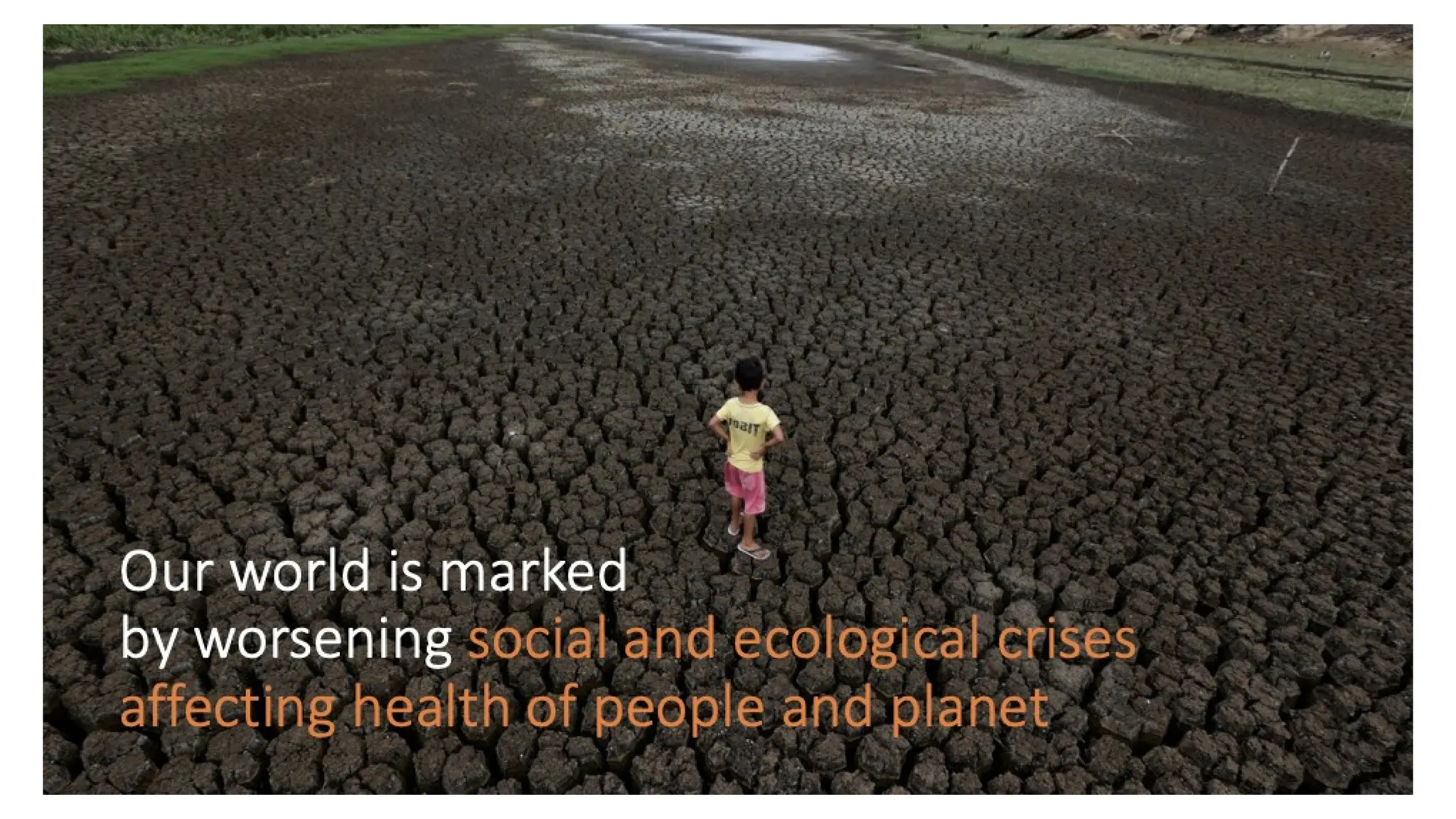
  • #6 Photo by Tomas Tuma on Unsplash
  • #13 Seeing a patient with low back pain in a clinic, usually a hospital. Review the referral and take a subjective assessment, screen for red flags, gather the patients story as well as their beliefs, expectations and fears. Ask their occupation and hobbies, their previous medical history and medications, their symptoms, behaviour and so on. Then you do an objective assessment. Looking at the spine and hips move and do a neurological examination. Palpate the body and summarise with a diagnosis, with a coherent management plan. What considerations do we take in respect of the environment?
  • #22 Dani’s section 12.5 mins including 3 mins to talk to neighbour
  • #23 Ask audience: Who is a clinician, a researcher, an academic? Who is new to this topic and wanting to know more? Who has already been active in sustainable healthcare delivery? If time allows, ask for some examples or suggest they use the afternoon networking meeting to share actions and experiences Infographic from NHS England (2020) - The NHS Carbon Footprint on the left shows the emissions we can control directly such as power/water suppliers to sites and on the right the NHS Carbon Footprint Plus is the emissions that we can influence such as procurement of medicines and equipment, food and catering, staff and visitor travel etc. As AHPs we make up a third of the NHS workforce and as physiotherapists we have a role here to consider the environmental impact of the supplychain for physio aids and equipment, to role model active transport and most importantly to communicate with our colleagues, patients and their families about the importance of planetary health.
  • #24 Sustainable healthcare is a health system that maintains or restores health for current generations while minimizing harm to the environment and ensuring the health of future generations. An environmentally sustainable healthcare system offers high-quality services in the present without compromising the ability to meet the health needs of the future (Palstam et al, 2022). With that in mind, Low carbon models of care are established by first understanding the basic principle that every care component has an associated carbon footprint with some elements of care more carbon and cost intensive than others. For example, using figures from Centre for Sustainable Healthcare - an average low intensity day on inpatient ward has a carbon footprint of 37.9kg CO2e which is roughly same as 1 return journey from London to Oxford in an average sized car or making 608 cups of tea and will take 1-2 large mature trees a year to offset. The carbon impact of the care we deliver will therefore increase if care needs are high and complex, care is delivered inefficiently and or inappropriately, or the care delivery and treatment is resource and carbon intensive. In order to truly reduce the carbon impact of the care we deliver, understanding the principles of sustainable healthcare and how these apply to everyone within the healthcare is fundamental: lowering the carbon footprint of care pathways must become business as usual and be embedded in our systems and policies, have clinical leadership, and a supported workforce.
  • #25 The NZCTU have illustrated the 4 key principles of sustainable healthcare or low carbon models of care illustrated in this framework. First, we need to reduce care needs and the burden of disease through disease prevention, health promotion and optimisation and enabling personalised care.  CLICK Next we must reduce inefficiencies and inappropriate care across the system by using the evidence base, efficient and lean pathways, optimise care location and using digitally enabled care where appropriate.  CLICK We should reduce carbon and resource intense care by picking low carbon treatments where possible whilst never compromising patient care, look at how we can play a part in influencing the things we procure and how we use them, support efficient energy use and utilise low carbon travel and transport options **Desflurane is a good example of this process, an anaesthetic with a very high greenhouse gas potential that was often a primary choice by anaesthetists. NHS england and the royal college of anesthetists subsequently partnered to look at this more closely, assessing its impact, looking at alternatives etc and have now jointly committed to decommission desfularane in routine practice by early 2024, replacing it with TIVA and other safe and effective alternatives with much lower carbon footprints. There is no detriment to the patient, the financial impact is less and the environmental impact is significantly less – a win for all involved. This couldn't have happened without the work and support of the clinical community – NHSE couldn't have done this in silo.** CLICK  And we must ensure this is embedded in business as usual through workforce training, ensuring it is explicitly incorporated within policies and governance structures and really leverage the role and responsibilities of ICSs here. Is this from NHS England (2022) Delivering a net zero NHS? Explain the projects and their scope ie Limb reconstruction at Barts and Royal London collaborating through SusQI project to reduce theatre time through OP appointments, reduce cost, time and carbon footprint of anaesthetic gases, room usage, travel and staffing; Northampton Gen Hospital hand therapy service, using process change to reduce dependence on OP appointments, increasing relative throughput, reducing stock use, room use and travel; equipment reuse and recycling at RNOHT through liaison with Sustainable Procurement Lead at NHSE and the London Community Equipment Consortium and a wider London project by the London Procurement Partnership to reduce landfill, environmental and financial costs of manufacturing new equipment; respiratory services taking the lead on inhaler prescription to move away from metered dose to dry powder through liaison with prescribers and pharmacy; pain management services prioritising self-management, non-pharmaceutical methods ie physio to reduce use of NSAIDs and reducing impact on river quality and fish stocks. Resources: Future NHS pages have a Greener Knowledge Hub workspace.FutureNHS Home - FutureNHS Collaboration Platform Carbon Literacy for healthcare - elearning for healthcare (e-lfh.org.uk)
  • #26 Once you start looking into this agenda, the biggest barriers can be knowing where to start, who to start with and how to find the time. Be reassured that you are not alone, there is already so much good work happening, from Filip’s EPA to the Greener NHS, the Greener AHP, the Centre for Sustainable Healthcare network as a few examples, plus individual clinicians and groups within individual Trusts. This includes people at grassroots level who simply want to make a difference to organisations who want to support you in making valuable changes. Through starting to explore, these individuals found their ‘tribe’, those like-minded individuals who started collaborations for change. So find those interested others, share your experiences and achievements and take action. NHS England » Greener Allied Health Professional hub www.england.nhs.uk/greenernhs E-Learning Module on Environmentally Sustainable Healthcare
  • #27 Just as an example of the range of information you will find on the greener NHS knowledge hub there is also a training hub area and there are some recent additions to that in the form of funded carbon literacy and leadership training offers. Both are hybrid courses with an initial online element followed by a workshop. For the carbon literacy training this is an online workshop for the leadership course this is face to face in Leeds. Carbon Literacy for healthcare - elearning for healthcare (e-lfh.org.uk) https://wrm-ltd.co.uk/carbon-literacy-for-healthcare-professionals/#bm-Contact Sustainability Leadership for Greener Health and Care Programme   – Leadership Academy
  • #28 How about development of our future workforce to embed sustainable healthcare in our future provision? A key player in supporting this education is Jessie Frost. She’s a paediatric physiotherapist who joined the Chief Sustainability Officer’s clinical fellowship scheme in 2022-23, and was then seconded for a second year onto a senior fellowship scheme working for an ICB in the East of England in all things sustainability still. Through this role, in December 2023, she developed a guidance document for Higher Education Institutions for providing education on sustainable healthcare in UK pre-registration curricula for AHPs. The QR code will take you to the document if you’re interested. The model is expressed through sunflower graphics to depict 5 foundations of planetary health and sustainable healthcare (the What), surrounded by 6 principles of how to incorporate the foundations into curricula and programmes (the How). The guidance advocates use of a ‘golden thread’ ie woven into the curricula; inclusion in assessment; nurturing critical thinking to help students get to grips with the complexity of the subject; teach across professions to foster interdisciplinary collaboration; ensuring monitoring and provision of support for learner well-being around eco-anxiety.
  • #29 I have mentioned carbon footprints here today but this is just one petal on the huge sunflower of environmental physiotherapy / planetary health
  • #30 Following the principles of Jessie guidance, Dani has integrated sustainable healthcare education into our curriculum at the UoP, via a year 3 module, with the opportunity for student to choose it as a topic for their assessment presentation for the module. With increased focus on this topic, the increase in uptake of students choosing this topic was 50% from 2023 to 2024 running of the module. Students gave feedback comments such as “I was so pleased to see this in the module, I follow as sustainable a life outside of Uni as I can and had no idea that I could apply this to practice. Its helped give me confidence to explore this in my future career and I’m really excited by that. Thank you.”; “My first degree was environmental science but I could find a career path that I wanted to follow, so made what I thought was a complete shift to do physio. I never realised that I might have the option to combine both sets of skill and knowledge until now - thank you.” We are now supporting colleagues to embed sustainability in all modules so following the Golden Thread analogy and support students to understand the topic and the actions they can take for change. So we have seen a surge in interest and this is reflected across the UK HEI’s through the stakeholder research undertaken for Jessie’s guidance document. Students want to explore this topic with educators, so may well be interested in undertaking QI projects on placement that support your own interests and help advocate for change in your organisations. There has been advocacy for inclusion of sustainability in the new version of the CPAF and to include sustainability education in new programme approvals and re-validation of programmes. Planetary Health Report Card: Plus Universities are beginning to develop initiatives such as uniform swaps and travel sharing for commuting students.
  • #31 In summary -
  • #33 Let’s start by embracing ambiguity. In our roles, we often face conflicting responsibilities—balancing personal and collective action, short-term needs with long-term sustainability. It’s in these contradictions that we find our ethical challenges. Donna Haraway suggests we ‘stay with the trouble’, to sit with discomfort as we navigate these tensions.” Action vs. Reflection Traveling for advocacy vs. staying home to reduce environmental impact. Global Impact vs. Local Choices Choosing to address planetary health at a conference vs. the carbon footprint of a single journey. Personal Responsibility vs. Collective Responsibility Individual efforts to minimize one’s footprint vs. systemic changes needed to address global issues. Professional Duty vs. Environmental Ethics The obligation to share knowledge and advocate for change vs. the ethical implications of contributing to environmental harm. Short-Term Needs vs. Long-Term Sustainability Immediate need for human connection and shared learning vs. commitment to sustainable practices for future generations.
  • #34 In the HEQED project, we view health as a dynamic, action-oriented pursuit. Health equity means fair opportunities for everyone to reach their full potential, which extends beyond individuals to include our environment. This holistic approach integrates human and planetary well-being, promoting both agency and sustainability.
  • #35 The Capability Approach, as defined by Amartya Sen, focuses on what people are able to do and be. Health, as Sridhar Venkatapuram notes, is a ‘meta-capability’—it underpins all other freedoms. Environmental factors directly impact these capabilities, limiting our patients' potential to flourish. This makes health equity not just a human issue, but an environmental one.
  • #36 The Capability Approach, as defined by Amartya Sen, focuses on what people are able to do and be. Health, as Sridhar Venkatapuram notes, is a ‘meta-capability’—it underpins all other freedoms. Environmental factors directly impact these capabilities, limiting our patients' potential to flourish. This makes health equity not just a human issue, but an environmental one.
  • #37 Environmental justice is about ensuring equitable access to clean air, water, and safe spaces—basic needs that support health capabilities. Structural inequalities put marginalized communities at greater risk, and sustainability is our responsibility to protect these capabilities for future generations. Justice requires that we advocate for both today’s communities and those yet to come
  • #40 Judith Shklar describes passive injustice as inaction in the face of harm—a subtle complicity. When we remain neutral, we allow environmental injustices to persist. As healthcare professionals, we cannot ignore the role of environmental health in our pursuit of equity. Justice requires us to stand against neglect and advocate for systems that support both human and planetary health.
  • #41 Climate vulnerability constrains fundamental capabilities—health, safety, and access to resources. This requires climate-resilient health systems and community-led adaptations. Building resilient systems is an act of equity, ensuring all individuals can maintain their health capabilities in the face of environmental challenges
  • #42 Justice is not passive. It’s the commitment to act in ways that promote fairness, equity, and sustainability. As physiotherapists and health professionals, we must ask ourselves—Who do we want to be? Are we willing to be the advocates for justice that our profession demands?
  • #43 Can we, as physiotherapists, truly separate our duty to our patients from our responsibility to the planet? The principle of ‘do no harm’ extends beyond individuals to include our shared environment. Our role demands that we see health in its full context—one that encompasses both human and planetary well-being
  • #45 After this, I will briefly touch on a few more examples
  • #46 Nature based health and therapy
  • #47 Photo by George Kedenburg III on Unsplash
  • #48 https://environmentalphysio.com/2020/05/01/restoring-harmony-how-pacific-indigenous-knowledge-can-help-physiotherapists-navigate-environmental-responsibility/