Hisrich
Peters
Shepherd
Chapter 1
Entrepreneurship
and the
Entrepreneurial Mind-Set
Copyright © 2010 by The McGraw-Hill Companies, Inc. All rights reserved.
McGraw-Hill/Irwin
1-2
Nature and Development of
Entrepreneurship
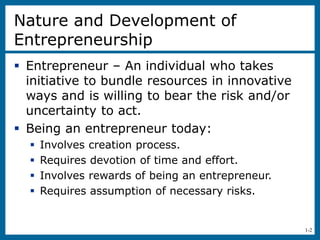
 Entrepreneur – An individual who takes
initiative to bundle resources in innovative
ways and is willing to bear the risk and/or
uncertainty to act.
 Being an entrepreneur today:
 Involves creation process.
 Requires devotion of time and effort.
 Involves rewards of being an entrepreneur.
 Requires assumption of necessary risks.
1-3
Nature and Development of
Entrepreneurship (cont.)
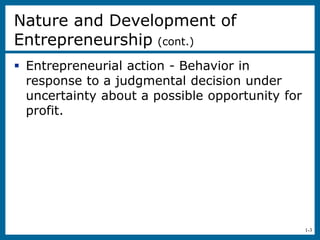
 Entrepreneurial action - Behavior in
response to a judgmental decision under
uncertainty about a possible opportunity for
profit.
1-4
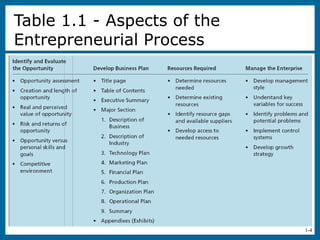
Table 1.1 - Aspects of the
Entrepreneurial Process
1-5
The Entrepreneurial Process
 Opportunity identification - The process by
which an entrepreneur comes up with the
opportunity for a new venture.
 Market size and the length of the window of
opportunity are the primary bases for
determining risks and rewards.
 Window of opportunity - The time period
available for creating the new venture.
 Business plan - The description of the
future direction of the business.
1-6
How Entrepreneurs Think
 Entrepreneurs in particular situations may
think differently when faced with a different
task or decision environment.
 Given the nature of their decision-making
environment, entrepreneurs need to
sometimes:
 Effectuate.
 Be cognitively adaptable.
 Learn from failure.
1-7
 Causal process
 Starts with a desired outcome.
 Focuses on the means to generate that
outcome.
 Effectuation process
 Starts with what one has (who they are, what
they know, and whom they know).
 Selects among possible outcomes.
 Entrepreneurial mind-set involves the
ability to rapidly sense, act, and mobilize,
even under uncertain conditions.
How Entrepreneurs Think (cont.)
1-8
 Cognitive adaptability describes the extent
to which entrepreneurs are:
 Dynamic, flexible, self-regulating and engaged
in the process of generating multiple decision
frameworks focused on sensing and processing
changes in their environments and then acting
on them.
 It reflects in an entrepreneur’s
metacognitive awareness.
How Entrepreneurs Think (cont.)
1-9
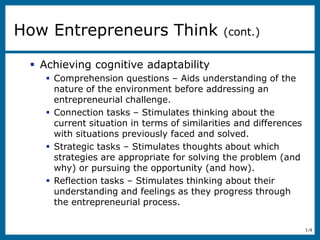
 Achieving cognitive adaptability
 Comprehension questions – Aids understanding of the
nature of the environment before addressing an
entrepreneurial challenge.
 Connection tasks – Stimulates thinking about the
current situation in terms of similarities and differences
with situations previously faced and solved.
 Strategic tasks – Stimulates thoughts about which
strategies are appropriate for solving the problem (and
why) or pursuing the opportunity (and how).
 Reflection tasks – Stimulates thinking about their
understanding and feelings as they progress through
the entrepreneurial process.
How Entrepreneurs Think (cont.)
1-10
 Entrepreneurs who are able to increase
cognitive adaptability have an improved ability
to:
 Adapt to new situations.
 Be creative.
 Communicate one’s reasoning behind a particular
response.
How Entrepreneurs Think (cont.)
1-11
 Learning from Business Failure
 Uncertainty, changing conditions, and
insufficient experience can contribute to failure
among entrepreneurial firms.
 An entrepreneur’s motivation is not simply from
personal profit but from:
 Loyalty to a product.
 Loyalty to a market and customers.
 Personal growth.
 The need to prove oneself.
How Entrepreneurs Think (cont.)
1-12
 Loss of a business can result in a negative
emotional response from the entrepreneur.
 It can interfere with:
 Entrepreneur’s ability to learn from the failure.
 Motivation to try again.
How Entrepreneurs Think (cont.)
1-13
 Recovery and Learning Process
 Emotional recovery from failure happens when
thoughts about the events surrounding, and
leading up to the loss of the business, no longer
generate a negative emotional response.
 Primary descriptions of the process of
recovering are:
 Loss-orientation.
 Restoration-orientation.
How Entrepreneurs Think (cont.)
1-14
 Loss-Orientation
 Involves working through, and processing, some
aspect of the loss experience and, as a result of this
process, breaking emotional bonds to the object lost.
 This process gradually provides the loss with meaning
and eventually produces a changed viewpoint.
 Involves confrontation, which is physically and
mentally exhausting.
 Characterized by feelings of relief and pain that wax
and wane over time.
How Entrepreneurs Think (cont.)
1-15
 Restoration-Orientation
 Based on both avoidance and a proactiveness toward
secondary sources of stress arising from a major loss.
 Involves suppression, which requires mental effort and
presents potentially adverse consequences for health.
 Provides an opportunity to address secondary causes
of stress.
 May reduce emotional significance of the loss.
How Entrepreneurs Think (cont.)
1-16
 A Dual Process for Learning from Failure
 The dual process of oscillating between the loss-
orientation and restoration-orientation enables a
person to:
 Obtain the benefits of each.
 Minimize the costs of maintaining one for too long.
 This dual process speeds the recovery process.
How Entrepreneurs Think (cont.)
1-17
How Entrepreneurs Think (cont.)
 Practical implications of the dual process:
 Knowledge that feelings and reactions being
experienced are normal.
 Realizing that psychological and physiological outcomes
caused by the feelings of loss are “symptoms” can
reduce secondary sources of stress.
 There is a process of recovery to learn from failure,
which offers some comfort that current feelings of loss
will eventually diminish.
 Recovery and learning process can be enhanced by
some degree of oscillation.
 Recovery from loss offers an opportunity to increase
one’s knowledge of entrepreneurship.
1-18
Ethics and Social Responsibility of
Entrepreneurs
 Entrepreneurs usually develop an internal
ethical code.
 Personal value systems tend to be
influenced by:
 Peer pressure.
 General social norms in the community.
 Pressures from their competitors.
 Business ethics - The study of behavior and
morals in a business situation.
1-19
Role of Entrepreneurship in
Economic Development
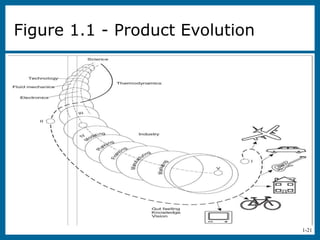
 Innovation is depicted as a key to economic
development.
 Product-evolution process - Process through
which innovation is developed and
commercialized.
 Iterative synthesis - The intersection of knowledge
and social need that starts the product
development process.
1-20
Role of Entrepreneurship in
Economic Development (cont.)
 Three types of innovation:
 Ordinary - New products with little technological
change.
 Technological – New products with significant
technological advancement.
 Breakthrough – New products with some
technological change.
1-21
Figure 1.1 - Product Evolution

Entrepreneurship Chapter #1.ppt

  • 1.
    Hisrich Peters Shepherd Chapter 1 Entrepreneurship and the EntrepreneurialMind-Set Copyright © 2010 by The McGraw-Hill Companies, Inc. All rights reserved. McGraw-Hill/Irwin
  • 2.
    1-2 Nature and Developmentof Entrepreneurship  Entrepreneur – An individual who takes initiative to bundle resources in innovative ways and is willing to bear the risk and/or uncertainty to act.  Being an entrepreneur today:  Involves creation process.  Requires devotion of time and effort.  Involves rewards of being an entrepreneur.  Requires assumption of necessary risks.
  • 3.
    1-3 Nature and Developmentof Entrepreneurship (cont.)  Entrepreneurial action - Behavior in response to a judgmental decision under uncertainty about a possible opportunity for profit.
  • 4.
    1-4 Table 1.1 -Aspects of the Entrepreneurial Process
  • 5.
    1-5 The Entrepreneurial Process Opportunity identification - The process by which an entrepreneur comes up with the opportunity for a new venture.  Market size and the length of the window of opportunity are the primary bases for determining risks and rewards.  Window of opportunity - The time period available for creating the new venture.  Business plan - The description of the future direction of the business.
  • 6.
    1-6 How Entrepreneurs Think Entrepreneurs in particular situations may think differently when faced with a different task or decision environment.  Given the nature of their decision-making environment, entrepreneurs need to sometimes:  Effectuate.  Be cognitively adaptable.  Learn from failure.
  • 7.
    1-7  Causal process Starts with a desired outcome.  Focuses on the means to generate that outcome.  Effectuation process  Starts with what one has (who they are, what they know, and whom they know).  Selects among possible outcomes.  Entrepreneurial mind-set involves the ability to rapidly sense, act, and mobilize, even under uncertain conditions. How Entrepreneurs Think (cont.)
  • 8.
    1-8  Cognitive adaptabilitydescribes the extent to which entrepreneurs are:  Dynamic, flexible, self-regulating and engaged in the process of generating multiple decision frameworks focused on sensing and processing changes in their environments and then acting on them.  It reflects in an entrepreneur’s metacognitive awareness. How Entrepreneurs Think (cont.)
  • 9.
    1-9  Achieving cognitiveadaptability  Comprehension questions – Aids understanding of the nature of the environment before addressing an entrepreneurial challenge.  Connection tasks – Stimulates thinking about the current situation in terms of similarities and differences with situations previously faced and solved.  Strategic tasks – Stimulates thoughts about which strategies are appropriate for solving the problem (and why) or pursuing the opportunity (and how).  Reflection tasks – Stimulates thinking about their understanding and feelings as they progress through the entrepreneurial process. How Entrepreneurs Think (cont.)
  • 10.
    1-10  Entrepreneurs whoare able to increase cognitive adaptability have an improved ability to:  Adapt to new situations.  Be creative.  Communicate one’s reasoning behind a particular response. How Entrepreneurs Think (cont.)
  • 11.
    1-11  Learning fromBusiness Failure  Uncertainty, changing conditions, and insufficient experience can contribute to failure among entrepreneurial firms.  An entrepreneur’s motivation is not simply from personal profit but from:  Loyalty to a product.  Loyalty to a market and customers.  Personal growth.  The need to prove oneself. How Entrepreneurs Think (cont.)
  • 12.
    1-12  Loss ofa business can result in a negative emotional response from the entrepreneur.  It can interfere with:  Entrepreneur’s ability to learn from the failure.  Motivation to try again. How Entrepreneurs Think (cont.)
  • 13.
    1-13  Recovery andLearning Process  Emotional recovery from failure happens when thoughts about the events surrounding, and leading up to the loss of the business, no longer generate a negative emotional response.  Primary descriptions of the process of recovering are:  Loss-orientation.  Restoration-orientation. How Entrepreneurs Think (cont.)
  • 14.
    1-14  Loss-Orientation  Involvesworking through, and processing, some aspect of the loss experience and, as a result of this process, breaking emotional bonds to the object lost.  This process gradually provides the loss with meaning and eventually produces a changed viewpoint.  Involves confrontation, which is physically and mentally exhausting.  Characterized by feelings of relief and pain that wax and wane over time. How Entrepreneurs Think (cont.)
  • 15.
    1-15  Restoration-Orientation  Basedon both avoidance and a proactiveness toward secondary sources of stress arising from a major loss.  Involves suppression, which requires mental effort and presents potentially adverse consequences for health.  Provides an opportunity to address secondary causes of stress.  May reduce emotional significance of the loss. How Entrepreneurs Think (cont.)
  • 16.
    1-16  A DualProcess for Learning from Failure  The dual process of oscillating between the loss- orientation and restoration-orientation enables a person to:  Obtain the benefits of each.  Minimize the costs of maintaining one for too long.  This dual process speeds the recovery process. How Entrepreneurs Think (cont.)
  • 17.
    1-17 How Entrepreneurs Think(cont.)  Practical implications of the dual process:  Knowledge that feelings and reactions being experienced are normal.  Realizing that psychological and physiological outcomes caused by the feelings of loss are “symptoms” can reduce secondary sources of stress.  There is a process of recovery to learn from failure, which offers some comfort that current feelings of loss will eventually diminish.  Recovery and learning process can be enhanced by some degree of oscillation.  Recovery from loss offers an opportunity to increase one’s knowledge of entrepreneurship.
  • 18.
    1-18 Ethics and SocialResponsibility of Entrepreneurs  Entrepreneurs usually develop an internal ethical code.  Personal value systems tend to be influenced by:  Peer pressure.  General social norms in the community.  Pressures from their competitors.  Business ethics - The study of behavior and morals in a business situation.
  • 19.
    1-19 Role of Entrepreneurshipin Economic Development  Innovation is depicted as a key to economic development.  Product-evolution process - Process through which innovation is developed and commercialized.  Iterative synthesis - The intersection of knowledge and social need that starts the product development process.
  • 20.
    1-20 Role of Entrepreneurshipin Economic Development (cont.)  Three types of innovation:  Ordinary - New products with little technological change.  Technological – New products with significant technological advancement.  Breakthrough – New products with some technological change.
  • 21.
    1-21 Figure 1.1 -Product Evolution