ENTREPRENEURSHIP
RECOGNIZE A POTENTIAL MARKET
1ST
QUARTER WEEK 3
LEARNING OBJECTIVES
 Learn and understand the sources of opportunities for business
 Determine the essentials in the entrepreneur’s opportunity
seeking
 Identify market problems and propose potential
products/services that will meet market needs
 Know the problem in which a business opportunity arises from
 Identify, screen and propose solutions to meet the problem
 Select the best product/service that will meet the market’s
need with a consideration of generating profit
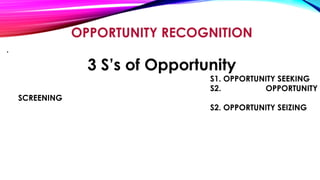
OPPORTUNITY RECOGNITION
.
3 S’s of Opportunity
S1. OPPORTUNITY SEEKING
S2. OPPORTUNITY
SCREENING
S2. OPPORTUNITY SEIZING
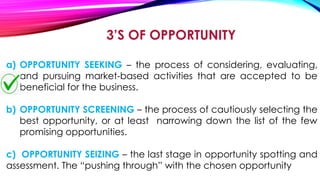
3’S OF OPPORTUNITY
a) OPPORTUNITY SEEKING – the process of considering, evaluating,
and pursuing market-based activities that are accepted to be
beneficial for the business.
b) OPPORTUNITY SCREENING – the process of cautiously selecting the
best opportunity, or at least narrowing down the list of the few
promising opportunities.
c) OPPORTUNITY SEIZING – the last stage in opportunity spotting and
assessment. The “pushing through” with the chosen opportunity
RECOGNIZE A POTENTIAL MARKET
• Analyze the market need
• Determine the possible products/services that will meet the need
• Screen and proposed solutions based on viability, profitability and
customer requirements
WHO IS POTENTIAL MARKET?
POTENTIAL MARKET
 Is the part of total population that has shown some level of interest
in buying a particular product/service
 Is the part of the market you can capture in the future. It includes
demographic groups that are not currently your customers but
could become customers in the future.
 Market potential is the total demand for a product in a given
business.
IMPORTANCE OF POTENTIAL MARKET
 Important part of business’s future growth
 Ensure the future of your business by identifying new customers
 Think proactively about ways for your business to grow and
change
 Show the potential of your business to investors or collaborators
 Increase a revenue and create a plan B
HOW TO IDENTIFY POTENTIAL MARKET?
IDENTIFYING POTENTIAL MARKETS BY ANSWERING THE FOLLOWING
QUESTIONS
 What other products do my customer needs now?
 What related products will they need in the future?
 Who else could make use of the products I am selling now?
 What demographic information does that new group have in
common with my current customers?
 Who else could make use of the products I am selling now?
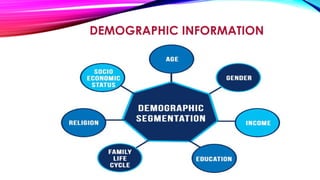
DEMOGRAPHIC INFORMATION
REACHING YOUR POTENTIAL MARKET
 The demographic information that people in a group have in
common.
 The best forms of media to reach them.
 How they prefer to shop and make purchases
 What values matters to them, both in everyday life and when
shopping
 The concerns, struggles, or problems that you can help them
overcome
REACHING YOUR POTENTIAL MARKET
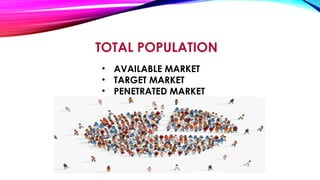
TOTAL POPULATION
• AVAILABLE MARKET
• TARGET MARKET
• PENETRATED MARKET
AVAILABLE MARKET
Prospects who are willing and capable (have sufficient resources)
buyers, have the access to a particular market or service
Defined as the number of people who are both willing and capable
of buying a particular product in the market
TARGET MARKET
Refers to a group of potential to whom a company wants to sell its
product and services.
Target markets are generally categorized by age, location, income
and lifestyle.
Defining a specific target market allows a company to home in on
specific market factors to reach and connect with customers
through sales and marketing efforts.
PENETRATED MARKET
A set of customers or clients who are already using a particular
product or service.
A penetrated market means that the potential users of a product or
service are aware of it, and in many cases are active consumers of
it.
THE MARKET NEED
THE MARKET NEED
NEED
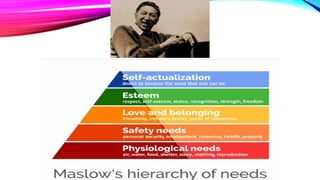
 A motivating force that compels action for its satisfaction. Needs
range from basic survival needs (common to all human beings)
satisfied by necessities, to cultural, intellectual, and social needs
(varying from place to place and age group to age group)
satisfied by necessaries
 A driver of human action which marketers try to identify,
emphasize, and satisfy, and around which promotional efforts are
organized
THE MARKET NEED
MARKET
 A Market is a place where two parties can gather to facilitate the
exchange of goods and services. The parties involved are usually
buyers and sellers. The market may be physical like a retail outlet,
where people meet face-to-face, or virtual like an online market,
where there is no direct physical contact between buyers and
sellers
 A market does not refer to a particular place but it refers to a
market for a commodity or commodities. It refers to an
arrangement whereby buyers and sellers come in close contact
with each other directly or indirectly to sell and buy goods
THE MARKET NEED
MARKET
 A market is any place where sellers of particular goods or services
can meet with buyers of those goods and services. It creates the
potential for a transaction to take place. The buyers must have
something they can offer in exchange for the product to create a
successful transaction
MARKET
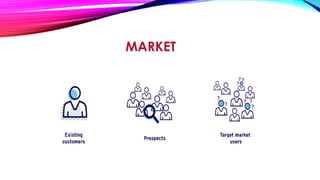
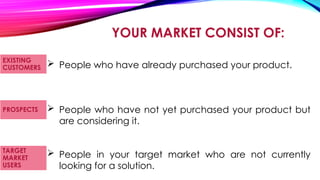
YOUR MARKET CONSIST OF:
 People who have already purchased your product.
 People who have not yet purchased your product but
are considering it.
 People in your target market who are not currently
looking for a solution.
EXISTING
CUSTOMERS
PROSPECTS
TARGET
MARKET
USERS
“
”
THE BEST MARKETERS ARE ALWAYS
CREATING RELATIONSHIPS.
RELATIONSHIPS WITH CUSTOMERS,
BRANDS AND OTHER MARKETERS.
Thank you for listening!
God bless

ENTREP_WEEK3 RECOGNIZE A POTENTIAL MARKET 2.pptx

  • 1.
    ENTREPRENEURSHIP RECOGNIZE A POTENTIALMARKET 1ST QUARTER WEEK 3
  • 2.
    LEARNING OBJECTIVES  Learnand understand the sources of opportunities for business  Determine the essentials in the entrepreneur’s opportunity seeking  Identify market problems and propose potential products/services that will meet market needs  Know the problem in which a business opportunity arises from  Identify, screen and propose solutions to meet the problem  Select the best product/service that will meet the market’s need with a consideration of generating profit
  • 3.
    OPPORTUNITY RECOGNITION . 3 S’sof Opportunity S1. OPPORTUNITY SEEKING S2. OPPORTUNITY SCREENING S2. OPPORTUNITY SEIZING
  • 4.
    3’S OF OPPORTUNITY a)OPPORTUNITY SEEKING – the process of considering, evaluating, and pursuing market-based activities that are accepted to be beneficial for the business. b) OPPORTUNITY SCREENING – the process of cautiously selecting the best opportunity, or at least narrowing down the list of the few promising opportunities. c) OPPORTUNITY SEIZING – the last stage in opportunity spotting and assessment. The “pushing through” with the chosen opportunity
  • 5.
    RECOGNIZE A POTENTIALMARKET • Analyze the market need • Determine the possible products/services that will meet the need • Screen and proposed solutions based on viability, profitability and customer requirements
  • 6.
  • 7.
    POTENTIAL MARKET  Isthe part of total population that has shown some level of interest in buying a particular product/service  Is the part of the market you can capture in the future. It includes demographic groups that are not currently your customers but could become customers in the future.  Market potential is the total demand for a product in a given business.
  • 8.
    IMPORTANCE OF POTENTIALMARKET  Important part of business’s future growth  Ensure the future of your business by identifying new customers  Think proactively about ways for your business to grow and change  Show the potential of your business to investors or collaborators  Increase a revenue and create a plan B
  • 9.
    HOW TO IDENTIFYPOTENTIAL MARKET?
  • 10.
    IDENTIFYING POTENTIAL MARKETSBY ANSWERING THE FOLLOWING QUESTIONS  What other products do my customer needs now?  What related products will they need in the future?  Who else could make use of the products I am selling now?  What demographic information does that new group have in common with my current customers?  Who else could make use of the products I am selling now?
  • 11.
  • 12.
    REACHING YOUR POTENTIALMARKET  The demographic information that people in a group have in common.  The best forms of media to reach them.  How they prefer to shop and make purchases  What values matters to them, both in everyday life and when shopping  The concerns, struggles, or problems that you can help them overcome REACHING YOUR POTENTIAL MARKET
  • 13.
    TOTAL POPULATION • AVAILABLEMARKET • TARGET MARKET • PENETRATED MARKET
  • 14.
    AVAILABLE MARKET Prospects whoare willing and capable (have sufficient resources) buyers, have the access to a particular market or service Defined as the number of people who are both willing and capable of buying a particular product in the market
  • 15.
    TARGET MARKET Refers toa group of potential to whom a company wants to sell its product and services. Target markets are generally categorized by age, location, income and lifestyle. Defining a specific target market allows a company to home in on specific market factors to reach and connect with customers through sales and marketing efforts.
  • 16.
    PENETRATED MARKET A setof customers or clients who are already using a particular product or service. A penetrated market means that the potential users of a product or service are aware of it, and in many cases are active consumers of it.
  • 17.
  • 18.
    THE MARKET NEED NEED A motivating force that compels action for its satisfaction. Needs range from basic survival needs (common to all human beings) satisfied by necessities, to cultural, intellectual, and social needs (varying from place to place and age group to age group) satisfied by necessaries  A driver of human action which marketers try to identify, emphasize, and satisfy, and around which promotional efforts are organized
  • 20.
    THE MARKET NEED MARKET A Market is a place where two parties can gather to facilitate the exchange of goods and services. The parties involved are usually buyers and sellers. The market may be physical like a retail outlet, where people meet face-to-face, or virtual like an online market, where there is no direct physical contact between buyers and sellers  A market does not refer to a particular place but it refers to a market for a commodity or commodities. It refers to an arrangement whereby buyers and sellers come in close contact with each other directly or indirectly to sell and buy goods
  • 21.
    THE MARKET NEED MARKET A market is any place where sellers of particular goods or services can meet with buyers of those goods and services. It creates the potential for a transaction to take place. The buyers must have something they can offer in exchange for the product to create a successful transaction
  • 22.
  • 23.
    YOUR MARKET CONSISTOF:  People who have already purchased your product.  People who have not yet purchased your product but are considering it.  People in your target market who are not currently looking for a solution. EXISTING CUSTOMERS PROSPECTS TARGET MARKET USERS
  • 24.
    “ ” THE BEST MARKETERSARE ALWAYS CREATING RELATIONSHIPS. RELATIONSHIPS WITH CUSTOMERS, BRANDS AND OTHER MARKETERS. Thank you for listening! God bless