ENTERTAINMENT IN
      GOA
   Goa is Known for its unlimited amount of fun and
    excitement. Goans greet their guests with open
    arms. As it has been in touch with varied outsiders, a
    cosmopolitan form of culture flourishes here, making
    this place somehow special in the country.
   Goa is known for it party and morden dances and
    disco. But Goa has more to it than that, against what
    the rest of the world thinks Goa has a rich traditional
    heritage and there is a lot of traditional form of
    entertainment in the state.
   Entertainment in Goa is mainly in the form of Dance,
    Music, & Drama apart from which there are many
    other forms of entertainment.
Dance
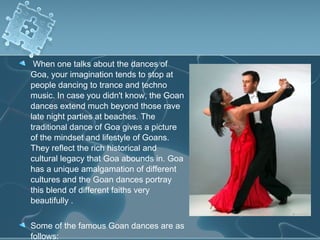
When one talks about the dances of
Goa, your imagination tends to stop at
people dancing to trance and techno
music. In case you didn't know, the Goan
dances extend much beyond those rave
late night parties at beaches. The
traditional dance of Goa gives a picture
of the mindset and lifestyle of Goans.
They reflect the rich historical and
cultural legacy that Goa abounds in. Goa
has a unique amalgamation of different
cultures and the Goan dances portray
this blend of different faiths very
beautifully .

Some of the famous Goan dances are as
follows:
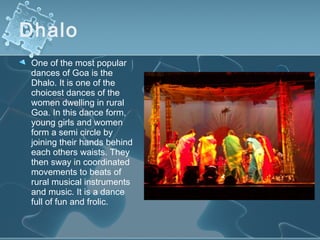
Dhalo
 One of the most popular
 dances of Goa is the
 Dhalo. It is one of the
 choicest dances of the
 women dwelling in rural
 Goa. In this dance form,
 young girls and women
 form a semi circle by
 joining their hands behind
 each others waists. They
 then sway in coordinated
 movements to beats of
 rural musical instruments
 and music. It is a dance
 full of fun and frolic.
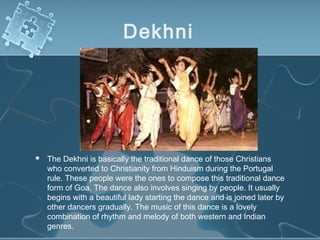
Dekhni


   The Dekhni is basically the traditional dance of those Christians
    who converted to Christianity from Hinduism during the Portugal
    rule. These people were the ones to compose this traditional dance
    form of Goa. The dance also involves singing by people. It usually
    begins with a beautiful lady starting the dance and is joined later by
    other dancers gradually. The music of this dance is a lovely
    combination of rhythm and melody of both western and Indian
    genres.
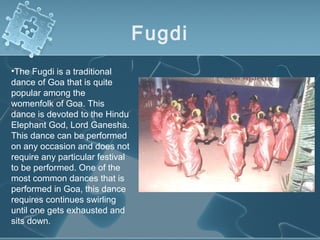
Fugdi
•The Fugdi is a traditional
dance of Goa that is quite
popular among the
womenfolk of Goa. This
dance is devoted to the Hindu
Elephant God, Lord Ganesha.
This dance can be performed
on any occasion and does not
require any particular festival
to be performed. One of the
most common dances that is
performed in Goa, this dance
requires continues swirling
until one gets exhausted and
sits down.
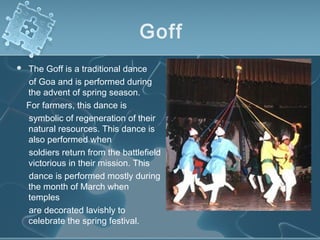
Goff
   The Goff is a traditional dance
    of Goa and is performed during
    the advent of spring season.
    For farmers, this dance is
    symbolic of regeneration of their
    natural resources. This dance is
    also performed when
    soldiers return from the battlefield
    victorious in their mission. This
    dance is performed mostly during
    the month of March when
    temples
    are decorated lavishly to
    celebrate the spring festival.
Kunbi
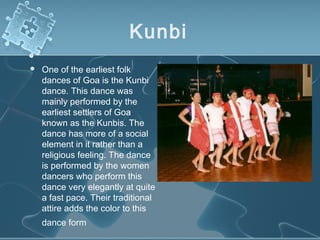
   One of the earliest folk
    dances of Goa is the Kunbi
    dance. This dance was
    mainly performed by the
    earliest settlers of Goa
    known as the Kunbis. The
    dance has more of a social
    element in it rather than a
    religious feeling. The dance
    is performed by the women
    dancers who perform this
    dance very elegantly at quite
    a fast pace. Their traditional
    attire adds the color to this
    dance form
Lamp


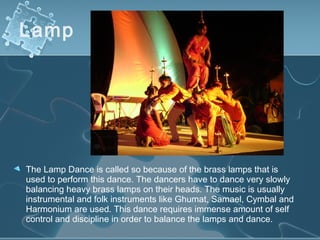
The Lamp Dance is called so because of the brass lamps that is
used to perform this dance. The dancers have to dance very slowly
balancing heavy brass lamps on their heads. The music is usually
instrumental and folk instruments like Ghumat, Samael, Cymbal and
Harmonium are used. This dance requires immense amount of self
control and discipline in order to balance the lamps and dance.
Corridinho
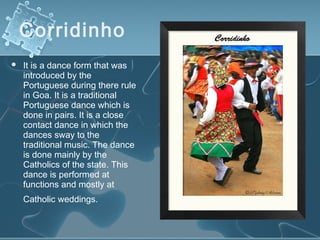
   It is a dance form that was
    introduced by the
    Portuguese during there rule
    in Goa. It is a traditional
    Portuguese dance which is
    done in pairs. It is a close
    contact dance in which the
    dances sway to the
    traditional music. The dance
    is done mainly by the
    Catholics of the state. This
    dance is performed at
    functions and mostly at
    Catholic weddings.
MUSIC
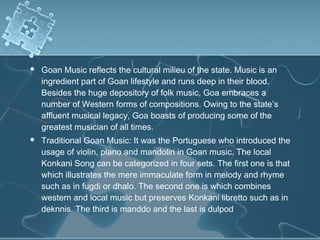
   Goan Music reflects the cultural milieu of the state. Music is an
    ingredient part of Goan lifestyle and runs deep in their blood.
    Besides the huge depository of folk music, Goa embraces a
    number of Western forms of compositions. Owing to the state’s
    affluent musical legacy, Goa boasts of producing some of the
    greatest musician of all times.
   Traditional Goan Music: It was the Portuguese who introduced the
    usage of violin, piano and mandolin in Goan music. The local
    Konkani Song can be categorized in four sets. The first one is that
    which illustrates the mere immaculate form in melody and rhyme
    such as in fugdi or dhalo. The second one is which combines
    western and local music but preserves Konkani libretto such as in
    deknnis. The third is manddo and the last is dulpod
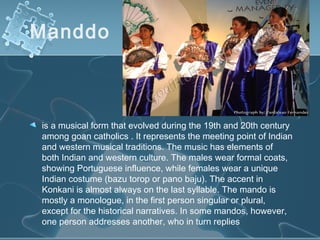
Manddo 


is a musical form that evolved during the 19th and 20th century
among goan catholics . It represents the meeting point of Indian
and western musical traditions. The music has elements of
both Indian and western culture. The males wear formal coats,
showing Portuguese influence, while females wear a unique
Indian costume (bazu torop or pano baju). The accent in
Konkani is almost always on the last syllable. The mando is
mostly a monologue, in the first person singular or plural,
except for the historical narratives. In some mandos, however,
one person addresses another, who in turn replies
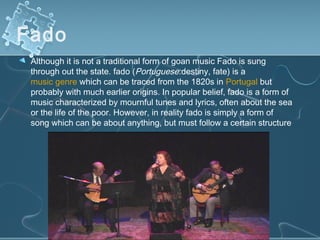
Fado 
 Although it is not a traditional form of goan music Fado is sung
 through out the state. fado (Portuguese:destiny, fate) is a 
 music genre which can be traced from the 1820s in Portugal but
 probably with much earlier origins. In popular belief, fado is a form of
 music characterized by mournful tunes and lyrics, often about the sea
 or the life of the poor. However, in reality fado is simply a form of
 song which can be about anything, but must follow a certain structure
DRAMA
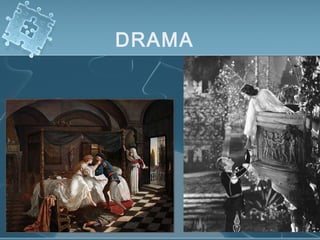
   Being rich in culture and heritage, the Goans have
    myriads of performing arts. Drama is one of them. The
    highlight of Goan drama, however, is their folk drama.
    Jagar and Tiatr are the names of two of the chief forms.
    However, the list does not end there. There is more to
    Goan drama forms. Some of the others are Ranmale,
    Dashavatari, Kalo, Goulankala, Lalit, Kala and Rathkala.
    All the folk dramas practiced in Goa use the narrative style
    with the complimentary help of song and dance. The
    stories that they narrate are mostly those from the
    Ramayana and the Mahabharata. However, with changing
    times, these dance dramas have remodeled themselves to
    include modern-day social issues as well.
Jagar
      Of all these forms of dance drama narratives, Jagar is the earliest in
       origin. Jagar is divided into two different categories based on the
      class and caste of the people who perform it. In no particular order,
the first is the Perani Jagar and the second is the Gawda Jagar. The former
       is acted out only by the Hindus; while the latter is enacted by the
       Christians. The latter form of Jagar has different types and can be
       interpreted both by the actors and the audiences in different fashions.
       Most of the themes are thus derived from contemporary social life.
       The Perina Jagar is performed by the Hindu Perani community. The
       other form, Gawda Jagar is performed by Christian Gawda
       community.
      The Perani Jagar involves performances based on the concepts of
       origin. Mythology plays an important part in many of the
       performances. This is exclusively performed by the Hindu community
       of Goa. You will learn much about the beliefs of the people.The
       mythological aspects makes it more colorful.
      The Gawda Jagar in contrast to Perani portrays the rural lifestyle in
       Goan villages. If you interested in knowing about the people of Goa,
       you should watch one of the Jagar Gawda performances. This is
       strictly performed by the Christian community of Gawda in Goa.
Tiatr


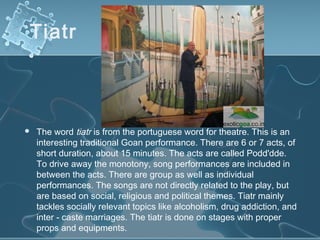
   The word tiatr is from the portuguese word for theatre. This is an
    interesting traditional Goan performance. There are 6 or 7 acts, of
    short duration, about 15 minutes. The acts are called Podd'dde.
    To drive away the monotony, song performances are included in
    between the acts. There are group as well as individual
    performances. The songs are not directly related to the play, but
    are based on social, religious and political themes. Tiatr mainly
    tackles socially relevant topics like alcoholism, drug addiction, and
    inter - caste marriages. The tiatr is done on stages with proper
    props and equipments.
   Khell Tiatr is a form of Tiatr, the only difference being in the
    songs which, unlike those in the Tiatr are related to the story
    being told. Khell tiatr is often done with out a stage in open
    areas for the locality to watch like a street play.
   To help in the promotion of entertainment facilities two
    organizations are working hard on this. They not only promote
    traditional but also more modern form of entertainment.
Entertainment Society of
Goa (ESG)
   Established by the Government of Goa in 2004, as the nodal
    agency in the organization of the International Film Festival of
    India (IFFI), the main objective of the Entertainment Society of
    Goa (ESG) is to frame an entertainment policy to help cultivate
    Goa into a world-class international entertainment nerve center
    of the country.
   Successfully hosting the 35th, 36th ,37th, 38th, 39th and 40th
    International Film Festival of India to a glare of media and
    fanfare, the objective of the Entertainment Society of Goa is to
    work towards building global visibility and branding. This goal
    ensures that the State earns revenue on a long term basis from
    ventures in film entertainment and leisure projects.
   Spearheading this objective by hosting the International Film
    Festival of India, the Entertainment Society of India believes in
    making a concerted effort to build a year-round event calendar,
    encouraging joint co-productions with international brands in
    the field of cinema, marketing and branding Goa through
    ventures that focus on entertainment and its allied activities. 
   Building on its mandate to create public consciousness about
    films and film festivals, the Entertainment Society of Goa
    endeavours to inculcate a cinematic sense of appreciation and
    infrastructure to attract international standard film studios, film
    institutes and build comprehensive facilities and provide
    services for telecommunications, entertainment and its allied
    products, through a self-sustaining pattern of revenue
    generation
Goa Tourism Development
Corporation (GTDC)
   For almost three decades now GTDC (Goa Tourism
    Development Corporation) has been at the helm of the tourism
    industry in Goa. We have quite literally been the helmsman on
    board inviting and guiding tourists from the country and from
    abroad on an engaging and edifying journey across the
    beautiful land of Goa.
    
   Set up as a Public Limited Company with a Memorandum and
    Articles of Association with a fullfledged Board of Directors, we
    have been both generous host and guide to millions of visitors
    from India and across the globe over the years. GTDC plays an
    active role in all commercial aspects of tourism, including
    providing accommodation, organizing sightseeing tours, cruises
    and other attractive packages.
CRM Processes / Mapping
   Goa Tourism Development Corporation strive to provide the
    finest Tourism related services to our guests. We vow never to
    sacrifice our professional integrity and to produce the highest
    quality work possible and pledge to stay true to it. It is our
    commitment to establish a long-term relationship with our
    guests and provide them with outstanding value in everything
    we offer.
   The GTDC conducts tours by road to cover every nook and
    corner of places of tourist interest in Goa. Tours are carefully
    designed to cater to all classes of tourists living at the
    residencies which enjoy excellent locations all over the state.
    Tour groups are accommodated in buses and cars. The tours
    leave from North or South Goa, exploring the entire state.
   Sea and river cruises are very much part of a visitor’s itinerary.
    GTDC invites visitors on balmy and exhilarating cruises on the
    ‘Santa Monica’ launch, the catamaran ‘Shantadurga’ and on
    the ML ‘Poseidon’. Enjoy the calm waters of the River Mandovi,
    golden sunsets, live music and games on these memorable
    cruises.
   The Goa Tourism Development Corporation also promotes the
    many festivals which are a great form of entertainment in the
    state.
Thank you

entertainment in goa

  • 1.
  • 2.
    Goa is Known for its unlimited amount of fun and excitement. Goans greet their guests with open arms. As it has been in touch with varied outsiders, a cosmopolitan form of culture flourishes here, making this place somehow special in the country.  Goa is known for it party and morden dances and disco. But Goa has more to it than that, against what the rest of the world thinks Goa has a rich traditional heritage and there is a lot of traditional form of entertainment in the state.  Entertainment in Goa is mainly in the form of Dance, Music, & Drama apart from which there are many other forms of entertainment.
  • 3.
  • 4.
    When one talksabout the dances of Goa, your imagination tends to stop at people dancing to trance and techno music. In case you didn't know, the Goan dances extend much beyond those rave late night parties at beaches. The traditional dance of Goa gives a picture of the mindset and lifestyle of Goans. They reflect the rich historical and cultural legacy that Goa abounds in. Goa has a unique amalgamation of different cultures and the Goan dances portray this blend of different faiths very beautifully . Some of the famous Goan dances are as follows:
  • 5.
    Dhalo One ofthe most popular dances of Goa is the Dhalo. It is one of the choicest dances of the women dwelling in rural Goa. In this dance form, young girls and women form a semi circle by joining their hands behind each others waists. They then sway in coordinated movements to beats of rural musical instruments and music. It is a dance full of fun and frolic.
  • 6.
    Dekhni  The Dekhni is basically the traditional dance of those Christians who converted to Christianity from Hinduism during the Portugal rule. These people were the ones to compose this traditional dance form of Goa. The dance also involves singing by people. It usually begins with a beautiful lady starting the dance and is joined later by other dancers gradually. The music of this dance is a lovely combination of rhythm and melody of both western and Indian genres.
  • 7.
    Fugdi •The Fugdi isa traditional dance of Goa that is quite popular among the womenfolk of Goa. This dance is devoted to the Hindu Elephant God, Lord Ganesha. This dance can be performed on any occasion and does not require any particular festival to be performed. One of the most common dances that is performed in Goa, this dance requires continues swirling until one gets exhausted and sits down.
  • 8.
    Goff  The Goff is a traditional dance of Goa and is performed during the advent of spring season. For farmers, this dance is symbolic of regeneration of their natural resources. This dance is also performed when soldiers return from the battlefield victorious in their mission. This dance is performed mostly during the month of March when temples are decorated lavishly to celebrate the spring festival.
  • 9.
    Kunbi  One of the earliest folk dances of Goa is the Kunbi dance. This dance was mainly performed by the earliest settlers of Goa known as the Kunbis. The dance has more of a social element in it rather than a religious feeling. The dance is performed by the women dancers who perform this dance very elegantly at quite a fast pace. Their traditional attire adds the color to this dance form
  • 10.
    Lamp The Lamp Danceis called so because of the brass lamps that is used to perform this dance. The dancers have to dance very slowly balancing heavy brass lamps on their heads. The music is usually instrumental and folk instruments like Ghumat, Samael, Cymbal and Harmonium are used. This dance requires immense amount of self control and discipline in order to balance the lamps and dance.
  • 11.
    Corridinho  It is a dance form that was introduced by the Portuguese during there rule in Goa. It is a traditional Portuguese dance which is done in pairs. It is a close contact dance in which the dances sway to the traditional music. The dance is done mainly by the Catholics of the state. This dance is performed at functions and mostly at Catholic weddings.
  • 12.
  • 13.
    Goan Music reflects the cultural milieu of the state. Music is an ingredient part of Goan lifestyle and runs deep in their blood. Besides the huge depository of folk music, Goa embraces a number of Western forms of compositions. Owing to the state’s affluent musical legacy, Goa boasts of producing some of the greatest musician of all times.  Traditional Goan Music: It was the Portuguese who introduced the usage of violin, piano and mandolin in Goan music. The local Konkani Song can be categorized in four sets. The first one is that which illustrates the mere immaculate form in melody and rhyme such as in fugdi or dhalo. The second one is which combines western and local music but preserves Konkani libretto such as in deknnis. The third is manddo and the last is dulpod
  • 14.
    Manddo  is a musicalform that evolved during the 19th and 20th century among goan catholics . It represents the meeting point of Indian and western musical traditions. The music has elements of both Indian and western culture. The males wear formal coats, showing Portuguese influence, while females wear a unique Indian costume (bazu torop or pano baju). The accent in Konkani is almost always on the last syllable. The mando is mostly a monologue, in the first person singular or plural, except for the historical narratives. In some mandos, however, one person addresses another, who in turn replies
  • 15.
    Fado  Although itis not a traditional form of goan music Fado is sung through out the state. fado (Portuguese:destiny, fate) is a  music genre which can be traced from the 1820s in Portugal but probably with much earlier origins. In popular belief, fado is a form of music characterized by mournful tunes and lyrics, often about the sea or the life of the poor. However, in reality fado is simply a form of song which can be about anything, but must follow a certain structure
  • 16.
  • 17.
    Being rich in culture and heritage, the Goans have myriads of performing arts. Drama is one of them. The highlight of Goan drama, however, is their folk drama. Jagar and Tiatr are the names of two of the chief forms. However, the list does not end there. There is more to Goan drama forms. Some of the others are Ranmale, Dashavatari, Kalo, Goulankala, Lalit, Kala and Rathkala. All the folk dramas practiced in Goa use the narrative style with the complimentary help of song and dance. The stories that they narrate are mostly those from the Ramayana and the Mahabharata. However, with changing times, these dance dramas have remodeled themselves to include modern-day social issues as well.
  • 18.
    Jagar  Of all these forms of dance drama narratives, Jagar is the earliest in origin. Jagar is divided into two different categories based on the class and caste of the people who perform it. In no particular order, the first is the Perani Jagar and the second is the Gawda Jagar. The former is acted out only by the Hindus; while the latter is enacted by the Christians. The latter form of Jagar has different types and can be interpreted both by the actors and the audiences in different fashions. Most of the themes are thus derived from contemporary social life. The Perina Jagar is performed by the Hindu Perani community. The other form, Gawda Jagar is performed by Christian Gawda community.  The Perani Jagar involves performances based on the concepts of origin. Mythology plays an important part in many of the performances. This is exclusively performed by the Hindu community of Goa. You will learn much about the beliefs of the people.The mythological aspects makes it more colorful.  The Gawda Jagar in contrast to Perani portrays the rural lifestyle in Goan villages. If you interested in knowing about the people of Goa, you should watch one of the Jagar Gawda performances. This is strictly performed by the Christian community of Gawda in Goa.
  • 19.
    Tiatr  The word tiatr is from the portuguese word for theatre. This is an interesting traditional Goan performance. There are 6 or 7 acts, of short duration, about 15 minutes. The acts are called Podd'dde. To drive away the monotony, song performances are included in between the acts. There are group as well as individual performances. The songs are not directly related to the play, but are based on social, religious and political themes. Tiatr mainly tackles socially relevant topics like alcoholism, drug addiction, and inter - caste marriages. The tiatr is done on stages with proper props and equipments.
  • 20.
    Khell Tiatr is a form of Tiatr, the only difference being in the songs which, unlike those in the Tiatr are related to the story being told. Khell tiatr is often done with out a stage in open areas for the locality to watch like a street play.  To help in the promotion of entertainment facilities two organizations are working hard on this. They not only promote traditional but also more modern form of entertainment.
  • 21.
    Entertainment Society of Goa (ESG)  Established by the Government of Goa in 2004, as the nodal agency in the organization of the International Film Festival of India (IFFI), the main objective of the Entertainment Society of Goa (ESG) is to frame an entertainment policy to help cultivate Goa into a world-class international entertainment nerve center of the country.  Successfully hosting the 35th, 36th ,37th, 38th, 39th and 40th International Film Festival of India to a glare of media and fanfare, the objective of the Entertainment Society of Goa is to work towards building global visibility and branding. This goal ensures that the State earns revenue on a long term basis from ventures in film entertainment and leisure projects.
  • 22.
    Spearheading this objective by hosting the International Film Festival of India, the Entertainment Society of India believes in making a concerted effort to build a year-round event calendar, encouraging joint co-productions with international brands in the field of cinema, marketing and branding Goa through ventures that focus on entertainment and its allied activities.   Building on its mandate to create public consciousness about films and film festivals, the Entertainment Society of Goa endeavours to inculcate a cinematic sense of appreciation and infrastructure to attract international standard film studios, film institutes and build comprehensive facilities and provide services for telecommunications, entertainment and its allied products, through a self-sustaining pattern of revenue generation
  • 23.
    Goa Tourism Development Corporation(GTDC)  For almost three decades now GTDC (Goa Tourism Development Corporation) has been at the helm of the tourism industry in Goa. We have quite literally been the helmsman on board inviting and guiding tourists from the country and from abroad on an engaging and edifying journey across the beautiful land of Goa.     Set up as a Public Limited Company with a Memorandum and Articles of Association with a fullfledged Board of Directors, we have been both generous host and guide to millions of visitors from India and across the globe over the years. GTDC plays an active role in all commercial aspects of tourism, including providing accommodation, organizing sightseeing tours, cruises and other attractive packages.
  • 24.
    CRM Processes /Mapping  Goa Tourism Development Corporation strive to provide the finest Tourism related services to our guests. We vow never to sacrifice our professional integrity and to produce the highest quality work possible and pledge to stay true to it. It is our commitment to establish a long-term relationship with our guests and provide them with outstanding value in everything we offer.  The GTDC conducts tours by road to cover every nook and corner of places of tourist interest in Goa. Tours are carefully designed to cater to all classes of tourists living at the residencies which enjoy excellent locations all over the state. Tour groups are accommodated in buses and cars. The tours leave from North or South Goa, exploring the entire state.
  • 25.
    Sea and river cruises are very much part of a visitor’s itinerary. GTDC invites visitors on balmy and exhilarating cruises on the ‘Santa Monica’ launch, the catamaran ‘Shantadurga’ and on the ML ‘Poseidon’. Enjoy the calm waters of the River Mandovi, golden sunsets, live music and games on these memorable cruises.  The Goa Tourism Development Corporation also promotes the many festivals which are a great form of entertainment in the state.
  • 26.

Editor's Notes

  • #7 Answering the question is not so easy. Contact centers, data aggregation systems and Web sites are just a few examples.
  • #8 Customer service excellence is an important differentiator for many companies, especially in financial services. Everyone wants to be the best, so the idea of CRM make a lot of good sense. Taking good care of customers is turning out to be more complicated and more expensive.
  • #9 Basically needs to deliver customer-centric business processes and operations. Provides the primary customer touch points, and allows an organization to create standard customer profiles, understand buying needs and get first-hand feedback from an organization’s most valuable asset—its customers
  • #10 Basically needs to deliver customer-centric business processes and operations.
  • #18 Example: If your business strategy calls for a strong Internet presence, then your customer service strategy must provide for comprehensive customer service via the Web. Implementing a successful CRM is a lot like implementing an ERP