קוים מנחים Harnessingcollective intelligence Wisdom of the crowd The web as a platforms
5.
“ Architecture ofparticipation ” …encourage users to actively contribute content, to share information, to collaborate and to add value... Being participation centered, Web2.0 applications are often referred to as Social Software or Social Media . (Dion Hinchcliff)
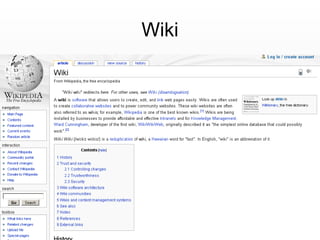
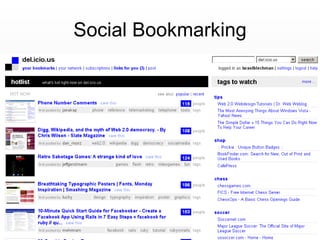
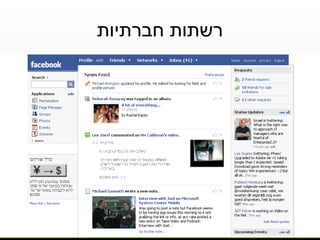
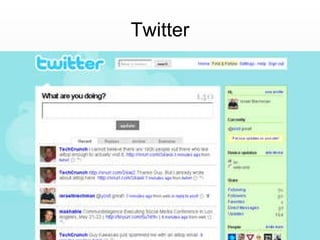
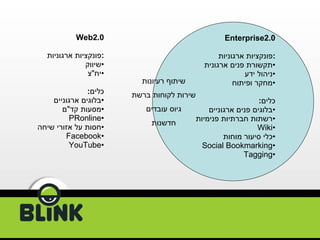
Web2.0 פונקציות ארגוניות: שיווק יח " צ כלים : בלוגים ארגוניים מסעות קד " ם PRonline חסות על אזורי שיחה Facebook YouTube Enterprise2.0 פונקציות ארגוניות : תקשורת פנים ארגונית ניהול ידע מחקר ופיתוח כלים : בלוגים פנים ארגוניים רשתות חברתיות פנימיות Wiki כלי סיעור מוחות Social Bookmarking Tagging שיתוף רעיונות שירות לקוחות ברשת גיוס עובדים חדשנות
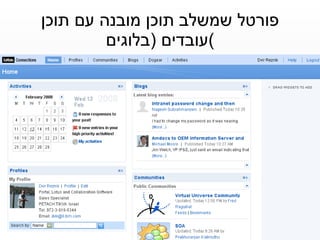
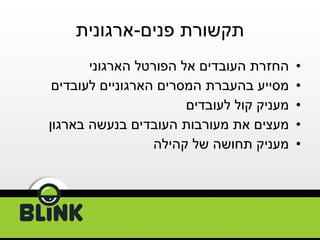
תקשורת פנים -ארגונית החזרת העובדים אל הפורטל הארגוני מסייע בהעברת המסרים הארגוניים לעובדים מעניק קול לעובדים מעצים את מעורבות העובדים בנעשה בארגון מעניק תחושה של קהילה
27.
חדשנות מוציא אתהחדשנות אל מחוץ למחלקות המחקר והפיתוח . מעודד עבודה וחשיבה שיתופית .
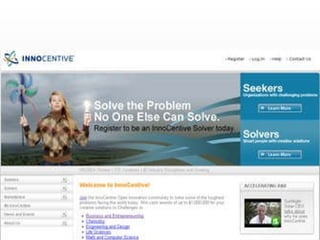
P&G improved R&Dproductivity “… the CEO declared that by the end of 2010, 50% of the R&D efforts would be successful thus increasing productivity by 30%. In order to pull this off, the CEO turned outside the organization for help. That is to say, he turned to Web 2.0 tools for help and gain access to the millions of potential contributors. …The result? More than 35% of the ideas now come from outside the R&D department and productivity has soared 60%. Almost 80% of the product launches are successful as compared to 30% for the industry.” (Dr. Todd Stephens, Social Software expert, AT&T)
31.
32.
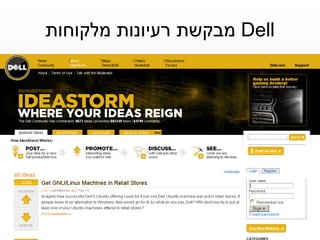
Salesforce.com develop newfeature with customers in 2006, the company hit on a solution: IdeaExchange, a groundswell application that enables customers not only to suggest feature ideas but to vote on them, with the most popular ideas eventually floating to the top of the list, while the less popular ones drift away. The application has been a huge success. Thanks to it, Salesforce.com was able to ship four new releases in 2007, in contrast to only two the year before. And recent releases now contain three times as many new features as in previous years. (MIT Sloan)
33.
IBM improved customersrelations and employee productivity “ Social computing has helped IBM become more approachable to customers , and more innovative . A lot of customers interact with specific Lotus bloggers, asking about features of Lotus products, giving feedback on how to improve and features they would like to see. IBM pays attention to this, and a lot of those suggestions do make it into the products. Social computing also contributes to employee productivity by increasing mutual synergy .” (John Rooney, head of the Technology Innovation Team in IBM)
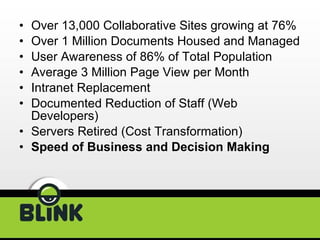
AT&T increased employee’sengagement “ Our collaborative team and intranet environment expanded to 28,000 sites. The social software emerged as one of the favorite communication mediums where the wiki pages exceeded 2,500 and we had over 200 blogs. All of this was accomplished in just over 6 months while the company went through a major reorganization. (Dr. Todd Stephens, Social Software expert, AT&T)
37.
Over 13,000 CollaborativeSites growing at 76% Over 1 Million Documents Housed and Managed User Awareness of 86% of Total Population Average 3 Million Page View per Month Intranet Replacement Documented Reduction of Staff (Web Developers) Servers Retired (Cost Transformation) Speed of Business and Decision Making
38.
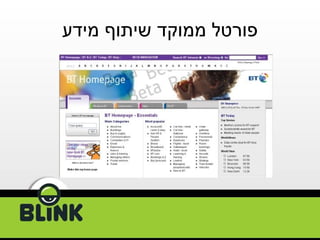
BT is preparedfor next generation employees “ As well as meeting the needs of today’s workforce, we are mindful of the needs of those entering the workforce over the coming years – so called Generation Y – for whom this technology is second nature and an important part of how they interact and manage their time. The extent to which a company adopts user generated tools is bound to become a barometer of company culture for those looking for suitable employment in the future ” (Richard Dennison, Knowledge Management Architect, BT)
39.
40.
41.
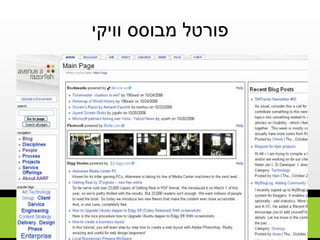
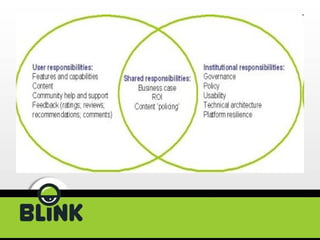
Our experience suggeststhat it is better to start small with simple and cheap tools with limited functionality. Let users dictate the direction and speed of adoption . Allow users to dictate how they are going to derive value from new tools and don’t be afraid to shut down applications that are withering on the vine. Let users play with new tools as soon as possible , warts and all. We positioned all our social media tools are ‘beta’ applications when they were first released to set the right user expectations. Engage the policy makers as early as possible . Emphasize that these tools represent an evolution rather than a revolution in the use of the web. After all, it’s just another form of content management.


![Blink ( http:// blinkit.co.il ) Address: 7 Bejerano Brothers, Ramat Gan Phone: +972-3-6119736 Fax: +972-3-6119767 Email: [email_address]](https://image.slidesharecdn.com/enterprise2-0-hebrew-1208350384143982-8/85/Enterprise2-0-Hebrew-2-0-45-320.jpg)