
Enterprise Portals 2.0 Monte Kluemper Principal Sales Consultant - Enterprise 2.0 Oracle Spain
Remember what portals looked like before Web 2.0?
Most information was published to users by authorized content authors or technical Webmasters.
Integrating enterprise applications was essential both for achieving ROI on the portal and for increasing user productivity.
Portal administration often needed to be delegated to departmental owners
The underlying portal framework had to be scalable, secure and easy to manage.
OK.  But Web 2.0 has changed all that, right?
Wrong!  Enterprise Portals still need all these things: Processes for publishing content to users Integration with enterprise applications Delegated administration of portals Enterprise scalability, security, and control
Still, Web 2.0 has changed the expectations of users regarding how they interact with portals
Users expect to be able to  generate and upload  their own content Blogs Wikis Documents Media (Photos, Video) Web Articles
They also expect to be able to  provide feedback  for existing content Discussions Comments Ratings Rankings Tags Links
They want to be able to  mashup data and components  inside and outside the portal Composite Apps Hybrids Mashups Widgets RSS / Syndication
They want to be able to share and contrast information with people inside their  social network Profiles / Friends Activity Tracking Presence / IM
And you better offer a  sexy interface  if you want users to use your portal as part of their daily routine and recommend it to others Partial Refresh Drag&Drop AJAX Updates Push OCC Smart Clients
So, what is Oracle doing?
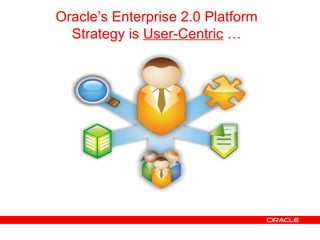
Oracle’s Enterprise 2.0 Platform Strategy is  User-Centric  …
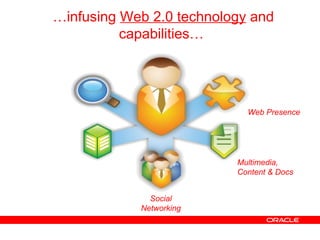
Social Networking Multimedia, Content & Docs Web Presence … infusing  Web 2.0 technology  and capabilities…
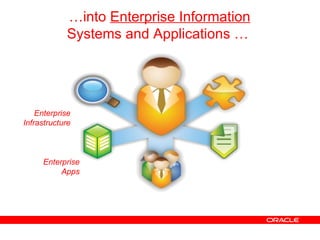
Enterprise Apps Enterprise Infrastructure … into  Enterprise Information  Systems and Applications …
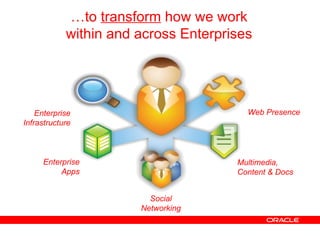
Social Networking Multimedia, Content & Docs Enterprise Apps Enterprise Infrastructure Web Presence … to  transform  how we work within and across Enterprises
Enterprise 2.0 transforms business by providing information in  CONTEXT … … and by enabling  PARTICIPATION
CONTEXT is fundamental for ensuring that information can be found when needed
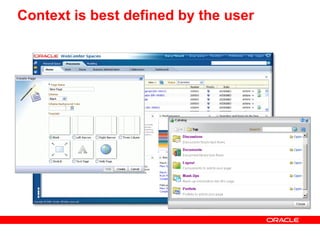
Context is best defined by the user
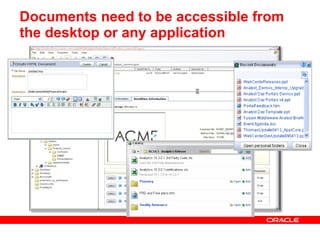
Documents need to be accessible from the desktop or any application
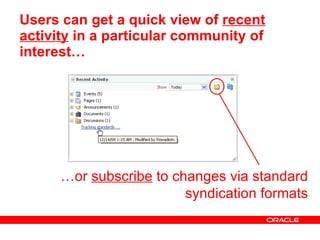
Users can get a quick view of  recent activity  in a particular community of interest…  … or  subscribe  to changes via standard syndication formats
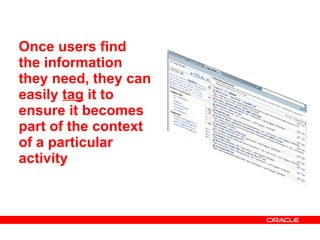
Once users find the information they need, they can easily  tag  it to ensure it becomes part of the context of a particular activity
USER PARTICIPATION is necessary to ensure that mission-critical information gets into the system
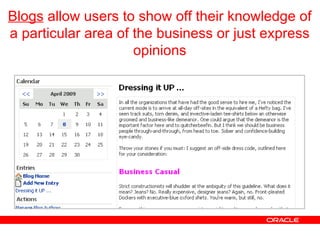
Blogs  allow users to show off their knowledge of a particular area of the business or just express opinions
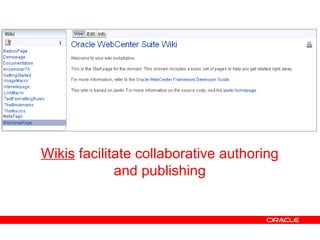
Wikis  facilitate collaborative authoring and publishing
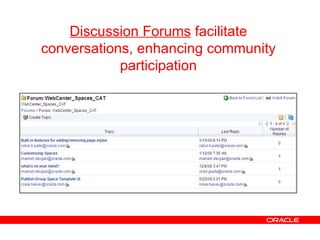
Discussion Forums  facilitate conversations, enhancing community participation
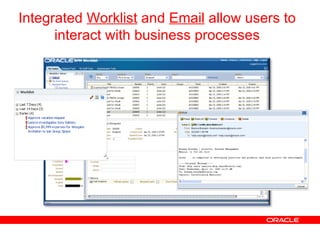
Integrated  Worklist  and  Email  allow users to interact with business processes
Sounds like a great strategy…but is any of this real?
Oracle WebCenter Suite Portal and community frameworks Portable Web 2.0 components Oracle Universal Content Mgmt In-context web content management Conversion, transformation, and reuse Oracle Secure Enterprise Search Scalable, secure search engine Oracle Beehive Collaborative services for the enterprise Oracle Enterprise 2.0 Platform
WebCenter Suite 11g was released this summer to rave reviews…
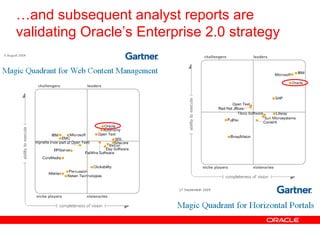
… and subsequent analyst reports are validating Oracle’s Enterprise 2.0 strategy
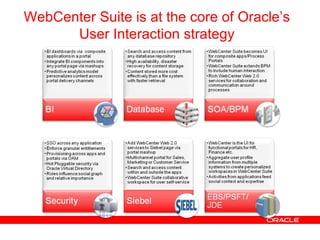
WebCenter Suite is at the core of Oracle’s User Interaction strategy
Enterprise 2.0 is ORACLE A  user-centric  platform combining  enterprise apps  and data with  Web 2.0 technologies  and capabilities to  TRANSFORM  the way users work.
 

Enterprise Portals 2.0 in Oracle

  • 1.
    Enterprise Portals 2.0Monte Kluemper Principal Sales Consultant - Enterprise 2.0 Oracle Spain
  • 2.
    Remember what portalslooked like before Web 2.0?
  • 3.
    Most information waspublished to users by authorized content authors or technical Webmasters.
  • 4.
    Integrating enterprise applicationswas essential both for achieving ROI on the portal and for increasing user productivity.
  • 5.
    Portal administration oftenneeded to be delegated to departmental owners
  • 6.
    The underlying portalframework had to be scalable, secure and easy to manage.
  • 7.
    OK. ButWeb 2.0 has changed all that, right?
  • 8.
    Wrong! EnterprisePortals still need all these things: Processes for publishing content to users Integration with enterprise applications Delegated administration of portals Enterprise scalability, security, and control
  • 9.
    Still, Web 2.0has changed the expectations of users regarding how they interact with portals
  • 10.
    Users expect tobe able to generate and upload their own content Blogs Wikis Documents Media (Photos, Video) Web Articles
  • 11.
    They also expectto be able to provide feedback for existing content Discussions Comments Ratings Rankings Tags Links
  • 12.
    They want tobe able to mashup data and components inside and outside the portal Composite Apps Hybrids Mashups Widgets RSS / Syndication
  • 13.
    They want tobe able to share and contrast information with people inside their social network Profiles / Friends Activity Tracking Presence / IM
  • 14.
    And you betteroffer a sexy interface if you want users to use your portal as part of their daily routine and recommend it to others Partial Refresh Drag&Drop AJAX Updates Push OCC Smart Clients
  • 15.
    So, what isOracle doing?
  • 16.
    Oracle’s Enterprise 2.0Platform Strategy is User-Centric …
  • 17.
    Social Networking Multimedia,Content & Docs Web Presence … infusing Web 2.0 technology and capabilities…
  • 18.
    Enterprise Apps EnterpriseInfrastructure … into Enterprise Information Systems and Applications …
  • 19.
    Social Networking Multimedia,Content & Docs Enterprise Apps Enterprise Infrastructure Web Presence … to transform how we work within and across Enterprises
  • 20.
    Enterprise 2.0 transformsbusiness by providing information in CONTEXT … … and by enabling PARTICIPATION
  • 21.
    CONTEXT is fundamentalfor ensuring that information can be found when needed
  • 22.
    Context is bestdefined by the user
  • 23.
    Documents need tobe accessible from the desktop or any application
  • 24.
    Users can geta quick view of recent activity in a particular community of interest… … or subscribe to changes via standard syndication formats
  • 25.
    Once users findthe information they need, they can easily tag it to ensure it becomes part of the context of a particular activity
  • 26.
    USER PARTICIPATION isnecessary to ensure that mission-critical information gets into the system
  • 27.
    Blogs allowusers to show off their knowledge of a particular area of the business or just express opinions
  • 28.
    Wikis facilitatecollaborative authoring and publishing
  • 29.
    Discussion Forums facilitate conversations, enhancing community participation
  • 30.
    Integrated Worklist and Email allow users to interact with business processes
  • 31.
    Sounds like agreat strategy…but is any of this real?
  • 32.
    Oracle WebCenter SuitePortal and community frameworks Portable Web 2.0 components Oracle Universal Content Mgmt In-context web content management Conversion, transformation, and reuse Oracle Secure Enterprise Search Scalable, secure search engine Oracle Beehive Collaborative services for the enterprise Oracle Enterprise 2.0 Platform
  • 33.
    WebCenter Suite 11gwas released this summer to rave reviews…
  • 34.
    … and subsequentanalyst reports are validating Oracle’s Enterprise 2.0 strategy
  • 35.
    WebCenter Suite isat the core of Oracle’s User Interaction strategy
  • 36.
    Enterprise 2.0 isORACLE A user-centric platform combining enterprise apps and data with Web 2.0 technologies and capabilities to TRANSFORM the way users work.
  • 37.

Editor's Notes

  • #24 Windows Explorer Drag-&-drop check-in Double-click check-out Content Preview Pane Email Integrations Drag-&-drop email Access managed content Outlook & Lotus Notes Desktop Applications MS Office, etc. Enterprise Applications E-Business Suite, Siebel, Siebel
  • #25 A secure dynamic snapshot of recent business interactions to key community assets Tracks recent activities in an application/scope – includes changes in Pages, Announcements, Documents, Discussions, and Lists Search based Honors underlying privileges provisioned for given services Supports RSS publishing
  • #26 Key Capabilities Users can tag any artifact Tag Cloud Views for private and public tags Integrated with Search Pre-built portlets for creating, managing and viewing tags Influences expertise recommendations Benefits User-generated taxonomy (folksonomy) facilitates more effective search/navigation and easier sharing with others
  • #28 Personal Publishing Capabilities for Users Simplified creation of personal logs and journals Supports sharing of personal opinions and ideas
  • #29 Collaborative Authoring and Publishing Easy document creation, editing, and access Facilitates sharing of knowledge and ideas
  • #30 Enhances Community Participation, Question Resolution & Knowledge Reuse Discussion on any WebCenter object Create forums, topics, and posts Organize by favorites, critical or popular topics Multiple Task Flows in Resource Catalog
  • #31 Extend Process-Based Applications to the Portal Build process portals that combine process with content and social interaction Extend process and communication to partners with B2B sites BPEL Worklist integrates tasks directly within the portal Seemless view of work across many applications Aggregate Worklists from multiple BPEL processes