Enter the World of Business
Warren Buffet: The Oracle of Omaha
Warren Buffett did not change his life plans when he was
rejected by Harvard. An avid reader with a photographic
memory, he persevered. He researched other universities and
discovered that Benjamin Graham, the author of the The
Intelligent Investor, was a professor at Columbia University. He
immediately enrolled there, was accepted, and became the star
pupil and eventual partner of the famous Graham. After
graduating, Buffett started a lucrative career, taking ownership
in companies that he believed would do well in business.
Buffett’s company, Berkshire Hathaway, has become a
conglomerate with ownership in well-performing companies,
including Geico, Heinz, Benjamin Moore, and See’s Candies.
Because Berkshire Hathaway owns companies in so many
different industries, it reduces the risk that the failure of any
one industry will significantly affect the company. Most
importantly, Buffett believes in these firms and their value, a
strategy that has made him one of the 10 richest people in the
world.
Leading such a variety of companies comes with challenges as
well. Companies require leaders who know the business and
have specialized expertise—something nearly impossible for
one person to do with so many different business areas. For this
reason, Buffett depends on his managers to lead the various
companies. He believes giving his managers autonomy allows
them to achieve their highest performance. He wants his
managers to “own” their job. By hiring knowledgeable
managers and empowering them to run the companies as they
believe best, Buffett is able to lead his vast business
conglomerate successfully.
Buffett’s organizational leadership philosophy includes
focusing on the business. At his headquarters, 25 people run the
organization. He encourages entrepreneurs “to focus on the
business and not growing a large staff.” Buffett has earned the
moniker “Oracle of Omaha” because he has lived there most of
his life and many investors follow his advice and decisions.1
LO 1-1
Define basic concepts such as business, product, profit, and
economics.
Introduction
We begin our study of business in this chapter by examining the
fundamentals of business and economics. First, we introduce the
nature of business, including its goals, activities, and
participants. Next, we describe the basics of economics and
apply them to the U.S. economy. Finally, we establish a
framework for studying business in this text.
The Nature of Business
A business tries to earn a profit by providing products that
satisfy people’s needs. The outcomes of its efforts
are products that have both tangible and intangible
characteristics that provide satisfaction and benefits. When you
purchase a product, you are buying the benefits and satisfaction
you think the product will provide. A Subway sandwich, for
example, may be purchased to satisfy hunger, while a Honda
Accord may be purchased to satisfy the need for transportation
and the desire to present a certain image.
business
individuals or organizations who try to earn a profit by
providing products that satisfy people’s needs.
product
a good or service with tangible and intangible characteristics
that provide satisfaction and benefits.
Most people associate the word product with tangible goods—an
automobile, smartphone, jeans, or some other tangible item.
However, a product can also be a service, which occurs when
people or machines provide or process something of value to
customers. Dry cleaning, a checkup by a doctor, a movie or
sports event—these are examples of services. An Uber ride
satisfies the need for transportation and is therefore a service. A
product can also be an idea. Accountants and attorneys, for
example, provide ideas for solving problems.
The Goal of Business
The primary goal of all businesses is to earn a profit, the
difference between what it costs to make and sell a product and
what a customer pays for it. In addition, a business has to pay
for all expenses necessary to operate. If a company spends $8 to
produce, finance, promote, and distribute a product that it sells
for $10, the business earns a profit of $2 on each product sold.
Businesses have the right to keep and use their profits as they
choose—within legal limits—because profit is the reward for
their efforts and for the risks they take in providing products.
Earning profits contributes to society by creating resources that
support our social institutions and government. Businesses that
create profits, pay taxes, and create jobs are the foundation of
our economy. In addition, profits must be earned in a
responsible manner. Not all organizations are businesses,
however. Nonprofit organizations—such as National Public
Radio (NPR), Habitat for Humanity, and other charities and
social causes—do not have the fundamental purpose of earning
profits, although they may provide goods or services and engage
in fund-raising. They also utilize skills related to management,
marketing, and finance. Profits earned by businesses support
nonprofit organizations through donations from employees.
profit
the difference between what it costs to make and sell a product
and what a customer pays for it.
nonprofit organizations
organizations that may provide goods or services but do not
have the fundamental purpose of earning profits.
To earn a profit, a person or organization needs management
skills to plan, organize, and control the activities of the
business and to find and develop employees so that it can make
products consumers will buy. A business also needs marketing
expertise to learn what products consumers need and want and
to develop, manufacture, price, promote, and distribute those
products. Additionally, a business needs financial resources and
skills to fund, maintain, and expand its operations. A business
must cover the cost of labor, operate facilities, pay taxes, and
provide management. Other challenges for businesspeople
include abiding by laws and government regulations, and
adapting to economic, technological, political, and social
changes. Even nonprofit organizations engage in management,
marketing, and finance activities to help reach their goals.
page 5
Sustainability is a growing concern among both consumers and
businesses. Microsoft recently completed the single largest
corporate purchase of solar energy ever in the United States.
©franco lucato/Shutterstock
To achieve and maintain profitability, businesses have found
that they must produce quality products, operate efficiently, and
be socially responsible and ethical in dealing with customers,
employees, investors, government regulators, and the
community. Because these groups have a stake in the success
and outcomes of a business, they are sometimes
called stakeholders. Many businesses, for example, are
concerned about how the production and distribution of their
products affect the environment. New fuel requirements are
forcing automakers to invest in smaller, lightweight cars.
Electric vehicles may be a solution, but only about 1 percent of
new car sales are plug-in-electric.2 Other businesses are
concerned with promoting science, engineering, and
mathematics careers among women. Traditionally, these careers
have been male dominated. A global survey found that when the
number of men and women were evenly matched, the team was
23 percent more likely to have an increase in profit over teams
dominated by one gender.3 Nonprofit organizations, such as the
American Red Cross, use business activities to support natural-
disaster victims, relief efforts, and a national blood supply.
stakeholders
groups that have a stake in the success and outcomes of a
business.
LO 1-2
Identify the main participants and activities of business.
The People and Activities of Business
Figure 1.1 shows the people and activities involved in business.
At the center of the figure are owners, employees, and
customers; the outer circle includes the primary business
activities—management, marketing, and finance. Owners have
to put up resources—money or credit—to start a business.
Employees are responsible for the work that goes on within a
business. Owners can manage the business themselves or hire
employees to accomplish this task. The president and chief
executive officer (CEO) of Procter & Gamble, David S. Taylor,
does not own P&G but is an employee who is responsible for
managing all the other employees in a way that earns a profit
for investors, who are the real owners. Finally, and most
importantly, a business’s major role is to satisfy the customers
who buy its goods or services. Note also that forces beyond an
organization’s control—such as legal and regulatory forces, the
economy, competition, technology, the political environment,
and ethical and social concerns—all have an impact on the daily
operations of businesses. You will learn more about these
participants in business activities throughout this book. Next,
we will examine the major activities of business.
page 6
FIGURE 1.1
Overview of the Business World
Management. Notice that in Figure 1.1, management and
employees are in the same segment of the circle. This is because
management involves developing plans, coordinating
employees’ actions to achieve the firm’s goals, organizing
people to work efficiently, and motivating them to achieve the
business’s goals. Management involves the functions of
planning, organizing, leading, and controlling. Effective
managers who are skilled in these functions display effective
leadership, decision making, and delegation of work tasks.
Management is also concerned with acquiring, developing, and
using resources (including people) effectively and efficiently.
Operations is another element of management. Managers must
oversee the firm’s operations to ensure that resources are
successfully transformed into goods and services. Although
most people associate operations with the development of
goods, operations management applies just as strongly to
services. Managers at the Ritz-Carlton, for instance, are
concerned with transforming resources such as employee
actions and hotel amenities into a quality customer service
experience. In essence, managers plan, organize, staff, and
control the tasks required to carry out the work of the company
or nonprofit organization. We take a closer look at management
activities in Parts 3 and 4 of this text.
Marketing. Marketing and customers are in the same segment
of Figure 1.1 because the focus of all marketing activities is
satisfying customers. Marketing includes all the activities
designed to provide goods and services that satisfy consumers’
needs and wants. Marketers gather information and conduct
research to determine what customers want. Using information
gathered from marketing research, marketers plan and develop
products and make decisions about how much to charge for their
products and when and where to make them available. They
also page 7 analyze the marketing environment to understand
changes in competition and consumers. The retail environment
is changing based on competition from online retailing such as
Amazon. This has caused some retail stores and malls to
close.4 Marketing focuses on the four P’s—product, price, place
(or distribution), and promotion—also known as the marketing
mix. Product management involves such key management
decisions as product adoption, development, branding, and
product positioning. Selecting the right price for the product is
essential to the organization as it relates directly to
profitability. Distribution is an important management concern
because it involves making sure products are available to
consumers in the right place at the right time. Supply chain
management involves purchasing and logistics as well as
operations to coordinate suppliers, producers, and distributors
to create value for customers. Marketers use promotion—
advertising, personal selling, sales promotion (coupons, games,
sweepstakes, movie tie-ins), and publicity—to communicate the
benefits and advantages of their products to consumers and to
increase sales. We will examine marketing activities in Part 5 of
this text.
M&Ms uses humor in its advertising to promote the chocolate
candies.
©Kisler Creations/Alamy Stock Photo
Finance. Owners and finance are in the same part of Figure
1.1 because, although management and marketing have to deal
with financial considerations, it is the primary responsibility of
the owners to provide financial resources for the operation of
the business. Moreover, the owners have the most to lose if the
business fails to make a profit. Finance refers to all activities
concerned with obtaining money and using it effectively. People
who work as accountants, stockbrokers, investment advisors, or
bankers are all part of the financial world. Owners sometimes
have to borrow money from banks to get started or attract
additional investors who become partners or stockholders.
Owners of small businesses in particular often rely on bank
loans for funding. Part 6 of this text discusses financial
management.
LO 1-3
Explain why studying business is important.
Why Study Business?
Studying business can help you develop skills and acquire
knowledge to prepare for your future career, regardless of
whether you plan to work for a multinational Fortune 500 firm,
start your own business, work for a government agency, or
manage or volunteer at a nonprofit organization. The field of
business offers a variety of interesting and challenging career
opportunities throughout the world, such as marketing, human
resources management, information technology, finance,
production, accounting, data analytics, and many more.
Studying business can also help you better understand the many
business activities that are necessary to provide satisfying
goods and services. Most businesses charge a reasonable price
for their products to ensure that they cover their production
costs, pay their employees, provide their owners with a return
on their investment, and perhaps give something back to their
local communities and societies. Habitat for Humanity is an
international nonprofit organization building housing for those
who cannot afford simple, decent housing. Habitat operates like
a business relying on volunteer labor and page 8 offers no-
interest mortgages for repayment. Habitat ReStore is a retail
unit that sells new and used building materials that are donated.
The Home Depot Foundation has provided grants to remodel and
renovate homes of U.S. military veterans.5 Thus, learning about
business can help you become a well-informed consumer and
member of society.
Many companies engage in socially responsible behavior to give
back to their communities. Bank of America partners with
Habitat for Humanity to build homes for disadvantaged
families.
©asiseeit/Getty Images
Business activities help generate the profits that are essential
not only to individual businesses and local economies, but also
to the health of the global economy. Without profits, businesses
find it difficult, if not impossible, to buy more raw materials,
hire more employees, attract more capital, and create additional
products that, in turn, make more profits and fuel the world
economy. Understanding how our free-enterprise economic
system allocates resources and provides incentives for industry
and the workplace is important to everyone.
LO 1-4
Compare the four types of economic systems.
The Economic Foundations of Business
It is useful to explore the economic environment in which
business is conducted. In this section, we examine economic
systems, the free-enterprise system, the concepts of supply and
demand, and the role of competition. These concepts play
important roles in determining how businesses operate in a
particular society.
Economics is the study of how resources are distributed for the
production of goods and services within a social system. You
are already familiar with the types of resources available. Land,
forests, minerals, water, and other things that are not made by
people are natural resources.Human resources, or labor, refer to
the physical and mental abilities that people use to produce
goods and services. Financial resources, or capital, are the
funds used to acquire the natural and human resources needed to
provide products. These resources are related to the factors of
production, consisting of land, labor, capital, and enterprise
used to produce goods and services. The firm can also have
intangible resources such as a good reputation for quality
products or being socially responsible. The goal is to turn the
factors of production and intangible resources into a
competitive advantage.
economics
the study of how resources are distributed for the production of
goods and services within a social system.
natural resources
land, forests, minerals, water, and other things that are not made
by people.
human resources (labor)
the physical and mental abilities that people use to produce
goods and services.
financial resources (capital)
the funds used to acquire the natural and human resources
needed to provide products.
Economic Systems
An economic system describes how a particular society
distributes its resources to produce goods and services. A
central issue of economics is how to fulfill an unlimited demand
for goods and services in a world with a limited supply of
resources. Different economic systems attempt to resolve this
central issue in numerous ways, as we shall see.
economic system
a description of how a particular society distributes its
resources to produce goods and services.
Although economic systems handle the distribution of resources
in different ways, all economic systems must address three
important issues:
1. What goods and services, and how much of each, will satisfy
consumers’ needs?
2. How will goods and services be produced, who will produce
them, and with what resources will they be produced?
3. How are the goods and services to be distributed to
consumers?
page 9
Communism, socialism, and capitalism, the basic economic
systems found in the world today (Table 1.1), have fundamental
differences in the way they address these issues. The factors of
production in command economies are controlled by
government planning. In many cases, the government owns or
controls the production of goods and services. Communism and
socialism are, therefore, considered command economies.
TABLE 1.1
Comparison of Communism, Socialism, and Capitalism
Communism
Socialism
Capitalism
Business ownership
Most businesses are owned and operated by the government.
The government owns and operates some basic industries;
individuals own small businesses.
Individuals own and operate all businesses.
Competition
Government controls competition and the economy.
Restricted in basic industries; encouraged in small business.
Encouraged by market forces and government regulations.
Profits
Excess income goes to the government. The government
supports social and economic institutions.
Profits earned by small businesses may be reinvested in the
business; profits from government-owned industries go to the
government.
Individuals and businesses are free to keep profits after paying
taxes.
Product availability and price
Consumers have a limited choice of goods and services; prices
are usually high.
Consumers have some choice of goods and services; prices are
determined by supply and demand.
Consumers have a wide choice of goods and services; prices are
determined by supply and demand.
Employment options
Little choice in choosing a career; most people work for
government-owned industries or farms.
More choice of careers; many people work in government jobs.
Unlimited choice of careers.
Communism. Karl Marx (1818–1883) first
described communism as a society in which the people, without
regard to class, own all the nation’s resources. In his ideal
political-economic system, everyone contributes according to
ability and receives benefits according to need. In a communist
economy, the people (through the government) own and operate
all businesses and factors of production. Central government
planning determines what goods and services satisfy citizens’
needs, how the goods and services are produced, and how they
are distributed. However, no true communist economy exists
today that satisfies Marx’s ideal.
communism
first described by Karl Marx as a society in which the people,
without regard to class, own all the nation’s resources.
Karl Marx, the founder of communism, described a society in
which the people own all of the nation’s resources and
contribute according to their ability.
©Everett Historical/Shutterstock
On paper, communism appears to be efficient and equitable,
producing less of a gap between rich and poor. In practice,
however, communist economies have been marked by low
standards of living, critical shortages of consumer goods, high
prices, corruption, and little freedom. Russia, Poland, Hungary,
and other eastern European nations have page 10 turned away
from communism and toward economic systems governed by
supply and demand rather than by central planning. However,
their experiments with alternative economic systems have been
fraught with difficulty and hardship. Countries such as
Venezuela have tried to incorporate communist economic
principles without success. Even Cuba is experiencing changes
to its predominately communist system. Massive government
layoffs required many Cubans to turn toward the private sector,
opening up more opportunities for entrepreneurship. The U.S.
government has reestablished diplomatic relations with Cuba.
Americans have more opportunities to visit Cuba than they have
had for the past 50 years. Similarly, China has become the first
communist country to make strong economic gains by adopting
capitalist approaches to business. Economic prosperity has
advanced in China with the government claiming to ensure
market openness, equality, and fairness through state
capitalism.6 As a result of economic challenges, communism is
declining and its future as an economic system is uncertain.
Need help understanding basic economic systems? Visit your
Connect ebook video tab for a brief animated explanation.
Socialism.Socialism is an economic system in which the
government owns and operates basic industries—postal service,
telephone, utilities, transportation, health care, banking, and
some manufacturing—but individuals own most businesses. For
example, in France the postal service industry La Poste is fully
owned by the French government and makes a profit. Central
planning determines what basic goods and services are
produced, how they are produced, and how they are distributed.
Individuals and small businesses provide other goods and
services based on consumer demand and the availability of
resources. Citizens are dependent on the government for many
goods and services.
socialism
an economic system in which the government owns and operates
basic industries but individuals own most businesses.
Most socialist nations, such as Norway, India, and Israel, are
democratic and recognize basic individual freedoms. Citizens
can vote for political offices, but central government planners
usually make many decisions about what is best for the nation.
People are free to go into the occupation of their choice, but
they often work in government-operated organizations.
Socialists believe their system permits a higher standard of
living than other economic systems, but the difference often
applies to the nation as a whole rather than to its individual
citizens. Socialist economies profess egalitarianism—equal
distribution of income and social services. They believe their
economies are more stable than those of other nations. Although
this may be true, taxes and unemployment are generally higher
in socialist countries. However, countries like Denmark have a
high standard of living and they rate high in being happy.
Cuba and the United States restored diplomatic relations, and as
a result, there are more opportunities to visit and do business
with Cuba.
©Maurizio De Mattei/Shutterstock
Capitalism.Capitalism, or free enterprise, is an economic system
in which individuals own and operate the majority of businesses
that provide goods and services. Competition, supply, and
demand determine which goods and services are produced, how
they are produced, and how they are distributed. The United
States, Canada, Japan, and Australia are examples of economic
systems based on capitalism.
capitalism (free enterprise)
an economic system in which individuals own and operate the
majority of businesses that provide goods and services.
There are two forms of capitalism: pure capitalism and modified
capitalism. In pure capitalism, also called a free-market
system, all economic decisions are made without government
intervention. page 11 This economic system was first described
by Adam Smith in The Wealth of Nations (1776). Smith, often
called the father of capitalism, believed that the “invisible hand
of competition” best regulates the economy. He argued that
competition should determine what goods and services people
need. Smith’s system is also called laissez-faire (“let it
be”) capitalism because the government does not interfere in
business.
free-market system
pure capitalism, in which all economic decisions are made
without government intervention.
Modified capitalism differs from pure capitalism in that the
government intervenes and regulates business to some extent.
One of the ways in which the United States and Canadian
governments regulate business is through laws. Laws such as
the Federal Trade Commission Act, which created the Federal
Trade Commission to enforce antitrust laws, illustrate the
importance of the government’s role in the economy. In the
United States, states have leeway to regulate business. For
example, the state of Washington requires employers to provide
paid sick leave, and a number of states have legalized
cannabis.7
Mixed Economies. No country practices a pure form of
communism, socialism, or capitalism, although most tend to
favor one system over the others. Most nations operate as mixed
economies, which have elements from more than one economic
system. In socialist Sweden, most businesses are owned and
operated by private individuals. In capitalist United States, an
independent federal agency operates the postal service and
another independent agency operates the Tennessee Valley
Authority, an electric utility. In Great Britain and Mexico, the
governments are attempting to sell many state-run businesses to
private individuals and companies. In Germany, the Deutsche
Post is privatized and trades on the stock market. In once-
communist Russia, Hungary, Poland, and other eastern
European nations, capitalist ideas have been implemented,
including private ownership of businesses.
mixed economies
economies made up of elements from more than one economic
system.
Countries such as China and Russia have used state capitalism
to advance the economy. State capitalism tries to integrate the
powers of the state with the advantages of capitalism. It is led
by the government but uses capitalistic tools such as listing
state-owned companies on the stock market and embracing
globalization.8 State capitalism includes some of the world’s
largest companies such as Russia’s Gazprom, which has the
largest reserves of natural gas. China’s ability to make huge
investments to the point of creating entirely new industries puts
many private industries at a disadvantage.9
The Free-Enterprise System
Many economies—including those of the United States, Canada,
and Japan—are based on free enterprise, and many communist
and socialist countries, such as China and Russia, are applying
more principles of free enterprise to their own economic
systems. Free enterprise provides an opportunity for a business
to succeed or fail on the basis of market demand. In a free-
enterprise system, companies that can efficiently manufacture
and sell products that consumers desire will probably succeed.
Inefficient businesses and those that sell products that do not
offer needed benefits will likely fail as consumers take their
business to firms that have more competitive products.
A number of basic individual and business rights must exist for
free enterprise to work. These rights are the goals of many
countries that have recently embraced free enterprise.
1. Individuals must have the right to own property and to pass
this property on to their heirs. This right motivates people to
work hard and save to buy property.
2. Individuals and businesses must have the right to earn profits
and to use the profits as they wish, within the constraints of
their society’s laws, principles, and values.
3. Individuals and businesses must have the right to make
decisions that determine the way the business operates.
Although there is government regulation, the philosophy in
countries like the United States and Australia is to permit
maximum freedom within a set of rules of fairness.
4. Individuals must have the right to choose what career to
pursue, where to live, what goods and services to purchase, and
more. Businesses must have the right to choose where to locate,
what goods and services to produce, what resources to use in
the production process, and so on.
Two entrepreneurs present an idea for a new product.
Entrepreneurs are more productive in free-enterprise systems.
©Cultura Creative (RF)/Alamy Stock Photo
Without these rights, businesses cannot function effectively
because they are not motivated to succeed. Thus, these rights
make possible the open exchange of goods and services. In the
countries that favor free enterprise, such as the United States,
citizens have the freedom to make many decisions about the
employment they choose and create their own productivity
systems. Many entrepreneurs are more productive in free-
enterprise societies because personal and financial incentives
are available that can aid in entrepreneurial success. For many
entrepreneurs, their work becomes a part of their system of
goals, values, and lifestyle. Consider the panelists (“sharks”) on
the ABC program Shark Tank who give entrepreneurs a chance
to receive funding to realize their dreams by deciding whether
to invest in their projects. They include Barbara Corcoran, who
built one of New York’s largest real estate companies; Mark
Cuban, founder of Broadcast.com and Micro
Solution
s; and Daymond John, founder of clothing company FUBU, as
well as others.10
LO 1-5
Describe the role of supply, demand, and competition in a free-
enterprise system.
The Forces of Supply and Demand
In the United States and in other free-enterprise systems, the
distribution of resources and products is determined by supply
and demand. Demand is the number of goods and services that
consumers are willing to buy at different prices at a specific
time. From your own experience, you probably recognize that
consumers are usually willing to buy more of an item as its
price falls because they want to save money. Consider
handmade rugs, for example. Consumers may be willing to buy
six rugs at $350 each, four at $500 each, but only two at $650
each. The relationship between the price and the number of rugs
consumers are willing to buy can be shown graphically with
a demand curve (see Figure 1.2).
demand
the number of goods and services that consumers are willing to
buy at different prices at a specific time.
FIGURE 1.2
Equilibrium Price of Handmade Rugs
Supply is the number of products that businesses are willing to
sell at different prices at a specific time. In general, because the
potential for profits is higher, businesses are willing to supply
more of a good or service at higher prices. For example, a
company that sells rugs may be willing to sell six at $650 each,
four at $500 each, but just two at $350 each. The relationship
between the price of rugs and the quantity the company is
willing to supply can be shown graphically with a supply
curve (see Figure 1.2).
supply
the number of products—goods and services—that businesses
are willing to sell at different prices at a specific time.
Need help understanding supply and demand? Visit your
Connect ebook video tab for a brief animated explanation.
In Figure 1.2, the supply and demand curves intersect at the
point where supply and demand are equal. The price at which
the number of products that businesses are willing to supply
equals the amount of products that consumers are willing to buy
at page 13 a specific point in time is the equilibrium price. In
our rug example, the company is willing to supply four rugs at
$500 each, and consumers are willing to buy four rugs at $500
each. Therefore, $500 is the equilibrium price for a rug at that
point in time, and most rug companies will price their rugs at
$500. As you might imagine, a business that charges more than
$500 (or whatever the current equilibrium price is) for its rugs
will not sell as many and might not earn a profit. On the other
hand, a business that charges less than $500 accepts a lower
profit per rug than could be made at the equilibrium price.
equilibrium price
the price at which the number of products that businesses are
willing to supply equals the amount of products that consumers
are willing to buy at a specific point in time.
If the cost of making rugs goes up, businesses will not offer as
many at the old price. Changing the price alters the supply
curve, and a new equilibrium price results. This is an ongoing
process, with supply and demand constantly changing in
response to changes in economic conditions, availability of
resources, and degree of competition. For example, the price of
oil can change rapidly and has been between $30 and $113 a
barrel over the last eight years. Prices for goods and services
vary according to these changes in supply and demand. Supply
and demand is the force that drives the distribution of resources
(goods and services, labor, and money) in a free-enterprise
economy.
Critics of supply and demand say the system does not distribute
resources equally. The forces of supply and demand prevent
sellers who have to sell at higher prices (because their costs are
high) and buyers who cannot afford to buy goods at the
equilibrium price from participating in the market. According to
critics, the wealthy can afford to buy more than they need, but
the poor may be unable to buy enough of what they need to
survive.
The Nature of Competition
Competition, the rivalry among businesses for consumers’
dollars, is another vital element in free enterprise. According to
Adam Smith, competition fosters efficiency and low prices by
forcing producers to offer the best products at the most
reasonable price; those who fail to do so are not able to stay in
business. Thus, competition should improve the quality of the
goods and services available and reduce prices. Competition
allows for open markets and provides opportunities for both
individuals and businesses to successfully compete.
Entrepreneurs can discover new technology, page 14 ways to
lower prices, as well as methods for providing better
distribution or services. Founder Jeff Bezos of Amazon is a
prime example. Amazon was able to offer products online at
competitive prices. Today, Amazon competes against such retail
giants as Walmart in a number of industries, including cloud
computing, entertainment, food, and most consumer products
found in retail stores. Bezos is now the richest person in the
world.
competition
the rivalry among businesses for consumers’ dollars.
Within a free-enterprise system, there are four types of
competitive environments: pure competition, monopolistic
competition, oligopoly, and monopoly.
Pure competition exists when there are many small businesses
selling one standardized product, such as agricultural
commodities like wheat, corn, and cotton. No one business sells
enough of the product to influence the product’s price. And,
because there is no difference in the products, prices are
determined solely by the forces of supply and demand.
pure competition
the market structure that exists when there are many small
businesses selling one standardized product.
Monopolistic competition exists when there are fewer
businesses than in a pure-competition environment and the
differences among the goods they sell are small. Aspirin, soft
drinks, and jeans are examples of such goods. These products
differ slightly in packaging, warranty, name, and other
characteristics, but all satisfy the same consumer need.
Businesses have some power over the price they charge in
monopolistic competition because they can make consumers
aware of product differences through advertising. Consumers
value some features more than others and are often willing to
pay higher prices for a product with the features they want. For
example, many consumers are willing to pay a higher price for
organic fruits and vegetables rather than receive a bargain on
nonorganic foods. The same holds true for non-genetically
modified foods.
monopolistic competition
the market structure that exists when there are fewer businesses
than in a pure-competition environment and the differences
among the goods they sell are small.
An oligopoly exists when there are very few businesses selling
a product. In an oligopoly, individual businesses have control
over their products’ price because each business supplies a large
portion of the products sold in the marketplace. Nonetheless,
the prices charged by different firms stay fairly close because a
price cut or increase by one company will trigger a similar
response from another company. In the airline industry, for
example, when one airline cuts fares to boost sales, other
airlines quickly follow with rate decreases to remain
competitive. On the other hand, airlines often raise prices at the
same time. Oligopolies exist when it is expensive for new firms
to enter the marketplace. Not just anyone can acquire enough
financial capital to build an automobile production facility or
purchase enough airplanes and related resources to build an
airline.
oligopoly
the market structure that exists when there are very few
businesses selling a product.
When there is one business providing a product in a given
market, a monopoly exists. Utility companies that supply
electricity, natural gas, and water are monopolies. The
government permits such monopolies because the cost of
creating the good or supplying the service is so great that new
producers cannot compete for sales. Government-granted
monopolies are subject to government-regulated prices. Some
monopolies exist because of technological developments that
are protected by patent laws. Patent laws grant the developer of
new technology a period of time (17 or 20 years) during which
no other producer can use the same technology without the
agreement of the original developer. The United States granted
its first patent in 1790. Now its patent office receives hundreds
of thousands of patent applications a year, although China has
surpassed the United States in patent applications.11 This
monopoly allows the developer to recover research,
development, and production expenses and to earn a reasonable
profit. A drug can receive a 17-year patent from the time it is
discovered or the chemical is identified. For example, Tamiflu
lost its patent, and now the generic version can be made by
other firms.
monopoly
the market structure that exists when there is only one business
providing a product in a given market.
page 15
Economic Cycles and Productivity
Expansion and Contraction. Economies are not stagnant; they
expand and contract. Economic expansion occurs when an
economy is growing and people are spending more money. Their
purchases stimulate the production of goods and services, which
in turn stimulates employment. The standard of living rises
because more people are employed and have money to spend.
Rapid expansions of the economy, however, may result
in inflation, a continuing rise in prices. Inflation can be harmful
if individuals’ incomes do not increase at the same pace as
rising prices, reducing their buying power. The worst case of
hyperinflation occurred in Hungary in 1946. At one point,
prices were doubling every 15.6 hours. One of the most recent
cases of hyperinflation occurred in Zimbabwe.12 Zimbabwe
suffered from hyperinflation so severe that its inflation
percentage rate rose into the hundreds of millions. With the
elimination of the Zimbabwean dollar and certain price controls,
the inflation rate began to decrease, but not before the country’s
economy was virtually decimated.13
economic expansion
the situation that occurs when an economy is growing and
people are spending more money; their purchases stimulate the
production of goods and services, which in turn stimulates
employment.
inflation
a condition characterized by a continuing rise in prices
Economic contraction occurs when spending declines.
Businesses cut back on production and lay off workers, and the
economy as a whole slows down. Contractions of the economy
lead to recession—a decline in production, employment, and
income. Recessions are often characterized by rising levels
of unemployment, which is measured as the percentage of the
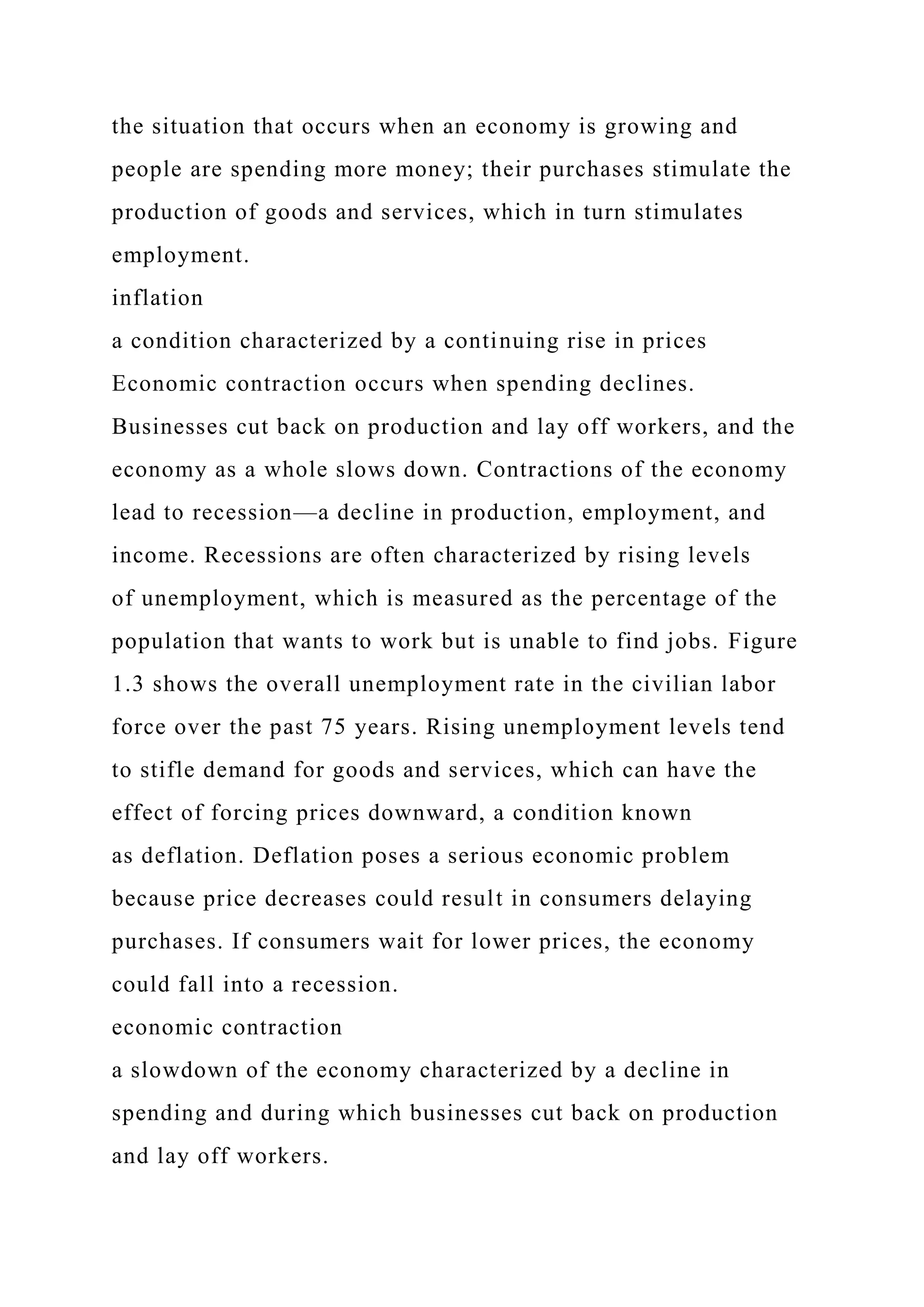
population that wants to work but is unable to find jobs. Figure
1.3 shows the overall unemployment rate in the civilian labor
force over the past 75 years. Rising unemployment levels tend
to stifle demand for goods and services, which can have the
effect of forcing prices downward, a condition known
as deflation. Deflation poses a serious economic problem
because price decreases could result in consumers delaying
purchases. If consumers wait for lower prices, the economy
could fall into a recession.
economic contraction
a slowdown of the economy characterized by a decline in
spending and during which businesses cut back on production
and lay off workers.
recession
a decline in production, employment, and income.
unemployment
the condition in which a percentage of the population wants to
work but is unable to find jobs.
FIGURE 1.3
Annual Average Unemployment Rate, Civilian Labor Force, 16
Years and Over
Sources: Bureau of Labor Statistics, “Labor Force Statistics
from the Current Population
Survey,” http://data.bls.gov/timeseries/LNS14000000 (accessed
March 25, 2018).
The United States has experienced numerous recessions, the
most recent ones occurring in 1990–1991, 2002–2003, and
2008–2011. The most recent recession (or economic slowdown)
was caused by the collapse in housing prices and
consumers’ page 16 inability to stay current on their mortgage
and credit card payments. This caused a crisis in the banking
industry, with the government bailing out banks to keep them
from failing. This in turn caused a slowdown in spending on
consumer goods and a decrease in employment. Unemployment
reached 10 percent of the labor force. Don’t forget that personal
consumption makes up almost 70 percent of gross domestic
product, so consumer engagement is extremely important for
economic activity. A severe recession may turn into
a depression, in which unemployment is very high, consumer
spending is low, and business output is sharply reduced, such as
what occurred in the United States in the early 1930s. The most
recent recession is often called the Great Recession because it
was the longest and most severe economic decline since the
Great Depression.
depression
a condition of the economy in which unemployment is very
high, consumer spending is low, and business output is sharply
reduced.
Economies expand and contract in response to changes in
consumer, business, and government spending. War also can
affect an economy, sometimes stimulating it (as in the United
States during World Wars I and II) and sometimes stifling it (as
during the Vietnam, Persian Gulf, and Iraq wars). Although
fluctuations in the economy are inevitable and to a certain
extent predictable, their effects—inflation and unemployment—
disrupt lives and thus governments try to minimize them.
LO 1-6
Specify why and how the health of the economy is measured.
Measuring the Economy. Countries measure the state of their
economies to determine whether they are expanding or
contracting and whether corrective action is necessary to
minimize the fluctuations. One commonly used measure is gross
domestic product (GDP)—the sum of all goods and services
produced in a country during a year. GDP measures only those
goods and services made within a country and therefore does
not include profits from companies’ overseas operations; it does
include profits earned by foreign companies within the country
being measured. However, it does not take into account the
concept of GDP in relation to population (GDP per
capita). Figure 1.4 shows the increase in U.S. GDP over several
years, while Table 1.2 compares a number of economic statistics
for a sampling of countries.
gross domestic product (GDP)
the sum of all goods and services produced in a country during
a year.
FIGURE 1.4
Growth in U.S. Gross Domestic Product
Source: U.S. Department of Commerce Bureau of Economic
Analysis, “National Economic
Accounts,” www.bea.gov/national/index.htm#gdp (accessed
March 25, 2018).
page 17
TABLE 1.2
Economic Indicators of Different Countries
Source: CIA, The World Fact
Book,https://www.cia.gov/library/publications/the-world-
factbook/rankorder/rankorderguide.html (accessed March 25,
2018).
Another important indicator of a nation’s economic health is the
relationship between its spending and income (from taxes).
When a nation spends more than it takes in from taxes, it has
a budget deficit. In the 1990s, the U.S. government eliminated
its long-standing budget deficit by balancing the money spent
for social, defense, and other programs with the amount of
money taken in from taxes.
budget deficit
the condition in which a nation spends more than it takes in
from taxes.
In recent years, however, the budget deficit has reemerged and
grown to record levels, partly due to defense spending in the
aftermath of the terrorist attacks of September 11, 2001.
Massive government stimulus spending during the most recent
recession also increased the national debt. Because many
Americans do not want their taxes increased and Congress has
difficulty agreeing on appropriate tax rates, it is difficult to
increase taxes and reduce the deficit. Like consumers and
businesses, when the government needs money, it borrows from
the public, banks, and even foreign investors. The national debt
is more than $24 trillion.14 This figure is especially worrisome
because to reduce the debt to a manageable level, the
government either has to increase its revenues (raise taxes) or
reduce spending on social, defense, and legal programs, neither
of which is politically popular. The United States recently
enacted tax cuts that are projected to increase the national debt
every year over the next 10 years.15 The national debt figure
changes daily and can be seen at the Department of the
Treasury, Bureau of the Public Debt, website. Table
1.3 describes some of the other ways we evaluate our nation’s
economy.
page 18
TABLE 1.3
How Do We Evaluate Our Nation’s Economy?
Unit of Measure
Description
Trade balance
The difference between our exports and our imports. If the
balance is negative, as it has been since the mid-1980s, it is
called a trade deficit and is generally viewed as unhealthy for
our economy.
Consumer Price Index
Measures changes in prices of goods and services purchased for
consumption by typical urban households.
Per capita income
Indicates the income level of “average” Americans. Useful in
determining how much “average” consumers spend and how
much money Americans are earning.
Unemployment rate
Indicates how many working-age Americans are not working
who otherwise want to work.
Inflation
Monitors price increases in consumer goods and services over
specified periods of time. Used to determine if costs of goods
and services are exceeding worker compensation over time.
Worker productivity
The amount of goods and services produced for each hour
worked.
LO 1-7
Outline the evolution of the American economy.
The American Economy
As we said previously, the United States is a mixed economy
with a foundation based on capitalism. The answers to the three
basic economic issues are determined primarily by competition
and the forces of supply and demand, although the federal
government does intervene in economic decisions to a certain
extent. For instance, the federal government exerts oversight
over the airline industry to make sure airlines remain
economically viable as well as for safety and security purposes.
Standard of living refers to the level of wealth and material
comfort that people have available to them. The United States,
Germany, Australia, and Norway all have a high standard of
living, meaning that most of their citizens are able to afford
basic necessities and some degree of comfort. These nations are
often characterized by a high GDP per capita. However, a
higher GDP per capita does not automatically translate into a
higher standard of living. Costs of goods and services are also
factors. The European Union and Japan, for instance, tend to
have higher costs of living than in the United States. Higher
prices mean that it costs more to obtain a certain level of
comfort than it does in other countries. Countries with low
standards of living are usually characterized by poverty, higher
unemployment, and lower education rates. To understand the
current state of the American economy and its effect on
business practices, it is helpful to examine its history and the
roles of the entrepreneur and the government.
standard of living
refers to the level of wealth and material comfort that people
have available to them.
The Importance of the American Economy
The American economy is an open economy, or an economy in
which economic activities occur between the country and the
international community. As an open economy, the United
States is a major player in international trade. Open economies
tend to grow faster than economies that do not engage in
international trade. This is because international trade is
positively related to efficiency and productivity. Companies in
the United States have greater access to a wider range of
resources and knowledge, including technology. In today’s
global environment, the ability to harness technology is critical
toward increased innovation.16 In contrast, research page
19 indicates a negative relationship between regulatory actions
and innovation in firms, suggesting that too much regulation
hinders business activities and their contribution to the
American economy.17
open economy
an economy in which economic activities occur between the
country and the international community.
When looking at the American economy, growth in GDP and
jobs are the two primary factors economists consider. A positive
relationship exists between a country’s employment rate and
economic growth. A nation’s output depends on the amount of
labor used in the production process, so there is also a positive
correlation between output and employment. In general, as the
labor force and productivity increase, so does GDP. Profitable
companies tend to hire more workers than those that are
unprofitable. Therefore, companies that hire employees not only
improve their profitability but also drive the economic well-
being of the American economy.18
Government public policy also drives the economy through job
creation. In order for any nation to ensure the social and
economic health of the country, there must be a tax base to
provide for the public interest. The vast majority of taxes come
from individuals. It is estimated that the U.S. government
obtains $2.3 trillion in individual income taxes
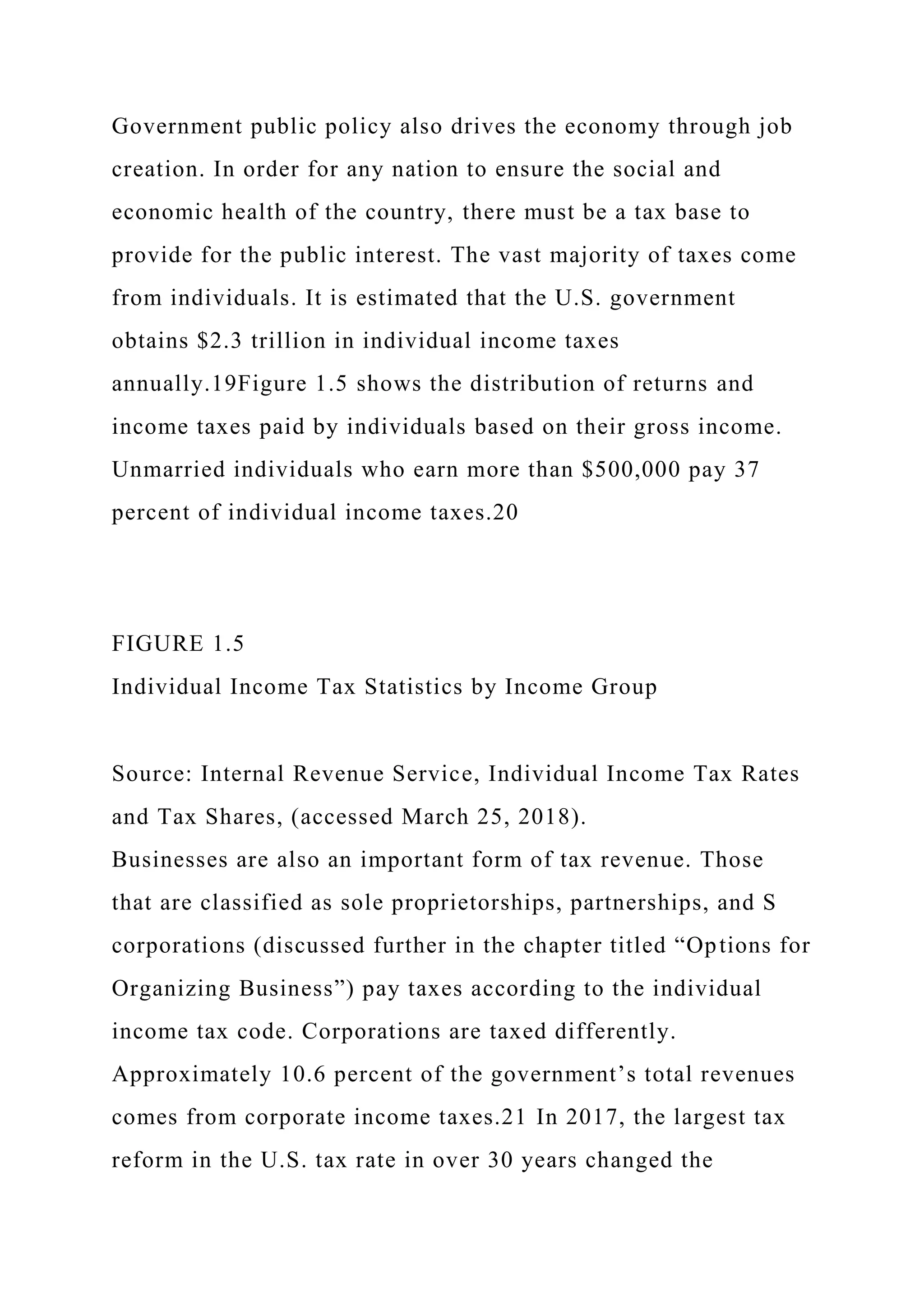
annually.19Figure 1.5 shows the distribution of returns and
income taxes paid by individuals based on their gross income.
Unmarried individuals who earn more than $500,000 pay 37
percent of individual income taxes.20
FIGURE 1.5
Individual Income Tax Statistics by Income Group
Source: Internal Revenue Service, Individual Income Tax Rates
and Tax Shares, (accessed March 25, 2018).
Businesses are also an important form of tax revenue. Those
that are classified as sole proprietorships, partnerships, and S
corporations (discussed further in the chapter titled “Options for
Organizing Business”) pay taxes according to the individual
income tax code. Corporations are taxed differently.
Approximately 10.6 percent of the government’s total revenues
comes from corporate income taxes.21 In 2017, the largest tax
reform in the U.S. tax rate in over 30 years changed the
corporate tax rate from 35 percent to 21 percent.22 The average
global corporate tax rate is 23 percent, while some countries
such as Ireland have a corporate tax rate as low as 12.5 percent.
The tax reform lowered the highest individual tax rate from 39.6
percent to 37 percent, but the reform capped the deduction of
state and local taxes at $10,000. This could result in high-
earners in states like New York and California with state and
local taxes paying more federal taxes than before the tax
reform.23 The tax reform was designed to stimulate the
economy but will increase the national debt.
page 20
Responding to Business Challenges
The Trix of the Trade: General Mills’ Brand Strategy
In its 150-year history, General Mills has evolved from a flour
mill to a packaged consumer goods company with revenues of
$16 billion. More recently, General Mills has begun investing
heavily in organic and natural foods with its acquisition of
organic food brands Cascade Farms and Annie’s. Sales of
organic products are a $43.4 billion industry and growing.
Demand for organic food is growing so rapidly that the supply
has been unable to keep up. As a result, General Mills has
begun underwriting the costs for farmers to convert their farms
to organic crops.
The consumer goods market is characterized by monopolistic
competition, meaning that General Mills has many competitors.
This requires General Mills to adapt to changing consumer
preferences. For example, consumers have been eating less
cereal and looking for quick breakfast items like yogurt and
breakfast bars. As a result, General Mills has expanded into
more on-the-go products such as yogurt and granola. Perhaps as
a way to meet the competition head on, General Mills has
adopted a new brand strategy: “Consumers first.”
General Mills wants its customer-centric focus to differentiate it
from rival firms. In keeping with this customer emphasis, it has
agreed to adopt genetically modified organism (GMO) labeling
for some of its products. While General Mills believes GMO
products are safe, it wants customers to know that it is listening
to their concerns. In fact, General Mills became a first mover in
this endeavor by reformulating its Cheerios to be GMO-free.
However, as competitors also turn toward organic ingredients, it
might not be long before other cereal manufacturers begin
developing their own GMO-free cereals. General Mills must
continue to innovate to maintain its competitive edge.24
Critical Thinking Questions
1. Why does the consumer goods industry operate in an
environment of monopolistic competition? What must firms like
General Mills do to succeed in this environment?
2. How is General Mills addressing the supply-demand problem
that it is facing with organic food?
3. What are some of the ways in which General Mills is
differentiating its products from the competition?
A Brief History of the American Economy
The Early Economy. Before the colonization of North
America, Native Americans lived as hunter/gatherers and
farmers, with some trade among tribes. The colonists who came
later operated primarily as an agricultural economy. People
were self-sufficient and produced everything they needed at
home, including food, clothing, and furniture. Abundant natural
resources and a moderate climate nourished industries such as
farming, fishing, shipping, and fur trading. A few manufactured
goods and money for the colonies’ burgeoning industries came
from England and other countries.
As the nation expanded slowly toward the West, people found
natural resources such as coal, copper, and iron ore and used
them to produce goods such as horseshoes, farm implements,
and kitchen utensils. Farm families who produced surplus goods
sold or traded them for things they could not produce
themselves, such as fine furniture and window glass. Some
families also spent time turning raw materials into clothes and
household goods. Because these goods were produced at home,
this system was called the domestic system.
The Industrial Revolution. The 19th century and the
Industrial Revolution brought the development of new
technology and factories. The factory brought together all the
resources needed to make a product—materials, machines, and
workers. Work in factories became specialized as workers
focused on one or two tasks. As work became more efficient,
productivity increased, making more goods available at lower
prices. Railroads brought major changes, allowing farmers to
send their surplus crops and goods all over the nation for barter
or for sale.
page 21
Factories began to spring up along the railways to manufacture
farm equipment and a variety of other goods to be shipped by
rail. Samuel Slater set up the first American textile factory after
he memorized the plans for an English factory and emigrated to
the United States. Eli Whitney revolutionized the cotton
industry with his cotton gin. Francis Cabot Lowell’s factory
organized all the steps in manufacturing cotton cloth for
maximum efficiency and productivity. John Deere’s farm
equipment increased farm production and reduced the number of
farmers required to feed the young nation. Farmers began to
move to cities to find jobs in factories and a higher standard of
living. Henry Ford developed the assembly-line system to
produce automobiles. Workers focused on one part of an
automobile and then pushed it to the next stage until it rolled
off the assembly line as a finished automobile. Ford’s assembly
line could manufacture many automobiles efficiently, and the
price of his cars was $200, making them affordable to many
Americans.
The Manufacturing and Marketing Economies.
Industrialization brought increased prosperity, and the United
States gradually became a manufacturing economy–one devoted
to manufacturing goods and providing services rather than
producing agricultural products. The assembly line was applied
to more industries, increasing the variety of goods available to
the consumer. Businesses became more concerned with the
needs of the consumer and entered the marketing
economy. Expensive goods such as cars and appliances could be
purchased on a time-payment plan. Companies conducted
research to find out what products consumers needed and
wanted. Advertising made consumers aware of products and
important information about features, prices, and other
competitive advantages.
Because these developments occurred in a free-enterprise
system, consumers determined what goods and services were
produced. They did this by purchasing the products they liked at
prices they were willing to pay. The United States prospered,
and American citizens had one of the highest standards of living
in the world.
The Service and New Digital Economy. After World War II,
with the increased standard of living, Americans had more
money and more time. They began to pay others to perform
services that made their lives easier. Beginning in the 1960s,
more and more women entered the workforce. The United States
began experiencing major shifts in the population. The U.S.
population grew about 10 percent in the past decade to 327
million. This is the slowest pace of growth since the Great
Depression, with the South leading the population gains. The
United States is undergoing a baby bust, with record lows in the
country’s fertility rate.25 While the birth rate in the United
States is declining, new immigrants help with population
gains.26 The profile of the family is also changing: Today there
are more single-parent families and individuals living alone,
and in two-parent families, both parents often work.
DID YOU KNOW? Approximately 57 percent of adult women
are involved in the workforce.27
One result of this trend is that time-pressed Americans are
increasingly paying others to do tasks they used to do at home,
like cooking, laundry, landscaping, and child care. These trends
have gradually changed the United States to a service
economy—one devoted to the production of services that make
life easier for busy consumers. Businesses increased their
demand for services, especially in the areas of finance and
information technology. Service industries such as restaurants,
banking, health care, child care, auto repair, leisure-related
industries, and even education are growing rapidly and may
account for as much as 80 percent of the U.S. economy. These
trends continue with advanced technology contributing to page
22 new service products based on technology and digital media
that provide smartphones, social networking, and virtual worlds.
This has led to the growth of e-commerce, or transactions
involving goods and services over the Internet. E-commerce has
led to firms that would have been unheard of a few decades ago,
such as eBay, Shopify, Etsy, and Amazon. Figure 1.6 shows the
percentage of adults who engage in e-commerce. More about the
digital world, business, and new online social media can be
found in the chapter titled “Digital Marketing and Social
Networking.”
FIGURE 1.6
Online Retailing and E-Commerce
Source: Aaron Smith and Monica Anderson, “Online Shopping
and E-Commerce,” Pew Research Center, December 19,
2016, http://www.pewinternet.org/2016/12/19/online-shopping-
and-e-commerce/ (accessed March 25, 2018).
LO 1-8
Explain the role of the entrepreneur in the economy.
The Role of the Entrepreneur
An entrepreneur is an individual who risks his or her wealth,
time, and effort to develop for profit an innovative product or
way of doing something. Heidi Ganahl is a true American
entrepreneur. She took the unusual concept of a day care center
for dogs and turned it into a successful $85 million franchise
operation. Her business, Camp Bow Wow, which offers
boarding, playtime, grooming, and other services for dogs,
expanded to more than 140 locations and plans to grow to 1,000
over the next several years.28
entrepreneur
an individual who risks his or her wealth, time, and effort to
develop for profit an innovative product or way of doing
something.
The free-enterprise system provides the conditions necessary for
entrepreneurs like Ganahl to succeed. In the past, entrepreneurs
were often inventors who brought all the factors of production
together to produce a new product. Thomas Edison, whose
inventions include the record player and light bulb, was an early
American entrepreneur. Henry Ford was one of the first persons
to develop mass assembly methods in the automobile industry.
Other entrepreneurs, so-called captains of industry, invested in
the country’s growth. John D. Rockefeller built Standard Oil out
of the fledgling oil industry, and Andrew Carnegie invested in
railroads and founded the United States Steel Corporation.
Andrew Mellon built the Aluminum Company of America and
Gulf Oil. J. P. Morgan started financial institutions to fund the
business activities of other entrepreneurs. Although these
entrepreneurs were born in another century, their legacy to the
American economy lives on in the companies they started, many
of which still operate today. Consider the history of Eli Lilly.
Colonel Eli Lilly in Indianapolis, Indiana, was continually
frustrated with the quality of pharmaceutical products sold at
the time. As a pharmaceutical chemist, he decided to start his
own page 23 firm that would offer the highest-quality
medicines. His firm, Eli Lilly and Company, would go on to
make landmark achievements, including being one of the first
pharmaceutical firms to mass-produce penicillin. Today, Eli
Lilly is one of the largest pharmaceutical firms in the world.30
Entrepreneurship in Action
ATA: Engineering Good Teamwork
ATA Engineering
Founder: Mary Baker
Founded: 2000, in San Diego, CA
Success: This 100 percent employee-owned firm has won
numerous awards, including a quality award from NASA and a
spot among The Wall Street Journal’s Top Small Workplaces.
ATA Engineering is a unique firm because—although founder
Mary Baker plays a role in the company as president and
director—the company became entirely employee owned a mere
four years after its founding. This gives the 120 employees at
ATA Engineering greater motivation to make it profitable
because they succeed when the company succeeds.
ATA Engineering Inc. is a provider of analysis and test-driven
design solutions for structural, mechanical, electromechanical,
and aerospace products. When it was founded, ATA Engineering
was not the only engineering firm in the industry. Competition
was high. However, it was spun off from Structural Dynamics
Research Corporation, a firm that had worked on NASA
projects. As a spinoff, ATA Engineering had the expertise
needed to continue this relationship. The company gained a
competitive advantage with its role as a NASA contractor. More
recently, the firm has helped to solve design issues on NASA’s
Mars Science Lab, which earned it the George M. Low Award,
NASA’s quality and performance award. Today, ATA
Engineering operates in seven offices across the nation.29
Critical Thinking Questions
1. How does creating an employee-owned business give
employees greater motivation to make the business profitable?
2. What are the disadvantages of an employee-owned business?
3. In what other ways does ATA stand apart from its
competitors?
Entrepreneurs are constantly changing American business
practices with new technology and innovative management
techniques. Bill Gates, for example, built Microsoft, a software
company whose products include Word and Windows, into a
multibillion-dollar enterprise. Frederick Smith had an idea to
deliver packages overnight, and now his FedEx Company plays
an important role in getting documents and packages delivered
all over the world for businesses and individuals. Steve Jobs co-
founded Apple and turned the company into a successful
consumer electronics firm that revolutionized many different
industries, with products such as the iPod, iPhone, Mac
computers, iPad, and Apple Watch. The company went from
near bankruptcy in the 1990s to become one of the most
valuable brands in the entire world. Entrepreneurs have been
associated with such uniquely American concepts as Dell
Computers, Ben & Jerry’s, Levi’s, McDonald’s, Dr Pepper,
SpaceX, Google, Facebook, and Walmart. Walmart, founded by
entrepreneur Sam Walton, was the first retailer to reach $100
billion in sales in one year and now routinely passes that mark,
with more than $453 billion in 2017.31 We will examine the
importance of entrepreneurship further in the chapter “Small
Business, Entrepreneurship, and Franchising.”
Apple Pay is a mobile payment system that allows users to store
credit card or debit card information on their phones. When
checking out at stores, users can bring up their credit card with
two taps and use the information to pay for their purchases.
©How Hwee Young/Epa/REX/Shutterstock
page 24
Going Green
Rainforest Alliance Stands Out in a Forest of Nonprofits
When you think of the phrase “nonprofit organization,” you
likely think of a bare-bones operation run by people who are so
dedicated that they do not mind working for peanuts. However,
the Rainforest Alliance, a highly recognized nonprofit aiming to
conserve biodiversity and promote sustainability, defies this
mold. With thousands of members and supporters, the
Rainforest Alliance has been fighting globally for wildlife and
wild lands since 1987.
As more consumers and businesses become interested in
preserving the world’s resources, the Rainforest Alliance has
gained widespread support. Interacting with key stakeholders is
critical to the Rainforest Alliance’s success. For instance, the
Rainforest Alliance has many resources for businesses that
partner with the organization. The Rainforest Alliance provides
auditing and certification services for businesses—such as
agricultural, tourism, and forestry organizations—that wish to
display the Rainforest Alliance certification seal. The
Rainforest Alliance blog describes how sustainability can
positively affect a business, and its seal is one way businesses
can inform consumers that they have incorporated sustainability
principles into their operations. The Rainforest Alliance even
has its own business unit, called RA-Cert, involved with
auditing, evaluation, and certification decisions. Additionally,
the Rainforest Alliance offers resources to businesses that want
to educate their own employees about sustainability.
Stakeholders generally have a positive image of the Rainforest
Alliance. One survey noted that coffee drinkers were likely to
spend extra on coffee certified by Rainforest Alliance. For
individuals looking to aid the environment and support small
growers, the Rainforest Alliance is making a positive difference
with its strong mission and interaction with stakeholders.32
Critical Thinking Questions
1. Why might investing in sustainability and becoming certified
by an organization like the Rainforest Alliance be a good
business decision?
2. Who do you feel are Rainforest Alliance’s primary
customers: consumers or businesses?
3. As a nonprofit, how does the Rainforest Alliance differ from
other organizations?
The Role of Government in the American Economy
The American economic system is best described as modified
capitalism because the government regulates business to
preserve competition and protect consumers and employees.
Federal, state, and local governments intervene in the economy
with laws and regulations designed to promote competition and
to protect consumers, employees, and the environment. Many of
these laws are discussed in Bonus Chapter A.
Additionally, government agencies such as the U.S. Department
of Commerce measure the health of the economy (GDP,
productivity, etc.) and, when necessary, take steps to minimize
the disruptive effects of economic fluctuations and reduce
unemployment. When the economy is contracting and
unemployment is rising, the federal government through the
Federal Reserve Board (see chapter titled “Money and the
Financial System”) tries to spur growth so that consumers will
spend more money and businesses will hire more employees. To
accomplish this, it may reduce interest rates or increase its own
spending for goods and services. When the economy expands so
fast that inflation results, the government may intervene to
reduce inflation by slowing down economic growth. This can be
accomplished by raising interest rates to discourage spending by
businesses and consumers. Techniques used to control the
economy are discussed in “Money and the Financial System.”
The Role of Ethics and Social Responsibility in Business
In the past few years, you may have read about a number of
scandals at well-known corporations, including Volkswagen,
which cheated on emissions tests, and Wells Fargo. Wells Fargo
employees opened more than 3.5 million accounts in
customer page 25 names without permission and disclosed that
the company had overcharged some auto loan and mortgage
customers. CEO Tim Sloan told Congress he’s “sorry for how
the bank abused consumers.”33 In many cases, misconduct by
individuals within these firms had an adverse effect on
employees, investors, and others associated with these firms.
These scandals undermined public confidence in corporate
America and sparked a new debate about ethics in
business. Business ethics generally refers to the standards and
principles used by society to define appropriate and
inappropriate conduct in the workplace. In many cases, these
standards have been codified as laws prohibiting actions deemed
unacceptable.
Society is increasingly demanding that businesspeople behave
socially responsibly toward their stakeholders, including
customers, employees, investors, government regulators,
communities, and the natural environment. Diversity in the
workforce is not only socially responsible, but also highly
beneficial to the financial performance of companies. According
to a McKinsey consulting firm study, organizations that have
diverse leadership are more likely to report higher financial
returns. This study defined diversity as women and minorities.
Diversity creates increased employee satisfaction and improved
decision making.34 When actions are heavily criticized, a
balance is usually required to support and protect various
stakeholders.
While one view is that ethics and social responsibility are a
good supplement to business activities, there is an alternative
viewpoint. Ethical behavior can not only enhance a company’s
reputation, but can also drive profits.35 The ethical and socially
responsible conduct of companies such as Whole Foods,
Starbucks, and the hotel chain Marriott provides evidence that
good ethics is good business. There is growing recognition that
the long-term value of conducting business in an ethical and
socially responsible manner that considers the interests of all
stakeholders creates superior financial performance.36
To promote socially responsible and ethical behavior while
achieving organizational goals, businesses can monitor changes
and trends in society’s values. Businesses should determine
what society wants and attempt to predict the long-term effects
of their decisions. While it requires an effort to address the
interests of all stakeholders, businesses can prioritize and
attempt to balance conflicting demands. The goal is to develop a
solid reputation of trust and avoid misconduct to develop
effective workplace ethics.
Can You Learn Business in a Classroom?
Obviously, the answer is yes, or there would be no purpose for
this textbook or course! To be successful in business, you need
knowledge, skills, experience, and good judgment. The topics
covered in this chapter and throughout this book provide some
of the knowledge you need to understand the world of business.
In addition, the “Build Your Skills” exercise near the end of
each chapter will help you develop skills that may be useful in
your future career. However, good judgment is based on
knowledge and experience plus personal insight and
understanding. Therefore, you need more courses in business,
along with some practical experience in the business world, to
help you develop the special insight necessary to put your
personal stamp on knowledge as you apply it. The challenge in
business is in the area of judgment, and judgment does not
develop from memorizing an introductory business textbook. If
you are observant in your daily experiences as an employee, as
a student, and as a consumer, you will improve your ability to
make good business judgments.
page 26
Whether you choose to work at an organization or become an
entrepreneur, you will be required to know the basic concepts
and principles in this book. You need to be prepared for
changes in the way business will be conducted in the future.
New business models or ways businesses create value will
emerge based on the Internet, connected technologies, drones,
driverless cars, and artificial intelligence. It should be exciting
to think about your opportunities and the challenges of creating
a successful career. Our society needs a strong economic
foundation to help people develop a desired standard of living.
Our world economy is becoming more digital and competitive,
requiring new skills and job positions. Individuals like you can
become leaders in business, nonprofits, and government to
create a better life.
Figure 1.7 is an overview of how the chapters in this book are
linked together and how the chapters relate to the participants,
the activities, and the environmental factors found in the
business world. The topics presented in the chapters that follow
are those that will give you the best opportunity to begin the
process of understanding the world of business.
FIGURE 1.7
The Organization of This Book
page 27
So You Want a Job in the Business World
When most people think of a career in business, they see
themselves entering the door to large companies and
multinationals that they read about in the news and that are
discussed in class. In a national survey, students indicated they
would like to work for Google, Disney, Apple, and Ernst &
Young. In fact, most jobs are not with large corporations, but
are in small companies, nonprofit organizations, government,
and even as self-employed individuals. There are nearly 27
million individuals in the United States who own their own
businesses and have no employees. With more than 75 percent
of the economy based on services, there are many jobs available
in industries such as health care, finance, education, hospitality,
and entertainment. E-commerce is creating the need for supply
chain jobs related to purchasing, transportation, and operations.
The world is changing quickly and large corporations replace
the equivalent of their entire workforce every four years.
The fast pace of technology today means that you have to be
prepared to take advantage of emerging job opportunities and
markets. You must also become adaptive and recognize that
business is becoming more global, with job opportunities
around the world. If you want to obtain such a job, you
shouldn’t miss a chance to spend some time overseas. To get
you started on the path to thinking about job opportunities,
consider all of the changes in business today that might affect
your possible long-term track and that could bring you lots of
success. Companies are looking for employees with skills that
can be used to address the changing business environment. For
example, the demand for graduates that are good at analyzing
data and navigating cloud-based computing is on the rise.
You’re on the road to learning the key knowledge, skills, and
trends that you can use to be a star in business. Business’s
impact on our society, especially in the area of sustainability
and improvement of the environment, is a growing challenge
and opportunity. Green businesses and green jobs in the
business world are provided to give you a glimpse at the
possibilities. Along the way, we will introduce you to some
specific careers and offer advice on developing your own job
opportunities. Research indicates that you won’t be that happy
with your job unless you enjoy your work and feel that it has a
purpose. Because you spend most of your waking hours every
day at work, you need to seriously think about what is important
to you in a job.37
Review Your Understanding
Define basic concepts such as business, product, profit, and
economics.
A business is an organization or individual that seeks a profit
by providing products that satisfy people’s needs. A product is a
good, service, or idea that has both tangible and intangible
characteristics that provide satisfaction and benefits. Profit, the
basic goal of business, is the difference between what it costs to
make and sell a product and what a customer pays for it.
Economics is the study of how resources are distributed for the
production of goods and services within a social system.
Identify the main participants and activities of business.
The three main participants in business are owners, employees,
and customers, but others—government regulators, suppliers,
social groups, etc.—are also important. Management involves
planning, organizing, and controlling the tasks required to carry
out the work of the company. Marketing refers to those
activities—research, product development, promotion, pricing,
and distribution—designed to provide goods and services that
satisfy customers. Finance refers to activities concerned with
funding a business and using its funds effectively.
Explain why studying business is important.
Studying business can help you prepare for a career and become
a better consumer.
Compare the four types of economic systems.
An economic system describes how a particular society
distributes its resources. Communism is an economic system in
which the people, without regard to class, own all the nation’s
resources. In a socialist system, the government owns and
operates basic industries, but individuals own most businesses.
Under capitalism, individuals own and operate the majority of
businesses that provide goods and services. Mixed economies
have elements from more than one economic system; most
countries have mixed economies.
Describe the role of supply, demand, and competition in a free-
enterprise system.
In a free-enterprise system, individuals own and operate the
majority of businesses, and the distribution of resources is
determined by competition, supply, and demand. Demand is the
number of goods and services that consumers are willing to buy
at different prices at a specific time. Supply is the number of
goods or services that businesses are willing to sell at different
prices at a specific time. The price at which the supply of a
product equals demand at a specific point in time is the
equilibrium price. Competition is the rivalry among businesses
to convince consumers to buy goods or services. Four types of
competitive environments are pure competition, monopolistic
competition, oligopoly, and monopoly. These economic
concepts determine how businesses may operate in a particular
society and, often, how much they can charge for their products.
Specify why and how the health of the economy is measured.
A country measures the state of its economy to determine
whether it is expanding or contracting and whether the country
needs to take steps to minimize fluctuations. One commonly
used measure is gross domestic product (GDP), the sum of all
goods and services produced in a country during a year. A
budget deficit occurs when a nation spends more than it takes in
from taxes.
Outline the evolution of the American economy.
The American economy is an open economy that engages in
significant international trade. Government public policy helps
drive the economy through job creation, requiring a tax base to
provide for the public interest. Much of the government’s
revenue comes from individual income taxes, but corporations
pay a high corporate tax in the United States.
The American economy has evolved through several stages: the
early economy, the Industrial Revolution, the manufacturing
economy, the marketing economy, and the service and Internet-
based economy of today.
Explain the role of the entrepreneur in the economy.
Entrepreneurs play an important role because they risk their
time, wealth, and efforts to develop new goods, services, and
ideas that fuel the growth of the American economy.
Evaluate a small-business owner’s situation in order to propose
a course of action.
“Solve the Dilemma” near the end of this chapter presents a
problem for the owner of the firm. Should you, as the owner,
raise prices, expand operations, or form a venture with a larger
company to deal with demand? You should be able to apply
your newfound understanding of the relationship between
supply and demand to assess the situation and reach a decision
about how to proceed.
Critical Thinking Questions
Enter the World of Business Questions
1. Describe Buffett’s business strategy. Why do you think it was
so successful?
2. What are some of the benefits of owning companies in
several different industries? The risks?
3. Why is it important for Buffett to allow managers the ability
to run the firms as they see fit?
Learn the Terms
budget deficit17
business4
capitalism (free enterprise)10
communism9
competition13
demand12
depression16
economic contraction15
economic expansion15
economic system8
economics8
entrepreneur22
equilibrium price13
financial resources (capital)8
free-market system10
gross domestic product (GDP)16
human resources (labor)8
inflation15
mixed economies11
monopolistic competition14
monopoly14
natural resources8
nonprofit organizations4
oligopoly14
open economy18
product4
profit4
pure competition14
recession15
socialism10
stakeholders5
standard of living18
supply12
unemployment15
page 29
Check Your Progress
1. What is the fundamental goal of business? Do all
organizations share this goal?
2. Name the forms a product may take and give some examples
of each.
3. Who are the main participants of business? What are the main
activities? What other factors have an impact on the conduct of
business in the United States?
4. What are four types of economic systems? Can you provide
an example of a country using each type?
5. Explain the terms supply,demand,equilibrium
price, and competition. How do these forces interact in the
American economy?
6. List the four types of competitive environments and provide
an example of a product of each environment.
7. List and define the various measures governments may use to
gauge the state of their economies. If unemployment is high,
will the growth of GDP be great or small?
8. Why are fluctuations in the economy harmful?
9. How did the Industrial Revolution influence the growth of the
American economy? Why do we apply the term service economy
to the United States today?
10. Explain the federal government’s role in the American
economy.
Get Involved
1. Discuss the economic changes occurring in Russia and
eastern European countries, which once operated as communist
economic systems. Why are these changes occurring? What do
you think the result will be?
2. Why is it important for the government to measure the
economy? What kinds of actions might it take to control the
economy’s growth?
3. Is the American economy currently expanding or contracting?
Defend your answer with the latest statistics on GDP, inflation,
unemployment, and so on. How is the federal government
responding?
Build Your Skills
The Forces of Supply and Demand
Background
WagWumps are a new children’s toy with the potential to be a
highly successful product. WagWumps are cute and furry, and
their eyes glow in the dark. Each family set consists of a
mother, a father, and two children. Wee-Toys’ manufacturing
costs are about $6 per set, with $3 representing marketing and
distribution costs. The wholesale price of a WagWump family
for a retailer is $15.75, and the toy carries a suggested retail
price of $26.99.
Task
Assume you are a decision maker at a retailer, such as Target or
Walmart, that must determine the price the stores in your
district should charge customers for the WagWump family set.
From the information provided, you know that the SRP
(suggested retail price) is $26.99 per set and that your company
can purchase the toy set from your wholesaler for $15.75 each.
Based on the following assumptions, plot your company’s
supply curve on the graph provided in Figure 1.8 and label it
“supply curve.”
FIGURE 1.8
Equilibrium Price of WagWumps
Quantity
Price
3,000
$16.99
5,000
21.99
7,000
26.99
Using the following assumptions, plot your customers’ demand
curve on Figure 1.8 and label it “demand curve.”
Quantity
Price
10,000
$16.99
6,000
21.99
2,000
26.99
page 30
For this specific time, determine the point at which the quantity
of toys your company is willing to supply equals the quantity of
toys the customers in your sales district are willing to buy and
label that point “equilibrium price.”
Solve the Dilemma
Mrs. Acres Homemade Pies
Shelly Acres, whose grandmother gave her a family recipe for
making pies, loved to cook, and she decided to start a business
she called Mrs. Acres Homemade Pies. The company produces
specialty pies and sells them in local supermarkets and select
family restaurants. In each of the first six months, Shelly and
three part-time employees sold 2,000 pies for $4.50 each,
netting $1.50 profit per pie. The pies were quite successful and
Shelly could not keep up with demand. The company’s success
results from a quality product and productive employees who
are motivated by incentives and who enjoy being part of a
successful new business.
To meet demand, Shelly expanded operations, borrowing money
and increasing staff to four full-time employees. Production and
sales increased to 8,000 pies per month, and profits soared to
$12,000 per month. However, demand for Mrs. Acres
Homemade Pies continues to accelerate beyond what Shelly can
supply. She has several options: (1) maintain current production
levels and raise prices; (2) expand the facility and staff while
maintaining the current price; or (3) contract the production of
the pies to a national restaurant chain, giving Shelly a
percentage of profits with minimal involvement.
LO 1-9
Evaluate a small-business owner’s situation in order to propose
a course of action.
Critical Thinking Questions
1. Explain and demonstrate the relationship between supply and
demand for Mrs. Acres Homemade Pies.
2. What challenges does Shelly face as she considers the three
options?
3. What would you do in Shelly’s position?
page 31
Build Your Business Plan
The Dynamics of Business and Economics
Have you ever thought about owning your business? If you
have, how did your idea come about? Is it your experience with
this particular field? Or might it be an idea that evolved from
your desires for a particular good or service not being offered in
your community? For example, perhaps you and your friends
have yearned for a place to go have coffee, relax, and talk. Now
is an opportunity to create the cafe bar you have been thinking
of!
Whether you consider yourself a visionary or a practical
thinker, think about your community. What needs are not being
met? While it is tempting to suggest a new restaurant (maybe
even one near campus), easier-to-implement business plans can
range from a lawn care business or a designated driver business
to a placement service agency for teenagers.
Once you have an idea for a business plan, think about how
profitable this idea might be. Is there sufficient demand for this
business? How large is the market for this particular business?
What about competitors? How many are there?
To learn about your industry, you should do a thorough search
of your initial ideas of a product on the Internet.
See for Yourself Videocase
Redbox Succeeds by Identifying Market Need
Redbox’s tell-tale bright red kiosks in stores and fast-food
restaurants across the country have become an image of what a
good business model can accomplish. The company’s ability to
offer customers a convenient and inexpensive DVD rental
option has allowed it to succeed despite the widespread growth
of streaming services such as Netflix and Amazon. However,
the firm acknowledges the future of streaming, and Redbox has
allegedly been discussing the launch of a new streaming service
called “Redbox Variety.” As one of the top rental companies in
the United States, Redbox is a true entrepreneurial success
story.
Building Redbox into a successful firm was not easy, however.
It was fraught with challenges. Like most successful companies,
Redbox started out by identifying a need. It recognized that
consumers could not often find the movies they wanted in
convenient locations. Like all good ideas, Redbox required
funding to get started. This proved to be a major difficulty.
Realizing that customers did not want to pay much for renting
movies, Redbox decided to charge only one dollar. Yet the
kiosks, which contain more than 800 components, required a
large amount of capital. The combination of the capital-
intensive nature of the business and the low prices was not an
attractive recipe for venture capital funding.
However, Redbox was certain that demand for its product
offerings would exceed the costs. The company finally found a
partner in the more established Outerwall, formerly known as
Coinstar, which already had partnerships with many different
retailers. The alliance opened the way for Redbox to begin
installing kiosks at the front of stores.
Redbox did not immediately expand across the country. Instead,
it took a cautious approach toward its business model. It began
by focusing its efforts on making one kiosk profitable, then
replicating this way of thinking regionally and nationally. In
this way, Redbox was able to test its concept without taking the
risk of widespread failure.
Even though it was expanding, it was some time before Redbox
was able to earn a profit. Like all entrepreneurs, the founders of
Redbox had to take many risks if they wanted the company to
succeed. “The risks for starting Redbox were significant,” said
Marc Achler, vice president of new business, strategy, and
innovation. “The first couple years we had some red ink. It took
us a while before we turned profitable.” Yet with persistence
and continual relationship building with retailers, Redbox has
been able to secure more than 50 percent of the physical DVD-
rental market.
One way that Redbox has been able to secure such a large share
of the market is by meeting the needs of a variety of
stakeholders. Redbox views its customers as its first priority
and has developed its kiosks and database to meet their needs.
For instance, customers can reserve movies online and pick
them up at their nearest kiosk. If a kiosk happens to be out of a
particular movie, customers can search the Redbox database to
locate the movie at a nearby kiosk. This combination of
convenience and low prices has attracted customers who desire
a simplified process to renting movies.
page 32
Additionally, Redbox has created a process that also benefits
the needs of its retail partners. Redbox kiosks help attract
consumers to the store, where they may purchase additional
products. Customers must come back the next day to return their
movie, where they may once again purchase more products from
the retailer. In this way, Redbox creates a win-win situation for
both itself and its partners.
This is not to say that everything is easy for Redbox. For
instance, it must continually safeguard against allowing
underage children to rent inappropriate (rated-R) movies. And
while Redbox has approached this changing and dynamic
marketplace proactively, it must continue to do so in order to
maintain its competitive position. With an increasing interest in
streaming, Redbox has seen sales decline in recent years. Its
first attempt to develop a streaming service with Verizon was
unable to compete with Netflix and was discontinued. However,
Redbox refuses to give up. It continues to look for other
opportunities to gain advantages against the competition.38
Critical Thinking Questions
1. Why are consumers so willing to rent from Redbox?
2. How was Redbox able to overcome some of its earliest
challenges?
3. What are some recommendations for ways that Redbox can
maintain its high market share?
You can find the related video in the Video Library in Connect.
Ask your instructor how you can access Connect.
Team Exercise
Major economic systems, including capitalism, socialism, and
communism, as well as mixed economic systems were discussed
in this chapter. Assuming that you want an economic system
that is best for the majority, not just a few members of society,
defend one of the economic systems as the best system. Form
groups and try to reach an agreement on one economic system.
Defend why you support the system that you advance.
Notes
1. Jena McGregor, “The Leadership Wisdom of Warren
Buffett,” Washington Post, March 2,
2015, https://www.washingtonpost.com/news/on-
leadership/wp/2015/03/02/the-leadership-wisdom-in-warren-
buffetts-letter/?utm_term=.4fcedcb25aff (accessed January 19,
2018); Robert Frank, “Warren Buffett Is the Most Charitable
Billionaire,” CNBC, September 21,
2017, https://www.cnbc.com/2017/09/21/warren-buffet-is-the-
most-charitable-billionaire.html (accessed January 19, 2018);
Investopedia Staff, “Warren Buffett: How He Does
It,” Investopedia, August 30,
2017, https://www.investopedia.com/articles/01/071801.asp (acc
essed January 19, 2018); CNBC LLC, “10 Top Brands Warren
Buffett’s Berkshire Hathaway Owns,” CNBC, May 5,
2014, https://www.cnbc.com/2014/05/05/10-top-brands-warren-
buffetts-berkshire-hathaway-owns.html?slide=7 (accessed
January 19, 2018); BuffetBooks, “What Is Value
Investing?” http://www.buffettsbooks.com/howtoinvestinstocks/
course1/investing-for-beginners/what-is-value-
investing.html#sthash.HPn7R7Gn.dpbs (accessed January 19,
2018); Joseph Chris, “9 Warren Buffett Leadership Style
Doctrines,” Driving Business Connections blog, September 15,
2015, http://www.josephchris.com/9-warren-buffett-leadership-
style-doctrines (accessed January 4, 2018); Tanza Loudenback,
“24 Mind-Blowing Facts about Warren Buffett and His $87
Billion Fortune,” Business Insider, January 10,
2018, http://www.businessinsider.com/facts-about-warren-
buffett-2016-12 (accessed January 19, 2018); Andrew Hill,
“Buffet’s Exceptional Style of Leadership,” Financial
Times, February 28,
2011, https://www.ft.com/content/73e667a8-436b-11e0-8f0d-
00144feabdc0 (accessed January 3, 2018); Jory MacKay, “This
Brilliant Strategy Used by Warren Buffett Will Help You
Prioritize Your Time,” Inc., November 15,
2017, https://www.inc.com/jory-mackay/warren-buffetts-
personal-pilot-reveals-billionaires-brilliant-method-for-
prioritizing.html (accessed January 4, 2018); posted by Practical
Wisdom, “Charlie Munger – Advice for the Young Generation—
This Is What You Need to Know in Your
Youth,” YouTube, September 6,
2017, https://www.youtube.com/watch?v=Qf4trOzMy2I (accesse
d January 4, 2018); Juno Tay, “Warren Buffet’s Speech to the
University of Georgia Students Part 1 (Archive 2001)” Nasdaq,
April 21, 2013, http://www.nasdaq.com/article/warren-buffett-
speech-to-university-of-georgia-students-part-1-cm238914 page
33 (accessed January 3, 2018); posted by Texas Business Hall
of Fame, “Warren Buffett and Charles Munger Class of
2016,” YouTube, January 23,
2017, https://www.youtube.com/watch?v=-
ARcxChbVHQ (accessed January 19, 2018); posted by
Motivation Madness, “Warren Buffett’s Life Advice Will
Change Your Future,” YouTube, September 11,
2017, https://www.youtube.com/watch?v=PX5-
XyBNi00 (accessed January 19, 2018).
2. Jay Young and Janet Loehrke, “Ward’s Automotive
Reports,”US Bureau of Economic Analysis, reported in USA
Today, March 14, 2017, p. 1B.
3. Charisse Jones, “Here’s the Secret to a Successful
Company,” USA Today, March 14, 2017, p. 1B.
4. Esther Fung, “Mall Owners Head for Exits as Retail Tenants
Move Out,” The Wall Street Journal, January 25, 2017, p. A1.
5. “Habitat for Humanity and Home Depot Foundation Partner
to Repair Homes for U.S. Military Veterans and
Families,” Habitat.org, March 16, 2017.
6. James T. Areddy and Craig Karmin, “China Stocks Once
Frothy, Fall by Half in Six Months,” The Wall Street
Journal, April 16, 2008, pp. 1, 7.
7. “American Politics: In Praise of State-ism,” The
Economist, January 6–12, 2018, p. 10.
8. “Special Report: The Visible Hand,” The Economist, January
21, 2012, pp. 3–5.
9. “Special Report: The World in Their Hands,” The
Economist, January 21, 2012, pp. 15–17.
10. “The Shark Tank,” ABC, http://abc.go.com/shows/shark-
tank/bios (accessed April 2, 2014).
11. World Intellectual Property Organization, World Intellectual
Property
Indicators, 2014, http://www.wipo.int/edocs/pubdocs/en/wipo_p
ub_941_2014.pdf (accessed May 1, 2017).
12. Paul Toscano, “The Worst Hyperinflation Situations of All
Time,” CNBC, February 14,
2011, http://www.cnbc.com/id/41532451 (accessed May 1,
2017).
13. “Zimbabwe,” CIA—The World
Factbook,https://www.cia.gov/library/publications/the-world-
factbook/geos/zi.html (accessed May 1, 2017).
14. “Federal Debt Clock,” U.S. Government
Debt,http://www.usgovernmentdebt.us/ (accessed March 25,
2018).
15. “The Great Experiment,” The Economist, February 10-16,
2018, p. 23.
16. World Trade Organization, “The WTO can . . . stimulate
economic growth and
employment,” https://www.wto.org/english/thewto_e/whatis_e/1
0thi_e/10thi03_e.htm (accessed May 1, 2017).
17. “The Criminalisation of American Business,” The
Economist, August 30–September 5, 2014, pp. 21–24; Tracy
Gonzalez-Padron, G. Tomas M. Hult, and O.C. Ferrell,
“Stakeholder Marketing Relationships to Social Responsibility
and Firm Performance,” Working paper, 2015.
18. Ryan C. Fuhrmann, “Okuns Law: Economic Growth and
Unemployment,” Investopedia, 2016, http://www.investopedia.c
om/articles/economics/12/okuns-law.asp (accessed May 1,
2017);World Trade Organization, “The WTO Can. . . Stimulate
Economic Growth and
Employment,” https://www.wto.org/english/thewto_e/whatis_e/
10thi_e/10thi03_e.htm (accessed May 1, 2017).
19. “U.S. Government Current Revenue History,” U.S.
Government
Revenue,https://www.usgovernmentrevenue.com/current_revenu
e (accessed March 25, 2018).
20. Amir El-Sibaie, “2018 Tax Brackets,” Tax
Foundation, January 2, 2018, https://taxfoundation.org/2018-
tax-brackets/ (accessed March 25, 2018).
21. Drew Desilver, “High-Income Americans Pay Most Income
Taxes, but Enough to Be ’Fair’?” Pew Research Center, April
13, 2016, http://www.pewresearch.org/fact-
tank/2016/04/13/high-income-americans-pay-most-income-
taxes-but-enough-to-be-fair/ (accessed July 25, 2018).
22. “Corporate Tax in America: Let the Games Begin,” The
Economist, December 16–22, 2017, p. 58.
23. “High Tax States: Tax Replanning,” The Economist, January
6, 2018, p. 17.
24. Sarah Elbert, “Food for Thought,” Delta Sky, December
2016, pp. 66–70; Annie Gasparro, “General Mills Starts Making
Some Cheerios Without GMOs,” The Wall Street
Journal, January 2,
2014, http://www.wsj.com/articles/SB100014240527023033709
04579297211874270146 (accessed January 6, 2017); Hadley
Malcolm, “General Mills to Label GMOs on Products across
Country,” USA Today, March 18,
2016, http://www.usatoday.com/story/money/2016/03/18/genera
l-mills-to-label-gmos-on-products/81981314/ (accessed January
6, 2017); Stephanie Strom, “Paying Farmers to Go Organic,
Even Before the Crops Come In,” The New York Times, July
14, 2016, http://www.nytimes.com/2016/07/15/business/paying-
farmers-to-go-organic-even-before-the-crops-come-
in.html (accessed January 6, 2017); John Kell, “General Mills
Reveals How It Plans to ‘Renovate’ Yogurt
Products,” Fortune, July 14,
2016, http://fortune.com/2016/07/14/general-mills-
yogurt/ (accessed January 2, 2018); Nathan Bomey, “Slumping
Yogurt, Cereal Sales Spoil General Mills’ Performance,” USA
Today, September 20,
2017, https://www.usatoday.com/story/money/2017/09/20/gener
al-mills-first-quarter-earnings/684218001/ (accessed January 2,
2018); Mary Ellen Shoup, “Chobani Beats Yoplait in Sales and
Market Share as Dannon Takes No. 1 Spot in US Yogurt
Market,” Dairy Reporter, March 13,
2017, https://www.dairyreporter.com/Article/2017/03/13/Choba
ni-surpasses-Yoplait-in-sales-and-market-share (accessed
January 2, page 34 2018); Sean Rossman, “What Is French
Yogurt and Is It the New Greek?” USA Today, July 6,
2017, https://www.usatoday.com/story/money/nation-
now/2017/07/06/what-french-yogurt-and-new-
greek/439935001/ (accessed January 2, 2018); Bruce Horovitz,
“Cheerios Drop Genetically Modified Ingredients,” USA
Today, January 2,
2014, https://www.usatoday.com/story/money/business/2014/01/
02/cheerios-gmos-cereals/4295739/ (accessed January 2, 2018).
25. Neil Shah, “Baby Bust Threatens Growth,” The Wall Street
Journal, December 4, 2014, p. A3.
26. U.S. Census Bureau, “State & County Quick
Facts,” http://quickfacts.census.gov/qfd/states/00000.html (acce
ssed May 1, 2017); Haya El Nasser, Gregory Korte, and Paul
Overberg, “308.7 Million,” USA Today, December 22, 2010, p.
1A.
27. U.S. Department of Labor, “Data &
Statistics,” http://www.dol.gov/wb/stats/stats_data.htm (accesse
d May 1, 2017).
28. Dinah Eng and Heidi Ganahl, “Finding Her ‘Wow’ in Camp
Bow Wow,” Fortune, March 15, 2015, pp. 41–42; Camp Bow
Wow, “About Us,” http://www.campbowwow.com/about-us/our-
history (accessed March 25, 2018).
29. Kelly K. Sports, “Top Small Workplaces 2008,” The Wall
Street Journal, February 22,
2009, https://www.wsj.com/articles/SB122347733961315417 (a
ccessed January 1, 2018); “ATA Engineering Named as One of
San Diego’s 100 Fastest Growing Companies,” ATA
Engineering, October 2, 2008, http://www.ata-e.com/news/ata-
engineering-named-one-san-diegos-100-fastest-growing-
companies/ (accessed January 1, 2018); “This Year’s Most
Innovative Employee-Owned Companies Awarded in Chicago
Last Week,” The National Center for Employee Ownership and
the Beyster Institute, http://www.ata-e.com/news/ata-wins-most-
innovative-employee-owned-company-award/ (accessed January
1, 2018); Michelle Strulzenberger, “Employee Ownership
Results in Better Workplace for ATA Engineering Inc.,”
January 16, 2009, http://axiomnews.ca/node/456 (accessed June
24, 2013); ATA Engineering, “ATA Engineering Recognized by
Wall Street Journal as One of the Top Small Workplaces for
2008,” October 13, 2008, http://www.ata-e.com/news/ata-
engineering-recognized-wall-street-journal-one-top-small-
workplaces-2008/ (accessed January 1, 2018); ATA Engineering
website, http://www.ata-e.com/ (accessed January 1, 2018);
ATA Engineering, “ATA Engineering Wins Top NASA Quality
Award,” June 26, 2013, http://www.ata-e.com/news/ata-
engineering-wins-top-nasa-quality-award/ (accessed January 1,
2018); Bloomberg, “Company Overview of ATA Engineering,
Inc.,” February 17,
2018, https://www.bloomberg.com/research/stocks/private/snaps
hot.asp?privcapId=9636531 (accessed February 17, 2018);
CalTech, “Mary Baker (MS ’67, PHD ’72),” CalTech
Alumni,https://www.alumni.caltech.edu/mary-baker/ (accessed
February 17, 2018).
30. Eli Lilly,
“Heritage,” www.lilly.com/about/heritage/Pages/heritage.aspx (
accessed May 1, 2017).
31. Marcia Kaplan, “Walmart Ecommerce Sales Up 23 Percent
in Fourth Quarter 2017,” Practical Ecommerce, March 1,
2018, https://www.practicalecommerce.com/walmarts-
ecommerce-sales-23-percent-fourth-quarter-2017 (accessed
March 25, 2018).
32. Rainforest Alliance, “Annual Report 2012,”
2012, http://www.rainforest-
alliance.org/sites/default/files/about/annual_reports/AR2012_sp
reads-optimized.pdf (accessed June 24, 2013); Rainforest
Alliance, “About Us,” http://www.rainforest-
alliance.org/about (accessed January 1, 2018); Kelly K. Spors,
“Top Small Workplaces 2008,” The Wall Street
Journal, February 22,
2009, https://www.wsj.com/articles/SB122347733961315417 (a
ccessed January 1, 2018); Richard Donovan, “Rainforest
Alliance Launches TREES,” Forest Stewardship
Council, www.fscus.org/news/index.php?article=169 (accessed
May 29, 2009); Rainforest Alliance, “Marketing Your
Commitment to Sustainability,” https://www.rainforest-
alliance.org/business/marketing (accessed January 1, 2018);
Rainforest Alliance, “Raising Awareness . . . Among
Employees,” https://www.rainforest-
alliance.org/business/marketing/awareness/employees (accessed
January 1, 2018); Rainforest Alliance, “What Does Rainforest
Alliance CertifiedTM Mean?” October 25,
2016, https://www.rainforest-alliance.org/faqs/what-does-
rainforest-alliance-certified-mean (accessed January 1, 2018).
33. Laura J. Keller and Shahien Nasiripour, “Wells Fargo’s
Uphill Battle,” Bloomberg Businessweek, March 5, 2018, pp.
31–32.
34. Joann S. Lublin, “New Report Finds a Diversity Dividend at
Work,” The Wall Street Journal, January 20,
2015, http://blogs.wsj.com/atwork/2015/01/20/new-report-finds-
a-diversity-dividend-at-work/ (accessed May 1, 2017).
35. “The 2011 World’s Most Ethical
Companies,” Ethisphere, 2011, Q1, pp. 31–43.
36. Isabelle Maignon, Tracy L. Gonzalez-Padron, G. Tomas M.
Hult, and O. C. Ferrell, “Stakeholder Orientation: Development
and Testing of a Framework for Socially Responsible
Marketing,” Journal of Strategic Marketing, 19, no. 4 (July
2011), p. 313–338.
37. Small Business Administration Office of Advocacy,
Frequently Asked Questions,
2012, www.sba.gov/sites/default/files/FAQ_Sept_2012.pdf (acc
essed May 1, 2017); Joel Holland, “Save the World, Make a
Million,” Entrepreneur, April
2010, http://www.entrepreneur.com/article/205556 (accessed
May 1, 2017); iContact, www.icontact.com (accessed May 1,
2017); Leigh Buchanan, “The U.S. Now Has 27 Million
Entrepreneurs,” Inc.,http://www.inc.com/leigh-buchanan/us-
entrepreneurshipreaches-record-highs.html (accessed May 1,
2017).
38. Small Business Administration Office of Advocacy,
Frequently Asked Questions,
2012, www.sba.gov/sites/default/files/FAQ_Sept_2012.pdf page
35 (accessed February 23, 2016); Joel Holland, “Save the
World, Make a Million,” Entrepreneur, April
2010, http://www.entrepreneur.com/article/205556 (accessed
February 23, 2016); iContact, www.icontact.com (accessed
February 23, 2016); Leigh Buchanan, “The U.S. Now Has 27
Million Entrepreneurs,” Inc.,http://www.inc.com/leigh-
buchanan/us-entrepreneurship-reaches-record-
highs.html (accessed February 23, 2016).
Credits
Design elements: Part opener, ©Steve Allen/Getty Images;
Consider Ethics and Social Responsibility icon, ©Design
Pics/PunchStock; Think Globally icon, ©Sheff/Shutterstock;
Responding to Business Challenges icon, ©Olivier
LeMoal/Shutterstock; Going Green icon, ©Beboy/Shutterstock;
Entrepreneurship in Action icon, ©Ruslan
Grechka/Shutterstock; Test Prep icon, ©McGraw-Hill
Education; Build Your Skills icon, ©Ilya Terentyev/Getty
Images; Solve the Dilemma icon, ©Beautyimage/Shutterstock;
Build Your Business Plan icon, ©ALMAGAMI/ Shutterstock;
See for Yourself Videocase icon, ©MIKHAIL
GRACHIKOV/Shutterstock.

Enter the World of BusinessWarren Buffet The Oracle of OmahaW.docx

  • 1.
    Enter the Worldof Business Warren Buffet: The Oracle of Omaha Warren Buffett did not change his life plans when he was rejected by Harvard. An avid reader with a photographic memory, he persevered. He researched other universities and discovered that Benjamin Graham, the author of the The Intelligent Investor, was a professor at Columbia University. He immediately enrolled there, was accepted, and became the star pupil and eventual partner of the famous Graham. After graduating, Buffett started a lucrative career, taking ownership in companies that he believed would do well in business. Buffett’s company, Berkshire Hathaway, has become a conglomerate with ownership in well-performing companies, including Geico, Heinz, Benjamin Moore, and See’s Candies. Because Berkshire Hathaway owns companies in so many different industries, it reduces the risk that the failure of any one industry will significantly affect the company. Most importantly, Buffett believes in these firms and their value, a strategy that has made him one of the 10 richest people in the world. Leading such a variety of companies comes with challenges as well. Companies require leaders who know the business and have specialized expertise—something nearly impossible for one person to do with so many different business areas. For this reason, Buffett depends on his managers to lead the various companies. He believes giving his managers autonomy allows them to achieve their highest performance. He wants his managers to “own” their job. By hiring knowledgeable managers and empowering them to run the companies as they believe best, Buffett is able to lead his vast business conglomerate successfully. Buffett’s organizational leadership philosophy includes focusing on the business. At his headquarters, 25 people run the organization. He encourages entrepreneurs “to focus on the
  • 2.
    business and notgrowing a large staff.” Buffett has earned the moniker “Oracle of Omaha” because he has lived there most of his life and many investors follow his advice and decisions.1 LO 1-1 Define basic concepts such as business, product, profit, and economics. Introduction We begin our study of business in this chapter by examining the fundamentals of business and economics. First, we introduce the nature of business, including its goals, activities, and participants. Next, we describe the basics of economics and apply them to the U.S. economy. Finally, we establish a framework for studying business in this text. The Nature of Business A business tries to earn a profit by providing products that satisfy people’s needs. The outcomes of its efforts are products that have both tangible and intangible characteristics that provide satisfaction and benefits. When you purchase a product, you are buying the benefits and satisfaction you think the product will provide. A Subway sandwich, for example, may be purchased to satisfy hunger, while a Honda Accord may be purchased to satisfy the need for transportation and the desire to present a certain image. business individuals or organizations who try to earn a profit by providing products that satisfy people’s needs. product a good or service with tangible and intangible characteristics that provide satisfaction and benefits. Most people associate the word product with tangible goods—an automobile, smartphone, jeans, or some other tangible item. However, a product can also be a service, which occurs when people or machines provide or process something of value to customers. Dry cleaning, a checkup by a doctor, a movie or sports event—these are examples of services. An Uber ride
  • 3.
    satisfies the needfor transportation and is therefore a service. A product can also be an idea. Accountants and attorneys, for example, provide ideas for solving problems. The Goal of Business The primary goal of all businesses is to earn a profit, the difference between what it costs to make and sell a product and what a customer pays for it. In addition, a business has to pay for all expenses necessary to operate. If a company spends $8 to produce, finance, promote, and distribute a product that it sells for $10, the business earns a profit of $2 on each product sold. Businesses have the right to keep and use their profits as they choose—within legal limits—because profit is the reward for their efforts and for the risks they take in providing products. Earning profits contributes to society by creating resources that support our social institutions and government. Businesses that create profits, pay taxes, and create jobs are the foundation of our economy. In addition, profits must be earned in a responsible manner. Not all organizations are businesses, however. Nonprofit organizations—such as National Public Radio (NPR), Habitat for Humanity, and other charities and social causes—do not have the fundamental purpose of earning profits, although they may provide goods or services and engage in fund-raising. They also utilize skills related to management, marketing, and finance. Profits earned by businesses support nonprofit organizations through donations from employees. profit the difference between what it costs to make and sell a product and what a customer pays for it. nonprofit organizations organizations that may provide goods or services but do not have the fundamental purpose of earning profits. To earn a profit, a person or organization needs management skills to plan, organize, and control the activities of the business and to find and develop employees so that it can make products consumers will buy. A business also needs marketing expertise to learn what products consumers need and want and
  • 4.
    to develop, manufacture,price, promote, and distribute those products. Additionally, a business needs financial resources and skills to fund, maintain, and expand its operations. A business must cover the cost of labor, operate facilities, pay taxes, and provide management. Other challenges for businesspeople include abiding by laws and government regulations, and adapting to economic, technological, political, and social changes. Even nonprofit organizations engage in management, marketing, and finance activities to help reach their goals. page 5 Sustainability is a growing concern among both consumers and businesses. Microsoft recently completed the single largest corporate purchase of solar energy ever in the United States. ©franco lucato/Shutterstock To achieve and maintain profitability, businesses have found that they must produce quality products, operate efficiently, and be socially responsible and ethical in dealing with customers, employees, investors, government regulators, and the community. Because these groups have a stake in the success and outcomes of a business, they are sometimes called stakeholders. Many businesses, for example, are concerned about how the production and distribution of their products affect the environment. New fuel requirements are forcing automakers to invest in smaller, lightweight cars. Electric vehicles may be a solution, but only about 1 percent of new car sales are plug-in-electric.2 Other businesses are concerned with promoting science, engineering, and mathematics careers among women. Traditionally, these careers have been male dominated. A global survey found that when the number of men and women were evenly matched, the team was 23 percent more likely to have an increase in profit over teams dominated by one gender.3 Nonprofit organizations, such as the American Red Cross, use business activities to support natural- disaster victims, relief efforts, and a national blood supply. stakeholders
  • 5.
    groups that havea stake in the success and outcomes of a business. LO 1-2 Identify the main participants and activities of business. The People and Activities of Business Figure 1.1 shows the people and activities involved in business. At the center of the figure are owners, employees, and customers; the outer circle includes the primary business activities—management, marketing, and finance. Owners have to put up resources—money or credit—to start a business. Employees are responsible for the work that goes on within a business. Owners can manage the business themselves or hire employees to accomplish this task. The president and chief executive officer (CEO) of Procter & Gamble, David S. Taylor, does not own P&G but is an employee who is responsible for managing all the other employees in a way that earns a profit for investors, who are the real owners. Finally, and most importantly, a business’s major role is to satisfy the customers who buy its goods or services. Note also that forces beyond an organization’s control—such as legal and regulatory forces, the economy, competition, technology, the political environment, and ethical and social concerns—all have an impact on the daily operations of businesses. You will learn more about these participants in business activities throughout this book. Next, we will examine the major activities of business. page 6 FIGURE 1.1 Overview of the Business World Management. Notice that in Figure 1.1, management and employees are in the same segment of the circle. This is because management involves developing plans, coordinating employees’ actions to achieve the firm’s goals, organizing people to work efficiently, and motivating them to achieve the business’s goals. Management involves the functions of
  • 6.
    planning, organizing, leading,and controlling. Effective managers who are skilled in these functions display effective leadership, decision making, and delegation of work tasks. Management is also concerned with acquiring, developing, and using resources (including people) effectively and efficiently. Operations is another element of management. Managers must oversee the firm’s operations to ensure that resources are successfully transformed into goods and services. Although most people associate operations with the development of goods, operations management applies just as strongly to services. Managers at the Ritz-Carlton, for instance, are concerned with transforming resources such as employee actions and hotel amenities into a quality customer service experience. In essence, managers plan, organize, staff, and control the tasks required to carry out the work of the company or nonprofit organization. We take a closer look at management activities in Parts 3 and 4 of this text. Marketing. Marketing and customers are in the same segment of Figure 1.1 because the focus of all marketing activities is satisfying customers. Marketing includes all the activities designed to provide goods and services that satisfy consumers’ needs and wants. Marketers gather information and conduct research to determine what customers want. Using information gathered from marketing research, marketers plan and develop products and make decisions about how much to charge for their products and when and where to make them available. They also page 7 analyze the marketing environment to understand changes in competition and consumers. The retail environment is changing based on competition from online retailing such as Amazon. This has caused some retail stores and malls to close.4 Marketing focuses on the four P’s—product, price, place (or distribution), and promotion—also known as the marketing mix. Product management involves such key management decisions as product adoption, development, branding, and product positioning. Selecting the right price for the product is essential to the organization as it relates directly to
  • 7.
    profitability. Distribution isan important management concern because it involves making sure products are available to consumers in the right place at the right time. Supply chain management involves purchasing and logistics as well as operations to coordinate suppliers, producers, and distributors to create value for customers. Marketers use promotion— advertising, personal selling, sales promotion (coupons, games, sweepstakes, movie tie-ins), and publicity—to communicate the benefits and advantages of their products to consumers and to increase sales. We will examine marketing activities in Part 5 of this text. M&Ms uses humor in its advertising to promote the chocolate candies. ©Kisler Creations/Alamy Stock Photo Finance. Owners and finance are in the same part of Figure 1.1 because, although management and marketing have to deal with financial considerations, it is the primary responsibility of the owners to provide financial resources for the operation of the business. Moreover, the owners have the most to lose if the business fails to make a profit. Finance refers to all activities concerned with obtaining money and using it effectively. People who work as accountants, stockbrokers, investment advisors, or bankers are all part of the financial world. Owners sometimes have to borrow money from banks to get started or attract additional investors who become partners or stockholders. Owners of small businesses in particular often rely on bank loans for funding. Part 6 of this text discusses financial management. LO 1-3 Explain why studying business is important. Why Study Business? Studying business can help you develop skills and acquire knowledge to prepare for your future career, regardless of whether you plan to work for a multinational Fortune 500 firm, start your own business, work for a government agency, or
  • 8.
    manage or volunteerat a nonprofit organization. The field of business offers a variety of interesting and challenging career opportunities throughout the world, such as marketing, human resources management, information technology, finance, production, accounting, data analytics, and many more. Studying business can also help you better understand the many business activities that are necessary to provide satisfying goods and services. Most businesses charge a reasonable price for their products to ensure that they cover their production costs, pay their employees, provide their owners with a return on their investment, and perhaps give something back to their local communities and societies. Habitat for Humanity is an international nonprofit organization building housing for those who cannot afford simple, decent housing. Habitat operates like a business relying on volunteer labor and page 8 offers no- interest mortgages for repayment. Habitat ReStore is a retail unit that sells new and used building materials that are donated. The Home Depot Foundation has provided grants to remodel and renovate homes of U.S. military veterans.5 Thus, learning about business can help you become a well-informed consumer and member of society. Many companies engage in socially responsible behavior to give back to their communities. Bank of America partners with Habitat for Humanity to build homes for disadvantaged families. ©asiseeit/Getty Images Business activities help generate the profits that are essential not only to individual businesses and local economies, but also to the health of the global economy. Without profits, businesses find it difficult, if not impossible, to buy more raw materials, hire more employees, attract more capital, and create additional products that, in turn, make more profits and fuel the world economy. Understanding how our free-enterprise economic system allocates resources and provides incentives for industry and the workplace is important to everyone.
  • 9.
    LO 1-4 Compare thefour types of economic systems. The Economic Foundations of Business It is useful to explore the economic environment in which business is conducted. In this section, we examine economic systems, the free-enterprise system, the concepts of supply and demand, and the role of competition. These concepts play important roles in determining how businesses operate in a particular society. Economics is the study of how resources are distributed for the production of goods and services within a social system. You are already familiar with the types of resources available. Land, forests, minerals, water, and other things that are not made by people are natural resources.Human resources, or labor, refer to the physical and mental abilities that people use to produce goods and services. Financial resources, or capital, are the funds used to acquire the natural and human resources needed to provide products. These resources are related to the factors of production, consisting of land, labor, capital, and enterprise used to produce goods and services. The firm can also have intangible resources such as a good reputation for quality products or being socially responsible. The goal is to turn the factors of production and intangible resources into a competitive advantage. economics the study of how resources are distributed for the production of goods and services within a social system. natural resources land, forests, minerals, water, and other things that are not made by people. human resources (labor) the physical and mental abilities that people use to produce goods and services. financial resources (capital) the funds used to acquire the natural and human resources needed to provide products.
  • 10.
    Economic Systems An economicsystem describes how a particular society distributes its resources to produce goods and services. A central issue of economics is how to fulfill an unlimited demand for goods and services in a world with a limited supply of resources. Different economic systems attempt to resolve this central issue in numerous ways, as we shall see. economic system a description of how a particular society distributes its resources to produce goods and services. Although economic systems handle the distribution of resources in different ways, all economic systems must address three important issues: 1. What goods and services, and how much of each, will satisfy consumers’ needs? 2. How will goods and services be produced, who will produce them, and with what resources will they be produced? 3. How are the goods and services to be distributed to consumers? page 9 Communism, socialism, and capitalism, the basic economic systems found in the world today (Table 1.1), have fundamental differences in the way they address these issues. The factors of production in command economies are controlled by government planning. In many cases, the government owns or controls the production of goods and services. Communism and socialism are, therefore, considered command economies. TABLE 1.1 Comparison of Communism, Socialism, and Capitalism Communism Socialism Capitalism Business ownership Most businesses are owned and operated by the government. The government owns and operates some basic industries;
  • 11.
    individuals own smallbusinesses. Individuals own and operate all businesses. Competition Government controls competition and the economy. Restricted in basic industries; encouraged in small business. Encouraged by market forces and government regulations. Profits Excess income goes to the government. The government supports social and economic institutions. Profits earned by small businesses may be reinvested in the business; profits from government-owned industries go to the government. Individuals and businesses are free to keep profits after paying taxes. Product availability and price Consumers have a limited choice of goods and services; prices are usually high. Consumers have some choice of goods and services; prices are determined by supply and demand. Consumers have a wide choice of goods and services; prices are determined by supply and demand. Employment options Little choice in choosing a career; most people work for government-owned industries or farms. More choice of careers; many people work in government jobs. Unlimited choice of careers. Communism. Karl Marx (1818–1883) first described communism as a society in which the people, without regard to class, own all the nation’s resources. In his ideal political-economic system, everyone contributes according to ability and receives benefits according to need. In a communist economy, the people (through the government) own and operate all businesses and factors of production. Central government planning determines what goods and services satisfy citizens’ needs, how the goods and services are produced, and how they are distributed. However, no true communist economy exists
  • 12.
    today that satisfiesMarx’s ideal. communism first described by Karl Marx as a society in which the people, without regard to class, own all the nation’s resources. Karl Marx, the founder of communism, described a society in which the people own all of the nation’s resources and contribute according to their ability. ©Everett Historical/Shutterstock On paper, communism appears to be efficient and equitable, producing less of a gap between rich and poor. In practice, however, communist economies have been marked by low standards of living, critical shortages of consumer goods, high prices, corruption, and little freedom. Russia, Poland, Hungary, and other eastern European nations have page 10 turned away from communism and toward economic systems governed by supply and demand rather than by central planning. However, their experiments with alternative economic systems have been fraught with difficulty and hardship. Countries such as Venezuela have tried to incorporate communist economic principles without success. Even Cuba is experiencing changes to its predominately communist system. Massive government layoffs required many Cubans to turn toward the private sector, opening up more opportunities for entrepreneurship. The U.S. government has reestablished diplomatic relations with Cuba. Americans have more opportunities to visit Cuba than they have had for the past 50 years. Similarly, China has become the first communist country to make strong economic gains by adopting capitalist approaches to business. Economic prosperity has advanced in China with the government claiming to ensure market openness, equality, and fairness through state capitalism.6 As a result of economic challenges, communism is declining and its future as an economic system is uncertain. Need help understanding basic economic systems? Visit your Connect ebook video tab for a brief animated explanation.
  • 13.
    Socialism.Socialism is aneconomic system in which the government owns and operates basic industries—postal service, telephone, utilities, transportation, health care, banking, and some manufacturing—but individuals own most businesses. For example, in France the postal service industry La Poste is fully owned by the French government and makes a profit. Central planning determines what basic goods and services are produced, how they are produced, and how they are distributed. Individuals and small businesses provide other goods and services based on consumer demand and the availability of resources. Citizens are dependent on the government for many goods and services. socialism an economic system in which the government owns and operates basic industries but individuals own most businesses. Most socialist nations, such as Norway, India, and Israel, are democratic and recognize basic individual freedoms. Citizens can vote for political offices, but central government planners usually make many decisions about what is best for the nation. People are free to go into the occupation of their choice, but they often work in government-operated organizations. Socialists believe their system permits a higher standard of living than other economic systems, but the difference often applies to the nation as a whole rather than to its individual citizens. Socialist economies profess egalitarianism—equal distribution of income and social services. They believe their economies are more stable than those of other nations. Although this may be true, taxes and unemployment are generally higher in socialist countries. However, countries like Denmark have a high standard of living and they rate high in being happy. Cuba and the United States restored diplomatic relations, and as a result, there are more opportunities to visit and do business with Cuba. ©Maurizio De Mattei/Shutterstock Capitalism.Capitalism, or free enterprise, is an economic system
  • 14.
    in which individualsown and operate the majority of businesses that provide goods and services. Competition, supply, and demand determine which goods and services are produced, how they are produced, and how they are distributed. The United States, Canada, Japan, and Australia are examples of economic systems based on capitalism. capitalism (free enterprise) an economic system in which individuals own and operate the majority of businesses that provide goods and services. There are two forms of capitalism: pure capitalism and modified capitalism. In pure capitalism, also called a free-market system, all economic decisions are made without government intervention. page 11 This economic system was first described by Adam Smith in The Wealth of Nations (1776). Smith, often called the father of capitalism, believed that the “invisible hand of competition” best regulates the economy. He argued that competition should determine what goods and services people need. Smith’s system is also called laissez-faire (“let it be”) capitalism because the government does not interfere in business. free-market system pure capitalism, in which all economic decisions are made without government intervention. Modified capitalism differs from pure capitalism in that the government intervenes and regulates business to some extent. One of the ways in which the United States and Canadian governments regulate business is through laws. Laws such as the Federal Trade Commission Act, which created the Federal Trade Commission to enforce antitrust laws, illustrate the importance of the government’s role in the economy. In the United States, states have leeway to regulate business. For example, the state of Washington requires employers to provide paid sick leave, and a number of states have legalized cannabis.7 Mixed Economies. No country practices a pure form of communism, socialism, or capitalism, although most tend to
  • 15.
    favor one systemover the others. Most nations operate as mixed economies, which have elements from more than one economic system. In socialist Sweden, most businesses are owned and operated by private individuals. In capitalist United States, an independent federal agency operates the postal service and another independent agency operates the Tennessee Valley Authority, an electric utility. In Great Britain and Mexico, the governments are attempting to sell many state-run businesses to private individuals and companies. In Germany, the Deutsche Post is privatized and trades on the stock market. In once- communist Russia, Hungary, Poland, and other eastern European nations, capitalist ideas have been implemented, including private ownership of businesses. mixed economies economies made up of elements from more than one economic system. Countries such as China and Russia have used state capitalism to advance the economy. State capitalism tries to integrate the powers of the state with the advantages of capitalism. It is led by the government but uses capitalistic tools such as listing state-owned companies on the stock market and embracing globalization.8 State capitalism includes some of the world’s largest companies such as Russia’s Gazprom, which has the largest reserves of natural gas. China’s ability to make huge investments to the point of creating entirely new industries puts many private industries at a disadvantage.9 The Free-Enterprise System Many economies—including those of the United States, Canada, and Japan—are based on free enterprise, and many communist and socialist countries, such as China and Russia, are applying more principles of free enterprise to their own economic systems. Free enterprise provides an opportunity for a business to succeed or fail on the basis of market demand. In a free- enterprise system, companies that can efficiently manufacture and sell products that consumers desire will probably succeed. Inefficient businesses and those that sell products that do not
  • 16.
    offer needed benefitswill likely fail as consumers take their business to firms that have more competitive products. A number of basic individual and business rights must exist for free enterprise to work. These rights are the goals of many countries that have recently embraced free enterprise. 1. Individuals must have the right to own property and to pass this property on to their heirs. This right motivates people to work hard and save to buy property. 2. Individuals and businesses must have the right to earn profits and to use the profits as they wish, within the constraints of their society’s laws, principles, and values. 3. Individuals and businesses must have the right to make decisions that determine the way the business operates. Although there is government regulation, the philosophy in countries like the United States and Australia is to permit maximum freedom within a set of rules of fairness. 4. Individuals must have the right to choose what career to pursue, where to live, what goods and services to purchase, and more. Businesses must have the right to choose where to locate, what goods and services to produce, what resources to use in the production process, and so on. Two entrepreneurs present an idea for a new product. Entrepreneurs are more productive in free-enterprise systems. ©Cultura Creative (RF)/Alamy Stock Photo Without these rights, businesses cannot function effectively because they are not motivated to succeed. Thus, these rights make possible the open exchange of goods and services. In the countries that favor free enterprise, such as the United States, citizens have the freedom to make many decisions about the employment they choose and create their own productivity systems. Many entrepreneurs are more productive in free- enterprise societies because personal and financial incentives are available that can aid in entrepreneurial success. For many entrepreneurs, their work becomes a part of their system of goals, values, and lifestyle. Consider the panelists (“sharks”) on
  • 17.
    the ABC programShark Tank who give entrepreneurs a chance to receive funding to realize their dreams by deciding whether to invest in their projects. They include Barbara Corcoran, who built one of New York’s largest real estate companies; Mark Cuban, founder of Broadcast.com and Micro Solution s; and Daymond John, founder of clothing company FUBU, as well as others.10 LO 1-5 Describe the role of supply, demand, and competition in a free- enterprise system. The Forces of Supply and Demand In the United States and in other free-enterprise systems, the distribution of resources and products is determined by supply and demand. Demand is the number of goods and services that consumers are willing to buy at different prices at a specific time. From your own experience, you probably recognize that consumers are usually willing to buy more of an item as its price falls because they want to save money. Consider handmade rugs, for example. Consumers may be willing to buy six rugs at $350 each, four at $500 each, but only two at $650 each. The relationship between the price and the number of rugs consumers are willing to buy can be shown graphically with a demand curve (see Figure 1.2).
  • 18.
    demand the number ofgoods and services that consumers are willing to buy at different prices at a specific time. FIGURE 1.2 Equilibrium Price of Handmade Rugs Supply is the number of products that businesses are willing to sell at different prices at a specific time. In general, because the potential for profits is higher, businesses are willing to supply more of a good or service at higher prices. For example, a company that sells rugs may be willing to sell six at $650 each, four at $500 each, but just two at $350 each. The relationship between the price of rugs and the quantity the company is willing to supply can be shown graphically with a supply curve (see Figure 1.2). supply the number of products—goods and services—that businesses are willing to sell at different prices at a specific time. Need help understanding supply and demand? Visit your Connect ebook video tab for a brief animated explanation. In Figure 1.2, the supply and demand curves intersect at the point where supply and demand are equal. The price at which the number of products that businesses are willing to supply
  • 19.
    equals the amountof products that consumers are willing to buy at page 13 a specific point in time is the equilibrium price. In our rug example, the company is willing to supply four rugs at $500 each, and consumers are willing to buy four rugs at $500 each. Therefore, $500 is the equilibrium price for a rug at that point in time, and most rug companies will price their rugs at $500. As you might imagine, a business that charges more than $500 (or whatever the current equilibrium price is) for its rugs will not sell as many and might not earn a profit. On the other hand, a business that charges less than $500 accepts a lower profit per rug than could be made at the equilibrium price. equilibrium price the price at which the number of products that businesses are willing to supply equals the amount of products that consumers are willing to buy at a specific point in time. If the cost of making rugs goes up, businesses will not offer as many at the old price. Changing the price alters the supply curve, and a new equilibrium price results. This is an ongoing process, with supply and demand constantly changing in response to changes in economic conditions, availability of resources, and degree of competition. For example, the price of oil can change rapidly and has been between $30 and $113 a barrel over the last eight years. Prices for goods and services vary according to these changes in supply and demand. Supply and demand is the force that drives the distribution of resources
  • 20.
    (goods and services,labor, and money) in a free-enterprise economy. Critics of supply and demand say the system does not distribute resources equally. The forces of supply and demand prevent sellers who have to sell at higher prices (because their costs are high) and buyers who cannot afford to buy goods at the equilibrium price from participating in the market. According to critics, the wealthy can afford to buy more than they need, but the poor may be unable to buy enough of what they need to survive. The Nature of Competition Competition, the rivalry among businesses for consumers’ dollars, is another vital element in free enterprise. According to Adam Smith, competition fosters efficiency and low prices by forcing producers to offer the best products at the most reasonable price; those who fail to do so are not able to stay in business. Thus, competition should improve the quality of the goods and services available and reduce prices. Competition allows for open markets and provides opportunities for both individuals and businesses to successfully compete. Entrepreneurs can discover new technology, page 14 ways to lower prices, as well as methods for providing better distribution or services. Founder Jeff Bezos of Amazon is a prime example. Amazon was able to offer products online at competitive prices. Today, Amazon competes against such retail
  • 21.
    giants as Walmartin a number of industries, including cloud computing, entertainment, food, and most consumer products found in retail stores. Bezos is now the richest person in the world. competition the rivalry among businesses for consumers’ dollars. Within a free-enterprise system, there are four types of competitive environments: pure competition, monopolistic competition, oligopoly, and monopoly. Pure competition exists when there are many small businesses selling one standardized product, such as agricultural commodities like wheat, corn, and cotton. No one business sells enough of the product to influence the product’s price. And, because there is no difference in the products, prices are determined solely by the forces of supply and demand. pure competition the market structure that exists when there are many small businesses selling one standardized product. Monopolistic competition exists when there are fewer businesses than in a pure-competition environment and the differences among the goods they sell are small. Aspirin, soft drinks, and jeans are examples of such goods. These products differ slightly in packaging, warranty, name, and other characteristics, but all satisfy the same consumer need. Businesses have some power over the price they charge in
  • 22.
    monopolistic competition becausethey can make consumers aware of product differences through advertising. Consumers value some features more than others and are often willing to pay higher prices for a product with the features they want. For example, many consumers are willing to pay a higher price for organic fruits and vegetables rather than receive a bargain on nonorganic foods. The same holds true for non-genetically modified foods. monopolistic competition the market structure that exists when there are fewer businesses than in a pure-competition environment and the differences among the goods they sell are small. An oligopoly exists when there are very few businesses selling a product. In an oligopoly, individual businesses have control over their products’ price because each business supplies a large portion of the products sold in the marketplace. Nonetheless, the prices charged by different firms stay fairly close because a price cut or increase by one company will trigger a similar response from another company. In the airline industry, for example, when one airline cuts fares to boost sales, other airlines quickly follow with rate decreases to remain competitive. On the other hand, airlines often raise prices at the same time. Oligopolies exist when it is expensive for new firms to enter the marketplace. Not just anyone can acquire enough financial capital to build an automobile production facility or
  • 23.
    purchase enough airplanesand related resources to build an airline. oligopoly the market structure that exists when there are very few businesses selling a product. When there is one business providing a product in a given market, a monopoly exists. Utility companies that supply electricity, natural gas, and water are monopolies. The government permits such monopolies because the cost of creating the good or supplying the service is so great that new producers cannot compete for sales. Government-granted monopolies are subject to government-regulated prices. Some monopolies exist because of technological developments that are protected by patent laws. Patent laws grant the developer of new technology a period of time (17 or 20 years) during which no other producer can use the same technology without the agreement of the original developer. The United States granted its first patent in 1790. Now its patent office receives hundreds of thousands of patent applications a year, although China has surpassed the United States in patent applications.11 This monopoly allows the developer to recover research, development, and production expenses and to earn a reasonable profit. A drug can receive a 17-year patent from the time it is discovered or the chemical is identified. For example, Tamiflu lost its patent, and now the generic version can be made by
  • 24.
    other firms. monopoly the marketstructure that exists when there is only one business providing a product in a given market. page 15 Economic Cycles and Productivity Expansion and Contraction. Economies are not stagnant; they expand and contract. Economic expansion occurs when an economy is growing and people are spending more money. Their purchases stimulate the production of goods and services, which in turn stimulates employment. The standard of living rises because more people are employed and have money to spend. Rapid expansions of the economy, however, may result in inflation, a continuing rise in prices. Inflation can be harmful if individuals’ incomes do not increase at the same pace as rising prices, reducing their buying power. The worst case of hyperinflation occurred in Hungary in 1946. At one point, prices were doubling every 15.6 hours. One of the most recent cases of hyperinflation occurred in Zimbabwe.12 Zimbabwe suffered from hyperinflation so severe that its inflation percentage rate rose into the hundreds of millions. With the elimination of the Zimbabwean dollar and certain price controls, the inflation rate began to decrease, but not before the country’s economy was virtually decimated.13 economic expansion
  • 25.
    the situation thatoccurs when an economy is growing and people are spending more money; their purchases stimulate the production of goods and services, which in turn stimulates employment. inflation a condition characterized by a continuing rise in prices Economic contraction occurs when spending declines. Businesses cut back on production and lay off workers, and the economy as a whole slows down. Contractions of the economy lead to recession—a decline in production, employment, and income. Recessions are often characterized by rising levels of unemployment, which is measured as the percentage of the population that wants to work but is unable to find jobs. Figure 1.3 shows the overall unemployment rate in the civilian labor force over the past 75 years. Rising unemployment levels tend to stifle demand for goods and services, which can have the effect of forcing prices downward, a condition known as deflation. Deflation poses a serious economic problem because price decreases could result in consumers delaying purchases. If consumers wait for lower prices, the economy could fall into a recession. economic contraction a slowdown of the economy characterized by a decline in spending and during which businesses cut back on production and lay off workers.
  • 26.
    recession a decline inproduction, employment, and income. unemployment the condition in which a percentage of the population wants to work but is unable to find jobs. FIGURE 1.3 Annual Average Unemployment Rate, Civilian Labor Force, 16 Years and Over Sources: Bureau of Labor Statistics, “Labor Force Statistics from the Current Population Survey,” http://data.bls.gov/timeseries/LNS14000000 (accessed March 25, 2018). The United States has experienced numerous recessions, the most recent ones occurring in 1990–1991, 2002–2003, and 2008–2011. The most recent recession (or economic slowdown) was caused by the collapse in housing prices and consumers’ page 16 inability to stay current on their mortgage and credit card payments. This caused a crisis in the banking industry, with the government bailing out banks to keep them from failing. This in turn caused a slowdown in spending on consumer goods and a decrease in employment. Unemployment reached 10 percent of the labor force. Don’t forget that personal consumption makes up almost 70 percent of gross domestic
  • 27.
    product, so consumerengagement is extremely important for economic activity. A severe recession may turn into a depression, in which unemployment is very high, consumer spending is low, and business output is sharply reduced, such as what occurred in the United States in the early 1930s. The most recent recession is often called the Great Recession because it was the longest and most severe economic decline since the Great Depression. depression a condition of the economy in which unemployment is very high, consumer spending is low, and business output is sharply reduced. Economies expand and contract in response to changes in consumer, business, and government spending. War also can affect an economy, sometimes stimulating it (as in the United States during World Wars I and II) and sometimes stifling it (as during the Vietnam, Persian Gulf, and Iraq wars). Although fluctuations in the economy are inevitable and to a certain extent predictable, their effects—inflation and unemployment— disrupt lives and thus governments try to minimize them. LO 1-6 Specify why and how the health of the economy is measured. Measuring the Economy. Countries measure the state of their economies to determine whether they are expanding or contracting and whether corrective action is necessary to
  • 28.
    minimize the fluctuations.One commonly used measure is gross domestic product (GDP)—the sum of all goods and services produced in a country during a year. GDP measures only those goods and services made within a country and therefore does not include profits from companies’ overseas operations; it does include profits earned by foreign companies within the country being measured. However, it does not take into account the concept of GDP in relation to population (GDP per capita). Figure 1.4 shows the increase in U.S. GDP over several years, while Table 1.2 compares a number of economic statistics for a sampling of countries. gross domestic product (GDP) the sum of all goods and services produced in a country during a year. FIGURE 1.4 Growth in U.S. Gross Domestic Product Source: U.S. Department of Commerce Bureau of Economic Analysis, “National Economic Accounts,” www.bea.gov/national/index.htm#gdp (accessed March 25, 2018). page 17 TABLE 1.2 Economic Indicators of Different Countries
  • 29.
    Source: CIA, TheWorld Fact Book,https://www.cia.gov/library/publications/the-world- factbook/rankorder/rankorderguide.html (accessed March 25, 2018). Another important indicator of a nation’s economic health is the relationship between its spending and income (from taxes). When a nation spends more than it takes in from taxes, it has a budget deficit. In the 1990s, the U.S. government eliminated its long-standing budget deficit by balancing the money spent for social, defense, and other programs with the amount of money taken in from taxes. budget deficit the condition in which a nation spends more than it takes in from taxes. In recent years, however, the budget deficit has reemerged and grown to record levels, partly due to defense spending in the aftermath of the terrorist attacks of September 11, 2001. Massive government stimulus spending during the most recent recession also increased the national debt. Because many Americans do not want their taxes increased and Congress has difficulty agreeing on appropriate tax rates, it is difficult to increase taxes and reduce the deficit. Like consumers and businesses, when the government needs money, it borrows from
  • 30.
    the public, banks,and even foreign investors. The national debt is more than $24 trillion.14 This figure is especially worrisome because to reduce the debt to a manageable level, the government either has to increase its revenues (raise taxes) or reduce spending on social, defense, and legal programs, neither of which is politically popular. The United States recently enacted tax cuts that are projected to increase the national debt every year over the next 10 years.15 The national debt figure changes daily and can be seen at the Department of the Treasury, Bureau of the Public Debt, website. Table 1.3 describes some of the other ways we evaluate our nation’s economy. page 18 TABLE 1.3 How Do We Evaluate Our Nation’s Economy? Unit of Measure Description Trade balance The difference between our exports and our imports. If the balance is negative, as it has been since the mid-1980s, it is called a trade deficit and is generally viewed as unhealthy for our economy. Consumer Price Index Measures changes in prices of goods and services purchased for consumption by typical urban households.
  • 31.
    Per capita income Indicatesthe income level of “average” Americans. Useful in determining how much “average” consumers spend and how much money Americans are earning. Unemployment rate Indicates how many working-age Americans are not working who otherwise want to work. Inflation Monitors price increases in consumer goods and services over specified periods of time. Used to determine if costs of goods and services are exceeding worker compensation over time. Worker productivity The amount of goods and services produced for each hour worked. LO 1-7 Outline the evolution of the American economy. The American Economy As we said previously, the United States is a mixed economy with a foundation based on capitalism. The answers to the three basic economic issues are determined primarily by competition and the forces of supply and demand, although the federal government does intervene in economic decisions to a certain extent. For instance, the federal government exerts oversight over the airline industry to make sure airlines remain economically viable as well as for safety and security purposes.
  • 32.
    Standard of livingrefers to the level of wealth and material comfort that people have available to them. The United States, Germany, Australia, and Norway all have a high standard of living, meaning that most of their citizens are able to afford basic necessities and some degree of comfort. These nations are often characterized by a high GDP per capita. However, a higher GDP per capita does not automatically translate into a higher standard of living. Costs of goods and services are also factors. The European Union and Japan, for instance, tend to have higher costs of living than in the United States. Higher prices mean that it costs more to obtain a certain level of comfort than it does in other countries. Countries with low standards of living are usually characterized by poverty, higher unemployment, and lower education rates. To understand the current state of the American economy and its effect on business practices, it is helpful to examine its history and the roles of the entrepreneur and the government. standard of living refers to the level of wealth and material comfort that people have available to them. The Importance of the American Economy The American economy is an open economy, or an economy in which economic activities occur between the country and the international community. As an open economy, the United States is a major player in international trade. Open economies
  • 33.
    tend to growfaster than economies that do not engage in international trade. This is because international trade is positively related to efficiency and productivity. Companies in the United States have greater access to a wider range of resources and knowledge, including technology. In today’s global environment, the ability to harness technology is critical toward increased innovation.16 In contrast, research page 19 indicates a negative relationship between regulatory actions and innovation in firms, suggesting that too much regulation hinders business activities and their contribution to the American economy.17 open economy an economy in which economic activities occur between the country and the international community. When looking at the American economy, growth in GDP and jobs are the two primary factors economists consider. A positive relationship exists between a country’s employment rate and economic growth. A nation’s output depends on the amount of labor used in the production process, so there is also a positive correlation between output and employment. In general, as the labor force and productivity increase, so does GDP. Profitable companies tend to hire more workers than those that are unprofitable. Therefore, companies that hire employees not only improve their profitability but also drive the economic well- being of the American economy.18
  • 34.
    Government public policyalso drives the economy through job creation. In order for any nation to ensure the social and economic health of the country, there must be a tax base to provide for the public interest. The vast majority of taxes come from individuals. It is estimated that the U.S. government obtains $2.3 trillion in individual income taxes annually.19Figure 1.5 shows the distribution of returns and income taxes paid by individuals based on their gross income. Unmarried individuals who earn more than $500,000 pay 37 percent of individual income taxes.20 FIGURE 1.5 Individual Income Tax Statistics by Income Group Source: Internal Revenue Service, Individual Income Tax Rates and Tax Shares, (accessed March 25, 2018). Businesses are also an important form of tax revenue. Those that are classified as sole proprietorships, partnerships, and S corporations (discussed further in the chapter titled “Options for Organizing Business”) pay taxes according to the individual income tax code. Corporations are taxed differently. Approximately 10.6 percent of the government’s total revenues comes from corporate income taxes.21 In 2017, the largest tax reform in the U.S. tax rate in over 30 years changed the
  • 35.
    corporate tax ratefrom 35 percent to 21 percent.22 The average global corporate tax rate is 23 percent, while some countries such as Ireland have a corporate tax rate as low as 12.5 percent. The tax reform lowered the highest individual tax rate from 39.6 percent to 37 percent, but the reform capped the deduction of state and local taxes at $10,000. This could result in high- earners in states like New York and California with state and local taxes paying more federal taxes than before the tax reform.23 The tax reform was designed to stimulate the economy but will increase the national debt. page 20 Responding to Business Challenges The Trix of the Trade: General Mills’ Brand Strategy In its 150-year history, General Mills has evolved from a flour mill to a packaged consumer goods company with revenues of $16 billion. More recently, General Mills has begun investing heavily in organic and natural foods with its acquisition of organic food brands Cascade Farms and Annie’s. Sales of organic products are a $43.4 billion industry and growing. Demand for organic food is growing so rapidly that the supply has been unable to keep up. As a result, General Mills has begun underwriting the costs for farmers to convert their farms to organic crops. The consumer goods market is characterized by monopolistic competition, meaning that General Mills has many competitors.
  • 36.
    This requires GeneralMills to adapt to changing consumer preferences. For example, consumers have been eating less cereal and looking for quick breakfast items like yogurt and breakfast bars. As a result, General Mills has expanded into more on-the-go products such as yogurt and granola. Perhaps as a way to meet the competition head on, General Mills has adopted a new brand strategy: “Consumers first.” General Mills wants its customer-centric focus to differentiate it from rival firms. In keeping with this customer emphasis, it has agreed to adopt genetically modified organism (GMO) labeling for some of its products. While General Mills believes GMO products are safe, it wants customers to know that it is listening to their concerns. In fact, General Mills became a first mover in this endeavor by reformulating its Cheerios to be GMO-free. However, as competitors also turn toward organic ingredients, it might not be long before other cereal manufacturers begin developing their own GMO-free cereals. General Mills must continue to innovate to maintain its competitive edge.24 Critical Thinking Questions 1. Why does the consumer goods industry operate in an environment of monopolistic competition? What must firms like General Mills do to succeed in this environment? 2. How is General Mills addressing the supply-demand problem that it is facing with organic food? 3. What are some of the ways in which General Mills is
  • 37.
    differentiating its productsfrom the competition? A Brief History of the American Economy The Early Economy. Before the colonization of North America, Native Americans lived as hunter/gatherers and farmers, with some trade among tribes. The colonists who came later operated primarily as an agricultural economy. People were self-sufficient and produced everything they needed at home, including food, clothing, and furniture. Abundant natural resources and a moderate climate nourished industries such as farming, fishing, shipping, and fur trading. A few manufactured goods and money for the colonies’ burgeoning industries came from England and other countries. As the nation expanded slowly toward the West, people found natural resources such as coal, copper, and iron ore and used them to produce goods such as horseshoes, farm implements, and kitchen utensils. Farm families who produced surplus goods sold or traded them for things they could not produce themselves, such as fine furniture and window glass. Some families also spent time turning raw materials into clothes and household goods. Because these goods were produced at home, this system was called the domestic system. The Industrial Revolution. The 19th century and the Industrial Revolution brought the development of new technology and factories. The factory brought together all the resources needed to make a product—materials, machines, and
  • 38.
    workers. Work infactories became specialized as workers focused on one or two tasks. As work became more efficient, productivity increased, making more goods available at lower prices. Railroads brought major changes, allowing farmers to send their surplus crops and goods all over the nation for barter or for sale. page 21 Factories began to spring up along the railways to manufacture farm equipment and a variety of other goods to be shipped by rail. Samuel Slater set up the first American textile factory after he memorized the plans for an English factory and emigrated to the United States. Eli Whitney revolutionized the cotton industry with his cotton gin. Francis Cabot Lowell’s factory organized all the steps in manufacturing cotton cloth for maximum efficiency and productivity. John Deere’s farm equipment increased farm production and reduced the number of farmers required to feed the young nation. Farmers began to move to cities to find jobs in factories and a higher standard of living. Henry Ford developed the assembly-line system to produce automobiles. Workers focused on one part of an automobile and then pushed it to the next stage until it rolled off the assembly line as a finished automobile. Ford’s assembly line could manufacture many automobiles efficiently, and the price of his cars was $200, making them affordable to many Americans.
  • 39.
    The Manufacturing andMarketing Economies. Industrialization brought increased prosperity, and the United States gradually became a manufacturing economy–one devoted to manufacturing goods and providing services rather than producing agricultural products. The assembly line was applied to more industries, increasing the variety of goods available to the consumer. Businesses became more concerned with the needs of the consumer and entered the marketing economy. Expensive goods such as cars and appliances could be purchased on a time-payment plan. Companies conducted research to find out what products consumers needed and wanted. Advertising made consumers aware of products and important information about features, prices, and other competitive advantages. Because these developments occurred in a free-enterprise system, consumers determined what goods and services were produced. They did this by purchasing the products they liked at prices they were willing to pay. The United States prospered, and American citizens had one of the highest standards of living in the world. The Service and New Digital Economy. After World War II, with the increased standard of living, Americans had more money and more time. They began to pay others to perform services that made their lives easier. Beginning in the 1960s, more and more women entered the workforce. The United States
  • 40.
    began experiencing majorshifts in the population. The U.S. population grew about 10 percent in the past decade to 327 million. This is the slowest pace of growth since the Great Depression, with the South leading the population gains. The United States is undergoing a baby bust, with record lows in the country’s fertility rate.25 While the birth rate in the United States is declining, new immigrants help with population gains.26 The profile of the family is also changing: Today there are more single-parent families and individuals living alone, and in two-parent families, both parents often work. DID YOU KNOW? Approximately 57 percent of adult women are involved in the workforce.27 One result of this trend is that time-pressed Americans are increasingly paying others to do tasks they used to do at home, like cooking, laundry, landscaping, and child care. These trends have gradually changed the United States to a service economy—one devoted to the production of services that make life easier for busy consumers. Businesses increased their demand for services, especially in the areas of finance and information technology. Service industries such as restaurants, banking, health care, child care, auto repair, leisure-related industries, and even education are growing rapidly and may account for as much as 80 percent of the U.S. economy. These trends continue with advanced technology contributing to page 22 new service products based on technology and digital media
  • 41.
    that provide smartphones,social networking, and virtual worlds. This has led to the growth of e-commerce, or transactions involving goods and services over the Internet. E-commerce has led to firms that would have been unheard of a few decades ago, such as eBay, Shopify, Etsy, and Amazon. Figure 1.6 shows the percentage of adults who engage in e-commerce. More about the digital world, business, and new online social media can be found in the chapter titled “Digital Marketing and Social Networking.” FIGURE 1.6 Online Retailing and E-Commerce Source: Aaron Smith and Monica Anderson, “Online Shopping and E-Commerce,” Pew Research Center, December 19, 2016, http://www.pewinternet.org/2016/12/19/online-shopping- and-e-commerce/ (accessed March 25, 2018). LO 1-8 Explain the role of the entrepreneur in the economy. The Role of the Entrepreneur An entrepreneur is an individual who risks his or her wealth, time, and effort to develop for profit an innovative product or way of doing something. Heidi Ganahl is a true American entrepreneur. She took the unusual concept of a day care center for dogs and turned it into a successful $85 million franchise
  • 42.
    operation. Her business,Camp Bow Wow, which offers boarding, playtime, grooming, and other services for dogs, expanded to more than 140 locations and plans to grow to 1,000 over the next several years.28 entrepreneur an individual who risks his or her wealth, time, and effort to develop for profit an innovative product or way of doing something. The free-enterprise system provides the conditions necessary for entrepreneurs like Ganahl to succeed. In the past, entrepreneurs were often inventors who brought all the factors of production together to produce a new product. Thomas Edison, whose inventions include the record player and light bulb, was an early American entrepreneur. Henry Ford was one of the first persons to develop mass assembly methods in the automobile industry. Other entrepreneurs, so-called captains of industry, invested in the country’s growth. John D. Rockefeller built Standard Oil out of the fledgling oil industry, and Andrew Carnegie invested in railroads and founded the United States Steel Corporation. Andrew Mellon built the Aluminum Company of America and Gulf Oil. J. P. Morgan started financial institutions to fund the business activities of other entrepreneurs. Although these entrepreneurs were born in another century, their legacy to the American economy lives on in the companies they started, many of which still operate today. Consider the history of Eli Lilly.
  • 43.
    Colonel Eli Lillyin Indianapolis, Indiana, was continually frustrated with the quality of pharmaceutical products sold at the time. As a pharmaceutical chemist, he decided to start his own page 23 firm that would offer the highest-quality medicines. His firm, Eli Lilly and Company, would go on to make landmark achievements, including being one of the first pharmaceutical firms to mass-produce penicillin. Today, Eli Lilly is one of the largest pharmaceutical firms in the world.30 Entrepreneurship in Action ATA: Engineering Good Teamwork ATA Engineering Founder: Mary Baker Founded: 2000, in San Diego, CA Success: This 100 percent employee-owned firm has won numerous awards, including a quality award from NASA and a spot among The Wall Street Journal’s Top Small Workplaces. ATA Engineering is a unique firm because—although founder Mary Baker plays a role in the company as president and director—the company became entirely employee owned a mere four years after its founding. This gives the 120 employees at ATA Engineering greater motivation to make it profitable because they succeed when the company succeeds. ATA Engineering Inc. is a provider of analysis and test-driven design solutions for structural, mechanical, electromechanical, and aerospace products. When it was founded, ATA Engineering
  • 44.
    was not theonly engineering firm in the industry. Competition was high. However, it was spun off from Structural Dynamics Research Corporation, a firm that had worked on NASA projects. As a spinoff, ATA Engineering had the expertise needed to continue this relationship. The company gained a competitive advantage with its role as a NASA contractor. More recently, the firm has helped to solve design issues on NASA’s Mars Science Lab, which earned it the George M. Low Award, NASA’s quality and performance award. Today, ATA Engineering operates in seven offices across the nation.29 Critical Thinking Questions 1. How does creating an employee-owned business give employees greater motivation to make the business profitable? 2. What are the disadvantages of an employee-owned business? 3. In what other ways does ATA stand apart from its competitors? Entrepreneurs are constantly changing American business practices with new technology and innovative management techniques. Bill Gates, for example, built Microsoft, a software company whose products include Word and Windows, into a multibillion-dollar enterprise. Frederick Smith had an idea to deliver packages overnight, and now his FedEx Company plays an important role in getting documents and packages delivered all over the world for businesses and individuals. Steve Jobs co- founded Apple and turned the company into a successful
  • 45.
    consumer electronics firmthat revolutionized many different industries, with products such as the iPod, iPhone, Mac computers, iPad, and Apple Watch. The company went from near bankruptcy in the 1990s to become one of the most valuable brands in the entire world. Entrepreneurs have been associated with such uniquely American concepts as Dell Computers, Ben & Jerry’s, Levi’s, McDonald’s, Dr Pepper, SpaceX, Google, Facebook, and Walmart. Walmart, founded by entrepreneur Sam Walton, was the first retailer to reach $100 billion in sales in one year and now routinely passes that mark, with more than $453 billion in 2017.31 We will examine the importance of entrepreneurship further in the chapter “Small Business, Entrepreneurship, and Franchising.” Apple Pay is a mobile payment system that allows users to store credit card or debit card information on their phones. When checking out at stores, users can bring up their credit card with two taps and use the information to pay for their purchases. ©How Hwee Young/Epa/REX/Shutterstock page 24 Going Green Rainforest Alliance Stands Out in a Forest of Nonprofits When you think of the phrase “nonprofit organization,” you likely think of a bare-bones operation run by people who are so dedicated that they do not mind working for peanuts. However,
  • 46.
    the Rainforest Alliance,a highly recognized nonprofit aiming to conserve biodiversity and promote sustainability, defies this mold. With thousands of members and supporters, the Rainforest Alliance has been fighting globally for wildlife and wild lands since 1987. As more consumers and businesses become interested in preserving the world’s resources, the Rainforest Alliance has gained widespread support. Interacting with key stakeholders is critical to the Rainforest Alliance’s success. For instance, the Rainforest Alliance has many resources for businesses that partner with the organization. The Rainforest Alliance provides auditing and certification services for businesses—such as agricultural, tourism, and forestry organizations—that wish to display the Rainforest Alliance certification seal. The Rainforest Alliance blog describes how sustainability can positively affect a business, and its seal is one way businesses can inform consumers that they have incorporated sustainability principles into their operations. The Rainforest Alliance even has its own business unit, called RA-Cert, involved with auditing, evaluation, and certification decisions. Additionally, the Rainforest Alliance offers resources to businesses that want to educate their own employees about sustainability. Stakeholders generally have a positive image of the Rainforest Alliance. One survey noted that coffee drinkers were likely to spend extra on coffee certified by Rainforest Alliance. For
  • 47.
    individuals looking toaid the environment and support small growers, the Rainforest Alliance is making a positive difference with its strong mission and interaction with stakeholders.32 Critical Thinking Questions 1. Why might investing in sustainability and becoming certified by an organization like the Rainforest Alliance be a good business decision? 2. Who do you feel are Rainforest Alliance’s primary customers: consumers or businesses? 3. As a nonprofit, how does the Rainforest Alliance differ from other organizations? The Role of Government in the American Economy The American economic system is best described as modified capitalism because the government regulates business to preserve competition and protect consumers and employees. Federal, state, and local governments intervene in the economy with laws and regulations designed to promote competition and to protect consumers, employees, and the environment. Many of these laws are discussed in Bonus Chapter A. Additionally, government agencies such as the U.S. Department of Commerce measure the health of the economy (GDP, productivity, etc.) and, when necessary, take steps to minimize the disruptive effects of economic fluctuations and reduce unemployment. When the economy is contracting and unemployment is rising, the federal government through the
  • 48.
    Federal Reserve Board(see chapter titled “Money and the Financial System”) tries to spur growth so that consumers will spend more money and businesses will hire more employees. To accomplish this, it may reduce interest rates or increase its own spending for goods and services. When the economy expands so fast that inflation results, the government may intervene to reduce inflation by slowing down economic growth. This can be accomplished by raising interest rates to discourage spending by businesses and consumers. Techniques used to control the economy are discussed in “Money and the Financial System.” The Role of Ethics and Social Responsibility in Business In the past few years, you may have read about a number of scandals at well-known corporations, including Volkswagen, which cheated on emissions tests, and Wells Fargo. Wells Fargo employees opened more than 3.5 million accounts in customer page 25 names without permission and disclosed that the company had overcharged some auto loan and mortgage customers. CEO Tim Sloan told Congress he’s “sorry for how the bank abused consumers.”33 In many cases, misconduct by individuals within these firms had an adverse effect on employees, investors, and others associated with these firms. These scandals undermined public confidence in corporate America and sparked a new debate about ethics in business. Business ethics generally refers to the standards and principles used by society to define appropriate and
  • 49.
    inappropriate conduct inthe workplace. In many cases, these standards have been codified as laws prohibiting actions deemed unacceptable. Society is increasingly demanding that businesspeople behave socially responsibly toward their stakeholders, including customers, employees, investors, government regulators, communities, and the natural environment. Diversity in the workforce is not only socially responsible, but also highly beneficial to the financial performance of companies. According to a McKinsey consulting firm study, organizations that have diverse leadership are more likely to report higher financial returns. This study defined diversity as women and minorities. Diversity creates increased employee satisfaction and improved decision making.34 When actions are heavily criticized, a balance is usually required to support and protect various stakeholders. While one view is that ethics and social responsibility are a good supplement to business activities, there is an alternative viewpoint. Ethical behavior can not only enhance a company’s reputation, but can also drive profits.35 The ethical and socially responsible conduct of companies such as Whole Foods, Starbucks, and the hotel chain Marriott provides evidence that good ethics is good business. There is growing recognition that the long-term value of conducting business in an ethical and socially responsible manner that considers the interests of all
  • 50.
    stakeholders creates superiorfinancial performance.36 To promote socially responsible and ethical behavior while achieving organizational goals, businesses can monitor changes and trends in society’s values. Businesses should determine what society wants and attempt to predict the long-term effects of their decisions. While it requires an effort to address the interests of all stakeholders, businesses can prioritize and attempt to balance conflicting demands. The goal is to develop a solid reputation of trust and avoid misconduct to develop effective workplace ethics. Can You Learn Business in a Classroom? Obviously, the answer is yes, or there would be no purpose for this textbook or course! To be successful in business, you need knowledge, skills, experience, and good judgment. The topics covered in this chapter and throughout this book provide some of the knowledge you need to understand the world of business. In addition, the “Build Your Skills” exercise near the end of each chapter will help you develop skills that may be useful in your future career. However, good judgment is based on knowledge and experience plus personal insight and understanding. Therefore, you need more courses in business, along with some practical experience in the business world, to help you develop the special insight necessary to put your personal stamp on knowledge as you apply it. The challenge in business is in the area of judgment, and judgment does not
  • 51.
    develop from memorizingan introductory business textbook. If you are observant in your daily experiences as an employee, as a student, and as a consumer, you will improve your ability to make good business judgments. page 26 Whether you choose to work at an organization or become an entrepreneur, you will be required to know the basic concepts and principles in this book. You need to be prepared for changes in the way business will be conducted in the future. New business models or ways businesses create value will emerge based on the Internet, connected technologies, drones, driverless cars, and artificial intelligence. It should be exciting to think about your opportunities and the challenges of creating a successful career. Our society needs a strong economic foundation to help people develop a desired standard of living. Our world economy is becoming more digital and competitive, requiring new skills and job positions. Individuals like you can become leaders in business, nonprofits, and government to create a better life. Figure 1.7 is an overview of how the chapters in this book are linked together and how the chapters relate to the participants, the activities, and the environmental factors found in the business world. The topics presented in the chapters that follow are those that will give you the best opportunity to begin the process of understanding the world of business.
  • 52.
    FIGURE 1.7 The Organizationof This Book page 27 So You Want a Job in the Business World When most people think of a career in business, they see themselves entering the door to large companies and multinationals that they read about in the news and that are discussed in class. In a national survey, students indicated they would like to work for Google, Disney, Apple, and Ernst & Young. In fact, most jobs are not with large corporations, but are in small companies, nonprofit organizations, government, and even as self-employed individuals. There are nearly 27 million individuals in the United States who own their own businesses and have no employees. With more than 75 percent of the economy based on services, there are many jobs available in industries such as health care, finance, education, hospitality, and entertainment. E-commerce is creating the need for supply chain jobs related to purchasing, transportation, and operations. The world is changing quickly and large corporations replace the equivalent of their entire workforce every four years. The fast pace of technology today means that you have to be prepared to take advantage of emerging job opportunities and markets. You must also become adaptive and recognize that
  • 53.
    business is becomingmore global, with job opportunities around the world. If you want to obtain such a job, you shouldn’t miss a chance to spend some time overseas. To get you started on the path to thinking about job opportunities, consider all of the changes in business today that might affect your possible long-term track and that could bring you lots of success. Companies are looking for employees with skills that can be used to address the changing business environment. For example, the demand for graduates that are good at analyzing data and navigating cloud-based computing is on the rise. You’re on the road to learning the key knowledge, skills, and trends that you can use to be a star in business. Business’s impact on our society, especially in the area of sustainability and improvement of the environment, is a growing challenge and opportunity. Green businesses and green jobs in the business world are provided to give you a glimpse at the possibilities. Along the way, we will introduce you to some specific careers and offer advice on developing your own job opportunities. Research indicates that you won’t be that happy with your job unless you enjoy your work and feel that it has a purpose. Because you spend most of your waking hours every day at work, you need to seriously think about what is important to you in a job.37 Review Your Understanding Define basic concepts such as business, product, profit, and
  • 54.
    economics. A business isan organization or individual that seeks a profit by providing products that satisfy people’s needs. A product is a good, service, or idea that has both tangible and intangible characteristics that provide satisfaction and benefits. Profit, the basic goal of business, is the difference between what it costs to make and sell a product and what a customer pays for it. Economics is the study of how resources are distributed for the production of goods and services within a social system. Identify the main participants and activities of business. The three main participants in business are owners, employees, and customers, but others—government regulators, suppliers, social groups, etc.—are also important. Management involves planning, organizing, and controlling the tasks required to carry out the work of the company. Marketing refers to those activities—research, product development, promotion, pricing, and distribution—designed to provide goods and services that satisfy customers. Finance refers to activities concerned with funding a business and using its funds effectively. Explain why studying business is important. Studying business can help you prepare for a career and become a better consumer. Compare the four types of economic systems. An economic system describes how a particular society distributes its resources. Communism is an economic system in
  • 55.
    which the people,without regard to class, own all the nation’s resources. In a socialist system, the government owns and operates basic industries, but individuals own most businesses. Under capitalism, individuals own and operate the majority of businesses that provide goods and services. Mixed economies have elements from more than one economic system; most countries have mixed economies. Describe the role of supply, demand, and competition in a free- enterprise system. In a free-enterprise system, individuals own and operate the majority of businesses, and the distribution of resources is determined by competition, supply, and demand. Demand is the number of goods and services that consumers are willing to buy at different prices at a specific time. Supply is the number of goods or services that businesses are willing to sell at different prices at a specific time. The price at which the supply of a product equals demand at a specific point in time is the equilibrium price. Competition is the rivalry among businesses to convince consumers to buy goods or services. Four types of competitive environments are pure competition, monopolistic competition, oligopoly, and monopoly. These economic concepts determine how businesses may operate in a particular society and, often, how much they can charge for their products. Specify why and how the health of the economy is measured. A country measures the state of its economy to determine
  • 56.
    whether it isexpanding or contracting and whether the country needs to take steps to minimize fluctuations. One commonly used measure is gross domestic product (GDP), the sum of all goods and services produced in a country during a year. A budget deficit occurs when a nation spends more than it takes in from taxes. Outline the evolution of the American economy. The American economy is an open economy that engages in significant international trade. Government public policy helps drive the economy through job creation, requiring a tax base to provide for the public interest. Much of the government’s revenue comes from individual income taxes, but corporations pay a high corporate tax in the United States. The American economy has evolved through several stages: the early economy, the Industrial Revolution, the manufacturing economy, the marketing economy, and the service and Internet- based economy of today. Explain the role of the entrepreneur in the economy. Entrepreneurs play an important role because they risk their time, wealth, and efforts to develop new goods, services, and ideas that fuel the growth of the American economy. Evaluate a small-business owner’s situation in order to propose a course of action. “Solve the Dilemma” near the end of this chapter presents a problem for the owner of the firm. Should you, as the owner,
  • 57.
    raise prices, expandoperations, or form a venture with a larger company to deal with demand? You should be able to apply your newfound understanding of the relationship between supply and demand to assess the situation and reach a decision about how to proceed. Critical Thinking Questions Enter the World of Business Questions 1. Describe Buffett’s business strategy. Why do you think it was so successful? 2. What are some of the benefits of owning companies in several different industries? The risks? 3. Why is it important for Buffett to allow managers the ability to run the firms as they see fit? Learn the Terms budget deficit17 business4 capitalism (free enterprise)10 communism9 competition13 demand12 depression16 economic contraction15 economic expansion15 economic system8 economics8
  • 58.
    entrepreneur22 equilibrium price13 financial resources(capital)8 free-market system10 gross domestic product (GDP)16 human resources (labor)8 inflation15 mixed economies11 monopolistic competition14 monopoly14 natural resources8 nonprofit organizations4 oligopoly14 open economy18 product4 profit4 pure competition14 recession15 socialism10 stakeholders5 standard of living18 supply12 unemployment15 page 29 Check Your Progress
  • 59.
    1. What isthe fundamental goal of business? Do all organizations share this goal? 2. Name the forms a product may take and give some examples of each. 3. Who are the main participants of business? What are the main activities? What other factors have an impact on the conduct of business in the United States? 4. What are four types of economic systems? Can you provide an example of a country using each type? 5. Explain the terms supply,demand,equilibrium price, and competition. How do these forces interact in the American economy? 6. List the four types of competitive environments and provide an example of a product of each environment. 7. List and define the various measures governments may use to gauge the state of their economies. If unemployment is high, will the growth of GDP be great or small? 8. Why are fluctuations in the economy harmful? 9. How did the Industrial Revolution influence the growth of the American economy? Why do we apply the term service economy to the United States today? 10. Explain the federal government’s role in the American economy. Get Involved 1. Discuss the economic changes occurring in Russia and
  • 60.
    eastern European countries,which once operated as communist economic systems. Why are these changes occurring? What do you think the result will be? 2. Why is it important for the government to measure the economy? What kinds of actions might it take to control the economy’s growth? 3. Is the American economy currently expanding or contracting? Defend your answer with the latest statistics on GDP, inflation, unemployment, and so on. How is the federal government responding? Build Your Skills The Forces of Supply and Demand Background WagWumps are a new children’s toy with the potential to be a highly successful product. WagWumps are cute and furry, and their eyes glow in the dark. Each family set consists of a mother, a father, and two children. Wee-Toys’ manufacturing costs are about $6 per set, with $3 representing marketing and distribution costs. The wholesale price of a WagWump family for a retailer is $15.75, and the toy carries a suggested retail price of $26.99. Task Assume you are a decision maker at a retailer, such as Target or Walmart, that must determine the price the stores in your district should charge customers for the WagWump family set.
  • 61.
    From the informationprovided, you know that the SRP (suggested retail price) is $26.99 per set and that your company can purchase the toy set from your wholesaler for $15.75 each. Based on the following assumptions, plot your company’s supply curve on the graph provided in Figure 1.8 and label it “supply curve.” FIGURE 1.8 Equilibrium Price of WagWumps Quantity Price 3,000 $16.99 5,000 21.99 7,000 26.99 Using the following assumptions, plot your customers’ demand curve on Figure 1.8 and label it “demand curve.” Quantity Price 10,000 $16.99 6,000
  • 62.
    21.99 2,000 26.99 page 30 For thisspecific time, determine the point at which the quantity of toys your company is willing to supply equals the quantity of toys the customers in your sales district are willing to buy and label that point “equilibrium price.” Solve the Dilemma Mrs. Acres Homemade Pies Shelly Acres, whose grandmother gave her a family recipe for making pies, loved to cook, and she decided to start a business she called Mrs. Acres Homemade Pies. The company produces specialty pies and sells them in local supermarkets and select family restaurants. In each of the first six months, Shelly and three part-time employees sold 2,000 pies for $4.50 each, netting $1.50 profit per pie. The pies were quite successful and Shelly could not keep up with demand. The company’s success results from a quality product and productive employees who are motivated by incentives and who enjoy being part of a successful new business. To meet demand, Shelly expanded operations, borrowing money and increasing staff to four full-time employees. Production and sales increased to 8,000 pies per month, and profits soared to $12,000 per month. However, demand for Mrs. Acres
  • 63.
    Homemade Pies continuesto accelerate beyond what Shelly can supply. She has several options: (1) maintain current production levels and raise prices; (2) expand the facility and staff while maintaining the current price; or (3) contract the production of the pies to a national restaurant chain, giving Shelly a percentage of profits with minimal involvement. LO 1-9 Evaluate a small-business owner’s situation in order to propose a course of action. Critical Thinking Questions 1. Explain and demonstrate the relationship between supply and demand for Mrs. Acres Homemade Pies. 2. What challenges does Shelly face as she considers the three options? 3. What would you do in Shelly’s position? page 31 Build Your Business Plan The Dynamics of Business and Economics Have you ever thought about owning your business? If you have, how did your idea come about? Is it your experience with this particular field? Or might it be an idea that evolved from your desires for a particular good or service not being offered in your community? For example, perhaps you and your friends have yearned for a place to go have coffee, relax, and talk. Now is an opportunity to create the cafe bar you have been thinking
  • 64.
    of! Whether you consideryourself a visionary or a practical thinker, think about your community. What needs are not being met? While it is tempting to suggest a new restaurant (maybe even one near campus), easier-to-implement business plans can range from a lawn care business or a designated driver business to a placement service agency for teenagers. Once you have an idea for a business plan, think about how profitable this idea might be. Is there sufficient demand for this business? How large is the market for this particular business? What about competitors? How many are there? To learn about your industry, you should do a thorough search of your initial ideas of a product on the Internet. See for Yourself Videocase Redbox Succeeds by Identifying Market Need Redbox’s tell-tale bright red kiosks in stores and fast-food restaurants across the country have become an image of what a good business model can accomplish. The company’s ability to offer customers a convenient and inexpensive DVD rental option has allowed it to succeed despite the widespread growth of streaming services such as Netflix and Amazon. However, the firm acknowledges the future of streaming, and Redbox has allegedly been discussing the launch of a new streaming service called “Redbox Variety.” As one of the top rental companies in the United States, Redbox is a true entrepreneurial success
  • 65.
    story. Building Redbox intoa successful firm was not easy, however. It was fraught with challenges. Like most successful companies, Redbox started out by identifying a need. It recognized that consumers could not often find the movies they wanted in convenient locations. Like all good ideas, Redbox required funding to get started. This proved to be a major difficulty. Realizing that customers did not want to pay much for renting movies, Redbox decided to charge only one dollar. Yet the kiosks, which contain more than 800 components, required a large amount of capital. The combination of the capital- intensive nature of the business and the low prices was not an attractive recipe for venture capital funding. However, Redbox was certain that demand for its product offerings would exceed the costs. The company finally found a partner in the more established Outerwall, formerly known as Coinstar, which already had partnerships with many different retailers. The alliance opened the way for Redbox to begin installing kiosks at the front of stores. Redbox did not immediately expand across the country. Instead, it took a cautious approach toward its business model. It began by focusing its efforts on making one kiosk profitable, then replicating this way of thinking regionally and nationally. In this way, Redbox was able to test its concept without taking the risk of widespread failure.
  • 66.
    Even though itwas expanding, it was some time before Redbox was able to earn a profit. Like all entrepreneurs, the founders of Redbox had to take many risks if they wanted the company to succeed. “The risks for starting Redbox were significant,” said Marc Achler, vice president of new business, strategy, and innovation. “The first couple years we had some red ink. It took us a while before we turned profitable.” Yet with persistence and continual relationship building with retailers, Redbox has been able to secure more than 50 percent of the physical DVD- rental market. One way that Redbox has been able to secure such a large share of the market is by meeting the needs of a variety of stakeholders. Redbox views its customers as its first priority and has developed its kiosks and database to meet their needs. For instance, customers can reserve movies online and pick them up at their nearest kiosk. If a kiosk happens to be out of a particular movie, customers can search the Redbox database to locate the movie at a nearby kiosk. This combination of convenience and low prices has attracted customers who desire a simplified process to renting movies. page 32 Additionally, Redbox has created a process that also benefits the needs of its retail partners. Redbox kiosks help attract consumers to the store, where they may purchase additional products. Customers must come back the next day to return their
  • 67.
    movie, where theymay once again purchase more products from the retailer. In this way, Redbox creates a win-win situation for both itself and its partners. This is not to say that everything is easy for Redbox. For instance, it must continually safeguard against allowing underage children to rent inappropriate (rated-R) movies. And while Redbox has approached this changing and dynamic marketplace proactively, it must continue to do so in order to maintain its competitive position. With an increasing interest in streaming, Redbox has seen sales decline in recent years. Its first attempt to develop a streaming service with Verizon was unable to compete with Netflix and was discontinued. However, Redbox refuses to give up. It continues to look for other opportunities to gain advantages against the competition.38 Critical Thinking Questions 1. Why are consumers so willing to rent from Redbox? 2. How was Redbox able to overcome some of its earliest challenges? 3. What are some recommendations for ways that Redbox can maintain its high market share? You can find the related video in the Video Library in Connect. Ask your instructor how you can access Connect. Team Exercise Major economic systems, including capitalism, socialism, and communism, as well as mixed economic systems were discussed
  • 68.
    in this chapter.Assuming that you want an economic system that is best for the majority, not just a few members of society, defend one of the economic systems as the best system. Form groups and try to reach an agreement on one economic system. Defend why you support the system that you advance. Notes 1. Jena McGregor, “The Leadership Wisdom of Warren Buffett,” Washington Post, March 2, 2015, https://www.washingtonpost.com/news/on- leadership/wp/2015/03/02/the-leadership-wisdom-in-warren- buffetts-letter/?utm_term=.4fcedcb25aff (accessed January 19, 2018); Robert Frank, “Warren Buffett Is the Most Charitable Billionaire,” CNBC, September 21, 2017, https://www.cnbc.com/2017/09/21/warren-buffet-is-the- most-charitable-billionaire.html (accessed January 19, 2018); Investopedia Staff, “Warren Buffett: How He Does It,” Investopedia, August 30, 2017, https://www.investopedia.com/articles/01/071801.asp (acc essed January 19, 2018); CNBC LLC, “10 Top Brands Warren Buffett’s Berkshire Hathaway Owns,” CNBC, May 5, 2014, https://www.cnbc.com/2014/05/05/10-top-brands-warren- buffetts-berkshire-hathaway-owns.html?slide=7 (accessed January 19, 2018); BuffetBooks, “What Is Value Investing?” http://www.buffettsbooks.com/howtoinvestinstocks/ course1/investing-for-beginners/what-is-value-
  • 69.
    investing.html#sthash.HPn7R7Gn.dpbs (accessed January19, 2018); Joseph Chris, “9 Warren Buffett Leadership Style Doctrines,” Driving Business Connections blog, September 15, 2015, http://www.josephchris.com/9-warren-buffett-leadership- style-doctrines (accessed January 4, 2018); Tanza Loudenback, “24 Mind-Blowing Facts about Warren Buffett and His $87 Billion Fortune,” Business Insider, January 10, 2018, http://www.businessinsider.com/facts-about-warren- buffett-2016-12 (accessed January 19, 2018); Andrew Hill, “Buffet’s Exceptional Style of Leadership,” Financial Times, February 28, 2011, https://www.ft.com/content/73e667a8-436b-11e0-8f0d- 00144feabdc0 (accessed January 3, 2018); Jory MacKay, “This Brilliant Strategy Used by Warren Buffett Will Help You Prioritize Your Time,” Inc., November 15, 2017, https://www.inc.com/jory-mackay/warren-buffetts- personal-pilot-reveals-billionaires-brilliant-method-for- prioritizing.html (accessed January 4, 2018); posted by Practical Wisdom, “Charlie Munger – Advice for the Young Generation— This Is What You Need to Know in Your Youth,” YouTube, September 6, 2017, https://www.youtube.com/watch?v=Qf4trOzMy2I (accesse d January 4, 2018); Juno Tay, “Warren Buffet’s Speech to the University of Georgia Students Part 1 (Archive 2001)” Nasdaq, April 21, 2013, http://www.nasdaq.com/article/warren-buffett-
  • 70.
    speech-to-university-of-georgia-students-part-1-cm238914 page 33 (accessedJanuary 3, 2018); posted by Texas Business Hall of Fame, “Warren Buffett and Charles Munger Class of 2016,” YouTube, January 23, 2017, https://www.youtube.com/watch?v=- ARcxChbVHQ (accessed January 19, 2018); posted by Motivation Madness, “Warren Buffett’s Life Advice Will Change Your Future,” YouTube, September 11, 2017, https://www.youtube.com/watch?v=PX5- XyBNi00 (accessed January 19, 2018). 2. Jay Young and Janet Loehrke, “Ward’s Automotive Reports,”US Bureau of Economic Analysis, reported in USA Today, March 14, 2017, p. 1B. 3. Charisse Jones, “Here’s the Secret to a Successful Company,” USA Today, March 14, 2017, p. 1B. 4. Esther Fung, “Mall Owners Head for Exits as Retail Tenants Move Out,” The Wall Street Journal, January 25, 2017, p. A1. 5. “Habitat for Humanity and Home Depot Foundation Partner to Repair Homes for U.S. Military Veterans and Families,” Habitat.org, March 16, 2017. 6. James T. Areddy and Craig Karmin, “China Stocks Once Frothy, Fall by Half in Six Months,” The Wall Street Journal, April 16, 2008, pp. 1, 7. 7. “American Politics: In Praise of State-ism,” The Economist, January 6–12, 2018, p. 10.
  • 71.
    8. “Special Report:The Visible Hand,” The Economist, January 21, 2012, pp. 3–5. 9. “Special Report: The World in Their Hands,” The Economist, January 21, 2012, pp. 15–17. 10. “The Shark Tank,” ABC, http://abc.go.com/shows/shark- tank/bios (accessed April 2, 2014). 11. World Intellectual Property Organization, World Intellectual Property Indicators, 2014, http://www.wipo.int/edocs/pubdocs/en/wipo_p ub_941_2014.pdf (accessed May 1, 2017). 12. Paul Toscano, “The Worst Hyperinflation Situations of All Time,” CNBC, February 14, 2011, http://www.cnbc.com/id/41532451 (accessed May 1, 2017). 13. “Zimbabwe,” CIA—The World Factbook,https://www.cia.gov/library/publications/the-world- factbook/geos/zi.html (accessed May 1, 2017). 14. “Federal Debt Clock,” U.S. Government Debt,http://www.usgovernmentdebt.us/ (accessed March 25, 2018). 15. “The Great Experiment,” The Economist, February 10-16, 2018, p. 23. 16. World Trade Organization, “The WTO can . . . stimulate economic growth and employment,” https://www.wto.org/english/thewto_e/whatis_e/1
  • 72.
    0thi_e/10thi03_e.htm (accessed May1, 2017). 17. “The Criminalisation of American Business,” The Economist, August 30–September 5, 2014, pp. 21–24; Tracy Gonzalez-Padron, G. Tomas M. Hult, and O.C. Ferrell, “Stakeholder Marketing Relationships to Social Responsibility and Firm Performance,” Working paper, 2015. 18. Ryan C. Fuhrmann, “Okuns Law: Economic Growth and Unemployment,” Investopedia, 2016, http://www.investopedia.c om/articles/economics/12/okuns-law.asp (accessed May 1, 2017);World Trade Organization, “The WTO Can. . . Stimulate Economic Growth and Employment,” https://www.wto.org/english/thewto_e/whatis_e/ 10thi_e/10thi03_e.htm (accessed May 1, 2017). 19. “U.S. Government Current Revenue History,” U.S. Government Revenue,https://www.usgovernmentrevenue.com/current_revenu e (accessed March 25, 2018). 20. Amir El-Sibaie, “2018 Tax Brackets,” Tax Foundation, January 2, 2018, https://taxfoundation.org/2018- tax-brackets/ (accessed March 25, 2018). 21. Drew Desilver, “High-Income Americans Pay Most Income Taxes, but Enough to Be ’Fair’?” Pew Research Center, April 13, 2016, http://www.pewresearch.org/fact- tank/2016/04/13/high-income-americans-pay-most-income- taxes-but-enough-to-be-fair/ (accessed July 25, 2018).
  • 73.
    22. “Corporate Taxin America: Let the Games Begin,” The Economist, December 16–22, 2017, p. 58. 23. “High Tax States: Tax Replanning,” The Economist, January 6, 2018, p. 17. 24. Sarah Elbert, “Food for Thought,” Delta Sky, December 2016, pp. 66–70; Annie Gasparro, “General Mills Starts Making Some Cheerios Without GMOs,” The Wall Street Journal, January 2, 2014, http://www.wsj.com/articles/SB100014240527023033709 04579297211874270146 (accessed January 6, 2017); Hadley Malcolm, “General Mills to Label GMOs on Products across Country,” USA Today, March 18, 2016, http://www.usatoday.com/story/money/2016/03/18/genera l-mills-to-label-gmos-on-products/81981314/ (accessed January 6, 2017); Stephanie Strom, “Paying Farmers to Go Organic, Even Before the Crops Come In,” The New York Times, July 14, 2016, http://www.nytimes.com/2016/07/15/business/paying- farmers-to-go-organic-even-before-the-crops-come- in.html (accessed January 6, 2017); John Kell, “General Mills Reveals How It Plans to ‘Renovate’ Yogurt Products,” Fortune, July 14, 2016, http://fortune.com/2016/07/14/general-mills- yogurt/ (accessed January 2, 2018); Nathan Bomey, “Slumping Yogurt, Cereal Sales Spoil General Mills’ Performance,” USA Today, September 20,
  • 74.
    2017, https://www.usatoday.com/story/money/2017/09/20/gener al-mills-first-quarter-earnings/684218001/ (accessedJanuary 2, 2018); Mary Ellen Shoup, “Chobani Beats Yoplait in Sales and Market Share as Dannon Takes No. 1 Spot in US Yogurt Market,” Dairy Reporter, March 13, 2017, https://www.dairyreporter.com/Article/2017/03/13/Choba ni-surpasses-Yoplait-in-sales-and-market-share (accessed January 2, page 34 2018); Sean Rossman, “What Is French Yogurt and Is It the New Greek?” USA Today, July 6, 2017, https://www.usatoday.com/story/money/nation- now/2017/07/06/what-french-yogurt-and-new- greek/439935001/ (accessed January 2, 2018); Bruce Horovitz, “Cheerios Drop Genetically Modified Ingredients,” USA Today, January 2, 2014, https://www.usatoday.com/story/money/business/2014/01/ 02/cheerios-gmos-cereals/4295739/ (accessed January 2, 2018). 25. Neil Shah, “Baby Bust Threatens Growth,” The Wall Street Journal, December 4, 2014, p. A3. 26. U.S. Census Bureau, “State & County Quick Facts,” http://quickfacts.census.gov/qfd/states/00000.html (acce ssed May 1, 2017); Haya El Nasser, Gregory Korte, and Paul Overberg, “308.7 Million,” USA Today, December 22, 2010, p. 1A. 27. U.S. Department of Labor, “Data & Statistics,” http://www.dol.gov/wb/stats/stats_data.htm (accesse
  • 75.
    d May 1,2017). 28. Dinah Eng and Heidi Ganahl, “Finding Her ‘Wow’ in Camp Bow Wow,” Fortune, March 15, 2015, pp. 41–42; Camp Bow Wow, “About Us,” http://www.campbowwow.com/about-us/our- history (accessed March 25, 2018). 29. Kelly K. Sports, “Top Small Workplaces 2008,” The Wall Street Journal, February 22, 2009, https://www.wsj.com/articles/SB122347733961315417 (a ccessed January 1, 2018); “ATA Engineering Named as One of San Diego’s 100 Fastest Growing Companies,” ATA Engineering, October 2, 2008, http://www.ata-e.com/news/ata- engineering-named-one-san-diegos-100-fastest-growing- companies/ (accessed January 1, 2018); “This Year’s Most Innovative Employee-Owned Companies Awarded in Chicago Last Week,” The National Center for Employee Ownership and the Beyster Institute, http://www.ata-e.com/news/ata-wins-most- innovative-employee-owned-company-award/ (accessed January 1, 2018); Michelle Strulzenberger, “Employee Ownership Results in Better Workplace for ATA Engineering Inc.,” January 16, 2009, http://axiomnews.ca/node/456 (accessed June 24, 2013); ATA Engineering, “ATA Engineering Recognized by Wall Street Journal as One of the Top Small Workplaces for 2008,” October 13, 2008, http://www.ata-e.com/news/ata- engineering-recognized-wall-street-journal-one-top-small- workplaces-2008/ (accessed January 1, 2018); ATA Engineering
  • 76.
    website, http://www.ata-e.com/ (accessedJanuary 1, 2018); ATA Engineering, “ATA Engineering Wins Top NASA Quality Award,” June 26, 2013, http://www.ata-e.com/news/ata- engineering-wins-top-nasa-quality-award/ (accessed January 1, 2018); Bloomberg, “Company Overview of ATA Engineering, Inc.,” February 17, 2018, https://www.bloomberg.com/research/stocks/private/snaps hot.asp?privcapId=9636531 (accessed February 17, 2018); CalTech, “Mary Baker (MS ’67, PHD ’72),” CalTech Alumni,https://www.alumni.caltech.edu/mary-baker/ (accessed February 17, 2018). 30. Eli Lilly, “Heritage,” www.lilly.com/about/heritage/Pages/heritage.aspx ( accessed May 1, 2017). 31. Marcia Kaplan, “Walmart Ecommerce Sales Up 23 Percent in Fourth Quarter 2017,” Practical Ecommerce, March 1, 2018, https://www.practicalecommerce.com/walmarts- ecommerce-sales-23-percent-fourth-quarter-2017 (accessed March 25, 2018). 32. Rainforest Alliance, “Annual Report 2012,” 2012, http://www.rainforest- alliance.org/sites/default/files/about/annual_reports/AR2012_sp reads-optimized.pdf (accessed June 24, 2013); Rainforest Alliance, “About Us,” http://www.rainforest- alliance.org/about (accessed January 1, 2018); Kelly K. Spors,
  • 77.
    “Top Small Workplaces2008,” The Wall Street Journal, February 22, 2009, https://www.wsj.com/articles/SB122347733961315417 (a ccessed January 1, 2018); Richard Donovan, “Rainforest Alliance Launches TREES,” Forest Stewardship Council, www.fscus.org/news/index.php?article=169 (accessed May 29, 2009); Rainforest Alliance, “Marketing Your Commitment to Sustainability,” https://www.rainforest- alliance.org/business/marketing (accessed January 1, 2018); Rainforest Alliance, “Raising Awareness . . . Among Employees,” https://www.rainforest- alliance.org/business/marketing/awareness/employees (accessed January 1, 2018); Rainforest Alliance, “What Does Rainforest Alliance CertifiedTM Mean?” October 25, 2016, https://www.rainforest-alliance.org/faqs/what-does- rainforest-alliance-certified-mean (accessed January 1, 2018). 33. Laura J. Keller and Shahien Nasiripour, “Wells Fargo’s Uphill Battle,” Bloomberg Businessweek, March 5, 2018, pp. 31–32. 34. Joann S. Lublin, “New Report Finds a Diversity Dividend at Work,” The Wall Street Journal, January 20, 2015, http://blogs.wsj.com/atwork/2015/01/20/new-report-finds- a-diversity-dividend-at-work/ (accessed May 1, 2017). 35. “The 2011 World’s Most Ethical Companies,” Ethisphere, 2011, Q1, pp. 31–43.
  • 78.
    36. Isabelle Maignon,Tracy L. Gonzalez-Padron, G. Tomas M. Hult, and O. C. Ferrell, “Stakeholder Orientation: Development and Testing of a Framework for Socially Responsible Marketing,” Journal of Strategic Marketing, 19, no. 4 (July 2011), p. 313–338. 37. Small Business Administration Office of Advocacy, Frequently Asked Questions, 2012, www.sba.gov/sites/default/files/FAQ_Sept_2012.pdf (acc essed May 1, 2017); Joel Holland, “Save the World, Make a Million,” Entrepreneur, April 2010, http://www.entrepreneur.com/article/205556 (accessed May 1, 2017); iContact, www.icontact.com (accessed May 1, 2017); Leigh Buchanan, “The U.S. Now Has 27 Million Entrepreneurs,” Inc.,http://www.inc.com/leigh-buchanan/us- entrepreneurshipreaches-record-highs.html (accessed May 1, 2017). 38. Small Business Administration Office of Advocacy, Frequently Asked Questions, 2012, www.sba.gov/sites/default/files/FAQ_Sept_2012.pdf page 35 (accessed February 23, 2016); Joel Holland, “Save the World, Make a Million,” Entrepreneur, April 2010, http://www.entrepreneur.com/article/205556 (accessed February 23, 2016); iContact, www.icontact.com (accessed February 23, 2016); Leigh Buchanan, “The U.S. Now Has 27 Million Entrepreneurs,” Inc.,http://www.inc.com/leigh-
  • 79.
    buchanan/us-entrepreneurship-reaches-record- highs.html (accessed February23, 2016). Credits Design elements: Part opener, ©Steve Allen/Getty Images; Consider Ethics and Social Responsibility icon, ©Design Pics/PunchStock; Think Globally icon, ©Sheff/Shutterstock; Responding to Business Challenges icon, ©Olivier LeMoal/Shutterstock; Going Green icon, ©Beboy/Shutterstock; Entrepreneurship in Action icon, ©Ruslan Grechka/Shutterstock; Test Prep icon, ©McGraw-Hill Education; Build Your Skills icon, ©Ilya Terentyev/Getty Images; Solve the Dilemma icon, ©Beautyimage/Shutterstock; Build Your Business Plan icon, ©ALMAGAMI/ Shutterstock; See for Yourself Videocase icon, ©MIKHAIL GRACHIKOV/Shutterstock.