English Work
Textbook - PageS 42,43 and 44
Done by:
Leonor Guégués
Leonor Chaves
21ST January 2016 English Work 1
Everyday Expressions
•Right – Bem…
•Here come – Aqui vêm…
•Great – Bom.
•Come on – Vá lá!...
21/01/2016 English Work - Leonor Guégués and Leonor Chaves 2
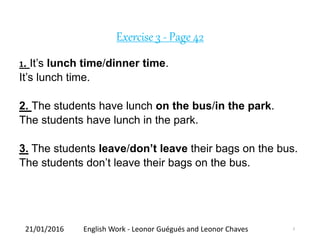
Exercise 3 - Page 42
1. It’s lunch time/dinner time.
It’s lunch time.
2. The students have lunch on the bus/in the park.
The students have lunch in the park.
3. The students leave/don’t leave their bags on the bus.
The students don’t leave their bags on the bus.
21/01/2016 English Work - Leonor Guégués and Leonor Chaves 3
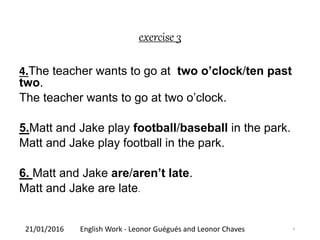
exercise 3
4.The teacher wants to go at two o’clock/ten past
two.
The teacher wants to go at two o’clock.
5.Matt and Jake play football/baseball in the park.
Matt and Jake play football in the park.
6. Matt and Jake are/aren’t late.
Matt and Jake are late.
21/01/2016 English Work - Leonor Guégués and Leonor Chaves 4
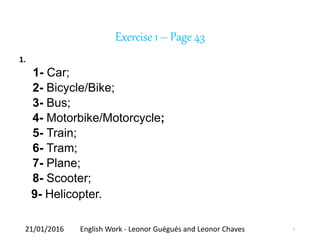
Exercise 1 – Page 43
1.
1- Car;
2- Bicycle/Bike;
3- Bus;
4- Motorbike/Motorcycle;
5- Train;
6- Tram;
7- Plane;
8- Scooter;
9- Helicopter.
21/01/2016 English Work - Leonor Guégués and Leonor Chaves 5
Exercise 3 – Page 43
3.
1- How do you come to school?
Example: I usually take a bus, but I sometimes
walk.
2- How does your mum go to work?
Example: She drives.
21/01/2016 English Work - Leonor Guégués and Leonor Chaves 6
Grammar:
Must: Obligation (obrigação)
Mustn´t: Prohibition (proibição)
Affirmative:
I/You/He/She/It/We/You/They – must stop.
Negative:
I/You/He/She/It/We/You/They – mustn´t (must not)
stop.
21/01/2016 English Work - Leonor Guégués and Leonor Chaves 7
Exercise 1 – Page 44
1- You mustn’t run in the school corridors.
2- It’s eleven o’clock, Carla. You must go to bed!
3- The boys mustn’t play football in the streets.
It’s dangerous!
4- Lessons start at quarter to nine, but we must
be at school at half past eight.
5- You must be home from the party by eleven
o’clock.
6- You mustn’t send messages in class.
21/01/2016 English Work - Leonor Guégués and Leonor Chaves 8
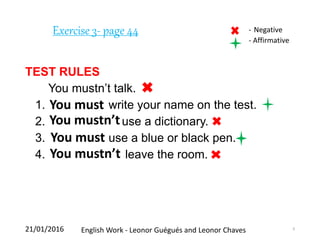
Exercise 3- page 44
TEST RULES
You mustn’t talk.
1. write your name on the test.
2. use a dictionary.
3. use a blue or black pen.
4. leave the room.
21/01/2016 English Work - Leonor Guégués and Leonor Chaves 9
You must
You mustn’t
You must
You mustn’t
- Negative
- Affirmative
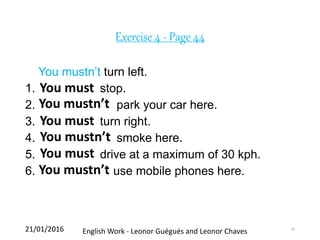
Exercise 4 - Page 44
You mustn’t turn left.
1. stop.
2. park your car here.
3. turn right.
4. smoke here.
5. drive at a maximum of 30 kph.
6. use mobile phones here.
21/01/2016 English Work - Leonor Guégués and Leonor Chaves 10
You must
You mustn’t
You must
You mustn’t
You must
You mustn’t
THE END!!!!
21/01/2016 English Work - Leonor Guégués and Leonor Chaves 11

English work nokas e nono

  • 1.
    English Work Textbook -PageS 42,43 and 44 Done by: Leonor Guégués Leonor Chaves 21ST January 2016 English Work 1
  • 2.
    Everyday Expressions •Right –Bem… •Here come – Aqui vêm… •Great – Bom. •Come on – Vá lá!... 21/01/2016 English Work - Leonor Guégués and Leonor Chaves 2
  • 3.
    Exercise 3 -Page 42 1. It’s lunch time/dinner time. It’s lunch time. 2. The students have lunch on the bus/in the park. The students have lunch in the park. 3. The students leave/don’t leave their bags on the bus. The students don’t leave their bags on the bus. 21/01/2016 English Work - Leonor Guégués and Leonor Chaves 3
  • 4.
    exercise 3 4.The teacherwants to go at two o’clock/ten past two. The teacher wants to go at two o’clock. 5.Matt and Jake play football/baseball in the park. Matt and Jake play football in the park. 6. Matt and Jake are/aren’t late. Matt and Jake are late. 21/01/2016 English Work - Leonor Guégués and Leonor Chaves 4
  • 5.
    Exercise 1 –Page 43 1. 1- Car; 2- Bicycle/Bike; 3- Bus; 4- Motorbike/Motorcycle; 5- Train; 6- Tram; 7- Plane; 8- Scooter; 9- Helicopter. 21/01/2016 English Work - Leonor Guégués and Leonor Chaves 5
  • 6.
    Exercise 3 –Page 43 3. 1- How do you come to school? Example: I usually take a bus, but I sometimes walk. 2- How does your mum go to work? Example: She drives. 21/01/2016 English Work - Leonor Guégués and Leonor Chaves 6
  • 7.
    Grammar: Must: Obligation (obrigação) Mustn´t:Prohibition (proibição) Affirmative: I/You/He/She/It/We/You/They – must stop. Negative: I/You/He/She/It/We/You/They – mustn´t (must not) stop. 21/01/2016 English Work - Leonor Guégués and Leonor Chaves 7
  • 8.
    Exercise 1 –Page 44 1- You mustn’t run in the school corridors. 2- It’s eleven o’clock, Carla. You must go to bed! 3- The boys mustn’t play football in the streets. It’s dangerous! 4- Lessons start at quarter to nine, but we must be at school at half past eight. 5- You must be home from the party by eleven o’clock. 6- You mustn’t send messages in class. 21/01/2016 English Work - Leonor Guégués and Leonor Chaves 8
  • 9.
    Exercise 3- page44 TEST RULES You mustn’t talk. 1. write your name on the test. 2. use a dictionary. 3. use a blue or black pen. 4. leave the room. 21/01/2016 English Work - Leonor Guégués and Leonor Chaves 9 You must You mustn’t You must You mustn’t - Negative - Affirmative
  • 10.
    Exercise 4 -Page 44 You mustn’t turn left. 1. stop. 2. park your car here. 3. turn right. 4. smoke here. 5. drive at a maximum of 30 kph. 6. use mobile phones here. 21/01/2016 English Work - Leonor Guégués and Leonor Chaves 10 You must You mustn’t You must You mustn’t You must You mustn’t
  • 11.
    THE END!!!! 21/01/2016 EnglishWork - Leonor Guégués and Leonor Chaves 11