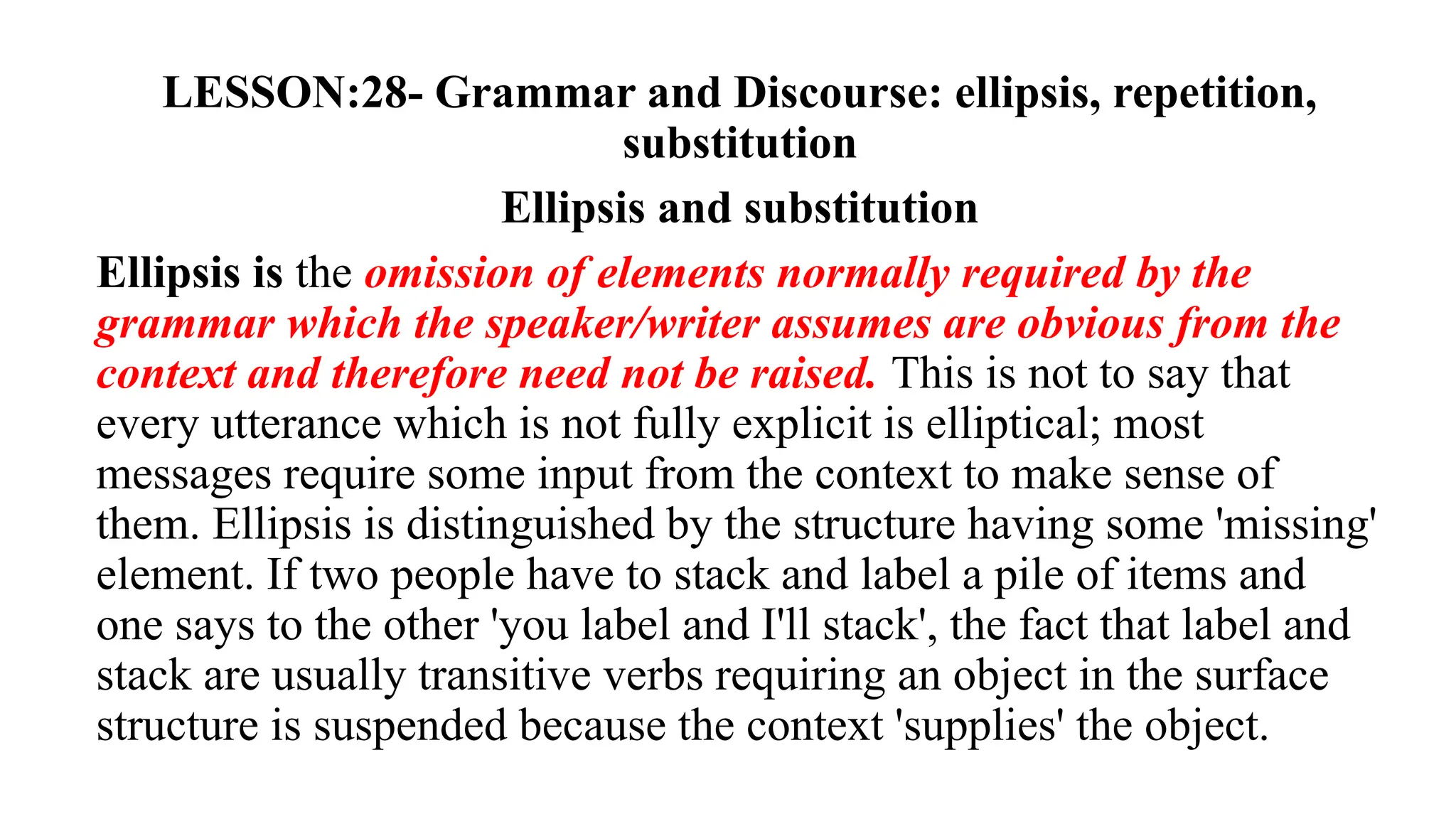
LESSON:28- Grammar andDiscourse: ellipsis, repetition,
substitution
Ellipsis and substitution
Ellipsis is the omission of elements normally required by the
grammar which the speaker/writer assumes are obvious from the
context and therefore need not be raised. This is not to say that
every utterance which is not fully explicit is elliptical; most
messages require some input from the context to make sense of
them. Ellipsis is distinguished by the structure having some 'missing'
element. If two people have to stack and label a pile of items and
one says to the other 'you label and I'll stack', the fact that label and
stack are usually transitive verbs requiring an object in the surface
structure is suspended because the context 'supplies' the object.
2.
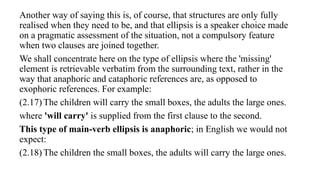
Another way ofsaying this is, of course, that structures are only fully
realised when they need to be, and that ellipsis is a speaker choice made
on a pragmatic assessment of the situation, not a compulsory feature
when two clauses are joined together.
We shall concentrate here on the type of ellipsis where the 'missing'
element is retrievable verbatim from the surrounding text, rather in the
way that anaphoric and cataphoric references are, as opposed to
exophoric references. For example:
(2.17) The children will carry the small boxes, the adults the large ones.
where 'will carry' is supplied from the first clause to the second.
This type of main-verb ellipsis is anaphoric; in English we would not
expect:
(2.18) The children the small boxes, the adults will carry the large ones.
3.
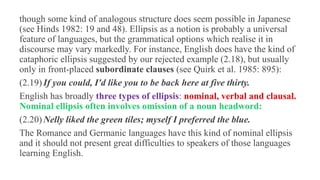
though some kindof analogous structure does seem possible in Japanese
(see Hinds 1982: 19 and 48). Ellipsis as a notion is probably a universal
feature of languages, but the grammatical options which realise it in
discourse may vary markedly. For instance, English does have the kind of
cataphoric ellipsis suggested by our rejected example (2.18), but usually
only in front-placed subordinate clauses (see Quirk et al. 1985: 895):
(2.19) If you could, I'd like you to be back here at five thirty.
English has broadly three types of ellipsis: nominal, verbal and clausal.
Nominal ellipsis often involves omission of a noun headword:
(2.20) Nelly liked the green tiles; myself I preferred the blue.
The Romance and Germanic languages have this kind of nominal ellipsis
and it should not present great difficulties to speakers of those languages
learning English.
4.
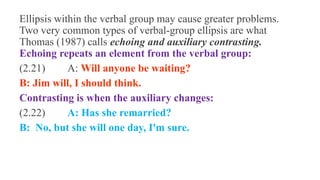
Ellipsis within theverbal group may cause greater problems.
Two very common types of verbal-group ellipsis are what
Thomas (1987) calls echoing and auxiliary contrasting.
Echoing repeats an element from the verbal group:
(2.21) A: Will anyone be waiting?
B: Jim will, I should think.
Contrasting is when the auxiliary changes:
(2.22) A: Has she remarried?
B: No, but she will one day, I'm sure.
5.
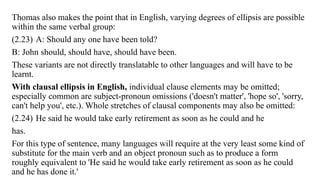
Thomas also makesthe point that in English, varying degrees of ellipsis are possible
within the same verbal group:
(2.23) A: Should any one have been told?
B: John should, should have, should have been.
These variants are not directly translatable to other languages and will have to be
learnt.
With clausal ellipsis in English, individual clause elements may be omitted;
especially common are subject-pronoun omissions ('doesn't matter', 'hope so', 'sorry,
can't help you', etc.). Whole stretches of clausal components may also be omitted:
(2.24) He said he would take early retirement as soon as he could and he
has.
For this type of sentence, many languages will require at the very least some kind of
substitute for the main verb and an object pronoun such as to produce a form
roughly equivalent to 'He said he would take early retirement as soon as he could
and he has done it.'
6.
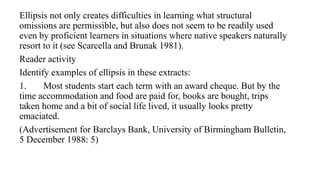
Ellipsis not onlycreates difficulties in learning what structural
omissions are permissible, but also does not seem to be readily used
even by proficient learners in situations where native speakers naturally
resort to it (see Scarcella and Brunak 1981).
Reader activity
Identify examples of ellipsis in these extracts:
1. Most students start each term with an award cheque. But by the
time accommodation and food are paid for, books are bought, trips
taken home and a bit of social life lived, it usually looks pretty
emaciated.
(Advertisement for Barclays Bank, University of Birmingham Bulletin,
5 December 1988: 5)
7.
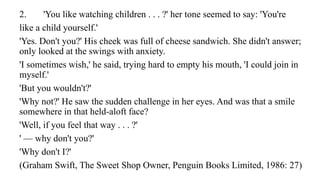
2. 'You likewatching children . . . ?' her tone seemed to say: 'You're
like a child yourself.'
'Yes. Don't you?' His cheek was full of cheese sandwich. She didn't answer;
only looked at the swings with anxiety.
'I sometimes wish,' he said, trying hard to empty his mouth, 'I could join in
myself.'
'But you wouldn't?'
'Why not?' He saw the sudden challenge in her eyes. And was that a smile
somewhere in that held-aloft face?
'Well, if you feel that way . . . ?'
' — why don't you?'
'Why don't I?'
(Graham Swift, The Sweet Shop Owner, Penguin Books Limited, 1986: 27)
8.
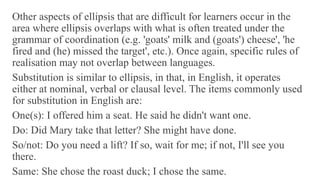
Other aspects ofellipsis that are difficult for learners occur in the
area where ellipsis overlaps with what is often treated under the
grammar of coordination (e.g. 'goats' milk and (goats') cheese', 'he
fired and (he) missed the target', etc.). Once again, specific rules of
realisation may not overlap between languages.
Substitution is similar to ellipsis, in that, in English, it operates
either at nominal, verbal or clausal level. The items commonly used
for substitution in English are:
One(s): I offered him a seat. He said he didn't want one.
Do: Did Mary take that letter? She might have done.
So/not: Do you need a lift? If so, wait for me; if not, I'll see you
there.
Same: She chose the roast duck; I chose the same.
9.
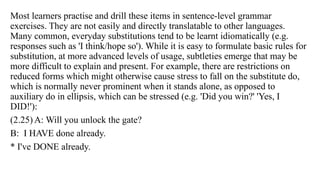
Most learners practiseand drill these items in sentence-level grammar
exercises. They are not easily and directly translatable to other languages.
Many common, everyday substitutions tend to be learnt idiomatically (e.g.
responses such as 'I think/hope so'). While it is easy to formulate basic rules for
substitution, at more advanced levels of usage, subtleties emerge that may be
more difficult to explain and present. For example, there are restrictions on
reduced forms which might otherwise cause stress to fall on the substitute do,
which is normally never prominent when it stands alone, as opposed to
auxiliary do in ellipsis, which can be stressed (e.g. 'Did you win?' 'Yes, I
DID!'):
(2.25) A: Will you unlock the gate?
B: I HAVE done already.
* I've DONE already.
10.
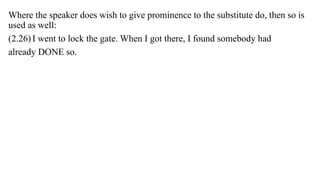
Where the speakerdoes wish to give prominence to the substitute do, then so is
used as well:
(2.26) I went to lock the gate. When I got there, I found somebody had
already DONE so.



![Lecture No. 09 Parallelism in Discourse , lecture No 13 [Autosaved].pptx](https://cdn.slidesharecdn.com/ss_thumbnails/lectureno-240323182838-de66f0aa-thumbnail.jpg?width=640&height=640&fit=bounds)


