ENGL 1303 Ogbaa
Essay 1: Summary/Strong Response
The Prompt
For your first writing assignment, you’ll use the strategies
outlined in Chapter 6 of the AB Guide,
“Reading Rhetorically,” to write a summary/strong response
essay based on ONE of the following
options:
Johnathan Haidt
https://www.theatlantic.com/magazine/archive/2015/09/the-
coddling-of-the-american-
mind/399356/
http://www.slate.com/articles/double_x/cover_story/2016/09/wh
at_science_can_tell_us_a
bout_trigger_warnings.html
Your essay will include (1) a summary of the text
(approximately 150-250 words), and (2) a strong
response in which you speak back to that reading from your own
critical thinking or values. To
generate ideas for response look to the question-asking
strategies in the AB Guide in Chapter 6, pp.
84-114. Your response may take the shape of a rhetorical
critique, an ideas critique, or a “blended”
approach where both strategies appear in your paper. Do not
write a personal reflection critique.
Envision your audience to be another college student who has
heard of the ideas from the text but
hasn’t thought about them thoroughly.
My Rationale
The essay’s objective is to teach summary writing and rhetorical
response. By writing, the student will
gain experience in doing both. Before focusing on individual
parts or aspects of a text, writers must
consider the text as a whole—hence the need for summary.
Summary writing is a valuable tool which
will allow the reader-turned-writer to understand and
communicate (in written form) the thesis or
goals of the essay. Strong response provides the reader-turned-
writer with the opportunity to look
closely at the essay while using rhetorical language and
concepts as a guide.
PRINTED
Rough Draft
due for Peer
Review on
Tues. 9/26
FINAL
Submit by
11:59 pm on
Fri. 9/29 via
TurnItIn
https://www.theatlantic.com/magazine/archive/2015/09/the-
coddling-of-the-american-mind/399356/
https://www.theatlantic.com/magazine/archive/2015/09/the-
coddling-of-the-american-mind/399356/
http://www.slate.com/articles/double_x/cover_story/2016/09/wh
at_science_can_tell_us_about_trigger_warnings.html
http://www.slate.com/articles/double_x/cover_story/2016/09/wh
at_science_can_tell_us_about_trigger_warnings.html
ENGL 1303 Ogbaa
Basic Structure
Introductory paragraph
ets up the problem or topic as context for the introduction of
your chosen text.
(where the article appeared), and
author’s central claim or main idea.
-filled thesis that sets up clear
expectations for the direction of your
essay and gives your reader a sense of the points you will
develop and discuss. Your thesis will
express your judgment about the text in terms of rhetorical
strategies, successes or problems,
or possibly questions it has raised in your mind. See pp. 108 for
sample thesis statements.
Summary of the article (150-250 words)
follow the order of the original
essay, keeping the proportions of the summary roughly
equivalent to the proportions of the
original text.
from your own. The summary does
not include your opinion.
folded into your own
sentence. Use author tags and
introductory phrases to incorporate direct quotes into your
sentences.
Response paragraphs supporting your thesis
reader.
uthor’s argument, main points, and/or ideas
your ideas with transitions.
from the text or your own
experience (examples/paraphrases/direct quotations).
Conclusion
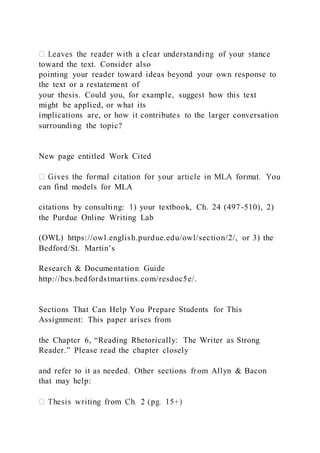
toward the text. Consider also
pointing your reader toward ideas beyond your own response to
the text or a restatement of
your thesis. Could you, for example, suggest how this text
might be applied, or what its
implications are, or how it contributes to the larger conversation
surrounding the topic?
New page entitled Work Cited
can find models for MLA
citations by consulting: 1) your textbook, Ch. 24 (497-510), 2)
the Purdue Online Writing Lab
(OWL) https://owl.english.purdue.edu/owl/section/2/, or 3) the
Bedford/St. Martin’s
Research & Documentation Guide
http://bcs.bedfordstmartins.com/resdoc5e/.
Sections That Can Help You Prepare Students for This
Assignment: This paper arises from
the Chapter 6, “Reading Rhetorically: The Writer as Strong
Reader.” Please read the chapter closely
and refer to it as needed. Other sections from Allyn & Bacon
that may help:
(pp.31-33)
-63)
-text citation (basics) from Ch. 24
https://owl.english.purdue.edu/owl/section/2/
http://bcs.bedfordstmartins.com/resdoc5e/
ENGL 1303 Ogbaa
ENGL 1303 Essay #1 “Summary and Strong Response” Rubric
Excellent
A [30-27 pts; 15-13 pts]
Proficient
B [26-24 pts; 12-10 pts]
Minimally Proficient
C [23-21 pts; 9 pts]
Needs Improvement
D [20-18 pts; 8 pts]
Rhetorical
Situation &
Context
[15 pts]
Essay communicates the context and the
rhetorical relationship between essay and
student. There is attention given to the “stakes”
attached to the ideas.
Essay communicates the context and the
rhetorical relationship between essay and
student. There is no mention of the “stakes”
attached to the ideas.
Essay communicates is missing either the
context of the essay or the rhetorical relationship
between essay and student. There is no attention
to the “stakes” attached to the ideas.
Essay shows very little, if
any, attention to the
rhetorical situation, context
or impact of ideas.
Summary
[15 pts]
Summary is concise, comprehensive and
objective. The summary gives attention or
space to ideas in the same proportion (or
emphasis) as the original work. Authorial tags
are used appropriately and at least one direct
quote is used.
Summary is concise but may not be
comprehensive and its objectivity may waiver.
The summary gives attention or space to ideas
in the same proportion (or emphasis) as the
original work. Authorial tags are used
appropriately and at least one direct quote is
used.
Summary neglects/omits at least one of the
central ideas and may include details or
examples instead. Summary may omit the direct
quote and/or the authorial tags. Summary may
write about ideas without respect to the emphasis
assigned by essay’s author(s).
Summary may err
dramatically in the following
ways: it may be very long
and include an abundance
of details or personal
opinions or it may be very
short and omit central
ideas.
Focus and
Thesis
[30 pts]
The thesis of the essay is very clear and easy
to identify, and is interesting.
The thesis of the paper is clear and
identifiable, and hooks the reader in some way.
There is a thesis, but it may be difficult to identify.
The thesis is simplistic.
There is no clear thesis or
what is intended as the
thesis does not assert a
stance or opinion.
Organization,
Coherence,
and Unity
[30 pts]
The essay is logically organized and readers
move easily from one idea and/or paragraph to
the next. Careful use of transition words,
phrases, or sentences to show the
relationships of ideas. Sections and
paragraphs show unity by focusing on one
main idea that supports the thesis. A
concluding section or paragraph weaves
together the strands of the essay perhaps
leaving readers with a thought-provoking
question or image, and provides a sense of
closure without simply restating the thesis.
The essay is logically organized and readers
usually move easily from one idea and/or
paragraph to the next. The essay is generally
coherent because of the use of transition
words, phrases, or sentences to show the
relationships of ideas. Sections and
paragraphs are usually unified by focusing on
one main idea that supports the thesis. A
concluding section or paragraph weaves
together the strands of the essay perhaps and
provides a sense of closure and may restate
the thesis.
The essay is sometimes logically organized and
readers sometimes have difficulty moving from
one idea and/or paragraph to the next. The essay
sometimes is not coherent because of inattention
to the use of transition words, phrases, or
sentences to show the relationships of ideas.
Sections and paragraphs show are not always
unified because they do not consistently focus by
on one main idea that supports the thesis. The
essay has a concluding section or paragraph. It
may simply restate the thesis. It may or may not
provide a satisfying sense of closure.
The essay lacks an
introduction and/or
conclusion. There is little
attention to logical
organization and
coherency.
Grammar /
Mechanics /
Style / Format
[20 pts]
There are few, if any, errors in grammar,
mechanics and punctuation. Works Cited page
is titled appropriately and begins on a separate
page.
Errors in grammar, mechanics and punctuation
do not disrupt the flow or clarity of the paper.
Works Cited page is either titled appropriately
incorrectly or does not begin on a separate
page.
Errors in grammar, mechanics and punctuation
sometimes disrupt the flow or clarity of the paper.
Works Cited page is titled incorrectly and does
not begin on a separate page.
The essay’s grammatical or
mechanical errors detract
from clarity or
comprehension. Works
Cited page is missing,
untitled or devoid of any
discernable format.
Vocabulary and
Concept
integration [20
pts]
The essay uses rhetorical concepts and terms
(logos, ethos, pathos) appropriately throughout
the essay. Terms are backed up with examples
from the text and related back to student’s
thesis.
The essay uses only one rhetorical concepts or
idea and neglects the others. The term or idea
is related back to the student’s thesis.
The rhetorical concepts/terms are not connected
back to the student’s thesis or the wider context
(goals) of the essay.
Essay may include the
terms logos, ethos, or
pathos but they are used
incorrectly or sporadically.
Required
Source Usage
[20 pts]
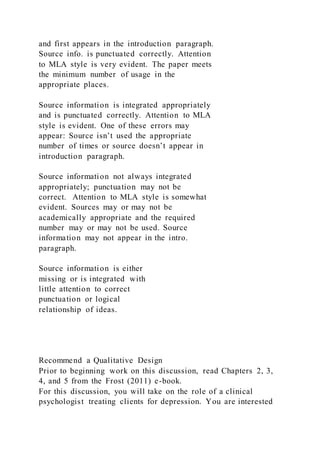
Source information is integrated appropriately
and first appears in the introduction paragraph.
Source info. is punctuated correctly. Attention
to MLA style is very evident. The paper meets
the minimum number of usage in the
appropriate places.
Source information is integrated appropriately
and is punctuated correctly. Attention to MLA
style is evident. One of these errors may
appear: Source isn’t used the appropriate
number of times or source doesn’t appear in
introduction paragraph.
Source information not always integrated
appropriately; punctuation may not be
correct. Attention to MLA style is somewhat
evident. Sources may or may not be
academically appropriate and the required
number may or may not be used. Source
information may not appear in the intro.
paragraph.
Source information is either
missing or is integrated with
little attention to correct
punctuation or logical
relationship of ideas.
Recommend a Qualitative Design
Prior to beginning work on this discussion, read Chapters 2, 3,
4, and 5 from the Frost (2011) e-book.
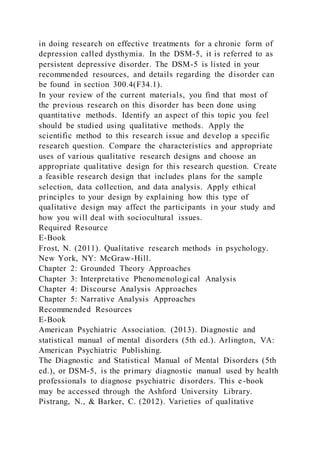
For this discussion, you will take on the role of a clinical
psychologist treating clients for depression. You are interested
in doing research on effective treatments for a chronic form of
depression called dysthymia. In the DSM-5, it is referred to as
persistent depressive disorder. The DSM-5 is listed in your
recommended resources, and details regarding the disorder can
be found in section 300.4(F34.1).
In your review of the current materials, you find that most of
the previous research on this disorder has been done using
quantitative methods. Identify an aspect of this topic you feel
should be studied using qualitative methods. Apply the
scientific method to this research issue and develop a specific
research question. Compare the characteristics and appropriate
uses of various qualitative research designs and choose an
appropriate qualitative design for this research question. Create
a feasible research design that includes plans for the sample
selection, data collection, and data analysis. Apply ethical
principles to your design by explaining how this type of
qualitative design may affect the participants in your study and
how you will deal with sociocultural issues.
Required Resource
E-Book
Frost, N. (2011). Qualitative research methods in psychology.
New York, NY: McGraw-Hill.
Chapter 2: Grounded Theory Approaches
Chapter 3: Interpretative Phenomenological Analysis
Chapter 4: Discourse Analysis Approaches
Chapter 5: Narrative Analysis Approaches
Recommended Resources
E-Book
American Psychiatric Association. (2013). Diagnostic and
statistical manual of mental disorders (5th ed.). Arlington, VA:
American Psychiatric Publishing.
The Diagnostic and Statistical Manual of Mental Disorders (5th
ed.), or DSM-5, is the primary diagnostic manual used by health
professionals to diagnose psychiatric disorders. This e-book
may be accessed through the Ashford University Library.
Pistrang, N., & Barker, C. (2012). Varieties of qualitative
research: A pragmatic approach to selecting methods. In H.
Cooper, P. M. Camic, D. L. Long, A. T. Panter, D. Rindskopf,
& K. J. Sher (Eds.) APA handbook of research methods in
psychology, vol. 2: Research designs: Quantitative, qualitative,
neuropsychological, and biological [Electronic version]. (pp. 5-
18). doi: 10.1037/13620-001
Articles
Chenail, R. J. (2011). Ten steps for conceptualizing and
conducting qualitative research studies in a pragmatically
curious manner. The Qualitative Report, 16(6), 1713-1730.
Retrieved from http://tqr.nova.edu/
Leech, N. L., & Onwuegbuzie, A. J. (2007). An array of
qualitative data analysis tools: A call for data analysis
triangulation. School Psychology Quarterly, 22(4), 557-584.
doi: 10.1037/1045-3830.22.4.557

ENGL 1303 Ogbaa Essay 1 SummaryStrong Response

  • 1.
    ENGL 1303 Ogbaa Essay1: Summary/Strong Response The Prompt For your first writing assignment, you’ll use the strategies outlined in Chapter 6 of the AB Guide, “Reading Rhetorically,” to write a summary/strong response essay based on ONE of the following options: Johnathan Haidt https://www.theatlantic.com/magazine/archive/2015/09/the- coddling-of-the-american- mind/399356/ http://www.slate.com/articles/double_x/cover_story/2016/09/wh at_science_can_tell_us_a bout_trigger_warnings.html Your essay will include (1) a summary of the text (approximately 150-250 words), and (2) a strong response in which you speak back to that reading from your own critical thinking or values. To generate ideas for response look to the question-asking
  • 2.
    strategies in theAB Guide in Chapter 6, pp. 84-114. Your response may take the shape of a rhetorical critique, an ideas critique, or a “blended” approach where both strategies appear in your paper. Do not write a personal reflection critique. Envision your audience to be another college student who has heard of the ideas from the text but hasn’t thought about them thoroughly. My Rationale The essay’s objective is to teach summary writing and rhetorical response. By writing, the student will gain experience in doing both. Before focusing on individual parts or aspects of a text, writers must consider the text as a whole—hence the need for summary. Summary writing is a valuable tool which will allow the reader-turned-writer to understand and communicate (in written form) the thesis or goals of the essay. Strong response provides the reader-turned- writer with the opportunity to look closely at the essay while using rhetorical language and concepts as a guide. PRINTED Rough Draft due for Peer Review on Tues. 9/26 FINAL
  • 3.
    Submit by 11:59 pmon Fri. 9/29 via TurnItIn https://www.theatlantic.com/magazine/archive/2015/09/the- coddling-of-the-american-mind/399356/ https://www.theatlantic.com/magazine/archive/2015/09/the- coddling-of-the-american-mind/399356/ http://www.slate.com/articles/double_x/cover_story/2016/09/wh at_science_can_tell_us_about_trigger_warnings.html http://www.slate.com/articles/double_x/cover_story/2016/09/wh at_science_can_tell_us_about_trigger_warnings.html ENGL 1303 Ogbaa Basic Structure Introductory paragraph ets up the problem or topic as context for the introduction of your chosen text. (where the article appeared), and author’s central claim or main idea. -filled thesis that sets up clear expectations for the direction of your essay and gives your reader a sense of the points you will develop and discuss. Your thesis will express your judgment about the text in terms of rhetorical
  • 4.
    strategies, successes orproblems, or possibly questions it has raised in your mind. See pp. 108 for sample thesis statements. Summary of the article (150-250 words) follow the order of the original essay, keeping the proportions of the summary roughly equivalent to the proportions of the original text. from your own. The summary does not include your opinion. folded into your own sentence. Use author tags and introductory phrases to incorporate direct quotes into your sentences. Response paragraphs supporting your thesis reader. uthor’s argument, main points, and/or ideas your ideas with transitions. from the text or your own experience (examples/paraphrases/direct quotations). Conclusion
  • 5.
    toward the text.Consider also pointing your reader toward ideas beyond your own response to the text or a restatement of your thesis. Could you, for example, suggest how this text might be applied, or what its implications are, or how it contributes to the larger conversation surrounding the topic? New page entitled Work Cited can find models for MLA citations by consulting: 1) your textbook, Ch. 24 (497-510), 2) the Purdue Online Writing Lab (OWL) https://owl.english.purdue.edu/owl/section/2/, or 3) the Bedford/St. Martin’s Research & Documentation Guide http://bcs.bedfordstmartins.com/resdoc5e/. Sections That Can Help You Prepare Students for This Assignment: This paper arises from the Chapter 6, “Reading Rhetorically: The Writer as Strong Reader.” Please read the chapter closely and refer to it as needed. Other sections from Allyn & Bacon that may help:
  • 6.
    (pp.31-33) -63) -text citation (basics)from Ch. 24 https://owl.english.purdue.edu/owl/section/2/ http://bcs.bedfordstmartins.com/resdoc5e/ ENGL 1303 Ogbaa ENGL 1303 Essay #1 “Summary and Strong Response” Rubric Excellent A [30-27 pts; 15-13 pts] Proficient B [26-24 pts; 12-10 pts] Minimally Proficient C [23-21 pts; 9 pts] Needs Improvement D [20-18 pts; 8 pts] Rhetorical Situation & Context [15 pts] Essay communicates the context and the rhetorical relationship between essay and
  • 7.
    student. There isattention given to the “stakes” attached to the ideas. Essay communicates the context and the rhetorical relationship between essay and student. There is no mention of the “stakes” attached to the ideas. Essay communicates is missing either the context of the essay or the rhetorical relationship between essay and student. There is no attention to the “stakes” attached to the ideas. Essay shows very little, if any, attention to the rhetorical situation, context or impact of ideas. Summary [15 pts] Summary is concise, comprehensive and objective. The summary gives attention or space to ideas in the same proportion (or emphasis) as the original work. Authorial tags are used appropriately and at least one direct quote is used. Summary is concise but may not be comprehensive and its objectivity may waiver. The summary gives attention or space to ideas in the same proportion (or emphasis) as the original work. Authorial tags are used appropriately and at least one direct quote is used.
  • 8.
    Summary neglects/omits atleast one of the central ideas and may include details or examples instead. Summary may omit the direct quote and/or the authorial tags. Summary may write about ideas without respect to the emphasis assigned by essay’s author(s). Summary may err dramatically in the following ways: it may be very long and include an abundance of details or personal opinions or it may be very short and omit central ideas. Focus and Thesis [30 pts] The thesis of the essay is very clear and easy to identify, and is interesting. The thesis of the paper is clear and identifiable, and hooks the reader in some way. There is a thesis, but it may be difficult to identify. The thesis is simplistic. There is no clear thesis or what is intended as the thesis does not assert a stance or opinion. Organization, Coherence,
  • 9.
    and Unity [30 pts] Theessay is logically organized and readers move easily from one idea and/or paragraph to the next. Careful use of transition words, phrases, or sentences to show the relationships of ideas. Sections and paragraphs show unity by focusing on one main idea that supports the thesis. A concluding section or paragraph weaves together the strands of the essay perhaps leaving readers with a thought-provoking question or image, and provides a sense of closure without simply restating the thesis. The essay is logically organized and readers usually move easily from one idea and/or paragraph to the next. The essay is generally coherent because of the use of transition words, phrases, or sentences to show the relationships of ideas. Sections and paragraphs are usually unified by focusing on one main idea that supports the thesis. A concluding section or paragraph weaves together the strands of the essay perhaps and provides a sense of closure and may restate the thesis. The essay is sometimes logically organized and readers sometimes have difficulty moving from one idea and/or paragraph to the next. The essay sometimes is not coherent because of inattention to the use of transition words, phrases, or sentences to show the relationships of ideas. Sections and paragraphs show are not always
  • 10.
    unified because theydo not consistently focus by on one main idea that supports the thesis. The essay has a concluding section or paragraph. It may simply restate the thesis. It may or may not provide a satisfying sense of closure. The essay lacks an introduction and/or conclusion. There is little attention to logical organization and coherency. Grammar / Mechanics / Style / Format [20 pts] There are few, if any, errors in grammar, mechanics and punctuation. Works Cited page is titled appropriately and begins on a separate page. Errors in grammar, mechanics and punctuation do not disrupt the flow or clarity of the paper. Works Cited page is either titled appropriately incorrectly or does not begin on a separate page. Errors in grammar, mechanics and punctuation sometimes disrupt the flow or clarity of the paper. Works Cited page is titled incorrectly and does not begin on a separate page. The essay’s grammatical or mechanical errors detract
  • 11.
    from clarity or comprehension.Works Cited page is missing, untitled or devoid of any discernable format. Vocabulary and Concept integration [20 pts] The essay uses rhetorical concepts and terms (logos, ethos, pathos) appropriately throughout the essay. Terms are backed up with examples from the text and related back to student’s thesis. The essay uses only one rhetorical concepts or idea and neglects the others. The term or idea is related back to the student’s thesis. The rhetorical concepts/terms are not connected back to the student’s thesis or the wider context (goals) of the essay. Essay may include the terms logos, ethos, or pathos but they are used incorrectly or sporadically. Required Source Usage [20 pts] Source information is integrated appropriately
  • 12.
    and first appearsin the introduction paragraph. Source info. is punctuated correctly. Attention to MLA style is very evident. The paper meets the minimum number of usage in the appropriate places. Source information is integrated appropriately and is punctuated correctly. Attention to MLA style is evident. One of these errors may appear: Source isn’t used the appropriate number of times or source doesn’t appear in introduction paragraph. Source information not always integrated appropriately; punctuation may not be correct. Attention to MLA style is somewhat evident. Sources may or may not be academically appropriate and the required number may or may not be used. Source information may not appear in the intro. paragraph. Source information is either missing or is integrated with little attention to correct punctuation or logical relationship of ideas. Recommend a Qualitative Design Prior to beginning work on this discussion, read Chapters 2, 3, 4, and 5 from the Frost (2011) e-book. For this discussion, you will take on the role of a clinical psychologist treating clients for depression. You are interested
  • 13.
    in doing researchon effective treatments for a chronic form of depression called dysthymia. In the DSM-5, it is referred to as persistent depressive disorder. The DSM-5 is listed in your recommended resources, and details regarding the disorder can be found in section 300.4(F34.1). In your review of the current materials, you find that most of the previous research on this disorder has been done using quantitative methods. Identify an aspect of this topic you feel should be studied using qualitative methods. Apply the scientific method to this research issue and develop a specific research question. Compare the characteristics and appropriate uses of various qualitative research designs and choose an appropriate qualitative design for this research question. Create a feasible research design that includes plans for the sample selection, data collection, and data analysis. Apply ethical principles to your design by explaining how this type of qualitative design may affect the participants in your study and how you will deal with sociocultural issues. Required Resource E-Book Frost, N. (2011). Qualitative research methods in psychology. New York, NY: McGraw-Hill. Chapter 2: Grounded Theory Approaches Chapter 3: Interpretative Phenomenological Analysis Chapter 4: Discourse Analysis Approaches Chapter 5: Narrative Analysis Approaches Recommended Resources E-Book American Psychiatric Association. (2013). Diagnostic and statistical manual of mental disorders (5th ed.). Arlington, VA: American Psychiatric Publishing. The Diagnostic and Statistical Manual of Mental Disorders (5th ed.), or DSM-5, is the primary diagnostic manual used by health professionals to diagnose psychiatric disorders. This e-book may be accessed through the Ashford University Library. Pistrang, N., & Barker, C. (2012). Varieties of qualitative
  • 14.
    research: A pragmaticapproach to selecting methods. In H. Cooper, P. M. Camic, D. L. Long, A. T. Panter, D. Rindskopf, & K. J. Sher (Eds.) APA handbook of research methods in psychology, vol. 2: Research designs: Quantitative, qualitative, neuropsychological, and biological [Electronic version]. (pp. 5- 18). doi: 10.1037/13620-001 Articles Chenail, R. J. (2011). Ten steps for conceptualizing and conducting qualitative research studies in a pragmatically curious manner. The Qualitative Report, 16(6), 1713-1730. Retrieved from http://tqr.nova.edu/ Leech, N. L., & Onwuegbuzie, A. J. (2007). An array of qualitative data analysis tools: A call for data analysis triangulation. School Psychology Quarterly, 22(4), 557-584. doi: 10.1037/1045-3830.22.4.557