Types of OHE
▶ In metro systems, there are primarily two types of OHE (Overhead Electrification)
systems commonly used:
1. 1. Single Wire with Return Current (SWRC): This type of OHE system uses a single
catenary wire to supply power to the trains, while the return current flows through the
running rails. The catenary wire carries the positive current, while the negative or return
current is conducted through the tracks. SWRC systems are simpler in design and
installation but may have limitations in terms of power capacity.
2. Two Wire with Insulated Return (TWIR): In TWIR systems, two catenary wires are used to
supply power to the trains. One wire carries the positive current, while the other wire
carries the negative or return current. The return current is insulated from the running
rails, reducing the risk of electrical interference with other systems. TWIR systems offer
higher power capacity and better electrical performance but are more complex to install
and maintain.
OHE, or Overhead Electrification, offers several advantages
over other electrical systems in metro systems:
2. Flexibility: OHE systems can accommodate a
wide range of train types and sizes, making
them flexible for different metro system
requirements. They can easily adapt to
changes in train technology and can be
expanded or modified as needed.
3. Energy Efficiency: OHE systems are known for
their energy efficiency. The power is supplied
directly to the trains from the overhead wires,
reducing energy losses during transmission.
This results in more efficient energy usage and
lower operational costs.
1. Cost-effective: OHE systems are generally
more cost-effective to install and maintain
compared to other electrical systems. The
overhead wires are relatively simple to
install,
and the infrastructure required is less complex 4.
than other alternatives.
Reliability: OHE systems have a proven track
record of reliability. The overhead wires are
less prone to disruptions caused by weather
conditions, such as heavy rain or snow,
compared to other systems that may have
underground components.
5. Safety: OHE systems are designed with safety
in mind. The overhead wires are placed out of
reach of pedestrians and vehicles, reducing the
risk of accidents or unauthorized access to the
electrical infrastructure.
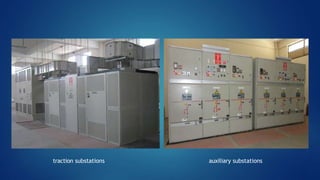
traction substations auxiliary substations
Traction substations
▶ Traction substations are essential components in metro systems. They play a crucial role
in supplying the required electrical power to the trains for their propulsion. Traction
substations receive high voltage electricity from the power grid and then convert it to
the appropriate voltage and current levels needed by the trains.
▶ These substations distribute the power through the overhead catenary system, which
allows the trains to collect the power through their pantographs. This power is then
used to drive the traction motors, enabling the trains to move along the tracks. Traction
substations are strategically located along the metro network to ensure a reliable and
efficient power supply to the trains.
Auxiliary substations
▶ Auxiliary substations, also known as ASS, are an important part of metro systems.
These substations provide power for various auxiliary systems and equipment within
the metro network. They supply electricity to systems such as lighting, ventilation,
escalators, elevators, signalling systems, and other electrical components necessary for
the smooth operation of the metro system.
▶ Auxiliary substations ensure that all the essential functions and services in the
metro, apart from the train propulsion, are powered effectively. They play a vital
role in maintaining the comfort, safety, and functionality of the metro system.
SCADA for power supply system
▶ The SCADA (Supervisory Control and Data Acquisition) system is an important
component of the power supply infrastructure in metro systems. It is used to monitor and
control the electrical distribution and power management within the metro network.
▶ The SCADA system collects real-time data from various substations, including traction
and auxiliary substations, to provide operators with a comprehensive view of the power
supply status. It allows operators to remotely monitor and control the power distribution,
detect faults, and take necessary actions to ensure uninterrupted power supply to the
trains and other auxiliary systems. The SCADA system plays a crucial role in maintaining
the reliability and efficiency of the power supply in metro systems
Working of SCADA
▶ The SCADA system works by collecting data from various sensors and devices in the power
supply system of a metro. This data includes information on voltage levels, current flow,
temperature, and other relevant parameters. The SCADA system then processes and
analyses this data, providing real-time monitoring and control capabilities to operators.
▶ Operators can use the SCADA system to remotely monitor the status of substations,
transformers, circuit breakers, and other components of the power supply system. They can also
control the operation of these devices, such as switching on or off certain circuits or adjusting
voltage levels.
▶ The SCADA system uses a network of communication channels to transmit data between the
central control station and the remote devices. This enables operators to have a
comprehensive view of the power supply system and make informed decisions to ensure its
efficient and reliable operation.
Green buildings in metro systems
▶ Green buildings in metro systems are an exciting aspect of sustainable urban design. They
focus on incorporating environmentally friendly features and practices to reduce energy
consumption, minimize waste, and promote a healthier indoor environment.
▶ These green buildings in metro systems often integrate energy-efficient systems, such as solar
panels for renewable energy generation, efficient lighting and HVAC systems, and water-saving
fixtures. They may also use sustainable construction materials, implement proper waste
management strategies, and prioritize green spaces and landscaping. By incorporating green
buildings within metro systems, cities can reduce their environmental impact, improve energy
efficiency, and create healthier and more sustainable spaces for commuters and surrounding
communities.
▶ There are several countries who focus on green buildings in metro systems. One notable
example is the Taipei Metro in Taiwan. They have implemented green building practices in
their stations, including energy-efficient lighting, rainwater harvesting systems, and green
roofs.
These features help reduce energy consumption and promote sustainability.
▶ Green buildings in metro systems contribute to sustainability in several ways. First, they
promote energy efficiency by incorporating features like solar panels, efficient lighting,
and HVAC systems. This reduces the overall energy consumption and carbon footprint of
the metro system.
▶ Second, green buildings prioritize water conservation through the use of water-saving
fixtures and systems. This helps reduce water consumption and promotes responsible
water management.
▶ Third, sustainable construction materials are used in green buildings, which are
environmentally friendly and have a lower impact on natural resources. This reduces
the depletion of resources and minimizes waste generation.
▶ Moreover, green buildings in metro systems often prioritize indoor air quality and
occupant comfort. They utilize proper ventilation systems, non-toxic materials, and natural
lighting, creating healthier and more pleasant spaces for commuters and employees.
Carbon credits
▶ Carbon credits can play a significant role in reducing the carbon footprint of metro systems.
Metro systems generate greenhouse gas emissions through their operations, such as energy
consumption and train operations. To offset these emissions, metro systems can participate
in carbon credit programs.
▶ Carbon credits are a market-based mechanism that allows organizations to invest in projects
that reduce or remove greenhouse gas emissions. By purchasing carbon credits, metro systems
can support projects that promote renewable energy, energy efficiency, or carbon sequestration.
These projects help to offset the emissions produced by the metro system, effectively
neutralizing their carbon footprint.
▶ Implementing carbon credits in metro systems can have multiple benefits. It not only helps to
reduce greenhouse gas emissions but also contributes to sustainable development and
supports the growth of renewable energy projects. Additionally, participating in carbon credit
programs can enhance the environmental reputation of the metro system and demonstrate a
commitment to sustainability. Overall, carbon credits provide a valuable tool for metro
systems to mitigate their environmental impact and contribute to global efforts in combating
climate change.

engineering the basis needs. .pptx

  • 1.
    Types of OHE ▶In metro systems, there are primarily two types of OHE (Overhead Electrification) systems commonly used: 1. 1. Single Wire with Return Current (SWRC): This type of OHE system uses a single catenary wire to supply power to the trains, while the return current flows through the running rails. The catenary wire carries the positive current, while the negative or return current is conducted through the tracks. SWRC systems are simpler in design and installation but may have limitations in terms of power capacity. 2. Two Wire with Insulated Return (TWIR): In TWIR systems, two catenary wires are used to supply power to the trains. One wire carries the positive current, while the other wire carries the negative or return current. The return current is insulated from the running rails, reducing the risk of electrical interference with other systems. TWIR systems offer higher power capacity and better electrical performance but are more complex to install and maintain.
  • 2.
    OHE, or OverheadElectrification, offers several advantages over other electrical systems in metro systems: 2. Flexibility: OHE systems can accommodate a wide range of train types and sizes, making them flexible for different metro system requirements. They can easily adapt to changes in train technology and can be expanded or modified as needed. 3. Energy Efficiency: OHE systems are known for their energy efficiency. The power is supplied directly to the trains from the overhead wires, reducing energy losses during transmission. This results in more efficient energy usage and lower operational costs. 1. Cost-effective: OHE systems are generally more cost-effective to install and maintain compared to other electrical systems. The overhead wires are relatively simple to install, and the infrastructure required is less complex 4. than other alternatives. Reliability: OHE systems have a proven track record of reliability. The overhead wires are less prone to disruptions caused by weather conditions, such as heavy rain or snow, compared to other systems that may have underground components. 5. Safety: OHE systems are designed with safety in mind. The overhead wires are placed out of reach of pedestrians and vehicles, reducing the risk of accidents or unauthorized access to the electrical infrastructure.
  • 3.
  • 4.
    Traction substations ▶ Tractionsubstations are essential components in metro systems. They play a crucial role in supplying the required electrical power to the trains for their propulsion. Traction substations receive high voltage electricity from the power grid and then convert it to the appropriate voltage and current levels needed by the trains. ▶ These substations distribute the power through the overhead catenary system, which allows the trains to collect the power through their pantographs. This power is then used to drive the traction motors, enabling the trains to move along the tracks. Traction substations are strategically located along the metro network to ensure a reliable and efficient power supply to the trains.
  • 5.
    Auxiliary substations ▶ Auxiliarysubstations, also known as ASS, are an important part of metro systems. These substations provide power for various auxiliary systems and equipment within the metro network. They supply electricity to systems such as lighting, ventilation, escalators, elevators, signalling systems, and other electrical components necessary for the smooth operation of the metro system. ▶ Auxiliary substations ensure that all the essential functions and services in the metro, apart from the train propulsion, are powered effectively. They play a vital role in maintaining the comfort, safety, and functionality of the metro system.
  • 6.
    SCADA for powersupply system ▶ The SCADA (Supervisory Control and Data Acquisition) system is an important component of the power supply infrastructure in metro systems. It is used to monitor and control the electrical distribution and power management within the metro network. ▶ The SCADA system collects real-time data from various substations, including traction and auxiliary substations, to provide operators with a comprehensive view of the power supply status. It allows operators to remotely monitor and control the power distribution, detect faults, and take necessary actions to ensure uninterrupted power supply to the trains and other auxiliary systems. The SCADA system plays a crucial role in maintaining the reliability and efficiency of the power supply in metro systems
  • 7.
    Working of SCADA ▶The SCADA system works by collecting data from various sensors and devices in the power supply system of a metro. This data includes information on voltage levels, current flow, temperature, and other relevant parameters. The SCADA system then processes and analyses this data, providing real-time monitoring and control capabilities to operators. ▶ Operators can use the SCADA system to remotely monitor the status of substations, transformers, circuit breakers, and other components of the power supply system. They can also control the operation of these devices, such as switching on or off certain circuits or adjusting voltage levels. ▶ The SCADA system uses a network of communication channels to transmit data between the central control station and the remote devices. This enables operators to have a comprehensive view of the power supply system and make informed decisions to ensure its efficient and reliable operation.
  • 8.
    Green buildings inmetro systems ▶ Green buildings in metro systems are an exciting aspect of sustainable urban design. They focus on incorporating environmentally friendly features and practices to reduce energy consumption, minimize waste, and promote a healthier indoor environment. ▶ These green buildings in metro systems often integrate energy-efficient systems, such as solar panels for renewable energy generation, efficient lighting and HVAC systems, and water-saving fixtures. They may also use sustainable construction materials, implement proper waste management strategies, and prioritize green spaces and landscaping. By incorporating green buildings within metro systems, cities can reduce their environmental impact, improve energy efficiency, and create healthier and more sustainable spaces for commuters and surrounding communities. ▶ There are several countries who focus on green buildings in metro systems. One notable example is the Taipei Metro in Taiwan. They have implemented green building practices in their stations, including energy-efficient lighting, rainwater harvesting systems, and green roofs. These features help reduce energy consumption and promote sustainability.
  • 9.
    ▶ Green buildingsin metro systems contribute to sustainability in several ways. First, they promote energy efficiency by incorporating features like solar panels, efficient lighting, and HVAC systems. This reduces the overall energy consumption and carbon footprint of the metro system. ▶ Second, green buildings prioritize water conservation through the use of water-saving fixtures and systems. This helps reduce water consumption and promotes responsible water management. ▶ Third, sustainable construction materials are used in green buildings, which are environmentally friendly and have a lower impact on natural resources. This reduces the depletion of resources and minimizes waste generation. ▶ Moreover, green buildings in metro systems often prioritize indoor air quality and occupant comfort. They utilize proper ventilation systems, non-toxic materials, and natural lighting, creating healthier and more pleasant spaces for commuters and employees.
  • 10.
    Carbon credits ▶ Carboncredits can play a significant role in reducing the carbon footprint of metro systems. Metro systems generate greenhouse gas emissions through their operations, such as energy consumption and train operations. To offset these emissions, metro systems can participate in carbon credit programs. ▶ Carbon credits are a market-based mechanism that allows organizations to invest in projects that reduce or remove greenhouse gas emissions. By purchasing carbon credits, metro systems can support projects that promote renewable energy, energy efficiency, or carbon sequestration. These projects help to offset the emissions produced by the metro system, effectively neutralizing their carbon footprint. ▶ Implementing carbon credits in metro systems can have multiple benefits. It not only helps to reduce greenhouse gas emissions but also contributes to sustainable development and supports the growth of renewable energy projects. Additionally, participating in carbon credit programs can enhance the environmental reputation of the metro system and demonstrate a commitment to sustainability. Overall, carbon credits provide a valuable tool for metro systems to mitigate their environmental impact and contribute to global efforts in combating climate change.