26th March 2022 , 10:00 AM (IST)
Online
Engineering Student Group
MuleSoft Meetup: #3
TOPIC :
API Implementation using, Anypoint API
Manager, API Policies, APIkit Router
Online Engineering Student Group: Meetup
2
Organizer(s)
3
https://www.linkedin.com/in/ravi-tamada-7543bb1a/
Online Engineering Student Group: Meetup
Topic Presenter
Safe Harbor Statement
4
• Both the speaker and host are organizing this meet up in individual capacity, only.
We are not representing our companies here.
• This presentation is strictly for learning purpose only. Organizer/Presenter do not hold
any responsibility that same solution will work for your business requirements also.
• This presentation is not meant for any promotional activities.
CHEERS..!!!
5
We have prizes to give away!
3 Winners a special prize is ready
What topics those covered in the
past Meetups 1 & 2?
7
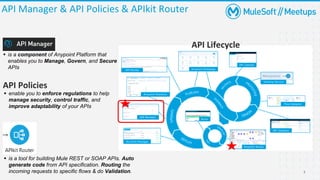
API Manager & API Policies & APIkit Router
API Policies
▪ enable you to enforce regulations to help
manage security, control traffic, and
improve adaptability of your APIs
▪ is a component of Anypoint Platform that
enables you to Manage, Govern, and Secure
APIs
▪ is a tool for building Mule REST or SOAP APIs. Auto
generate code from API specification. Routing the
incoming requests to specific flows & do Validation.
API Lifecycle
PART 1:
Anypoint API Manager
9
API Manager
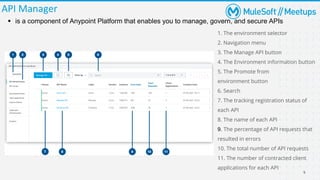
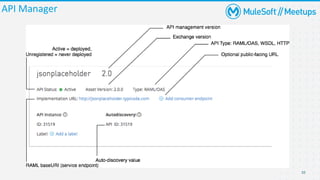
▪ is a component of Anypoint Platform that enables you to manage, govern, and secure APIs
1. The environment selector
2. Navigation menu
3. The Manage API button
4. The Environment information button
5. The Promote from
environment button
6. Search
7. The tracking registration status of
each API
8. The name of each API
9. The percentage of API requests that
resulted in errors
10. The total number of API requests
11. The number of contracted client
applications for each API
10
API Manager
PART 2:
API Policies
12
API Policies
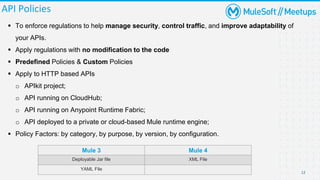
▪ To enforce regulations to help manage security, control traffic, and improve adaptability of
your APIs.
▪ Apply regulations with no modification to the code
▪ Predefined Policies & Custom Policies
▪ Apply to HTTP based APIs
o APIkit project;
o API running on CloudHub;
o API running on Anypoint Runtime Fabric;
o API deployed to a private or cloud-based Mule runtime engine;
▪ Policy Factors: by category, by purpose, by version, by configuration.
Mule 3 Mule 4
Deployable Jar file XML File
YAML File
13
API Policies
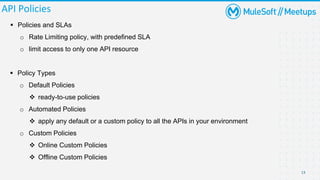
▪ Policies and SLAs
o Rate Limiting policy, with predefined SLA
o limit access to only one API resource
▪ Policy Types
o Default Policies
❖ ready-to-use policies
o Automated Policies
❖ apply any default or a custom policy to all the APIs in your environment
o Custom Policies
❖ Online Custom Policies
❖ Offline Custom Policies
14
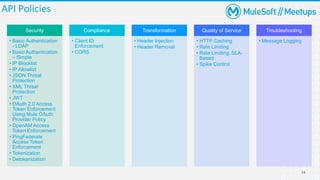
API Policies
Security
• Basic Authentication
- LDAP
• Basic Authentication
– Simple
• IP Blocklist
• IP Allowlist
• JSON Threat
Protection
• XML Threat
Protection
• JWT
• OAuth 2.0 Access
Token Enforcement
Using Mule OAuth
Provider Policy
• OpenAM Access
Token Enforcement
• PingFederate
Access Token
Enforcement
• Tokenization
• Detokenization
Compliance
• Client ID
Enforcement
• CORS
Transformation
• Header Injection
• Header Removal
Quality of Service
• HTTP Caching
• Rate Limiting
• Rate Limiting, SLA-
Based
• Spike Control
Troubleshooting
• Message Logging
PART 3:
API Implementation using
APIkit Router
16
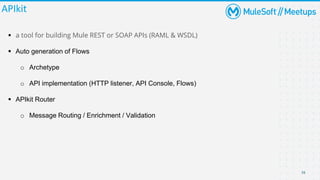
APIkit
▪ a tool for building Mule REST or SOAP APIs (RAML & WSDL)
▪ Auto generation of Flows
o Archetype
o API implementation (HTTP listener, API Console, Flows)
▪ APIkit Router
o Message Routing / Enrichment / Validation
17
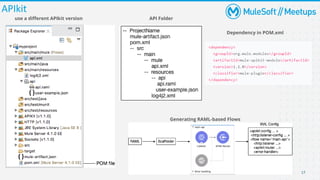
APIkit
use a different APIkit version
Dependency in POM.xml
API Folder
Generating RAML-based Flows
18
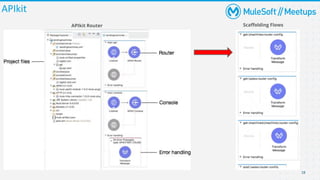
APIkit
APIkit Router Scaffolding Flows
19
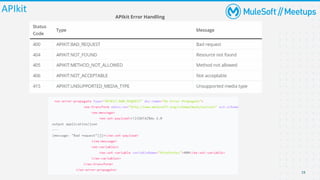
APIkit
APIkit Error Handling
Q & A
Trivia Quiz
22
Question 1
23
Question 1
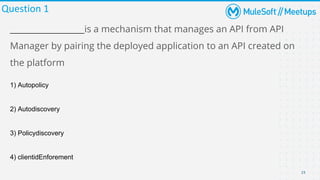
____________________is a mechanism that manages an API from API
Manager by pairing the deployed application to an API created on
the platform
1) Autopolicy
2) Autodiscovery
3) Policydiscovery
4) clientidEnforement
24
Question 2
25
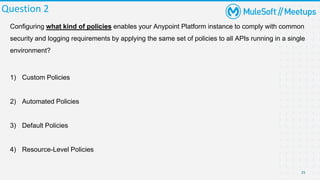
Question 2
Configuring what kind of policies enables your Anypoint Platform instance to comply with common
security and logging requirements by applying the same set of policies to all APIs running in a single
environment?
1) Custom Policies
2) Automated Policies
3) Default Policies
4) Resource-Level Policies
26
Question 3
27
Question 3
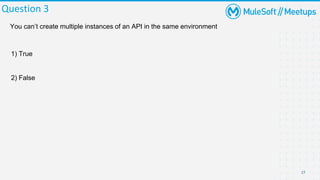
You can’t create multiple instances of an API in the same environment
1) True
2) False
28
Question 4
29
Question 4
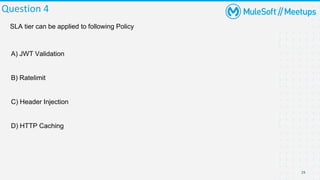
SLA tier can be applied to following Policy
A) JWT Validation
B) Ratelimit
C) Header Injection
D) HTTP Caching
30
Question 5
31
Question 5
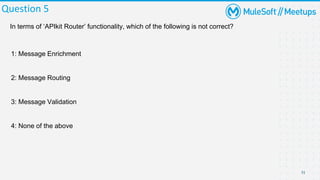
In terms of ‘APIkit Router’ functionality, which of the following is not correct?
1: Message Enrichment
2: Message Routing
3: Message Validation
4: None of the above
Thanks

Engineering Student MuleSoft Meetup#3 - API Implementation using APIKIT router, Anypoint API Manager and API Policies

  • 1.
    26th March 2022, 10:00 AM (IST) Online Engineering Student Group MuleSoft Meetup: #3 TOPIC : API Implementation using, Anypoint API Manager, API Policies, APIkit Router
  • 2.
    Online Engineering StudentGroup: Meetup 2 Organizer(s)
  • 3.
  • 4.
    Safe Harbor Statement 4 •Both the speaker and host are organizing this meet up in individual capacity, only. We are not representing our companies here. • This presentation is strictly for learning purpose only. Organizer/Presenter do not hold any responsibility that same solution will work for your business requirements also. • This presentation is not meant for any promotional activities.
  • 5.
    CHEERS..!!! 5 We have prizesto give away! 3 Winners a special prize is ready
  • 6.
    What topics thosecovered in the past Meetups 1 & 2?
  • 7.
    7 API Manager &API Policies & APIkit Router API Policies ▪ enable you to enforce regulations to help manage security, control traffic, and improve adaptability of your APIs ▪ is a component of Anypoint Platform that enables you to Manage, Govern, and Secure APIs ▪ is a tool for building Mule REST or SOAP APIs. Auto generate code from API specification. Routing the incoming requests to specific flows & do Validation. API Lifecycle
  • 8.
  • 9.
    9 API Manager ▪ isa component of Anypoint Platform that enables you to manage, govern, and secure APIs 1. The environment selector 2. Navigation menu 3. The Manage API button 4. The Environment information button 5. The Promote from environment button 6. Search 7. The tracking registration status of each API 8. The name of each API 9. The percentage of API requests that resulted in errors 10. The total number of API requests 11. The number of contracted client applications for each API
  • 10.
  • 11.
  • 12.
    12 API Policies ▪ Toenforce regulations to help manage security, control traffic, and improve adaptability of your APIs. ▪ Apply regulations with no modification to the code ▪ Predefined Policies & Custom Policies ▪ Apply to HTTP based APIs o APIkit project; o API running on CloudHub; o API running on Anypoint Runtime Fabric; o API deployed to a private or cloud-based Mule runtime engine; ▪ Policy Factors: by category, by purpose, by version, by configuration. Mule 3 Mule 4 Deployable Jar file XML File YAML File
  • 13.
    13 API Policies ▪ Policiesand SLAs o Rate Limiting policy, with predefined SLA o limit access to only one API resource ▪ Policy Types o Default Policies ❖ ready-to-use policies o Automated Policies ❖ apply any default or a custom policy to all the APIs in your environment o Custom Policies ❖ Online Custom Policies ❖ Offline Custom Policies
  • 14.
    14 API Policies Security • BasicAuthentication - LDAP • Basic Authentication – Simple • IP Blocklist • IP Allowlist • JSON Threat Protection • XML Threat Protection • JWT • OAuth 2.0 Access Token Enforcement Using Mule OAuth Provider Policy • OpenAM Access Token Enforcement • PingFederate Access Token Enforcement • Tokenization • Detokenization Compliance • Client ID Enforcement • CORS Transformation • Header Injection • Header Removal Quality of Service • HTTP Caching • Rate Limiting • Rate Limiting, SLA- Based • Spike Control Troubleshooting • Message Logging
  • 15.
    PART 3: API Implementationusing APIkit Router
  • 16.
    16 APIkit ▪ a toolfor building Mule REST or SOAP APIs (RAML & WSDL) ▪ Auto generation of Flows o Archetype o API implementation (HTTP listener, API Console, Flows) ▪ APIkit Router o Message Routing / Enrichment / Validation
  • 17.
    17 APIkit use a differentAPIkit version Dependency in POM.xml API Folder Generating RAML-based Flows
  • 18.
  • 19.
  • 20.
  • 21.
  • 22.
  • 23.
    23 Question 1 ____________________is amechanism that manages an API from API Manager by pairing the deployed application to an API created on the platform 1) Autopolicy 2) Autodiscovery 3) Policydiscovery 4) clientidEnforement
  • 24.
  • 25.
    25 Question 2 Configuring whatkind of policies enables your Anypoint Platform instance to comply with common security and logging requirements by applying the same set of policies to all APIs running in a single environment? 1) Custom Policies 2) Automated Policies 3) Default Policies 4) Resource-Level Policies
  • 26.
  • 27.
    27 Question 3 You can’tcreate multiple instances of an API in the same environment 1) True 2) False
  • 28.
  • 29.
    29 Question 4 SLA tiercan be applied to following Policy A) JWT Validation B) Ratelimit C) Header Injection D) HTTP Caching
  • 30.
  • 31.
    31 Question 5 In termsof ‘APIkit Router’ functionality, which of the following is not correct? 1: Message Enrichment 2: Message Routing 3: Message Validation 4: None of the above
  • 32.