10/6/2023
MGT 603 Engineering Strategy
Module 1.1
Facilitator name: Dr Anthos Yannakou
Developed by Dr Anthos Yannakou, Unit Coordinator
• Welcome
• Introductions
• Expectations
• Subject overview
• Assessment overview
• Module 1.1 content overview
• Next week
• Conclusion
3
Agenda
4
Introduction: facilitators and students
• Understand and conform with Torrens policies/procedures.
• Attend sessions or listen to the recordings every week.
• Make sure to review the “Referencing” guideline provided on Blackboard and
adhere to the advised guidelines when referencing.
• Please make sure to review the Academic Integrity Policies and Procedures as
soon as possible and be in touch in case you have further questions. Make
sure you tick the ‘Academic Integrity Checklist’ for students and note the policy
regarding Artificial Intelligence).
• Be a great student and team member.
5
Expectations of students
6
Netiquette for online class
8
What do you need to do to be successful in this subject?
• Engage with the material/resources on Blackboard every week.
• Prepare for and attend and engage in the weekly sessions. If you cant attend, let
me know and listen to the recording
• At the weekly sessions, ask questions, take part in discussions on important topics,
share experiences, and learn from one another.
• Start your assessments early.
• Make sure to complete all the learning activities on Blackboard such as the
Discussion Forums.
• Read all the readings as well as wider reading through the university library.
• Ask for feedback on assessments and implement constructive feedback/comments.
9
Subject Learning Outcomes
10
Module Topic
1.Strategic business planning
Strategy process and structure
Business planning
2. Innovation strategy and management
Innovation strategy development
Management of innovation
3. Technology and R&D strategy and
management
Technology strategy development
Technology and R&D management
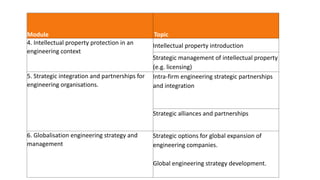
Module Topic
4. Intellectual property protection in an
engineering context
Intellectual property introduction
Strategic management of intellectual property
(e.g. licensing)
5. Strategic integration and partnerships for
engineering organisations.
Intra-firm engineering strategic partnerships
and integration
Strategic alliances and partnerships
6. Globalisation engineering strategy and
management
Strategic options for global expansion of
engineering companies.
Global engineering strategy development.
13
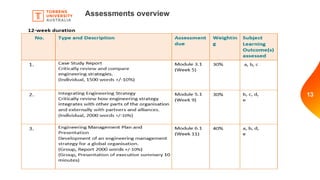
Assessments overview
14
Safe Assign
• From 2021, Torrens University is using ‘SafeAssign’ on Blackboard.
• SafeAssign is a plagiarism prevention tool that allows your facilitator to check the
originality of an assessment submission.
• SafeAssign automatically conducts the check by comparing your assignment against
a database of other assignment submissions.
• When you submit your assessment, it will be automatically fed through SafeAssign.
• You will be allowed to review SafeAssign findings and resubmit until the due
date/deadline.
Module 1.1
Key Concepts:
• What is strategy?
• Wh is strategy important?
• What is the strategic process?
• How should strategies be managed and
structured?
16
Overview of strategy,
https://www.youtube.com/watch?v=VcWI3WVXmFk
A company’s strategy is the coordinated set of actions that its managers take in order to
outperform its competitors to achieve superior profitability.
Strategy is all about how to:
• Outcompete rivals
• Respond to economic and market conditions and growth opportunities
Manage functional pieces of the business
• Improve the firm’s financial and market performance
17
What is strategy?
Thompson, AA, Peteraf, MA, Gamble, JE, Strickland, AJ 2020, Crafting and executing strategy, 22nd
edition, McGraw Hill
1. Where are we now? Understand organisation, business environment, industry,
competitive conditions
2. Where would we like to be in the future? Create a vision for the organisation’s
future direction; develop vision, mission, core values
3. How are going to get there? Craft an action plan that will get us there- what
we should and should not do; set objectives
4. Develop supporting strategies that align with and support the organisational
strategy such as HR, finance, engineering
5. Continually monitor, assess, control, and correct- manage the process in a
flexible and continuous improvement manner
18
The strategy process
19
The strategy process
20
Strategic vision, mission, values
Vision: ‘Where do we want to be?
Mission: “Who are we, what do we do, and why are we here?
Values: “How do we want to behave in pursuing our vision and mission?
• Delineates management’s future aspirations for the business to its
stakeholders
• Provides direction
• Sets out the compelling rationale (strategic soundness) for the firm’s direction.
• Uses distinctive and specific language to set the firm apart from its rivals:
• Walmart: Saving people money so they can live better
• Apple: We believe that we are on the face of the earth to make great products
and that’s not changing
21
Strategic Vision
• Uses specific language to give the firm its own unique identity
• Describes the firm’s current business and purpose
• Should focus on describing the company’s business, not on “making a profit”—
earning a profit is an objective not a mission
• Amazon: Our mission is to continually raise the bar of the customer experience
by using the internet and technology to help consumers find, discover and buy
anything, and empower businesses and content creators to maximise their
success. We aim to be Earth's most customer centric company.
22
Strategic mission
• Values are the beliefs, traits, and behavioural norms that employees are expected to display in
conducting the firm’s business and in pursuing its strategic vision and mission
• Values become an integral part of the firm’s culture and what makes it tick when strongly
espoused and supported by top management
• Values, matched with the firm’s vision, mission, and strategy, contribute to the firm’s business
success
• Apple core values include “inclusion and diversity, education, accessibility, environment,
supplier responsibility and privacy.”
23
Strategic values
• After finalisation of the corporate strategic plan, supporting plans are then
developed. These could be business units or functions such as engineering,
HR, operations, finance
• The functional strategy defines the 'how', after corporate strategy has defined
the 'where' and business strategy the 'what’
• Functional level strategy is characterised by a strong emphasis on detail,
metrics and practicality. As a result, functional level strategy development
involves a much greater level of communication and feedback both vertically
and horizontally than strategy development at the corporate levels. This is key
to aligning functional strategies with the broader goals of corporate strategy
24
Strategy levels
25
Strategy levels
• Go through Module 1.1 material, including readings
• Complete discussion forums for Module 1.1 and come prepared for a
discussion
• Read Assessment 1 and come with any questions
• Research and answer the questions on the following slides and come
prepared for a discussion
26
Preparation for next Week
Each student to choose, research a technical, or scientific, or engineering
organisation.
Identify and share with the class the organisation’s:
• Vision
• Mission
• Core values
27
Vision, mission, and values for a technical, scientific, or
engineering organisation
Listen to the following video, reflect on the following question and contribute to a
discussion in Session 2: How can ethics be incorporated in strategy?
28
Strategy and Ethics, https://www.youtube.com/watch?v=2trdgy5jG4M
10/6/2023
10/6/2023
Week 1
Conclusion
10/6/2023
MEM 603 Engineering Strategy
Module 1.2
Facilitator name:
Developed by Dr Anthos Yannakou, Unit Coordinator
• Welcome
• Subject overview
• Preparation for this week
• Summary Module 1.1
• Module 1.2 content overview
• Next week
• Conclusion
3
Agenda
Module Topic
1.Strategic business planning
Strategy process and structure
Business planning
2. Innovation strategy and management
Innovation strategy development
Management of innovation
3. Technology and R&D strategy and
management
Technology strategy development
Technology and R&D management
Module Topic
4. Intellectual property protection in an
engineering context
Intellectual property introduction
Strategic management of intellectual property
(e.g. licensing)
5. Strategic integration and partnerships for
engineering organisations.
Intra-firm engineering strategic partnerships
and integration
Strategic alliances and partnerships
6. Globalisation engineering strategy and
management
Strategic options for global expansion of
engineering companies.
Global engineering strategy development.
• Go through Module 1.1 material, including readings
• Complete discussion forums for Module 1.1 and come prepared for a
discussion
• Read Assessment 1 and come with any questions
• Research and answer the questions on the following slide, and come prepared
for a discussion
6
Preparation for next Week
Each student to choose, research a technical, or scientific, or engineering
organisation.
Identify and share with the class the organisation’s:
• Vision
• Mission
• Core values
7
Vision, mission, and values for a technical, scientific, or
engineering organisation
Listen to the following video, reflect on the following question and contribute to a
discussion in Session 2: How can ethics be incorporated in strategy?
8
Strategy and Ethics, https://www.youtube.com/watch?v=2trdgy5jG4M
Summary Module 1.1
Key Concepts:
• What is strategy?
• What is the strategic process?
• How should strategies be managed and
structured?
A company’s strategy is the coordinated set of actions that its managers take in order to
outperform its competitors to achieve superior profitability.
Strategy is all about how to:
• Outcompete rivals
• Respond to economic and market conditions and growth opportunities
Manage functional pieces of the business
• Improve the firm’s financial and market performance
10
What is strategy?
Thompson, AA, Peteraf, MA, Gamble, JE, Strickland, AJ 2020, Crafting and executing strategy, 22nd
edition, McGraw Hill
1. Where are we now? Understand organisation, business environment, industry,
competitive conditions
2. Where would we like to be in the future? Create a vision for the organisation’s
future direction; develop vision, mission, core values
3. How are going to get there? Craft an action plan that will get us there- what
we should and should not do; set objectives
4. Develop supporting strategies that align with and support the organisational
strategy such as HR, finance, engineering
5. Continually monitor, assess, control, and correct- manage the process in a
flexible and continuous improvement manner
11
The strategy process
12
The strategy process
13
Strategic vision, mission, values
Vision: ‘Where do we want to be?
Mission: “Who are we, what do we do, and why are we here?
Values: “How do we want to behave in pursuing our vision and mission?
• Delineates management’s future aspirations for the business to its
stakeholders
• Provides direction
• Sets out the compelling rationale (strategic soundness) for the firm’s direction.
• Uses distinctive and specific language to set the firm apart from its rivals:
• Walmart: Saving people money so they can live better
• Apple: We believe that we are on the face of the earth to make great products
and that’s not changing
14
Strategic Vision
• Uses specific language to give the firm its own unique identity
• Describes the firm’s current business and purpose
• Should focus on describing the company’s business, not on “making a profit”—
earning a profit is an objective not a mission
• Amazon: Our mission is to continually raise the bar of the customer experience
by using the internet and technology to help consumers find, discover and buy
anything, and empower businesses and content creators to maximise their
success. We aim to be Earth's most customer centric company.
15
Strategic mission
• Values are the beliefs, traits, and behavioural norms that employees are expected to display in
conducting the firm’s business and in pursuing its strategic vision and mission
• Values become an integral part of the firm’s culture and what makes it tick when strongly
espoused and supported by top management
• Values, matched with the firm’s vision, mission, and strategy, contribute to the firm’s business
success
• Apple core values include “inclusion and diversity, education, accessibility, environment,
supplier responsibility and privacy.”
16
Strategic values
Each student to choose, research a technical, or scientific, or engineering
organisation.
Identify and share with the class the organisation’s:
• Vision
• Mission
• Core values
17
Vision, mission, and values for a technical, scientific, or
engineering organisation
• After finalisation of the corporate strategic plan, supporting plans are then
developed. These could be business units or functions such as engineering,
HR, operations, finance
• The functional strategy defines the 'how', after corporate strategy has defined
the 'where' and business strategy the 'what’
• Functional level strategy is characterised by a strong emphasis on detail,
metrics and practicality. As a result, functional level strategy development
involves a much greater level of communication and feedback both vertically
and horizontally than strategy development at the corporate levels. This is key
to aligning functional strategies with the broader goals of corporate strategy
18
Strategy levels
19
Strategy levels
Module 1.2
Key Concepts:
• Link between strategy and business
planning
• Business planning
• Business Plan development
• A strategic plan is used for implementing and managing the strategic direction of
an existing organisation. A business plan is used to obtain funding, or direct
operations such as for engineering. A strategic plan generally covers a period of 3
to 5+ years, whereas a business plan is normally for one year
• A strategic plan is critical to prioritising resources (time, money and people) to
grow the revenue and increase the return on investment. A strategic plan focuses
on building a sustainable competitive advantage and is futuristic in nature
• A business plan focuses on shorter efficient use of resources and detailed
implementation of actions required to support the strategy. A business plan
contains business goals, the methods on how these goals can be attained, and the
time frame within which these goals need to be achieved
21
Link between strategy and business planning
A business plan needs to provide the context of how it links with the
organisational strategy, and include sections such as:
• Business overview
• Functional plans including engineering and other technical operations such as
R&D and innovation
• Planned actions over the next 2 to 3 years
• Financial plan (budget)
22
Business Plan
How to develop your business plan, https://business.gov.au/Planning/Business-
plans/How-to-develop-your-business-plan
23
Developing a business plan
24
Assessments overview
• Critically review and compare the engineering strategies of two major global
automotive manufacturing companies in 1500 words (+/-10%). Your research
from publicly available information needs to include each company’s current
and future-oriented R&D, technology and innovation strategies.
• This assessment requires you to research and assess the engineering
strategies of two major automotive companies and to compare them. The
engineering strategies need to be current and future oriented. You will be
provided with a list of major automotive companies, and you can then choose
two companies from this list.
25
Assessment 1 briefing
• You need to prepare for and approach this task by going through the content
and readings provided in Module 1 (Strategic business planning), Module 2
(Innovation strategy and management), and Module 3 (Technology and R&D
strategy and management), as well as doing original research from publicly
available information.
• Please note that the focus is on improvement of engineering operations via
R&D, innovation, and technology (including Intellectual Property).
26
Assessment 1 briefing
A suggested structure for the assessment is as follows:
1. Introduction
Summarise background information provided; Provide background to the 2 global
automotive companies
2. Literature study
Summarise the research from a literature study for each selected automotive
company
3. Findings from the literature study
Discuss and compare the strategies of the selected automotive companies from
the literature study
4. Conclusion
6. Reference List
7. Appendices
27
Assessment 1 briefing
28
Assessment 1 briefing
• Go through Module 1.2 material, including readings
• Complete discussion forums for Module 1.2 and come prepared for a
discussion
• Start Assessment 1 and come with any questions; start by choosing 2
automotive companies
29
Preparation for next Week
10/6/2023
10/6/2023
Week 2
Conclusion

Engineering strategy

  • 1.
    10/6/2023 MGT 603 EngineeringStrategy Module 1.1 Facilitator name: Dr Anthos Yannakou Developed by Dr Anthos Yannakou, Unit Coordinator
  • 3.
    • Welcome • Introductions •Expectations • Subject overview • Assessment overview • Module 1.1 content overview • Next week • Conclusion 3 Agenda
  • 4.
  • 5.
    • Understand andconform with Torrens policies/procedures. • Attend sessions or listen to the recordings every week. • Make sure to review the “Referencing” guideline provided on Blackboard and adhere to the advised guidelines when referencing. • Please make sure to review the Academic Integrity Policies and Procedures as soon as possible and be in touch in case you have further questions. Make sure you tick the ‘Academic Integrity Checklist’ for students and note the policy regarding Artificial Intelligence). • Be a great student and team member. 5 Expectations of students
  • 6.
  • 8.
    8 What do youneed to do to be successful in this subject? • Engage with the material/resources on Blackboard every week. • Prepare for and attend and engage in the weekly sessions. If you cant attend, let me know and listen to the recording • At the weekly sessions, ask questions, take part in discussions on important topics, share experiences, and learn from one another. • Start your assessments early. • Make sure to complete all the learning activities on Blackboard such as the Discussion Forums. • Read all the readings as well as wider reading through the university library. • Ask for feedback on assessments and implement constructive feedback/comments.
  • 9.
  • 10.
  • 11.
    Module Topic 1.Strategic businessplanning Strategy process and structure Business planning 2. Innovation strategy and management Innovation strategy development Management of innovation 3. Technology and R&D strategy and management Technology strategy development Technology and R&D management
  • 12.
    Module Topic 4. Intellectualproperty protection in an engineering context Intellectual property introduction Strategic management of intellectual property (e.g. licensing) 5. Strategic integration and partnerships for engineering organisations. Intra-firm engineering strategic partnerships and integration Strategic alliances and partnerships 6. Globalisation engineering strategy and management Strategic options for global expansion of engineering companies. Global engineering strategy development.
  • 13.
  • 14.
    14 Safe Assign • From2021, Torrens University is using ‘SafeAssign’ on Blackboard. • SafeAssign is a plagiarism prevention tool that allows your facilitator to check the originality of an assessment submission. • SafeAssign automatically conducts the check by comparing your assignment against a database of other assignment submissions. • When you submit your assessment, it will be automatically fed through SafeAssign. • You will be allowed to review SafeAssign findings and resubmit until the due date/deadline.
  • 15.
    Module 1.1 Key Concepts: •What is strategy? • Wh is strategy important? • What is the strategic process? • How should strategies be managed and structured?
  • 16.
  • 17.
    A company’s strategyis the coordinated set of actions that its managers take in order to outperform its competitors to achieve superior profitability. Strategy is all about how to: • Outcompete rivals • Respond to economic and market conditions and growth opportunities Manage functional pieces of the business • Improve the firm’s financial and market performance 17 What is strategy? Thompson, AA, Peteraf, MA, Gamble, JE, Strickland, AJ 2020, Crafting and executing strategy, 22nd edition, McGraw Hill
  • 18.
    1. Where arewe now? Understand organisation, business environment, industry, competitive conditions 2. Where would we like to be in the future? Create a vision for the organisation’s future direction; develop vision, mission, core values 3. How are going to get there? Craft an action plan that will get us there- what we should and should not do; set objectives 4. Develop supporting strategies that align with and support the organisational strategy such as HR, finance, engineering 5. Continually monitor, assess, control, and correct- manage the process in a flexible and continuous improvement manner 18 The strategy process
  • 19.
  • 20.
    20 Strategic vision, mission,values Vision: ‘Where do we want to be? Mission: “Who are we, what do we do, and why are we here? Values: “How do we want to behave in pursuing our vision and mission?
  • 21.
    • Delineates management’sfuture aspirations for the business to its stakeholders • Provides direction • Sets out the compelling rationale (strategic soundness) for the firm’s direction. • Uses distinctive and specific language to set the firm apart from its rivals: • Walmart: Saving people money so they can live better • Apple: We believe that we are on the face of the earth to make great products and that’s not changing 21 Strategic Vision
  • 22.
    • Uses specificlanguage to give the firm its own unique identity • Describes the firm’s current business and purpose • Should focus on describing the company’s business, not on “making a profit”— earning a profit is an objective not a mission • Amazon: Our mission is to continually raise the bar of the customer experience by using the internet and technology to help consumers find, discover and buy anything, and empower businesses and content creators to maximise their success. We aim to be Earth's most customer centric company. 22 Strategic mission
  • 23.
    • Values arethe beliefs, traits, and behavioural norms that employees are expected to display in conducting the firm’s business and in pursuing its strategic vision and mission • Values become an integral part of the firm’s culture and what makes it tick when strongly espoused and supported by top management • Values, matched with the firm’s vision, mission, and strategy, contribute to the firm’s business success • Apple core values include “inclusion and diversity, education, accessibility, environment, supplier responsibility and privacy.” 23 Strategic values
  • 24.
    • After finalisationof the corporate strategic plan, supporting plans are then developed. These could be business units or functions such as engineering, HR, operations, finance • The functional strategy defines the 'how', after corporate strategy has defined the 'where' and business strategy the 'what’ • Functional level strategy is characterised by a strong emphasis on detail, metrics and practicality. As a result, functional level strategy development involves a much greater level of communication and feedback both vertically and horizontally than strategy development at the corporate levels. This is key to aligning functional strategies with the broader goals of corporate strategy 24 Strategy levels
  • 25.
  • 26.
    • Go throughModule 1.1 material, including readings • Complete discussion forums for Module 1.1 and come prepared for a discussion • Read Assessment 1 and come with any questions • Research and answer the questions on the following slides and come prepared for a discussion 26 Preparation for next Week
  • 27.
    Each student tochoose, research a technical, or scientific, or engineering organisation. Identify and share with the class the organisation’s: • Vision • Mission • Core values 27 Vision, mission, and values for a technical, scientific, or engineering organisation
  • 28.
    Listen to thefollowing video, reflect on the following question and contribute to a discussion in Session 2: How can ethics be incorporated in strategy? 28 Strategy and Ethics, https://www.youtube.com/watch?v=2trdgy5jG4M
  • 29.
  • 30.
    10/6/2023 MEM 603 EngineeringStrategy Module 1.2 Facilitator name: Developed by Dr Anthos Yannakou, Unit Coordinator
  • 32.
    • Welcome • Subjectoverview • Preparation for this week • Summary Module 1.1 • Module 1.2 content overview • Next week • Conclusion 3 Agenda
  • 33.
    Module Topic 1.Strategic businessplanning Strategy process and structure Business planning 2. Innovation strategy and management Innovation strategy development Management of innovation 3. Technology and R&D strategy and management Technology strategy development Technology and R&D management
  • 34.
    Module Topic 4. Intellectualproperty protection in an engineering context Intellectual property introduction Strategic management of intellectual property (e.g. licensing) 5. Strategic integration and partnerships for engineering organisations. Intra-firm engineering strategic partnerships and integration Strategic alliances and partnerships 6. Globalisation engineering strategy and management Strategic options for global expansion of engineering companies. Global engineering strategy development.
  • 35.
    • Go throughModule 1.1 material, including readings • Complete discussion forums for Module 1.1 and come prepared for a discussion • Read Assessment 1 and come with any questions • Research and answer the questions on the following slide, and come prepared for a discussion 6 Preparation for next Week
  • 36.
    Each student tochoose, research a technical, or scientific, or engineering organisation. Identify and share with the class the organisation’s: • Vision • Mission • Core values 7 Vision, mission, and values for a technical, scientific, or engineering organisation
  • 37.
    Listen to thefollowing video, reflect on the following question and contribute to a discussion in Session 2: How can ethics be incorporated in strategy? 8 Strategy and Ethics, https://www.youtube.com/watch?v=2trdgy5jG4M
  • 38.
    Summary Module 1.1 KeyConcepts: • What is strategy? • What is the strategic process? • How should strategies be managed and structured?
  • 39.
    A company’s strategyis the coordinated set of actions that its managers take in order to outperform its competitors to achieve superior profitability. Strategy is all about how to: • Outcompete rivals • Respond to economic and market conditions and growth opportunities Manage functional pieces of the business • Improve the firm’s financial and market performance 10 What is strategy? Thompson, AA, Peteraf, MA, Gamble, JE, Strickland, AJ 2020, Crafting and executing strategy, 22nd edition, McGraw Hill
  • 40.
    1. Where arewe now? Understand organisation, business environment, industry, competitive conditions 2. Where would we like to be in the future? Create a vision for the organisation’s future direction; develop vision, mission, core values 3. How are going to get there? Craft an action plan that will get us there- what we should and should not do; set objectives 4. Develop supporting strategies that align with and support the organisational strategy such as HR, finance, engineering 5. Continually monitor, assess, control, and correct- manage the process in a flexible and continuous improvement manner 11 The strategy process
  • 41.
  • 42.
    13 Strategic vision, mission,values Vision: ‘Where do we want to be? Mission: “Who are we, what do we do, and why are we here? Values: “How do we want to behave in pursuing our vision and mission?
  • 43.
    • Delineates management’sfuture aspirations for the business to its stakeholders • Provides direction • Sets out the compelling rationale (strategic soundness) for the firm’s direction. • Uses distinctive and specific language to set the firm apart from its rivals: • Walmart: Saving people money so they can live better • Apple: We believe that we are on the face of the earth to make great products and that’s not changing 14 Strategic Vision
  • 44.
    • Uses specificlanguage to give the firm its own unique identity • Describes the firm’s current business and purpose • Should focus on describing the company’s business, not on “making a profit”— earning a profit is an objective not a mission • Amazon: Our mission is to continually raise the bar of the customer experience by using the internet and technology to help consumers find, discover and buy anything, and empower businesses and content creators to maximise their success. We aim to be Earth's most customer centric company. 15 Strategic mission
  • 45.
    • Values arethe beliefs, traits, and behavioural norms that employees are expected to display in conducting the firm’s business and in pursuing its strategic vision and mission • Values become an integral part of the firm’s culture and what makes it tick when strongly espoused and supported by top management • Values, matched with the firm’s vision, mission, and strategy, contribute to the firm’s business success • Apple core values include “inclusion and diversity, education, accessibility, environment, supplier responsibility and privacy.” 16 Strategic values
  • 46.
    Each student tochoose, research a technical, or scientific, or engineering organisation. Identify and share with the class the organisation’s: • Vision • Mission • Core values 17 Vision, mission, and values for a technical, scientific, or engineering organisation
  • 47.
    • After finalisationof the corporate strategic plan, supporting plans are then developed. These could be business units or functions such as engineering, HR, operations, finance • The functional strategy defines the 'how', after corporate strategy has defined the 'where' and business strategy the 'what’ • Functional level strategy is characterised by a strong emphasis on detail, metrics and practicality. As a result, functional level strategy development involves a much greater level of communication and feedback both vertically and horizontally than strategy development at the corporate levels. This is key to aligning functional strategies with the broader goals of corporate strategy 18 Strategy levels
  • 48.
  • 49.
    Module 1.2 Key Concepts: •Link between strategy and business planning • Business planning • Business Plan development
  • 50.
    • A strategicplan is used for implementing and managing the strategic direction of an existing organisation. A business plan is used to obtain funding, or direct operations such as for engineering. A strategic plan generally covers a period of 3 to 5+ years, whereas a business plan is normally for one year • A strategic plan is critical to prioritising resources (time, money and people) to grow the revenue and increase the return on investment. A strategic plan focuses on building a sustainable competitive advantage and is futuristic in nature • A business plan focuses on shorter efficient use of resources and detailed implementation of actions required to support the strategy. A business plan contains business goals, the methods on how these goals can be attained, and the time frame within which these goals need to be achieved 21 Link between strategy and business planning
  • 51.
    A business planneeds to provide the context of how it links with the organisational strategy, and include sections such as: • Business overview • Functional plans including engineering and other technical operations such as R&D and innovation • Planned actions over the next 2 to 3 years • Financial plan (budget) 22 Business Plan
  • 52.
    How to developyour business plan, https://business.gov.au/Planning/Business- plans/How-to-develop-your-business-plan 23 Developing a business plan
  • 53.
  • 54.
    • Critically reviewand compare the engineering strategies of two major global automotive manufacturing companies in 1500 words (+/-10%). Your research from publicly available information needs to include each company’s current and future-oriented R&D, technology and innovation strategies. • This assessment requires you to research and assess the engineering strategies of two major automotive companies and to compare them. The engineering strategies need to be current and future oriented. You will be provided with a list of major automotive companies, and you can then choose two companies from this list. 25 Assessment 1 briefing
  • 55.
    • You needto prepare for and approach this task by going through the content and readings provided in Module 1 (Strategic business planning), Module 2 (Innovation strategy and management), and Module 3 (Technology and R&D strategy and management), as well as doing original research from publicly available information. • Please note that the focus is on improvement of engineering operations via R&D, innovation, and technology (including Intellectual Property). 26 Assessment 1 briefing
  • 56.
    A suggested structurefor the assessment is as follows: 1. Introduction Summarise background information provided; Provide background to the 2 global automotive companies 2. Literature study Summarise the research from a literature study for each selected automotive company 3. Findings from the literature study Discuss and compare the strategies of the selected automotive companies from the literature study 4. Conclusion 6. Reference List 7. Appendices 27 Assessment 1 briefing
  • 57.
  • 58.
    • Go throughModule 1.2 material, including readings • Complete discussion forums for Module 1.2 and come prepared for a discussion • Start Assessment 1 and come with any questions; start by choosing 2 automotive companies 29 Preparation for next Week
  • 59.