Joshua Grosserhode
Engineering Portfolio
grosserj@oregonstate.edu
Table of Contents
Project Page
Rocket Deployed Glider 1
Paper Launcher 4
30 Hour Challenge 6
Documents
Resume 8
1
Rocket Deployed Glider
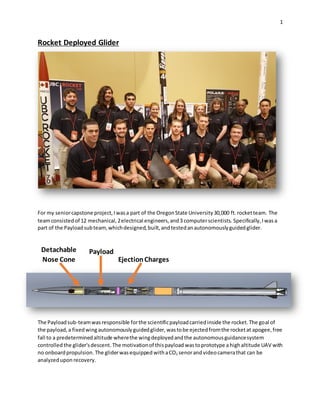
For my seniorcapstone project,Iwasa part of the OregonState University30,000 ft.rocketteam. The
teamconsistedof 12 mechanical,2electrical engineers,and3 computerscientists. Specifically,Iwasa
part of the Payloadsubteam,whichdesigned,built,andtestedanautonomouslyguidedglider.
The Payloadsub-teamwasresponsible forthe scientificpayloadcarriedinside the rocket.The goal of
the payload,a fixedwing autonomouslyguidedglider, wastobe ejectedfromthe rocketat apogee,free
fall to a predeterminedaltitude wherethe wingdeployedandthe autonomousguidancesystem
controlled the glider'sdescent. The motivationof thispayload wastoprototype ahighaltitude UAV with
no onboardpropulsion. The gliderwasequipped withaCO2 senorand videocamerathat can be
analyzedupon recovery.
Payload
EjectionCharges
Detachable
Nose Cone
2
Two recoverysystems were used,aprimaryanda secondary.The primaryrecoverysystem wasthe wing
and tail whichslowedthe descentandguidedittothe landingside.The secondaryrecoverysystem was
a deployable parachute that furtherslowedthe descentonce the payloadwas ata loweraltitude.Both
recoverysystems were entirelystudentdesigned,manufacturedandtested.
Stored/Free Fall Configuration FlightConfiguration
A carbon fiberloadstiffenedwingwasused asthe primaryliftingbodyforthe glider.A loadstiffened
wingcapable of beingrolledunderpressure andautomaticallystiffenedintoaflightconfigurationwhen
released.The wing wasmade outthree pliesof T-800 carbon fiberweave witha[45°/-45°/45°] layup
schedule,allowingittoroll and be placedintothe rockettube.
The tail sectionof the payloadwasdesignedto give the glidercontrol authority andstability duringits
flight,whilestillbeingcapable of fittinginsideof the rocket.Originallyatraditiontail designwas
selectedforsimplicitybutthisresultedinalackof surface areaneededtoproperlycontrol the glider.
The solution wasto use an invertedV-tail. Withthe V-tail,itwaspossible fitamuchlargercontrol area
inside the rocket,since the tail canroll similarlytothe wing. Additionally, the inverted“V”designonly
had twocontrol surfacesreducingthe numberof requiredcomponents.
3
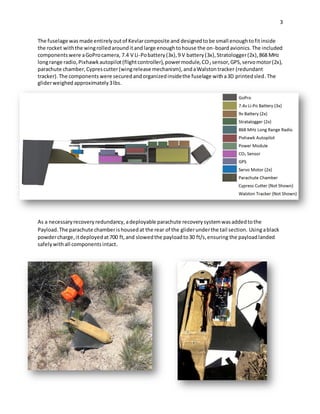
The fuselage was made entirelyoutof Kevlarcomposite and designedtobe small enoughtofitinside
the rocket withthe wingrolledarounditandlarge enoughtohouse the on-boardavionics.The included
components were aGoProcamera, 7.4 V Li-Pobattery(3x),9 V battery(3x), Stratologger(2x),868 MHz
longrange radio,Pixhawkautopilot(flightcontroller),powermodule,CO2 sensor,GPS,servomotor(2x),
parachute chamber,Cyprescutter(wingrelease mechanism),andaWalstontracker (redundant
tracker).The components were securedandorganizedinsidethe fuselage witha3D printedsled.The
gliderweighed approximately3lbs.
As a necessaryrecoveryredundancy,adeployable parachute recoverysystemwasaddedtothe
Payload.The parachute chamberishousedat the rear of the gliderunderthe tail section. Usingablack
powdercharge,itdeployedat700 ft,and slowedthe payloadto30 ft/s,ensuring the payloadlanded
safelywithall componentsintact.
4
Paper Launcher
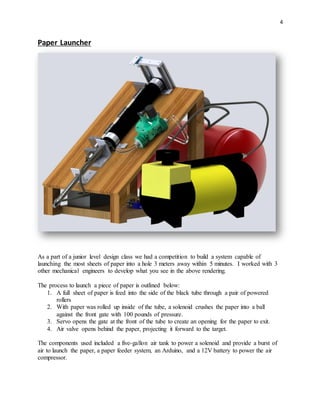
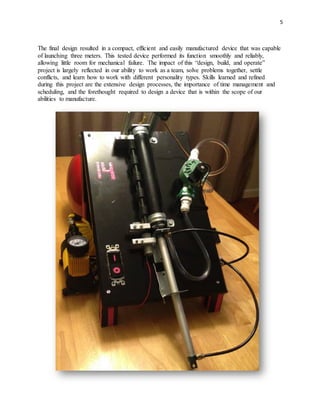
As a part of a junior level design class we had a competition to build a system capable of
launching the most sheets of paper into a hole 3 meters away within 5 minutes. I worked with 3
other mechanical engineers to develop what you see in the above rendering.
The process to launch a piece of paper is outlined below:
1. A full sheet of paper is feed into the side of the black tube through a pair of powered
rollers
2. With paper was rolled up inside of the tube, a solenoid crushes the paper into a ball
against the front gate with 100 pounds of pressure.
3. Servo opens the gate at the front of the tube to create an opening for the paper to exit.
4. Air valve opens behind the paper, projecting it forward to the target.
The components used included a five-gallon air tank to power a solenoid and provide a burst of
air to launch the paper, a paper feeder system, an Arduino, and a 12V battery to power the air
compressor.
5
The final design resulted in a compact, efficient and easily manufactured device that was capable
of launching three meters. This tested device performed its function smoothly and reliably,
allowing little room for mechanical failure. The impact of this “design, build, and operate”
project is largely reflected in our ability to work as a team, solve problems together, settle
conflicts, and learn how to work with different personality types. Skills learned and refined
during this project are the extensive design processes, the importance of time management and
scheduling, and the forethought required to design a device that is within the scope of our
abilities to manufacture.
6
30 Hour Challenge
OregonState Universityhasa quarterly competitioncalledHWeekend. Itisa 30 hour openended
engineeringchallengewhereteams are givenavarietyof electronicsandaccesstoa lasercutterand 3D
printerto buildwhatevertheywant.I participated inthe eventtwice,andbothtimesIworkedina team
of 7 engineers.
The firsttime we builta remote control car that was controlledwithaSmartPhone app. The ideawas
for the car to be able to drive intoawall,flipover,andcontinue driving.Thisdidnotworksince the
wheel were made fromacrylic,whichdidnothave adequate griptoclimbawall. Shownbelow isthe car
we designed,built,anddrove within30 hours.
7
The secondprojectthat I workedonwas an automatedsidewalkchalkmarker.The ideawasforitto
take an image fromthe internet,transformitintoafieldof 1’sand 0’s. Thenitwouldrecreate the image
on a sidewalkusingaliquidchalkmarker.We finishedbuilding the device anddevelopingthe software
for itwithinthe 30 hourwindow,howeverwe didnothave the time tobridge the gap betweenthe two
to geta functioningprototype.
Joshua Grosserhode
Education
Oregon State University, Corvallis, OR					 September 2013 - June 2017
Bachelor of Science in Mechanical Engineering
Minor in Aerospace Engineering
GPA: 3.56
Relevant Coursework
•	 Space Systems (orbital mechanics, rocket and satellite propulsion, satellite dynamics)
•	 Aerospace Applications (aerodynamics, flight stability, and aircraft propulsion)
•	 Aero Vehicle Design (structure analysis, composite applications, and wind tunnel testing)
•	 Mechanical Vibrations (vibrational responses of multiple degree of freedom and continuous systems)
•	 Geometric Dimensioning & Tolerancing (datum and surface features, and stacking tolerances)
Software Skills
SolidWorks • ANSYS • MATLAB • Mathcad• Microsoft Office
Experience
NuScale Power, Corvallis, OR						 June 2016 - June 2017
Mechanical Engineer Intern
•	 Estimated leak rates for emergency cooling valves and deformation of helical pipes in reactor vessel
•	 Conducted stress analyses of pipe supports, nozzles, and vessels using ANSYS and hand calculations
•	 Generated efficient meshes of complex pressure vessel heads that had several protruding nozzles
•	 Wrote technical documents explaining calculations following ASME and company procedures
Center for Applied Systems and Software, Corvallis, OR		 October 2015 - May 2016
Test Engineer
•	 Conducted tests determining interoperability of commercially used network transceivers and switches
•	 Wrote instructions for recreating bugs in software and faults in hardware
Heuberger Construction, Hood River, OR				 Seasonal 2013 - 2015
Construction Worker
•	 Constructed and remodeled homes, including foundations, framing, and siding
•	 Independently followed and implemented blueprints
Senior Design Project: 30,000 ft. Sounding Rocket, Payload Subteam
for Spaceport America, Intercollegiate Rocketry Competition
•	 Designed and built an autonomously guided glider that deployed from the rocket as a payload
•	 Analyzed aerodynamics and stability of the glider when designing the wing and tail
•	 Manufactured composite Kevlar fuselage and carbon fiber lifting surfaces
•	 Fabricated mounts for internal electrical components using additive manufacturing
•	 Earned Sportsmanship award with Oregon State team and was first team to launch due to planning
and preparation
•	 Collaborated with mechanical, electrical, and computer science engineering students
•	 Performed geometric dimensioning and tolerancing (GD&T) on the propulsion subteam’s
pressure chamber
Joshua.Grosserhode@Gmail.com
(541) 490-0345
Kirkland, WA 98033

Engineering Portfolio

  • 1.
  • 2.
    Table of Contents ProjectPage Rocket Deployed Glider 1 Paper Launcher 4 30 Hour Challenge 6 Documents Resume 8
  • 3.
    1 Rocket Deployed Glider Formy seniorcapstone project,Iwasa part of the OregonState University30,000 ft.rocketteam. The teamconsistedof 12 mechanical,2electrical engineers,and3 computerscientists. Specifically,Iwasa part of the Payloadsubteam,whichdesigned,built,andtestedanautonomouslyguidedglider. The Payloadsub-teamwasresponsible forthe scientificpayloadcarriedinside the rocket.The goal of the payload,a fixedwing autonomouslyguidedglider, wastobe ejectedfromthe rocketat apogee,free fall to a predeterminedaltitude wherethe wingdeployedandthe autonomousguidancesystem controlled the glider'sdescent. The motivationof thispayload wastoprototype ahighaltitude UAV with no onboardpropulsion. The gliderwasequipped withaCO2 senorand videocamerathat can be analyzedupon recovery. Payload EjectionCharges Detachable Nose Cone
  • 4.
    2 Two recoverysystems wereused,aprimaryanda secondary.The primaryrecoverysystem wasthe wing and tail whichslowedthe descentandguidedittothe landingside.The secondaryrecoverysystem was a deployable parachute that furtherslowedthe descentonce the payloadwas ata loweraltitude.Both recoverysystems were entirelystudentdesigned,manufacturedandtested. Stored/Free Fall Configuration FlightConfiguration A carbon fiberloadstiffenedwingwasused asthe primaryliftingbodyforthe glider.A loadstiffened wingcapable of beingrolledunderpressure andautomaticallystiffenedintoaflightconfigurationwhen released.The wing wasmade outthree pliesof T-800 carbon fiberweave witha[45°/-45°/45°] layup schedule,allowingittoroll and be placedintothe rockettube. The tail sectionof the payloadwasdesignedto give the glidercontrol authority andstability duringits flight,whilestillbeingcapable of fittinginsideof the rocket.Originallyatraditiontail designwas selectedforsimplicitybutthisresultedinalackof surface areaneededtoproperlycontrol the glider. The solution wasto use an invertedV-tail. Withthe V-tail,itwaspossible fitamuchlargercontrol area inside the rocket,since the tail canroll similarlytothe wing. Additionally, the inverted“V”designonly had twocontrol surfacesreducingthe numberof requiredcomponents.
  • 5.
    3 The fuselage wasmade entirelyoutof Kevlarcomposite and designedtobe small enoughtofitinside the rocket withthe wingrolledarounditandlarge enoughtohouse the on-boardavionics.The included components were aGoProcamera, 7.4 V Li-Pobattery(3x),9 V battery(3x), Stratologger(2x),868 MHz longrange radio,Pixhawkautopilot(flightcontroller),powermodule,CO2 sensor,GPS,servomotor(2x), parachute chamber,Cyprescutter(wingrelease mechanism),andaWalstontracker (redundant tracker).The components were securedandorganizedinsidethe fuselage witha3D printedsled.The gliderweighed approximately3lbs. As a necessaryrecoveryredundancy,adeployable parachute recoverysystemwasaddedtothe Payload.The parachute chamberishousedat the rear of the gliderunderthe tail section. Usingablack powdercharge,itdeployedat700 ft,and slowedthe payloadto30 ft/s,ensuring the payloadlanded safelywithall componentsintact.
  • 6.
    4 Paper Launcher As apart of a junior level design class we had a competition to build a system capable of launching the most sheets of paper into a hole 3 meters away within 5 minutes. I worked with 3 other mechanical engineers to develop what you see in the above rendering. The process to launch a piece of paper is outlined below: 1. A full sheet of paper is feed into the side of the black tube through a pair of powered rollers 2. With paper was rolled up inside of the tube, a solenoid crushes the paper into a ball against the front gate with 100 pounds of pressure. 3. Servo opens the gate at the front of the tube to create an opening for the paper to exit. 4. Air valve opens behind the paper, projecting it forward to the target. The components used included a five-gallon air tank to power a solenoid and provide a burst of air to launch the paper, a paper feeder system, an Arduino, and a 12V battery to power the air compressor.
  • 7.
    5 The final designresulted in a compact, efficient and easily manufactured device that was capable of launching three meters. This tested device performed its function smoothly and reliably, allowing little room for mechanical failure. The impact of this “design, build, and operate” project is largely reflected in our ability to work as a team, solve problems together, settle conflicts, and learn how to work with different personality types. Skills learned and refined during this project are the extensive design processes, the importance of time management and scheduling, and the forethought required to design a device that is within the scope of our abilities to manufacture.
  • 8.
    6 30 Hour Challenge OregonStateUniversityhasa quarterly competitioncalledHWeekend. Itisa 30 hour openended engineeringchallengewhereteams are givenavarietyof electronicsandaccesstoa lasercutterand 3D printerto buildwhatevertheywant.I participated inthe eventtwice,andbothtimesIworkedina team of 7 engineers. The firsttime we builta remote control car that was controlledwithaSmartPhone app. The ideawas for the car to be able to drive intoawall,flipover,andcontinue driving.Thisdidnotworksince the wheel were made fromacrylic,whichdidnothave adequate griptoclimbawall. Shownbelow isthe car we designed,built,anddrove within30 hours.
  • 9.
    7 The secondprojectthat Iworkedonwas an automatedsidewalkchalkmarker.The ideawasforitto take an image fromthe internet,transformitintoafieldof 1’sand 0’s. Thenitwouldrecreate the image on a sidewalkusingaliquidchalkmarker.We finishedbuilding the device anddevelopingthe software for itwithinthe 30 hourwindow,howeverwe didnothave the time tobridge the gap betweenthe two to geta functioningprototype.
  • 10.
    Joshua Grosserhode Education Oregon StateUniversity, Corvallis, OR September 2013 - June 2017 Bachelor of Science in Mechanical Engineering Minor in Aerospace Engineering GPA: 3.56 Relevant Coursework • Space Systems (orbital mechanics, rocket and satellite propulsion, satellite dynamics) • Aerospace Applications (aerodynamics, flight stability, and aircraft propulsion) • Aero Vehicle Design (structure analysis, composite applications, and wind tunnel testing) • Mechanical Vibrations (vibrational responses of multiple degree of freedom and continuous systems) • Geometric Dimensioning & Tolerancing (datum and surface features, and stacking tolerances) Software Skills SolidWorks • ANSYS • MATLAB • Mathcad• Microsoft Office Experience NuScale Power, Corvallis, OR June 2016 - June 2017 Mechanical Engineer Intern • Estimated leak rates for emergency cooling valves and deformation of helical pipes in reactor vessel • Conducted stress analyses of pipe supports, nozzles, and vessels using ANSYS and hand calculations • Generated efficient meshes of complex pressure vessel heads that had several protruding nozzles • Wrote technical documents explaining calculations following ASME and company procedures Center for Applied Systems and Software, Corvallis, OR October 2015 - May 2016 Test Engineer • Conducted tests determining interoperability of commercially used network transceivers and switches • Wrote instructions for recreating bugs in software and faults in hardware Heuberger Construction, Hood River, OR Seasonal 2013 - 2015 Construction Worker • Constructed and remodeled homes, including foundations, framing, and siding • Independently followed and implemented blueprints Senior Design Project: 30,000 ft. Sounding Rocket, Payload Subteam for Spaceport America, Intercollegiate Rocketry Competition • Designed and built an autonomously guided glider that deployed from the rocket as a payload • Analyzed aerodynamics and stability of the glider when designing the wing and tail • Manufactured composite Kevlar fuselage and carbon fiber lifting surfaces • Fabricated mounts for internal electrical components using additive manufacturing • Earned Sportsmanship award with Oregon State team and was first team to launch due to planning and preparation • Collaborated with mechanical, electrical, and computer science engineering students • Performed geometric dimensioning and tolerancing (GD&T) on the propulsion subteam’s pressure chamber Joshua.Grosserhode@Gmail.com (541) 490-0345 Kirkland, WA 98033