Considering production in a cross-culture environment
© Alpha Consultants
Intro
April Bledsoe
Sr. Engineering Specialist
Navistar, Inc.
Section Rep, Chicago SWE
Tamera Garrett
Human Resource Professional &
Talent Acquisition Consultant
Member, Collegiate Section
© Alpha Consultants
इंजीनियर
‫مهندس‬
工程師
inženýr
ingenieur
insener
inhinyero
insinööri
ingénieur
mühendis
μηχανικός
‫מהנדס‬
วิศวกร
mérnök
Innealtóir
Ingegnere
エンジニア
기관사
inżynier
engenheiro
inginer
инженер
ingeniero
© Alpha Consultants
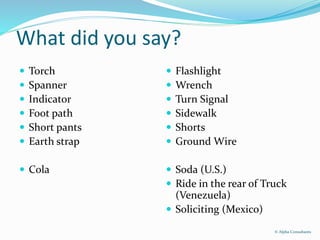
What did you say?
 Torch
 Spanner
 Indicator
 Foot path
 Short pants
 Earth strap
 Cola
 Flashlight
 Wrench
 Turn Signal
 Sidewalk
 Shorts
 Ground Wire
 Soda (U.S.)
 Ride in the rear of Truck
(Venezuela)
 Soliciting (Mexico)
© Alpha Consultants
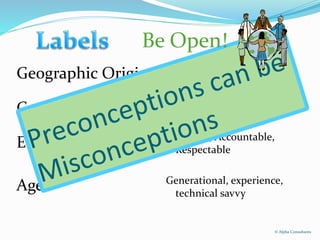
Geographic Origin
Gender
Education
Age
Lazy, combative, smarter,
rude, etc.
Weak, Assertive, Equipped
Qualified, Accountable,
Respectable
Generational, experience,
technical savvy
Be Open!
© Alpha Consultants
Time Oriented vs Event Oriented
Time Event
 A time oriented culture focuses
on time, they tend to be
punctual, efficient and
quick. Things start on time and
end on time. Most activities last
a certain amount of time and
you can't add something to the
schedule without taking
something out. Time
frames and punctuality are
important. Everything is
orderly, neat and in its place.
 An event oriented culture focuses
more on the moment at hand and
less on the future. They think
differently about time and put it
way down on the scale of
importance. Everything will work
itself out and there's no need to
get undone about a schedule. The
value of the event and the
moment is what
matters. Activities and schedules
normally start late and last longer
with no definite time
frame to be kept.
© Alpha Consultants
Share story (potential for lessons
learned)
 Cultural Experience
 Gender Experience
 Education Experience
 Age
© Alpha Consultants
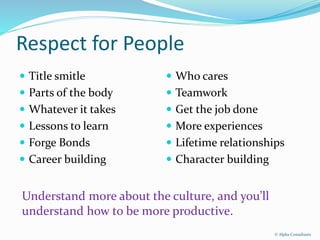
Respect for People
 Title smitle
 Parts of the body
 Whatever it takes
 Lessons to learn
 Forge Bonds
 Career building
 Who cares
 Teamwork
 Get the job done
 More experiences
 Lifetime relationships
 Character building
Understand more about the culture, and you’ll
understand how to be more productive.
© Alpha Consultants
TIPS
 Add drawings
 Saying it louder doesn’t
help!
 Do your homework on
your team’s culture.
 Don’t make assumptions
that become
misconceptions.
 Be patient and willing to
take a different
approach.
 Confirm understanding.
 Write down
steps/methods.
 If you are not sure, ASK!
 Learn at least a few
words in other language.
© Alpha Consultants
Questions to ask yourself?
Language differences aside, when working on a diverse team (more than
one culture represented), do you see challenges in communicating
concepts?
Do you find that one’s own cultural perceptions may create filters by
which the communiqué is received?
Do you recognize that the other person’s filters may be why they are not
understanding the concept, or even context of what you are trying to
communicate?
What are some of your strategies or tips to get your point across and
confirm it is understood?
© Alpha Consultants
Suggested Resources
 www.Geert-Hofstede.com – Characteristics by country.
 When Generations Collide, Lancaster & Stillman
 Generations at Work, Zemke
 From Boomers to Bloggers, Burmeister
 Bridging the Generation Gap, Gravett & Throckmorton
 The Six Thinking Hats, De Bono
 Ties to Tatoos, Elliott-Yeary
 Blink, Gladwell
© Alpha Consultants
© Alpha Consultants

Global Engineering: Considering Production in a Cross-Culture Environment

  • 1.
    Considering production ina cross-culture environment © Alpha Consultants
  • 2.
    Intro April Bledsoe Sr. EngineeringSpecialist Navistar, Inc. Section Rep, Chicago SWE Tamera Garrett Human Resource Professional & Talent Acquisition Consultant Member, Collegiate Section © Alpha Consultants
  • 3.
  • 4.
    What did yousay?  Torch  Spanner  Indicator  Foot path  Short pants  Earth strap  Cola  Flashlight  Wrench  Turn Signal  Sidewalk  Shorts  Ground Wire  Soda (U.S.)  Ride in the rear of Truck (Venezuela)  Soliciting (Mexico) © Alpha Consultants
  • 5.
    Geographic Origin Gender Education Age Lazy, combative,smarter, rude, etc. Weak, Assertive, Equipped Qualified, Accountable, Respectable Generational, experience, technical savvy Be Open! © Alpha Consultants
  • 6.
    Time Oriented vsEvent Oriented Time Event  A time oriented culture focuses on time, they tend to be punctual, efficient and quick. Things start on time and end on time. Most activities last a certain amount of time and you can't add something to the schedule without taking something out. Time frames and punctuality are important. Everything is orderly, neat and in its place.  An event oriented culture focuses more on the moment at hand and less on the future. They think differently about time and put it way down on the scale of importance. Everything will work itself out and there's no need to get undone about a schedule. The value of the event and the moment is what matters. Activities and schedules normally start late and last longer with no definite time frame to be kept. © Alpha Consultants
  • 7.
    Share story (potentialfor lessons learned)  Cultural Experience  Gender Experience  Education Experience  Age © Alpha Consultants
  • 8.
    Respect for People Title smitle  Parts of the body  Whatever it takes  Lessons to learn  Forge Bonds  Career building  Who cares  Teamwork  Get the job done  More experiences  Lifetime relationships  Character building Understand more about the culture, and you’ll understand how to be more productive. © Alpha Consultants
  • 9.
    TIPS  Add drawings Saying it louder doesn’t help!  Do your homework on your team’s culture.  Don’t make assumptions that become misconceptions.  Be patient and willing to take a different approach.  Confirm understanding.  Write down steps/methods.  If you are not sure, ASK!  Learn at least a few words in other language. © Alpha Consultants
  • 10.
    Questions to askyourself? Language differences aside, when working on a diverse team (more than one culture represented), do you see challenges in communicating concepts? Do you find that one’s own cultural perceptions may create filters by which the communiqué is received? Do you recognize that the other person’s filters may be why they are not understanding the concept, or even context of what you are trying to communicate? What are some of your strategies or tips to get your point across and confirm it is understood? © Alpha Consultants
  • 11.
    Suggested Resources  www.Geert-Hofstede.com– Characteristics by country.  When Generations Collide, Lancaster & Stillman  Generations at Work, Zemke  From Boomers to Bloggers, Burmeister  Bridging the Generation Gap, Gravett & Throckmorton  The Six Thinking Hats, De Bono  Ties to Tatoos, Elliott-Yeary  Blink, Gladwell © Alpha Consultants
  • 12.

Editor's Notes

  • #2 Survey audience – Global exposure, where from, etc.
  • #4 160 + languages spoken in our design office at one time
  • #5 Audience game.
  • #6 Points: Impacts to better communciation Observe body language Difference in viewpoint isn’t only across languages and borders, but also even within same language across regions,etc. Consider each team member’s filter to understand why they might not understand your concept or your terminology. FOLLOW with Time exercise before next slide.
  • #7 What is U.S.A.?
  • #8 Share 2 experiences. Solicit experiences from audience.
  • #9 Everyone from CEO to facilities person has contribution to product development and success of the team.
  • #10 Solicit additional tips from audience
  • #11 Share survey results, tips, lessons learned.
  • #13 Closing remarks.