Engineering History: What cool &
useful things have engineers
done in the past?
Fall 2012
Lecture # 4
1
A video introduction:
• History of Engineering --
YouTube
• TED--why is X unknown
2
When did engineering begin?
Who were the first engineers?
What were the first engineering designs?
3
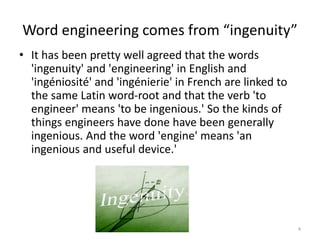
Word engineering comes from “ingenuity”
• It has been pretty well agreed that the words
'ingenuity' and 'engineering' in English and
'ingéniosité' and 'ingénierie' in French are linked to
the same Latin word-root and that the verb 'to
engineer' means 'to be ingenious.' So the kinds of
things engineers have done have been generally
ingenious. And the word 'engine' means 'an
ingenious and useful device.'
4
Introduction
In prehistoric times, men and women had to be
ingenious in order to survive hunger, enemies,
climate and, later, the tyranny of distance. So
there have always been 'engineers' around,
many of whom were involved in activities we
would not associate with engineering today.
They were rather involved in hunting, farming,
fishing, fighting, implement- and tool-making,
transportation and many other things.
5
The Beginnings of Engineering:
6000 - 3000 B.C. in Asia Minor
6
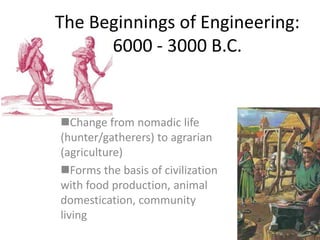
The Beginnings of Engineering:
6000 - 3000 B.C.
Change from nomadic life
(hunter/gatherers) to agrarian
(agriculture)
Forms the basis of civilization
with food production, animal
domestication, community
living
7
The Beginnings of Engineering:
6000 - 3000 B.C.
Early Achievement Progression in this Era
People discovered methods of producing fire at
will
People discovered how to use rocks as tools
People learn how to shape soft metals into tools
Mixing different kinds of metals could make
better tools
8
The Beginning of Engineering:
6000 - 3000 B.C.
Major Engineering Projects or Inventions
Irrigation systems to promote crop growth
Animal-, water-, and wind-driven machines
The wheel and axle
 Plow & Yoke
9
Engineering in Early
Civilizations:3000 -600 B.C.
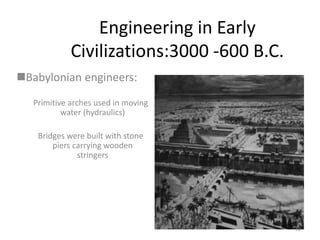
Babylonian engineers:
Primitive arches used in moving
water (hydraulics)
Bridges were built with stone
piers carrying wooden
stringers
10
Engineering in Early
Civilizations:3000 -600 B.C.
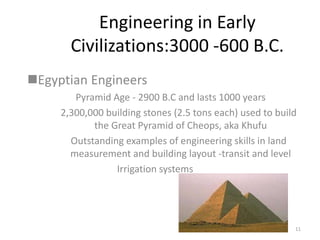
Egyptian Engineers
Pyramid Age - 2900 B.C and lasts 1000 years
2,300,000 building stones (2.5 tons each) used to build
the Great Pyramid of Cheops, aka Khufu
Outstanding examples of engineering skills in land
measurement and building layout -transit and level
Irrigation systems
11
Let’s Travel Through Time
• 1200 BC – AD 1
• AD 1 – 1000
• 1000 – 1400
• 1400 – 1700
• 1700 – 1800
• 1800 – 1875
• 1875 – 1925
• 1925 – 1950
• 1950 – 1975
• 1975 – 1990
• 1990 -- 2000
12
In Class Hands On Activity
• Teams of 6
• Each team the list of engineering
inventions
• As a group, put each invention in the
correct time period. That is, put a
sticky with the time period number
next to each invention. Put the sheets
on the wall with your numbers.
• When we get the answers, if yours is
wrong, have a representative remove
the sticky. The team with the most
correct answers at the end of class
wins.
13
In Class Hands On Activity
• Team representatives – place each
sticky note on the wall under the
time period you think the activity
belongs
• You have “two minutes to win it”
and place all your sticky notes
• Ready! Set! GO!
14
Traveling Through the Ages
• 1200 B.C. – A.D. 1
– Quality of wrought iron is improved
– Swords are mass produced
– Siege towers are perfected
– Greeks develop manufacturing
– Archimedes introduces mathematics in Greece
– Concrete is used for arched bridges, roads and
aqueducts in Rome.
15
Activity Answers
1200BC-AD1 C Concrete used for arched bridges, roads & aqueducts
1200BC-AD1 Z Wrought Iron Quality allowed swords massed produced
16
Traveling Through the Ages: A.D. 1-1000
• Chinese further develop the study of
mathematics
• Gunpowder is perfected
• Abacus calculating machine introduced to
Europe from the Orient
• Cotton and silk manufactured
17
Activity Answers
18
AD1-AD1000 D Cotton and silk manufactured
AD1-AD1000 Q Gunpowder perfected
Traveling Through the Ages: 1000-1400
• Silk and glass industries continue to grow
• Chimneys first appeared in European buildings
• Locks for canals were developed in Italy
• Spinning wheels developed to twist fiber into
thread
• Leonardo Fibonacci, a medieval
mathematician, writes the first Western text
on algebra
19
Activity Answers
20
1000-1400 R Locks for canals were developed in Italy
1000-1400 W Spinning wheels developed to twist fiber into thread
Traveling Through the Ages: 1400-1700
• First toilet is invented in England
• Galileo constructs a series of telescopes, with
which he observes the rotation about the sun
• Engineers organized as a separate unit in the
French army
• Isaac Newton constructs first reflecting
telescopes
• Boyle’s Gas Law, stating pressure varies
inversely with volume, is first introduced.
21
Activity Answers
22
1400-1700 L First reflecting telescopes
1400-1700 N First toilet is invented
Traveling Through the Ages: 1700-1800
• Industrial Revolution begins in Europe
• James Watt patents his first steam engine
• Society of Engineers, a professional
engineering society, is formed in London
• First building made completely of cast iron
built in England
• First mechanical loom created
23
Activity Answers
24
1700-1800 K First patent on steam engine
1700-1800 V Society of Engineers formed
Traveling Through the Ages: 1800-1875
• First railroad locomotive is designed and
manufactured
• Italy’s Volta developed the first battery
• Single wire telegraph line is developed
• Reinforced concrete is first used
• First synthetic plastic material is created
• First oil well drilled in Pennsylvania
• Typewriter is perfected
• There were 70 engineering schools in the US
• Compressed-air refrigeration plant built in Paris
25
Activity Answers
26
1800-1875 J First oil well drilled
1800-1875 M First synthetic plastic material created
1800-1875 T Reinforced concrete first used
Traveling Through the Ages: 1875-1925
• Telephone is patented in the US by Alexander Graham
Bell
• Thomas Edison invents the light bulb and the
phonograph
• Gasoline engine developed by Gottlieb Daimler
• Automobile introduced by Karl Benz
• Wright brothers complete first sustained flight
• Ford develops first diesel engines in tractors
• First commercial flight between Paris and London
begins
• Detroit becomes center of auto production industry
27
Activity Answers
28
1875-1925 H First commercial flight between Paris and London
1875-1925 O Gasoline engine developed
1875-1925 X Telephone patented
Traveling Through the Ages: 1925-1950
• John Logie Baird invents a primitive form of
television
• The VW Beetle goes into production
• First atomic bomb is used
• The transistor is invented
29
Activity Answers
30
1925-1950 G First atomic bomb used
1925-1950 S Primitive form of TV invented
1925-1950 Y Transistor invented
Traveling Through the Ages: 1950-1975
• Computers first introduced into the market,
and are common by 1960
• Sputnik I, the first artificial satellite, put into
space by USSR
• First communication satellite—Telstar—is put
into space
• The U.S. completes the first ever moon
landing
31
Activity Answers
32
1950-1975 B Computer first introduced into market
1950-1975 F First artificial satellite put into space
1950-1975 I First ever moon landing by US
Traveling Through the Ages: 1975-1990
• The Concord is first used for supersonic flight
between Europe and the U.S.
• Columbia space shuttle is reused for space
travel
• First artificial heart is successfully implanted
33
Activity Answers
34
1975-1990 A Columbia space shuttle reused for space travel
1975-1990 E First artificial heart successfully implanted
Traveling Through the Ages: 1990-2000
• Robots travel on Mars
• The “Chunnel” between England and France is
finished
• GPS is used to predict and report weather
conditions, as well as many other consumer
applications
35
Activity Answers
36
1990-2000 P GPS used for consumer applications
1990-2000 U Robots travel on Mars
In Summary…
Every new innovation
builds on ideas of
previous innovations!
37
Happy 100+ Birthday!
• Some engineering feats that are more than
100 years old and still operating!
38
Giant Ferris Wheel
• Vienna Austria
• 1897
• Wheel diameter: 200ft
• Height above ground: 21ft
• Speed of rotation: ¾ meter per second
• 30 cabins and 120 wheel spokes
• Built as part of the Golden Jubilee
celebrations for Emperor Franz Josef
39
Suspension Railway
• Wuppertal, Germany
• 1903
• 13.3 KM (8.3 miles)
• 17 MPH
• Monorail with majority over the Wupper river
– Avoid right of way problems over land
• 80,000 passengers per day
• Ranks as one of the safest public transport systems
– 2 accidents (neither engineering related)
• Circus PR of having elephant ride monorail in 1950 – elephant jumped
into the river (only minor injuries)
• 1999 car derailed
– Tool left on track by workman – human error not engineering error
40
Transporter Bridge (Aerial Ferry)
• Middlesbrough, England
• 1911
• 855 ft in length
• 250 to 300 passengers
• Problem: Limited approach span
• Problem: River traffic requires 90 ft clearance
• Gondola carrying passengers & vehicles
suspended from a girder to transit the river
(being raised from ground level on one side and
lowered on the other side)
41
You are part of the next 100 years!!!
42
2112
Further Reading
• http://www.creatingtechnology.org/history.ht
m
• http://www.loc.gov/rr/scitech/SciRefGuides/e
ng-history.html
43
44
Credits
• Fantastic Feats & Failures
• Modern Marvels, History Channel
45

engineering history engineering history..

  • 1.
    Engineering History: Whatcool & useful things have engineers done in the past? Fall 2012 Lecture # 4 1
  • 2.
    A video introduction: •History of Engineering -- YouTube • TED--why is X unknown 2
  • 3.
    When did engineeringbegin? Who were the first engineers? What were the first engineering designs? 3
  • 4.
    Word engineering comesfrom “ingenuity” • It has been pretty well agreed that the words 'ingenuity' and 'engineering' in English and 'ingéniosité' and 'ingénierie' in French are linked to the same Latin word-root and that the verb 'to engineer' means 'to be ingenious.' So the kinds of things engineers have done have been generally ingenious. And the word 'engine' means 'an ingenious and useful device.' 4
  • 5.
    Introduction In prehistoric times,men and women had to be ingenious in order to survive hunger, enemies, climate and, later, the tyranny of distance. So there have always been 'engineers' around, many of whom were involved in activities we would not associate with engineering today. They were rather involved in hunting, farming, fishing, fighting, implement- and tool-making, transportation and many other things. 5
  • 6.
    The Beginnings ofEngineering: 6000 - 3000 B.C. in Asia Minor 6
  • 7.
    The Beginnings ofEngineering: 6000 - 3000 B.C. Change from nomadic life (hunter/gatherers) to agrarian (agriculture) Forms the basis of civilization with food production, animal domestication, community living 7
  • 8.
    The Beginnings ofEngineering: 6000 - 3000 B.C. Early Achievement Progression in this Era People discovered methods of producing fire at will People discovered how to use rocks as tools People learn how to shape soft metals into tools Mixing different kinds of metals could make better tools 8
  • 9.
    The Beginning ofEngineering: 6000 - 3000 B.C. Major Engineering Projects or Inventions Irrigation systems to promote crop growth Animal-, water-, and wind-driven machines The wheel and axle  Plow & Yoke 9
  • 10.
    Engineering in Early Civilizations:3000-600 B.C. Babylonian engineers: Primitive arches used in moving water (hydraulics) Bridges were built with stone piers carrying wooden stringers 10
  • 11.
    Engineering in Early Civilizations:3000-600 B.C. Egyptian Engineers Pyramid Age - 2900 B.C and lasts 1000 years 2,300,000 building stones (2.5 tons each) used to build the Great Pyramid of Cheops, aka Khufu Outstanding examples of engineering skills in land measurement and building layout -transit and level Irrigation systems 11
  • 12.
    Let’s Travel ThroughTime • 1200 BC – AD 1 • AD 1 – 1000 • 1000 – 1400 • 1400 – 1700 • 1700 – 1800 • 1800 – 1875 • 1875 – 1925 • 1925 – 1950 • 1950 – 1975 • 1975 – 1990 • 1990 -- 2000 12
  • 13.
    In Class HandsOn Activity • Teams of 6 • Each team the list of engineering inventions • As a group, put each invention in the correct time period. That is, put a sticky with the time period number next to each invention. Put the sheets on the wall with your numbers. • When we get the answers, if yours is wrong, have a representative remove the sticky. The team with the most correct answers at the end of class wins. 13
  • 14.
    In Class HandsOn Activity • Team representatives – place each sticky note on the wall under the time period you think the activity belongs • You have “two minutes to win it” and place all your sticky notes • Ready! Set! GO! 14
  • 15.
    Traveling Through theAges • 1200 B.C. – A.D. 1 – Quality of wrought iron is improved – Swords are mass produced – Siege towers are perfected – Greeks develop manufacturing – Archimedes introduces mathematics in Greece – Concrete is used for arched bridges, roads and aqueducts in Rome. 15
  • 16.
    Activity Answers 1200BC-AD1 CConcrete used for arched bridges, roads & aqueducts 1200BC-AD1 Z Wrought Iron Quality allowed swords massed produced 16
  • 17.
    Traveling Through theAges: A.D. 1-1000 • Chinese further develop the study of mathematics • Gunpowder is perfected • Abacus calculating machine introduced to Europe from the Orient • Cotton and silk manufactured 17
  • 18.
    Activity Answers 18 AD1-AD1000 DCotton and silk manufactured AD1-AD1000 Q Gunpowder perfected
  • 19.
    Traveling Through theAges: 1000-1400 • Silk and glass industries continue to grow • Chimneys first appeared in European buildings • Locks for canals were developed in Italy • Spinning wheels developed to twist fiber into thread • Leonardo Fibonacci, a medieval mathematician, writes the first Western text on algebra 19
  • 20.
    Activity Answers 20 1000-1400 RLocks for canals were developed in Italy 1000-1400 W Spinning wheels developed to twist fiber into thread
  • 21.
    Traveling Through theAges: 1400-1700 • First toilet is invented in England • Galileo constructs a series of telescopes, with which he observes the rotation about the sun • Engineers organized as a separate unit in the French army • Isaac Newton constructs first reflecting telescopes • Boyle’s Gas Law, stating pressure varies inversely with volume, is first introduced. 21
  • 22.
    Activity Answers 22 1400-1700 LFirst reflecting telescopes 1400-1700 N First toilet is invented
  • 23.
    Traveling Through theAges: 1700-1800 • Industrial Revolution begins in Europe • James Watt patents his first steam engine • Society of Engineers, a professional engineering society, is formed in London • First building made completely of cast iron built in England • First mechanical loom created 23
  • 24.
    Activity Answers 24 1700-1800 KFirst patent on steam engine 1700-1800 V Society of Engineers formed
  • 25.
    Traveling Through theAges: 1800-1875 • First railroad locomotive is designed and manufactured • Italy’s Volta developed the first battery • Single wire telegraph line is developed • Reinforced concrete is first used • First synthetic plastic material is created • First oil well drilled in Pennsylvania • Typewriter is perfected • There were 70 engineering schools in the US • Compressed-air refrigeration plant built in Paris 25
  • 26.
    Activity Answers 26 1800-1875 JFirst oil well drilled 1800-1875 M First synthetic plastic material created 1800-1875 T Reinforced concrete first used
  • 27.
    Traveling Through theAges: 1875-1925 • Telephone is patented in the US by Alexander Graham Bell • Thomas Edison invents the light bulb and the phonograph • Gasoline engine developed by Gottlieb Daimler • Automobile introduced by Karl Benz • Wright brothers complete first sustained flight • Ford develops first diesel engines in tractors • First commercial flight between Paris and London begins • Detroit becomes center of auto production industry 27
  • 28.
    Activity Answers 28 1875-1925 HFirst commercial flight between Paris and London 1875-1925 O Gasoline engine developed 1875-1925 X Telephone patented
  • 29.
    Traveling Through theAges: 1925-1950 • John Logie Baird invents a primitive form of television • The VW Beetle goes into production • First atomic bomb is used • The transistor is invented 29
  • 30.
    Activity Answers 30 1925-1950 GFirst atomic bomb used 1925-1950 S Primitive form of TV invented 1925-1950 Y Transistor invented
  • 31.
    Traveling Through theAges: 1950-1975 • Computers first introduced into the market, and are common by 1960 • Sputnik I, the first artificial satellite, put into space by USSR • First communication satellite—Telstar—is put into space • The U.S. completes the first ever moon landing 31
  • 32.
    Activity Answers 32 1950-1975 BComputer first introduced into market 1950-1975 F First artificial satellite put into space 1950-1975 I First ever moon landing by US
  • 33.
    Traveling Through theAges: 1975-1990 • The Concord is first used for supersonic flight between Europe and the U.S. • Columbia space shuttle is reused for space travel • First artificial heart is successfully implanted 33
  • 34.
    Activity Answers 34 1975-1990 AColumbia space shuttle reused for space travel 1975-1990 E First artificial heart successfully implanted
  • 35.
    Traveling Through theAges: 1990-2000 • Robots travel on Mars • The “Chunnel” between England and France is finished • GPS is used to predict and report weather conditions, as well as many other consumer applications 35
  • 36.
    Activity Answers 36 1990-2000 PGPS used for consumer applications 1990-2000 U Robots travel on Mars
  • 37.
    In Summary… Every newinnovation builds on ideas of previous innovations! 37
  • 38.
    Happy 100+ Birthday! •Some engineering feats that are more than 100 years old and still operating! 38
  • 39.
    Giant Ferris Wheel •Vienna Austria • 1897 • Wheel diameter: 200ft • Height above ground: 21ft • Speed of rotation: ¾ meter per second • 30 cabins and 120 wheel spokes • Built as part of the Golden Jubilee celebrations for Emperor Franz Josef 39
  • 40.
    Suspension Railway • Wuppertal,Germany • 1903 • 13.3 KM (8.3 miles) • 17 MPH • Monorail with majority over the Wupper river – Avoid right of way problems over land • 80,000 passengers per day • Ranks as one of the safest public transport systems – 2 accidents (neither engineering related) • Circus PR of having elephant ride monorail in 1950 – elephant jumped into the river (only minor injuries) • 1999 car derailed – Tool left on track by workman – human error not engineering error 40
  • 41.
    Transporter Bridge (AerialFerry) • Middlesbrough, England • 1911 • 855 ft in length • 250 to 300 passengers • Problem: Limited approach span • Problem: River traffic requires 90 ft clearance • Gondola carrying passengers & vehicles suspended from a girder to transit the river (being raised from ground level on one side and lowered on the other side) 41
  • 42.
    You are partof the next 100 years!!! 42 2112
  • 43.
    Further Reading • http://www.creatingtechnology.org/history.ht m •http://www.loc.gov/rr/scitech/SciRefGuides/e ng-history.html 43
  • 44.
  • 45.
    Credits • Fantastic Feats& Failures • Modern Marvels, History Channel 45