Engaging students How to design authentic and meaningful projects www.etwinning.es Proyectos de Colaboración Escolar en Europa Instituto de Tecnologías Educativas Torrelaguna 58, 28027 Madrid. Tfno:  +34 913778383
@MontBerte: Bacon and eggs – hens anre involved, pigs are committed www.etwinning.es Proyectos de Colaboración Escolar en Europa Instituto de Tecnologías Educativas Torrelaguna 58, 28027 Madrid. Tfno:  +34 913778383 Involving vs engaging?
What means engaging them?  How can we hook them on learning? What type of knowledge will stick in their memory? www.etwinning.es Proyectos de Colaboración Escolar en Europa Instituto de Tecnologías Educativas Torrelaguna 58, 28027 Madrid. Tfno:  +34 913778383 Why should we engage students?
by  jaysalikin by  Joe Shlabotnik by  Joe Shlabotnik
Project Based Learning is an instructional approach built upon  authentic  learning activities  designed to answer a question or solve a problem It is the depth of their  cognitive engagement  that distinguishes projects from busywork   www.etwinning.es Proyectos de Colaboración Escolar en Europa Instituto de Tecnologías Educativas Torrelaguna 58, 28027 Madrid. Tfno:  +34 913778383 What is Project Based Learning?
One that fulfills two criteria:  First, students must perceive the work as personally meaningful, as  a task that matters  and that they want to do well. Second, a meaningful project fulfills an  educational purpose . www.etwinning.es Proyectos de Colaboración Escolar en Europa Instituto de Tecnologías Educativas Torrelaguna 58, 28027 Madrid. Tfno:  +34 913778383 What is a project... a meaningful authentic project?
http://www.youtube.com/watch?v=3W4fBj7o5WE&feature=player_embedded
What will students learn through a project? Contents: curriculum Skills: analyze, evaluate, create...  Attitudes: curiosity, confidence, persistance, courage... www.etwinning.es Proyectos de Colaboración Escolar en Europa Instituto de Tecnologías Educativas Torrelaguna 58, 28027 Madrid. Tfno:  +34 913778383 What are we working on?
The Six A's of Designing Projects Seis principios del aprendizaje por proyectos www.etwinning.es Proyectos de Colaboración Escolar en Europa Instituto de Tecnologías Educativas Torrelaguna 58, 28027 Madrid. Tfno:  +34 913778383 Think about your project...
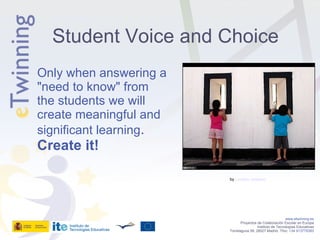
by  Luciano Joaquim Only when answering a "need to know" from the students we will create meaningful and significant learning .  Create it! www.etwinning.es Proyectos de Colaboración Escolar en Europa Instituto de Tecnologías Educativas Torrelaguna 58, 28027 Madrid. Tfno:  +34 913778383 Student Voice and Choice
Let the students take on the roles of scientists, historians, screenwritters...  And expect the type of products these experts might produce. www.etwinning.es Proyectos de Colaboración Escolar en Europa Instituto de Tecnologías Educativas Torrelaguna 58, 28027 Madrid. Tfno:  +34 913778383 Play
If the project is valuable for the community it will be engaging. With authentic products and real community members  www.etwinning.es Proyectos de Colaboración Escolar en Europa Instituto de Tecnologías Educativas Torrelaguna 58, 28027 Madrid. Tfno:  +34 913778383 Keep it real
by  Luciano Joaquim School should prepare students to face  real world challenges  and  problems www.etwinning.es Proyectos de Colaboración Escolar en Europa Instituto de Tecnologías Educativas Torrelaguna 58, 28027 Madrid. Tfno:  +34 913778383 So open the classroom doors and look at the world.
Providing students with  just-in-time  feedback during a project is key to a succeding project.  They need constant guidance and validation. www.etwinning.es Proyectos de Colaboración Escolar en Europa Instituto de Tecnologías Educativas Torrelaguna 58, 28027 Madrid. Tfno:  +34 913778383 Gather feedback
Sharing the final products with the audience they work for brings students valuable feedbackand an opportunity practice their oral skills www.etwinning.es Proyectos de Colaboración Escolar en Europa Instituto de Tecnologías Educativas Torrelaguna 58, 28027 Madrid. Tfno:  +34 913778383 Again, keep it real!
Analyze the  benefits  of the results for both the individuals and the group/community.  Learn about  rubrics  as teacher's guidance.  Try writing journals, so that students  reflect  on their thinking and problem-solving processes www.etwinning.es Proyectos de Colaboración Escolar en Europa Instituto de Tecnologías Educativas Torrelaguna 58, 28027 Madrid. Tfno:  +34 913778383 Encourage self-assessment and reflection
You and your students need to get ready for 21st century skills.  To boost collaboration skills, work on role-playing and team-building activities.  You need to learn how to use time and task organizers.  www.etwinning.es Proyectos de Colaboración Escolar en Europa Instituto de Tecnologías Educativas Torrelaguna 58, 28027 Madrid. Tfno:  +34 913778383 Yes, it is a hard work you are facing... but it is worthed
www.etwinning.es Proyectos de Colaboración Escolar en Europa Instituto de Tecnologías Educativas Torrelaguna 58, 28027 Madrid. Tfno:  +34 913778383 Let's get practical,  hands on a project!

Engaging students

  • 1.
    Engaging students Howto design authentic and meaningful projects www.etwinning.es Proyectos de Colaboración Escolar en Europa Instituto de Tecnologías Educativas Torrelaguna 58, 28027 Madrid. Tfno: +34 913778383
  • 2.
    @MontBerte: Bacon andeggs – hens anre involved, pigs are committed www.etwinning.es Proyectos de Colaboración Escolar en Europa Instituto de Tecnologías Educativas Torrelaguna 58, 28027 Madrid. Tfno: +34 913778383 Involving vs engaging?
  • 3.
    What means engagingthem? How can we hook them on learning? What type of knowledge will stick in their memory? www.etwinning.es Proyectos de Colaboración Escolar en Europa Instituto de Tecnologías Educativas Torrelaguna 58, 28027 Madrid. Tfno: +34 913778383 Why should we engage students?
  • 4.
    by jaysalikinby Joe Shlabotnik by Joe Shlabotnik
  • 5.
    Project Based Learningis an instructional approach built upon authentic learning activities designed to answer a question or solve a problem It is the depth of their cognitive engagement that distinguishes projects from busywork www.etwinning.es Proyectos de Colaboración Escolar en Europa Instituto de Tecnologías Educativas Torrelaguna 58, 28027 Madrid. Tfno: +34 913778383 What is Project Based Learning?
  • 6.
    One that fulfillstwo criteria: First, students must perceive the work as personally meaningful, as a task that matters and that they want to do well. Second, a meaningful project fulfills an educational purpose . www.etwinning.es Proyectos de Colaboración Escolar en Europa Instituto de Tecnologías Educativas Torrelaguna 58, 28027 Madrid. Tfno: +34 913778383 What is a project... a meaningful authentic project?
  • 7.
  • 8.
    What will studentslearn through a project? Contents: curriculum Skills: analyze, evaluate, create... Attitudes: curiosity, confidence, persistance, courage... www.etwinning.es Proyectos de Colaboración Escolar en Europa Instituto de Tecnologías Educativas Torrelaguna 58, 28027 Madrid. Tfno: +34 913778383 What are we working on?
  • 9.
    The Six A'sof Designing Projects Seis principios del aprendizaje por proyectos www.etwinning.es Proyectos de Colaboración Escolar en Europa Instituto de Tecnologías Educativas Torrelaguna 58, 28027 Madrid. Tfno: +34 913778383 Think about your project...
  • 10.
    by LucianoJoaquim Only when answering a "need to know" from the students we will create meaningful and significant learning . Create it! www.etwinning.es Proyectos de Colaboración Escolar en Europa Instituto de Tecnologías Educativas Torrelaguna 58, 28027 Madrid. Tfno: +34 913778383 Student Voice and Choice
  • 11.
    Let the studentstake on the roles of scientists, historians, screenwritters... And expect the type of products these experts might produce. www.etwinning.es Proyectos de Colaboración Escolar en Europa Instituto de Tecnologías Educativas Torrelaguna 58, 28027 Madrid. Tfno: +34 913778383 Play
  • 12.
    If the projectis valuable for the community it will be engaging. With authentic products and real community members www.etwinning.es Proyectos de Colaboración Escolar en Europa Instituto de Tecnologías Educativas Torrelaguna 58, 28027 Madrid. Tfno: +34 913778383 Keep it real
  • 13.
    by LucianoJoaquim School should prepare students to face real world challenges and problems www.etwinning.es Proyectos de Colaboración Escolar en Europa Instituto de Tecnologías Educativas Torrelaguna 58, 28027 Madrid. Tfno: +34 913778383 So open the classroom doors and look at the world.
  • 14.
    Providing students with just-in-time feedback during a project is key to a succeding project. They need constant guidance and validation. www.etwinning.es Proyectos de Colaboración Escolar en Europa Instituto de Tecnologías Educativas Torrelaguna 58, 28027 Madrid. Tfno: +34 913778383 Gather feedback
  • 15.
    Sharing the finalproducts with the audience they work for brings students valuable feedbackand an opportunity practice their oral skills www.etwinning.es Proyectos de Colaboración Escolar en Europa Instituto de Tecnologías Educativas Torrelaguna 58, 28027 Madrid. Tfno: +34 913778383 Again, keep it real!
  • 16.
    Analyze the benefits of the results for both the individuals and the group/community. Learn about rubrics as teacher's guidance. Try writing journals, so that students reflect on their thinking and problem-solving processes www.etwinning.es Proyectos de Colaboración Escolar en Europa Instituto de Tecnologías Educativas Torrelaguna 58, 28027 Madrid. Tfno: +34 913778383 Encourage self-assessment and reflection
  • 17.
    You and yourstudents need to get ready for 21st century skills. To boost collaboration skills, work on role-playing and team-building activities. You need to learn how to use time and task organizers. www.etwinning.es Proyectos de Colaboración Escolar en Europa Instituto de Tecnologías Educativas Torrelaguna 58, 28027 Madrid. Tfno: +34 913778383 Yes, it is a hard work you are facing... but it is worthed
  • 18.
    www.etwinning.es Proyectos deColaboración Escolar en Europa Instituto de Tecnologías Educativas Torrelaguna 58, 28027 Madrid. Tfno: +34 913778383 Let's get practical, hands on a project!

Editor's Notes

  • #5 Project-based learning is learner centered. Students have a significant voice in selecting the content areas and nature of the projects that they do. There is considerable focus on students understanding what it is they are doing, why it is important, and how they will be assessed. Indeed, students may help to set some of the goals over which they will be assessed and how they will be assessed over these goals. All of these learner-centered characteristics of PBL contribute to learner motivation and active engagement. A high level of intrinsic motivation and active engagement are essential to the success of a PBL lesson.
  • #6 2. From student point of view, Project-Based Learning: 1. Is learner centered and intrinsically motivating. 2. Encourages collaboration and cooperative learning. 3. Requires students to produce a product, presentation, or performance. 4. Allows students to make incremental and continual improvement in their product, presentation, or performance. 5. Is designed so that students are actively engaged in "doing" things rather then in "learning about" something. 6. Is challenging; focusing on higher-order skills. 2. From teacher point of view, Project-Based Learning: . Has authentic content and purpose. 1. Uses authentic assessment. 2. Is teacher facilitated--but the teacher is much more a "guide on the side" rather than a "sage on the stage." 3. Has explicit educational goals. 4. Is rooted in constructivism (a social learning theory). 5. Is designed so that the teacher will be a learner. 6. Teacher plays a major role in setting the learning goals of the project. 7. Teacher and students provide formative evaluation. 8. Teacher, students, and others may help in the summative (final) evaluation. 9. Rubrics created by a combination of teacher and students. These facilitate self-evaluation, peer evaluation, evaluation by the teacher, and evaluation by outside experts.
  • #16 Una Matriz de Valoración (Rúbrica - Rubric en inglés [1]) facilita la Calificación del desempeño del estudiante en las áreas del currículo (materias o temas) que son complejas, imprecisas y subjetivas. Esta Matriz podría explicarse como un listado del conjunto de criterios específicos y fundamentales que permiten valorar el aprendizaje, los conocimientos y/o las competencias, logrados por el estudiante en un trabajo o materia particular. http://www.eduteka.org/MatrizValoracion.php3 Analyze the benefits of the results for both the individuals and the group/community. Learn about rubrics as teacher's guidance. In writing journals, students reflected on their thinking and problem-solving processes, which they knew they would need to explain in their oral presentation
  • #17 You and your students need to get ready for 21st century skills: learn about rubrics as teacher's guidance. To boost collaboration skills, work on role-playing and team-building activities. Learn how to use time and task organizers. Practice oral presentation skills and learned to produce videos and podcasts
  • #18 http://pbl-online.org/ProjectPlanning/PlanningForm.htm Project Planning Form, driving the design of an Engaging Project step by step, showing an example