Energy
• Law of conservation of energy – energy
cannot be created or destroyed but can be
changed from one form to another
• Energy efficiency – the amount of useful
energy after a conversion – the more
efficient the more energy that can be used
• Ex: shape of car, shape of plane, houses,
windows
• Energy conversion – when a form of
energy is changed to another form of
energy
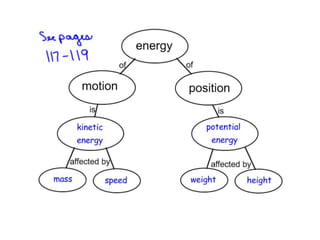
• Energy – ability to do work
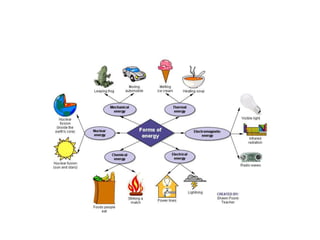
• 9 Types of Energy
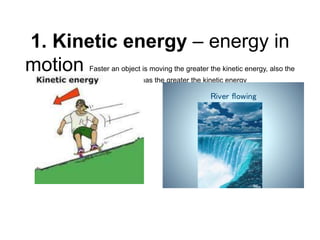
1. Kinetic energy – energy in
motion Faster an object is moving the greater the kinetic energy, also the
more mass an object has the greater the kinetic energy
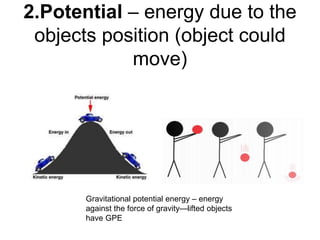
2.Potential – energy due to the
objects position (object could
move)
Gravitational potential energy – energy
against the force of gravity—lifted objects
have GPE
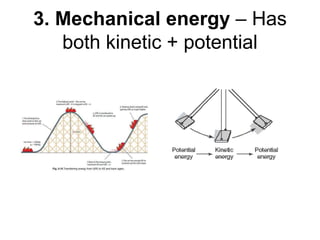
3. Mechanical energy – Has
both kinetic + potential
• 4.Thermal energy – all the kinetic energy
due to motion of particles that make up the
object (faster the particles move the
greater the thermal energy)
• 5.Chemical energy – energy of a
compound that changes as its atoms are
rearranged, a form of potential energy
• 6.Electrical energy – energy of moving
electrons, a form of potential energy since
motion only happens when object is connected
to actual output
• 7.Sound energy – vibrating object transmit
energy through matter (S-L-G)
• 8.Light energy – vibration of electrically
charged particles, doesn’t need to be carried
through matter, can travel in a vacuum (area
with no matter-- SPACE)
• 9.Nuclear energy – energy from the change in
the nucleus of an atom
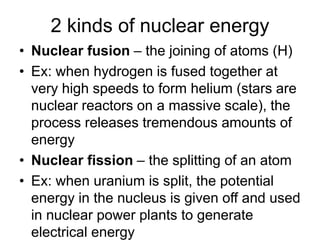
2 kinds of nuclear energy
• Nuclear fusion – the joining of atoms (H)
• Ex: when hydrogen is fused together at
very high speeds to form helium (stars are
nuclear reactors on a massive scale), the
process releases tremendous amounts of
energy
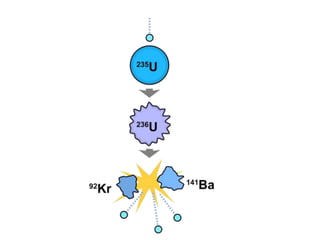
• Nuclear fission – the splitting of an atom
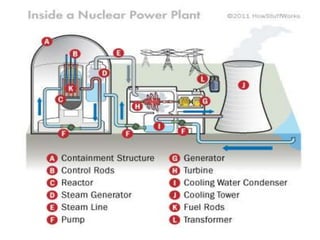
• Ex: when uranium is split, the potential
energy in the nucleus is given off and used
in nuclear power plants to generate
electrical energy
• Electrical Energy– can be changed into
thermal, sound, light and kinetic energy
(most common energy used)
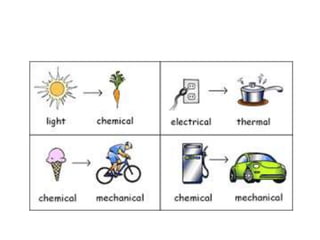
• Energy conversions allow us to maintain
our daily lives through machines
• Energy conversions always create a
certain amount of thermal energy for the
transition to take place
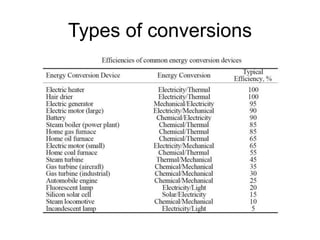
Types of conversions
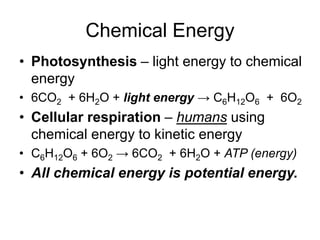
Chemical Energy
• Photosynthesis – light energy to chemical
energy
• 6CO2 + 6H2O + light energy → C6H12O6 + 6O2
• Cellular respiration – humans using
chemical energy to kinetic energy
• C6H12O6 + 6O2 → 6CO2 + 6H2O + ATP (energy)
• All chemical energy is potential energy.
Energy

Energy

  • 1.
    Energy • Law ofconservation of energy – energy cannot be created or destroyed but can be changed from one form to another • Energy efficiency – the amount of useful energy after a conversion – the more efficient the more energy that can be used • Ex: shape of car, shape of plane, houses, windows
  • 2.
    • Energy conversion– when a form of energy is changed to another form of energy • Energy – ability to do work • 9 Types of Energy
  • 3.
    1. Kinetic energy– energy in motion Faster an object is moving the greater the kinetic energy, also the more mass an object has the greater the kinetic energy
  • 4.
    2.Potential – energydue to the objects position (object could move) Gravitational potential energy – energy against the force of gravity—lifted objects have GPE
  • 6.
    3. Mechanical energy– Has both kinetic + potential
  • 7.
    • 4.Thermal energy– all the kinetic energy due to motion of particles that make up the object (faster the particles move the greater the thermal energy) • 5.Chemical energy – energy of a compound that changes as its atoms are rearranged, a form of potential energy
  • 8.
    • 6.Electrical energy– energy of moving electrons, a form of potential energy since motion only happens when object is connected to actual output • 7.Sound energy – vibrating object transmit energy through matter (S-L-G) • 8.Light energy – vibration of electrically charged particles, doesn’t need to be carried through matter, can travel in a vacuum (area with no matter-- SPACE) • 9.Nuclear energy – energy from the change in the nucleus of an atom
  • 9.
    2 kinds ofnuclear energy • Nuclear fusion – the joining of atoms (H) • Ex: when hydrogen is fused together at very high speeds to form helium (stars are nuclear reactors on a massive scale), the process releases tremendous amounts of energy • Nuclear fission – the splitting of an atom • Ex: when uranium is split, the potential energy in the nucleus is given off and used in nuclear power plants to generate electrical energy
  • 12.
    • Electrical Energy–can be changed into thermal, sound, light and kinetic energy (most common energy used) • Energy conversions allow us to maintain our daily lives through machines • Energy conversions always create a certain amount of thermal energy for the transition to take place
  • 14.
  • 15.
    Chemical Energy • Photosynthesis– light energy to chemical energy • 6CO2 + 6H2O + light energy → C6H12O6 + 6O2 • Cellular respiration – humans using chemical energy to kinetic energy • C6H12O6 + 6O2 → 6CO2 + 6H2O + ATP (energy) • All chemical energy is potential energy.