DATA SHEET
Symantec Endpoint Detection
and Response
Rapid threat discovery and remediation
Enterprises are increasingly under threat from sophisticated
attacks. In fact, research has found that threats dwell in
a customer’s environment an average of 190 days.1
These
Advanced Persistent Threats use stealthy techniques to evade
detection and bypass traditional security defenses. Once an
advanced attack gains access to a customer environment
the attacker has many tools to evade detection and begin
to exploit valuable resources and data. Security teams face
multiple challenges when attempting to detect and fully expose
the extent of an advanced attack including manual searches
through large and disparate data sources, lack of visibility into
critical control points, alert fatigue from false positives, and
difficulty identifying and fixing impacted endpoints.
Symantec EDR Solution
Symantec EDR exposes advanced attacks with precision
machine learning and global threat intelligence minimizing
false positives and helps ensure high levels of productivity
for security teams. Symantec EDR capabilities allow incident
responders to quickly search, identify and contain all impacted
endpoints while investigating threats using a choice of on-
premises and cloud-based sandboxing. Also, Symantec EDR
enhances investigator productivity with automated investigation
playbooks and user behavior analytics that brings the skills and
best practices of the most experienced security analysts to any
organization, resulting in significantly lower costs.
At-a-glance
Detect and Expose – Reduce time to breach discovery and
quickly expose scope
• 
Apply Machine Learning and Behavioral Analytics to expose
suspicious activity, detect and prioritize incidents
• 
Automatically identify and create incidents for suspicious
scripts and memory exploits
• 
Expose memory-based attacks with analysis of process memory
Investigate and Contain – Increase incident responder
productivity and ensure threat containment
• 
Ensure complete incident playback with continuous recording
of endpoint activity, view specific endpoint processes
• 
Hunt for threats by searching for indicators of compromise
across all endpoints in real-time
• 
Contain potentially compromised endpoints during investigation
with endpoint quarantine
Resolve – Rapidly fix endpoints and ensure the threat
does not return
• 
Delete malicious files and associated artifacts on all
impacted endpoints
• 
Blacklist and whitelist files at the endpoint
• 
Enhanced reporting allows any table to be exported for
incident resolution reports
Integrate and Automate – Unify investigator views,
orchestrate data and work flows
• Easily integrate incident data and actions into existing
SOC infrastructure including Splunk and ServiceNow
• Replicate the best practices and analysis of skilled
investigators with automated incident playbook rules
• 
Gain in-depth visibility into endpoint activity with
automated artifact collection
1
“Cost of a Data Breach Report, Ponemon 2018” https://www-01.ibm.com/common/ssi/cgi-bin/ssialias?htmlfid=55017055USEN
02
DATA SHEET  |  CLOUDSOC™ GATEWAY
In addition, continuous and on-demand recording of system
activity supports full endpoint visibility. Symantec EDR utilizes
advanced attack detections at the endpoint and cloud-based
analytics to detect targeted attacks such as breach detection,
command and control beaconing, lateral movement and
suspicious power shell executions.
Increase Visibility and
Productivity
Symantec EDR increases investigator productivity by prioritizing
incidents by risk. And Symantec EDR automatically generates
incidents for targeted attacks identified through Symantec’s
Target Attack Analytics and Dynamic Adversary Intelligence.
Investigators can take advantage of Endpoint Activity Recording
to hunt for Indicators of Attack and perform endpoint analysis.
Symantec EDR supports continuous and on-demand retrieval
for a wide range of events including session, process, module
load point modifications, file and folder operations and registry
changes. In addition, critical network events are recorded for
multiple protocols (customers can configure which supported
protocols they prefer to record). Network events recorded
include session start and end time, first URL associated with
session, IP Protocol, source and destination IP port and more.
According to Symantec Internet Safety and Threat Report
(ISTR), more than 20% of the malware is VM-aware which
means they evade detection in a traditional sandbox. Symantec
EDR includes sandboxing that can detect such VM-aware
threats by employing advanced techniques that include
mimicking human behavior and if necessary, using physical
servers for detonation. Symantec EDR supports the automatic
submission of suspicious files to the sandbox for analysis.
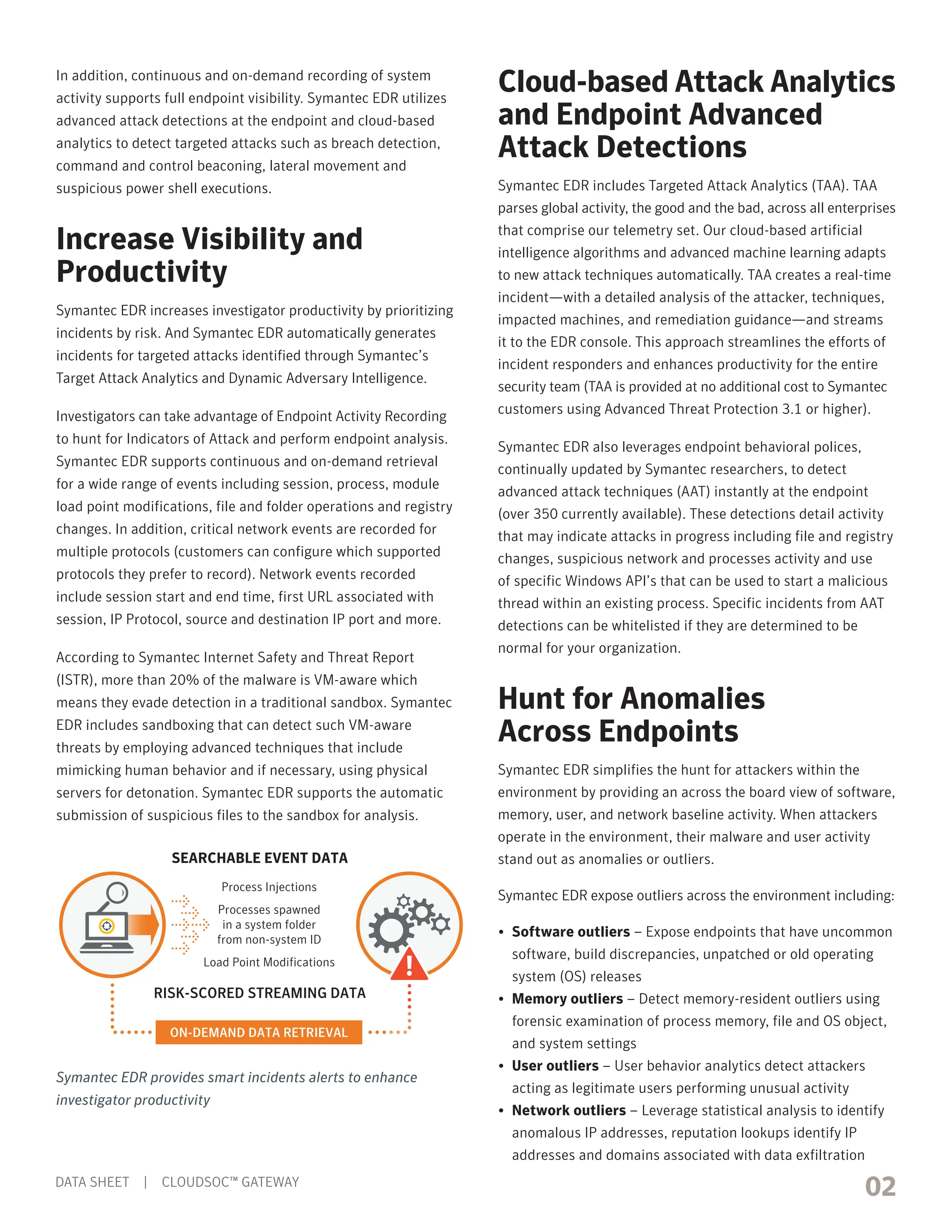
RISK-SCORED STREAMING DATA
SEARCHABLE EVENT DATA
ON-DEMAND DATA RETRIEVAL
Process Injections
Processes spawned
in a system folder
from non-system ID
Load Point Modifications
Symantec EDR provides smart incidents alerts to enhance
investigator productivity
Cloud-based Attack Analytics
and Endpoint Advanced
Attack Detections
Symantec EDR includes Targeted Attack Analytics (TAA). TAA
parses global activity, the good and the bad, across all enterprises
that comprise our telemetry set. Our cloud-based artificial
intelligence algorithms and advanced machine learning adapts
to new attack techniques automatically. TAA creates a real-time
incident—with a detailed analysis of the attacker, techniques,
impacted machines, and remediation guidance—and streams
it to the EDR console. This approach streamlines the efforts of
incident responders and enhances productivity for the entire
security team (TAA is provided at no additional cost to Symantec
customers using Advanced Threat Protection 3.1 or higher).
Symantec EDR also leverages endpoint behavioral polices,
continually updated by Symantec researchers, to detect
advanced attack techniques (AAT) instantly at the endpoint
(over 350 currently available). These detections detail activity
that may indicate attacks in progress including file and registry
changes, suspicious network and processes activity and use
of specific Windows API’s that can be used to start a malicious
thread within an existing process. Specific incidents from AAT
detections can be whitelisted if they are determined to be
normal for your organization.
Hunt for Anomalies
Across Endpoints
Symantec EDR simplifies the hunt for attackers within the
environment by providing an across the board view of software,
memory, user, and network baseline activity. When attackers
operate in the environment, their malware and user activity
stand out as anomalies or outliers.
Symantec EDR expose outliers across the environment including:
• 
Software outliers – Expose endpoints that have uncommon
software, build discrepancies, unpatched or old operating
system (OS) releases
• 
Memory outliers – Detect memory-resident outliers using
forensic examination of process memory, file and OS object,
and system settings
• 
User outliers – User behavior analytics detect attackers
acting as legitimate users performing unusual activity
• 
Network outliers – Leverage statistical analysis to identify
anomalous IP addresses, reputation lookups identify IP
addresses and domains associated with data exfiltration
03
DATA SHEET  |  CLOUDSOC™ GATEWAY
These outlier detections are provided via cloud-based service
and are available using built-in and custom playbooks that
produce specific reports on wide variety of anomalous activity.
MITRE ATTCK Event
Enrichment and Cyber
Analytics
Symantec EDR provides tools to detect and visualize the attack
lifecycle based on the MITRE ATTCK framework. The EDR
tool describes attack methods based on the standard tactics
and techniques in the ATTCK matrix. In addition, quick filters
make it easy for investigators to narrow results to one or more
phases of the MITRE ATTCK lifecycle including initial access,
persistence, lateral movement and command and control.
Critically, Symantec EDR supports MITRE Cyber Analytics
through automated investigation playbooks. MITRE
recommends organizations implement a zero-trust approach to
forensic collection and investigation by interrogating autorun
differences, suspicious run locations, potential DDL injections
and SMB event monitoring. Symantec EDR makes it easy to
run scheduled sweeps across endpoints to determine if any
attacks can be detected using common knowledge of the MITRE
community of adversary models.
Complete and Rapid
Endpoint Repair
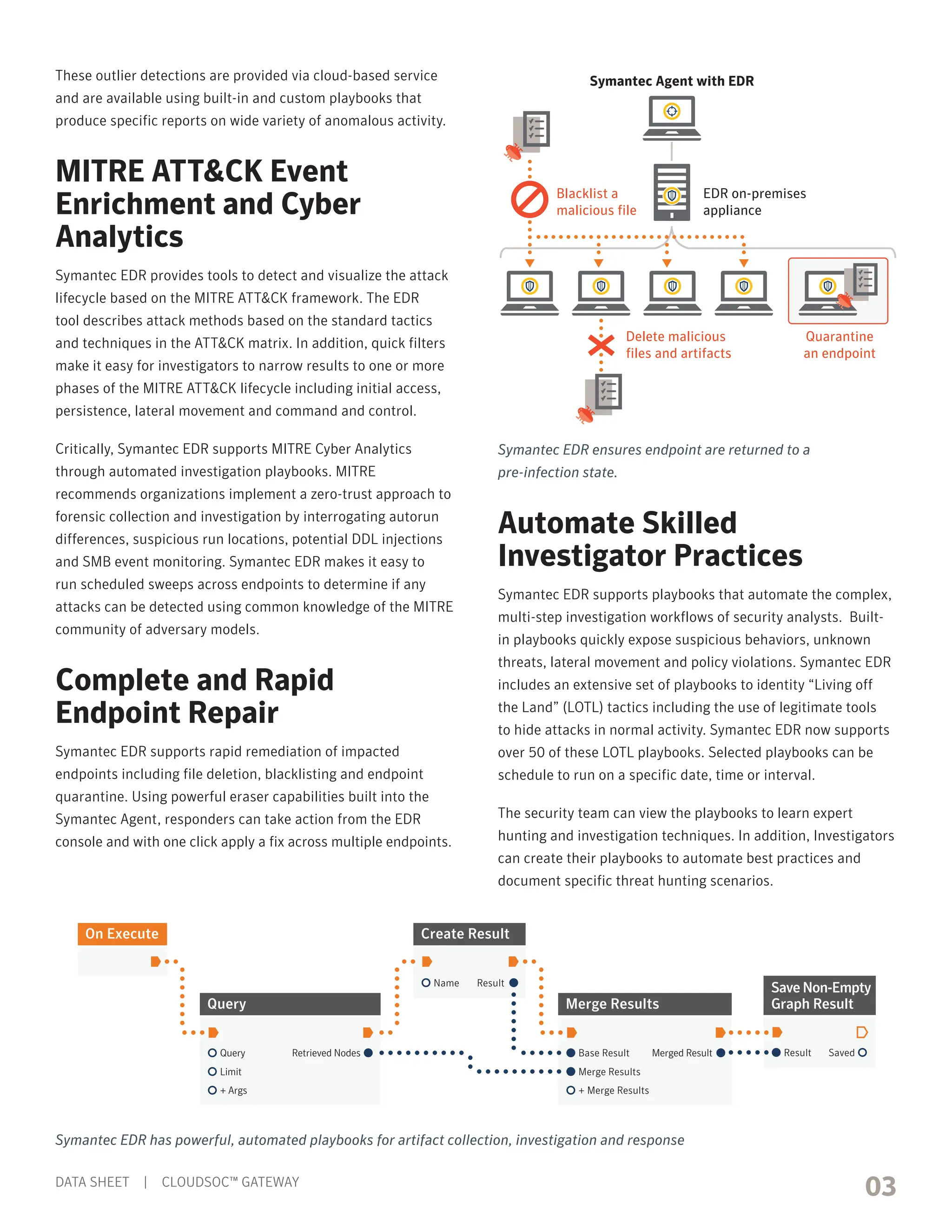
Symantec EDR supports rapid remediation of impacted
endpoints including file deletion, blacklisting and endpoint
quarantine. Using powerful eraser capabilities built into the
Symantec Agent, responders can take action from the EDR
console and with one click apply a fix across multiple endpoints.
Delete malicious
files and artifacts
Blacklist a
malicious file
EDR on-premises
appliance
Quarantine
an endpoint
Symantec Agent with EDR
Symantec EDR ensures endpoint are returned to a
pre-infection state.
Automate Skilled
Investigator Practices
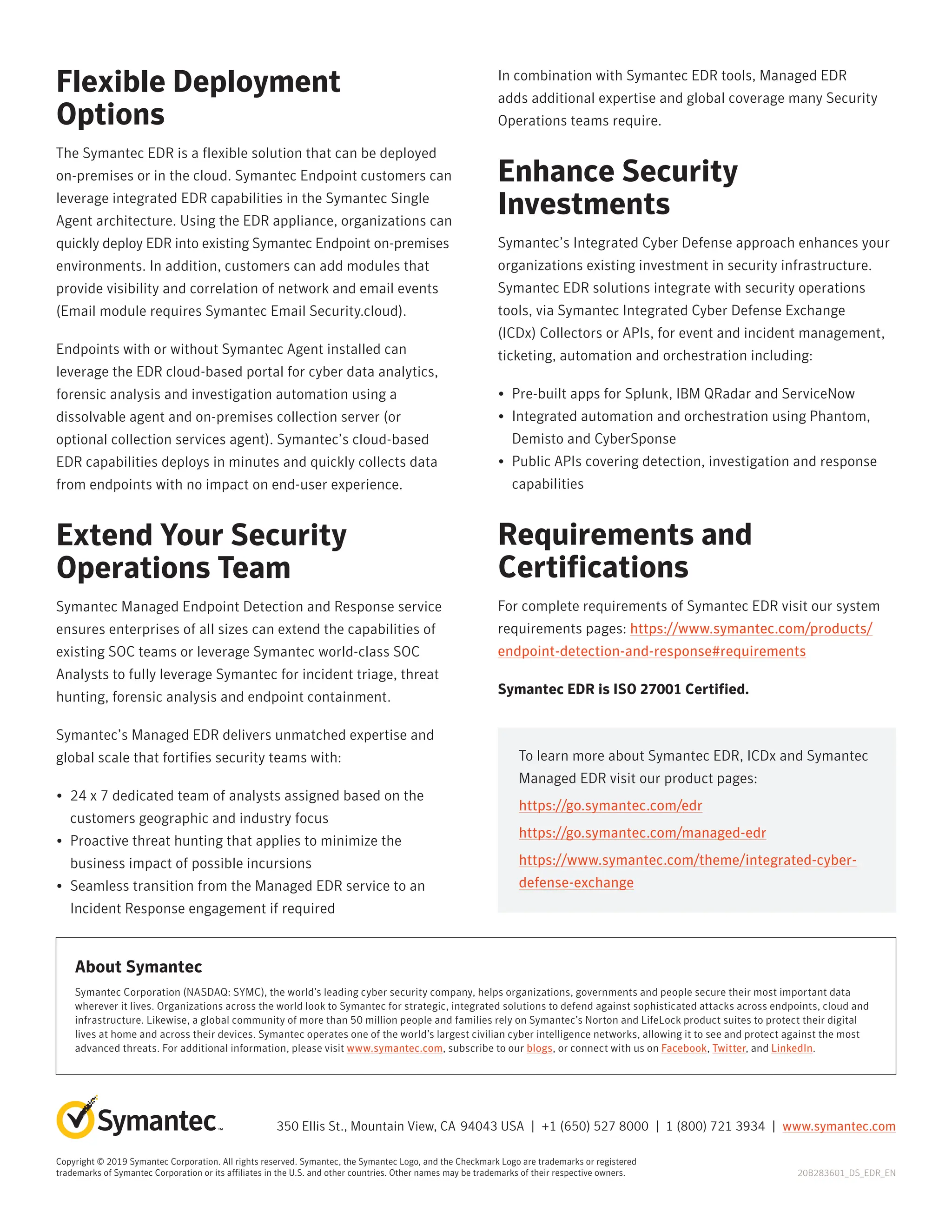
Symantec EDR supports playbooks that automate the complex,
multi-step investigation workflows of security analysts. Built-
in playbooks quickly expose suspicious behaviors, unknown
threats, lateral movement and policy violations. Symantec EDR
includes an extensive set of playbooks to identity “Living off
the Land” (LOTL) tactics including the use of legitimate tools
to hide attacks in normal activity. Symantec EDR now supports
over 50 of these LOTL playbooks. Selected playbooks can be
schedule to run on a specific date, time or interval.
The security team can view the playbooks to learn expert
hunting and investigation techniques. In addition, Investigators
can create their playbooks to automate best practices and
document specific threat hunting scenarios.
Symantec EDR has powerful, automated playbooks for artifact collection, investigation and response
Query
Query Retrieved Nodes
Limit
+ Args
Merge Results
Base Result Merged Result
Merge Results
+ Merge Results
Create Result
Name Result
Save Non-Empty
Graph Result
Result Saved
On Execute
Flexible Deployment
Options
The Symantec EDR is a flexible solution that can be deployed
on-premises or in the cloud. Symantec Endpoint customers can
leverage integrated EDR capabilities in the Symantec Single
Agent architecture. Using the EDR appliance, organizations can
quickly deploy EDR into existing Symantec Endpoint on-premises
environments. In addition, customers can add modules that
provide visibility and correlation of network and email events
(Email module requires Symantec Email Security.cloud).
Endpoints with or without Symantec Agent installed can
leverage the EDR cloud-based portal for cyber data analytics,
forensic analysis and investigation automation using a
dissolvable agent and on-premises collection server (or
optional collection services agent). Symantec’s cloud-based
EDR capabilities deploys in minutes and quickly collects data
from endpoints with no impact on end-user experience.
Extend Your Security
Operations Team
Symantec Managed Endpoint Detection and Response service
ensures enterprises of all sizes can extend the capabilities of
existing SOC teams or leverage Symantec world-class SOC
Analysts to fully leverage Symantec for incident triage, threat
hunting, forensic analysis and endpoint containment.
Symantec’s Managed EDR delivers unmatched expertise and
global scale that fortifies security teams with:
• 
24 x 7 dedicated team of analysts assigned based on the
customers geographic and industry focus
• 
Proactive threat hunting that applies to minimize the
business impact of possible incursions
• 
Seamless transition from the Managed EDR service to an
Incident Response engagement if required
In combination with Symantec EDR tools, Managed EDR
adds additional expertise and global coverage many Security
Operations teams require.
Enhance Security
Investments
Symantec’s Integrated Cyber Defense approach enhances your
organizations existing investment in security infrastructure.
Symantec EDR solutions integrate with security operations
tools, via Symantec Integrated Cyber Defense Exchange
(ICDx) Collectors or APIs, for event and incident management,
ticketing, automation and orchestration including:
• 
Pre-built apps for Splunk, IBM QRadar and ServiceNow
• 
Integrated automation and orchestration using Phantom,
Demisto and CyberSponse
• 
Public APIs covering detection, investigation and response
capabilities
Requirements and
Certifications
For complete requirements of Symantec EDR visit our system
requirements pages: https://www.symantec.com/products/
endpoint-detection-and-response#requirements
Symantec EDR is ISO 27001 Certified.
Copyright © 2019 Symantec Corporation. All rights reserved. Symantec, the Symantec Logo, and the Checkmark Logo are trademarks or registered
trademarks of Symantec Corporation or its affiliates in the U.S. and other countries. Other names may be trademarks of their respective owners.
350 Ellis St., Mountain View, CA 94043 USA | +1 (650) 527 8000 | 1 (800) 721 3934 | www.symantec.com
20B283601_DS_EDR_EN
About Symantec
Symantec Corporation (NASDAQ: SYMC), the world’s leading cyber security company, helps organizations, governments and people secure their most important data
wherever it lives. Organizations across the world look to Symantec for strategic, integrated solutions to defend against sophisticated attacks across endpoints, cloud and
infrastructure. Likewise, a global community of more than 50 million people and families rely on Symantec’s Norton and LifeLock product suites to protect their digital
lives at home and across their devices. Symantec operates one of the world’s largest civilian cyber intelligence networks, allowing it to see and protect against the most
advanced threats. For additional information, please visit www.symantec.com, subscribe to our blogs, or connect with us on Facebook, Twitter, and LinkedIn.
To learn more about Symantec EDR, ICDx and Symantec
Managed EDR visit our product pages:
https://go.symantec.com/edr
https://go.symantec.com/managed-edr
https://www.symantec.com/theme/integrated-cyber-
defense-exchange

endpoint-detection-and-response-datasheet.pdf

  • 1.
    DATA SHEET Symantec EndpointDetection and Response Rapid threat discovery and remediation Enterprises are increasingly under threat from sophisticated attacks. In fact, research has found that threats dwell in a customer’s environment an average of 190 days.1 These Advanced Persistent Threats use stealthy techniques to evade detection and bypass traditional security defenses. Once an advanced attack gains access to a customer environment the attacker has many tools to evade detection and begin to exploit valuable resources and data. Security teams face multiple challenges when attempting to detect and fully expose the extent of an advanced attack including manual searches through large and disparate data sources, lack of visibility into critical control points, alert fatigue from false positives, and difficulty identifying and fixing impacted endpoints. Symantec EDR Solution Symantec EDR exposes advanced attacks with precision machine learning and global threat intelligence minimizing false positives and helps ensure high levels of productivity for security teams. Symantec EDR capabilities allow incident responders to quickly search, identify and contain all impacted endpoints while investigating threats using a choice of on- premises and cloud-based sandboxing. Also, Symantec EDR enhances investigator productivity with automated investigation playbooks and user behavior analytics that brings the skills and best practices of the most experienced security analysts to any organization, resulting in significantly lower costs. At-a-glance Detect and Expose – Reduce time to breach discovery and quickly expose scope •  Apply Machine Learning and Behavioral Analytics to expose suspicious activity, detect and prioritize incidents •  Automatically identify and create incidents for suspicious scripts and memory exploits •  Expose memory-based attacks with analysis of process memory Investigate and Contain – Increase incident responder productivity and ensure threat containment •  Ensure complete incident playback with continuous recording of endpoint activity, view specific endpoint processes •  Hunt for threats by searching for indicators of compromise across all endpoints in real-time •  Contain potentially compromised endpoints during investigation with endpoint quarantine Resolve – Rapidly fix endpoints and ensure the threat does not return •  Delete malicious files and associated artifacts on all impacted endpoints •  Blacklist and whitelist files at the endpoint •  Enhanced reporting allows any table to be exported for incident resolution reports Integrate and Automate – Unify investigator views, orchestrate data and work flows • Easily integrate incident data and actions into existing SOC infrastructure including Splunk and ServiceNow • Replicate the best practices and analysis of skilled investigators with automated incident playbook rules •  Gain in-depth visibility into endpoint activity with automated artifact collection 1 “Cost of a Data Breach Report, Ponemon 2018” https://www-01.ibm.com/common/ssi/cgi-bin/ssialias?htmlfid=55017055USEN
  • 2.
    02 DATA SHEET  |  CLOUDSOC™ GATEWAY Inaddition, continuous and on-demand recording of system activity supports full endpoint visibility. Symantec EDR utilizes advanced attack detections at the endpoint and cloud-based analytics to detect targeted attacks such as breach detection, command and control beaconing, lateral movement and suspicious power shell executions. Increase Visibility and Productivity Symantec EDR increases investigator productivity by prioritizing incidents by risk. And Symantec EDR automatically generates incidents for targeted attacks identified through Symantec’s Target Attack Analytics and Dynamic Adversary Intelligence. Investigators can take advantage of Endpoint Activity Recording to hunt for Indicators of Attack and perform endpoint analysis. Symantec EDR supports continuous and on-demand retrieval for a wide range of events including session, process, module load point modifications, file and folder operations and registry changes. In addition, critical network events are recorded for multiple protocols (customers can configure which supported protocols they prefer to record). Network events recorded include session start and end time, first URL associated with session, IP Protocol, source and destination IP port and more. According to Symantec Internet Safety and Threat Report (ISTR), more than 20% of the malware is VM-aware which means they evade detection in a traditional sandbox. Symantec EDR includes sandboxing that can detect such VM-aware threats by employing advanced techniques that include mimicking human behavior and if necessary, using physical servers for detonation. Symantec EDR supports the automatic submission of suspicious files to the sandbox for analysis. RISK-SCORED STREAMING DATA SEARCHABLE EVENT DATA ON-DEMAND DATA RETRIEVAL Process Injections Processes spawned in a system folder from non-system ID Load Point Modifications Symantec EDR provides smart incidents alerts to enhance investigator productivity Cloud-based Attack Analytics and Endpoint Advanced Attack Detections Symantec EDR includes Targeted Attack Analytics (TAA). TAA parses global activity, the good and the bad, across all enterprises that comprise our telemetry set. Our cloud-based artificial intelligence algorithms and advanced machine learning adapts to new attack techniques automatically. TAA creates a real-time incident—with a detailed analysis of the attacker, techniques, impacted machines, and remediation guidance—and streams it to the EDR console. This approach streamlines the efforts of incident responders and enhances productivity for the entire security team (TAA is provided at no additional cost to Symantec customers using Advanced Threat Protection 3.1 or higher). Symantec EDR also leverages endpoint behavioral polices, continually updated by Symantec researchers, to detect advanced attack techniques (AAT) instantly at the endpoint (over 350 currently available). These detections detail activity that may indicate attacks in progress including file and registry changes, suspicious network and processes activity and use of specific Windows API’s that can be used to start a malicious thread within an existing process. Specific incidents from AAT detections can be whitelisted if they are determined to be normal for your organization. Hunt for Anomalies Across Endpoints Symantec EDR simplifies the hunt for attackers within the environment by providing an across the board view of software, memory, user, and network baseline activity. When attackers operate in the environment, their malware and user activity stand out as anomalies or outliers. Symantec EDR expose outliers across the environment including: •  Software outliers – Expose endpoints that have uncommon software, build discrepancies, unpatched or old operating system (OS) releases •  Memory outliers – Detect memory-resident outliers using forensic examination of process memory, file and OS object, and system settings •  User outliers – User behavior analytics detect attackers acting as legitimate users performing unusual activity •  Network outliers – Leverage statistical analysis to identify anomalous IP addresses, reputation lookups identify IP addresses and domains associated with data exfiltration
  • 3.
    03 DATA SHEET  |  CLOUDSOC™ GATEWAY Theseoutlier detections are provided via cloud-based service and are available using built-in and custom playbooks that produce specific reports on wide variety of anomalous activity. MITRE ATTCK Event Enrichment and Cyber Analytics Symantec EDR provides tools to detect and visualize the attack lifecycle based on the MITRE ATTCK framework. The EDR tool describes attack methods based on the standard tactics and techniques in the ATTCK matrix. In addition, quick filters make it easy for investigators to narrow results to one or more phases of the MITRE ATTCK lifecycle including initial access, persistence, lateral movement and command and control. Critically, Symantec EDR supports MITRE Cyber Analytics through automated investigation playbooks. MITRE recommends organizations implement a zero-trust approach to forensic collection and investigation by interrogating autorun differences, suspicious run locations, potential DDL injections and SMB event monitoring. Symantec EDR makes it easy to run scheduled sweeps across endpoints to determine if any attacks can be detected using common knowledge of the MITRE community of adversary models. Complete and Rapid Endpoint Repair Symantec EDR supports rapid remediation of impacted endpoints including file deletion, blacklisting and endpoint quarantine. Using powerful eraser capabilities built into the Symantec Agent, responders can take action from the EDR console and with one click apply a fix across multiple endpoints. Delete malicious files and artifacts Blacklist a malicious file EDR on-premises appliance Quarantine an endpoint Symantec Agent with EDR Symantec EDR ensures endpoint are returned to a pre-infection state. Automate Skilled Investigator Practices Symantec EDR supports playbooks that automate the complex, multi-step investigation workflows of security analysts. Built- in playbooks quickly expose suspicious behaviors, unknown threats, lateral movement and policy violations. Symantec EDR includes an extensive set of playbooks to identity “Living off the Land” (LOTL) tactics including the use of legitimate tools to hide attacks in normal activity. Symantec EDR now supports over 50 of these LOTL playbooks. Selected playbooks can be schedule to run on a specific date, time or interval. The security team can view the playbooks to learn expert hunting and investigation techniques. In addition, Investigators can create their playbooks to automate best practices and document specific threat hunting scenarios. Symantec EDR has powerful, automated playbooks for artifact collection, investigation and response Query Query Retrieved Nodes Limit + Args Merge Results Base Result Merged Result Merge Results + Merge Results Create Result Name Result Save Non-Empty Graph Result Result Saved On Execute
  • 4.
    Flexible Deployment Options The SymantecEDR is a flexible solution that can be deployed on-premises or in the cloud. Symantec Endpoint customers can leverage integrated EDR capabilities in the Symantec Single Agent architecture. Using the EDR appliance, organizations can quickly deploy EDR into existing Symantec Endpoint on-premises environments. In addition, customers can add modules that provide visibility and correlation of network and email events (Email module requires Symantec Email Security.cloud). Endpoints with or without Symantec Agent installed can leverage the EDR cloud-based portal for cyber data analytics, forensic analysis and investigation automation using a dissolvable agent and on-premises collection server (or optional collection services agent). Symantec’s cloud-based EDR capabilities deploys in minutes and quickly collects data from endpoints with no impact on end-user experience. Extend Your Security Operations Team Symantec Managed Endpoint Detection and Response service ensures enterprises of all sizes can extend the capabilities of existing SOC teams or leverage Symantec world-class SOC Analysts to fully leverage Symantec for incident triage, threat hunting, forensic analysis and endpoint containment. Symantec’s Managed EDR delivers unmatched expertise and global scale that fortifies security teams with: •  24 x 7 dedicated team of analysts assigned based on the customers geographic and industry focus •  Proactive threat hunting that applies to minimize the business impact of possible incursions •  Seamless transition from the Managed EDR service to an Incident Response engagement if required In combination with Symantec EDR tools, Managed EDR adds additional expertise and global coverage many Security Operations teams require. Enhance Security Investments Symantec’s Integrated Cyber Defense approach enhances your organizations existing investment in security infrastructure. Symantec EDR solutions integrate with security operations tools, via Symantec Integrated Cyber Defense Exchange (ICDx) Collectors or APIs, for event and incident management, ticketing, automation and orchestration including: •  Pre-built apps for Splunk, IBM QRadar and ServiceNow •  Integrated automation and orchestration using Phantom, Demisto and CyberSponse •  Public APIs covering detection, investigation and response capabilities Requirements and Certifications For complete requirements of Symantec EDR visit our system requirements pages: https://www.symantec.com/products/ endpoint-detection-and-response#requirements Symantec EDR is ISO 27001 Certified. Copyright © 2019 Symantec Corporation. All rights reserved. Symantec, the Symantec Logo, and the Checkmark Logo are trademarks or registered trademarks of Symantec Corporation or its affiliates in the U.S. and other countries. Other names may be trademarks of their respective owners. 350 Ellis St., Mountain View, CA 94043 USA | +1 (650) 527 8000 | 1 (800) 721 3934 | www.symantec.com 20B283601_DS_EDR_EN About Symantec Symantec Corporation (NASDAQ: SYMC), the world’s leading cyber security company, helps organizations, governments and people secure their most important data wherever it lives. Organizations across the world look to Symantec for strategic, integrated solutions to defend against sophisticated attacks across endpoints, cloud and infrastructure. Likewise, a global community of more than 50 million people and families rely on Symantec’s Norton and LifeLock product suites to protect their digital lives at home and across their devices. Symantec operates one of the world’s largest civilian cyber intelligence networks, allowing it to see and protect against the most advanced threats. For additional information, please visit www.symantec.com, subscribe to our blogs, or connect with us on Facebook, Twitter, and LinkedIn. To learn more about Symantec EDR, ICDx and Symantec Managed EDR visit our product pages: https://go.symantec.com/edr https://go.symantec.com/managed-edr https://www.symantec.com/theme/integrated-cyber- defense-exchange