I-Endocrine System
Dr. Iman Nabil
Pituitary gland
Anterior Lobe
Adenohypophysis
(glandular part)
Posterior lobe
Neurohypophysis
(nervous part)
Stain Dark Pale
Consist of Irregular branching
cords of polygonal
cells surrounded by
sinusoids.
Mainly unmylinated
nerve fibers.
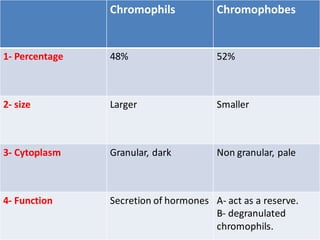
Chromophils Chromophobes
1- Percentage 48% 52%
2- size Larger Smaller
3- Cytoplasm Granular, dark Non granular, pale
4- Function Secretion of hormones A- act as a reserve.
B- degranulated
chromophils.
Chromophils
Acidophils Basophils
Number 37% 11%
Nature Protein Glycoprotein
PAS stain PAS -ve PAS +ve
Size Smaller Larger
Granules Larger Smaller
Secretion ⚫Somatotrophs
(growth h.)
⚫Mammotrophs
(prolactin)
⚫Thyrotrophs (TSH)
⚫Gonadotrophs
. (FSH& LH)
⚫Corticotrophs (ACTH)
Thyroid gland
How does the follicular cell adapt
to its function?
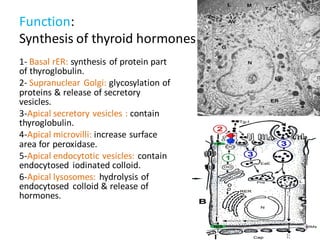
Function:
Synthesis of thyroid hormones
1- Basal rER: synthesis of protein part
of thyroglobulin.
2- Supranuclear Golgi: glycosylation of
proteins & release of secretory
vesicles.
3-Apical secretory vesicles : contain
thyroglobulin.
4-Apical microvilli: increase surface
area for peroxidase.
5-Apical endocytotic vesicles: contain
endocytosed iodinated colloid.
6-Apical lysosomes: hydrolysis of
endocytosed colloid & release of
hormones.
How does the parafollicular cell adapt
to its function?
Function: secretes calcitonin
EM (DNES):
• Moderate amount of rER.
• Infranuclear Golgi.
• Basal secretory granules
towards the blood capillaries.
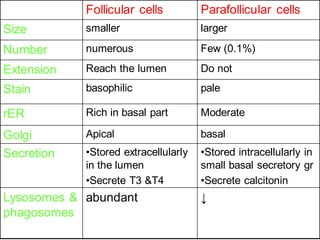
Follicular cells Parafollicular cells
Size smaller larger
Number numerous Few (0.1%)
Extension Reach the lumen Do not
Stain basophilic pale
rER Rich in basal part Moderate
Golgi Apical basal
Secretion •Stored extracellularly
in the lumen
•Secrete T3 &T4
•Stored intracellularly in
small basal secretory gr
•Secrete calcitonin
Lysosomes &
phagosomes
abundant ↓
Parathyroid gland
How does the chief cell adapt to its
function?
Function:
Secretes parathyroid
hormone.
EM: (DNES)
1- Moderate organelles
(WHY).
2-Secretory granules.
3- Euchromatic nucleus.
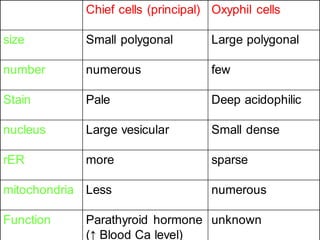
Chief cells (principal) Oxyphil cells
size Small polygonal Large polygonal
number numerous few
Stain Pale Deep acidophilic
nucleus Large vesicular Small dense
rER more sparse
mitochondria Less numerous
Function Parathyroid hormone
(↑ Blood Ca level)
unknown
Suprarenal gland
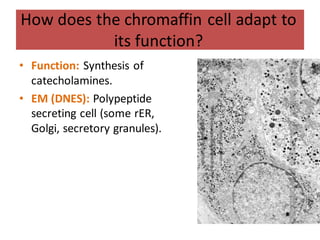
How does the chromaffin cell adapt to
its function?
• Function: Synthesis of
catecholamines.
• EM (DNES): Polypeptide
secreting cell (some rER,
Golgi, secretory granules).
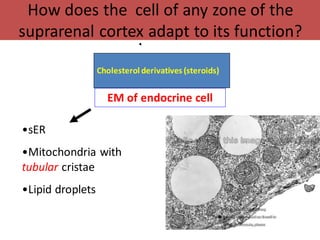
How does the cell of any zone of the
suprarenal cortex adapt to its function?
Cholesterol derivatives (steroids)
•sER
•Mitochondria with
tubular cristae
•Lipid droplets
EM of endocrine cell
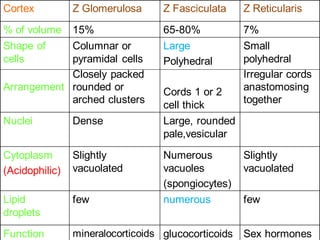
Cortex Z Glomerulosa Z Fasciculata Z Reticularis
% of volume 15% 65-80% 7%
Shape of
cells
Arrangement
Columnar or
pyramidal cells
Closely packed
rounded or
arched clusters
Large
Polyhedral
Cords 1 or 2
cell thick
Small
polyhedral
Irregular cords
anastomosing
together
Nuclei Dense Large, rounded
pale,vesicular
Cytoplasm
(Acidophilic)
Slightly
vacuolated
Numerous
vacuoles
(spongiocytes)
Slightly
vacuolated
Lipid
droplets
few numerous few
Function mineralocorticoids glucocorticoids Sex hormones
Pancreas
DeltaBetaAlpha
5-10%70%20%Number
PeripheryCentralPeripherySite
SmallSmallLargeSize
rectangular crystalline
core surroundedby
an electro-lucent
halo.
larger granules with
homogenous dense
core.
Granules: EM
SomatostatinInsulin , C peptide &
GABA
GlucagonFunction
Male genital system
1-
Spermatogonium
2- Primary
spermatocyte
3- Secondary
spermatocyte
4- Spermatid
1- Shape Sexual
maturation:
small,rounded,1-
2 layers, resting
on basal lamina.
2 types : A & B.
Largest
spermatogenic
cells.
2- 3 layers.
Frequently seen
in section
Smaller.
Rarely seen in
section
Early:
small,rounded.
Late: elongated
with dark nucleus
2- nucleus contain46 S
chromosomes.
large,pale,
contains46-d
chromosomes.
Contains23 d
chromosomes.
central, rounded
contains23 S
chromosomes.
3- Division Type A:enter
mitosis at
puberty to give
type A & type B.
Type B: enter
mitosis to give
primary
spermatocytes
Enter first
meiotic division
to give secondary
spermatocytes
Enter second
meiotic division
to give
spermatids.
Don’t divide,but
undergoes
morphological
changes
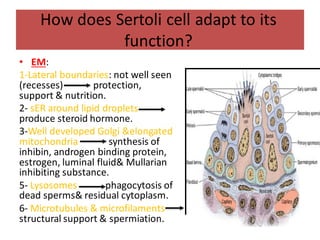
How does Sertoli cell adapt to its
function?
• EM:
1-Lateral boundaries: not well seen
(recesses) protection,
support & nutrition.
2- sER around lipid droplets
produce steroid hormone.
3-Well developed Golgi &elongated
mitochondria synthesis of
inhibin, androgen binding protein,
estrogen, luminal fluid& Mullarian
inhibiting substance.
5- Lysosomes phagocytosis of
dead sperms& residual cytoplasm.
6- Microtubules & microfilaments
structural support & spermiation.
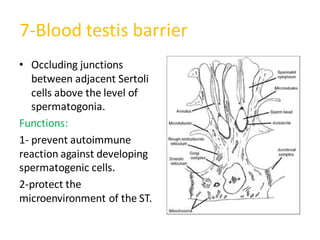
7-Blood testis barrier
• Occluding junctions
between adjacent Sertoli
cells above the level of
spermatogonia.
Functions:
1- prevent autoimmune
reaction against developing
spermatogenic cells.
2-protect the
microenvironment of the ST.
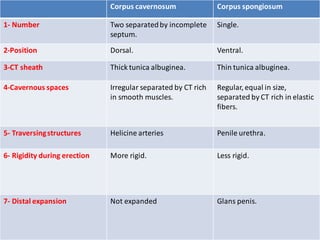
Corpus cavernosum Corpus spongiosum
1- Number Two separatedby incomplete
septum.
Single.
2-Position Dorsal. Ventral.
3-CT sheath Thick tunica albuginea. Thin tunica albuginea.
4-Cavernous spaces Irregular separated by CT rich
in smooth muscles.
Regular, equal in size,
separated by CT rich in elastic
fibers.
5- Traversingstructures Helicine arteries Penile urethra.
6- Rigidity during erection More rigid. Less rigid.
7- Distal expansion Not expanded Glans penis.
Endocrine genitourinary block   copy

Endocrine genitourinary block copy

  • 1.
  • 2.
  • 3.
    Anterior Lobe Adenohypophysis (glandular part) Posteriorlobe Neurohypophysis (nervous part) Stain Dark Pale Consist of Irregular branching cords of polygonal cells surrounded by sinusoids. Mainly unmylinated nerve fibers.
  • 4.
    Chromophils Chromophobes 1- Percentage48% 52% 2- size Larger Smaller 3- Cytoplasm Granular, dark Non granular, pale 4- Function Secretion of hormones A- act as a reserve. B- degranulated chromophils.
  • 5.
    Chromophils Acidophils Basophils Number 37%11% Nature Protein Glycoprotein PAS stain PAS -ve PAS +ve Size Smaller Larger Granules Larger Smaller Secretion ⚫Somatotrophs (growth h.) ⚫Mammotrophs (prolactin) ⚫Thyrotrophs (TSH) ⚫Gonadotrophs . (FSH& LH) ⚫Corticotrophs (ACTH)
  • 6.
  • 7.
    How does thefollicular cell adapt to its function?
  • 8.
    Function: Synthesis of thyroidhormones 1- Basal rER: synthesis of protein part of thyroglobulin. 2- Supranuclear Golgi: glycosylation of proteins & release of secretory vesicles. 3-Apical secretory vesicles : contain thyroglobulin. 4-Apical microvilli: increase surface area for peroxidase. 5-Apical endocytotic vesicles: contain endocytosed iodinated colloid. 6-Apical lysosomes: hydrolysis of endocytosed colloid & release of hormones.
  • 9.
    How does theparafollicular cell adapt to its function? Function: secretes calcitonin EM (DNES): • Moderate amount of rER. • Infranuclear Golgi. • Basal secretory granules towards the blood capillaries.
  • 10.
    Follicular cells Parafollicularcells Size smaller larger Number numerous Few (0.1%) Extension Reach the lumen Do not Stain basophilic pale rER Rich in basal part Moderate Golgi Apical basal Secretion •Stored extracellularly in the lumen •Secrete T3 &T4 •Stored intracellularly in small basal secretory gr •Secrete calcitonin Lysosomes & phagosomes abundant ↓
  • 11.
  • 12.
    How does thechief cell adapt to its function? Function: Secretes parathyroid hormone. EM: (DNES) 1- Moderate organelles (WHY). 2-Secretory granules. 3- Euchromatic nucleus.
  • 13.
    Chief cells (principal)Oxyphil cells size Small polygonal Large polygonal number numerous few Stain Pale Deep acidophilic nucleus Large vesicular Small dense rER more sparse mitochondria Less numerous Function Parathyroid hormone (↑ Blood Ca level) unknown
  • 14.
  • 15.
    How does thechromaffin cell adapt to its function? • Function: Synthesis of catecholamines. • EM (DNES): Polypeptide secreting cell (some rER, Golgi, secretory granules).
  • 16.
    How does thecell of any zone of the suprarenal cortex adapt to its function? Cholesterol derivatives (steroids) •sER •Mitochondria with tubular cristae •Lipid droplets EM of endocrine cell
  • 17.
    Cortex Z GlomerulosaZ Fasciculata Z Reticularis % of volume 15% 65-80% 7% Shape of cells Arrangement Columnar or pyramidal cells Closely packed rounded or arched clusters Large Polyhedral Cords 1 or 2 cell thick Small polyhedral Irregular cords anastomosing together Nuclei Dense Large, rounded pale,vesicular Cytoplasm (Acidophilic) Slightly vacuolated Numerous vacuoles (spongiocytes) Slightly vacuolated Lipid droplets few numerous few Function mineralocorticoids glucocorticoids Sex hormones
  • 18.
  • 19.
    DeltaBetaAlpha 5-10%70%20%Number PeripheryCentralPeripherySite SmallSmallLargeSize rectangular crystalline core surroundedby anelectro-lucent halo. larger granules with homogenous dense core. Granules: EM SomatostatinInsulin , C peptide & GABA GlucagonFunction
  • 20.
  • 21.
    1- Spermatogonium 2- Primary spermatocyte 3- Secondary spermatocyte 4-Spermatid 1- Shape Sexual maturation: small,rounded,1- 2 layers, resting on basal lamina. 2 types : A & B. Largest spermatogenic cells. 2- 3 layers. Frequently seen in section Smaller. Rarely seen in section Early: small,rounded. Late: elongated with dark nucleus 2- nucleus contain46 S chromosomes. large,pale, contains46-d chromosomes. Contains23 d chromosomes. central, rounded contains23 S chromosomes. 3- Division Type A:enter mitosis at puberty to give type A & type B. Type B: enter mitosis to give primary spermatocytes Enter first meiotic division to give secondary spermatocytes Enter second meiotic division to give spermatids. Don’t divide,but undergoes morphological changes
  • 22.
    How does Sertolicell adapt to its function? • EM: 1-Lateral boundaries: not well seen (recesses) protection, support & nutrition. 2- sER around lipid droplets produce steroid hormone. 3-Well developed Golgi &elongated mitochondria synthesis of inhibin, androgen binding protein, estrogen, luminal fluid& Mullarian inhibiting substance. 5- Lysosomes phagocytosis of dead sperms& residual cytoplasm. 6- Microtubules & microfilaments structural support & spermiation.
  • 23.
    7-Blood testis barrier •Occluding junctions between adjacent Sertoli cells above the level of spermatogonia. Functions: 1- prevent autoimmune reaction against developing spermatogenic cells. 2-protect the microenvironment of the ST.
  • 24.
    Corpus cavernosum Corpusspongiosum 1- Number Two separatedby incomplete septum. Single. 2-Position Dorsal. Ventral. 3-CT sheath Thick tunica albuginea. Thin tunica albuginea. 4-Cavernous spaces Irregular separated by CT rich in smooth muscles. Regular, equal in size, separated by CT rich in elastic fibers. 5- Traversingstructures Helicine arteries Penile urethra. 6- Rigidity during erection More rigid. Less rigid. 7- Distal expansion Not expanded Glans penis.