WHITEPAPER


             ENABLING INTEROPERABILITY OF
             ENTERPRISE DATA AND APPLICATIONS
             USING THE OPEN SOURCE INGRES
             DATABASE
             MEETING ENTERPRISE IT REQUIREMENTS WITH OPEN SOURCE SOFTWARE
TABLE OF CONTENTS


3     Closing the Interoperability Gap
4       Interoperability Barriers Hinder the Adoption of Open Source
4       Making Open Source Solutions Work Together
5     Taking a Fresh Look at the Ingres Database
5       Managing with Minimal Staff
5       Leveraging Broad Platform Support
6       Supporting Multiple Application Development Frameworks
7       Integrating Business Intelligence
8       Reducing TCO for Enterprise Content Management
8       Creating Cost-Effective ERP Systems on Open Source
8       Simplifying Custom System Development
9     Conclusion
10    References


                                                                       Table of Contents   ::
CLOSING THE INTEROPERABILITY GAP
                               IDC has called open source “the most significant all-encompassing and long-term trend that the
                               software industry has seen since the early 1980s.” Strong annual growth of revenue from stand-
                               alone open source software (OSS) is compelling evidence: Worldwide revenue reached $1.8
                               billion in 2006 and is expected to reach $5.8 billion by 2011 – an impressive compound annual
                               growth rate of more than 26%.1 Despite strong growth, a number of factors prevent pervasive
                               adoption of OSS today. Chief among these are interoperability issues such as centralized identity
                               management, data integration, portability, and compatibility with other products. However, the
                               introduction of the Ingres Database into the open source arena helps close the interoperability
                               gap and provides enterprise-class data management capabilities to the open source community.
The introduction of the
                               Corporate IT executives have long strived to simplify IT management by reducing the num-
Ingres Database into the       ber of vendors they rely on for software, services, and support. Their objective, of course, is to
open source arena helps        reduce the overall cost of IT infrastructure management. While some cost reduction is expected
                               due to volume license terms, far greater returns are expected from the perceived integration of
close the interoperability
                               a single vendor stack. To capitalize on this trend, proprietary software companies have imple-
gap and provides enterprise-   mented extensive merger and acquisition strategies that expand their portfolios. In their attempt
class data management          to establish a single point of accountability, IT managers have bought into these comprehensive
                               software stacks – only to discover the stacks often fail to offer seamless interoperability. In addi-
capabilities to the open
                               tion, business needs continue to drive the acquisition of solutions from more and varied sources
source community.              (including so-called rogue applications that creep into organizations through non-IT channels).
                               Increasingly, these sources include OSS solutions.
                               This paper discusses various aspects of interoperability and how Ingres Corporation is work-
                               ing to extend and improve the interoperability of the Ingres Database to work with other open
                               source offerings as well as proprietary solutions.


                               1
                                   IDC, Worldwide Open Source Software Business Models 2007-2011 Forecast: A Preliminary View, Doc #206681, May 2007.


                                                                                                       Enabling Interoperability with Ingres Open Source   ::   3
Interoperability Barriers Hinder the Adoption of Open Source
The adoption of open source software increased dramatically in 2007. OSS is broadly adopted
in the financial, telecommunications, and public sectors in both the United States and Europe.
However, there are significant obstacles that slow adoption, particularly in the area of interoper-
ability. Nearly one-third of respondents surveyed cited incompatibility with existing applications
and data as a barrier to OSS adoption.2 In addition, there is a strong need to integrate OSS solu-
tions with enterprise management and monitoring frameworks.
Other obstacles to adoption are tied to the lifecycle management of OSS. OSS must provide the
same levels of backward compatibility as proprietary offerings so customers can take advantage
of new technologies without the expense of re-working existing solutions. OSS solutions also
must offer the same level of quality, flexibility, and control as proprietary offerings.


               Open Source Adoption in North America

                                                                        Figure 1:
                                      Don’t                             The Actuate 2007 Open Source Software Survey
                                      know                              (Source: Actuate Corp.)
           Not monitoring


                                               Already using
        Monitoring
        developments


       Currently evaluating

     Planning to adopt >2 years                          In process of adoption
                                                  Planning to adopt within 6 months
      Planning to adopt 1-2 years
                                                 Planning to adopt within 6-12 months


IT teams also demand tools that allow applications to be developed and deployed quickly and
easily using the development languages and environments familiar to developers. This means
that OSS offerings need to support the gamut of development environments, from legacy to Web
2.0 applications.

Making Open Source Solutions Work Together
Open source vendors recognize the need for stronger interoperability and are committed to
working together to improve the way their solutions work together and with other products.
The Open Solutions Alliance (OSA) is a group of leading OSS companies dedicated to making
enterprise-class open software solutions work together. OSA helps customers put open solutions
to work by enabling application integration, certifying quality solutions, and promoting coop-
eration among open solutions developers.

2
    Actuate Corporation. The Actuate 2007 Open Source Survey, June 2007.


                                                                  Enabling Interoperability with Ingres Open Source   ::   4
OSA recognizes that the challenges that impede OSS adoption cannot be readily addressed
                           by any one vendor in isolation. Ingres Corporation is proud to have joined other leading OSS
                           vendors – such as Concursive Corp (formerly Centric CRM), Hyperic, JasperSoft, Openbravo,
                           and SpikeSource – in the Open Solutions Alliance.
                           Ingres is working to improve the interoperability of the Ingres Database with solutions of other
                           alliance members. For more information about OSA, visit http://www.opensolutionsalliance.org.


                           TAKING A FRESH LOOK AT THE INGRES DATABASE
                           The Ingres Database is a commercially supported, open-source relational database management
                           system (RDBMS) that has been supporting mission-critical workloads for over thirty years. By
                           helping to eliminate, simplify, and automate the many tasks that are traditionally associated
                           with maintaining an enterprise-class RDBMS, Ingres Database reduces complexity, time,
                           administration, and costs. For example, the software’s ease of use along with readily accessible,
                           global open source community support minimizes the need for companies to maintain an
Typically, Ingres          arsenal of database administrators (DBAs). In addition to running on a wide variety of popular
                           Linux, UNIX, and Windows platforms, Ingres Database works in varied development and
customers report using     deployment environments for server, desktop, web, and mobile application development.
one-third or less of the   Ingres Database is widely used by public sector and commercial enterprises for managing a
staff they would need      wide variety of applications including business intelligence (BI) systems, enterprise content
                           management (ECM), enterprise resource planning (ERP), and custom applications. Currently,
to manage competitors’
                           the company is dramatically expanding its database solution, and improving interoperability
products.
                           with both proprietary software and OSS offerings.

                           Managing with Minimal Staff
                           The open source Ingres Database is easy to manage. Since many typical DBA operations are self-
                           managed by the Ingres Database, fewer administration resources are required. Administration
                           activities can also be controlled within an application. Typically, Ingres customers report using
                           one-third or less of the staff they would need to manage competitors’ products.

                           Leveraging Broad Platform Support
                           The Ingres Database is designed to meet the data server needs of small- to large-size businesses.
                           It can be deployed on Linux, UNIX, or Windows servers of any size, from one processor to
                           hundreds of processors. Ingres Database is an ideal foundation for building enterprisewide
                           solutions – such as high-performing, 24x7, high-volume transaction processing business
                           solutions or web-based solutions. For many commercial and OSS independent software
                           vendors (ISVs) who are building enterprise solutions, such as business intelligence, content
                           management, e-commerce, enterprise resource planning, logistical management, and supply
                           chain management applications, Ingres Database has become the data server backend of choice.
                           Additionally, Ingres offers connectivity, compatibility, and integration with other enterprise data
                           sources, such as Oracle, Sybase, and Microsoft SQL Server.

                                                                               Enabling Interoperability with Ingres Open Source   ::   5
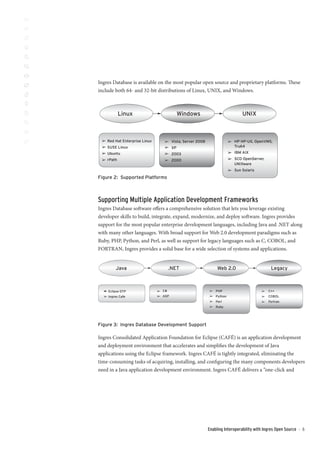
Ingres Database is available on the most popular open source and proprietary platforms. These
include both 64- and 32-bit distributions of Linux, UNIX, and Windows.


            Linux                         Windows                            UNIX


    Red Hat Enterprise Linux         Vista, Server 2008                 HP HP-UX, OpenVMS,
    SUSE Linux                       XP                                 Tru64
    Ubuntu                           2003                               IBM AIX
    rPath                            2000                               SCO OpenServer,
                                                                        UNIXware
                                                                        Sun Solaris
Figure 2: Supported Platforms


Supporting Multiple Application Development Frameworks
Ingres Database software offers a comprehensive solution that lets you leverage existing
developer skills to build, integrate, expand, modernize, and deploy software. Ingres provides
support for the most popular enterprise development languages, including Java and .NET along
with many other languages. With broad support for Web 2.0 development paradigms such as
Ruby, PHP, Python, and Perl, as well as support for legacy languages such as C, COBOL, and
FORTRAN, Ingres provides a solid base for a wide selection of systems and applications.


        Java                        .NET                       Web 2.0                      Legacy


    Eclipse DTP                C#                             PHP                          C++
    Ingres Cafe                ASP                            Python                       COBOL
                                                              Perl                         Fortran
                                                              Ruby


Figure 3: Ingres Database Development Support

Ingres Consolidated Application Foundation for Eclipse (CAFÉ) is an application development
and deployment environment that accelerates and simplifies the development of Java
applications using the Eclipse framework. Ingres CAFÉ is tightly integrated, eliminating the
time-consuming tasks of acquiring, installing, and configuring the many components developers
need in a Java application development environment. Ingres CAFÉ delivers a “one-click and


                                                          Enabling Interoperability with Ingres Open Source   ::   6
code” solution for development, and brings together leading open source products. The Ingres
CAFÉ environment includes:
• Eclipse IDE
• Ingres Database
• Ingres Eclipse Data Tools Plug-in (DTP)
• Apache Tomcat
• Hibernate
• Java Server Faces Libraries

Ingres also facilitates the rapid development of data-centric applications through its
comprehensive Ingres OpenROAD integrated development environment (IDE) support. Ingres
OpenROAD reduces the total cost of ownership (TCO) for software development infrastructure
by allowing application developers to design, prototype, build, and deploy applications on a
broad spectrum of client or server platforms.

Integrating Business Intelligence
As the implementation of BI platforms continues to expand, Ingres is committed to reducing
the cost, complexity, and time needed to implement BI solutions. By tightly integrating Ingres
Database with a number of proprietary and OSS BI suites, BI solutions can be implemented in
less time – and with less expense. The Ingres Icebreaker BI Appliance is a new, innovative BI
solution that is robust, comprehensive, and cost-effective – ideal for organizations seeking to
become more competitive, respond quickly to market demand, and ultimately enrich the bottom
line. Conventional BI implementations can be expensive, often with limited returns. For that
reason, organizations looking for an alternative solution to costly, traditional approaches can use
Ingres Icebreaker BI Appliance to address decision-making challenges.
Powered by JasperSoft, Ingres Icebreaker BI Appliance delivers all of an organization’s BI
needs – from reporting, analysis, and dashboards to complete data integration with existing
systems. It comes with a fully featured BI suite that includes extraction, transformation, and
load (ETL) and online analytical processing (OLAP) functionality, along with report design,
delivery, and security. Ingres Icebreaker BI Appliance eliminates unnecessary implementation
and maintenance costs and gets customers to informed decision-making faster by melding a
tailored Linux operating system, the Ingres Database, and the open source JasperSoft Business
Intelligence Suite.
Ingres Corporation works closely with business partners and ISVs to further reduce cost and
complexity. ISVs such as Wipro, Optwize, and Tata Consultancy Service (TCS) build analytic
solutions on the Ingres Icebreaker BI Appliance to provide turnkey solutions in areas such as IT
and financial management.


                                                    Enabling Interoperability with Ingres Open Source   ::   7
Reducing TCO for Enterprise Content Management
                             Content management systems create, edit, manage, and publish content. Systems today range
                             from simple, web content systems to complex, enterprise-wide systems that help manage
                             workflow. Complex enterprise content management systems often require components from
                             multiple vendors and can easily exceed $1 million to implement. Open source ECM solutions
                             can dramatically reduce the cost associated with ECM systems. Close integration with other OSS
                             components can help extend the affordability of ECM solutions to new markets.
                             Ingres is working with open source ECM vendor Alfresco to do just that. The Ingres Icebreaker
                             ECM Appliance delivers document management, collaboration, records management,
                             knowledge management, web content management, and imaging in a software appliance
Because the Ingres
                             consisting of Linux operating system, the Ingres Database, and Alfresco ECM solution. Software
Database can be managed      support and system updates are provided by a single source – Ingres Corporation. This single
programmatically,            point of contact greatly reduces the total cost of ownership and simplifies implementation and
                             management.
ERP systems built on
Ingres can be deployed       Creating Cost-Effective ERP Systems on Open Source
without requiring on-site    Enterprise resource planning systems support a variety of business functions that typically
database administration.     include manufacturing, supply chain management, financials, project management, human
                             resources, and customer relationship management. An ERP system based on an OSS allows
This facility can greatly
                             every department of a business to store and retrieve vital information cost-effectively. Because
reduce the total cost of     the Ingres Database can be managed programmatically, ERP systems built on Ingres can be
ownership of the solution.   deployed without requiring on-site database administration. This facility can greatly reduce the
                             total cost of ownership of the solution.
                             A number of vendors around the world support the Ingres Database as a repository for their
                             ERP systems, and many deploy exclusively on Ingres. In addition, Ingres is working with a
                             number of OSS ERP providers to certify Ingres as a repository.

                             Simplifying Custom System Development
                             Because Ingres supports open standards such as ANSI SQL, JDBC, and ODBC, developers can
                             easily apply their existing skills to build systems on Ingres. Because Ingres supports such a vast
                             array of development paradigms, including Java and .NET, Ingres is the perfect platform for
                             custom system development.
                             For Java developers, Ingres CAFÉ is the natural choice for proof of concepts. Developers can
                             download this complete development and deployment environment and begin development
                             with a single click of a mouse. And because the Ingres Database is built for enterprise
                             deployment and scales well, proof of concepts built on Ingres can move into production without
                             modification.


                                                                                  Enabling Interoperability with Ingres Open Source   ::   8
As an enterprise-class RDBMS, Ingres is well suited for the long lifecycles of custom
applications. New releases of Ingres are backward compatible, requiring no modification of
existing applications when upgrading. Upgrades of the Ingres Database can also be executed in
situ, eliminating the costly downtime required to unload and reload the database for upgrades.


CONCLUSION
Ingres simplifies IT management by providing a flexible, enterprise-class RDBMS that integrates
easily into existing environments and provides a cost-effective open source support model.
The Ingres Database ease of management helps reduce the overall cost of IT infrastructure
management. And the open source database company’s innovative approach to software
appliances provides key business functionality such as business intelligence and enterprise
content management that is truly seamless.
The Ingres Database provides the enterprise features and interoperability you need with the
open source business model you want. By closing the interoperability gap, Ingres is clearing the
way for pervasive adoption of low-cost, easy-to-manage open source software.


                                                   Enabling Interoperability with Ingres Open Source   ::   9
REFERENCES
eWeek.com (2007). Interoperability Issues Hamper Open-Source Adoption, by Peter Galli.
Retrieved June 29, 2008, from http://wwweweek.com/c/a/Linux-and-Open-Source/
Interoperability-Issues-Hamper-OpenSource-Adoption/

eWeek.com (2008). Interoperability Still Stumbling Block for Open Source in 2008, by Peter
Galli. Retrieved July 1, 2008, from http://www.eweek.com/c/a/Linux-and-Open-Source/
Interoperability-Still-Stumbling-Block-for-Open-Source-in-2008/

Actuate Corporation. The Actuate 2007 Open Source Software Survey, June 2007.

IDC Press Release, IDC Reveals the Real Impact of Open Source: Sustaining Innovations and
Extending the Useful Life of Software Assets, Doc #prUS20311906, Aug 2006.

IDC, Worldwide Open Source Software Business Models 2007-2011 Forecast: A Preliminary View,
Doc #206681, May 2007.


                                                   Enabling Interoperability with Ingres Open Source   ::   10
Enabling Interoperability with Ingres Open Source   ::   11
About Ingres Corporation
Ingres Corporation is a leading provider of open source database management software. Built on over 25 years of technology investment, Ingres is a leader
in software and service innovation, providing the enterprise with proven reliability combined with the value and flexibility of open source. The company’s
partnerships with leading open source providers further enhance the Ingres value proposition. Ingres has major development, sales, and support centers
throughout the world, supporting thousands of customers in the United States and internationally.


INGRES CORPORATION : 500 ARGUELLO STREET : SUITE 200 : REDWOOD CITY, CALIFORNIA 94063
PHONE +1.650.587.5500 : FAX +1.650.587.5550 : www.ingres.com : For more information, contact info@ingres.com


©2008 Ingres Corporation. All rights reserved. Printed in the U.S.A. Ingres is a trademark of Ingres Corporation in the United States and in other countries.
All other trademarks, trade names, service marks, and logos referenced herein belong to their respective companies.                                             WP-306A

Enabling interoperability wp

  • 1.
    WHITEPAPER ENABLING INTEROPERABILITY OF ENTERPRISE DATA AND APPLICATIONS USING THE OPEN SOURCE INGRES DATABASE MEETING ENTERPRISE IT REQUIREMENTS WITH OPEN SOURCE SOFTWARE
  • 2.
    TABLE OF CONTENTS 3 Closing the Interoperability Gap 4 Interoperability Barriers Hinder the Adoption of Open Source 4 Making Open Source Solutions Work Together 5 Taking a Fresh Look at the Ingres Database 5 Managing with Minimal Staff 5 Leveraging Broad Platform Support 6 Supporting Multiple Application Development Frameworks 7 Integrating Business Intelligence 8 Reducing TCO for Enterprise Content Management 8 Creating Cost-Effective ERP Systems on Open Source 8 Simplifying Custom System Development 9 Conclusion 10 References Table of Contents ::
  • 3.
    CLOSING THE INTEROPERABILITYGAP IDC has called open source “the most significant all-encompassing and long-term trend that the software industry has seen since the early 1980s.” Strong annual growth of revenue from stand- alone open source software (OSS) is compelling evidence: Worldwide revenue reached $1.8 billion in 2006 and is expected to reach $5.8 billion by 2011 – an impressive compound annual growth rate of more than 26%.1 Despite strong growth, a number of factors prevent pervasive adoption of OSS today. Chief among these are interoperability issues such as centralized identity management, data integration, portability, and compatibility with other products. However, the introduction of the Ingres Database into the open source arena helps close the interoperability gap and provides enterprise-class data management capabilities to the open source community. The introduction of the Corporate IT executives have long strived to simplify IT management by reducing the num- Ingres Database into the ber of vendors they rely on for software, services, and support. Their objective, of course, is to open source arena helps reduce the overall cost of IT infrastructure management. While some cost reduction is expected due to volume license terms, far greater returns are expected from the perceived integration of close the interoperability a single vendor stack. To capitalize on this trend, proprietary software companies have imple- gap and provides enterprise- mented extensive merger and acquisition strategies that expand their portfolios. In their attempt class data management to establish a single point of accountability, IT managers have bought into these comprehensive software stacks – only to discover the stacks often fail to offer seamless interoperability. In addi- capabilities to the open tion, business needs continue to drive the acquisition of solutions from more and varied sources source community. (including so-called rogue applications that creep into organizations through non-IT channels). Increasingly, these sources include OSS solutions. This paper discusses various aspects of interoperability and how Ingres Corporation is work- ing to extend and improve the interoperability of the Ingres Database to work with other open source offerings as well as proprietary solutions. 1 IDC, Worldwide Open Source Software Business Models 2007-2011 Forecast: A Preliminary View, Doc #206681, May 2007. Enabling Interoperability with Ingres Open Source :: 3
  • 4.
    Interoperability Barriers Hinderthe Adoption of Open Source The adoption of open source software increased dramatically in 2007. OSS is broadly adopted in the financial, telecommunications, and public sectors in both the United States and Europe. However, there are significant obstacles that slow adoption, particularly in the area of interoper- ability. Nearly one-third of respondents surveyed cited incompatibility with existing applications and data as a barrier to OSS adoption.2 In addition, there is a strong need to integrate OSS solu- tions with enterprise management and monitoring frameworks. Other obstacles to adoption are tied to the lifecycle management of OSS. OSS must provide the same levels of backward compatibility as proprietary offerings so customers can take advantage of new technologies without the expense of re-working existing solutions. OSS solutions also must offer the same level of quality, flexibility, and control as proprietary offerings. Open Source Adoption in North America Figure 1: Don’t The Actuate 2007 Open Source Software Survey know (Source: Actuate Corp.) Not monitoring Already using Monitoring developments Currently evaluating Planning to adopt >2 years In process of adoption Planning to adopt within 6 months Planning to adopt 1-2 years Planning to adopt within 6-12 months IT teams also demand tools that allow applications to be developed and deployed quickly and easily using the development languages and environments familiar to developers. This means that OSS offerings need to support the gamut of development environments, from legacy to Web 2.0 applications. Making Open Source Solutions Work Together Open source vendors recognize the need for stronger interoperability and are committed to working together to improve the way their solutions work together and with other products. The Open Solutions Alliance (OSA) is a group of leading OSS companies dedicated to making enterprise-class open software solutions work together. OSA helps customers put open solutions to work by enabling application integration, certifying quality solutions, and promoting coop- eration among open solutions developers. 2 Actuate Corporation. The Actuate 2007 Open Source Survey, June 2007. Enabling Interoperability with Ingres Open Source :: 4
  • 5.
    OSA recognizes thatthe challenges that impede OSS adoption cannot be readily addressed by any one vendor in isolation. Ingres Corporation is proud to have joined other leading OSS vendors – such as Concursive Corp (formerly Centric CRM), Hyperic, JasperSoft, Openbravo, and SpikeSource – in the Open Solutions Alliance. Ingres is working to improve the interoperability of the Ingres Database with solutions of other alliance members. For more information about OSA, visit http://www.opensolutionsalliance.org. TAKING A FRESH LOOK AT THE INGRES DATABASE The Ingres Database is a commercially supported, open-source relational database management system (RDBMS) that has been supporting mission-critical workloads for over thirty years. By helping to eliminate, simplify, and automate the many tasks that are traditionally associated with maintaining an enterprise-class RDBMS, Ingres Database reduces complexity, time, administration, and costs. For example, the software’s ease of use along with readily accessible, global open source community support minimizes the need for companies to maintain an Typically, Ingres arsenal of database administrators (DBAs). In addition to running on a wide variety of popular Linux, UNIX, and Windows platforms, Ingres Database works in varied development and customers report using deployment environments for server, desktop, web, and mobile application development. one-third or less of the Ingres Database is widely used by public sector and commercial enterprises for managing a staff they would need wide variety of applications including business intelligence (BI) systems, enterprise content management (ECM), enterprise resource planning (ERP), and custom applications. Currently, to manage competitors’ the company is dramatically expanding its database solution, and improving interoperability products. with both proprietary software and OSS offerings. Managing with Minimal Staff The open source Ingres Database is easy to manage. Since many typical DBA operations are self- managed by the Ingres Database, fewer administration resources are required. Administration activities can also be controlled within an application. Typically, Ingres customers report using one-third or less of the staff they would need to manage competitors’ products. Leveraging Broad Platform Support The Ingres Database is designed to meet the data server needs of small- to large-size businesses. It can be deployed on Linux, UNIX, or Windows servers of any size, from one processor to hundreds of processors. Ingres Database is an ideal foundation for building enterprisewide solutions – such as high-performing, 24x7, high-volume transaction processing business solutions or web-based solutions. For many commercial and OSS independent software vendors (ISVs) who are building enterprise solutions, such as business intelligence, content management, e-commerce, enterprise resource planning, logistical management, and supply chain management applications, Ingres Database has become the data server backend of choice. Additionally, Ingres offers connectivity, compatibility, and integration with other enterprise data sources, such as Oracle, Sybase, and Microsoft SQL Server. Enabling Interoperability with Ingres Open Source :: 5
  • 6.
    Ingres Database isavailable on the most popular open source and proprietary platforms. These include both 64- and 32-bit distributions of Linux, UNIX, and Windows. Linux Windows UNIX Red Hat Enterprise Linux Vista, Server 2008 HP HP-UX, OpenVMS, SUSE Linux XP Tru64 Ubuntu 2003 IBM AIX rPath 2000 SCO OpenServer, UNIXware Sun Solaris Figure 2: Supported Platforms Supporting Multiple Application Development Frameworks Ingres Database software offers a comprehensive solution that lets you leverage existing developer skills to build, integrate, expand, modernize, and deploy software. Ingres provides support for the most popular enterprise development languages, including Java and .NET along with many other languages. With broad support for Web 2.0 development paradigms such as Ruby, PHP, Python, and Perl, as well as support for legacy languages such as C, COBOL, and FORTRAN, Ingres provides a solid base for a wide selection of systems and applications. Java .NET Web 2.0 Legacy Eclipse DTP C# PHP C++ Ingres Cafe ASP Python COBOL Perl Fortran Ruby Figure 3: Ingres Database Development Support Ingres Consolidated Application Foundation for Eclipse (CAFÉ) is an application development and deployment environment that accelerates and simplifies the development of Java applications using the Eclipse framework. Ingres CAFÉ is tightly integrated, eliminating the time-consuming tasks of acquiring, installing, and configuring the many components developers need in a Java application development environment. Ingres CAFÉ delivers a “one-click and Enabling Interoperability with Ingres Open Source :: 6
  • 7.
    code” solution fordevelopment, and brings together leading open source products. The Ingres CAFÉ environment includes: • Eclipse IDE • Ingres Database • Ingres Eclipse Data Tools Plug-in (DTP) • Apache Tomcat • Hibernate • Java Server Faces Libraries Ingres also facilitates the rapid development of data-centric applications through its comprehensive Ingres OpenROAD integrated development environment (IDE) support. Ingres OpenROAD reduces the total cost of ownership (TCO) for software development infrastructure by allowing application developers to design, prototype, build, and deploy applications on a broad spectrum of client or server platforms. Integrating Business Intelligence As the implementation of BI platforms continues to expand, Ingres is committed to reducing the cost, complexity, and time needed to implement BI solutions. By tightly integrating Ingres Database with a number of proprietary and OSS BI suites, BI solutions can be implemented in less time – and with less expense. The Ingres Icebreaker BI Appliance is a new, innovative BI solution that is robust, comprehensive, and cost-effective – ideal for organizations seeking to become more competitive, respond quickly to market demand, and ultimately enrich the bottom line. Conventional BI implementations can be expensive, often with limited returns. For that reason, organizations looking for an alternative solution to costly, traditional approaches can use Ingres Icebreaker BI Appliance to address decision-making challenges. Powered by JasperSoft, Ingres Icebreaker BI Appliance delivers all of an organization’s BI needs – from reporting, analysis, and dashboards to complete data integration with existing systems. It comes with a fully featured BI suite that includes extraction, transformation, and load (ETL) and online analytical processing (OLAP) functionality, along with report design, delivery, and security. Ingres Icebreaker BI Appliance eliminates unnecessary implementation and maintenance costs and gets customers to informed decision-making faster by melding a tailored Linux operating system, the Ingres Database, and the open source JasperSoft Business Intelligence Suite. Ingres Corporation works closely with business partners and ISVs to further reduce cost and complexity. ISVs such as Wipro, Optwize, and Tata Consultancy Service (TCS) build analytic solutions on the Ingres Icebreaker BI Appliance to provide turnkey solutions in areas such as IT and financial management. Enabling Interoperability with Ingres Open Source :: 7
  • 8.
    Reducing TCO forEnterprise Content Management Content management systems create, edit, manage, and publish content. Systems today range from simple, web content systems to complex, enterprise-wide systems that help manage workflow. Complex enterprise content management systems often require components from multiple vendors and can easily exceed $1 million to implement. Open source ECM solutions can dramatically reduce the cost associated with ECM systems. Close integration with other OSS components can help extend the affordability of ECM solutions to new markets. Ingres is working with open source ECM vendor Alfresco to do just that. The Ingres Icebreaker ECM Appliance delivers document management, collaboration, records management, knowledge management, web content management, and imaging in a software appliance Because the Ingres consisting of Linux operating system, the Ingres Database, and Alfresco ECM solution. Software Database can be managed support and system updates are provided by a single source – Ingres Corporation. This single programmatically, point of contact greatly reduces the total cost of ownership and simplifies implementation and management. ERP systems built on Ingres can be deployed Creating Cost-Effective ERP Systems on Open Source without requiring on-site Enterprise resource planning systems support a variety of business functions that typically database administration. include manufacturing, supply chain management, financials, project management, human resources, and customer relationship management. An ERP system based on an OSS allows This facility can greatly every department of a business to store and retrieve vital information cost-effectively. Because reduce the total cost of the Ingres Database can be managed programmatically, ERP systems built on Ingres can be ownership of the solution. deployed without requiring on-site database administration. This facility can greatly reduce the total cost of ownership of the solution. A number of vendors around the world support the Ingres Database as a repository for their ERP systems, and many deploy exclusively on Ingres. In addition, Ingres is working with a number of OSS ERP providers to certify Ingres as a repository. Simplifying Custom System Development Because Ingres supports open standards such as ANSI SQL, JDBC, and ODBC, developers can easily apply their existing skills to build systems on Ingres. Because Ingres supports such a vast array of development paradigms, including Java and .NET, Ingres is the perfect platform for custom system development. For Java developers, Ingres CAFÉ is the natural choice for proof of concepts. Developers can download this complete development and deployment environment and begin development with a single click of a mouse. And because the Ingres Database is built for enterprise deployment and scales well, proof of concepts built on Ingres can move into production without modification. Enabling Interoperability with Ingres Open Source :: 8
  • 9.
    As an enterprise-classRDBMS, Ingres is well suited for the long lifecycles of custom applications. New releases of Ingres are backward compatible, requiring no modification of existing applications when upgrading. Upgrades of the Ingres Database can also be executed in situ, eliminating the costly downtime required to unload and reload the database for upgrades. CONCLUSION Ingres simplifies IT management by providing a flexible, enterprise-class RDBMS that integrates easily into existing environments and provides a cost-effective open source support model. The Ingres Database ease of management helps reduce the overall cost of IT infrastructure management. And the open source database company’s innovative approach to software appliances provides key business functionality such as business intelligence and enterprise content management that is truly seamless. The Ingres Database provides the enterprise features and interoperability you need with the open source business model you want. By closing the interoperability gap, Ingres is clearing the way for pervasive adoption of low-cost, easy-to-manage open source software. Enabling Interoperability with Ingres Open Source :: 9
  • 10.
    REFERENCES eWeek.com (2007). InteroperabilityIssues Hamper Open-Source Adoption, by Peter Galli. Retrieved June 29, 2008, from http://wwweweek.com/c/a/Linux-and-Open-Source/ Interoperability-Issues-Hamper-OpenSource-Adoption/ eWeek.com (2008). Interoperability Still Stumbling Block for Open Source in 2008, by Peter Galli. Retrieved July 1, 2008, from http://www.eweek.com/c/a/Linux-and-Open-Source/ Interoperability-Still-Stumbling-Block-for-Open-Source-in-2008/ Actuate Corporation. The Actuate 2007 Open Source Software Survey, June 2007. IDC Press Release, IDC Reveals the Real Impact of Open Source: Sustaining Innovations and Extending the Useful Life of Software Assets, Doc #prUS20311906, Aug 2006. IDC, Worldwide Open Source Software Business Models 2007-2011 Forecast: A Preliminary View, Doc #206681, May 2007. Enabling Interoperability with Ingres Open Source :: 10
  • 11.
    Enabling Interoperability withIngres Open Source :: 11
  • 12.
    About Ingres Corporation IngresCorporation is a leading provider of open source database management software. Built on over 25 years of technology investment, Ingres is a leader in software and service innovation, providing the enterprise with proven reliability combined with the value and flexibility of open source. The company’s partnerships with leading open source providers further enhance the Ingres value proposition. Ingres has major development, sales, and support centers throughout the world, supporting thousands of customers in the United States and internationally. INGRES CORPORATION : 500 ARGUELLO STREET : SUITE 200 : REDWOOD CITY, CALIFORNIA 94063 PHONE +1.650.587.5500 : FAX +1.650.587.5550 : www.ingres.com : For more information, contact info@ingres.com ©2008 Ingres Corporation. All rights reserved. Printed in the U.S.A. Ingres is a trademark of Ingres Corporation in the United States and in other countries. All other trademarks, trade names, service marks, and logos referenced herein belong to their respective companies. WP-306A