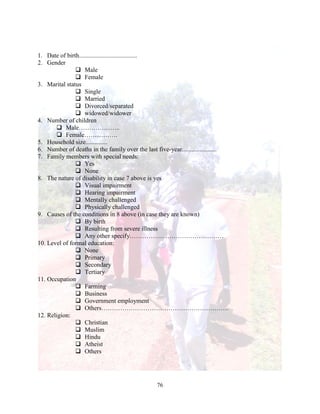
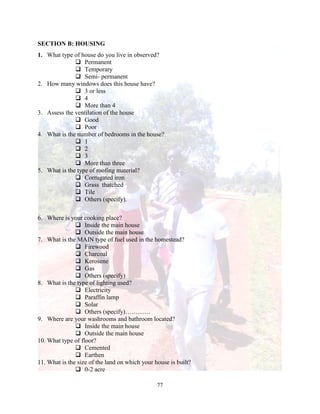
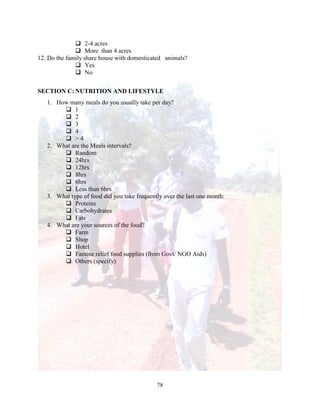
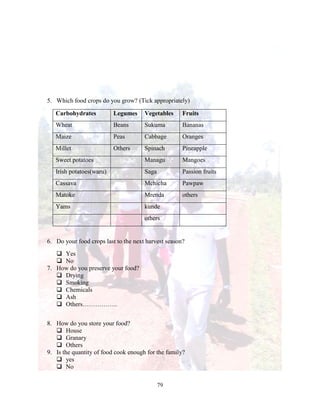
MASENO UNIVERSITY
SCHOOL OF MEDICINE
COMMUNITY HEALTH ATTACHMENT REPORT ON
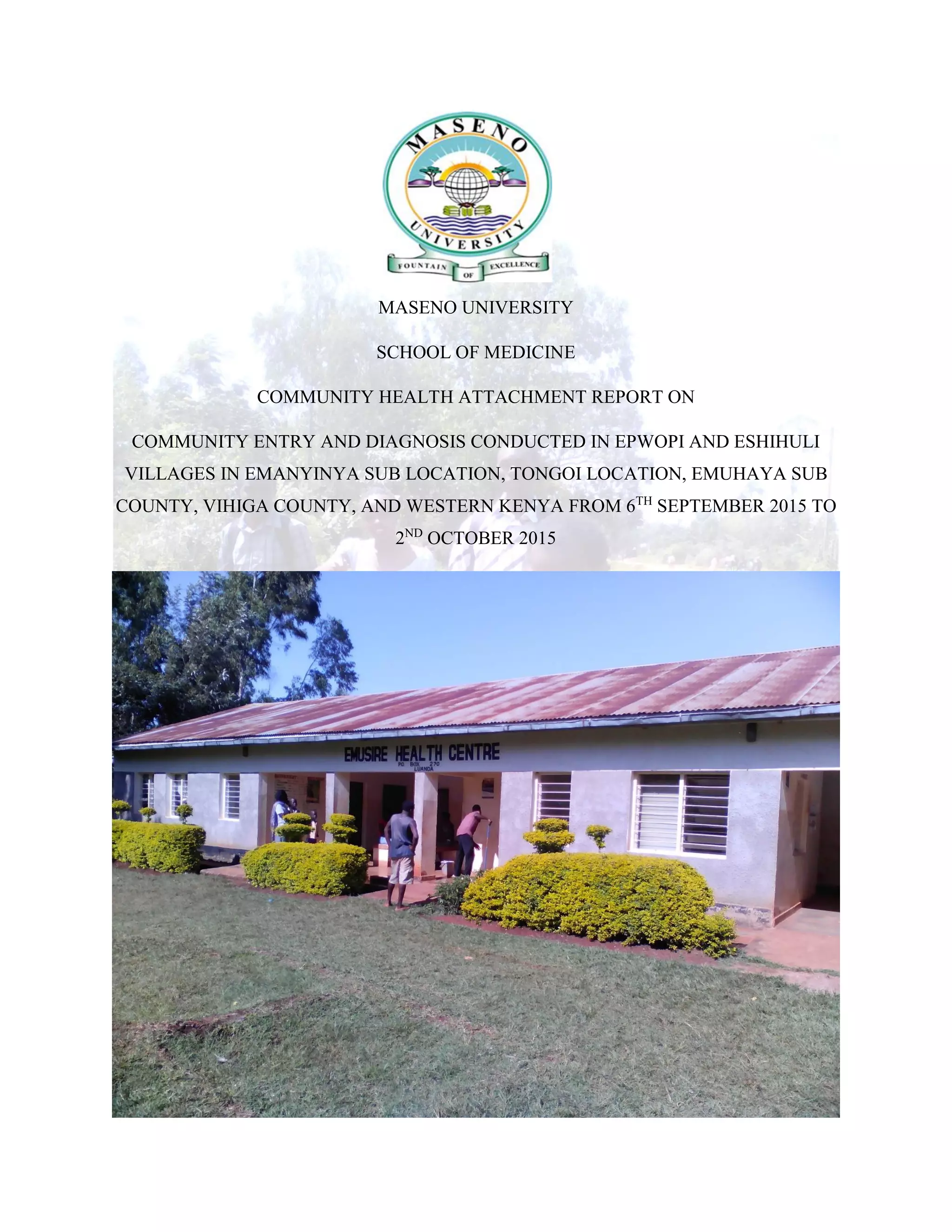
COMMUNITY ENTRY AND DIAGNOSIS CONDUCTED IN EPWOPI AND ESHIHULI
VILLAGES IN EMANYINYA SUB LOCATION, TONGOI LOCATION, EMUHAYA SUB
COUNTY, VIHIGA COUNTY, AND WESTERN KENYA FROM 6TH
SEPTEMBER 2015 TO
2ND
OCTOBER 2015
i
DECLARATION
We, Okoth Kevin, Ruguru Joan, Hilda Tiren, Kipkirui Nicholas, Onunga Anthony and Wakhu
Lesley hereby declare that this report is original, and to the best of our knowledge has not been
presented by any other individual or group in this or any other institution of higher learning and
is compiled from the research undertaken by this group from 6th
September, 2015 to 2nd
October,
2015 in an honest manner in order to fulfill the Community Entry and Diagnosis objectives.
All Rights Reserved. No part of this publication may be reproduced, stored in a retrieval system
or, or transmitted in any form or by any means, electronic, mechanical, photocopying, recording,
scanning or otherwise, except under the terms of the Copyright or the consent of Maseno
University.
Authors:
Name Admission Number Sign Date
Okoth Kevin Tony Ms/00040/2013 _________________ _______________
Wakhu Lesley Mukoya Ms/00035/2013 _________________ _______________
Tiren Hilda Chemutai Ms/00015/2013 _________________ _______________
Kipkirui Nicholas Ms/00024/2013 _________________ _______________
Onunga Anthony Ms/00032/2013 _________________ _______________
Ruguru Joan Kimani Ms/00007/2013 _________________ _______________
Supervisors:
Name Sign Date
Dr. Benson Nyambega _________________ _______________
Miss Indrah Ongwong’a _________________ _______________
Dr. Bonuke Anyona _________________ _______________
ii
ACKNOLWEDGMENT
We wish to express our sincere thanks to Maseno University School of Medicine for providing
the means to make this study possible. Thanks goes to our supervisors, all of Maseno University:
Dr. S .B. Anyona, Dr. B. Nyambega and Ms. I. Ongwong’a for their guidance, encouragement,
advice and constructive criticism. We also appreciate our various families for the unfailing
support they gave during this period.
Special thanks goes to the staff of Emusire Health Centre: Clinical Officer-in- charge, Ruth Bore
and her well able team of clinicians, Sarah Opanga, the Nursing Officer-in-charge, and her good
nurses, Benjamin Amwai, officer in-charge of the laboratory, Public Health Officer, Mr.
Josephat Maganga and his team and the support staff led by Josephine Muyela. They made our
stay comfortable and allowed us to learn more from them than we had imagined.
We are also indebted to the people of Tongoi location under the leadership of the acting chief
who is also the substantive Assistant Chief of Emanyinya sub-location together with the village
elders and community health volunteers. They allowed us into their community and facilitated
our movement into the deepest parts of the villages, this especially the community health
workers under the Public Health Office. This was pivotal in our data collection. We laud the
general population of Epwopi and Eshihuli for their willingness to share with us the information
we needed despite the fact that our data collection ate into their precious time.
Most importantly we cannot thank enough the good God for seeing us through the challenges
and successes of this undertaking.
iii
ABBREVIATIONS
OPS Out Patient Services
FGD Focused Group Discussion
CHVs Community Health Volunteers
CHA Community Health Attachment
PHC Primary Health Care
ANC Ante natal clinic
ARV Anti-retroviral
CDF Constituency Development Fund
MCH Maternal Child Health
IPD In patient Department
URTI Upper Respiratory Tract Infection
WHO World Health Organization
FP Family Planning
NGO Non-Governmental Organization
AI Adequate Intake
FGD Focused Group Discussion
KDHS Kenya Demography Health Survey
CPR Contraceptive Prevalence Rate
KIHBS Kenya Integrated Budget Survey
CIA
HSB
Center of Intelligence Agency
Health Seeking Behavior
PHC Primary Health Care
CDC Center for Disease Control and Prevention
iv
DECLARATION............................................................................................................................. i
ACKNOLWEDGMENT.................................................................................................................ii
ABBREVIATIONS .......................................................................................................................iii
ABSTRACT..................................................................................................................................vii
CHAPTER ONE: INTRODUCTION............................................................................................. 1
1.1 BACKGROUND INFORMATION .............................................................................................1
1.2 STUDY JUSTIFICATION ...........................................................................................................5
1.3 OBJECTIVES...............................................................................................................................5
1.4 RESEARCH QUESTION.............................................................................................................5
CHAPTER 2. LITERATURE REVIEW.................................................................................... 7
2.1 DEMOGRAPHY AND HOUSING....................................................................................................7
2.2 NUTRITION AND LIFESTYLE .......................................................................................................8
2.3 HIV AIDS ...........................................................................................................................................9
2.4 WASTE MANAGEMENT.................................................................................................................9
2.5 ENVIRONMENT AND WATER SUPPLY.....................................................................................10
2.6 MATERNAL CHILD HEALTH AND FAMILY PLANNING.......................................................10
2.7 COMMON HEALTH PROBLEMS.................................................................................................11
2.8 HEALTH SEEKING BEHAVIORS.................................................................................................13
2.9 PRIMARY HEALTH CARE............................................................................................................15
CHAPTER 3. METHODOLOGY............................................................................................. 16
3.1 STUDY AREA .................................................................................................................................16
3.2 SAMPLING......................................................................................................................................16
3.3 SAMPLE SIZE .................................................................................................................................16
3.4 STUDY METHODS.........................................................................................................................17
3.5 DATA COLLECTION METHODS.................................................................................................17
3.6 ELIGIBILITY CRETERIA...............................................................................................................17
3.7 DATA ANALYSIS AND PRESENTATION ..................................................................................18
3.8 LIMITATIONS.................................................................................................................................18
3.9 ASSUMPTIONS...............................................................................................................................18
v
CHAPTER 4. RESULTS............................................................................................................ 19
4.0. COMMUNITY ENTRY ................................................................................................................19
4.0.1 HEALTH SEEKING BEHAVIOURS OF THE COMMUNITY..................................................19
4.0.2 NUTRITION..................................................................................................................................19
4.0.3 HIV & AIDS AWARENESS.........................................................................................................19
4.0.4 ENVIRONMENTAL HEALTH ISSUES......................................................................................20
4.0.5 PRIMARY HEALTH CARE ACTIVITIES..................................................................................20
4.0.6 HEALTH CENTER INFORMATION AND HEALTH STATISTICS IN VIHIGA COUNTY ..20
4.1 COMMUNITY DIAGNOSIS............................................................................................... 22
4.1.1 DEMOGRAPHY ...........................................................................................................................22
4.1.2 NUTRITION AND LIFESTYLE ..................................................................................................29
4.1.3 HIV AIDS ......................................................................................................................................33
4.1.4 HEALTH SEEKING BEHAVIOURS...........................................................................................34
4.1.5 ENVIRONMENT, SANITATION, PERSONAL HYGIENE AND WATER SUPPLY ..............39
4.1.6 CULTURAL PRACTICES AND TRADITIONS .........................................................................45
4.1.7 COMMON HEALTH PROBLEMS..............................................................................................47
4.1.8 MATERNAL CHILD HEALTH AND FAMILY PLANNING....................................................48
CHAPTER 5. DISCUSSION ..................................................................................................... 51
5.1 DEMOGRAPHY AND HOUSING..................................................................................................51
5.2 NUTRITION AND LIFESTYLE .....................................................................................................53
5.3 HIV AND AIDS ...............................................................................................................................55
5.4 HEALTH SEEKING BEHAVIOURS..............................................................................................55
5.4 SANITATION, ENVIRONMENT AND WATER SUPPLY...........................................................57
5.5 CULTURAL PRACTICES AND TRADITIONS ............................................................................61
5.6 COMMON HEALTH PROBLEMS.................................................................................................63
5.7 MATERNAL CHILD HEALTH AND FAMILY PLANNING.......................................................64
CHAPTER 6. CONCLUSION................................................................................................... 67
CHAPTER 7. RECOMMENDATIONS ................................................................................... 69
REFERENCES............................................................................................................................ 70
APPENDICES............................................................................................................................. 72
vi
LIST OF FIGURES
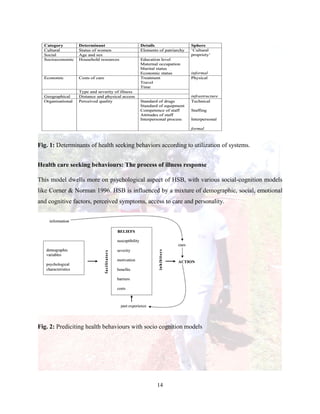
Fig. 1: Determinants of health seeking behaviors according to utilization of systems. ............... 14
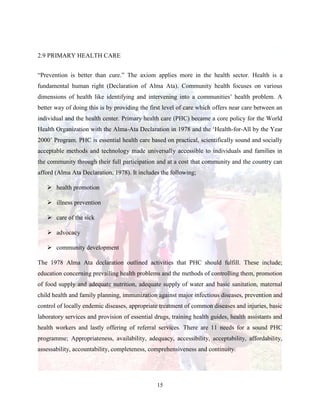
Fig. 2: Prediciting health behaviours with socio cognition models.............................................. 14
Fig. 4.1: Gender and marital status............................................................................................... 22
Fig. 4.2: Level of education and occupation ................................................................................ 23
Fig. 4.3: Special needs and causes of disability ........................................................................... 24
Fig. 4.4: Household sizes and deaths that occurred in the last 5 years........................................ 25
Fig. 4.6: Household activities....................................................................................................... 28
Fig. 4.7: Food in the households .................................................................................................. 30
Fig. 4.8: food taken and exercise done plus their frequencies...................................................... 31
Fig. 4.9: Breastfeeding and infant nutrition.................................................................................. 32
Fig. 4.10: HIV & AIDS ................................................................................................................ 33
Fig. 4.11: Institution visited upon getting ill................................................................................ 34
Fig. 4.12: Distance from the health center and time taken to be served....................................... 35
Fig. 4.13: Drug availability, payment and affordability of health services.................................. 36
Fig. 4.14: Outreach services and their frequencies in a month .................................................... 37
Fig. 4.15: Health care services rating........................................................................................... 38
Fig. 4.16: Human waste................................................................................................................ 39
Fig. 4.17: Homestead cleanliness and waste disposal methods.................................................... 40
Fig. 4.18: Oral health.................................................................................................................... 41
Fig. 4.19: Personal hygiene and hand washing practices ............................................................. 42
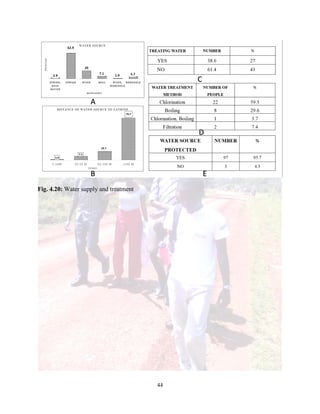
Fig. 4.20: Water supply and treatment ......................................................................................... 44
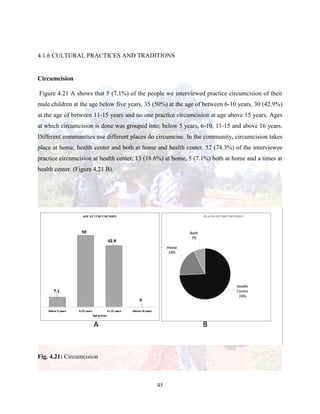
Fig. 4.21: Circumcision................................................................................................................ 45
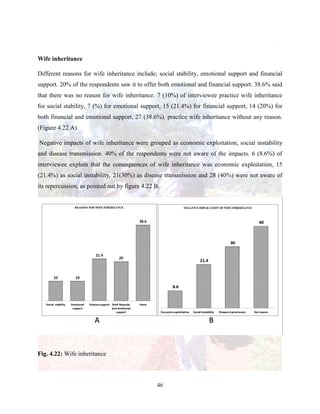
Fig. 4.22: Wife inheritance........................................................................................................... 46
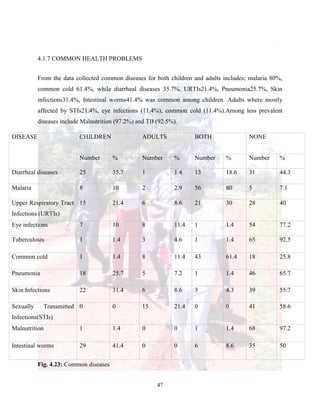
Fig. 4.23: Common diseases......................................................................................................... 47
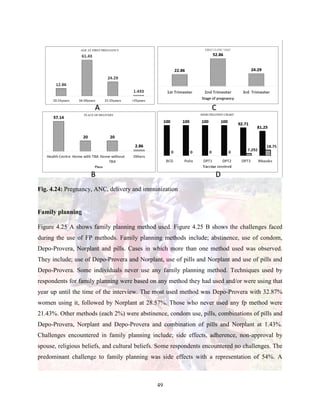
Fig. 4.24: Pregnancy, ANC, delivery and immunization ............................................................. 49
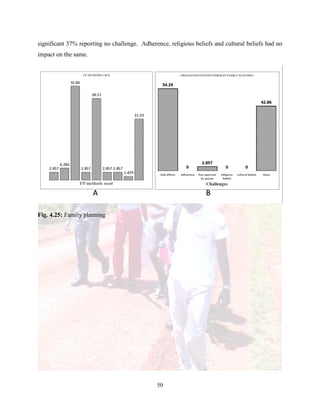
Fig. 4.25: Family planning ........................................................................................................... 50
vii
ABSTRACT
INTRODUCTION
Community entry is the process of initiating and sustaining a desirable relationship with the
purpose of securing and maintaining the community’s interest and working with them.
Community diagnosis is used to determine and describe the health status of a population (HSP),
reflected in health indicators in a community. The research was meant to examine the health
determinants in Eshihuli and Epwopi villages and come up with recommendations on how to
improve it.
METHODOLOGY
This paper contains a research that was conducted on community entry and diagnosis that
targeted a rural setting in western region of Kenya. Seventy households, a total of 384 people,
from two villages were chosen. Convenience sampling was used to choose the villages and
purposive sampling to choose households with children under 5 years. Data was collected using
semi- structured questionnaires, interviews, focused group discussion (FGD), observation and by
secondary sources like internet, government sources and journals. The study took one month.
RESULTS
Research conducted involved 70 households from 2 villages. Female respondents were 69
(98.57%). Thirty eight (54.29%) mothers breastfed up to 13-24 months, 52.86% starting
weaning at the age of 3-6 months using mainly porridge and mashed potatoes. Only 34% of the
respondents had a good level of HIV AIDS awareness. 38.6% treated water, with majority using
it raw. The main rite of passage is circumcision for the males and about 75% are circumcised at
the health center. The most prevalent disease in children was intestinal worms (41.4%) and
Sexually Transmitted Infections in adults (21.4%).all children had received the basic
vaccinations, while some had not got the third DPT dose and measles vaccine. Majority
(88.57%) of the women were aware of family planning methods with 32.86% using Depo
Provera making it the most popular.
CONCLUSION AND RECOMMENDATIONS
There is need to educate the community more on health issues like family planning, HIV AIDS,
nutrition and general body health.
1
CHAPTER ONE: INTRODUCTION
1.1 BACKGROUND INFORMATION
Community health refers to the health status of a defined group of people or community and
actions that protect and improve the health of a community. Communities live under norms or
values that govern them, and need to be followed. Actions protecting the community are
organized into three aspects; Health promotion, health protection and health services. The history
of community health goes back to 25,000 b.c.e in Spain, where cave walls included murals of
physical deformities. In 21st
Century b.c.e, Chinese also dug wells for providing drinking water.
Encyclopedia of Public Health lists four factors that affect community and population health as:
i. Physical factors like geography, environment, community strategy and industrial
development.
ii. Social and cultural factors like beliefs, economy, social norms, taboos and socio-
economic status of a community.
iii. Community organization like availability of health agencies.
iv. Individual behaviors like smoking, general body cleanliness and health seeking behavior.
The Ministry of Health and Sanitation in Kenya has given a top priority to community health
services. The Kenya Essential Health Package (KEHP) introduced a six life cycle cohorts and six
delivery system levels. Level 1 services are aimed at empowering Kenyan households and
communities to take charge of improving primary health care and own health. The health care
system in Kenya includes the Public System headed by the Ministry of Health (MOH) and the
private sector that includes private for profit, NGOs and Faith Based Organization hospitals. The
public sector comprises 51% of the 4700 health facilities in Kenya. The first line of health care is
at the individual followed by dispensaries and health centers. More sophisticated level of care is
provided by the County Referral Hospitals and Provincial Teaching and Referral hospitals. The
health center of study is Emusire Health Center. The referral hospital is Vihiga County referral
Hospital. At the apex of health care provision are two National Referral hospitals in Kenya in the
public sector; Kenyatta National Hospital (KNH) in Nairobi and Moi Referral and Teaching
Hospital (MTRH) in Eldoret.
2
The attachment programme could not be successful without looking into the community in study
(The Abaluhya).
GENERAL HISTORY
The Abanyole are a sub-tribe of the larger Abaluhya. The community of study belongs to the
Abatongoi sub clan. Their cradle is Egypt and they migrated along River Nile up to Khartoum in
Sudan before entering Uganda where they settled at Kiliatongo. They split up at this point and
some moved towards Kenya while another group, the Abanyoro remained in Uganda. In Kenya,
they first settled in Ebulonya before bearing children who formed clans including Amutete,
Abasiratsi among others. Most people view the community as hostile and mostly do bhang as
part of drug abuse. They worshipped Were, their supreme God, facing the east to the rising sun
under the ‘olusiola’ tree led by the father of the house. The tree was also used to curse those who
had gone against the ethics and rules of the tribe. A girl was ready for marriage at the age of 25
to 30 years and boys at the age of 35-40 years. Currently, they marry at the age of 18 years or
earlier.
MAJOR HISTORICAL EVENTS
The major historical events that took place in the community include the 1994 famine, famously
known by the community as Saba lala. During this time, people only washed their hands once to
signify that they only took meals once in a day. This occurred due to lack of rainfall for a long
time. It made farmers who relied on their farm produce for income suffer economically. There
was also general cases of malnutrition and death among the population.
In 2012, there was a mass livestock theft that occurred. No force or violence was used, no life
was lost and the actual reason that led to it is still unclear. Those who depended on their
livestock for livelihood incurred losses. Mothers who were depending on cow milk to feed their
babies also suffered and the babies’ conditions worsened until they were able to find an
alternative source.
There was also a jigger outbreak, an issue they claim is still rampant among them. This both
affects the young and the old especially where hygiene is compromised. This makes most of the
money earned channeled to treatment and buying of insecticides. The social life of those affected
were also tampered with as they were afraid to get out in public and go to the health facility. This
3
also led to non-compliance when the CHVs came for anti-jigger door-door campaign and
treatment.
CULTURAL PRACTICES OF THE COMMUNITY
1. Religion
The Abanyole believe in an all-powerful God called Were. They worshipped facing the east to
the rising sun. They offered prayers under the ‘olusiola’ tree led by the father of the house. The
tree was also use to curse those who had gone against the ethics and rules of the tribe.
2. Marriage
A girl was ready for marriage at the age of 25 to 30 years; a boy at the age of 35-40 years.
Currently, they marry at the age of 18 years or earlier.
3. Birth and naming
When a boy was born, a spear was put outside the house on the right side of the entrance, but if it
was a girl, they would place the pot supporter, ‘engaraa’ (made from banana leaves) on the left
side of the entrance. They viewed twins as a blessing unlike other tribes which view the same as
a curse. Naming would take a week. Sheep were slaughtered and the meat roasted. The child’s
name came from deceased old people from the clan. If members committed incest and gave birth
to a child, a chicken’s beak was cut and tied on a string and the victims smeared with a mixture
of millet flour and herbs to disown the act. It was unnatural for miscarriage to occur. It was
associated with adultery, eating non-recommended food and being battled.
4. Circumcision
Boys at the age of 15 were circumcised, after which they were treated with herbs from the engai
tree. After recovery, they were then considered men.
5. Death
Initially, the dead were left in the wild to be eaten by wild animals. They started burying the dead
after the emergence of infectious diseases. A person who had committed suicide was buried at
night and was never accorded any respect. Mentally challenged people and the childless were
buried in the homestead away from the house. Miscarried fetuses were buried outside the
4
homestead. On the second day after burial, family members would shave their heads at the grave
to signify a new beginning. After three weeks, the widow would wear her late husband’s shirt or
coat and move around the clan to signify the end of mourning and that she could then be
inherited.
GOVERNMENTAL STRUCTURE
 Villages are headed by village elders whose sole function is to maintain law and order.
The villages in Emanyinya sub location include Eshihuli, Epwopi, Emanyinya, Emakunda
A, Emakunda B and Muikaka.
 Sub location headed by the assistant chief who also coordinates with the village elders
and chief to maintain law and order.
 Tongoi location headed by chief. The chief maintains order and exercises the jurisdiction
and power bestowed upon him by the Chief’s Act upon persons residing in the location.
Tongoi chief is Mr. Ainea Olocho.
 Central Bunyore County Assembly Ward was the ward of study.
 Tongoi location is located within Emuhaya Sub County.
 The overall head is the County government headed by Governor. Vihiga County is
headed by Hon. Moses Akaranga.
SOCIAL STRUCTURE
Family
Family is the basic social unit in the community. The father is the head of the family. He is the
breadwinner and decision maker. The head is allowed to have more than one wife. The family
can also be extended which consists of grandfather, his wife (or wives), children and
grandchildren. If the grandfather is not alive then eldest son becomes the head of the extended
family.
Clan
Blood related families constitute the clan. They all have one ancestor headed by clan elder.
People from the same clan are not allowed to marry. Marrying within a clan is a taboo.
5
1.2 STUDY JUSTIFICATION
Many studies have been done to reveal the health problems of different communities in Kenya.
This paper highlights a study of the same. The main topics of study were Demography, Housing,
Nutrition and Lifestyle, level of HIV AIDS awareness, Sanitation, Environment and Water
supply, Cultural practices and Tradition, Common health problems in a community, Maternal
Child Health (MCH), Pests and Vectors prevalence. The research was significant in determining
the common health problems in the community of study and in Kenya at large, attempt to
identify them and recommend to relevant authorities to intervene
1.3 OBJECTIVES
BROAD OBJECTIVE
To assess the health determinants and health status of Emanyinya sub-location.
SPECIFIC OBJECTIVES
 To find out the influence of demography on health status of the community.
 To discuss the impact of nutrition and lifestyle on health status of Emanyinya
community.
 To evaluate the level of HIV and AIDS prevalence in the community.
 To discuss how environment and sanitation of the community has an influence on their
health.
 To find out the culture and traditions of the community.
 To evaluate Maternal Child Health status of the community.
1.4 RESEARCH QUESTION
The research ought to seek the following questions:
i. How does demography, housing, HIV/AIDS, culture, nutrition, lifestyle, sanitation, and
environment in Emanyinya community influence their health status?
6
ii. Do the study areas reveal a positive or negative impact on health of the community?
iii. What are the possible solutions to the negative impact on the community?
7
CHAPTER 2. LITERATURE REVIEW
This chapter gives a brief background of the study topics in relation to research done globally
and regionally. This will be important when discussing the subjects outlined below.
2.1 DEMOGRAPHY AND HOUSING
The study was carried out in Emanyinya Sub-location which is in Emuhaya constituency with a
population of 95,064 people. The constituency is approximately 94.50 square kilometers.
Emanyinya sub-location is also in Central Bunyore County Assembly Ward with a population of
27, 316 people. It’s approximately 27.80 square kilometers, according to the Interim Electoral
and Boundaries Commission (IEBC) final report of boundaries of constituencies and wards.
Emanyinya sub-location is purely rural. Vihiga County’s population stands at 612,000 with an
annual population growth rate and fertility rate of 2.51% and 5.1% respectively. The county’s
urbanization rate is 31%, with 123,347 households. The age distribution is; 0-14 years (44.2%),
15-64 years (49.4%), 65+ years (6.1%). Poverty level stands at 62 % in both rural and urban
areas. Almost all residents own all the land they live in. the infant mortality rate is 100 out of
1000 live births and the under-five mortality rates are 120 out of 1000 live births. Some of the
land is owned communally and is mostly used for farming. The type of houses are either
permanent or semi-permanent. It depends on the social status of the residents.
According to the 2009 Census and preliminary results produced in 2010, Christians were 82.5%
in Kenya, forming the major denomination. Ventilation is important for healthy respiratory life.
According to the building regulations of 2010, a house should have the window space, roof
windows, doors and roof lights should not exceed 25% of the total floor space of the dwelling
area. It is also recommended that people cook outside especially when the ventilation is poor.
This is safer as it reduces chances of the small houses from catching fire. It is suggested that one
builds separate housing for the animals so as to prevent spread of diseases between animals and
human beings. Also some vectors that mostly attack animals can also attack human beings, for
example ticks.
8
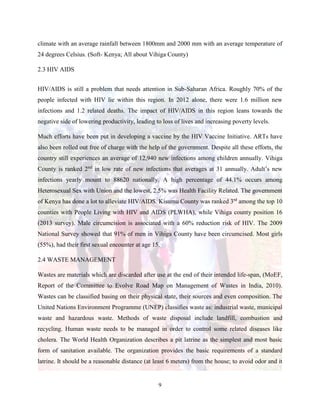
The Kenya Integrated Household Budget Survey (KIHBS) shows that most households have a
mean of 5.1 people. The mortality records on Kenya from the CIA world Fact book June 30th
2015 indicates that there are 7 deaths out of 1000 people each year.
2.2 NUTRITION AND LIFESTYLE
A nutrient-rich diet plays a major role in maintaining a healthy body and mind. This is necessary
in upholding the requisite metabolic rate, growth, development and repair of the body. Nutrients
are consumed through the food that we eat; and through metabolic processes in the digestive
system these nutrients are absorbed at a cellular level. However, under-nutrition, over- nutrition,
and malnutrition are linked to sub-optimal health outcomes. Poor diets have been linked to the
occurrence of chronic diseases: cardiovascular diseases, Type-2 diabetes, cancer, osteoporosis
and anemia. For example, research shows that low intake of fruit and vegetables increases the
risk for developing cancer, as well as cardiovascular disease, whereas low intake of dietary fiber
has been linked to being overweight. Individuals’ reasons for buying and eating particular foods
have been described as a “complex bio-psychosocial process that is relative to person, place and
time” (Walsh & Nelson 2010, p. 194). Most researchers believe that dietary habits and food
preferences develop in childhood, and are established by age 15, and become habitual in due
course (Birch1999; Sweeting & Anderson 1994).
The World Health Organization (WHO) recommends that children between age 0 and 6 months
be breastfed exclusively, which thereafter breastfeeding can continue amidst other solid foods.
Breast-feeding can go up to the age of 2 years. This is important in developing the child’s
immunity and bonding with the mother, the function of oxytocin. Mothers living with HIV are
not exempted. According to the Kenya Demographic Health Survey, 61% of children below the
age 6 months are exclusively breast fed, with 51% of mothers still breastfeeding. The study also
established that 15% of children below 6 months are weaned. Breastfeeding is just one
determinant of child’s nutritional status, just like anthropometry. In Kenya, 26% of children are
stunted, with the level of education and socio-economic status being a determinant. The Mid-
Upper Arm Circumference is also used to find out if a child is malnourished or not.
The main economic activities in Vihiga County include tea, maize, dairy farming, millet and
cassava, thus provides adequate food supply for the community. This is supported by the good
9
climate with an average rainfall between 1800mm and 2000 mm with an average temperature of
24 degrees Celsius. (Soft- Kenya; All about Vihiga County)
2.3 HIV AIDS
HIV/AIDS is still a problem that needs attention in Sub-Saharan Africa. Roughly 70% of the
people infected with HIV lie within this region. In 2012 alone, there were 1.6 million new
infections and 1.2 related deaths. The impact of HIV/AIDS in this region leans towards the
negative side of lowering productivity, leading to loss of lives and increasing poverty levels.
Much efforts have been put in developing a vaccine by the HIV Vaccine Initiative. ARTs have
also been rolled out free of charge with the help of the government. Despite all these efforts, the
country still experiences an average of 12,940 new infections among children annually. Vihiga
County is ranked 2nd
in low rate of new infections that averages at 31 annually. Adult’s new
infections yearly mount to 88620 nationally. A high percentage of 44.1% occurs among
Heterosexual Sex with Union and the lowest, 2.5% was Health Facility Related. The government
of Kenya has done a lot to alleviate HIV/AIDS. Kisumu County was ranked 3rd
among the top 10
counties with People Living with HIV and AIDS (PLWHA), while Vihiga county position 16
(2013 survey). Male circumcision is associated with a 60% reduction risk of HIV. The 2009
National Survey showed that 91% of men in Vihiga County have been circumcised. Most girls
(55%), had their first sexual encounter at age 15.
2.4 WASTE MANAGEMENT
Wastes are materials which are discarded after use at the end of their intended life-span, (MoEF,
Report of the Committee to Evolve Road Map on Management of Wastes in India, 2010).
Wastes can be classified basing on their physical state, their sources and even composition. The
United Nations Environment Programme (UNEP) classifies waste as: industrial waste, municipal
waste and hazardous waste. Methods of waste disposal include landfill, combustion and
recycling. Human waste needs to be managed in order to control some related diseases like
cholera. The World Health Organization describes a pit latrine as the simplest and most basic
form of sanitation available. The organization provides the basic requirements of a standard
latrine. It should be a reasonable distance (at least 6 meters) from the house; to avoid odor and it
10
should be located not so far away to allow accessibility even during bad weather. The latrine
should be 30 meters away from the nearest water source.
2.5 ENVIRONMENT AND WATER SUPPLY
A water source refers to the supply of ground and surface water for a certain region. Water
supply to rural populations includes rainwater, ground water and/or spring water. Water is
essential in people’s lives. According to The world Health Organization, 80% of all diseases in
the world are associated with water. To eradicate disease, people need access to safe water. A
research conducted in 2015 by Resources for The Future revealed that 60% of rural household
get their water from outside their homes and the members use 2 to 3 hours a day on water
collection. In rural Kenya, where 78% of the national population is found, only 38% to 52% have
easy access to safe water; in urban areas 59% to 83% have easy access to safe water (World
Bank 2009).
2.6 MATERNAL CHILD HEALTH AND FAMILY PLANNING
According to the Inter-parliamentary Union, 2013 (IPU) maternal morbidity and mortality relate
to illness or death occurring during pregnancy or childbirth, or within two months of the birth or
termination of a pregnancy. In Kenya, maternal mortality remains high at 488 maternal deaths
per 100,000 live births (IPU). While this is below the Sub-Saharan average of 640 deaths per
100,000, Kenya experiences very slow progression in maternal health. Most maternal deaths are
due to causes directly related to pregnancy and childbirth, unsafe abortion and obstetric
complications such as severe bleeding, infection, hypertensive disorders and obstructed labor.
Others are due to causes such as malaria, diabetes, hepatitis and anemia, which are aggravated by
pregnancy. While approximately 92% of women giving birth received some antenatal care in
2010, only 47% had the recommended four or more. According to a survey done in Vihiga
County, 61.2% of deliveries occur at the health center nationally and 50.2% in the county. The
KDHS also shows that 62% of births are delivered by skilled providers countrywide and 97.1%
in Vihiga County. This is influenced by factors like socio-economic status and education level.
The research goes further and says that 61.3% of women had 4 visits to the Ante Natal Care
when they were pregnant. WHO recommends at least 4 visits to ANC during pregnancy, and
58% of Kenyans do so.
11
Conferring to Deutsche Stiftung Weltbevoelkerung (DSW) in A Review of National and District
Policies and Budgets, community perceptions from focused group discussions revealed that
many women would like to plan their pregnancies but are not using any family planning (FP)
methods because the health facilities offering them are long distances from their villages. Health
facilities assessments show that that FP commodities in facilities expire or are redistributed
because of under-utilization. However, in Kenya, Contraception Prevalence Rate (CPR) is 58%
in married women and 65% in sexually active single women. 53% of women use modern
methods like injections, pills and implants, with injectable being popularly used (26%) followed
by implants (10%) and pills (8%). 62% of them are in urban areas while 56% in rural areas.
2.7 COMMON HEALTH PROBLEMS
Sub-Saharan Africa has become a hub of diseases like malaria, HIV/AIDS, pneumonia, diarrheal
diseases among others. Diarrheal disease is the second leading cause of death in children under
five (WHO fact sheet, April 2013). Africa Check factsheet groups top killers and preventable
diseases in Africa in 2012 into three categories; Group 1 results through communicable diseases,
perinatal, maternal and nutritional causes, with 5-9 million deaths amounting to 61.7% of all
deaths in sub-Saharan Africa. Group 2 deaths are as a result of non-communicable diseases,
accounting for 2.7 million deaths (28.6%). This category include heart diseases, cancer and
diabetes. Group three are due to injury, causing 939,000, or 9.8% of the total group. A focus on
Vihiga County shows that Malaria, URTIs, diarrhea and HIV/AIDS are the most prevalent
diseases.
The diseases of focus are diarrhea, pneumonia and malaria which accounts for 19%, 18% and
16% of death respectively in sub-Saharan Africa (R.E. Black et al. 2010 and WHO 2015).
Globally, an estimated 1.7 Billion cases of diarrhea are reported annually, and around 760,000
children die every year. The disease is of high burden among developing countries, and
responsible for 8.5% and 7.7% of deaths in Southeast Asia and Africa respectively.
Diarrhea is defined as the passage of loose or watery stool more than three times in a period of
24 hours. It occurs in three types; acute, persistent or dysentery. It’s important to note that babies
who are exclusively breast fed pass loose stool. This is not diarrhea. The common pathogen is
Vibrio cholerae. Three pathogenic strains of Escherichia coli also cause it. Diarrhea is passed via
12
fecal-oral route from one person to another directly or indirectly through contaminated food or
water. Diarrhea is also related to dehydration that causes death in children affected. Control
measures include proper hygiene and exclusive breast feeding in children up to the age of 6
months. During diarrheal attack, an Oral Rehydration Therapy is recommended.
Upper- Respiratory Tract Infections involves the nose, sinuses, pharynx and larynx. They are
caused by rhinovirus (Common), coronavirus, para-influenza virus, adenovirus, enterovirus and
Respiratory Syncytial Virus (RSV). Predisposing factors are majorly over population in poorly
ventilated areas, thus allowing for faster spread. Prevention can be via vaccines and treatment
with antibiotics.
Malaria occurs mostly in poor, tropical and subtropical areas of the world (Center for Disease
Control and Prevention 2015), www.cdc.gov/malaria_qorldwide/impact.html. Center for Disease
Control and Prevention (CDC) outlines reasons why Africa is the most affected region. Africa
harbors the female anopheles mosquito which is responsible for high transmission rates. The
predominant parasite species is Plasmodium falciparum which is the virulent form that causes
severe malaria and death. The local weather conditions in Africa is also a boost to the
transmission of the parasite. The adequate rainfall in Vihiga County explains why the disease is
prevalent during the moths of April-July, as there are breeding grounds for mosquitoes. Scarce
resources and socio-economic instability have also hindered efficient malaria control activities in
Africa. CDC rates malaria as the leading killer disease in developing countries with young
children and pregnant women being the vulnerable ones. In 2012, malaria caused an estimated
207 million clinical episodes and 627,000 in Africa.
Inter Health Worldwide research conducted in Western Kenya in June 2015 shows that malaria is
the leading cause of morbidity and mortality in the region. In 2012, over 9 million cases were
reported in Nyanza and Western Kenya. The disease was also responsible for 30-50% of
outpatient admission, loss of 120 million working days and 20% of all deaths in under-fives
(Ministry of Health Kenya, 2006). Focus in Vihiga County by the Ministry of Health Kenya
shows that malaria test positivity rate is at 52%. The number of case per 100,000 people stands at
41,402 as compared to the national level o 20252. Malaria admissions in the county is 7,125.
13
2.8 HEALTH SEEKING BEHAVIORS
Health is a state of complete physical, mental, and social well-being and not merely the absence
of disease or infirmity−WHO. (1948). For one to seek medical attention, he or she must have an
impairment in their vital organs. There are factors that will determine an individual’s response to
an illness. Health seeking behaviours (HSB) shows us how patients engage with the health care
system. There has been a plethora of studies showing the models used to describe HSB. One is
based on the utilization of system and the other on response to illness.
Health care seeking behaviours: Utilization of the system
This model suggests that the decision to seek medical attention is influenced by an array of
socio-economic factors like sex, age, social status of women, perceived quality of service at the
health centre and access to the service. Geographical influence on HSB is an important factor.
The same study was conducted by Babar et al. (2004). The rate of patient inflow at the health
centre can be used as a determinant of the distance and terrain separating an individual from the
health care facility. Proximity to the health centre makes it convenient for one to visit the health
centre more often. Longer travel times and greater distances constitute a major barrier for
repeated visits. One way to overcome this is by increasing the number of health centers in the
rural areas, encouraging the private clinics to provide cheaper services and increasing the number
of outreach services in the areas. Quality of health services should not be left out in discussing
HSB. A health facility near the households may provide poor services, making one to go to one
that is far but offers good services. The services may range from patient-staff relationship to
quality of drugs and equipment used.
14
Fig. 1: Determinants of health seeking behaviors according to utilization of systems.
Health care seeking behaviours: The process of illness response
This model dwells more on psychological aspect of HSB, with various social-cognition models
like Corner & Norman 1996. HSB is influenced by a mixture of demographic, social, emotional
and cognitive factors, perceived symptoms, access to care and personality.
Fig. 2: Prediciting health behaviours with socio cognition models
15
2.9 PRIMARY HEALTH CARE
“Prevention is better than cure.” The axiom applies more in the health sector. Health is a
fundamental human right (Declaration of Alma Ata). Community health focuses on various
dimensions of health like identifying and intervening into a communities’ health problem. A
better way of doing this is by providing the first level of care which offers near care between an
individual and the health center. Primary health care (PHC) became a core policy for the World
Health Organization with the Alma-Ata Declaration in 1978 and the ‘Health-for-All by the Year
2000’ Program. PHC is essential health care based on practical, scientifically sound and socially
acceptable methods and technology made universally accessible to individuals and families in
the community through their full participation and at a cost that community and the country can
afford (Alma Ata Declaration, 1978). It includes the following;
 health promotion
 illness prevention
 care of the sick
 advocacy
 community development
The 1978 Alma Ata declaration outlined activities that PHC should fulfill. These include;
education concerning prevailing health problems and the methods of controlling them, promotion
of food supply and adequate nutrition, adequate supply of water and basic sanitation, maternal
child health and family planning, immunization against major infectious diseases, prevention and
control of locally endemic diseases, appropriate treatment of common diseases and injuries, basic
laboratory services and provision of essential drugs, training health guides, health assistants and
health workers and lastly offering of referral services. There are 11 needs for a sound PHC
programme; Appropriateness, availability, adequacy, accessibility, acceptability, affordability,
assessability, accountability, completeness, comprehensiveness and continuity.
16
CHAPTER 3. METHODOLOGY
This chapter describes the research methodology used in this study which focuses on the research
design and research methods.
3.1 STUDY AREA
The study was conducted in Emanyinya Sub location located in Tongoi Location, Central
Bunyore Ward, Luanda Division, Emuhaya District, Vihiga County, and Western Province in
Kenya. Two villages, Epwopi and Eshihuli, were sampled in Emanyinya sub-location. The
natives of the region are the Abanyole, a sub tribe of the Abaluhya tribe. Climate-Data.org,
Koppen and Geiger classifies the type of weather in Emuhaya as tropical, in which Emanyinya
Sub location lies. It’s asserted that the precipitation is lowest in January and peak in April and
that February is the hottest month of the year and July the coldest month.
3.2 SAMPLING
Purposive sampling was used to select the households with children under 5 years. Random
sampling was used to select the households during the process of data collection. Convenience
sampling technique was used in selecting villages near the health center. Seventy households
were chosen.
3.3 SAMPLE SIZE
The number of households in Eshihuli and Epwopi village was 261, with a total population of 1,
436. 70 households (384 people) were selected with 35 households from Epwopi village and 35
from Eshihuli village. The 70 households represented 26.74% of the population of study.
According to Business Advocacy Network, the sample size of unknown population is calculated
using the formula below:
n = z2p (1-p) /e2
17
Where: z is the confidence level of 95% (1.96), p is the prevalence of the characteristic of
interest (50%) and e is the level of statistical significance set (5%).
3.4 STUDY METHODS
Primary data was obtained by questionnaires, interviews, Focused group discussions and
observations. Secondary data was obtained from journals, government sources, internet and other
materials.
3.5 DATA COLLECTION METHODS
The methods used in data collection were:
Interviews
This was done in Barazas with the chief and the villagers to find out about the history of the
community. Community Health Volunteers (CHV) were also interviewed on the health issues of
the community. The health center staff were asked about the health facility.
Focused Group Discussions (FGD)
There was a focused group discussion with the health center staff and the community. A FGD
was done at Mulwanda Church of God in which the CHVs were involved.
Questionnaires
Semi-structured questionnaires were administered to different households and used to diagnose
the community. A total of 70 were used.
Observations
During the walks in the community, we observed some health determinants, for example, the
ventilation quality of houses.
3.6 ELIGIBILITY CRETERIA
The research targeted the population of rural areas and particularly those in Emanyinya sub
location which is within the catchment area of Emusire Health Center. Study was conducted for
18
people of different sex and age groups but emphasis was put in the households with children
under 5 years.
3.7 DATA ANALYSIS AND PRESENTATION
Both the qualitative and quantitative data collected was fed into Microsoft Excel 2013 and
analyzed using the available commands. Tables were generated and copied to Ms Word in the
result section. Data was presented in the form of pie charts, tables and graphs, from which
interpretations were made and discussions made. Conclusions were drawn and recommendations
given to the areas of interest.
3.8 LIMITATIONS
1. Fatigue since it involved a lot of walking from one household to another.
2. Language barrier at the beginning but was resolved by the CHVs who accompanied us.
3. Poor infrastructure as some roads were too narrow for the bus to navigate.
4. Adverse weather conditions which were hot weather and rains during community
diagnosis.
5. Frequent blackouts at the health center increased the amount of time used in analyzing
data.
3.9 ASSUMPTIONS
The information given by the respondents during the study was considered to be genuine,
accurate and represented the whole population.
19
CHAPTER 4. RESULTS
4.0. COMMUNITY ENTRY
4.0.1 HEALTH SEEKING BEHAVIOURS OF THE COMMUNITY
Health care providers in the community include the traditional birth attendants, herbalists,
community health workers, community health extension health workers, nurses and clinical
officers at the health center, public health officers and Non-Governmental Organizations (NGOs)
like the SOFDI. The health care providers in this community mostly handle preventive care like
water treatment and immunization and treat the basic disease like malaria and diarrheal cases.
Most people in this community first go to chemist and buy drugs to alleviate their symptoms
when they feel unwell then health center when they do not get better. They are referred to Vihiga
county and referral hospital if they do not get better within 24 hours. The people in this
community are well informed on the benefits of modern medical services.
4.0.2 NUTRITION
The community’s staple food is maize meal and is mostly taken with tea. They also take it with
vegetables like kales, mrenda and kunde. At times they eat maize with beans (pure). The planting
seasons are April and September which coincide with the rains. They mostly grow maize and
beans in both seasons and supplement with kales and kunde. Most houses store their produce in
their houses. There are no taboos related to food.
4.0.3 HIV & AIDS AWARENESS
All respondents were aware of existence of HIV/AIDS and that it can be screened. However,
only 34 % had a good knowledge about how the disease is transmitted, prevented and managed.
Most of them heard about HIV & AIDS from the media, health center and from health workers.
HIV is still a major problem in the community. This is due to inadequate knowledge about it
given that most of the respondents were oblivious of how it is transmitted.
20
4.0.4 ENVIRONMENTAL HEALTH ISSUES
The community has closely worked with the Public Health Officers, the health center and other
NGOs like SOFDI to ensure clean and safe drinking water for all. SOFDI for example has
protected springs around and provided a chlorine dispenser near other water sources for the
locals to treat water with after fetching. The community also burns most of their general waste
(44.3%) thus ensuring a clean environment. The dust and smoke which contributes to higher
percentage of air pollution contribute a lot to the incidences of respiratory disorders among
children and adults.
4.0.5 PRIMARY HEALTH CARE ACTIVITIES
Primary health care (PHC) has become a key policy for the World Health Organization (WHO)
with the Alma-Ata Declaration in 1978. This has led to communities being involved in ill health
promotion, illness prevention, care of the sick and advocacy. The PHC activities observed in the
community were preventive care like door to door immunization of polio, routine health
education at the health center and household level, follow up done by the CHVs and emergency
immunization program. The community also protected their water sources, had Traditional Birth
Attendants (TBAs) who cared for the expecting mothers who could not reach the health center
on time.
4.0.6 HEALTH CENTER INFORMATION AND HEALTH STATISTICS IN VIHIGA
COUNTY
Emusire health center is located in Western Province, Vihiga County, Emuhaya District, Luanda
Division, Central Bunyore Ward, Tongoi Location, Emusire Sub location and Emuhaya
Constituency. It is in the outskirts about 7 Km from Luanda town. It is a government institution
owned by the Ministry of Health. Its postal address 107 Bunyore and the MFL code is 16979.
The health center is between other health facilities: Ebukanga Dispensary, Esirulo Imani Medical
Clinic, Mwichio Amua Medical Clinic, Ojm Medical Clinic and Rotary Doctors Clinic, both
within the Central Bunyore Ward. The nearest schools are Emusire Primary and High Schools.
The health facility offers both in and out-patient services. Most people who visit the health
21
facility come from within Central Bunyore Ward that includes Emanyinya, Emusire, Esirulo,
Essunza and Essaba Sub-locations. Some cases that cannot be handled by the private clinics are
referred to the health center. According to the research conducted, this is where most people visit
in case of an illness. During the April and July, when there is high malaria prevalence, there is
huge number of patients thus services run up to 6 pm.
Patient flow starts from the registration desk then to consultation room for clerking by the
clinical officer. Patient then proceeds to the registration desk to be given an OPD number and for
recording of details of treatment. They goes to the pharmacy for drug issuance. If need be the
patient is injected, dressed or sent to the laboratory for a series of tests. Expectant mothers and
those with children under 5 years visit the Ante Natal Care & Maternal Child Health
departments, mostly on Monday and Thursday. Relevant cases are referred to Comprehensive
Care Center for special care. Referrals are made to Vihiga County Hospital. During emergencies,
Ipali Health Center is contacted for an ambulance to transport the sick.
EHC is funded by Vihiga County Government with cash from the National Government. During
the month of July 2015, Hon. Dr. Wilbur Ottichilo issued Community Development Fund cheque
worth 650, 000/= to the facility, and 400,000/= in 2012. This included money for paying the
health workers in the facility, purchasing drugs and equipment and also maintenance. The
ongoing construction of a mortuary is funded by the Economic Stimulus Project.
A document by Ministry of Health, Kenya that was last updated on May 2015 shows the public
health personnel, financing and facilities in Vihiga County in 2015. It shows that Vihiga County
has 45 nurses, 8 doctors, and 15 clinical officers per 100,000 people respectively. The results
shows that a deficit in health personnel needs to be addresses for better patient care. This is
closely related to the national figure of 55 nurses, 10 doctors and 21 clinical officers per 100,000
people respectively. Public health facilities in Vihiga County are 46. There are 4 Non-
Governmental health facilities, 10 Faith based health facilities and 33 private facilities. The
national figure for these are 4,929 public, 347 Non-governmental, 1081 Faith based and 3797
private health facilities in Kenya. The total government health spending (per capita, KES) in
Vihiga County is 1,143 as compared to 1,585 in the country at large. The National Health
Insurance Fund (NHIF) coverage in the county, if compared to the percentage of the population
in Vihiga is 24.2.
22
4.1 COMMUNITY DIAGNOSIS
4.1.1 DEMOGRAPHY
Gender & marital status of the respondents
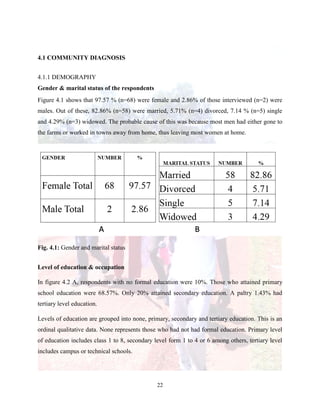
Figure 4.1 shows that 97.57 % (n=68) were female and 2.86% of those interviewed (n=2) were
males. Out of these, 82.86% (n=58) were married, 5.71% (n=4) divorced, 7.14 % (n=5) single
and 4.29% (n=3) widowed. The probable cause of this was because most men had either gone to
the farms or worked in towns away from home, thus leaving most women at home.
Fig. 4.1: Gender and marital status
Level of education & occupation
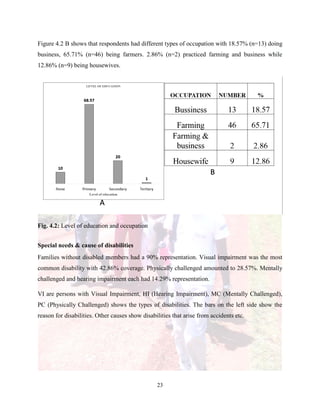
In figure 4.2 A, respondents with no formal education were 10%. Those who attained primary
school education were 68.57%. Only 20% attained secondary education. A paltry 1.43% had
tertiary level education.
Levels of education are grouped into none, primary, secondary and tertiary education. This is an
ordinal qualitative data. None represents those who had not had formal education. Primary level
of education includes class 1 to 8, secondary level form 1 to 4 or 6 among others, tertiary level
includes campus or technical schools.
23
Figure 4.2 B shows that respondents had different types of occupation with 18.57% (n=13) doing
business, 65.71% (n=46) being farmers. 2.86% (n=2) practiced farming and business while
12.86% (n=9) being housewives.
Fig. 4.2: Level of education and occupation
Special needs & cause of disabilities
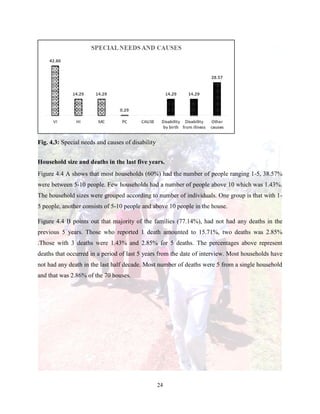
Families without disabled members had a 90% representation. Visual impairment was the most
common disability with 42.86% coverage. Physically challenged amounted to 28.57%. Mentally
challenged and hearing impairment each had 14.29% representation.
VI are persons with Visual Impairment, HI (Hearing Impairment), MC (Mentally Challenged),
PC (Physically Challenged) shows the types of disabilities. The bars on the left side show the
reason for disabilities. Other causes show disabilities that arise from accidents etc.
24
Fig. 4.3: Special needs and causes of disability
Household size and deaths in the last five years.
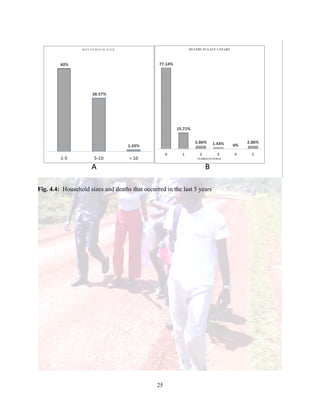
Figure 4.4 A shows that most households (60%) had the number of people ranging 1-5, 38.57%
were between 5-10 people. Few households had a number of people above 10 which was 1.43%.
The household sizes were grouped according to number of individuals. One group is that with 1-
5 people, another consists of 5-10 people and above 10 people in the house.
Figure 4.4 B points out that majority of the families (77.14%), had not had any deaths in the
previous 5 years. Those who reported 1 death amounted to 15.71%, two deaths was 2.85%
.Those with 3 deaths were 1.43% and 2.85% for 5 deaths. The percentages above represent
deaths that occurred in a period of last 5 years from the date of interview. Most households have
not had any death in the last half decade. Most number of deaths were 5 from a single household
and that was 2.86% of the 70 houses.
25
Fig. 4.4: Household sizes and deaths that occurred in the last 5 years
26
Housing conditions
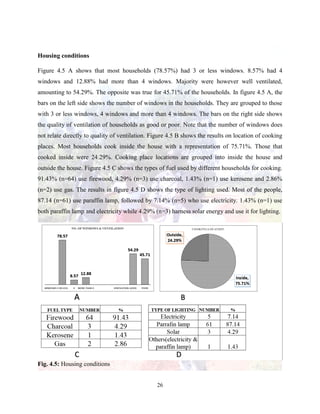
Figure 4.5 A shows that most households (78.57%) had 3 or less windows. 8.57% had 4
windows and 12.88% had more than 4 windows. Majority were however well ventilated,
amounting to 54.29%. The opposite was true for 45.71% of the households. In figure 4.5 A, the
bars on the left side shows the number of windows in the households. They are grouped to those
with 3 or less windows, 4 windows and more than 4 windows. The bars on the right side shows
the quality of ventilation of households as good or poor. Note that the number of windows does
not relate directly to quality of ventilation. Figure 4.5 B shows the results on location of cooking
places. Most households cook inside the house with a representation of 75.71%. Those that
cooked inside were 24.29%. Cooking place locations are grouped into inside the house and
outside the house. Figure 4.5 C shows the types of fuel used by different households for cooking.
91.43% (n=64) use firewood, 4.29% (n=3) use charcoal, 1.43% (n=1) use kerosene and 2.86%
(n=2) use gas. The results in figure 4.5 D shows the type of lighting used. Most of the people,
87.14 (n=61) use paraffin lamp, followed by 7.14% (n=5) who use electricity. 1.43% (n=1) use
both paraffin lamp and electricity while 4.29% (n=3) harness solar energy and use it for lighting.
Fig. 4.5: Housing conditions
27
Household activities
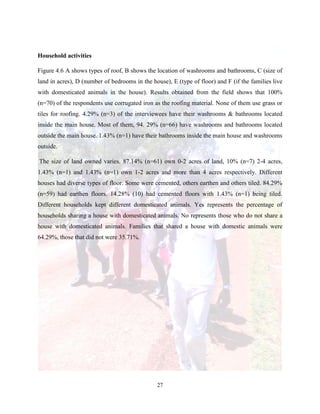
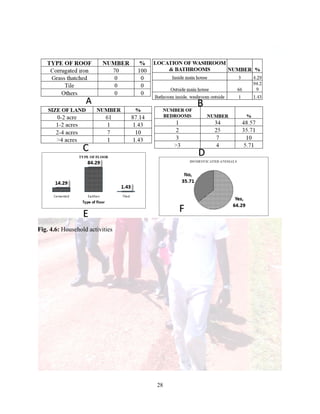
Figure 4.6 A shows types of roof, B shows the location of washrooms and bathrooms, C (size of
land in acres), D (number of bedrooms in the house), E (type of floor) and F (if the families live
with domesticated animals in the house). Results obtained from the field shows that 100%
(n=70) of the respondents use corrugated iron as the roofing material. None of them use grass or
tiles for roofing. 4.29% (n=3) of the interviewees have their washrooms & bathrooms located
inside the main house. Most of them, 94. 29% (n=66) have washrooms and bathrooms located
outside the main house. 1.43% (n=1) have their bathrooms inside the main house and washrooms
outside.
The size of land owned varies. 87.14% (n=61) own 0-2 acres of land, 10% (n=7) 2-4 acres,
1.43% (n=1) and 1.43% (n=1) own 1-2 acres and more than 4 acres respectively. Different
houses had diverse types of floor. Some were cemented, others earthen and others tiled. 84.29%
(n=59) had earthen floors. 14.28% (10) had cemented floors with 1.43% (n=1) being tiled.
Different households kept different domesticated animals. Yes represents the percentage of
households sharing a house with domesticated animals. No represents those who do not share a
house with domesticated animals. Families that shared a house with domestic animals were
64.29%, those that did not were 35.71%.
28
Fig. 4.6: Household activities
29
4.1.2 NUTRITION AND LIFESTYLE
Foods in the households surveyed
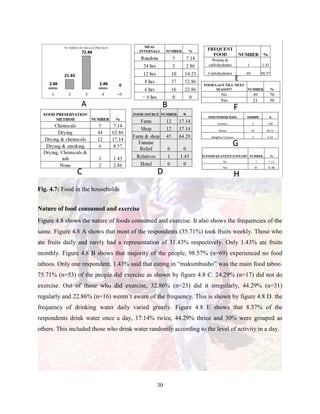
Figure 4.7 shows number of meals taken per day (A), meal intervals (B), food preservation
method (C), food source (D), frequent foods taken (E), if food harvested last till the next season
(F), food storage place (G) and whether the quantity of food is enough for the family (H).
Out of the respondents interviewed 72.86% (n=70), took three meals per day. 21.43% took 2
meals per day. Those who took 1 meal and 4 per day were both 2.86%. None took more than 4
meals per day. The number of meals were grouped into 1, 2, 3, 4 and above 4 meals per day.
7.14% (n=5) of the respondents randomly took meals. 2.86% (n=2) took ate after 24 hours,
14.23% (n=10) at a 12 hour interval, 52.86% (n=37) after every 8 hours, 22.86% (n=16) at a
6hour frequency. None took meals below every 6 hours. 7.14% (n=5) use chemicals to preserve
their food products. 62.86 % (n=44) rely on sunlight for drying, 17.14% (n=12) dry and use
chemicals, 8.57% (=6) dry and smoke the food products, 1.43% (n=1) use both smoke, chemicals
and drying as preservation method and only 2.86% (n=2) don’t preserve their foodstuffs. The
families obtain their foods from different places with 17.14% (n=12) getting them from farm.
The same percentage obtains their food from shops. 64.29% (n=45) rely on both farm and shop,
1.43% (n=1) gets food from relatives. None obtains food from famine relief or hotels.
98.57% (n=69) of the respondents take carbohydrates most frequently. 1.43% (n=1) take both
carbohydrates and proteins. 70% (n=49) of the interviews said that their food products lasted
them till the next season and 30% (n=21) had theirs depleted before the next season. 95.71% (n=
67) store their food in the house, 2.86% (n=2) in the granary and 1.43% (n=1) uses the
neighbor’s house to store food. 92.86% (n=65%) of the families had the food quantity enough for
them while 3.14% (n=5) got food deficit for the family.
30
Fig. 4.7: Food in the households
Nature of food consumed and exercise
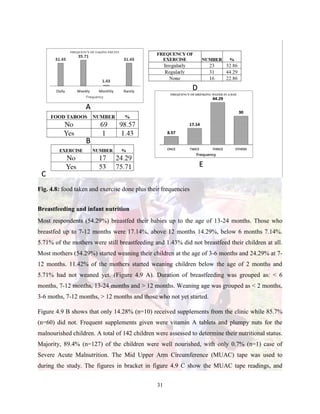
Figure 4.8 shows the nature of foods consumed and exercise. It also shows the frequencies of the
same. Figure 4.8 A shows that most of the respondents (35.71%) took fruits weekly. Those who
ate fruits daily and rarely had a representation of 31.43% respectively. Only 1.43% ate fruits
monthly. Figure 4.8 B shows that majority of the people, 98.57% (n=69) experienced no food
taboos. Only one respondent, 1.43% said that eating in “makumbusho” was the main food taboo.
75.71% (n=53) of the people did exercise as shown by figure 4.8 C. 24.29% (n=17) did not do
exercise. Out of those who did exercise, 32.86% (n=23) did it irregularly, 44.29% (n=31)
regularly and 22.86% (n=16) weren’t aware of the frequency. This is shown by figure 4.8 D. the
frequency of drinking water daily varied greatly. Figure 4.8 E shows that 8.57% of the
respondents drink water once a day, 17.14% twice, 44.29% thrice and 30% were grouped as
others. This included those who drink water randomly according to the level of activity in a day.
31
Fig. 4.8: food taken and exercise done plus their frequencies
Breastfeeding and infant nutrition
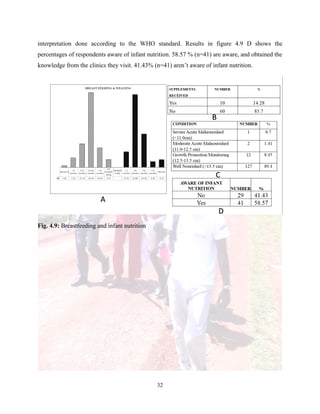
Most respondents (54.29%) breastfed their babies up to the age of 13-24 months. Those who
breastfed up to 7-12 months were 17.14%, above 12 months 14.29%, below 6 months 7.14%.
5.71% of the mothers were still breastfeeding and 1.43% did not breastfeed their children at all.
Most mothers (54.29%) started weaning their children at the age of 3-6 months and 24.29% at 7-
12 months. 11.42% of the mothers started weaning children below the age of 2 months and
5.71% had not weaned yet. (Figure 4.9 A). Duration of breastfeeding was grouped as: < 6
months, 7-12 months, 13-24 months and > 12 months. Weaning age was grouped as < 2 months,
3-6 moths, 7-12 months, > 12 months and those who not yet started.
Figure 4.9 B shows that only 14.28% (n=10) received supplements from the clinic while 85.7%
(n=60) did not. Frequent supplements given were vitamin A tablets and plumpy nuts for the
malnourished children. A total of 142 children were assessed to determine their nutritional status.
Majority, 89.4% (n=127) of the children were well nourished, with only 0.7% (n=1) case of
Severe Acute Malnutrition. The Mid Upper Arm Circumference (MUAC) tape was used to
during the study. The figures in bracket in figure 4.9 C show the MUAC tape readings, and
32
interpretation done according to the WHO standard. Results in figure 4.9 D shows the
percentages of respondents aware of infant nutrition. 58.57 % (n=41) are aware, and obtained the
knowledge from the clinics they visit. 41.43% (n=41) aren’t aware of infant nutrition.
Fig. 4.9: Breastfeeding and infant nutrition
33
4.1.3 HIV AIDS
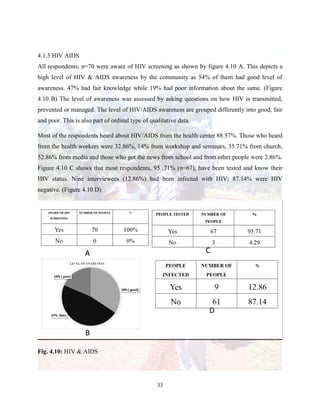
All respondents, n=70 were aware of HIV screening as shown by figure 4.10 A. This depicts a
high level of HIV & AIDS awareness by the community as 54% of them had good level of
awareness. 47% had fair knowledge while 19% had poor information about the same. (Figure
4.10 B) The level of awareness was assessed by asking questions on how HIV is transmitted,
prevented or managed. The level of HIV/AIDS awareness are grouped differently into good, fair
and poor. This is also part of ordinal type of qualitative data.
Most of the respondents heard about HIV/AIDS from the health center 88.57%. Those who heard
from the health workers were 32.86%, 14% from workshop and seminars, 35.71% from church,
52.86% from media and those who got the news from school and from other people were 2.86%.
Figure 4.10 C shows that most respondents, 95 .71% (n=67), have been tested and know their
HIV status. Nine interviewees (12.86%) had been infected with HIV; 87.14% were HIV
negative. (Figure 4.10 D)
Fig. 4.10: HIV & AIDS
34
4.1.4 HEALTH SEEKING BEHAVIOURS
Institution visited during illness
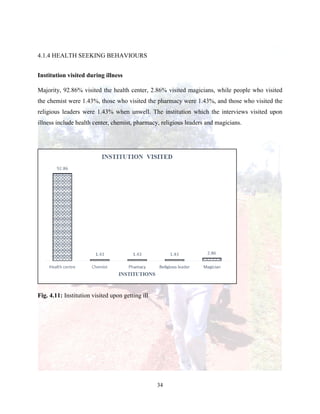
Majority, 92.86% visited the health center, 2.86% visited magicians, while people who visited
the chemist were 1.43%, those who visited the pharmacy were 1.43%, and those who visited the
religious leaders were 1.43% when unwell. The institution which the interviews visited upon
illness include health center, chemist, pharmacy, religious leaders and magicians.
Fig. 4.11: Institution visited upon getting ill
35
Distance from the health center & time taken to be served
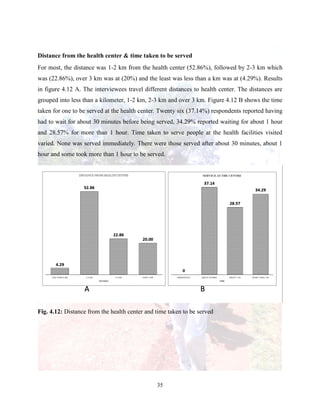
For most, the distance was 1-2 km from the health center (52.86%), followed by 2-3 km which
was (22.86%), over 3 km was at (20%) and the least was less than a km was at (4.29%). Results
in figure 4.12 A. The interviewees travel different distances to health center. The distances are
grouped into less than a kilometer, 1-2 km, 2-3 km and over 3 km. Figure 4.12 B shows the time
taken for one to be served at the health center. Twenty six (37.14%) respondents reported having
had to wait for about 30 minutes before being served, 34.29% reported waiting for about 1 hour
and 28.57% for more than 1 hour. Time taken to serve people at the health facilities visited
varied. None was served immediately. There were those served after about 30 minutes, about 1
hour and some took more than 1 hour to be served.
Fig. 4.12: Distance from the health center and time taken to be served
36
Availability of drugs, payment and affordability of health services
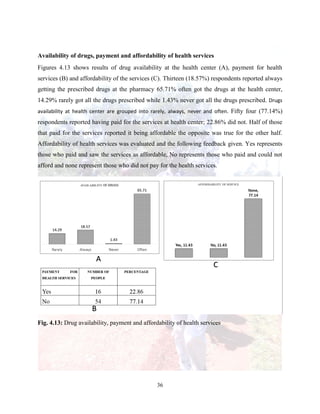
Figures 4.13 shows results of drug availability at the health center (A), payment for health
services (B) and affordability of the services (C). Thirteen (18.57%) respondents reported always
getting the prescribed drugs at the pharmacy 65.71% often got the drugs at the health center,
14.29% rarely got all the drugs prescribed while 1.43% never got all the drugs prescribed. Drugs
availability at health center are grouped into rarely, always, never and often. Fifty four (77.14%)
respondents reported having paid for the services at health center; 22.86% did not. Half of those
that paid for the services reported it being affordable the opposite was true for the other half.
Affordability of health services was evaluated and the following feedback given. Yes represents
those who paid and saw the services as affordable, No represents those who paid and could not
afford and none represent those who did not pay for the health services.
Fig. 4.13: Drug availability, payment and affordability of health services
37
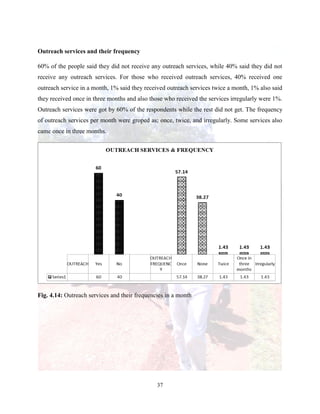
Outreach services and their frequency
60% of the people said they did not receive any outreach services, while 40% said they did not
receive any outreach services. For those who received outreach services, 40% received one
outreach service in a month, 1% said they received outreach services twice a month, 1% also said
they received once in three months and also those who received the services irregularly were 1%.
Outreach services were got by 60% of the respondents while the rest did not get. The frequency
of outreach services per month were groped as; once, twice, and irregularly. Some services also
came once in three months.
Fig. 4.14: Outreach services and their frequencies in a month
38
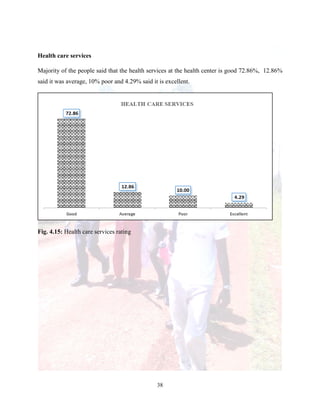
Health care services
Majority of the people said that the health services at the health center is good 72.86%, 12.86%
said it was average, 10% poor and 4.29% said it is excellent.
Fig. 4.15: Health care services rating
39
4.1.5 ENVIRONMENT, SANITATION, PERSONAL HYGIENE AND WATER SUPPLY
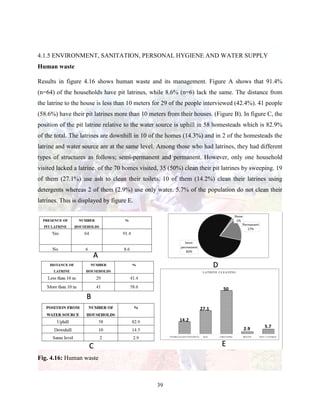
Human waste
Results in figure 4.16 shows human waste and its management. Figure A shows that 91.4%
(n=64) of the households have pit latrines, while 8.6% (n=6) lack the same. The distance from
the latrine to the house is less than 10 meters for 29 of the people interviewed (42.4%). 41 people
(58.6%) have their pit latrines more than 10 meters from their houses. (Figure B). In figure C, the
position of the pit latrine relative to the water source is uphill in 58 homesteads which is 82.9%
of the total. The latrines are downhill in 10 of the homes (14.3%) and in 2 of the homesteads the
latrine and water source are at the same level. Among those who had latrines, they had different
types of structures as follows; semi-permanent and permanent. However, only one household
visited lacked a latrine. of the 70 homes visited, 35 (50%) clean their pit latrines by sweeping. 19
of them (27.1%) use ash to clean their toilets. 10 of them (14.2%) clean their latrines using
detergents whereas 2 of them (2.9%) use only water. 5.7% of the population do not clean their
latrines. This is displayed by figure E.
Fig. 4.16: Human waste
40
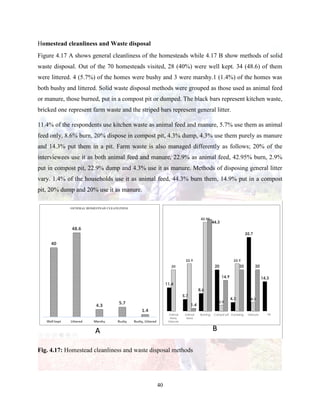
Homestead cleanliness and Waste disposal
Figure 4.17 A shows general cleanliness of the homesteads while 4.17 B show methods of solid
waste disposal. Out of the 70 homesteads visited, 28 (40%) were well kept. 34 (48.6) of them
were littered. 4 (5.7%) of the homes were bushy and 3 were marshy.1 (1.4%) of the homes was
both bushy and littered. Solid waste disposal methods were grouped as those used as animal feed
or manure, those burned, put in a compost pit or dumped. The black bars represent kitchen waste,
bricked one represent farm waste and the striped bars represent general litter.
11.4% of the respondents use kitchen waste as animal feed and manure, 5.7% use them as animal
feed only, 8.6% burn, 20% dispose in compost pit, 4.3% dump, 4.3% use them purely as manure
and 14.3% put them in a pit. Farm waste is also managed differently as follows; 20% of the
interviewees use it as both animal feed and manure, 22.9% as animal feed, 42.95% burn, 2.9%
put in compost pit, 22.9% dump and 4.3% use it as manure. Methods of disposing general litter
vary. 1.4% of the households use it as animal feed, 44.3% burn them, 14.9% put in a compost
pit, 20% dump and 20% use it as manure.
Fig. 4.17: Homestead cleanliness and waste disposal methods
41
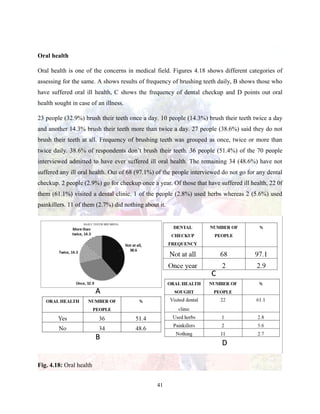
Oral health
Oral health is one of the concerns in medical field. Figures 4.18 shows different categories of
assessing for the same. A shows results of frequency of brushing teeth daily, B shows those who
have suffered oral ill health, C shows the frequency of dental checkup and D points out oral
health sought in case of an illness.
23 people (32.9%) brush their teeth once a day. 10 people (14.3%) brush their teeth twice a day
and another 14.3% brush their teeth more than twice a day. 27 people (38.6%) said they do not
brush their teeth at all. Frequency of brushing teeth was grouped as once, twice or more than
twice daily. 38.6% of respondents don’t brush their teeth. 36 people (51.4%) of the 70 people
interviewed admitted to have ever suffered ill oral health. The remaining 34 (48.6%) have not
suffered any ill oral health. Out of 68 (97.1%) of the people interviewed do not go for any dental
checkup. 2 people (2.9%) go for checkup once a year. Of those that have suffered ill health, 22 0f
them (61.1%) visited a dental clinic. 1 of the people (2.8%) used herbs whereas 2 (5.6%) used
painkillers. 11 of them (2.7%) did nothing about it.
Fig. 4.18: Oral health
42
Hand washing practices and personal hygiene
One of the good health practices in households include washing of fruits, vegetables and also
hand washing. Study conducted showed that 21.43% (n=15) do not wash fruits before eating and
78.57% (n=55) wash before eating, as shown by figure 4.19 A. Figure 4.19 B shows that 68
people, which amount to 97.14% of the respondents wash vegetables before cooking and 2.86%
(n=2) do not. Figure C indicates that 69 people (98.57%) wash hands before eating and 1.43%
(n=1) do not. Most households wash their hands before preparing food (91.43%, n=64) and
8.57% (n=6) do not. Only 10 respondents (14.23%) do not wash their hands after visiting the
toilet. Majority 85.71% (n=60) do wash.
Fig. 4.19: Personal hygiene and hand washing practices
43
Water supply and treatment
Figure 4.20 A shows that out of the 70 people interviewed, 44(62.9%) get their water from
springs. 14 of them (20%) get water from the river while 5 people (7.1%) have wells as their
water source. 4 of those interviewed which accounts for 5.7% use the borehole as a water source
whereas 2 of them (2.9%) use both spring and rain water. The remaining 1 person which
accounts for 1.4% of the population uses both the river and borehole. Distance of water source
from latrine was grouped into; 5-10, 10-50, 50-100 and above 100 meters. Out of the 70 people
interviewed, 53 (75.7%) found to have their pit latrines being over 100 m from their water
sources.11 among them (15.7&) have their latrines between 50 and 200 m away from the water
sources.5 people (7.1%) have their latrines and water sources separated by a distance of between
10 to 50 meters. (Figure 4.20 B).
On water treatment, 43 of those interviewed (61.4%) do not treat their water after they get it
from the water source; 27 people (38.6) used various water treatment methods before
consumption. (Figure 4.20 C). Among the 27 who treat their water, 16 of them (59.3%) use
chlorination and 8 of them (29.6%) boil their water before consumption. 2 (7.4%)) among those
who treat water use filtration method while 1 person (3.7 %%) among the interviewed uses both
chlorination and boiling. This is shown by figure 4.20 D. The water sources around the
community are mostly protected (Figure 4.20 E). 67 people (95.7%) of those interviewed said
their water source was protected compared to the 3 people (4.3%) who said it wasn’t.
44
Fig. 4.20: Water supply and treatment
45
4.1.6 CULTURAL PRACTICES AND TRADITIONS
Circumcision
Figure 4.21 A shows that 5 (7.1%) of the people we interviewed practice circumcision of their
male children at the age below five years, 35 (50%) at the age of between 6-10 years, 30 (42.9%)
at the age of between 11-15 years and no one practice circumcision at age above 15 years. Ages
at which circumcision is done was grouped into; below 5 years, 6-10, 11-15 and above 16 years.
Different communities use different places do circumcise. In the community, circumcision takes
place at home, health center and both at home and health center. 52 (74.3%) of the interviewee
practice circumcision at health center, 13 (18.6%) at home, 5 (7.1%) both at home and a times at
health center. (Figure 4.21 B).
Fig. 4.21: Circumcision
46
Wife inheritance
Different reasons for wife inheritance include; social stability, emotional support and financial
support. 20% of the respondents saw it to offer both emotional and financial support. 38.6% said
that there was no reason for wife inheritance. 7 (10%) of interviewee practice wife inheritance
for social stability, 7 (%) for emotional support, 15 (21.4%) for financial support, 14 (20%) for
both financial and emotional support, 27 (38.6%). practice wife inheritance without any reason.
(Figure 4.22 A).
Negative impacts of wife inheritance were grouped as economic exploitation, social instability
and disease transmission. 40% of the respondents were not aware of the impacts. 6 (8.6%) of
interviewee explain that the consequences of wife inheritance was economic exploitation, 15
(21.4%) as social instability, 21(30%) as disease transmission and 28 (40%) were not aware of
its repercussion, as pointed out by figure 4.22 B.
Fig. 4.22: Wife inheritance
47
4.1.7 COMMON HEALTH PROBLEMS
From the data collected common diseases for both children and adults includes; malaria 80%,
common cold 61.4%, while diarrheal diseases 35.7%, URTIs21.4%, Pneumonia25.7%, Skin
infections31.4%, Intestinal worms41.4% was common among children. Adults where mostly
affected by STIs21.4%, eye infections (11.4%), common cold (11.4%).Among less prevalent
diseases include Malnutrition (97.2%) and TB (92.5%).
DISEASE CHILDREN ADULTS BOTH NONE
Number % Number % Number % Number %
Diarrheal diseases 25 35.7 1 1.4 13 18.6 31 44.3
Malaria 8 10 2 2.9 56 80 5 7.1
Upper Respiratory Tract
Infections (URTIs)
15 21.4 6 8.6 21 30 28 40
Eye infections 7 10 8 11.4 1 1.4 54 77.2
Tuberculosis 1 1.4 3 4.6 1 1.4 65 92.5
Common cold 1 1.4 8 11.4 43 61.4 18 25.8
Pneumonia 18 25.7 5 7.2 1 1.4 46 65.7
Skin Infections 22 31.4 6 8.6 3 4.3 39 55.7
Sexually Transmitted
Infections(STIs)
0 0 15 21.4 0 0 41 58.6
Malnutrition 1 1.4 0 0 1 1.4 68 97.2
Intestinal worms 29 41.4 0 0 6 8.6 35 50
Fig. 4.23: Common diseases
48
4.1.8 MATERNAL CHILD HEALTH AND FAMILY PLANNING
Pregnancy, delivery, ANC care and immunization
Of the women studied, 12.86% reported having had their first pregnancy at age of 10-15 years,
61.43% at the age of 16-20, this is a majority of the respondents. 24.29% at the age of 21-25. The
least category was that of women above 25 years (Figure 4.24 A). This represented 1 out of the
70 which is 1.43%. Ages at which the respondents first got pregnant were grouped as 10-15, 16-
20, 21-25 and above 25 years. Places of delivery include; Health center, home with help of TBA,
home without help of TBA and others (Delivery on the way etc.). Figure 4.24 B shows that
majority of the respondents, 57.14% reported having delivered their last child in the Health
Centre. This is quite commendable. 20% of those interviewed delivered their last child at home
with the support of a TBA, this equaled those that delivered at home without the support of a
TBA; 20%. The remaining 2.86% delivered their last children under circumstances that were
termed as “others” (on their way to health center).
Interviewees visited clinic at different times during pregnancy for ante-natal care. The phases of
visit were grouped according to stages of pregnancy which were; first trimester, second trimester
and third trimester.70 out of the 70 women interviewed (100%) reported having visited the Ante-
natal clinic at some point during their pregnancy. There was however a variation in the time
when they first visited the clinic. Study showed that a majority, 52.86% first visited the ANC
during the 2nd
Trimester of their pregnancy, followed by 24.29% during the 3rd
Trimester. This
was closely followed by those that did so during the 1st
Trimester, which represented 22.86% of
the respondents. (Figure 4.24 C). The immunization schedule should be strictly adhered to.
Ninety six children under 5years were studied in the survey. 100% of the children had received
the following vaccines: BCG, Polio, DPT 1, and DPT 2. DPT 3 had been given to 92.71% of the
children leaving 7.292% without having received the same. 81.25% had at the time of the
interview received the measles vaccine, leaving 18.25% without. Vaccines in question were
BCG, Polio (first, second and third doses, DPT1, 2, 3 and Measles vaccines. (Figure 4.24 D).
49
Fig. 4.24: Pregnancy, ANC, delivery and immunization
Family planning
Figure 4.25 A shows family planning method used. Figure 4.25 B shows the challenges faced
during the use of FP methods. Family planning methods include; abstinence, use of condom,
Depo-Provera, Norplant and pills. Cases in which more than one method used was observed.
They include; use of Depo-Provera and Norplant, use of pills and Norplant and use of pills and
Depo-Provera. Some individuals never use any family planning method. Techniques used by
respondents for family planning were based on any method they had used and/or were using that
year up until the time of the interview. The most used method was Depo-Provera with 32.87%
women using it, followed by Norplant at 28.57%. Those who never used any fp method were
21.43%. Other methods (each 2%) were abstinence, condom use, pills, combinations of pills and
Depo-Provera, Norplant and Depo-Provera and combination of pills and Norplant at 1.43%.
Challenges encountered in family planning include; side effects, adherence, non-approval by
spouse, religious beliefs, and cultural beliefs. Some respondents encountered no challenges. The
predominant challenge to family planning was side effects with a representation of 54%. A
50
significant 37% reporting no challenge. Adherence, religious beliefs and cultural beliefs had no
impact on the same.
Fig. 4.25: Family planning
51
CHAPTER 5. DISCUSSION
This part of the report presents discussion of various findings.
5.1 DEMOGRAPHY AND HOUSING
Majority (97.57%) of the respondents were female. 100% were Christians, higher than the
national average of 82.6%. The high number of women could be attributed to the fact that most
homesteads had women at home looking after children and doing household chores at the time of
the interview. Most men had gone to towns or to the fields in search of livelihood for their
families. This is a common trend in the rural areas. The highest number of people per household
was ranging between 1 and 5, with an average of 5.5 which accounted for 60%. This is well
within the national average of 5.1 people per household according a survey by KIHBS. Strategies
for effective family planning should be rolled out into the community to avoid future
overpopulation. The range 5-10 had a representation of 38.57%. The least, 1.43% had a
household of more than 10 people. It was observed that a large portion of the families had a
lower economic status. As seen in the result section, only 18.57% (n=13) of the respondents had
businesses running, while the rest were farmers and housewives. Income generated from their
occupation could be meager, a probable cause of poverty in the region, with 62% of people in
both rural and urban areas in Vihiga County living in deficiency. Poverty could also pre-dispose
the community members to health problems like malnutrition and affect their HSBs. Number of
deaths registered were ranging between 0 and 5 deaths per household in the previous five years.
Those who had one death were 15.71%. Those with 2 deaths were 2.85%. Those with 3 deaths
were 1.43%. Those with 5 deaths were 2.85%. The results reveal a low mortality rate in the area.
Families with disabilities represented 10%. Most of the disabilities were visual impairment.
Mentally challenged people were 28.57% while physically impaired people were 28.57%.
Hearing impaired people were 14.29%. The county government of Vihiga should set up centers
that deal with people with disabilities in the region, like the Nyabondo Center for people with
disabilities. They can be established independently or in cooperated at the health centers
52
Churches and NGOs can also get involved to empower this less fortunate group, especially those
in lower economic strata of the society and teach them skills like farming and entrepreneurship.
The level of education in the community was a place of interest. Respondents with no formal
education amounted to 10%. Those who attained primary education were 68.57%. Those with
secondary education was 20%. Only 1.43% attained tertiary education. The finding was in line
with Western Kenya Region’s education level statistics, which show that 67.1% of the residents
had primary level of education, 12.7% had secondary level of education while only 1.8% had
tertiary level of education (Kenya Demographic and Health Survey, 2003). Good education level
equips one with knowledge to venture into a career of choice or apply the correct technological
know-how for a livelihood, a precursor to good economy and antidote to abject poverty.
The number of windows in the houses was small as most of the population, 78.57% had 3 or less
windows, most of which were not opened during the day. This has led to poor ventilation. Only
54.29% of the households had good ventilation. This could be a huge contribution to most of the
upper respiratory tract infections. It was evident that most of the population, 75.71% cooked
inside the house and only 24.29% outside. Considering the poor ventilation of most households,
the inhabitants are predisposed to common upper respiratory tract infections. An 84.29%
majority had earthen floors which very likely contributes to the high occurrence of fleas causing
jiggers in families with poor hygiene. Cemented houses were 14.28%, tiled were 1.43%. Most
families share a house with domesticated animals. This added up to 64.29% le. Those who had
separate house for the animals were 35.71%. This would cause stuffy and unpleasant odor in the
houses. Animals are also vectors for harmful insects that cause diseases. Pets have benefits to the
owners. For instance, they are companions and bring joy to the families. However, they do have
harmful effects on health. Cat’s feaces can predispose one to toxoplasmosis which causes
miscarriage in pregnant women. Their fur can be allergens to others. Therefore, proper handling
of the animals will ensure a positive health effect on the household members.
53
5.2 NUTRITION AND LIFESTYLE
A healthy diet is multi-factorial: age, gender, level of physical activity, geographical area, and
political influence among other factors. Being on the recommended diet decreases the likelihood
of malnutrition and non-communicable diseases, maintains health and promotes regression of
disease. According to the study in Emanyinya, 72.86% of the respondents took 3 meals per day,
21.43% 2 meals per day and there was a tie of 2.86% for those who took 1 meal and 4 meals per
day. There are 6 principles of a good nutrition. The diet should be adequate, balanced, moderate,
contain a variety of foods that provide different types of nutrients, have a correct nutrient density
and satisfies energy control. All respondents (100%) had consumed carbohydrates in the past
months and 1.43% had consumed proteins. No fat consumption was reported. This shows that
the diet is not balanced. The fact that there was 100% consumption of carbohydrates relates to
the geographical and dietary preference of the Abaluhya people which is mainly maize meal.
Weekly fruit consumption was 35.71%. Daily and monthly consumption was 31.43 and 1.43%
respectively. A significant 31.43% did not take fruits. Several studies show that fruit
consumption reduces the risk of heart diseases and tumors. Nevertheless, eating of fruits and
vegetables during the childhood and adolescent stage is important for nutrient provision,
establishment of an eating pattern of the same and maintenance of appetite.
All the respondents drank water daily with variation on the frequency; 44.29% drink water 3
times a day, 30% randomly depending on physical activities, 17.14% twice and 8.57% once a
day. According to Mayo Clinic, uptake of water depends on many factors like health,
environment and level of activity. Water that is lost during the day needs to be replenished. The
Institute of Medicine determined that an Adequate Intake (AI) for men is 13 cups (3 liters) of
beverages daily and the AI for women is 9 cups (2.2 liters) of the same daily. However, the “8
glass” rule, which accounts for 1.9 liters of water daily is still recommended because it is easier
to remember.
The WHO suggests that exclusive breast-feeding is recommended up to the age of 6 months with
continued breastfeeding along with appropriate complementary foods up to the age of 2 years.
Most respondents (54.29%) breastfed their babies up to the age of 13-24 months. Those who
54
breastfed up to 7-12 months were 17.14%, above 12 months 14.29%, below 6 months 7.14%.
5.71% of the mothers were currently breastfeeding and 1.43% never breastfeed their children at
all. Most mothers (54.29%) started weaning their children at the age of 3-6 months and 24.29%
at 7-12 months. 11.42% of the mothers started weaning children below the age of 2 months and
5.71% had not weaned their children yet. Major concern was 7.14% of the mothers who started
weaning before the age of 6 months and those who did not breastfeed at all. This shows that the
region has a higher number of children being weaned at an early age compared to the KDHS data
of 15% women who do the same countrywide. From the facts above, it is evident that most of the
women have not conformed to the required schedule of child nutrition, with exclusive
breastfeeding lower than the national average 61%. The women reported lack of breast milk and
that most of them had numerous jobs that did not allow them to breastfeed. This is unsafe to the
child as infant nutrition is important in maintaining the child’s immunity. According to the Baby
Center Expert Advice, low breast milk results from nipple pain, poor latch techniques, illness,
estrogen-based birth control pills and hormonal disorder. The environment is a determinant too.
It was noted that a large percentage of women (85.7%) did not receive supplements from the
clinic. The main supplement were the vitamin tablets. The blue capsules (100,000 International
Units) should be given to children between the ages of 6-11 months once every 6 months. The
red capsules (200,000 International Units) should be given at 12-59 months twice a year at an
interval of 6 moths. Other supplements include the plumpy nuts for the malnourished children.
The anthropometry shows that most of the children are well nourished (89.4%). There was only
one case of Severe Acute Malnutrition (SAM) representing 0.7%, which calls for immediate
referral to the health facility. Those on Growth Promotion Follow-up (GPF) were 8.45% and
should be continuously counseled. Supplements should also be given to the 1.41% with
Moderate Acute Malnutrition (MAN).
55
5.3 HIV AND AIDS
Majority of the respondents had heard about HIV from the health center and represented 88.57%.
This is due to the fact that health facilities received adequate support to address issues
concerning HIV and because also it is a policy for every patient that visit the health center and
the antenatal clinic for pregnant women to be tested for HIV. The people of Eshihuli and Epwopi
had basic information about HIV with rare in-depth knowledge; 47% had a fair knowledge about
HIV. Most of the people had been tested for HIV. Only 12.86% reported having person(s)
infected with the disease in their household. This was higher compared to the average of 1.99%
of PLWHA in Vihiga County. This may be attributed to the fact that cultural practices like wife
inheritance and traditional circumcision.
Efforts have been put by the governments in sub-Saharan Africa and other stakeholders to curb
the threat of HIV/AIDS. Rolling out of ARVs is one of the ways. Much still needs to be done as
AIDS has become a barrier of development in Africa. However, numerous factors regress the
efforts made to curb HIV/AIDS in Africa. One of these is culture. Cultural practices like Female
Genital Mutilation (FGM), wife inheritance, male circumcision, land inheritance and virginity
testing pose hindrance to eliminating the virus. Seeking to influence the cultural norms into a
manner that will help reduce the spread of HIV/AIDS will result into some aspect of cultural
adaptation. Human rights norms can have a transformative effect on culture, helping to reinforce
the positive effects of tradition and culture and undermining harmful effects (Paper
commissioned by the United Nations Economic and Commission for Asia and the Pacific by
Goonesekere).
5.4 HEALTH SEEKING BEHAVIOURS
Majority of respondents (92.86) visit the health center when they got sick. This high number
may be attributed to the fact that most of them are aware of the importance of modern health
care. The rest visit go to the magicians and/or religious leaders. It’s important for one to visit the
health center upon falling sick. Some go to the chemist to buy drugs to relieve the symptoms.
This can pose a health risk if proper prescription is not made. The health center is located 1-2
56
km from most people’s houses. Since many people go to the health center for medical care, there
was usually a long queue which made them wait for a while before they got served, some said
they had to wait for about 30minutes, others about an hour and the rest for more than one hour,
no one was served immediately. 65.71% of the respondents reported having gotten drugs at the
health center, 18.57% responded that they always got the prescribed drugs, 14.29% rarely got all
the prescribed drugs while 1.43% never got all the drugs prescribed. The health center
experiences shortages of drugs.
According 54 (77.14%) respondents, services at the health center were free; 16 (22.86%) paid for
services (buying a records book the first time they visited the health center). It was affordable for
50% of those that paid. `
Outreach services in the community are offered by the public health office, they include: door to
door polio immunization of children, jigger removal and fumigation of houses. 60% benefited
from the services. The remaining 40% was attributed to reluctance and ignorance.
The community perceived the services at the health center to be good. Majority reported
recovering when treated at the health center.
57
5.4 SANITATION, ENVIRONMENT AND WATER SUPPLY
WASTE DISPOSAL
Most of the households used their solid wastes as manure. The kitchen solid wastes were used as
manure by 25 households (35.7%). Solid farm wastes were used as manure by many households
but in this case it was in combination with other methods of disposal. Of the 70 households
visited, 30 (43%) use their solid farm wastes as manure and also dispose of it in compost pit.
Sixteen households (22.9%) use it as animal feed and manure. Another 16 (22.9%) households
use their solid farm wastes as manure and alternatively burn. The use of the wastes as manure
and animal feed is a good practice because the people reuse their wastes for beneficial purposes.
Those who dispose of it in compost pits should be encouraged to do so because after a period of
time, the waste decomposes and is used as manure in the farms. For the general litter, 31 (44.3%)
households burn their general litter; 10 (14.9%) use it as manure and dispose it in compost pits.
14 (20%) households dump their general litter and 14 (20%) use both pits and burning to
dispose their general litter. Most households that burned their waste did so for the inorganic
materials which were non-biodegradable. This prevents soil pollution though produces smoke
which is an agent of air pollution. Burning is also advantageous as it reduces the volume of
wastes to between 20-30% of the original. Most of the liquid wastes in the community are
poured away. Of the 70 households assessed, 49 (70%) pour away their kitchen liquid wastes.
The liquid farm wastes were mostly poured away.
The general cleanliness of 28 (40%) out of 70 homesteads was as well kept. Many homes, 34
(48.6%) were littered with 3 (4.3%) being marshy. Four out of 70, (5.7%) were bushy and 1
(1.4%) bushy and littered. The state of the homes influences the health of the families. Littered
homes attract flies which are vectors for some disease-causing organisms. Bushy homes provide
breeding grounds for mosquitoes which are agents of malaria transmission.
58
HUMAN WASTE
Of the 70 households assessed, 64 (91.4%) had pit latrines and 6 (8.6%) did not. Those who did
not own a latrine had alternatives; 5 out of the 6 people without latrines used their neighbor’s.
The remaining one person used one belonging to a church. All interviewees with latrines always
used them. The distance of the latrine from the houses was less than 10 meters for 29 (41.4%)
households. The remaining 41 (58.6%) have their latrines more than 10 meters from the house.
According to the World Health Organization, a latrine should be a minimum of 6 meters from
the house. This is both for accessibility and safety; the latrine can be reached even during bad
weather and the house can be kept free of odor from the latrine. In this case the households that
had their latrines less than 10m from the houses (44.14%) had small pieces of land which limited
their space. This predisposes them to health hazards such as vector-borne diseases by houseflies.
The distance of the latrines to the water source was more than 30 meters for 66 (94.3%) of the
households. It was less than 30 meters for 4 (5.7%). The latrines were located uphill relative to
the water sources in 58 (82.9%) households. They were situated downhill in 10 (14.3%) and at
the same level for 2 (2.9%) households. Generally, the community conformed to the WHO
recommended 30 m distance of latrine from the water source to avoid possible pollution by flow
of human excreta from the latrines to the water sources. The topography of the area largely
contributed to the location of latrines relative to water sources. The uphill position of the latrines
exposes the people to many health hazards because the place is rocky and therefore there are
cracks in the ground through which pollution of human wastes can flow from the latrine pits to
the water sources. This can lead to spread of water borne diseases in the community.
Most of the latrines in the community are semi-permanent. Of the 70 homesteads, 57 households
had a semi-permanent latrines and 13 had permanent ones. The figures include the type of latrine
used by those who owned none, meaning the structure of their alternatives were considered, in
this case the church and neighbor’s latrines. The structure of the latrine should be firm and safe
to the users. A permanent latrine with a firm foundation is preferred to the semi-permanent ones
because it is easier to clean and safer. The many semi-permanent latrines relate to poverty levels
in the community.
59
It was found that 35 (50%) households clean their latrines by sweeping; 19 (22.1%) households
used ashes to clean their toilets whereas 10 cleaned their toilets with detergents. Two households
(2.9%) use water and 4 (5.7%) did not clean their latrines at all. The method of cleaning a latrine
is influenced by its structure. The many semi-permanent latrines limit the cleaning of the latrine
to use of ash and sweeping. Only those with permanent structures can use detergents and water.
Despite this, the management of latrines was generally good.
A large part of the population 63 (90%) do not have taboos limiting the use of latrines. The
remaining 7 (10%) had taboos that limited sharing especially the father with children.
HYGIENE
Most interviewees 62 (88.6%) reported washing their fruits before consumption. The remaining
8 (11.4%) do not. This is because they find the fruits on trees as they walk around and do not go
back home to wash them. A 69 (98.6%) majority wash their hands before eating. Before food
preparation, 64 people (91.54%) wash their hands whereas the remaining 6 (8.6%) do not. Sixty
of the 70 (85.7%) interviewed wash their hands after visiting the toilet. Good hygiene ensures
good health in the home and in this case, diarrheal cases are highly prevented by the above
mentioned hygiene practices.
ORAL HEALTH
A large number of the people interviewed, 27 (38.6%) do not brush their teeth at all; 23(32.9%)
brush their teeth once a day and the remainder (28.6%) brush their teeth three times or more in a
day. Those found to have ever suffered ill oral health were 36 (51.4%). This relates to the oral
hygiene habits above. It was also found that 97.1% of the population do not go for any dental
checkup and those that did, did so only twice a year. This contributes largely to the many cases
of ill oral health. Another factor is lack of a dental clinic within the community and also high
poverty levels.
60
ENVIRONMENT AND WATER SUPPLY
A significant 44 (62.9%) get water from springs; 14 (20%) get it from the river. Figure 1 below
shows the efforts SOFDI, an NGO, are making to ensure safe drinking water for the community.
They have chlorine dispensers at strategic points where the villagers can treat their water after
f
PICTURE 1: A water spring and chlorine dispenser located near water point in Emusire sub
location, and constructed a barrier for the spring that is treated from the source.
POLLUTION
The most common cause of air pollution in the community is dust. Smoke is also an air pollutant
considering that many people cook inside the main houses. This is the cause of the cases of upper
respiratory diseases which are among the top ten infections recorded at the community health
center. Water pollution is mainly caused by domestic waste and the soil in the community is
polluted mainly by general litter which is disposed by landfill and burying. Waste disposal on the
land surface leads to production of methane which is a threat to the respiratory system of
humans. High concentrations of methane displace oxygen in air and the less oxygen
61
concentrations will lead to increased heart rates and in severe cases can cause convulsions and
coma.
5.5 CULTURAL PRACTICES AND TRADITIONS
Rite of passage
The rite of passage practiced by the sample population was circumcision of boys. The age at
which the rite was performed varied greatly among the respondents. Majority of the respondents,
50%, did it at the age of 6-10 years, followed by at 10-15 years for 42.9% of the respondents, 5
years and below represented 7.1% of the population, no circumcision was done to anyone above
15 years old. A 743% majority were circumcised at the health center this is encouraging as it
reduces the chances disease transmission. However, 18.6% underwent the ritual at home by
specially trained individuals from Bunyore community.
According to WHO, male circumcision is the surgical removal of all parts of the foreskin of the
penis. WHO determined that the main reason for male circumcision is for religious and cultural
purposes. Male circumcision is one of the cultural practices with positive effects on health if
done in a clinical setting, but poses a health risk if carried out traditionally using one knife.
Evidence shows that male circumcision reduces the risk of HIV infection among heterosexual
males. The WHO recommends circumcision as part of comprehensive HIV program in areas
with high rates. Circumcision is also associated with reduced rates of cancer causing forms of
Human Papilloma Virus (HPV) and risk of both urinary tract infections and penile cancer. The
step that the community has taken to embrace hospitals for circumcision further reduces the risk
of contracting HIV.
Marriage
Majority of the respondents (75.4%) had a traditional ceremony while, 24.6% practiced religious
type of marriage in which religious leaders presided over. These is because of little western
62
influence as far as marriage is concerned. Polygamy was practiced among 60% of the population
with only 40% being monogamous. It was also noted that polygamous had more respect from
their peer because of perceived wealth. Polygamy should be excoriated because it plays a huge
role in transmission of STIs and HIV. It also reduced asses to some basic and secondary needs
e.g.; education of children. It is a key factor behind increase poverty level within the community
Wife inheritance
Wife inheritance is a cultural practice in which a widow is required to marry a kinsman of her
late husband, often his brothers. The custom is justified on the basis that it ensures that the
wealth does not leave the patrilineal family, and for protection of wife and children.
Most of the respondents (58.6%) practice wife inheritance following the event of husband’s
death while the remaining (41.4%) did not. This plays a role in transmission of HIV. According
to 58.6% of the respondents, no specific person who inherited the widow. There was a 73.2%
chance that they would be inherited by husband’s brother, 14.4% by non-family member and
12.2% by anyone else. Wife inheritance was done by majority of respondents (38.6%) for no
reason, 21.4% for financial support, 20% for both financial and emotional support, 10% for
social stability and the other 10% for emotional support. The impacts of wife inheritance were
disease transmission (30%), social instability (21.4%) and economic exploitation represented by
8.6%.Most respondents (40%) were not aware of the repercussion of wife inheritance. The
community should be educated on the negative effects of wife inheritance.
Birth rituals
Majority of the respondents (61.4%) performed rituals at birth to signify a new life whereas
38.6% did not. Among those that performed rituals (81.4%) performed naming and shaving of
their infants, 11.6% used herbs to bathe the child and the remaining 7% prayed for their child
before leaving the bedroom to keep evil spirits at bay.
Death/burial
Majority of respondents (55.7%) performed rituals after demise of their member while the
remaining 44.3% did not. Amongst the rituals performed include shaving of the heads of the
63
family members and relatives (65.2%), some slaughtered a cow or chicken (15.5%).This practice
can be key factor in the spread of diarrheal diseases associated with poor hygiene and spread in a
short time to the relatively large population of attendees. The remaining 19.3% underwent
traditional cleansing ceremony whereby they were isolated and their movement restricted during
mourning period. The burial ceremonies for a majority of respondents (80%) were conducted
religiously by the church leaders while the remaining 20% conducted burials traditionally
presided majorly by elders. Drum beating and bawling was done to mourn the deceased and
console the bereaved. The deceased was buried with their heads facing west. Bull was
slaughtered if the deceased was an adult male while at cow if slaughtered if the bereaved was an
adult female. This shows that culture is still valued in many community.
5.6 COMMON HEALTH PROBLEMS
The major illnesses among the children are malaria (10%), diarrheal cases (35.7%), Upper
Respiratory Tract Infections (21.4%), skin infections (31.4%) and intestinal worms (41.4%). In
adults, they include Sexually Transmitted Infections, URTI, malaria and skin infections. This
information matches the one which was collected in the health center, thus showing a common
trend of diseases in the region. Malaria cases are peek in April, the month which has long rains.
This is due to collection of stagnant water and the breeding grounds provided by plants in the
farm. Malaria is managed by administration of anti-malarial drugs like Artemether Lumefantrine
and prophylaxis like chloroquine. Control methods include sleeping under treated mosquito nets,
biological methods like sterilization of males, draining of stagnant water and clearing of bushes.
Upper respiratory tract infections are mainly caused by the poor ventilations in the households
that have cooking places inside. The dust on the surrounding murram roads during the sunny
days also contributes significantly. Diarrhea, skin infections and intestinal worms are caused by
low hygiene standards in the community. Through the community health workers and public
health workers the health facility can organize door to door campaigns on sanitation and hygiene.
This would help in educating the community on the importance of hygiene and in the long run
prevent most of this diseases.
64
5.7 MATERNAL CHILD HEALTH AND FAMILY PLANNING
Majority of the interviewees, 43 (61.43%) reported having had their first pregnancy at their first
pregnancy at the age of 16-20. The age group with the least respondents for the same was above
25 years old. This is consistent with the World Fact Book by the USA’s Central Intelligence
Agency which estimates the national average at 19.1 years. Primary education in Kenya begins at
age 6 and runs for eight years (UNICEF Kenya/2009), therefore secondary education would
generally run between the ages of 15 and 19. This is however the age at which most of the
population had their first pregnancy. According to Kenya Demographic and Health Survey
(KDHS 2008-09), age at first birth increases with wealth and education. Women with no or
primary education have their first birth at a median age 18.7 compared with 22.1 among women
with secondary and higher education. This is explained by the fact that majority of women (more
than 65%) in this survey had attained only primary education and 10% with no education.
All the respondents in this survey reported having visited the ante-natal clinic at least at once
during their first pregnancy. The variation came with the time of initiation. Majority initiated the
visits during the 2nd
trimester, this represented 37 (52.86%). The smallest number, 16 (22.86%)
initiated the visit during the first trimester. This is contrary to WHO and the Ministry of Health’s
standards both of which recommend that the first visit should be as soon possible in order to
increase the chances of achieving the 4 recommended visits. From the focused group discussions
and casual talk with patients at the Ante-natal clinic (ANC) the major citations for delaying ANC
visit were: fear of reprimand of the young mothers from the nurses for getting pregnant instead
of being in school, non-approval by the babies’ fathers, limited understanding of the importance
of visiting the ANC as soon as possible and the distance between to health center from home
being large.
Despite the fact that there was 100% ANC visit, only 40 (57.14%) of the women delivered at the
health center. This is commendable because majority of the women have a reduced risk of death
due to birth complications. This is also higher than the average of Vihiga County which stands at
50.2%. This is presumably because the residents are well informed. The remaining percentage
however have risky deliveries, 14 (20%) had their deliveries at home with the help of a
65
Traditional Birth Attendant (TBA), another 14 (20%) had deliveries at home without of a TBA.
A potential reason for delivering with support of a TBA is that the women still trust the TBA
more than they do the trained health professionals especially because of their perceived
negligence and harshness. Others cited distance to health center as the major obstacle. Those
who delivered without a TBA reported that they were able to do it by themselves hence did not
need to seek help. The remaining 2 (2.86%) delivered on their way to health center.
All 96 (100%) of the children studied had received the following essential vaccines: BCG, Polio,
DPT1, and DPT2. Only 7 (7.292%) and 18 (18.75%) had not received the 3rd
DPT and measles
vaccines respectively. This is majorly due to the extensive and intensive work done by the public
health officer, Mr. Maganga and his team of Community health workers (CHW) to see that the
national average of 92.71% of children having basic vaccines beaten. The population in the
catchment area are therefore well informed on matters vaccination. They are making tremendous
steps towards achieving the fourth millennium development goal (reducing child mortality).
Majority of the interviewees, 62 (88.57%) were aware of family planning, leaving only 8
(11.43%) not aware of the same. This again shows that the community is well informed thanks to
the work done by the public health office. Most of those that were aware, most reported having
used more than one form of contraception during that year up until the time of the interview. The
reason cited was the side effects of the first method, there was however the will to plan their
families which caused the change to the second method with little or no side effects. Usage of
Depo Provera alone was 23 (32.86%), making it the most popular. Two respondents (2.857%)
had been on pills but changed to Depo Provera. This is explained by perceived efficiency and
convenience of the same. From our observations most preferred the 3- months- interval
injections. Fifteen respondents 15 (21.43%) were not any form of contraception mainly because
they were intending to conceive, with a few citing side effects as the stumbling block. Pills and
abstinence were the least popular methods, each with a representation of 2.857%. Many reported
perceiving pills as less effective due to their non-invasive nature. The data was within the KDHS
research on contraception that saw injectable having high priority of use, followed by implants
then pills.
Side effects (54.29%) and non-approval by spouse (2.857%) were the only challenges reported
in the use of contraception. A significant 30 (42.86%) reported not experienced any challenge.
66
Cultural beliefs, religious beliefs and adherence had no impact on family planning. Side effects is
explained by the fact that artificial forms of contraception are chemical compounds and therefore
alter the body functions in a way, albeit mildly when used in correct amounts. Non-approval is
because of their conservative nature and resistance to change. This community is therefore
enlightened, especially because cultural beliefs do not stop them from planning their families.
67
CHAPTER 6. CONCLUSION
Most of the respondents were female. The average household size was 5.5 people. This shows
some evidence of effective family planning. The study area had a low mortality rate shown by
77.14% of the households reporting 0 deaths over the last 5 years. Only one out of 70 attained
tertiary education, with majority leaving at primary level. The community has a general low level
of formal education, which is a factor in high poverty levels. URTIs were rampant due to the
poor ventilation of the houses. The situation was worsened by the fact that majority (75.71%)
cook inside the poorly ventilated houses, in which domestic animals also reside. The nutritional
status of the community was generally good. This is contributed to by the conducive climate that
promotes food security. A significant number of breastfeeding and would-be mothers lack
knowledge about importance of exclusive breastfeeding and weaning at 6 months age. It was
impressive that 100% of the interviewees were aware that HIV exists, and that 95.71% know
their status. However, more should be done to educate them on HIV and AIDS. The fact that a
majority of 92.86% visited the health center upon getting sick displays the good health seeking
behavior. There is a general positive attitude towards conventional medicine.
Waste disposal in the community is mainly by burning and using them as manure. Majority of
the households have pit latrines which are located mostly more than 10 meters from the houses.
Many of the latrines are located uphill relative to the water sources and are more than 30 meters
away. The latrines are mostly semi-permanent in structure. Majority of the homesteads are
littered and some are bushy thus the malarial cases diagnosed at the health center. Many people
observe good food and body hygiene and this relates to low diarrheal cases. Dental health is
poorly observed in the community. Water springs are the major sources of water for the
community and many people do not treat their water before drinking. The major water pollutant
is domestic waste and air is mainly polluted by dust and smoke which is due to the practice of
cooking in the house. The rite of passage for the community is male circumcision, whose
traditional practice is being replaced with surgical circumcision at the health center. Wife
inheritance is also a concern. 61.43% of the respondents had their first pregnancy at the age of
16-20 years, this is directly linked to the low levels of formal education.
68
It was commendable that 100% of the women visited clinic during pregnancy, but contradictory
as only 57.14% delivered at the health center. Depo Provera was commonly used FP method.
69
CHAPTER 7. RECOMMENDATIONS
THE SCHOOL OF MEDICINE
i. Undertake medical camps to enlighten the community on health issues that will fulfil the
preventive aspect of Primary Health Care.
ii. Improve on transport of students during the entire program and timely availing required
materials for smooth running process.
iii. Do enough preparations including finishing theory lectures on community health and
biostatistics and availing the necessary materials before the attachment.
iv. Avail supervisors who are conversant with the attachment to new centers to ensure
smooth running of activities.
THE HEALTH FACILTIY
The health facility should continue working closely with the Public Health Office and CHVs to
conduct outreach programs and door to door vaccinations to be able to improve the health status
of the community they serve.
THE COMMUNITY
Parties involved in wife inheritance should know their status before getting engaged in
remarriage to avoid infection. The community should also improve on maintaining healthy status
by treating their drinking water and observing general body hygiene.
THE GOVERNMENT
The government should:
i. Fund Emusire Health Center, increase the workforce and improve on the infrastructure
there.
ii. Work in partnership with other NGOs to better the lives of the villagers.
iii. Implement the research reports done through the County Director of Health at the County
level.
70
REFERENCES
1. Birch, L.L. 1999, 'Development of food preferences', Annual Review of Nutrition, v.19,
pp.41-62.
2. Birmingham City University, Center for Academic Success, Study guide: writing,
updated 7th
January 2011.
3. Gibney, M., Lanham-New, S., Cassidy, A. & Vorster, H. 2009, Introduction to human
nutrition, 2nded, Wiley-Blackwell, San Francisco. Walsh, A. & Nelson, R. 2010, 'The
link between die and health: An exploratory study of adolescents in Northern Ireland
using food maps', International Journal of Consumer Studies, v.34, pp.190-195.
4. Gideon Were, Western Kenya, EALB, Nairobi, 1967.
5. Glacomo Lazzeri, Andrea Pammolli, Elena Azzollini, Rita Simi, Veronica Meoni, Daniel
Rudolph de Wet and Mariano Vincenzo Giacchi, Association between fruits and
vegetables intake and frequency of breakfast and snacks consumption: a cross-sectional
study.
6. Green Lawrence w, McKenzie, James f, Encyclopedia of Public Health, 2002
7. Jennifer Callen, RNC, MSC; Janet Pinelli, RNC, MSCN, DNS, A Review of the
Literature Examining the Benefits and Challenges, Incidence and Duration, and Barriers
to Breastfeeding in Preterm Infants.
8. Koppen and Gregor, Climate-Data-org, viewed 20 September 2015.
9. Lake Victoria North Water Service Board, Hygiene and Sanitation Awareness Campaign
Report, April 2012.
10. Lytle, L.A., Himes, J.H., Feldman, H., Zive, M., Dwyer, J., Hoelscher, D. et al. 2002,
'Nutrient intake over time in a multi-ethnic sample of youth', Public Health Nutrition, v.5,
n.2, pp.319-328.
11. M. Sundaravadivel, S. Vigneswaran, Rural Water Supply Systems.
12. Ministry of Health, Emuhaya News, Emuhaya Constituency Development Fund (CDF),
Issue No. 12, January-June 2012.
13. Ministry of Health, Evaluation of the Community Health Strategy Implementation in
Kenya, October 2010.
14. Ministry of Health, Kenya AIDS Response Progress Report, 2014.
71
15. Ministry of Health, Kenya Demographic and Health Survey 2009.
16. Ministry of Health, Kenya Demographic and Health Survey 2014.
17. Ministry of Health, Kenya HIV County Profile, 2014.
18. Packland Baseline Report in Western Kenya 2010.
19. Patrick, K., Norman, G.J., Calfas, K.J., Sallis, J.F., Zabinski, M.F., Rupp, J. et al. 2004,
'Diet, physical activity, and sedentary behaviors as risk factors for overweight in
adolescence', Archives of Pediaric Adolescent Medicine, v.158, pp.385-390.
20. Pesa, J.A. & Turner, L.W. 2001, 'Fruit and vegetalbe intake and weight-control behaviors
among US youth, American Journal of Health Behavior, v.25, n.1, pp.3-9.
21. Rashmi Shah, U.S Sharma & Abhay Tiwan, Rushtamji Institute of Technology, 2012.
22. Samson Kironde and Martha Kahirimbanyi, community participation in primary health
care (PHC) programmes: Lessons from tuberculosis treatment delivery in South Africa,
African Health Sciences, Makerere Medical School.
23. SWAP Kenya, Safe Water And AIDS Project, Annual Report, 2013.
24. UNEP (2013), Guidelines for Waste Management Strategies.
25. UNICEF Kenya /2009/ d’Elbee.
26. UN Millennium Declaration, September 2000.
27. World Fact Book- CIA.
28. World Health Organization, Guidelines on HIV and infant feeding 2010, Principles and
recommendations for infant feeding in the context of HIV and a summary of evidence
72
APPENDICES
APPENDIX ONE: INTERVIEW GUIDE DURING COMMUNITY ENTRY
History of the community
1. Can you tell us what you know about the community?
2. What is the name of the community/ethnic group?
3. Where did the people who settled here come from?
4. When was that?
5. What have you heard others say about the community?
Historical events
1. Can you tell us about the major events that have occurred in the
community?
2. When did they occur and why?
3. How did these events affect the community?
a. Economically
b. Socially
c. Health wise
Cultural practices
1. Can you tell us what you know about the cultural practices of the
community?
2. What social events take place in this community?
73
3. When do they take place?
4. What do they signify?
5. In your opinion what are the cultural practices that benefit the health of your community?
How are they beneficial?
6. What about those that are not beneficial/ why are they not beneficial?
Health seeking behaviors
1. What are the major illnesses in your community?
a. For the children
b. For the adults
In your opinion what causes them?
2. What can the community do to prevent them
3. Who are the health care providers in the community?
4. What is the nature of their work?
5. What do people in the community do when they fall sick?
6. Where do they go to get treatment?
7. Why do they go there?
Nutrition
1. What is the community’s staple food?
2. What are the main farming seasons of the year?
3. What crops are grown in each season?
4. What are the main methods of food storage in the community?
5. What are the taboos surrounding food in the community?
74
APPENDIX TWO: QUESTIONNAIRE USED TO CONDUCT COMMUNITY
DIAGNOSIS
MASENO UNIVERSITY
SCHOOL OF MEDICINE
MBChB PROGRAMME
MCH 202: COMMUNITY HEALTH 1
COMMUNITY DIAGNOSIS QUESTIONNAIRE
SEPT-OCT 2015
75
QUESTIONNAIRE NO.
HEALTH CENTRE …………………………………………………………….
VILLAGE ………………………………………………………………
SUB-LOCATION ………………………………………………………………
LOCATION/DIVISION ……………………………………………………………
DISTRICT ………………………………………………………………
DATE OF INTERVIEW ………………………………………………………………
INTERVIEWER NO. ………………………………………………………………..
SECTION A: DEMOGRAPHY
76
1. Date of birth.....................................
2. Gender
 Male
 Female
3. Marital status
 Single
 Married
 Divorced/separated
 widowed/widower
4. Number of children
 Male………………..
 Female…………….
5. Household size..............
6. Number of deaths in the family over the last five-year......................
7. Family members with special needs:
 Yes
 None
8. The nature of disability in case 7 above is yes
 Visual impairment
 Hearing impairment
 Mentally challenged
 Physically challenged
9. Causes of the conditions in 8 above (in case they are known)
 By birth
 Resulting from severe illness
 Any other specify………………………………………
10. Level of formal education:
 None
 Primary
 Secondary
 Tertiary
11. Occupation
 Farming
 Business
 Government employment
 Others…………………………………………………….
12. Religion:
 Christian
 Muslim
 Hindu
 Atheist
 Others
77
SECTION B: HOUSING
1. What type of house do you live in observed?
 Permanent
 Temporary
 Semi- permanent
2. How many windows does this house have?
 3 or less
 4
 More than 4
3. Assess the ventilation of the house
 Good
 Poor
4. What is the number of bedrooms in the house?
 1
 2
 3
 More than three
5. What is the type of roofing material?
 Corrugated iron
 Grass thatched
 Tile
 Others (specify).
6. Where is your cooking place?
 Inside the main house
 Outside the main house
7. What is the MAIN type of fuel used in the homestead?
 Firewood
 Charcoal
 Kerosene
 Gas
 Others (specify)
8. What is the type of lighting used?
 Electricity
 Paraffin lamp
 Solar
 Others (specify)…………
9. Where are your washrooms and bathroom located?
 Inside the main house
 Outside the main house
10. What type of floor?
 Cemented
 Earthen
11. What is the size of the land on which your house is built?
 0-2 acre
78
 2-4 acres
 More than 4 acres
12. Do the family share house with domesticated animals?
 Yes
 No
SECTION C: NUTRITION AND LIFESTYLE
1. How many meals do you usually take per day?
 1
 2
 3
 4
 > 4
2. What are the Meals intervals?
 Random
 24hrs
 12hrs
 8hrs
 6hrs
 Less than 6hrs
3. What type of food did you take frequently over the last one month:
 Proteins
 Carbohydrates
 Fats
4. What are your sources of the food?
 Farm
 Shop
 Hotel
 Famine relief food supplies (from Govt/ NGO Aids)
 Others (specify)
79
5. Which food crops do you grow? (Tick appropriately)
Carbohydrates Legumes Vegetables Fruits
Wheat Beans Sukuma Bananas
Maize Peas Cabbage Oranges
Millet Others Spinach Pineapple
Sweet potatoes Managu Mangoes
Irish potatoes(waru) Saga Passion fruits
Cassava Mchicha Pawpaw
Matoke Mrenda others
Yams kunde
others
6. Do your food crops last to the next harvest season?
 Yes
 No
7. How do you preserve your food?
 Drying
 Smoking
 Chemicals
 Ash
 Others……………..
8. How do you store your food?
 House
 Granary
 Others
9. Is the quantity of food cook enough for the family?
 yes
 No
80
10. How often do you take fruits?
 Daily
 Weekly
 Monthly
 Rarely
11. Are there any taboos inhibiting intake of certain foods?
 Yes
 No
12. If yes, specify…………………………………
13. What animal products have you consumed in the past 1-week?
 Milk
 Meat
 Chicken
 Fish
 Others……………
14. Do you exercise?
 Yes
 No
15. If yes, How often?
 Regularly
 Irregularly
16. How often do you drink water in a day
 Once
 Twice
 Thrice
 Others……………………
17. For how long did you breast-feed your last child?
 Not at all
 Less than 6 months
 7-12months
 13-24 months
 More than 2 years
18. At what age did you start weaning your last child?
 Less than 2 months
 3-6 months
 7-12 months
 More than 12 months
19. What food did you use for weaning?
 Formulae (eg cerelac)
81
 Porridge
 Mashed potatoes
 Fruits
 Others……………….
20. Do you receive any supplement from the clinic?
 Yes
 No
21. If yes, specify…………………………………………………..
22. Do you have access to information on infant nutrition?
 Yes
 Now
23. If yes
specify………………………………………………………………………………………
……………………………………
13. Anthropometry
child Gender Date of birth Height (cm) Weight(kg) MUAC
1
2
3
4
5
6
7
8
9
SECTION D: HIV/AIDS
1. Have you heard about HIV/AIDS?
 YES
 NO
2. If yes where did you get the information?
 Health Centre
 Health worker
 Church
 Workshop and Seminars
 Media
 Others………
3. Are you aware of HIV screening?
82
 Yes
 No
4. Assess the level of awareness of the interviewee on HIV/AIDS (with regard to modes of
transmission, prevention and treatment)
 Poor
 Fair
 Good
5. Have you been tested for HIV/AIDS
 Yes
 NO
6. If yes when?
7. Do you have infected persons in your family?
 Yes
 No
8. In the event of illness which of the following institutions do you visit?
 Herbalist
 Magician
 Health center
 Religious leader
 Others………………..
9. How far is the nearest Government Health Center?
 Less than a kilometer
 1-2km
 2-3km
 Over 3km
10. After how long is one served at the health center?
 Immediately
 About 30 mins
 About 1 hr.
 More than 1 hr
11. Do you get all the drugs prescribed at the Health Centre?
 Never
 Rarely
 Often
 Always
12. Do you pay for the health services
 Yes
 No
13. If yes is it affordable?
 Yes
 No
14. What was your experience when you visited the health center? (Explain if good or bad)
......................................................................................................................................................
........................................................................................................................................
15. Are there any door-to-door services or outreach services conducted by the health Centre
within this community?
83
 YES
 NO
16. If yes, how often do you get the services in a month?
 Once
 Twice
 Thrice
 Every week
17. Rank the quality of healthcare services provided at the nearest Government Health Facility.
 Excellent
 Good
 Average
 Poor
18. Do you use any other health facilities in this community?
 District hospitals
 Chemistry
 Dispensary
 Others……………………………………….
SECTION E: SANITATION
I. WASTE DISPOSAL
METHOD OF
DISPOSAL
TYPES OF WASTE
Kitchen waste Farm waste General litter
Solid Liquid Solid Liquid Solid Liquid
Pouring or
dumping
Pit
Burning
Compost pit
Animal feeds
Manure
Others
II. HUMAN WASTE
1. Do you have a pit latrine?
 Yes
 No
2. If yes, do you use it?
84
 Always
 Sometime
 Rarely
3. If no, what do you use?
 Flying toilet
 Bush
 Direct into the water source
 Others, specify……………………..
4. How far is the latrine from the homestead?
 Less than 10M
 More than 10M
5. How far is the latrine from the water source:
 Less than 30M
 More than 30M0
6. What is the position of the latrine from the water source?
 Up hill
 Down hill
 Same level
7. How is the latrine structure
 Permanent (Cement floor)
 Semi-permanent (Mad/timber floor)
8. How do you keep it clean?
 Chemical (detergents)
 Ash
 Others…………………
9. Are there taboos associated with sharing latrines?
 YES
 NO
10. If yes, specify…………..
11. Observe the general cleanliness of the compound.
 Well kept
 Marshy
 Bushy
 Littered
III.HYGIENE
1. Do you wash your fruits before eating?
 Yes
 No
2. Do you wash your vegetable or other foods before cooking?
 Yes
 No
3. Do you wash your hands:
a) Before eating
 Yes
 No
85
b) Before preparing food
 Yes
 No
c) After visiting the toilet
 Yes
 No
19. How many times do you brush your teeth in a day?
 Not at all
 Once
 Twice
 More than twice
20. Have suffered ill oral health (teeth, gums and buccal cavity)
 Yes
 No
21. If yes, what did you do?
 Visited a dental clinic
 Used herbs
 Others (Specify)………………….
22. How often do you go for dental check up in a year?
 Not at all
 Once
 Twice
 More than twice
SECTION F: ENVIRONMENT AND WATER SUPPLY
1. What is your water source?
 Spring
 River
 Well
 Borehole
 Lake
 Rain water
2. What is the distance to the water source?
 0-50 meters
 50-200 meters
 200-500 meters
 500-1000metres
 Above 1000 meters, specify……………….
3. Is your water source protected?
 Yes
 No
4. How do you store your water?
 In pots/ sufurias
 In tanks
86
 In drums
 Buckets
 Other means, specify………………..
5.Which containers do you use to transport your water?
 Jerricans
 Buckets
 Earthen pots
 Others, specify…………………
6.Do you treat your water?
 Yes
 No
7.If yes, which of the following methods do you use?
 Chlorination
 Filtration
 Boiling
 Sedimentation
 Others, specify…………………
8.How far is your water source from the latrine?
 0-5 meters
 5-10 meters
 10-50 meters
 50-100 meters
 More than 100 meters
 Others specify………………….
9.How do you dispose of your garbage?
 Burning
 Open disposal
 Burying
 Landfill
 Others specify…………………….
10.What are the causes of air pollution in your area?
 None
 Dust
 Noise
 Others, specify……………………
11.What are the causes of water pollution in your area?
 None
 Domestic waste
 Agrochemicals
 Others, specify…………………………
12.What are the causes of soil pollution?
87
 None
 General litter
 Human waste
 Others, specify…………………………..
SECTION G:CULTURAL PRACTICES AND TRADITONS
Rites of passage
1. What is your rite of passage?
 Circumcision
 Removal of teeth
 Any other (specify)
2. If circumcision, is it for
 Male
 Female
 Both
3. At what age is the rite of passage conducted?..........…………………………..
4. Where is the circumcision conducted?
 Home
 Health center
Marriage
5. Which type of marriage is commonly practiced in your community?
 Religious
 Traditional
6. Is polygamy practiced in your community?
 Monogamous
 Polygamous
7. Is wife inheritance practiced in your community?
 Yes
 No
8. If yes, how is it done?
 Within the husbands family (by the brothers)
 Church member
 Other (specify)………………………………….
9. What are the benefits of wife inheritance?
1. Financial support
2. Emotional support
3. Social stability
4. Others (specify)……..
10. What are the negative implications of wife inheritance?
1. Economic exploitation
2. Social instability
3. Disease transmission in case of a sick partner
4. Others (specify)……………
11. Are there rituals performed immediately after childbirth?
88
 Yes
 No
12. If yes, Specify……………………….
13. Are there rituals performed immediately after death?
 Yes
 No
 If yes, specify…………………
14. How do you conduct burials in your community?
 Traditionally
 Religiously by the church
 Others (Specify)………………..

SECTION H: COMMON HEALTH PROBLEMS IN THE COMMUNITY
DISEASE CHILDREN (TICK) ADULT (TICK)
Diarrhoeal diseases
Malaria
Upper respiratory tract
infections
Eye infections
Tuberculosis
Common cold
Pneumonia
Skin infections
STIs
Malnutrition
Intestinal worms
SECTION I: MCH (WOMEN ONLY)
15. How old were you during your first pregnancy?
 10-15 years
 16-20 years
 21-25 years
 Over 25 years
16. Did you visit the ever visit the pregnant women’s clinic?
 Yes
 No
89
17. If yes, at what stage did you first visit the clinic
 During the 1st
trimester
 During the 2nd
trimester
 During the 3rd
trimester
18. Where did you deliver your last child?
 Health Center
 Home with support from TBA
 Home without TBA support
 Others (specify)…………..
19. Comment on the choice above……………………………………
20. Are your children below the age of five year immunized (Ask for hospital card)
Child Age BCG Polio DPT1 DPT2 DPT3 Measles
1
2
3
4
5
6
7
1. Are you aware of any family planning method?
 Yes
 No
2. If yes, which one do you use?
 Pills
 Depo provera
 IUD
 Norplant
 Tubal ligation
 Condoms
 Abstinence
 Others……………..
3. What challenges do you have in the use of family methods in your community?
 Side effects
 Adherence
 Non-approval by spouse
 Religious believes
 Cultural believes
 Others………….
90
SECTION J: PESTS AND VECTORS
Pest/Vector Present (Tick)/Absent (X) Control/Prevention
Rats
Cockroaches
Bedbugs
Houseflies
Ticks
Jiggers
Mosquitoes
Fleas
Tsetseflies
Others
91
Picture A1. Map of Vihiga County
Picture A2. Emusire Health Center
92
Picture A3. Students and the Tutor, Dr. Benson Nyambega looking at a water treatment plan by
SOFDI in Emusire Sub-Location.
Picture A4. Students giving back feedback on community entry and diagnosis to the health
facility.
93
Picture A5. Students giving feedback to the community at Epwopi Church of God.

Emusire Final report

  • 1.
    MASENO UNIVERSITY SCHOOL OFMEDICINE COMMUNITY HEALTH ATTACHMENT REPORT ON COMMUNITY ENTRY AND DIAGNOSIS CONDUCTED IN EPWOPI AND ESHIHULI VILLAGES IN EMANYINYA SUB LOCATION, TONGOI LOCATION, EMUHAYA SUB COUNTY, VIHIGA COUNTY, AND WESTERN KENYA FROM 6TH SEPTEMBER 2015 TO 2ND OCTOBER 2015
  • 2.
    i DECLARATION We, Okoth Kevin,Ruguru Joan, Hilda Tiren, Kipkirui Nicholas, Onunga Anthony and Wakhu Lesley hereby declare that this report is original, and to the best of our knowledge has not been presented by any other individual or group in this or any other institution of higher learning and is compiled from the research undertaken by this group from 6th September, 2015 to 2nd October, 2015 in an honest manner in order to fulfill the Community Entry and Diagnosis objectives. All Rights Reserved. No part of this publication may be reproduced, stored in a retrieval system or, or transmitted in any form or by any means, electronic, mechanical, photocopying, recording, scanning or otherwise, except under the terms of the Copyright or the consent of Maseno University. Authors: Name Admission Number Sign Date Okoth Kevin Tony Ms/00040/2013 _________________ _______________ Wakhu Lesley Mukoya Ms/00035/2013 _________________ _______________ Tiren Hilda Chemutai Ms/00015/2013 _________________ _______________ Kipkirui Nicholas Ms/00024/2013 _________________ _______________ Onunga Anthony Ms/00032/2013 _________________ _______________ Ruguru Joan Kimani Ms/00007/2013 _________________ _______________ Supervisors: Name Sign Date Dr. Benson Nyambega _________________ _______________ Miss Indrah Ongwong’a _________________ _______________ Dr. Bonuke Anyona _________________ _______________
  • 3.
    ii ACKNOLWEDGMENT We wish toexpress our sincere thanks to Maseno University School of Medicine for providing the means to make this study possible. Thanks goes to our supervisors, all of Maseno University: Dr. S .B. Anyona, Dr. B. Nyambega and Ms. I. Ongwong’a for their guidance, encouragement, advice and constructive criticism. We also appreciate our various families for the unfailing support they gave during this period. Special thanks goes to the staff of Emusire Health Centre: Clinical Officer-in- charge, Ruth Bore and her well able team of clinicians, Sarah Opanga, the Nursing Officer-in-charge, and her good nurses, Benjamin Amwai, officer in-charge of the laboratory, Public Health Officer, Mr. Josephat Maganga and his team and the support staff led by Josephine Muyela. They made our stay comfortable and allowed us to learn more from them than we had imagined. We are also indebted to the people of Tongoi location under the leadership of the acting chief who is also the substantive Assistant Chief of Emanyinya sub-location together with the village elders and community health volunteers. They allowed us into their community and facilitated our movement into the deepest parts of the villages, this especially the community health workers under the Public Health Office. This was pivotal in our data collection. We laud the general population of Epwopi and Eshihuli for their willingness to share with us the information we needed despite the fact that our data collection ate into their precious time. Most importantly we cannot thank enough the good God for seeing us through the challenges and successes of this undertaking.
  • 4.
    iii ABBREVIATIONS OPS Out PatientServices FGD Focused Group Discussion CHVs Community Health Volunteers CHA Community Health Attachment PHC Primary Health Care ANC Ante natal clinic ARV Anti-retroviral CDF Constituency Development Fund MCH Maternal Child Health IPD In patient Department URTI Upper Respiratory Tract Infection WHO World Health Organization FP Family Planning NGO Non-Governmental Organization AI Adequate Intake FGD Focused Group Discussion KDHS Kenya Demography Health Survey CPR Contraceptive Prevalence Rate KIHBS Kenya Integrated Budget Survey CIA HSB Center of Intelligence Agency Health Seeking Behavior PHC Primary Health Care CDC Center for Disease Control and Prevention
  • 5.
    iv DECLARATION............................................................................................................................. i ACKNOLWEDGMENT.................................................................................................................ii ABBREVIATIONS .......................................................................................................................iii ABSTRACT..................................................................................................................................vii CHAPTERONE: INTRODUCTION............................................................................................. 1 1.1 BACKGROUND INFORMATION .............................................................................................1 1.2 STUDY JUSTIFICATION ...........................................................................................................5 1.3 OBJECTIVES...............................................................................................................................5 1.4 RESEARCH QUESTION.............................................................................................................5 CHAPTER 2. LITERATURE REVIEW.................................................................................... 7 2.1 DEMOGRAPHY AND HOUSING....................................................................................................7 2.2 NUTRITION AND LIFESTYLE .......................................................................................................8 2.3 HIV AIDS ...........................................................................................................................................9 2.4 WASTE MANAGEMENT.................................................................................................................9 2.5 ENVIRONMENT AND WATER SUPPLY.....................................................................................10 2.6 MATERNAL CHILD HEALTH AND FAMILY PLANNING.......................................................10 2.7 COMMON HEALTH PROBLEMS.................................................................................................11 2.8 HEALTH SEEKING BEHAVIORS.................................................................................................13 2.9 PRIMARY HEALTH CARE............................................................................................................15 CHAPTER 3. METHODOLOGY............................................................................................. 16 3.1 STUDY AREA .................................................................................................................................16 3.2 SAMPLING......................................................................................................................................16 3.3 SAMPLE SIZE .................................................................................................................................16 3.4 STUDY METHODS.........................................................................................................................17 3.5 DATA COLLECTION METHODS.................................................................................................17 3.6 ELIGIBILITY CRETERIA...............................................................................................................17 3.7 DATA ANALYSIS AND PRESENTATION ..................................................................................18 3.8 LIMITATIONS.................................................................................................................................18 3.9 ASSUMPTIONS...............................................................................................................................18
  • 6.
    v CHAPTER 4. RESULTS............................................................................................................19 4.0. COMMUNITY ENTRY ................................................................................................................19 4.0.1 HEALTH SEEKING BEHAVIOURS OF THE COMMUNITY..................................................19 4.0.2 NUTRITION..................................................................................................................................19 4.0.3 HIV & AIDS AWARENESS.........................................................................................................19 4.0.4 ENVIRONMENTAL HEALTH ISSUES......................................................................................20 4.0.5 PRIMARY HEALTH CARE ACTIVITIES..................................................................................20 4.0.6 HEALTH CENTER INFORMATION AND HEALTH STATISTICS IN VIHIGA COUNTY ..20 4.1 COMMUNITY DIAGNOSIS............................................................................................... 22 4.1.1 DEMOGRAPHY ...........................................................................................................................22 4.1.2 NUTRITION AND LIFESTYLE ..................................................................................................29 4.1.3 HIV AIDS ......................................................................................................................................33 4.1.4 HEALTH SEEKING BEHAVIOURS...........................................................................................34 4.1.5 ENVIRONMENT, SANITATION, PERSONAL HYGIENE AND WATER SUPPLY ..............39 4.1.6 CULTURAL PRACTICES AND TRADITIONS .........................................................................45 4.1.7 COMMON HEALTH PROBLEMS..............................................................................................47 4.1.8 MATERNAL CHILD HEALTH AND FAMILY PLANNING....................................................48 CHAPTER 5. DISCUSSION ..................................................................................................... 51 5.1 DEMOGRAPHY AND HOUSING..................................................................................................51 5.2 NUTRITION AND LIFESTYLE .....................................................................................................53 5.3 HIV AND AIDS ...............................................................................................................................55 5.4 HEALTH SEEKING BEHAVIOURS..............................................................................................55 5.4 SANITATION, ENVIRONMENT AND WATER SUPPLY...........................................................57 5.5 CULTURAL PRACTICES AND TRADITIONS ............................................................................61 5.6 COMMON HEALTH PROBLEMS.................................................................................................63 5.7 MATERNAL CHILD HEALTH AND FAMILY PLANNING.......................................................64 CHAPTER 6. CONCLUSION................................................................................................... 67 CHAPTER 7. RECOMMENDATIONS ................................................................................... 69 REFERENCES............................................................................................................................ 70 APPENDICES............................................................................................................................. 72
  • 7.
    vi LIST OF FIGURES Fig.1: Determinants of health seeking behaviors according to utilization of systems. ............... 14 Fig. 2: Prediciting health behaviours with socio cognition models.............................................. 14 Fig. 4.1: Gender and marital status............................................................................................... 22 Fig. 4.2: Level of education and occupation ................................................................................ 23 Fig. 4.3: Special needs and causes of disability ........................................................................... 24 Fig. 4.4: Household sizes and deaths that occurred in the last 5 years........................................ 25 Fig. 4.6: Household activities....................................................................................................... 28 Fig. 4.7: Food in the households .................................................................................................. 30 Fig. 4.8: food taken and exercise done plus their frequencies...................................................... 31 Fig. 4.9: Breastfeeding and infant nutrition.................................................................................. 32 Fig. 4.10: HIV & AIDS ................................................................................................................ 33 Fig. 4.11: Institution visited upon getting ill................................................................................ 34 Fig. 4.12: Distance from the health center and time taken to be served....................................... 35 Fig. 4.13: Drug availability, payment and affordability of health services.................................. 36 Fig. 4.14: Outreach services and their frequencies in a month .................................................... 37 Fig. 4.15: Health care services rating........................................................................................... 38 Fig. 4.16: Human waste................................................................................................................ 39 Fig. 4.17: Homestead cleanliness and waste disposal methods.................................................... 40 Fig. 4.18: Oral health.................................................................................................................... 41 Fig. 4.19: Personal hygiene and hand washing practices ............................................................. 42 Fig. 4.20: Water supply and treatment ......................................................................................... 44 Fig. 4.21: Circumcision................................................................................................................ 45 Fig. 4.22: Wife inheritance........................................................................................................... 46 Fig. 4.23: Common diseases......................................................................................................... 47 Fig. 4.24: Pregnancy, ANC, delivery and immunization ............................................................. 49 Fig. 4.25: Family planning ........................................................................................................... 50
  • 8.
    vii ABSTRACT INTRODUCTION Community entry isthe process of initiating and sustaining a desirable relationship with the purpose of securing and maintaining the community’s interest and working with them. Community diagnosis is used to determine and describe the health status of a population (HSP), reflected in health indicators in a community. The research was meant to examine the health determinants in Eshihuli and Epwopi villages and come up with recommendations on how to improve it. METHODOLOGY This paper contains a research that was conducted on community entry and diagnosis that targeted a rural setting in western region of Kenya. Seventy households, a total of 384 people, from two villages were chosen. Convenience sampling was used to choose the villages and purposive sampling to choose households with children under 5 years. Data was collected using semi- structured questionnaires, interviews, focused group discussion (FGD), observation and by secondary sources like internet, government sources and journals. The study took one month. RESULTS Research conducted involved 70 households from 2 villages. Female respondents were 69 (98.57%). Thirty eight (54.29%) mothers breastfed up to 13-24 months, 52.86% starting weaning at the age of 3-6 months using mainly porridge and mashed potatoes. Only 34% of the respondents had a good level of HIV AIDS awareness. 38.6% treated water, with majority using it raw. The main rite of passage is circumcision for the males and about 75% are circumcised at the health center. The most prevalent disease in children was intestinal worms (41.4%) and Sexually Transmitted Infections in adults (21.4%).all children had received the basic vaccinations, while some had not got the third DPT dose and measles vaccine. Majority (88.57%) of the women were aware of family planning methods with 32.86% using Depo Provera making it the most popular. CONCLUSION AND RECOMMENDATIONS There is need to educate the community more on health issues like family planning, HIV AIDS, nutrition and general body health.
  • 9.
    1 CHAPTER ONE: INTRODUCTION 1.1BACKGROUND INFORMATION Community health refers to the health status of a defined group of people or community and actions that protect and improve the health of a community. Communities live under norms or values that govern them, and need to be followed. Actions protecting the community are organized into three aspects; Health promotion, health protection and health services. The history of community health goes back to 25,000 b.c.e in Spain, where cave walls included murals of physical deformities. In 21st Century b.c.e, Chinese also dug wells for providing drinking water. Encyclopedia of Public Health lists four factors that affect community and population health as: i. Physical factors like geography, environment, community strategy and industrial development. ii. Social and cultural factors like beliefs, economy, social norms, taboos and socio- economic status of a community. iii. Community organization like availability of health agencies. iv. Individual behaviors like smoking, general body cleanliness and health seeking behavior. The Ministry of Health and Sanitation in Kenya has given a top priority to community health services. The Kenya Essential Health Package (KEHP) introduced a six life cycle cohorts and six delivery system levels. Level 1 services are aimed at empowering Kenyan households and communities to take charge of improving primary health care and own health. The health care system in Kenya includes the Public System headed by the Ministry of Health (MOH) and the private sector that includes private for profit, NGOs and Faith Based Organization hospitals. The public sector comprises 51% of the 4700 health facilities in Kenya. The first line of health care is at the individual followed by dispensaries and health centers. More sophisticated level of care is provided by the County Referral Hospitals and Provincial Teaching and Referral hospitals. The health center of study is Emusire Health Center. The referral hospital is Vihiga County referral Hospital. At the apex of health care provision are two National Referral hospitals in Kenya in the public sector; Kenyatta National Hospital (KNH) in Nairobi and Moi Referral and Teaching Hospital (MTRH) in Eldoret.
  • 10.
    2 The attachment programmecould not be successful without looking into the community in study (The Abaluhya). GENERAL HISTORY The Abanyole are a sub-tribe of the larger Abaluhya. The community of study belongs to the Abatongoi sub clan. Their cradle is Egypt and they migrated along River Nile up to Khartoum in Sudan before entering Uganda where they settled at Kiliatongo. They split up at this point and some moved towards Kenya while another group, the Abanyoro remained in Uganda. In Kenya, they first settled in Ebulonya before bearing children who formed clans including Amutete, Abasiratsi among others. Most people view the community as hostile and mostly do bhang as part of drug abuse. They worshipped Were, their supreme God, facing the east to the rising sun under the ‘olusiola’ tree led by the father of the house. The tree was also used to curse those who had gone against the ethics and rules of the tribe. A girl was ready for marriage at the age of 25 to 30 years and boys at the age of 35-40 years. Currently, they marry at the age of 18 years or earlier. MAJOR HISTORICAL EVENTS The major historical events that took place in the community include the 1994 famine, famously known by the community as Saba lala. During this time, people only washed their hands once to signify that they only took meals once in a day. This occurred due to lack of rainfall for a long time. It made farmers who relied on their farm produce for income suffer economically. There was also general cases of malnutrition and death among the population. In 2012, there was a mass livestock theft that occurred. No force or violence was used, no life was lost and the actual reason that led to it is still unclear. Those who depended on their livestock for livelihood incurred losses. Mothers who were depending on cow milk to feed their babies also suffered and the babies’ conditions worsened until they were able to find an alternative source. There was also a jigger outbreak, an issue they claim is still rampant among them. This both affects the young and the old especially where hygiene is compromised. This makes most of the money earned channeled to treatment and buying of insecticides. The social life of those affected were also tampered with as they were afraid to get out in public and go to the health facility. This
  • 11.
    3 also led tonon-compliance when the CHVs came for anti-jigger door-door campaign and treatment. CULTURAL PRACTICES OF THE COMMUNITY 1. Religion The Abanyole believe in an all-powerful God called Were. They worshipped facing the east to the rising sun. They offered prayers under the ‘olusiola’ tree led by the father of the house. The tree was also use to curse those who had gone against the ethics and rules of the tribe. 2. Marriage A girl was ready for marriage at the age of 25 to 30 years; a boy at the age of 35-40 years. Currently, they marry at the age of 18 years or earlier. 3. Birth and naming When a boy was born, a spear was put outside the house on the right side of the entrance, but if it was a girl, they would place the pot supporter, ‘engaraa’ (made from banana leaves) on the left side of the entrance. They viewed twins as a blessing unlike other tribes which view the same as a curse. Naming would take a week. Sheep were slaughtered and the meat roasted. The child’s name came from deceased old people from the clan. If members committed incest and gave birth to a child, a chicken’s beak was cut and tied on a string and the victims smeared with a mixture of millet flour and herbs to disown the act. It was unnatural for miscarriage to occur. It was associated with adultery, eating non-recommended food and being battled. 4. Circumcision Boys at the age of 15 were circumcised, after which they were treated with herbs from the engai tree. After recovery, they were then considered men. 5. Death Initially, the dead were left in the wild to be eaten by wild animals. They started burying the dead after the emergence of infectious diseases. A person who had committed suicide was buried at night and was never accorded any respect. Mentally challenged people and the childless were buried in the homestead away from the house. Miscarried fetuses were buried outside the
  • 12.
    4 homestead. On thesecond day after burial, family members would shave their heads at the grave to signify a new beginning. After three weeks, the widow would wear her late husband’s shirt or coat and move around the clan to signify the end of mourning and that she could then be inherited. GOVERNMENTAL STRUCTURE  Villages are headed by village elders whose sole function is to maintain law and order. The villages in Emanyinya sub location include Eshihuli, Epwopi, Emanyinya, Emakunda A, Emakunda B and Muikaka.  Sub location headed by the assistant chief who also coordinates with the village elders and chief to maintain law and order.  Tongoi location headed by chief. The chief maintains order and exercises the jurisdiction and power bestowed upon him by the Chief’s Act upon persons residing in the location. Tongoi chief is Mr. Ainea Olocho.  Central Bunyore County Assembly Ward was the ward of study.  Tongoi location is located within Emuhaya Sub County.  The overall head is the County government headed by Governor. Vihiga County is headed by Hon. Moses Akaranga. SOCIAL STRUCTURE Family Family is the basic social unit in the community. The father is the head of the family. He is the breadwinner and decision maker. The head is allowed to have more than one wife. The family can also be extended which consists of grandfather, his wife (or wives), children and grandchildren. If the grandfather is not alive then eldest son becomes the head of the extended family. Clan Blood related families constitute the clan. They all have one ancestor headed by clan elder. People from the same clan are not allowed to marry. Marrying within a clan is a taboo.
  • 13.
    5 1.2 STUDY JUSTIFICATION Manystudies have been done to reveal the health problems of different communities in Kenya. This paper highlights a study of the same. The main topics of study were Demography, Housing, Nutrition and Lifestyle, level of HIV AIDS awareness, Sanitation, Environment and Water supply, Cultural practices and Tradition, Common health problems in a community, Maternal Child Health (MCH), Pests and Vectors prevalence. The research was significant in determining the common health problems in the community of study and in Kenya at large, attempt to identify them and recommend to relevant authorities to intervene 1.3 OBJECTIVES BROAD OBJECTIVE To assess the health determinants and health status of Emanyinya sub-location. SPECIFIC OBJECTIVES  To find out the influence of demography on health status of the community.  To discuss the impact of nutrition and lifestyle on health status of Emanyinya community.  To evaluate the level of HIV and AIDS prevalence in the community.  To discuss how environment and sanitation of the community has an influence on their health.  To find out the culture and traditions of the community.  To evaluate Maternal Child Health status of the community. 1.4 RESEARCH QUESTION The research ought to seek the following questions: i. How does demography, housing, HIV/AIDS, culture, nutrition, lifestyle, sanitation, and environment in Emanyinya community influence their health status?
  • 14.
    6 ii. Do thestudy areas reveal a positive or negative impact on health of the community? iii. What are the possible solutions to the negative impact on the community?
  • 15.
    7 CHAPTER 2. LITERATUREREVIEW This chapter gives a brief background of the study topics in relation to research done globally and regionally. This will be important when discussing the subjects outlined below. 2.1 DEMOGRAPHY AND HOUSING The study was carried out in Emanyinya Sub-location which is in Emuhaya constituency with a population of 95,064 people. The constituency is approximately 94.50 square kilometers. Emanyinya sub-location is also in Central Bunyore County Assembly Ward with a population of 27, 316 people. It’s approximately 27.80 square kilometers, according to the Interim Electoral and Boundaries Commission (IEBC) final report of boundaries of constituencies and wards. Emanyinya sub-location is purely rural. Vihiga County’s population stands at 612,000 with an annual population growth rate and fertility rate of 2.51% and 5.1% respectively. The county’s urbanization rate is 31%, with 123,347 households. The age distribution is; 0-14 years (44.2%), 15-64 years (49.4%), 65+ years (6.1%). Poverty level stands at 62 % in both rural and urban areas. Almost all residents own all the land they live in. the infant mortality rate is 100 out of 1000 live births and the under-five mortality rates are 120 out of 1000 live births. Some of the land is owned communally and is mostly used for farming. The type of houses are either permanent or semi-permanent. It depends on the social status of the residents. According to the 2009 Census and preliminary results produced in 2010, Christians were 82.5% in Kenya, forming the major denomination. Ventilation is important for healthy respiratory life. According to the building regulations of 2010, a house should have the window space, roof windows, doors and roof lights should not exceed 25% of the total floor space of the dwelling area. It is also recommended that people cook outside especially when the ventilation is poor. This is safer as it reduces chances of the small houses from catching fire. It is suggested that one builds separate housing for the animals so as to prevent spread of diseases between animals and human beings. Also some vectors that mostly attack animals can also attack human beings, for example ticks.
  • 16.
    8 The Kenya IntegratedHousehold Budget Survey (KIHBS) shows that most households have a mean of 5.1 people. The mortality records on Kenya from the CIA world Fact book June 30th 2015 indicates that there are 7 deaths out of 1000 people each year. 2.2 NUTRITION AND LIFESTYLE A nutrient-rich diet plays a major role in maintaining a healthy body and mind. This is necessary in upholding the requisite metabolic rate, growth, development and repair of the body. Nutrients are consumed through the food that we eat; and through metabolic processes in the digestive system these nutrients are absorbed at a cellular level. However, under-nutrition, over- nutrition, and malnutrition are linked to sub-optimal health outcomes. Poor diets have been linked to the occurrence of chronic diseases: cardiovascular diseases, Type-2 diabetes, cancer, osteoporosis and anemia. For example, research shows that low intake of fruit and vegetables increases the risk for developing cancer, as well as cardiovascular disease, whereas low intake of dietary fiber has been linked to being overweight. Individuals’ reasons for buying and eating particular foods have been described as a “complex bio-psychosocial process that is relative to person, place and time” (Walsh & Nelson 2010, p. 194). Most researchers believe that dietary habits and food preferences develop in childhood, and are established by age 15, and become habitual in due course (Birch1999; Sweeting & Anderson 1994). The World Health Organization (WHO) recommends that children between age 0 and 6 months be breastfed exclusively, which thereafter breastfeeding can continue amidst other solid foods. Breast-feeding can go up to the age of 2 years. This is important in developing the child’s immunity and bonding with the mother, the function of oxytocin. Mothers living with HIV are not exempted. According to the Kenya Demographic Health Survey, 61% of children below the age 6 months are exclusively breast fed, with 51% of mothers still breastfeeding. The study also established that 15% of children below 6 months are weaned. Breastfeeding is just one determinant of child’s nutritional status, just like anthropometry. In Kenya, 26% of children are stunted, with the level of education and socio-economic status being a determinant. The Mid- Upper Arm Circumference is also used to find out if a child is malnourished or not. The main economic activities in Vihiga County include tea, maize, dairy farming, millet and cassava, thus provides adequate food supply for the community. This is supported by the good
  • 17.
    9 climate with anaverage rainfall between 1800mm and 2000 mm with an average temperature of 24 degrees Celsius. (Soft- Kenya; All about Vihiga County) 2.3 HIV AIDS HIV/AIDS is still a problem that needs attention in Sub-Saharan Africa. Roughly 70% of the people infected with HIV lie within this region. In 2012 alone, there were 1.6 million new infections and 1.2 related deaths. The impact of HIV/AIDS in this region leans towards the negative side of lowering productivity, leading to loss of lives and increasing poverty levels. Much efforts have been put in developing a vaccine by the HIV Vaccine Initiative. ARTs have also been rolled out free of charge with the help of the government. Despite all these efforts, the country still experiences an average of 12,940 new infections among children annually. Vihiga County is ranked 2nd in low rate of new infections that averages at 31 annually. Adult’s new infections yearly mount to 88620 nationally. A high percentage of 44.1% occurs among Heterosexual Sex with Union and the lowest, 2.5% was Health Facility Related. The government of Kenya has done a lot to alleviate HIV/AIDS. Kisumu County was ranked 3rd among the top 10 counties with People Living with HIV and AIDS (PLWHA), while Vihiga county position 16 (2013 survey). Male circumcision is associated with a 60% reduction risk of HIV. The 2009 National Survey showed that 91% of men in Vihiga County have been circumcised. Most girls (55%), had their first sexual encounter at age 15. 2.4 WASTE MANAGEMENT Wastes are materials which are discarded after use at the end of their intended life-span, (MoEF, Report of the Committee to Evolve Road Map on Management of Wastes in India, 2010). Wastes can be classified basing on their physical state, their sources and even composition. The United Nations Environment Programme (UNEP) classifies waste as: industrial waste, municipal waste and hazardous waste. Methods of waste disposal include landfill, combustion and recycling. Human waste needs to be managed in order to control some related diseases like cholera. The World Health Organization describes a pit latrine as the simplest and most basic form of sanitation available. The organization provides the basic requirements of a standard latrine. It should be a reasonable distance (at least 6 meters) from the house; to avoid odor and it
  • 18.
    10 should be locatednot so far away to allow accessibility even during bad weather. The latrine should be 30 meters away from the nearest water source. 2.5 ENVIRONMENT AND WATER SUPPLY A water source refers to the supply of ground and surface water for a certain region. Water supply to rural populations includes rainwater, ground water and/or spring water. Water is essential in people’s lives. According to The world Health Organization, 80% of all diseases in the world are associated with water. To eradicate disease, people need access to safe water. A research conducted in 2015 by Resources for The Future revealed that 60% of rural household get their water from outside their homes and the members use 2 to 3 hours a day on water collection. In rural Kenya, where 78% of the national population is found, only 38% to 52% have easy access to safe water; in urban areas 59% to 83% have easy access to safe water (World Bank 2009). 2.6 MATERNAL CHILD HEALTH AND FAMILY PLANNING According to the Inter-parliamentary Union, 2013 (IPU) maternal morbidity and mortality relate to illness or death occurring during pregnancy or childbirth, or within two months of the birth or termination of a pregnancy. In Kenya, maternal mortality remains high at 488 maternal deaths per 100,000 live births (IPU). While this is below the Sub-Saharan average of 640 deaths per 100,000, Kenya experiences very slow progression in maternal health. Most maternal deaths are due to causes directly related to pregnancy and childbirth, unsafe abortion and obstetric complications such as severe bleeding, infection, hypertensive disorders and obstructed labor. Others are due to causes such as malaria, diabetes, hepatitis and anemia, which are aggravated by pregnancy. While approximately 92% of women giving birth received some antenatal care in 2010, only 47% had the recommended four or more. According to a survey done in Vihiga County, 61.2% of deliveries occur at the health center nationally and 50.2% in the county. The KDHS also shows that 62% of births are delivered by skilled providers countrywide and 97.1% in Vihiga County. This is influenced by factors like socio-economic status and education level. The research goes further and says that 61.3% of women had 4 visits to the Ante Natal Care when they were pregnant. WHO recommends at least 4 visits to ANC during pregnancy, and 58% of Kenyans do so.
  • 19.
    11 Conferring to DeutscheStiftung Weltbevoelkerung (DSW) in A Review of National and District Policies and Budgets, community perceptions from focused group discussions revealed that many women would like to plan their pregnancies but are not using any family planning (FP) methods because the health facilities offering them are long distances from their villages. Health facilities assessments show that that FP commodities in facilities expire or are redistributed because of under-utilization. However, in Kenya, Contraception Prevalence Rate (CPR) is 58% in married women and 65% in sexually active single women. 53% of women use modern methods like injections, pills and implants, with injectable being popularly used (26%) followed by implants (10%) and pills (8%). 62% of them are in urban areas while 56% in rural areas. 2.7 COMMON HEALTH PROBLEMS Sub-Saharan Africa has become a hub of diseases like malaria, HIV/AIDS, pneumonia, diarrheal diseases among others. Diarrheal disease is the second leading cause of death in children under five (WHO fact sheet, April 2013). Africa Check factsheet groups top killers and preventable diseases in Africa in 2012 into three categories; Group 1 results through communicable diseases, perinatal, maternal and nutritional causes, with 5-9 million deaths amounting to 61.7% of all deaths in sub-Saharan Africa. Group 2 deaths are as a result of non-communicable diseases, accounting for 2.7 million deaths (28.6%). This category include heart diseases, cancer and diabetes. Group three are due to injury, causing 939,000, or 9.8% of the total group. A focus on Vihiga County shows that Malaria, URTIs, diarrhea and HIV/AIDS are the most prevalent diseases. The diseases of focus are diarrhea, pneumonia and malaria which accounts for 19%, 18% and 16% of death respectively in sub-Saharan Africa (R.E. Black et al. 2010 and WHO 2015). Globally, an estimated 1.7 Billion cases of diarrhea are reported annually, and around 760,000 children die every year. The disease is of high burden among developing countries, and responsible for 8.5% and 7.7% of deaths in Southeast Asia and Africa respectively. Diarrhea is defined as the passage of loose or watery stool more than three times in a period of 24 hours. It occurs in three types; acute, persistent or dysentery. It’s important to note that babies who are exclusively breast fed pass loose stool. This is not diarrhea. The common pathogen is Vibrio cholerae. Three pathogenic strains of Escherichia coli also cause it. Diarrhea is passed via
  • 20.
    12 fecal-oral route fromone person to another directly or indirectly through contaminated food or water. Diarrhea is also related to dehydration that causes death in children affected. Control measures include proper hygiene and exclusive breast feeding in children up to the age of 6 months. During diarrheal attack, an Oral Rehydration Therapy is recommended. Upper- Respiratory Tract Infections involves the nose, sinuses, pharynx and larynx. They are caused by rhinovirus (Common), coronavirus, para-influenza virus, adenovirus, enterovirus and Respiratory Syncytial Virus (RSV). Predisposing factors are majorly over population in poorly ventilated areas, thus allowing for faster spread. Prevention can be via vaccines and treatment with antibiotics. Malaria occurs mostly in poor, tropical and subtropical areas of the world (Center for Disease Control and Prevention 2015), www.cdc.gov/malaria_qorldwide/impact.html. Center for Disease Control and Prevention (CDC) outlines reasons why Africa is the most affected region. Africa harbors the female anopheles mosquito which is responsible for high transmission rates. The predominant parasite species is Plasmodium falciparum which is the virulent form that causes severe malaria and death. The local weather conditions in Africa is also a boost to the transmission of the parasite. The adequate rainfall in Vihiga County explains why the disease is prevalent during the moths of April-July, as there are breeding grounds for mosquitoes. Scarce resources and socio-economic instability have also hindered efficient malaria control activities in Africa. CDC rates malaria as the leading killer disease in developing countries with young children and pregnant women being the vulnerable ones. In 2012, malaria caused an estimated 207 million clinical episodes and 627,000 in Africa. Inter Health Worldwide research conducted in Western Kenya in June 2015 shows that malaria is the leading cause of morbidity and mortality in the region. In 2012, over 9 million cases were reported in Nyanza and Western Kenya. The disease was also responsible for 30-50% of outpatient admission, loss of 120 million working days and 20% of all deaths in under-fives (Ministry of Health Kenya, 2006). Focus in Vihiga County by the Ministry of Health Kenya shows that malaria test positivity rate is at 52%. The number of case per 100,000 people stands at 41,402 as compared to the national level o 20252. Malaria admissions in the county is 7,125.
  • 21.
    13 2.8 HEALTH SEEKINGBEHAVIORS Health is a state of complete physical, mental, and social well-being and not merely the absence of disease or infirmity−WHO. (1948). For one to seek medical attention, he or she must have an impairment in their vital organs. There are factors that will determine an individual’s response to an illness. Health seeking behaviours (HSB) shows us how patients engage with the health care system. There has been a plethora of studies showing the models used to describe HSB. One is based on the utilization of system and the other on response to illness. Health care seeking behaviours: Utilization of the system This model suggests that the decision to seek medical attention is influenced by an array of socio-economic factors like sex, age, social status of women, perceived quality of service at the health centre and access to the service. Geographical influence on HSB is an important factor. The same study was conducted by Babar et al. (2004). The rate of patient inflow at the health centre can be used as a determinant of the distance and terrain separating an individual from the health care facility. Proximity to the health centre makes it convenient for one to visit the health centre more often. Longer travel times and greater distances constitute a major barrier for repeated visits. One way to overcome this is by increasing the number of health centers in the rural areas, encouraging the private clinics to provide cheaper services and increasing the number of outreach services in the areas. Quality of health services should not be left out in discussing HSB. A health facility near the households may provide poor services, making one to go to one that is far but offers good services. The services may range from patient-staff relationship to quality of drugs and equipment used.
  • 22.
    14 Fig. 1: Determinantsof health seeking behaviors according to utilization of systems. Health care seeking behaviours: The process of illness response This model dwells more on psychological aspect of HSB, with various social-cognition models like Corner & Norman 1996. HSB is influenced by a mixture of demographic, social, emotional and cognitive factors, perceived symptoms, access to care and personality. Fig. 2: Prediciting health behaviours with socio cognition models
  • 23.
    15 2.9 PRIMARY HEALTHCARE “Prevention is better than cure.” The axiom applies more in the health sector. Health is a fundamental human right (Declaration of Alma Ata). Community health focuses on various dimensions of health like identifying and intervening into a communities’ health problem. A better way of doing this is by providing the first level of care which offers near care between an individual and the health center. Primary health care (PHC) became a core policy for the World Health Organization with the Alma-Ata Declaration in 1978 and the ‘Health-for-All by the Year 2000’ Program. PHC is essential health care based on practical, scientifically sound and socially acceptable methods and technology made universally accessible to individuals and families in the community through their full participation and at a cost that community and the country can afford (Alma Ata Declaration, 1978). It includes the following;  health promotion  illness prevention  care of the sick  advocacy  community development The 1978 Alma Ata declaration outlined activities that PHC should fulfill. These include; education concerning prevailing health problems and the methods of controlling them, promotion of food supply and adequate nutrition, adequate supply of water and basic sanitation, maternal child health and family planning, immunization against major infectious diseases, prevention and control of locally endemic diseases, appropriate treatment of common diseases and injuries, basic laboratory services and provision of essential drugs, training health guides, health assistants and health workers and lastly offering of referral services. There are 11 needs for a sound PHC programme; Appropriateness, availability, adequacy, accessibility, acceptability, affordability, assessability, accountability, completeness, comprehensiveness and continuity.
  • 24.
    16 CHAPTER 3. METHODOLOGY Thischapter describes the research methodology used in this study which focuses on the research design and research methods. 3.1 STUDY AREA The study was conducted in Emanyinya Sub location located in Tongoi Location, Central Bunyore Ward, Luanda Division, Emuhaya District, Vihiga County, and Western Province in Kenya. Two villages, Epwopi and Eshihuli, were sampled in Emanyinya sub-location. The natives of the region are the Abanyole, a sub tribe of the Abaluhya tribe. Climate-Data.org, Koppen and Geiger classifies the type of weather in Emuhaya as tropical, in which Emanyinya Sub location lies. It’s asserted that the precipitation is lowest in January and peak in April and that February is the hottest month of the year and July the coldest month. 3.2 SAMPLING Purposive sampling was used to select the households with children under 5 years. Random sampling was used to select the households during the process of data collection. Convenience sampling technique was used in selecting villages near the health center. Seventy households were chosen. 3.3 SAMPLE SIZE The number of households in Eshihuli and Epwopi village was 261, with a total population of 1, 436. 70 households (384 people) were selected with 35 households from Epwopi village and 35 from Eshihuli village. The 70 households represented 26.74% of the population of study. According to Business Advocacy Network, the sample size of unknown population is calculated using the formula below: n = z2p (1-p) /e2
  • 25.
    17 Where: z isthe confidence level of 95% (1.96), p is the prevalence of the characteristic of interest (50%) and e is the level of statistical significance set (5%). 3.4 STUDY METHODS Primary data was obtained by questionnaires, interviews, Focused group discussions and observations. Secondary data was obtained from journals, government sources, internet and other materials. 3.5 DATA COLLECTION METHODS The methods used in data collection were: Interviews This was done in Barazas with the chief and the villagers to find out about the history of the community. Community Health Volunteers (CHV) were also interviewed on the health issues of the community. The health center staff were asked about the health facility. Focused Group Discussions (FGD) There was a focused group discussion with the health center staff and the community. A FGD was done at Mulwanda Church of God in which the CHVs were involved. Questionnaires Semi-structured questionnaires were administered to different households and used to diagnose the community. A total of 70 were used. Observations During the walks in the community, we observed some health determinants, for example, the ventilation quality of houses. 3.6 ELIGIBILITY CRETERIA The research targeted the population of rural areas and particularly those in Emanyinya sub location which is within the catchment area of Emusire Health Center. Study was conducted for
  • 26.
    18 people of differentsex and age groups but emphasis was put in the households with children under 5 years. 3.7 DATA ANALYSIS AND PRESENTATION Both the qualitative and quantitative data collected was fed into Microsoft Excel 2013 and analyzed using the available commands. Tables were generated and copied to Ms Word in the result section. Data was presented in the form of pie charts, tables and graphs, from which interpretations were made and discussions made. Conclusions were drawn and recommendations given to the areas of interest. 3.8 LIMITATIONS 1. Fatigue since it involved a lot of walking from one household to another. 2. Language barrier at the beginning but was resolved by the CHVs who accompanied us. 3. Poor infrastructure as some roads were too narrow for the bus to navigate. 4. Adverse weather conditions which were hot weather and rains during community diagnosis. 5. Frequent blackouts at the health center increased the amount of time used in analyzing data. 3.9 ASSUMPTIONS The information given by the respondents during the study was considered to be genuine, accurate and represented the whole population.
  • 27.
    19 CHAPTER 4. RESULTS 4.0.COMMUNITY ENTRY 4.0.1 HEALTH SEEKING BEHAVIOURS OF THE COMMUNITY Health care providers in the community include the traditional birth attendants, herbalists, community health workers, community health extension health workers, nurses and clinical officers at the health center, public health officers and Non-Governmental Organizations (NGOs) like the SOFDI. The health care providers in this community mostly handle preventive care like water treatment and immunization and treat the basic disease like malaria and diarrheal cases. Most people in this community first go to chemist and buy drugs to alleviate their symptoms when they feel unwell then health center when they do not get better. They are referred to Vihiga county and referral hospital if they do not get better within 24 hours. The people in this community are well informed on the benefits of modern medical services. 4.0.2 NUTRITION The community’s staple food is maize meal and is mostly taken with tea. They also take it with vegetables like kales, mrenda and kunde. At times they eat maize with beans (pure). The planting seasons are April and September which coincide with the rains. They mostly grow maize and beans in both seasons and supplement with kales and kunde. Most houses store their produce in their houses. There are no taboos related to food. 4.0.3 HIV & AIDS AWARENESS All respondents were aware of existence of HIV/AIDS and that it can be screened. However, only 34 % had a good knowledge about how the disease is transmitted, prevented and managed. Most of them heard about HIV & AIDS from the media, health center and from health workers. HIV is still a major problem in the community. This is due to inadequate knowledge about it given that most of the respondents were oblivious of how it is transmitted.
  • 28.
    20 4.0.4 ENVIRONMENTAL HEALTHISSUES The community has closely worked with the Public Health Officers, the health center and other NGOs like SOFDI to ensure clean and safe drinking water for all. SOFDI for example has protected springs around and provided a chlorine dispenser near other water sources for the locals to treat water with after fetching. The community also burns most of their general waste (44.3%) thus ensuring a clean environment. The dust and smoke which contributes to higher percentage of air pollution contribute a lot to the incidences of respiratory disorders among children and adults. 4.0.5 PRIMARY HEALTH CARE ACTIVITIES Primary health care (PHC) has become a key policy for the World Health Organization (WHO) with the Alma-Ata Declaration in 1978. This has led to communities being involved in ill health promotion, illness prevention, care of the sick and advocacy. The PHC activities observed in the community were preventive care like door to door immunization of polio, routine health education at the health center and household level, follow up done by the CHVs and emergency immunization program. The community also protected their water sources, had Traditional Birth Attendants (TBAs) who cared for the expecting mothers who could not reach the health center on time. 4.0.6 HEALTH CENTER INFORMATION AND HEALTH STATISTICS IN VIHIGA COUNTY Emusire health center is located in Western Province, Vihiga County, Emuhaya District, Luanda Division, Central Bunyore Ward, Tongoi Location, Emusire Sub location and Emuhaya Constituency. It is in the outskirts about 7 Km from Luanda town. It is a government institution owned by the Ministry of Health. Its postal address 107 Bunyore and the MFL code is 16979. The health center is between other health facilities: Ebukanga Dispensary, Esirulo Imani Medical Clinic, Mwichio Amua Medical Clinic, Ojm Medical Clinic and Rotary Doctors Clinic, both within the Central Bunyore Ward. The nearest schools are Emusire Primary and High Schools. The health facility offers both in and out-patient services. Most people who visit the health
  • 29.
    21 facility come fromwithin Central Bunyore Ward that includes Emanyinya, Emusire, Esirulo, Essunza and Essaba Sub-locations. Some cases that cannot be handled by the private clinics are referred to the health center. According to the research conducted, this is where most people visit in case of an illness. During the April and July, when there is high malaria prevalence, there is huge number of patients thus services run up to 6 pm. Patient flow starts from the registration desk then to consultation room for clerking by the clinical officer. Patient then proceeds to the registration desk to be given an OPD number and for recording of details of treatment. They goes to the pharmacy for drug issuance. If need be the patient is injected, dressed or sent to the laboratory for a series of tests. Expectant mothers and those with children under 5 years visit the Ante Natal Care & Maternal Child Health departments, mostly on Monday and Thursday. Relevant cases are referred to Comprehensive Care Center for special care. Referrals are made to Vihiga County Hospital. During emergencies, Ipali Health Center is contacted for an ambulance to transport the sick. EHC is funded by Vihiga County Government with cash from the National Government. During the month of July 2015, Hon. Dr. Wilbur Ottichilo issued Community Development Fund cheque worth 650, 000/= to the facility, and 400,000/= in 2012. This included money for paying the health workers in the facility, purchasing drugs and equipment and also maintenance. The ongoing construction of a mortuary is funded by the Economic Stimulus Project. A document by Ministry of Health, Kenya that was last updated on May 2015 shows the public health personnel, financing and facilities in Vihiga County in 2015. It shows that Vihiga County has 45 nurses, 8 doctors, and 15 clinical officers per 100,000 people respectively. The results shows that a deficit in health personnel needs to be addresses for better patient care. This is closely related to the national figure of 55 nurses, 10 doctors and 21 clinical officers per 100,000 people respectively. Public health facilities in Vihiga County are 46. There are 4 Non- Governmental health facilities, 10 Faith based health facilities and 33 private facilities. The national figure for these are 4,929 public, 347 Non-governmental, 1081 Faith based and 3797 private health facilities in Kenya. The total government health spending (per capita, KES) in Vihiga County is 1,143 as compared to 1,585 in the country at large. The National Health Insurance Fund (NHIF) coverage in the county, if compared to the percentage of the population in Vihiga is 24.2.
  • 30.
    22 4.1 COMMUNITY DIAGNOSIS 4.1.1DEMOGRAPHY Gender & marital status of the respondents Figure 4.1 shows that 97.57 % (n=68) were female and 2.86% of those interviewed (n=2) were males. Out of these, 82.86% (n=58) were married, 5.71% (n=4) divorced, 7.14 % (n=5) single and 4.29% (n=3) widowed. The probable cause of this was because most men had either gone to the farms or worked in towns away from home, thus leaving most women at home. Fig. 4.1: Gender and marital status Level of education & occupation In figure 4.2 A, respondents with no formal education were 10%. Those who attained primary school education were 68.57%. Only 20% attained secondary education. A paltry 1.43% had tertiary level education. Levels of education are grouped into none, primary, secondary and tertiary education. This is an ordinal qualitative data. None represents those who had not had formal education. Primary level of education includes class 1 to 8, secondary level form 1 to 4 or 6 among others, tertiary level includes campus or technical schools.
  • 31.
    23 Figure 4.2 Bshows that respondents had different types of occupation with 18.57% (n=13) doing business, 65.71% (n=46) being farmers. 2.86% (n=2) practiced farming and business while 12.86% (n=9) being housewives. Fig. 4.2: Level of education and occupation Special needs & cause of disabilities Families without disabled members had a 90% representation. Visual impairment was the most common disability with 42.86% coverage. Physically challenged amounted to 28.57%. Mentally challenged and hearing impairment each had 14.29% representation. VI are persons with Visual Impairment, HI (Hearing Impairment), MC (Mentally Challenged), PC (Physically Challenged) shows the types of disabilities. The bars on the left side show the reason for disabilities. Other causes show disabilities that arise from accidents etc.
  • 32.
    24 Fig. 4.3: Specialneeds and causes of disability Household size and deaths in the last five years. Figure 4.4 A shows that most households (60%) had the number of people ranging 1-5, 38.57% were between 5-10 people. Few households had a number of people above 10 which was 1.43%. The household sizes were grouped according to number of individuals. One group is that with 1- 5 people, another consists of 5-10 people and above 10 people in the house. Figure 4.4 B points out that majority of the families (77.14%), had not had any deaths in the previous 5 years. Those who reported 1 death amounted to 15.71%, two deaths was 2.85% .Those with 3 deaths were 1.43% and 2.85% for 5 deaths. The percentages above represent deaths that occurred in a period of last 5 years from the date of interview. Most households have not had any death in the last half decade. Most number of deaths were 5 from a single household and that was 2.86% of the 70 houses.
  • 33.
    25 Fig. 4.4: Householdsizes and deaths that occurred in the last 5 years
  • 34.
    26 Housing conditions Figure 4.5A shows that most households (78.57%) had 3 or less windows. 8.57% had 4 windows and 12.88% had more than 4 windows. Majority were however well ventilated, amounting to 54.29%. The opposite was true for 45.71% of the households. In figure 4.5 A, the bars on the left side shows the number of windows in the households. They are grouped to those with 3 or less windows, 4 windows and more than 4 windows. The bars on the right side shows the quality of ventilation of households as good or poor. Note that the number of windows does not relate directly to quality of ventilation. Figure 4.5 B shows the results on location of cooking places. Most households cook inside the house with a representation of 75.71%. Those that cooked inside were 24.29%. Cooking place locations are grouped into inside the house and outside the house. Figure 4.5 C shows the types of fuel used by different households for cooking. 91.43% (n=64) use firewood, 4.29% (n=3) use charcoal, 1.43% (n=1) use kerosene and 2.86% (n=2) use gas. The results in figure 4.5 D shows the type of lighting used. Most of the people, 87.14 (n=61) use paraffin lamp, followed by 7.14% (n=5) who use electricity. 1.43% (n=1) use both paraffin lamp and electricity while 4.29% (n=3) harness solar energy and use it for lighting. Fig. 4.5: Housing conditions
  • 35.
    27 Household activities Figure 4.6A shows types of roof, B shows the location of washrooms and bathrooms, C (size of land in acres), D (number of bedrooms in the house), E (type of floor) and F (if the families live with domesticated animals in the house). Results obtained from the field shows that 100% (n=70) of the respondents use corrugated iron as the roofing material. None of them use grass or tiles for roofing. 4.29% (n=3) of the interviewees have their washrooms & bathrooms located inside the main house. Most of them, 94. 29% (n=66) have washrooms and bathrooms located outside the main house. 1.43% (n=1) have their bathrooms inside the main house and washrooms outside. The size of land owned varies. 87.14% (n=61) own 0-2 acres of land, 10% (n=7) 2-4 acres, 1.43% (n=1) and 1.43% (n=1) own 1-2 acres and more than 4 acres respectively. Different houses had diverse types of floor. Some were cemented, others earthen and others tiled. 84.29% (n=59) had earthen floors. 14.28% (10) had cemented floors with 1.43% (n=1) being tiled. Different households kept different domesticated animals. Yes represents the percentage of households sharing a house with domesticated animals. No represents those who do not share a house with domesticated animals. Families that shared a house with domestic animals were 64.29%, those that did not were 35.71%.
  • 36.
  • 37.
    29 4.1.2 NUTRITION ANDLIFESTYLE Foods in the households surveyed Figure 4.7 shows number of meals taken per day (A), meal intervals (B), food preservation method (C), food source (D), frequent foods taken (E), if food harvested last till the next season (F), food storage place (G) and whether the quantity of food is enough for the family (H). Out of the respondents interviewed 72.86% (n=70), took three meals per day. 21.43% took 2 meals per day. Those who took 1 meal and 4 per day were both 2.86%. None took more than 4 meals per day. The number of meals were grouped into 1, 2, 3, 4 and above 4 meals per day. 7.14% (n=5) of the respondents randomly took meals. 2.86% (n=2) took ate after 24 hours, 14.23% (n=10) at a 12 hour interval, 52.86% (n=37) after every 8 hours, 22.86% (n=16) at a 6hour frequency. None took meals below every 6 hours. 7.14% (n=5) use chemicals to preserve their food products. 62.86 % (n=44) rely on sunlight for drying, 17.14% (n=12) dry and use chemicals, 8.57% (=6) dry and smoke the food products, 1.43% (n=1) use both smoke, chemicals and drying as preservation method and only 2.86% (n=2) don’t preserve their foodstuffs. The families obtain their foods from different places with 17.14% (n=12) getting them from farm. The same percentage obtains their food from shops. 64.29% (n=45) rely on both farm and shop, 1.43% (n=1) gets food from relatives. None obtains food from famine relief or hotels. 98.57% (n=69) of the respondents take carbohydrates most frequently. 1.43% (n=1) take both carbohydrates and proteins. 70% (n=49) of the interviews said that their food products lasted them till the next season and 30% (n=21) had theirs depleted before the next season. 95.71% (n= 67) store their food in the house, 2.86% (n=2) in the granary and 1.43% (n=1) uses the neighbor’s house to store food. 92.86% (n=65%) of the families had the food quantity enough for them while 3.14% (n=5) got food deficit for the family.
  • 38.
    30 Fig. 4.7: Foodin the households Nature of food consumed and exercise Figure 4.8 shows the nature of foods consumed and exercise. It also shows the frequencies of the same. Figure 4.8 A shows that most of the respondents (35.71%) took fruits weekly. Those who ate fruits daily and rarely had a representation of 31.43% respectively. Only 1.43% ate fruits monthly. Figure 4.8 B shows that majority of the people, 98.57% (n=69) experienced no food taboos. Only one respondent, 1.43% said that eating in “makumbusho” was the main food taboo. 75.71% (n=53) of the people did exercise as shown by figure 4.8 C. 24.29% (n=17) did not do exercise. Out of those who did exercise, 32.86% (n=23) did it irregularly, 44.29% (n=31) regularly and 22.86% (n=16) weren’t aware of the frequency. This is shown by figure 4.8 D. the frequency of drinking water daily varied greatly. Figure 4.8 E shows that 8.57% of the respondents drink water once a day, 17.14% twice, 44.29% thrice and 30% were grouped as others. This included those who drink water randomly according to the level of activity in a day.
  • 39.
    31 Fig. 4.8: foodtaken and exercise done plus their frequencies Breastfeeding and infant nutrition Most respondents (54.29%) breastfed their babies up to the age of 13-24 months. Those who breastfed up to 7-12 months were 17.14%, above 12 months 14.29%, below 6 months 7.14%. 5.71% of the mothers were still breastfeeding and 1.43% did not breastfeed their children at all. Most mothers (54.29%) started weaning their children at the age of 3-6 months and 24.29% at 7- 12 months. 11.42% of the mothers started weaning children below the age of 2 months and 5.71% had not weaned yet. (Figure 4.9 A). Duration of breastfeeding was grouped as: < 6 months, 7-12 months, 13-24 months and > 12 months. Weaning age was grouped as < 2 months, 3-6 moths, 7-12 months, > 12 months and those who not yet started. Figure 4.9 B shows that only 14.28% (n=10) received supplements from the clinic while 85.7% (n=60) did not. Frequent supplements given were vitamin A tablets and plumpy nuts for the malnourished children. A total of 142 children were assessed to determine their nutritional status. Majority, 89.4% (n=127) of the children were well nourished, with only 0.7% (n=1) case of Severe Acute Malnutrition. The Mid Upper Arm Circumference (MUAC) tape was used to during the study. The figures in bracket in figure 4.9 C show the MUAC tape readings, and
  • 40.
    32 interpretation done accordingto the WHO standard. Results in figure 4.9 D shows the percentages of respondents aware of infant nutrition. 58.57 % (n=41) are aware, and obtained the knowledge from the clinics they visit. 41.43% (n=41) aren’t aware of infant nutrition. Fig. 4.9: Breastfeeding and infant nutrition
  • 41.
    33 4.1.3 HIV AIDS Allrespondents, n=70 were aware of HIV screening as shown by figure 4.10 A. This depicts a high level of HIV & AIDS awareness by the community as 54% of them had good level of awareness. 47% had fair knowledge while 19% had poor information about the same. (Figure 4.10 B) The level of awareness was assessed by asking questions on how HIV is transmitted, prevented or managed. The level of HIV/AIDS awareness are grouped differently into good, fair and poor. This is also part of ordinal type of qualitative data. Most of the respondents heard about HIV/AIDS from the health center 88.57%. Those who heard from the health workers were 32.86%, 14% from workshop and seminars, 35.71% from church, 52.86% from media and those who got the news from school and from other people were 2.86%. Figure 4.10 C shows that most respondents, 95 .71% (n=67), have been tested and know their HIV status. Nine interviewees (12.86%) had been infected with HIV; 87.14% were HIV negative. (Figure 4.10 D) Fig. 4.10: HIV & AIDS
  • 42.
    34 4.1.4 HEALTH SEEKINGBEHAVIOURS Institution visited during illness Majority, 92.86% visited the health center, 2.86% visited magicians, while people who visited the chemist were 1.43%, those who visited the pharmacy were 1.43%, and those who visited the religious leaders were 1.43% when unwell. The institution which the interviews visited upon illness include health center, chemist, pharmacy, religious leaders and magicians. Fig. 4.11: Institution visited upon getting ill
  • 43.
    35 Distance from thehealth center & time taken to be served For most, the distance was 1-2 km from the health center (52.86%), followed by 2-3 km which was (22.86%), over 3 km was at (20%) and the least was less than a km was at (4.29%). Results in figure 4.12 A. The interviewees travel different distances to health center. The distances are grouped into less than a kilometer, 1-2 km, 2-3 km and over 3 km. Figure 4.12 B shows the time taken for one to be served at the health center. Twenty six (37.14%) respondents reported having had to wait for about 30 minutes before being served, 34.29% reported waiting for about 1 hour and 28.57% for more than 1 hour. Time taken to serve people at the health facilities visited varied. None was served immediately. There were those served after about 30 minutes, about 1 hour and some took more than 1 hour to be served. Fig. 4.12: Distance from the health center and time taken to be served
  • 44.
    36 Availability of drugs,payment and affordability of health services Figures 4.13 shows results of drug availability at the health center (A), payment for health services (B) and affordability of the services (C). Thirteen (18.57%) respondents reported always getting the prescribed drugs at the pharmacy 65.71% often got the drugs at the health center, 14.29% rarely got all the drugs prescribed while 1.43% never got all the drugs prescribed. Drugs availability at health center are grouped into rarely, always, never and often. Fifty four (77.14%) respondents reported having paid for the services at health center; 22.86% did not. Half of those that paid for the services reported it being affordable the opposite was true for the other half. Affordability of health services was evaluated and the following feedback given. Yes represents those who paid and saw the services as affordable, No represents those who paid and could not afford and none represent those who did not pay for the health services. Fig. 4.13: Drug availability, payment and affordability of health services
  • 45.
    37 Outreach services andtheir frequency 60% of the people said they did not receive any outreach services, while 40% said they did not receive any outreach services. For those who received outreach services, 40% received one outreach service in a month, 1% said they received outreach services twice a month, 1% also said they received once in three months and also those who received the services irregularly were 1%. Outreach services were got by 60% of the respondents while the rest did not get. The frequency of outreach services per month were groped as; once, twice, and irregularly. Some services also came once in three months. Fig. 4.14: Outreach services and their frequencies in a month
  • 46.
    38 Health care services Majorityof the people said that the health services at the health center is good 72.86%, 12.86% said it was average, 10% poor and 4.29% said it is excellent. Fig. 4.15: Health care services rating
  • 47.
    39 4.1.5 ENVIRONMENT, SANITATION,PERSONAL HYGIENE AND WATER SUPPLY Human waste Results in figure 4.16 shows human waste and its management. Figure A shows that 91.4% (n=64) of the households have pit latrines, while 8.6% (n=6) lack the same. The distance from the latrine to the house is less than 10 meters for 29 of the people interviewed (42.4%). 41 people (58.6%) have their pit latrines more than 10 meters from their houses. (Figure B). In figure C, the position of the pit latrine relative to the water source is uphill in 58 homesteads which is 82.9% of the total. The latrines are downhill in 10 of the homes (14.3%) and in 2 of the homesteads the latrine and water source are at the same level. Among those who had latrines, they had different types of structures as follows; semi-permanent and permanent. However, only one household visited lacked a latrine. of the 70 homes visited, 35 (50%) clean their pit latrines by sweeping. 19 of them (27.1%) use ash to clean their toilets. 10 of them (14.2%) clean their latrines using detergents whereas 2 of them (2.9%) use only water. 5.7% of the population do not clean their latrines. This is displayed by figure E. Fig. 4.16: Human waste
  • 48.
    40 Homestead cleanliness andWaste disposal Figure 4.17 A shows general cleanliness of the homesteads while 4.17 B show methods of solid waste disposal. Out of the 70 homesteads visited, 28 (40%) were well kept. 34 (48.6) of them were littered. 4 (5.7%) of the homes were bushy and 3 were marshy.1 (1.4%) of the homes was both bushy and littered. Solid waste disposal methods were grouped as those used as animal feed or manure, those burned, put in a compost pit or dumped. The black bars represent kitchen waste, bricked one represent farm waste and the striped bars represent general litter. 11.4% of the respondents use kitchen waste as animal feed and manure, 5.7% use them as animal feed only, 8.6% burn, 20% dispose in compost pit, 4.3% dump, 4.3% use them purely as manure and 14.3% put them in a pit. Farm waste is also managed differently as follows; 20% of the interviewees use it as both animal feed and manure, 22.9% as animal feed, 42.95% burn, 2.9% put in compost pit, 22.9% dump and 4.3% use it as manure. Methods of disposing general litter vary. 1.4% of the households use it as animal feed, 44.3% burn them, 14.9% put in a compost pit, 20% dump and 20% use it as manure. Fig. 4.17: Homestead cleanliness and waste disposal methods
  • 49.
    41 Oral health Oral healthis one of the concerns in medical field. Figures 4.18 shows different categories of assessing for the same. A shows results of frequency of brushing teeth daily, B shows those who have suffered oral ill health, C shows the frequency of dental checkup and D points out oral health sought in case of an illness. 23 people (32.9%) brush their teeth once a day. 10 people (14.3%) brush their teeth twice a day and another 14.3% brush their teeth more than twice a day. 27 people (38.6%) said they do not brush their teeth at all. Frequency of brushing teeth was grouped as once, twice or more than twice daily. 38.6% of respondents don’t brush their teeth. 36 people (51.4%) of the 70 people interviewed admitted to have ever suffered ill oral health. The remaining 34 (48.6%) have not suffered any ill oral health. Out of 68 (97.1%) of the people interviewed do not go for any dental checkup. 2 people (2.9%) go for checkup once a year. Of those that have suffered ill health, 22 0f them (61.1%) visited a dental clinic. 1 of the people (2.8%) used herbs whereas 2 (5.6%) used painkillers. 11 of them (2.7%) did nothing about it. Fig. 4.18: Oral health
  • 50.
    42 Hand washing practicesand personal hygiene One of the good health practices in households include washing of fruits, vegetables and also hand washing. Study conducted showed that 21.43% (n=15) do not wash fruits before eating and 78.57% (n=55) wash before eating, as shown by figure 4.19 A. Figure 4.19 B shows that 68 people, which amount to 97.14% of the respondents wash vegetables before cooking and 2.86% (n=2) do not. Figure C indicates that 69 people (98.57%) wash hands before eating and 1.43% (n=1) do not. Most households wash their hands before preparing food (91.43%, n=64) and 8.57% (n=6) do not. Only 10 respondents (14.23%) do not wash their hands after visiting the toilet. Majority 85.71% (n=60) do wash. Fig. 4.19: Personal hygiene and hand washing practices
  • 51.
    43 Water supply andtreatment Figure 4.20 A shows that out of the 70 people interviewed, 44(62.9%) get their water from springs. 14 of them (20%) get water from the river while 5 people (7.1%) have wells as their water source. 4 of those interviewed which accounts for 5.7% use the borehole as a water source whereas 2 of them (2.9%) use both spring and rain water. The remaining 1 person which accounts for 1.4% of the population uses both the river and borehole. Distance of water source from latrine was grouped into; 5-10, 10-50, 50-100 and above 100 meters. Out of the 70 people interviewed, 53 (75.7%) found to have their pit latrines being over 100 m from their water sources.11 among them (15.7&) have their latrines between 50 and 200 m away from the water sources.5 people (7.1%) have their latrines and water sources separated by a distance of between 10 to 50 meters. (Figure 4.20 B). On water treatment, 43 of those interviewed (61.4%) do not treat their water after they get it from the water source; 27 people (38.6) used various water treatment methods before consumption. (Figure 4.20 C). Among the 27 who treat their water, 16 of them (59.3%) use chlorination and 8 of them (29.6%) boil their water before consumption. 2 (7.4%)) among those who treat water use filtration method while 1 person (3.7 %%) among the interviewed uses both chlorination and boiling. This is shown by figure 4.20 D. The water sources around the community are mostly protected (Figure 4.20 E). 67 people (95.7%) of those interviewed said their water source was protected compared to the 3 people (4.3%) who said it wasn’t.
  • 52.
    44 Fig. 4.20: Watersupply and treatment
  • 53.
    45 4.1.6 CULTURAL PRACTICESAND TRADITIONS Circumcision Figure 4.21 A shows that 5 (7.1%) of the people we interviewed practice circumcision of their male children at the age below five years, 35 (50%) at the age of between 6-10 years, 30 (42.9%) at the age of between 11-15 years and no one practice circumcision at age above 15 years. Ages at which circumcision is done was grouped into; below 5 years, 6-10, 11-15 and above 16 years. Different communities use different places do circumcise. In the community, circumcision takes place at home, health center and both at home and health center. 52 (74.3%) of the interviewee practice circumcision at health center, 13 (18.6%) at home, 5 (7.1%) both at home and a times at health center. (Figure 4.21 B). Fig. 4.21: Circumcision
  • 54.
    46 Wife inheritance Different reasonsfor wife inheritance include; social stability, emotional support and financial support. 20% of the respondents saw it to offer both emotional and financial support. 38.6% said that there was no reason for wife inheritance. 7 (10%) of interviewee practice wife inheritance for social stability, 7 (%) for emotional support, 15 (21.4%) for financial support, 14 (20%) for both financial and emotional support, 27 (38.6%). practice wife inheritance without any reason. (Figure 4.22 A). Negative impacts of wife inheritance were grouped as economic exploitation, social instability and disease transmission. 40% of the respondents were not aware of the impacts. 6 (8.6%) of interviewee explain that the consequences of wife inheritance was economic exploitation, 15 (21.4%) as social instability, 21(30%) as disease transmission and 28 (40%) were not aware of its repercussion, as pointed out by figure 4.22 B. Fig. 4.22: Wife inheritance
  • 55.
    47 4.1.7 COMMON HEALTHPROBLEMS From the data collected common diseases for both children and adults includes; malaria 80%, common cold 61.4%, while diarrheal diseases 35.7%, URTIs21.4%, Pneumonia25.7%, Skin infections31.4%, Intestinal worms41.4% was common among children. Adults where mostly affected by STIs21.4%, eye infections (11.4%), common cold (11.4%).Among less prevalent diseases include Malnutrition (97.2%) and TB (92.5%). DISEASE CHILDREN ADULTS BOTH NONE Number % Number % Number % Number % Diarrheal diseases 25 35.7 1 1.4 13 18.6 31 44.3 Malaria 8 10 2 2.9 56 80 5 7.1 Upper Respiratory Tract Infections (URTIs) 15 21.4 6 8.6 21 30 28 40 Eye infections 7 10 8 11.4 1 1.4 54 77.2 Tuberculosis 1 1.4 3 4.6 1 1.4 65 92.5 Common cold 1 1.4 8 11.4 43 61.4 18 25.8 Pneumonia 18 25.7 5 7.2 1 1.4 46 65.7 Skin Infections 22 31.4 6 8.6 3 4.3 39 55.7 Sexually Transmitted Infections(STIs) 0 0 15 21.4 0 0 41 58.6 Malnutrition 1 1.4 0 0 1 1.4 68 97.2 Intestinal worms 29 41.4 0 0 6 8.6 35 50 Fig. 4.23: Common diseases
  • 56.
    48 4.1.8 MATERNAL CHILDHEALTH AND FAMILY PLANNING Pregnancy, delivery, ANC care and immunization Of the women studied, 12.86% reported having had their first pregnancy at age of 10-15 years, 61.43% at the age of 16-20, this is a majority of the respondents. 24.29% at the age of 21-25. The least category was that of women above 25 years (Figure 4.24 A). This represented 1 out of the 70 which is 1.43%. Ages at which the respondents first got pregnant were grouped as 10-15, 16- 20, 21-25 and above 25 years. Places of delivery include; Health center, home with help of TBA, home without help of TBA and others (Delivery on the way etc.). Figure 4.24 B shows that majority of the respondents, 57.14% reported having delivered their last child in the Health Centre. This is quite commendable. 20% of those interviewed delivered their last child at home with the support of a TBA, this equaled those that delivered at home without the support of a TBA; 20%. The remaining 2.86% delivered their last children under circumstances that were termed as “others” (on their way to health center). Interviewees visited clinic at different times during pregnancy for ante-natal care. The phases of visit were grouped according to stages of pregnancy which were; first trimester, second trimester and third trimester.70 out of the 70 women interviewed (100%) reported having visited the Ante- natal clinic at some point during their pregnancy. There was however a variation in the time when they first visited the clinic. Study showed that a majority, 52.86% first visited the ANC during the 2nd Trimester of their pregnancy, followed by 24.29% during the 3rd Trimester. This was closely followed by those that did so during the 1st Trimester, which represented 22.86% of the respondents. (Figure 4.24 C). The immunization schedule should be strictly adhered to. Ninety six children under 5years were studied in the survey. 100% of the children had received the following vaccines: BCG, Polio, DPT 1, and DPT 2. DPT 3 had been given to 92.71% of the children leaving 7.292% without having received the same. 81.25% had at the time of the interview received the measles vaccine, leaving 18.25% without. Vaccines in question were BCG, Polio (first, second and third doses, DPT1, 2, 3 and Measles vaccines. (Figure 4.24 D).
  • 57.
    49 Fig. 4.24: Pregnancy,ANC, delivery and immunization Family planning Figure 4.25 A shows family planning method used. Figure 4.25 B shows the challenges faced during the use of FP methods. Family planning methods include; abstinence, use of condom, Depo-Provera, Norplant and pills. Cases in which more than one method used was observed. They include; use of Depo-Provera and Norplant, use of pills and Norplant and use of pills and Depo-Provera. Some individuals never use any family planning method. Techniques used by respondents for family planning were based on any method they had used and/or were using that year up until the time of the interview. The most used method was Depo-Provera with 32.87% women using it, followed by Norplant at 28.57%. Those who never used any fp method were 21.43%. Other methods (each 2%) were abstinence, condom use, pills, combinations of pills and Depo-Provera, Norplant and Depo-Provera and combination of pills and Norplant at 1.43%. Challenges encountered in family planning include; side effects, adherence, non-approval by spouse, religious beliefs, and cultural beliefs. Some respondents encountered no challenges. The predominant challenge to family planning was side effects with a representation of 54%. A
  • 58.
    50 significant 37% reportingno challenge. Adherence, religious beliefs and cultural beliefs had no impact on the same. Fig. 4.25: Family planning
  • 59.
    51 CHAPTER 5. DISCUSSION Thispart of the report presents discussion of various findings. 5.1 DEMOGRAPHY AND HOUSING Majority (97.57%) of the respondents were female. 100% were Christians, higher than the national average of 82.6%. The high number of women could be attributed to the fact that most homesteads had women at home looking after children and doing household chores at the time of the interview. Most men had gone to towns or to the fields in search of livelihood for their families. This is a common trend in the rural areas. The highest number of people per household was ranging between 1 and 5, with an average of 5.5 which accounted for 60%. This is well within the national average of 5.1 people per household according a survey by KIHBS. Strategies for effective family planning should be rolled out into the community to avoid future overpopulation. The range 5-10 had a representation of 38.57%. The least, 1.43% had a household of more than 10 people. It was observed that a large portion of the families had a lower economic status. As seen in the result section, only 18.57% (n=13) of the respondents had businesses running, while the rest were farmers and housewives. Income generated from their occupation could be meager, a probable cause of poverty in the region, with 62% of people in both rural and urban areas in Vihiga County living in deficiency. Poverty could also pre-dispose the community members to health problems like malnutrition and affect their HSBs. Number of deaths registered were ranging between 0 and 5 deaths per household in the previous five years. Those who had one death were 15.71%. Those with 2 deaths were 2.85%. Those with 3 deaths were 1.43%. Those with 5 deaths were 2.85%. The results reveal a low mortality rate in the area. Families with disabilities represented 10%. Most of the disabilities were visual impairment. Mentally challenged people were 28.57% while physically impaired people were 28.57%. Hearing impaired people were 14.29%. The county government of Vihiga should set up centers that deal with people with disabilities in the region, like the Nyabondo Center for people with disabilities. They can be established independently or in cooperated at the health centers
  • 60.
    52 Churches and NGOscan also get involved to empower this less fortunate group, especially those in lower economic strata of the society and teach them skills like farming and entrepreneurship. The level of education in the community was a place of interest. Respondents with no formal education amounted to 10%. Those who attained primary education were 68.57%. Those with secondary education was 20%. Only 1.43% attained tertiary education. The finding was in line with Western Kenya Region’s education level statistics, which show that 67.1% of the residents had primary level of education, 12.7% had secondary level of education while only 1.8% had tertiary level of education (Kenya Demographic and Health Survey, 2003). Good education level equips one with knowledge to venture into a career of choice or apply the correct technological know-how for a livelihood, a precursor to good economy and antidote to abject poverty. The number of windows in the houses was small as most of the population, 78.57% had 3 or less windows, most of which were not opened during the day. This has led to poor ventilation. Only 54.29% of the households had good ventilation. This could be a huge contribution to most of the upper respiratory tract infections. It was evident that most of the population, 75.71% cooked inside the house and only 24.29% outside. Considering the poor ventilation of most households, the inhabitants are predisposed to common upper respiratory tract infections. An 84.29% majority had earthen floors which very likely contributes to the high occurrence of fleas causing jiggers in families with poor hygiene. Cemented houses were 14.28%, tiled were 1.43%. Most families share a house with domesticated animals. This added up to 64.29% le. Those who had separate house for the animals were 35.71%. This would cause stuffy and unpleasant odor in the houses. Animals are also vectors for harmful insects that cause diseases. Pets have benefits to the owners. For instance, they are companions and bring joy to the families. However, they do have harmful effects on health. Cat’s feaces can predispose one to toxoplasmosis which causes miscarriage in pregnant women. Their fur can be allergens to others. Therefore, proper handling of the animals will ensure a positive health effect on the household members.
  • 61.
    53 5.2 NUTRITION ANDLIFESTYLE A healthy diet is multi-factorial: age, gender, level of physical activity, geographical area, and political influence among other factors. Being on the recommended diet decreases the likelihood of malnutrition and non-communicable diseases, maintains health and promotes regression of disease. According to the study in Emanyinya, 72.86% of the respondents took 3 meals per day, 21.43% 2 meals per day and there was a tie of 2.86% for those who took 1 meal and 4 meals per day. There are 6 principles of a good nutrition. The diet should be adequate, balanced, moderate, contain a variety of foods that provide different types of nutrients, have a correct nutrient density and satisfies energy control. All respondents (100%) had consumed carbohydrates in the past months and 1.43% had consumed proteins. No fat consumption was reported. This shows that the diet is not balanced. The fact that there was 100% consumption of carbohydrates relates to the geographical and dietary preference of the Abaluhya people which is mainly maize meal. Weekly fruit consumption was 35.71%. Daily and monthly consumption was 31.43 and 1.43% respectively. A significant 31.43% did not take fruits. Several studies show that fruit consumption reduces the risk of heart diseases and tumors. Nevertheless, eating of fruits and vegetables during the childhood and adolescent stage is important for nutrient provision, establishment of an eating pattern of the same and maintenance of appetite. All the respondents drank water daily with variation on the frequency; 44.29% drink water 3 times a day, 30% randomly depending on physical activities, 17.14% twice and 8.57% once a day. According to Mayo Clinic, uptake of water depends on many factors like health, environment and level of activity. Water that is lost during the day needs to be replenished. The Institute of Medicine determined that an Adequate Intake (AI) for men is 13 cups (3 liters) of beverages daily and the AI for women is 9 cups (2.2 liters) of the same daily. However, the “8 glass” rule, which accounts for 1.9 liters of water daily is still recommended because it is easier to remember. The WHO suggests that exclusive breast-feeding is recommended up to the age of 6 months with continued breastfeeding along with appropriate complementary foods up to the age of 2 years. Most respondents (54.29%) breastfed their babies up to the age of 13-24 months. Those who
  • 62.
    54 breastfed up to7-12 months were 17.14%, above 12 months 14.29%, below 6 months 7.14%. 5.71% of the mothers were currently breastfeeding and 1.43% never breastfeed their children at all. Most mothers (54.29%) started weaning their children at the age of 3-6 months and 24.29% at 7-12 months. 11.42% of the mothers started weaning children below the age of 2 months and 5.71% had not weaned their children yet. Major concern was 7.14% of the mothers who started weaning before the age of 6 months and those who did not breastfeed at all. This shows that the region has a higher number of children being weaned at an early age compared to the KDHS data of 15% women who do the same countrywide. From the facts above, it is evident that most of the women have not conformed to the required schedule of child nutrition, with exclusive breastfeeding lower than the national average 61%. The women reported lack of breast milk and that most of them had numerous jobs that did not allow them to breastfeed. This is unsafe to the child as infant nutrition is important in maintaining the child’s immunity. According to the Baby Center Expert Advice, low breast milk results from nipple pain, poor latch techniques, illness, estrogen-based birth control pills and hormonal disorder. The environment is a determinant too. It was noted that a large percentage of women (85.7%) did not receive supplements from the clinic. The main supplement were the vitamin tablets. The blue capsules (100,000 International Units) should be given to children between the ages of 6-11 months once every 6 months. The red capsules (200,000 International Units) should be given at 12-59 months twice a year at an interval of 6 moths. Other supplements include the plumpy nuts for the malnourished children. The anthropometry shows that most of the children are well nourished (89.4%). There was only one case of Severe Acute Malnutrition (SAM) representing 0.7%, which calls for immediate referral to the health facility. Those on Growth Promotion Follow-up (GPF) were 8.45% and should be continuously counseled. Supplements should also be given to the 1.41% with Moderate Acute Malnutrition (MAN).
  • 63.
    55 5.3 HIV ANDAIDS Majority of the respondents had heard about HIV from the health center and represented 88.57%. This is due to the fact that health facilities received adequate support to address issues concerning HIV and because also it is a policy for every patient that visit the health center and the antenatal clinic for pregnant women to be tested for HIV. The people of Eshihuli and Epwopi had basic information about HIV with rare in-depth knowledge; 47% had a fair knowledge about HIV. Most of the people had been tested for HIV. Only 12.86% reported having person(s) infected with the disease in their household. This was higher compared to the average of 1.99% of PLWHA in Vihiga County. This may be attributed to the fact that cultural practices like wife inheritance and traditional circumcision. Efforts have been put by the governments in sub-Saharan Africa and other stakeholders to curb the threat of HIV/AIDS. Rolling out of ARVs is one of the ways. Much still needs to be done as AIDS has become a barrier of development in Africa. However, numerous factors regress the efforts made to curb HIV/AIDS in Africa. One of these is culture. Cultural practices like Female Genital Mutilation (FGM), wife inheritance, male circumcision, land inheritance and virginity testing pose hindrance to eliminating the virus. Seeking to influence the cultural norms into a manner that will help reduce the spread of HIV/AIDS will result into some aspect of cultural adaptation. Human rights norms can have a transformative effect on culture, helping to reinforce the positive effects of tradition and culture and undermining harmful effects (Paper commissioned by the United Nations Economic and Commission for Asia and the Pacific by Goonesekere). 5.4 HEALTH SEEKING BEHAVIOURS Majority of respondents (92.86) visit the health center when they got sick. This high number may be attributed to the fact that most of them are aware of the importance of modern health care. The rest visit go to the magicians and/or religious leaders. It’s important for one to visit the health center upon falling sick. Some go to the chemist to buy drugs to relieve the symptoms. This can pose a health risk if proper prescription is not made. The health center is located 1-2
  • 64.
    56 km from mostpeople’s houses. Since many people go to the health center for medical care, there was usually a long queue which made them wait for a while before they got served, some said they had to wait for about 30minutes, others about an hour and the rest for more than one hour, no one was served immediately. 65.71% of the respondents reported having gotten drugs at the health center, 18.57% responded that they always got the prescribed drugs, 14.29% rarely got all the prescribed drugs while 1.43% never got all the drugs prescribed. The health center experiences shortages of drugs. According 54 (77.14%) respondents, services at the health center were free; 16 (22.86%) paid for services (buying a records book the first time they visited the health center). It was affordable for 50% of those that paid. ` Outreach services in the community are offered by the public health office, they include: door to door polio immunization of children, jigger removal and fumigation of houses. 60% benefited from the services. The remaining 40% was attributed to reluctance and ignorance. The community perceived the services at the health center to be good. Majority reported recovering when treated at the health center.
  • 65.
    57 5.4 SANITATION, ENVIRONMENTAND WATER SUPPLY WASTE DISPOSAL Most of the households used their solid wastes as manure. The kitchen solid wastes were used as manure by 25 households (35.7%). Solid farm wastes were used as manure by many households but in this case it was in combination with other methods of disposal. Of the 70 households visited, 30 (43%) use their solid farm wastes as manure and also dispose of it in compost pit. Sixteen households (22.9%) use it as animal feed and manure. Another 16 (22.9%) households use their solid farm wastes as manure and alternatively burn. The use of the wastes as manure and animal feed is a good practice because the people reuse their wastes for beneficial purposes. Those who dispose of it in compost pits should be encouraged to do so because after a period of time, the waste decomposes and is used as manure in the farms. For the general litter, 31 (44.3%) households burn their general litter; 10 (14.9%) use it as manure and dispose it in compost pits. 14 (20%) households dump their general litter and 14 (20%) use both pits and burning to dispose their general litter. Most households that burned their waste did so for the inorganic materials which were non-biodegradable. This prevents soil pollution though produces smoke which is an agent of air pollution. Burning is also advantageous as it reduces the volume of wastes to between 20-30% of the original. Most of the liquid wastes in the community are poured away. Of the 70 households assessed, 49 (70%) pour away their kitchen liquid wastes. The liquid farm wastes were mostly poured away. The general cleanliness of 28 (40%) out of 70 homesteads was as well kept. Many homes, 34 (48.6%) were littered with 3 (4.3%) being marshy. Four out of 70, (5.7%) were bushy and 1 (1.4%) bushy and littered. The state of the homes influences the health of the families. Littered homes attract flies which are vectors for some disease-causing organisms. Bushy homes provide breeding grounds for mosquitoes which are agents of malaria transmission.
  • 66.
    58 HUMAN WASTE Of the70 households assessed, 64 (91.4%) had pit latrines and 6 (8.6%) did not. Those who did not own a latrine had alternatives; 5 out of the 6 people without latrines used their neighbor’s. The remaining one person used one belonging to a church. All interviewees with latrines always used them. The distance of the latrine from the houses was less than 10 meters for 29 (41.4%) households. The remaining 41 (58.6%) have their latrines more than 10 meters from the house. According to the World Health Organization, a latrine should be a minimum of 6 meters from the house. This is both for accessibility and safety; the latrine can be reached even during bad weather and the house can be kept free of odor from the latrine. In this case the households that had their latrines less than 10m from the houses (44.14%) had small pieces of land which limited their space. This predisposes them to health hazards such as vector-borne diseases by houseflies. The distance of the latrines to the water source was more than 30 meters for 66 (94.3%) of the households. It was less than 30 meters for 4 (5.7%). The latrines were located uphill relative to the water sources in 58 (82.9%) households. They were situated downhill in 10 (14.3%) and at the same level for 2 (2.9%) households. Generally, the community conformed to the WHO recommended 30 m distance of latrine from the water source to avoid possible pollution by flow of human excreta from the latrines to the water sources. The topography of the area largely contributed to the location of latrines relative to water sources. The uphill position of the latrines exposes the people to many health hazards because the place is rocky and therefore there are cracks in the ground through which pollution of human wastes can flow from the latrine pits to the water sources. This can lead to spread of water borne diseases in the community. Most of the latrines in the community are semi-permanent. Of the 70 homesteads, 57 households had a semi-permanent latrines and 13 had permanent ones. The figures include the type of latrine used by those who owned none, meaning the structure of their alternatives were considered, in this case the church and neighbor’s latrines. The structure of the latrine should be firm and safe to the users. A permanent latrine with a firm foundation is preferred to the semi-permanent ones because it is easier to clean and safer. The many semi-permanent latrines relate to poverty levels in the community.
  • 67.
    59 It was foundthat 35 (50%) households clean their latrines by sweeping; 19 (22.1%) households used ashes to clean their toilets whereas 10 cleaned their toilets with detergents. Two households (2.9%) use water and 4 (5.7%) did not clean their latrines at all. The method of cleaning a latrine is influenced by its structure. The many semi-permanent latrines limit the cleaning of the latrine to use of ash and sweeping. Only those with permanent structures can use detergents and water. Despite this, the management of latrines was generally good. A large part of the population 63 (90%) do not have taboos limiting the use of latrines. The remaining 7 (10%) had taboos that limited sharing especially the father with children. HYGIENE Most interviewees 62 (88.6%) reported washing their fruits before consumption. The remaining 8 (11.4%) do not. This is because they find the fruits on trees as they walk around and do not go back home to wash them. A 69 (98.6%) majority wash their hands before eating. Before food preparation, 64 people (91.54%) wash their hands whereas the remaining 6 (8.6%) do not. Sixty of the 70 (85.7%) interviewed wash their hands after visiting the toilet. Good hygiene ensures good health in the home and in this case, diarrheal cases are highly prevented by the above mentioned hygiene practices. ORAL HEALTH A large number of the people interviewed, 27 (38.6%) do not brush their teeth at all; 23(32.9%) brush their teeth once a day and the remainder (28.6%) brush their teeth three times or more in a day. Those found to have ever suffered ill oral health were 36 (51.4%). This relates to the oral hygiene habits above. It was also found that 97.1% of the population do not go for any dental checkup and those that did, did so only twice a year. This contributes largely to the many cases of ill oral health. Another factor is lack of a dental clinic within the community and also high poverty levels.
  • 68.
    60 ENVIRONMENT AND WATERSUPPLY A significant 44 (62.9%) get water from springs; 14 (20%) get it from the river. Figure 1 below shows the efforts SOFDI, an NGO, are making to ensure safe drinking water for the community. They have chlorine dispensers at strategic points where the villagers can treat their water after f PICTURE 1: A water spring and chlorine dispenser located near water point in Emusire sub location, and constructed a barrier for the spring that is treated from the source. POLLUTION The most common cause of air pollution in the community is dust. Smoke is also an air pollutant considering that many people cook inside the main houses. This is the cause of the cases of upper respiratory diseases which are among the top ten infections recorded at the community health center. Water pollution is mainly caused by domestic waste and the soil in the community is polluted mainly by general litter which is disposed by landfill and burying. Waste disposal on the land surface leads to production of methane which is a threat to the respiratory system of humans. High concentrations of methane displace oxygen in air and the less oxygen
  • 69.
    61 concentrations will leadto increased heart rates and in severe cases can cause convulsions and coma. 5.5 CULTURAL PRACTICES AND TRADITIONS Rite of passage The rite of passage practiced by the sample population was circumcision of boys. The age at which the rite was performed varied greatly among the respondents. Majority of the respondents, 50%, did it at the age of 6-10 years, followed by at 10-15 years for 42.9% of the respondents, 5 years and below represented 7.1% of the population, no circumcision was done to anyone above 15 years old. A 743% majority were circumcised at the health center this is encouraging as it reduces the chances disease transmission. However, 18.6% underwent the ritual at home by specially trained individuals from Bunyore community. According to WHO, male circumcision is the surgical removal of all parts of the foreskin of the penis. WHO determined that the main reason for male circumcision is for religious and cultural purposes. Male circumcision is one of the cultural practices with positive effects on health if done in a clinical setting, but poses a health risk if carried out traditionally using one knife. Evidence shows that male circumcision reduces the risk of HIV infection among heterosexual males. The WHO recommends circumcision as part of comprehensive HIV program in areas with high rates. Circumcision is also associated with reduced rates of cancer causing forms of Human Papilloma Virus (HPV) and risk of both urinary tract infections and penile cancer. The step that the community has taken to embrace hospitals for circumcision further reduces the risk of contracting HIV. Marriage Majority of the respondents (75.4%) had a traditional ceremony while, 24.6% practiced religious type of marriage in which religious leaders presided over. These is because of little western
  • 70.
    62 influence as faras marriage is concerned. Polygamy was practiced among 60% of the population with only 40% being monogamous. It was also noted that polygamous had more respect from their peer because of perceived wealth. Polygamy should be excoriated because it plays a huge role in transmission of STIs and HIV. It also reduced asses to some basic and secondary needs e.g.; education of children. It is a key factor behind increase poverty level within the community Wife inheritance Wife inheritance is a cultural practice in which a widow is required to marry a kinsman of her late husband, often his brothers. The custom is justified on the basis that it ensures that the wealth does not leave the patrilineal family, and for protection of wife and children. Most of the respondents (58.6%) practice wife inheritance following the event of husband’s death while the remaining (41.4%) did not. This plays a role in transmission of HIV. According to 58.6% of the respondents, no specific person who inherited the widow. There was a 73.2% chance that they would be inherited by husband’s brother, 14.4% by non-family member and 12.2% by anyone else. Wife inheritance was done by majority of respondents (38.6%) for no reason, 21.4% for financial support, 20% for both financial and emotional support, 10% for social stability and the other 10% for emotional support. The impacts of wife inheritance were disease transmission (30%), social instability (21.4%) and economic exploitation represented by 8.6%.Most respondents (40%) were not aware of the repercussion of wife inheritance. The community should be educated on the negative effects of wife inheritance. Birth rituals Majority of the respondents (61.4%) performed rituals at birth to signify a new life whereas 38.6% did not. Among those that performed rituals (81.4%) performed naming and shaving of their infants, 11.6% used herbs to bathe the child and the remaining 7% prayed for their child before leaving the bedroom to keep evil spirits at bay. Death/burial Majority of respondents (55.7%) performed rituals after demise of their member while the remaining 44.3% did not. Amongst the rituals performed include shaving of the heads of the
  • 71.
    63 family members andrelatives (65.2%), some slaughtered a cow or chicken (15.5%).This practice can be key factor in the spread of diarrheal diseases associated with poor hygiene and spread in a short time to the relatively large population of attendees. The remaining 19.3% underwent traditional cleansing ceremony whereby they were isolated and their movement restricted during mourning period. The burial ceremonies for a majority of respondents (80%) were conducted religiously by the church leaders while the remaining 20% conducted burials traditionally presided majorly by elders. Drum beating and bawling was done to mourn the deceased and console the bereaved. The deceased was buried with their heads facing west. Bull was slaughtered if the deceased was an adult male while at cow if slaughtered if the bereaved was an adult female. This shows that culture is still valued in many community. 5.6 COMMON HEALTH PROBLEMS The major illnesses among the children are malaria (10%), diarrheal cases (35.7%), Upper Respiratory Tract Infections (21.4%), skin infections (31.4%) and intestinal worms (41.4%). In adults, they include Sexually Transmitted Infections, URTI, malaria and skin infections. This information matches the one which was collected in the health center, thus showing a common trend of diseases in the region. Malaria cases are peek in April, the month which has long rains. This is due to collection of stagnant water and the breeding grounds provided by plants in the farm. Malaria is managed by administration of anti-malarial drugs like Artemether Lumefantrine and prophylaxis like chloroquine. Control methods include sleeping under treated mosquito nets, biological methods like sterilization of males, draining of stagnant water and clearing of bushes. Upper respiratory tract infections are mainly caused by the poor ventilations in the households that have cooking places inside. The dust on the surrounding murram roads during the sunny days also contributes significantly. Diarrhea, skin infections and intestinal worms are caused by low hygiene standards in the community. Through the community health workers and public health workers the health facility can organize door to door campaigns on sanitation and hygiene. This would help in educating the community on the importance of hygiene and in the long run prevent most of this diseases.
  • 72.
    64 5.7 MATERNAL CHILDHEALTH AND FAMILY PLANNING Majority of the interviewees, 43 (61.43%) reported having had their first pregnancy at their first pregnancy at the age of 16-20. The age group with the least respondents for the same was above 25 years old. This is consistent with the World Fact Book by the USA’s Central Intelligence Agency which estimates the national average at 19.1 years. Primary education in Kenya begins at age 6 and runs for eight years (UNICEF Kenya/2009), therefore secondary education would generally run between the ages of 15 and 19. This is however the age at which most of the population had their first pregnancy. According to Kenya Demographic and Health Survey (KDHS 2008-09), age at first birth increases with wealth and education. Women with no or primary education have their first birth at a median age 18.7 compared with 22.1 among women with secondary and higher education. This is explained by the fact that majority of women (more than 65%) in this survey had attained only primary education and 10% with no education. All the respondents in this survey reported having visited the ante-natal clinic at least at once during their first pregnancy. The variation came with the time of initiation. Majority initiated the visits during the 2nd trimester, this represented 37 (52.86%). The smallest number, 16 (22.86%) initiated the visit during the first trimester. This is contrary to WHO and the Ministry of Health’s standards both of which recommend that the first visit should be as soon possible in order to increase the chances of achieving the 4 recommended visits. From the focused group discussions and casual talk with patients at the Ante-natal clinic (ANC) the major citations for delaying ANC visit were: fear of reprimand of the young mothers from the nurses for getting pregnant instead of being in school, non-approval by the babies’ fathers, limited understanding of the importance of visiting the ANC as soon as possible and the distance between to health center from home being large. Despite the fact that there was 100% ANC visit, only 40 (57.14%) of the women delivered at the health center. This is commendable because majority of the women have a reduced risk of death due to birth complications. This is also higher than the average of Vihiga County which stands at 50.2%. This is presumably because the residents are well informed. The remaining percentage however have risky deliveries, 14 (20%) had their deliveries at home with the help of a
  • 73.
    65 Traditional Birth Attendant(TBA), another 14 (20%) had deliveries at home without of a TBA. A potential reason for delivering with support of a TBA is that the women still trust the TBA more than they do the trained health professionals especially because of their perceived negligence and harshness. Others cited distance to health center as the major obstacle. Those who delivered without a TBA reported that they were able to do it by themselves hence did not need to seek help. The remaining 2 (2.86%) delivered on their way to health center. All 96 (100%) of the children studied had received the following essential vaccines: BCG, Polio, DPT1, and DPT2. Only 7 (7.292%) and 18 (18.75%) had not received the 3rd DPT and measles vaccines respectively. This is majorly due to the extensive and intensive work done by the public health officer, Mr. Maganga and his team of Community health workers (CHW) to see that the national average of 92.71% of children having basic vaccines beaten. The population in the catchment area are therefore well informed on matters vaccination. They are making tremendous steps towards achieving the fourth millennium development goal (reducing child mortality). Majority of the interviewees, 62 (88.57%) were aware of family planning, leaving only 8 (11.43%) not aware of the same. This again shows that the community is well informed thanks to the work done by the public health office. Most of those that were aware, most reported having used more than one form of contraception during that year up until the time of the interview. The reason cited was the side effects of the first method, there was however the will to plan their families which caused the change to the second method with little or no side effects. Usage of Depo Provera alone was 23 (32.86%), making it the most popular. Two respondents (2.857%) had been on pills but changed to Depo Provera. This is explained by perceived efficiency and convenience of the same. From our observations most preferred the 3- months- interval injections. Fifteen respondents 15 (21.43%) were not any form of contraception mainly because they were intending to conceive, with a few citing side effects as the stumbling block. Pills and abstinence were the least popular methods, each with a representation of 2.857%. Many reported perceiving pills as less effective due to their non-invasive nature. The data was within the KDHS research on contraception that saw injectable having high priority of use, followed by implants then pills. Side effects (54.29%) and non-approval by spouse (2.857%) were the only challenges reported in the use of contraception. A significant 30 (42.86%) reported not experienced any challenge.
  • 74.
    66 Cultural beliefs, religiousbeliefs and adherence had no impact on family planning. Side effects is explained by the fact that artificial forms of contraception are chemical compounds and therefore alter the body functions in a way, albeit mildly when used in correct amounts. Non-approval is because of their conservative nature and resistance to change. This community is therefore enlightened, especially because cultural beliefs do not stop them from planning their families.
  • 75.
    67 CHAPTER 6. CONCLUSION Mostof the respondents were female. The average household size was 5.5 people. This shows some evidence of effective family planning. The study area had a low mortality rate shown by 77.14% of the households reporting 0 deaths over the last 5 years. Only one out of 70 attained tertiary education, with majority leaving at primary level. The community has a general low level of formal education, which is a factor in high poverty levels. URTIs were rampant due to the poor ventilation of the houses. The situation was worsened by the fact that majority (75.71%) cook inside the poorly ventilated houses, in which domestic animals also reside. The nutritional status of the community was generally good. This is contributed to by the conducive climate that promotes food security. A significant number of breastfeeding and would-be mothers lack knowledge about importance of exclusive breastfeeding and weaning at 6 months age. It was impressive that 100% of the interviewees were aware that HIV exists, and that 95.71% know their status. However, more should be done to educate them on HIV and AIDS. The fact that a majority of 92.86% visited the health center upon getting sick displays the good health seeking behavior. There is a general positive attitude towards conventional medicine. Waste disposal in the community is mainly by burning and using them as manure. Majority of the households have pit latrines which are located mostly more than 10 meters from the houses. Many of the latrines are located uphill relative to the water sources and are more than 30 meters away. The latrines are mostly semi-permanent in structure. Majority of the homesteads are littered and some are bushy thus the malarial cases diagnosed at the health center. Many people observe good food and body hygiene and this relates to low diarrheal cases. Dental health is poorly observed in the community. Water springs are the major sources of water for the community and many people do not treat their water before drinking. The major water pollutant is domestic waste and air is mainly polluted by dust and smoke which is due to the practice of cooking in the house. The rite of passage for the community is male circumcision, whose traditional practice is being replaced with surgical circumcision at the health center. Wife inheritance is also a concern. 61.43% of the respondents had their first pregnancy at the age of 16-20 years, this is directly linked to the low levels of formal education.
  • 76.
    68 It was commendablethat 100% of the women visited clinic during pregnancy, but contradictory as only 57.14% delivered at the health center. Depo Provera was commonly used FP method.
  • 77.
    69 CHAPTER 7. RECOMMENDATIONS THESCHOOL OF MEDICINE i. Undertake medical camps to enlighten the community on health issues that will fulfil the preventive aspect of Primary Health Care. ii. Improve on transport of students during the entire program and timely availing required materials for smooth running process. iii. Do enough preparations including finishing theory lectures on community health and biostatistics and availing the necessary materials before the attachment. iv. Avail supervisors who are conversant with the attachment to new centers to ensure smooth running of activities. THE HEALTH FACILTIY The health facility should continue working closely with the Public Health Office and CHVs to conduct outreach programs and door to door vaccinations to be able to improve the health status of the community they serve. THE COMMUNITY Parties involved in wife inheritance should know their status before getting engaged in remarriage to avoid infection. The community should also improve on maintaining healthy status by treating their drinking water and observing general body hygiene. THE GOVERNMENT The government should: i. Fund Emusire Health Center, increase the workforce and improve on the infrastructure there. ii. Work in partnership with other NGOs to better the lives of the villagers. iii. Implement the research reports done through the County Director of Health at the County level.
  • 78.
    70 REFERENCES 1. Birch, L.L.1999, 'Development of food preferences', Annual Review of Nutrition, v.19, pp.41-62. 2. Birmingham City University, Center for Academic Success, Study guide: writing, updated 7th January 2011. 3. Gibney, M., Lanham-New, S., Cassidy, A. & Vorster, H. 2009, Introduction to human nutrition, 2nded, Wiley-Blackwell, San Francisco. Walsh, A. & Nelson, R. 2010, 'The link between die and health: An exploratory study of adolescents in Northern Ireland using food maps', International Journal of Consumer Studies, v.34, pp.190-195. 4. Gideon Were, Western Kenya, EALB, Nairobi, 1967. 5. Glacomo Lazzeri, Andrea Pammolli, Elena Azzollini, Rita Simi, Veronica Meoni, Daniel Rudolph de Wet and Mariano Vincenzo Giacchi, Association between fruits and vegetables intake and frequency of breakfast and snacks consumption: a cross-sectional study. 6. Green Lawrence w, McKenzie, James f, Encyclopedia of Public Health, 2002 7. Jennifer Callen, RNC, MSC; Janet Pinelli, RNC, MSCN, DNS, A Review of the Literature Examining the Benefits and Challenges, Incidence and Duration, and Barriers to Breastfeeding in Preterm Infants. 8. Koppen and Gregor, Climate-Data-org, viewed 20 September 2015. 9. Lake Victoria North Water Service Board, Hygiene and Sanitation Awareness Campaign Report, April 2012. 10. Lytle, L.A., Himes, J.H., Feldman, H., Zive, M., Dwyer, J., Hoelscher, D. et al. 2002, 'Nutrient intake over time in a multi-ethnic sample of youth', Public Health Nutrition, v.5, n.2, pp.319-328. 11. M. Sundaravadivel, S. Vigneswaran, Rural Water Supply Systems. 12. Ministry of Health, Emuhaya News, Emuhaya Constituency Development Fund (CDF), Issue No. 12, January-June 2012. 13. Ministry of Health, Evaluation of the Community Health Strategy Implementation in Kenya, October 2010. 14. Ministry of Health, Kenya AIDS Response Progress Report, 2014.
  • 79.
    71 15. Ministry ofHealth, Kenya Demographic and Health Survey 2009. 16. Ministry of Health, Kenya Demographic and Health Survey 2014. 17. Ministry of Health, Kenya HIV County Profile, 2014. 18. Packland Baseline Report in Western Kenya 2010. 19. Patrick, K., Norman, G.J., Calfas, K.J., Sallis, J.F., Zabinski, M.F., Rupp, J. et al. 2004, 'Diet, physical activity, and sedentary behaviors as risk factors for overweight in adolescence', Archives of Pediaric Adolescent Medicine, v.158, pp.385-390. 20. Pesa, J.A. & Turner, L.W. 2001, 'Fruit and vegetalbe intake and weight-control behaviors among US youth, American Journal of Health Behavior, v.25, n.1, pp.3-9. 21. Rashmi Shah, U.S Sharma & Abhay Tiwan, Rushtamji Institute of Technology, 2012. 22. Samson Kironde and Martha Kahirimbanyi, community participation in primary health care (PHC) programmes: Lessons from tuberculosis treatment delivery in South Africa, African Health Sciences, Makerere Medical School. 23. SWAP Kenya, Safe Water And AIDS Project, Annual Report, 2013. 24. UNEP (2013), Guidelines for Waste Management Strategies. 25. UNICEF Kenya /2009/ d’Elbee. 26. UN Millennium Declaration, September 2000. 27. World Fact Book- CIA. 28. World Health Organization, Guidelines on HIV and infant feeding 2010, Principles and recommendations for infant feeding in the context of HIV and a summary of evidence
  • 80.
    72 APPENDICES APPENDIX ONE: INTERVIEWGUIDE DURING COMMUNITY ENTRY History of the community 1. Can you tell us what you know about the community? 2. What is the name of the community/ethnic group? 3. Where did the people who settled here come from? 4. When was that? 5. What have you heard others say about the community? Historical events 1. Can you tell us about the major events that have occurred in the community? 2. When did they occur and why? 3. How did these events affect the community? a. Economically b. Socially c. Health wise Cultural practices 1. Can you tell us what you know about the cultural practices of the community? 2. What social events take place in this community?
  • 81.
    73 3. When dothey take place? 4. What do they signify? 5. In your opinion what are the cultural practices that benefit the health of your community? How are they beneficial? 6. What about those that are not beneficial/ why are they not beneficial? Health seeking behaviors 1. What are the major illnesses in your community? a. For the children b. For the adults In your opinion what causes them? 2. What can the community do to prevent them 3. Who are the health care providers in the community? 4. What is the nature of their work? 5. What do people in the community do when they fall sick? 6. Where do they go to get treatment? 7. Why do they go there? Nutrition 1. What is the community’s staple food? 2. What are the main farming seasons of the year? 3. What crops are grown in each season? 4. What are the main methods of food storage in the community? 5. What are the taboos surrounding food in the community?
  • 82.
    74 APPENDIX TWO: QUESTIONNAIREUSED TO CONDUCT COMMUNITY DIAGNOSIS MASENO UNIVERSITY SCHOOL OF MEDICINE MBChB PROGRAMME MCH 202: COMMUNITY HEALTH 1 COMMUNITY DIAGNOSIS QUESTIONNAIRE SEPT-OCT 2015
  • 83.
    75 QUESTIONNAIRE NO. HEALTH CENTRE……………………………………………………………. VILLAGE ……………………………………………………………… SUB-LOCATION ……………………………………………………………… LOCATION/DIVISION …………………………………………………………… DISTRICT ……………………………………………………………… DATE OF INTERVIEW ……………………………………………………………… INTERVIEWER NO. ……………………………………………………………….. SECTION A: DEMOGRAPHY
  • 84.
    76 1. Date ofbirth..................................... 2. Gender  Male  Female 3. Marital status  Single  Married  Divorced/separated  widowed/widower 4. Number of children  Male………………..  Female……………. 5. Household size.............. 6. Number of deaths in the family over the last five-year...................... 7. Family members with special needs:  Yes  None 8. The nature of disability in case 7 above is yes  Visual impairment  Hearing impairment  Mentally challenged  Physically challenged 9. Causes of the conditions in 8 above (in case they are known)  By birth  Resulting from severe illness  Any other specify……………………………………… 10. Level of formal education:  None  Primary  Secondary  Tertiary 11. Occupation  Farming  Business  Government employment  Others……………………………………………………. 12. Religion:  Christian  Muslim  Hindu  Atheist  Others
  • 85.
    77 SECTION B: HOUSING 1.What type of house do you live in observed?  Permanent  Temporary  Semi- permanent 2. How many windows does this house have?  3 or less  4  More than 4 3. Assess the ventilation of the house  Good  Poor 4. What is the number of bedrooms in the house?  1  2  3  More than three 5. What is the type of roofing material?  Corrugated iron  Grass thatched  Tile  Others (specify). 6. Where is your cooking place?  Inside the main house  Outside the main house 7. What is the MAIN type of fuel used in the homestead?  Firewood  Charcoal  Kerosene  Gas  Others (specify) 8. What is the type of lighting used?  Electricity  Paraffin lamp  Solar  Others (specify)………… 9. Where are your washrooms and bathroom located?  Inside the main house  Outside the main house 10. What type of floor?  Cemented  Earthen 11. What is the size of the land on which your house is built?  0-2 acre
  • 86.
    78  2-4 acres More than 4 acres 12. Do the family share house with domesticated animals?  Yes  No SECTION C: NUTRITION AND LIFESTYLE 1. How many meals do you usually take per day?  1  2  3  4  > 4 2. What are the Meals intervals?  Random  24hrs  12hrs  8hrs  6hrs  Less than 6hrs 3. What type of food did you take frequently over the last one month:  Proteins  Carbohydrates  Fats 4. What are your sources of the food?  Farm  Shop  Hotel  Famine relief food supplies (from Govt/ NGO Aids)  Others (specify)
  • 87.
    79 5. Which foodcrops do you grow? (Tick appropriately) Carbohydrates Legumes Vegetables Fruits Wheat Beans Sukuma Bananas Maize Peas Cabbage Oranges Millet Others Spinach Pineapple Sweet potatoes Managu Mangoes Irish potatoes(waru) Saga Passion fruits Cassava Mchicha Pawpaw Matoke Mrenda others Yams kunde others 6. Do your food crops last to the next harvest season?  Yes  No 7. How do you preserve your food?  Drying  Smoking  Chemicals  Ash  Others…………….. 8. How do you store your food?  House  Granary  Others 9. Is the quantity of food cook enough for the family?  yes  No
  • 88.
    80 10. How oftendo you take fruits?  Daily  Weekly  Monthly  Rarely 11. Are there any taboos inhibiting intake of certain foods?  Yes  No 12. If yes, specify………………………………… 13. What animal products have you consumed in the past 1-week?  Milk  Meat  Chicken  Fish  Others…………… 14. Do you exercise?  Yes  No 15. If yes, How often?  Regularly  Irregularly 16. How often do you drink water in a day  Once  Twice  Thrice  Others…………………… 17. For how long did you breast-feed your last child?  Not at all  Less than 6 months  7-12months  13-24 months  More than 2 years 18. At what age did you start weaning your last child?  Less than 2 months  3-6 months  7-12 months  More than 12 months 19. What food did you use for weaning?  Formulae (eg cerelac)
  • 89.
    81  Porridge  Mashedpotatoes  Fruits  Others………………. 20. Do you receive any supplement from the clinic?  Yes  No 21. If yes, specify………………………………………………….. 22. Do you have access to information on infant nutrition?  Yes  Now 23. If yes specify……………………………………………………………………………………… …………………………………… 13. Anthropometry child Gender Date of birth Height (cm) Weight(kg) MUAC 1 2 3 4 5 6 7 8 9 SECTION D: HIV/AIDS 1. Have you heard about HIV/AIDS?  YES  NO 2. If yes where did you get the information?  Health Centre  Health worker  Church  Workshop and Seminars  Media  Others……… 3. Are you aware of HIV screening?
  • 90.
    82  Yes  No 4.Assess the level of awareness of the interviewee on HIV/AIDS (with regard to modes of transmission, prevention and treatment)  Poor  Fair  Good 5. Have you been tested for HIV/AIDS  Yes  NO 6. If yes when? 7. Do you have infected persons in your family?  Yes  No 8. In the event of illness which of the following institutions do you visit?  Herbalist  Magician  Health center  Religious leader  Others……………….. 9. How far is the nearest Government Health Center?  Less than a kilometer  1-2km  2-3km  Over 3km 10. After how long is one served at the health center?  Immediately  About 30 mins  About 1 hr.  More than 1 hr 11. Do you get all the drugs prescribed at the Health Centre?  Never  Rarely  Often  Always 12. Do you pay for the health services  Yes  No 13. If yes is it affordable?  Yes  No 14. What was your experience when you visited the health center? (Explain if good or bad) ...................................................................................................................................................... ........................................................................................................................................ 15. Are there any door-to-door services or outreach services conducted by the health Centre within this community?
  • 91.
    83  YES  NO 16.If yes, how often do you get the services in a month?  Once  Twice  Thrice  Every week 17. Rank the quality of healthcare services provided at the nearest Government Health Facility.  Excellent  Good  Average  Poor 18. Do you use any other health facilities in this community?  District hospitals  Chemistry  Dispensary  Others………………………………………. SECTION E: SANITATION I. WASTE DISPOSAL METHOD OF DISPOSAL TYPES OF WASTE Kitchen waste Farm waste General litter Solid Liquid Solid Liquid Solid Liquid Pouring or dumping Pit Burning Compost pit Animal feeds Manure Others II. HUMAN WASTE 1. Do you have a pit latrine?  Yes  No 2. If yes, do you use it?
  • 92.
    84  Always  Sometime Rarely 3. If no, what do you use?  Flying toilet  Bush  Direct into the water source  Others, specify…………………….. 4. How far is the latrine from the homestead?  Less than 10M  More than 10M 5. How far is the latrine from the water source:  Less than 30M  More than 30M0 6. What is the position of the latrine from the water source?  Up hill  Down hill  Same level 7. How is the latrine structure  Permanent (Cement floor)  Semi-permanent (Mad/timber floor) 8. How do you keep it clean?  Chemical (detergents)  Ash  Others………………… 9. Are there taboos associated with sharing latrines?  YES  NO 10. If yes, specify………….. 11. Observe the general cleanliness of the compound.  Well kept  Marshy  Bushy  Littered III.HYGIENE 1. Do you wash your fruits before eating?  Yes  No 2. Do you wash your vegetable or other foods before cooking?  Yes  No 3. Do you wash your hands: a) Before eating  Yes  No
  • 93.
    85 b) Before preparingfood  Yes  No c) After visiting the toilet  Yes  No 19. How many times do you brush your teeth in a day?  Not at all  Once  Twice  More than twice 20. Have suffered ill oral health (teeth, gums and buccal cavity)  Yes  No 21. If yes, what did you do?  Visited a dental clinic  Used herbs  Others (Specify)…………………. 22. How often do you go for dental check up in a year?  Not at all  Once  Twice  More than twice SECTION F: ENVIRONMENT AND WATER SUPPLY 1. What is your water source?  Spring  River  Well  Borehole  Lake  Rain water 2. What is the distance to the water source?  0-50 meters  50-200 meters  200-500 meters  500-1000metres  Above 1000 meters, specify………………. 3. Is your water source protected?  Yes  No 4. How do you store your water?  In pots/ sufurias  In tanks
  • 94.
    86  In drums Buckets  Other means, specify……………….. 5.Which containers do you use to transport your water?  Jerricans  Buckets  Earthen pots  Others, specify………………… 6.Do you treat your water?  Yes  No 7.If yes, which of the following methods do you use?  Chlorination  Filtration  Boiling  Sedimentation  Others, specify………………… 8.How far is your water source from the latrine?  0-5 meters  5-10 meters  10-50 meters  50-100 meters  More than 100 meters  Others specify…………………. 9.How do you dispose of your garbage?  Burning  Open disposal  Burying  Landfill  Others specify……………………. 10.What are the causes of air pollution in your area?  None  Dust  Noise  Others, specify…………………… 11.What are the causes of water pollution in your area?  None  Domestic waste  Agrochemicals  Others, specify………………………… 12.What are the causes of soil pollution?
  • 95.
    87  None  Generallitter  Human waste  Others, specify………………………….. SECTION G:CULTURAL PRACTICES AND TRADITONS Rites of passage 1. What is your rite of passage?  Circumcision  Removal of teeth  Any other (specify) 2. If circumcision, is it for  Male  Female  Both 3. At what age is the rite of passage conducted?..........………………………….. 4. Where is the circumcision conducted?  Home  Health center Marriage 5. Which type of marriage is commonly practiced in your community?  Religious  Traditional 6. Is polygamy practiced in your community?  Monogamous  Polygamous 7. Is wife inheritance practiced in your community?  Yes  No 8. If yes, how is it done?  Within the husbands family (by the brothers)  Church member  Other (specify)…………………………………. 9. What are the benefits of wife inheritance? 1. Financial support 2. Emotional support 3. Social stability 4. Others (specify)…….. 10. What are the negative implications of wife inheritance? 1. Economic exploitation 2. Social instability 3. Disease transmission in case of a sick partner 4. Others (specify)…………… 11. Are there rituals performed immediately after childbirth?
  • 96.
    88  Yes  No 12.If yes, Specify………………………. 13. Are there rituals performed immediately after death?  Yes  No  If yes, specify………………… 14. How do you conduct burials in your community?  Traditionally  Religiously by the church  Others (Specify)………………..  SECTION H: COMMON HEALTH PROBLEMS IN THE COMMUNITY DISEASE CHILDREN (TICK) ADULT (TICK) Diarrhoeal diseases Malaria Upper respiratory tract infections Eye infections Tuberculosis Common cold Pneumonia Skin infections STIs Malnutrition Intestinal worms SECTION I: MCH (WOMEN ONLY) 15. How old were you during your first pregnancy?  10-15 years  16-20 years  21-25 years  Over 25 years 16. Did you visit the ever visit the pregnant women’s clinic?  Yes  No
  • 97.
    89 17. If yes,at what stage did you first visit the clinic  During the 1st trimester  During the 2nd trimester  During the 3rd trimester 18. Where did you deliver your last child?  Health Center  Home with support from TBA  Home without TBA support  Others (specify)………….. 19. Comment on the choice above…………………………………… 20. Are your children below the age of five year immunized (Ask for hospital card) Child Age BCG Polio DPT1 DPT2 DPT3 Measles 1 2 3 4 5 6 7 1. Are you aware of any family planning method?  Yes  No 2. If yes, which one do you use?  Pills  Depo provera  IUD  Norplant  Tubal ligation  Condoms  Abstinence  Others…………….. 3. What challenges do you have in the use of family methods in your community?  Side effects  Adherence  Non-approval by spouse  Religious believes  Cultural believes  Others………….
  • 98.
    90 SECTION J: PESTSAND VECTORS Pest/Vector Present (Tick)/Absent (X) Control/Prevention Rats Cockroaches Bedbugs Houseflies Ticks Jiggers Mosquitoes Fleas Tsetseflies Others
  • 99.
    91 Picture A1. Mapof Vihiga County Picture A2. Emusire Health Center
  • 100.
    92 Picture A3. Studentsand the Tutor, Dr. Benson Nyambega looking at a water treatment plan by SOFDI in Emusire Sub-Location. Picture A4. Students giving back feedback on community entry and diagnosis to the health facility.
  • 101.
    93 Picture A5. Studentsgiving feedback to the community at Epwopi Church of God.