——
Empowerment
Technologies
Planning and Conceptualizing
Social Advocacy for
Developing
an ICT Project
Learning Competency:
Identify a local or regional cause or
issue for Social Change related to
specific professional tracks that can
be addressed or tackled using an ICT
Project for Social Change
(CS_ICT11/12-ICTPT-Iim-p16)
OBJECTIVES:
1. understand how to plan and
conceptualized an ICT Project;
2. understand what concept paper is;
3. understand the steps on how to create
a concept paper;and
4. create his/her own concept paper on
proposed ICT Project.
——
Planning and Conceptualizing
Social Advocacy Developing
an ICT Project
ICT serves as the steppingstone for the economic,
social, industrial growth and development of the
first world countries around the globe. Thus, ICT
is generally seen as an advantageous instrument
to provide better and cheaper ways of
communication and promote changes that to
enables the generation of new knowledge and
equipping the people with the relevant skills
needed. Hence, ICT projects undergoes deep
research, inquiry and studies before implemented
that is why planning and conceptualizing are vital
for any projects.
Directions: Find the definition of those words.
1. It includes the mission and vision and brief
overview of a project or concept paper.
2. It includes the reasons why the project is
worth the time, effort and money in creation of
the concept paper.
3. It includes all the necessary information about
the project or a concept paper.
4. It includes the budget needed for the project
or concept paper.
5. It includes the information on how the project
or concept paper creator can be reach.
6. It serves a lot in terms of getting the audience
interest and gives a fully overview of a project or
concept paper.
Activity
title
introduction
description
contact
support
purpose
Introduction 1. It includes the mission and vision and
brief overview of a project or concept paper.
Purpose 2. It includes the reasons why the project
is worth the time, effort and money in
creation of the concept paper.
Description 3. It includes all the necessary information
about the project or a concept paper.
Support 4. It includes the budget needed for the
project or concept paper.
Contact 5. It includes the information on how the
project or concept paper creator can be
reach.
Title 6. It serves a lot in terms of getting the
audience interest and gives a fully overview
of a project or concept paper.
Directions: Answer the following questions on a separate paper.
1.Do you think a Concept Paper is a good source of information
for people to be enlighten their minds in giving possible
solution/s to an existing problemto relevant societal issues in
your locality or region? Explain your answer.
2.As part of your community, school, and neighborhood, how
do you think a student like you can bring impact to specific
local or regional issue to be resolved?
Analysis
Always start with the ends in mind.
Generate your own ideas about content and
identify various opportunities based on
your target audience. Have a clear plan of
actions, responsibilities, work
requirements, timeframe and budget if
needed. Set a SMART goal to target
Planning and Conceptualizing the Content
Abstraction:
Specific
(What do you want to do or want to achieve?)
Set a real goal that is direct, detailed and meaningful. Make
sure that your goals are focused and can identify a concrete
outcome. Your goal will be at risk or vague without the
specifics of the goal, because knowing what you wanted to
achieve is knowing the leverage to success.
Measurable
(When will you know when you reach it? What are the
signs of your success?)
–Make sure that you goal is trackable and quantifiable.
Defining your own definition of “success” will aid you to
estimate your current achievement level on reaching your
specific goals.
Attainable
(Is it possible for you to reach your goal?)
Work towards a goal that is challenging but possible and
doable. Check if you have the tools or resources that
will help you to achieve and attain your goals.
Realistic
(Are your current skills enough to reach your goal?)
Knowing yourself is the key to your success. Be honest
with yourself and know your capabilities and the things
that you cannot do. Be realistic toward your
goals as well as on your capacity to do.
Time-Bound
(When exactly do you plan to accomplish it?)
Give yourself a deadline. Every goal should have a
target date to finish. Having deadlines motivates
oneself to do more efficiently and helps you to be
focused in reaching your goals.
Concept Paper
• Concept papers are summaries of projects or issues
that contemplate interests, experience and expertise
that commonly serves as a purpose of delivering an in-
depth discussion of a certain topic that a person has a
strong position on.
• The terms "concept paper”, “proposal" or “abstract”
are often used interchangeably as they can be used for
the same function.
• Concept paper can also be used as a mainstream
educational tool to develop and to create solution to a
certain problem or issue.
• Concept paper provides guidance for the
implementation of a project, concept paper carries
and gives good practices, viewpoint, advocacy, belief
and values or other correlated issues that needs and
promotes action to be taken in the future.
• Concept paper can range from (2) two to (3) three
pages for a small research project to up to 20 pages
for immense research projects.
• For the formatting of concept paper it is
suggested to be the following:
a) the font style should be formal such as Times
New Roman, Garamond, Baskerville or similar
Serif typefaces.;
b) the line and paragraph spacing should be in
double space;and
c) the font size should be at 12 points.
Key Points on making your Concept Paper
1. Rise with a concept topic or idea that you are genuinely
interested.
2. Write down the questions associated the topic or idea you
have chosen.
3. Create a possible solution from each of the questions that
you have developed.
4. Classify what kind of data you need that will answer your
questions and identity how will gather the information
needed.
5. Identify how you will analyze, interpret, and present the
overall data you gathered.
Elements of a Concept Paper for Social
Advocacy
1. Title Page
2. Introduction
3. Purpose
4. Description
5. Support
6. Contact Information
Title Page
The title of your concept paper will serve a lot in terms
of getting the audience interest, so make sure to have
a short but a catchy and interesting title of your
chosen topic. The title of your project or concept
paper should also give a fully overview of what the
concept paper is all about and what are the things you
are resounding out about. In creating your title make
sure stick to the main point of the chosen topic and
use relevant, easy-to_x0002_understand word and
avoid being wordy. Title page usually in the form of
Introduction
This element of concept paper serves as the most
important part of your concept paper. You must keep on
pursuing an adding value to convince the reader about
your project’s mission and vision. This part of your
concept paper should detail your mission or goal and
the vision or dream you have in taking up this concept
paper. You need to elaborate and identity it by providing
them the urge of solving an existing problem and to
provide meaningful insights of your project.
Introduction
Your introduction should also contain the
following:
a) the clear problem you wanted to solve;
b) why did you like to investigate under this study.
c) how your research or concept paper would be helpful for
others; and
d) what are the clear evidence that your study is beneficial and
necessary to be discussed.
Lastly, what making your introduction critical is that making it
you need to make a clear and good
impression to the possible readers.
Purpose
This element of concept paper includes the reasons
why your chosen project or advocacy campaign is
worth all the time effort and money. You need to make a
strong atmosphere of purpose. Your purpose should not
only be to prove your right, but it is more about on how
you can help other people in the purpose of your
chosen concept paper. Remember your main purpose
here is to bring something good and create an impact
for a change.
Description
This element of concept paper includes all the
necessary information, data and details about your
project. This element talks about the steps and
procedure on how you will do things properly. It also
expounds the methods and plans on how you will
answer the problems of the concept and in revealing
the efficacy of your solution to the problems.
This element also involves ways on how you will
process your concept into a clear technique of
the production of concrete solution in harmonious
purpose that will lead to the creation of a successful
project or advocacy.
Description
Support
This element of concept paper contains your budget
needed for the project. Every project needed funds to
be published and materialized their certain cause, thus
support from a sponsor/s necessary to be consider.
Remember that support does not only means monetary
things, but it can also be as moral support from your
friends, relative and among others, depending on the
topic or cause who have chosen.
Contact Information
The element of concept paper that includes
information on how the you can be contacted.
These includes the following (but not limited to):
a) name/s of the creator/s,
b) address,
c) phone or telephone number,
d) email address, and
e) website.
Directions: Answer the following questions on a 1 whole sheet
of paper.
1.In your perspective, give one specific local or regional issue
that can be solved using Social Advocacy as ICT Project such
as in creation of a Concept Paper?
2.Do you think a Concept Paper is a good source of information
for people to be enlighten their minds in giving possible
solution/s to an existing problemto relevant societal issues in
your locality or region? Explain your answer.
3.As part of your community, school, and neighborhood, how
do you think a student like you can bring impact to specific
local or regional issue to be resolved?
Generalization
——
BE READY!
QUIZ TIME!
Assessment:15 items
Directions: Choose the best answer for each
question. Write the letter of your answer
on a 1/4 sheet of paper.
1. In planning and conceptualizing the content, you
always need to start with the ends in mind and generate
your own ideas by identifying various opportunities
based on the target audience and ensuring your goal is
SMART. The “S” in SMART goal stands for what?
A. Specific
B. Standard
C. Sustainable
D. Systematical
2. The process of planning and conceptualizing Social
Advocacy that answers when will you know when you
reach it and making sure that you goal is trackable and
quantifiable.
A. Specific
B. Realistic
C. Attainable
D. Measurable
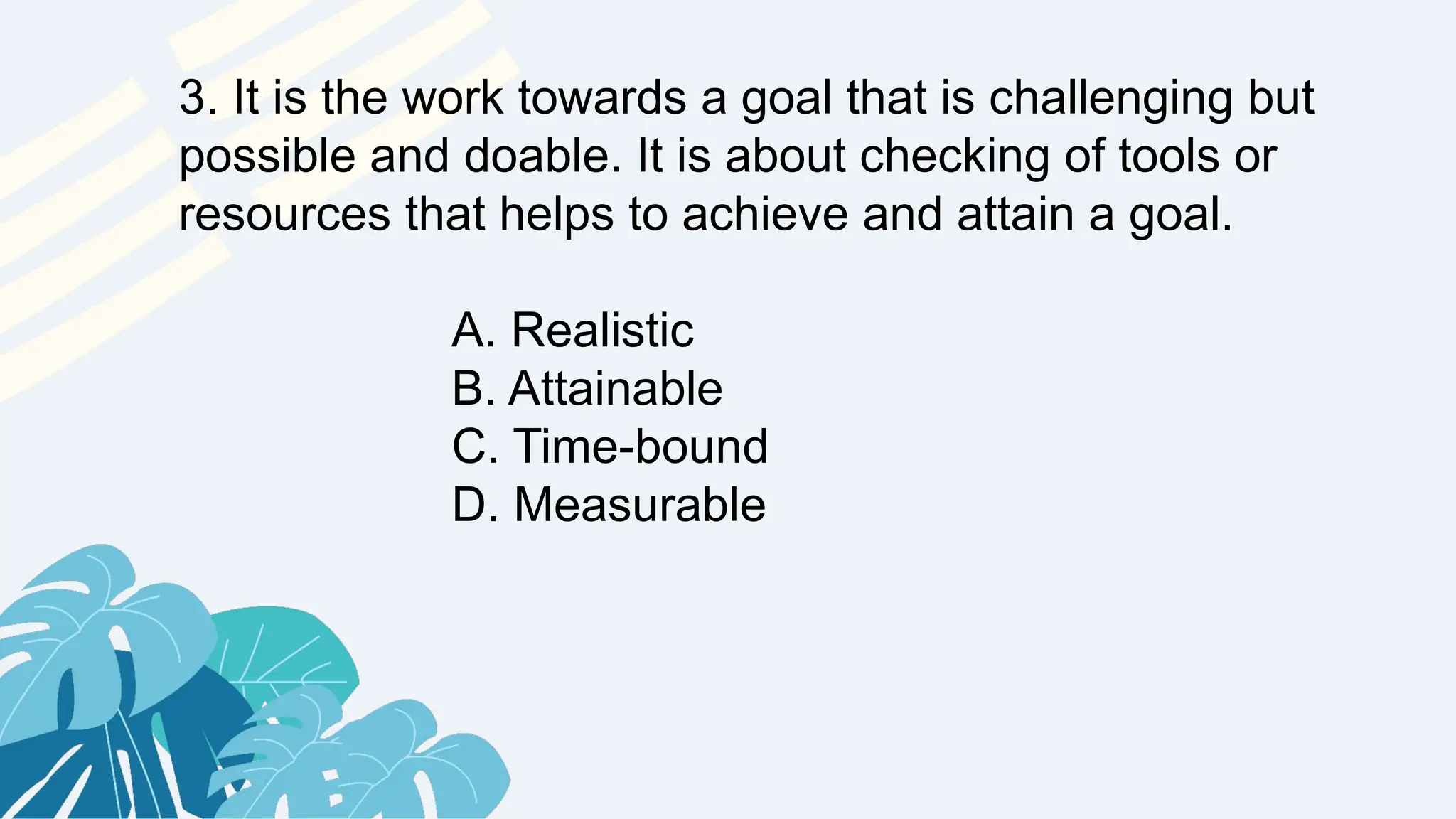
3. It is the work towards a goal that is challenging but
possible and doable. It is about checking of tools or
resources that helps to achieve and attain a goal.
A. Realistic
B. Attainable
C. Time-bound
D. Measurable
4. The process of planning and conceptualizing where
knowing yourself is the key to your success. Honesty
within yourself will make it all possible.
A. Specific
B. Realistic
C. Attainable
D. Time-Bound
5. It is a process of giving yourself a deadline that helps
you to be focused in reaching your goals.
A. Realistic
B. Attainable
C. Time-bound
D. Measurable
6. It is summaries of projects or issues that contemplate
interests, experience and expertise that commonly
serves as a purpose of delivering an in-depth discussion
of a certain topic that a person has a strong position on.
A. Dissertation
B. Concept Paper
C. Concept Map
D. Conceptualized Framework
7. The proper formatting of concept paper is suggested to
be the following, EXCEPT ONE.
A. The font size should be at 12 points.
B. Use whatever font style and font size you desire
to use.
C. The line and paragraph spacing should be in
double space.
D. Use font style such as Times New Roman,
Garamond, Baskerville or other similar Serif
typefaces.
8. Which of the following is NOT a key point in making a
concept paper?
A. Write down the questions correlated the topic or idea
you have chosen.
B. Come up with a concept topic or idea that will make you
on the spot of fame and power.
C. Develop hypothesis or possible solutions from each of
the questions that you have listed.
D. Identify what kind of data you need to answer questions
and on how you will gather the information needed.
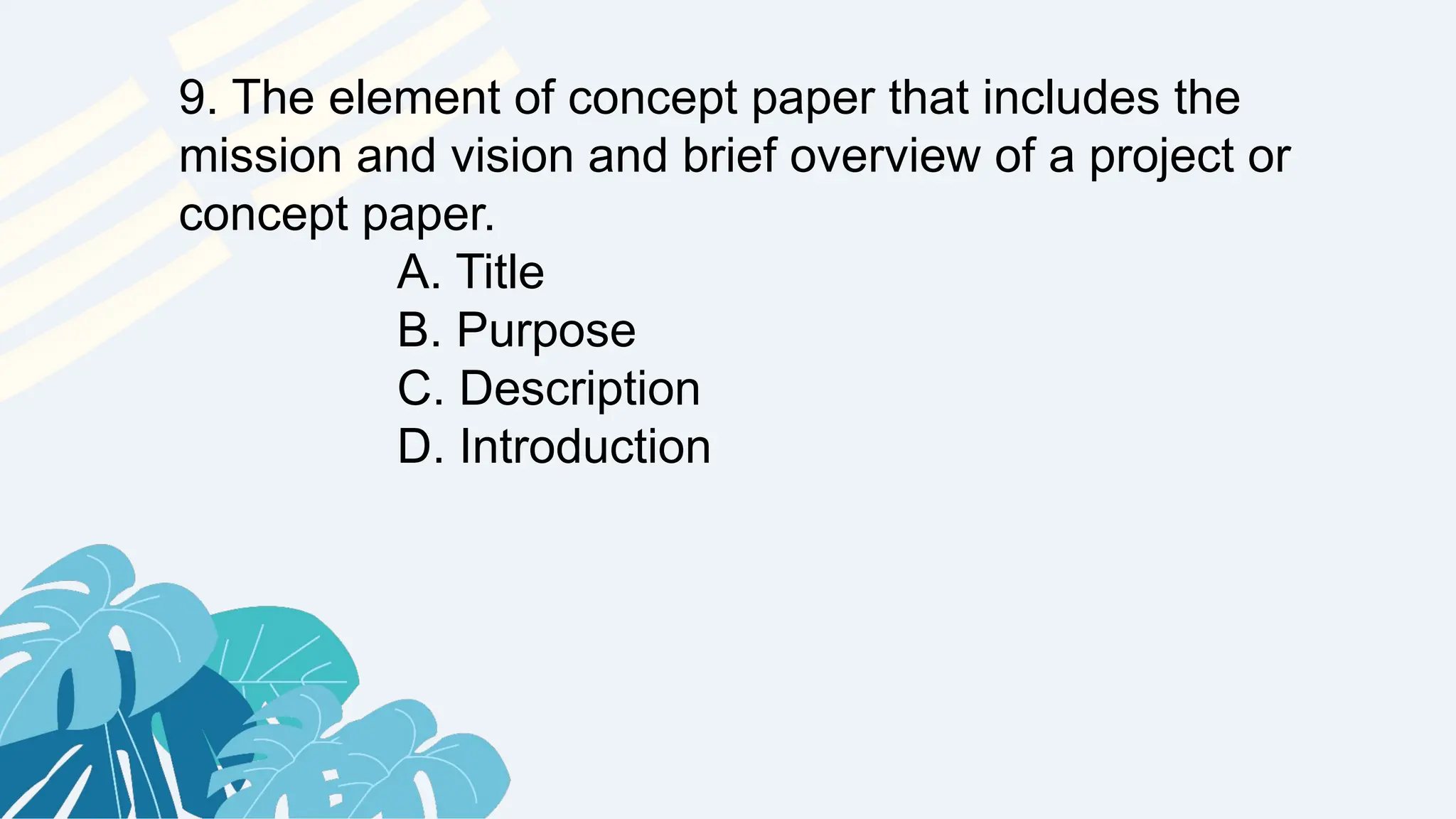
9. The element of concept paper that includes the
mission and vision and brief overview of a project or
concept paper.
A. Title
B. Purpose
C. Description
D. Introduction
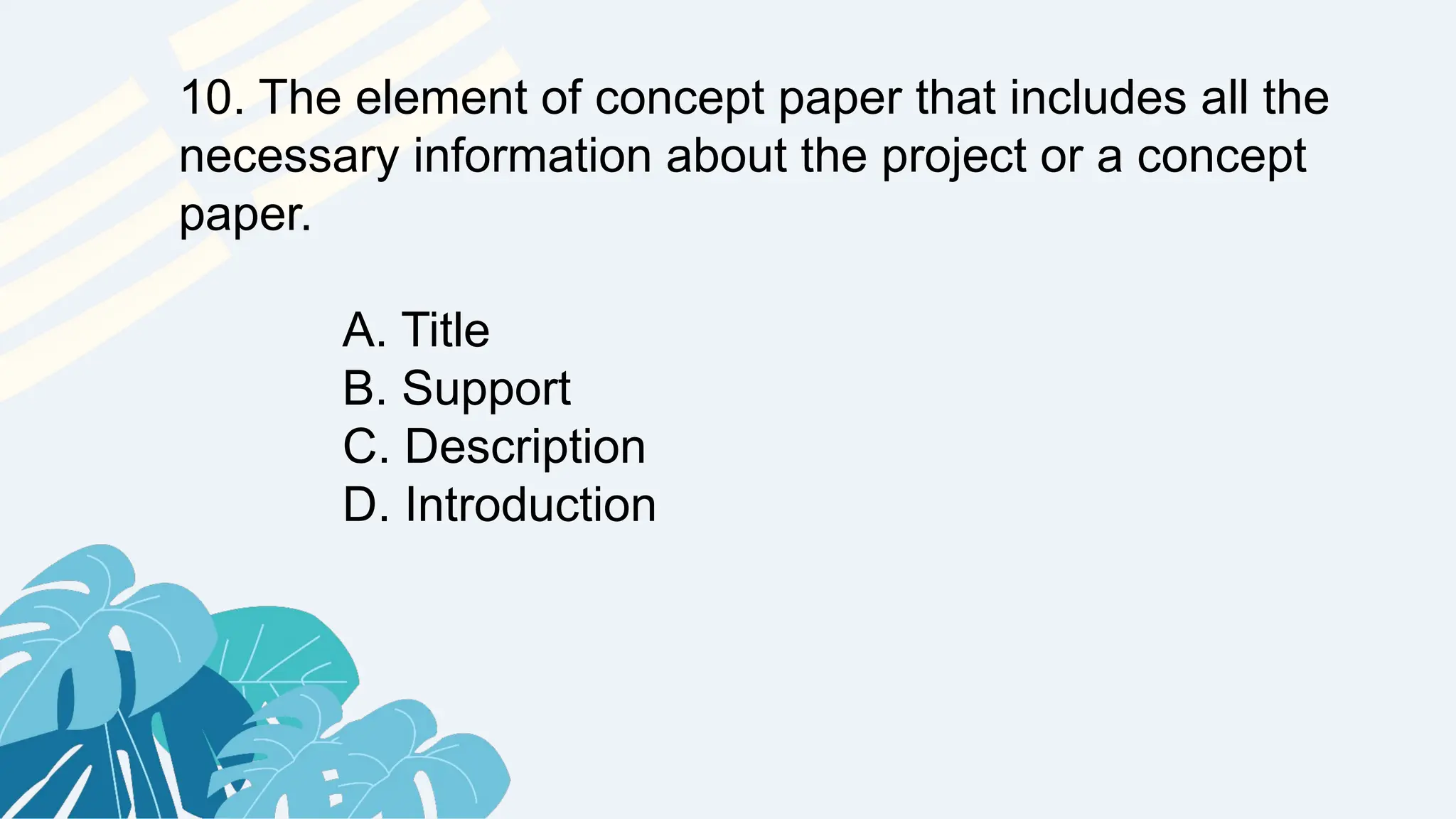
10. The element of concept paper that includes all the
necessary information about the project or a concept
paper.
A. Title
B. Support
C. Description
D. Introduction
11. Support is one of the elements of a concept paper.
Which of the following defines it?
A. It includes the budget needed for the project or
concept paper.
B. It includes all the necessary information about the
project or a concept paper.
C. It includes the mission and vision and brief overview of
a project or concept paper.
D. It serves a lot in terms of getting the audience interest
and gives a fully overview of a project or concept paper.
12. Title is one of the elements of concept paper. Which of
the following define it?
A. It includes the reasons why the project is worth the
time, effort and money in creation of the concept paper.
B. It includes all the necessary information about the
project or a concept paper.
C. It includes the mission and vision and brief overview of
a project or concept paper.
D. It serves a lot in terms of getting the audience interest
and gives a fully overview of a project or concept paper.
13. It is the element of concept that talks about the
reasons why the project is worth the time, effort and
money in creation of the concept paper.
A. Purpose
B. Description
C. Introduction
D. Contact Information
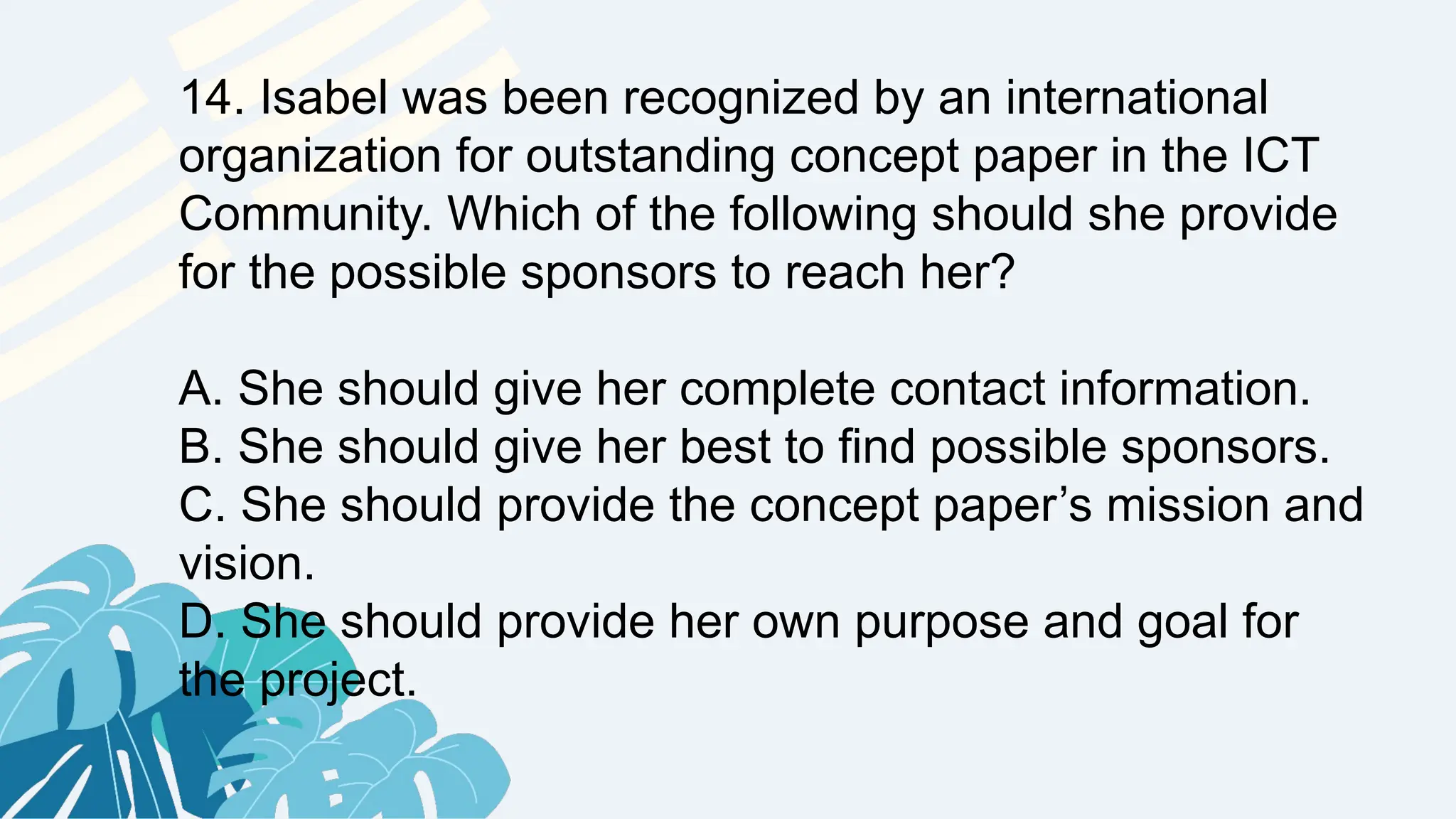
14. Isabel was been recognized by an international
organization for outstanding concept paper in the ICT
Community. Which of the following should she provide
for the possible sponsors to reach her?
A. She should give her complete contact information.
B. She should give her best to find possible sponsors.
C. She should provide the concept paper’s mission and
vision.
D. She should provide her own purpose and goal for
the project.
15. Which of the following statement is NOT true about concept
paper?
A. The terms "concept paper”, “proposal" or “abstract” are often used
interchangeably as they can be used for the same function.
B. Concept paper can also be used as a mainstream educational tool
to develop and to create solution to a certain problem or issue.
C. Concept papers are summaries of projects or issues that
contemplate interests, experience and expertise that commonly
serves as a purpose of delivering an in-depth discussion of a certain
topic that a person has a strong position on.
D. None of the above.
——
ANSWERS
1. A
2. D
3. B
4. B
5. C
6. B
7. B
8. B
9. D
10. C
11. A
12. D
13. A
14. A
15. D

empowerment technologies Planning and Conceptualizing

  • 1.
  • 2.
    Learning Competency: Identify alocal or regional cause or issue for Social Change related to specific professional tracks that can be addressed or tackled using an ICT Project for Social Change (CS_ICT11/12-ICTPT-Iim-p16)
  • 3.
    OBJECTIVES: 1. understand howto plan and conceptualized an ICT Project; 2. understand what concept paper is; 3. understand the steps on how to create a concept paper;and 4. create his/her own concept paper on proposed ICT Project.
  • 4.
    —— Planning and Conceptualizing SocialAdvocacy Developing an ICT Project
  • 5.
    ICT serves asthe steppingstone for the economic, social, industrial growth and development of the first world countries around the globe. Thus, ICT is generally seen as an advantageous instrument to provide better and cheaper ways of communication and promote changes that to enables the generation of new knowledge and equipping the people with the relevant skills needed. Hence, ICT projects undergoes deep research, inquiry and studies before implemented that is why planning and conceptualizing are vital for any projects.
  • 6.
    Directions: Find thedefinition of those words. 1. It includes the mission and vision and brief overview of a project or concept paper. 2. It includes the reasons why the project is worth the time, effort and money in creation of the concept paper. 3. It includes all the necessary information about the project or a concept paper. 4. It includes the budget needed for the project or concept paper. 5. It includes the information on how the project or concept paper creator can be reach. 6. It serves a lot in terms of getting the audience interest and gives a fully overview of a project or concept paper. Activity title introduction description contact support purpose
  • 8.
    Introduction 1. Itincludes the mission and vision and brief overview of a project or concept paper. Purpose 2. It includes the reasons why the project is worth the time, effort and money in creation of the concept paper. Description 3. It includes all the necessary information about the project or a concept paper. Support 4. It includes the budget needed for the project or concept paper. Contact 5. It includes the information on how the project or concept paper creator can be reach. Title 6. It serves a lot in terms of getting the audience interest and gives a fully overview of a project or concept paper.
  • 9.
    Directions: Answer thefollowing questions on a separate paper. 1.Do you think a Concept Paper is a good source of information for people to be enlighten their minds in giving possible solution/s to an existing problemto relevant societal issues in your locality or region? Explain your answer. 2.As part of your community, school, and neighborhood, how do you think a student like you can bring impact to specific local or regional issue to be resolved? Analysis
  • 10.
    Always start withthe ends in mind. Generate your own ideas about content and identify various opportunities based on your target audience. Have a clear plan of actions, responsibilities, work requirements, timeframe and budget if needed. Set a SMART goal to target
  • 11.
    Planning and Conceptualizingthe Content Abstraction:
  • 13.
    Specific (What do youwant to do or want to achieve?) Set a real goal that is direct, detailed and meaningful. Make sure that your goals are focused and can identify a concrete outcome. Your goal will be at risk or vague without the specifics of the goal, because knowing what you wanted to achieve is knowing the leverage to success.
  • 14.
    Measurable (When will youknow when you reach it? What are the signs of your success?) –Make sure that you goal is trackable and quantifiable. Defining your own definition of “success” will aid you to estimate your current achievement level on reaching your specific goals.
  • 15.
    Attainable (Is it possiblefor you to reach your goal?) Work towards a goal that is challenging but possible and doable. Check if you have the tools or resources that will help you to achieve and attain your goals.
  • 16.
    Realistic (Are your currentskills enough to reach your goal?) Knowing yourself is the key to your success. Be honest with yourself and know your capabilities and the things that you cannot do. Be realistic toward your goals as well as on your capacity to do.
  • 17.
    Time-Bound (When exactly doyou plan to accomplish it?) Give yourself a deadline. Every goal should have a target date to finish. Having deadlines motivates oneself to do more efficiently and helps you to be focused in reaching your goals.
  • 18.
    Concept Paper • Conceptpapers are summaries of projects or issues that contemplate interests, experience and expertise that commonly serves as a purpose of delivering an in- depth discussion of a certain topic that a person has a strong position on. • The terms "concept paper”, “proposal" or “abstract” are often used interchangeably as they can be used for the same function. • Concept paper can also be used as a mainstream educational tool to develop and to create solution to a certain problem or issue.
  • 19.
    • Concept paperprovides guidance for the implementation of a project, concept paper carries and gives good practices, viewpoint, advocacy, belief and values or other correlated issues that needs and promotes action to be taken in the future. • Concept paper can range from (2) two to (3) three pages for a small research project to up to 20 pages for immense research projects.
  • 20.
    • For theformatting of concept paper it is suggested to be the following: a) the font style should be formal such as Times New Roman, Garamond, Baskerville or similar Serif typefaces.; b) the line and paragraph spacing should be in double space;and c) the font size should be at 12 points.
  • 21.
    Key Points onmaking your Concept Paper 1. Rise with a concept topic or idea that you are genuinely interested. 2. Write down the questions associated the topic or idea you have chosen. 3. Create a possible solution from each of the questions that you have developed. 4. Classify what kind of data you need that will answer your questions and identity how will gather the information needed. 5. Identify how you will analyze, interpret, and present the overall data you gathered.
  • 22.
    Elements of aConcept Paper for Social Advocacy 1. Title Page 2. Introduction 3. Purpose 4. Description 5. Support 6. Contact Information
  • 23.
    Title Page The titleof your concept paper will serve a lot in terms of getting the audience interest, so make sure to have a short but a catchy and interesting title of your chosen topic. The title of your project or concept paper should also give a fully overview of what the concept paper is all about and what are the things you are resounding out about. In creating your title make sure stick to the main point of the chosen topic and use relevant, easy-to_x0002_understand word and avoid being wordy. Title page usually in the form of
  • 24.
    Introduction This element ofconcept paper serves as the most important part of your concept paper. You must keep on pursuing an adding value to convince the reader about your project’s mission and vision. This part of your concept paper should detail your mission or goal and the vision or dream you have in taking up this concept paper. You need to elaborate and identity it by providing them the urge of solving an existing problem and to provide meaningful insights of your project.
  • 25.
    Introduction Your introduction shouldalso contain the following: a) the clear problem you wanted to solve; b) why did you like to investigate under this study. c) how your research or concept paper would be helpful for others; and d) what are the clear evidence that your study is beneficial and necessary to be discussed. Lastly, what making your introduction critical is that making it you need to make a clear and good impression to the possible readers.
  • 26.
    Purpose This element ofconcept paper includes the reasons why your chosen project or advocacy campaign is worth all the time effort and money. You need to make a strong atmosphere of purpose. Your purpose should not only be to prove your right, but it is more about on how you can help other people in the purpose of your chosen concept paper. Remember your main purpose here is to bring something good and create an impact for a change.
  • 27.
    Description This element ofconcept paper includes all the necessary information, data and details about your project. This element talks about the steps and procedure on how you will do things properly. It also expounds the methods and plans on how you will answer the problems of the concept and in revealing the efficacy of your solution to the problems.
  • 28.
    This element alsoinvolves ways on how you will process your concept into a clear technique of the production of concrete solution in harmonious purpose that will lead to the creation of a successful project or advocacy. Description
  • 29.
    Support This element ofconcept paper contains your budget needed for the project. Every project needed funds to be published and materialized their certain cause, thus support from a sponsor/s necessary to be consider. Remember that support does not only means monetary things, but it can also be as moral support from your friends, relative and among others, depending on the topic or cause who have chosen.
  • 30.
    Contact Information The elementof concept paper that includes information on how the you can be contacted. These includes the following (but not limited to): a) name/s of the creator/s, b) address, c) phone or telephone number, d) email address, and e) website.
  • 31.
    Directions: Answer thefollowing questions on a 1 whole sheet of paper. 1.In your perspective, give one specific local or regional issue that can be solved using Social Advocacy as ICT Project such as in creation of a Concept Paper? 2.Do you think a Concept Paper is a good source of information for people to be enlighten their minds in giving possible solution/s to an existing problemto relevant societal issues in your locality or region? Explain your answer. 3.As part of your community, school, and neighborhood, how do you think a student like you can bring impact to specific local or regional issue to be resolved? Generalization
  • 32.
  • 33.
    Assessment:15 items Directions: Choosethe best answer for each question. Write the letter of your answer on a 1/4 sheet of paper.
  • 34.
    1. In planningand conceptualizing the content, you always need to start with the ends in mind and generate your own ideas by identifying various opportunities based on the target audience and ensuring your goal is SMART. The “S” in SMART goal stands for what? A. Specific B. Standard C. Sustainable D. Systematical
  • 35.
    2. The processof planning and conceptualizing Social Advocacy that answers when will you know when you reach it and making sure that you goal is trackable and quantifiable. A. Specific B. Realistic C. Attainable D. Measurable
  • 36.
    3. It isthe work towards a goal that is challenging but possible and doable. It is about checking of tools or resources that helps to achieve and attain a goal. A. Realistic B. Attainable C. Time-bound D. Measurable
  • 37.
    4. The processof planning and conceptualizing where knowing yourself is the key to your success. Honesty within yourself will make it all possible. A. Specific B. Realistic C. Attainable D. Time-Bound
  • 38.
    5. It isa process of giving yourself a deadline that helps you to be focused in reaching your goals. A. Realistic B. Attainable C. Time-bound D. Measurable
  • 39.
    6. It issummaries of projects or issues that contemplate interests, experience and expertise that commonly serves as a purpose of delivering an in-depth discussion of a certain topic that a person has a strong position on. A. Dissertation B. Concept Paper C. Concept Map D. Conceptualized Framework
  • 40.
    7. The properformatting of concept paper is suggested to be the following, EXCEPT ONE. A. The font size should be at 12 points. B. Use whatever font style and font size you desire to use. C. The line and paragraph spacing should be in double space. D. Use font style such as Times New Roman, Garamond, Baskerville or other similar Serif typefaces.
  • 41.
    8. Which ofthe following is NOT a key point in making a concept paper? A. Write down the questions correlated the topic or idea you have chosen. B. Come up with a concept topic or idea that will make you on the spot of fame and power. C. Develop hypothesis or possible solutions from each of the questions that you have listed. D. Identify what kind of data you need to answer questions and on how you will gather the information needed.
  • 42.
    9. The elementof concept paper that includes the mission and vision and brief overview of a project or concept paper. A. Title B. Purpose C. Description D. Introduction
  • 43.
    10. The elementof concept paper that includes all the necessary information about the project or a concept paper. A. Title B. Support C. Description D. Introduction
  • 44.
    11. Support isone of the elements of a concept paper. Which of the following defines it? A. It includes the budget needed for the project or concept paper. B. It includes all the necessary information about the project or a concept paper. C. It includes the mission and vision and brief overview of a project or concept paper. D. It serves a lot in terms of getting the audience interest and gives a fully overview of a project or concept paper.
  • 45.
    12. Title isone of the elements of concept paper. Which of the following define it? A. It includes the reasons why the project is worth the time, effort and money in creation of the concept paper. B. It includes all the necessary information about the project or a concept paper. C. It includes the mission and vision and brief overview of a project or concept paper. D. It serves a lot in terms of getting the audience interest and gives a fully overview of a project or concept paper.
  • 46.
    13. It isthe element of concept that talks about the reasons why the project is worth the time, effort and money in creation of the concept paper. A. Purpose B. Description C. Introduction D. Contact Information
  • 47.
    14. Isabel wasbeen recognized by an international organization for outstanding concept paper in the ICT Community. Which of the following should she provide for the possible sponsors to reach her? A. She should give her complete contact information. B. She should give her best to find possible sponsors. C. She should provide the concept paper’s mission and vision. D. She should provide her own purpose and goal for the project.
  • 48.
    15. Which ofthe following statement is NOT true about concept paper? A. The terms "concept paper”, “proposal" or “abstract” are often used interchangeably as they can be used for the same function. B. Concept paper can also be used as a mainstream educational tool to develop and to create solution to a certain problem or issue. C. Concept papers are summaries of projects or issues that contemplate interests, experience and expertise that commonly serves as a purpose of delivering an in-depth discussion of a certain topic that a person has a strong position on. D. None of the above.
  • 49.
  • 50.
    1. A 2. D 3.B 4. B 5. C 6. B 7. B 8. B 9. D 10. C 11. A 12. D 13. A 14. A 15. D

Editor's Notes

  • #11 Always start with the ends in mind. Generate your own ideas about content and identify various opportunities based on your target audience. Have a clear plan of actions, responsibilities, work requirements, timeframe and budget if needed. Set a SMART goal to target.