Journal (EMPA-REG OUTCOMEtrial)
Presenter: Mohamed Ali PGY1/IM
Moderator: Zemir Abdi, MD (internist at Haramaya university)
Empagliflozin, Cardiovascular
Outcomes, and Mortality in Type 2
Diabetes
2.
Background
⚫There are 29.1mil Americans (9.3% of the
population) with Type 2 Diabetes Mellitus (T2DM) in
20121.
⚫Remains the 7th leading cause of mortality in the
United States in 20101.
⚫Total costs of diagnosed DM is $245 billion in 2012
($176 billion for direct medical costs and $69 billion
in reduced productivity)1.
⚫Hospitalization rates for MI and stroke were 1.8 times
and 1.5 times, respectively, higher among adults with
DM than those without.
3.
Sodium-Glucose Cotransporter 2(SGLT2)
Inhibitors
⚫SGLT2 receptors are expressed almost exlcusively
in the kidney and are responsible for the
majority of glucose reabsorption2.
⚫Inhibition of SGLT2 can decrease plasma glucose
by increasing urinary glucose excretion2.
⚫First agent, canagliflozin (Invokana®) became
available on the US market May, 2013.
4.
Sodium-Glucose Cotransporter 2(SGLT2)
Inhibitors
⚫Other agents: dapagliflozin, empagliflozin, and
combination products.
⚫Both canagliflozin and dapagliflozin are on the VA’s
non-formulary.
⚫Formulary status of empagliflozin is pending.
⚫The drug monograph is available on PBM Intranet.
5.
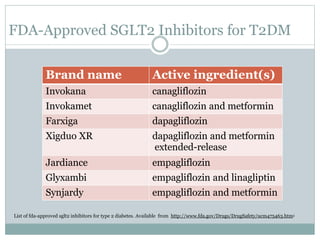
FDA-Approved SGLT2 Inhibitorsfor T2DM
Brand name Active ingredient(s)
Invokana canagliflozin
Invokamet canagliflozin and metformin
Farxiga dapagliflozin
Xigduo XR dapagliflozin and metformin
extended-release
Jardiance empagliflozin
Glyxambi empagliflozin and linagliptin
Synjardy empagliflozin and metformin
List of fda-approved sglt2 inhibitors for type 2 diabetes. Available from http://www.fda.gov/Drugs/DrugSafety/ucm475463.htm3
6.
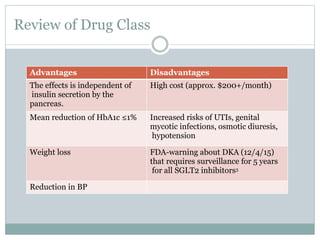
Review of DrugClass
Advantages Disadvantages
The effects is independent of
insulin secretion by the
pancreas.
High cost (approx. $200+/month)
Mean reduction of HbA1c ≤1% Increased risks of UTIs, genital
mycotic infections, osmotic diuresis,
hypotension
Weight loss FDA-warning about DKA (12/4/15)
that requires surveillance for 5 years
for all SGLT2 inhibitors3
Reduction in BP
7.
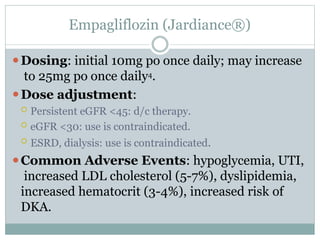
Empagliflozin (Jardiance®)
⚫Dosing: initial10mg po once daily; may increase
to 25mg po once daily4.
⚫Dose adjustment:
Persistent eGFR <45: d/c therapy.
eGFR <30: use is contraindicated.
ESRD, dialysis: use is contraindicated.
⚫Common Adverse Events: hypoglycemia, UTI,
increased LDL cholesterol (5-7%), dyslipidemia,
increased hematocrit (3-4%), increased risk of
DKA.
Zinman B, etal. Empagliflozin, cardiovascular outcomes and mortality in type 2 diabetes. N Engl J Med; 2015 5
10.
Background
⚫The presence ofboth T2DM and CV disease
increases the risk of death.
⚫Evidence that glucose-lowering therapy reduces the
rates of CV events and death has not been
convincingly shown.
⚫There is concern that intensive glucose lowering or
the use of specific glucose-lowering drugs may be
associated with adverse CV outcomes.
⚫It is necessary to establish the CV safety benefits of
glucose-lowering agents.
11.
EMPA-REG OUTCOME TRIAL
⚫Theeffects of empagliflozin in addition to standard
care, on cardiovascular morbidity and mortality in
patients with T2DM at high cardiovascular risk
are not known.
⚫Hypothesis: to demonstrate noninferiority for the
primary outcome with empagliflozin versus placebo
with a margin of 1.3 for hazard ratio.
12.
Study Design
⚫Designed andoverseen by steering committee of
academic investigators and employees of
Boehringer Ingelheim.
⚫Phase III, multicenter, international, randomized,
double-blind, placebo-controlled trial.
⚫Enrollment: September 2010 to April 2013.
13.
Study Design
⚫Locations: 590sites from 42 countries in North
America (plus Australia and New Zealand), Latin
America, Europe, Africa, and Asia.
⚫Trial continued until an adjudicated primary
outcome event had occurred in at least 691 patients.
14.
Inclusion Criteria
Patients whoare:
⚫≥ 18 years of age
⚫Have T2DM
⚫BMI≤ 45
⚫eGFR of at least 30mL/min/1.73 m2 BSA
⚫Had established cardiovascular disease
⚫Had received no glucose-lowering agents for ≥12
weeks before randomization
⚫Had HbA1c ≥ 7.0% and ≤ 9.0%
15.
Definition of HighRisk of Cardiovascular Events
(≥1 of the following)
⚫H/o of MI >2mo prior to informed consent.
⚫Evidence of multi-vessel CAD i.e. presence of
significant stenosis, prev revascularization, and/or
combination of the above.
⚫Evidence of single-vessel CAD: ischemia, hospital
discharge for unstable angina ≤12 mo prior to consent.
⚫H/o stroke >2 mo prior to consent.
⚫Occlusive PAD: limb angioplasty, stenting,
bypass/amputation d/t circulatory insufficiency;
significant peripheral artery stenosis; ankle brachial
index <0.9 in ≥ 1 ankle.
16.
Key Exclusion Criteria
Patientswho have:
⚫Uncontrolled hyperglycemia (glucose >240 mg/dL).
⚫Liver disease (indicated by AST, ALT or alk
phosphatase >3x ULN).
⚫Planned cardiac surgery or angioplasty within 3
months.
⚫eGFR <30mL/min/1.73m2.
⚫Contraindications to background therapy according to
local label.
⚫Any uncontrolled endocrine disorder except T2DM.
⚫Pre-menopausal women.
17.
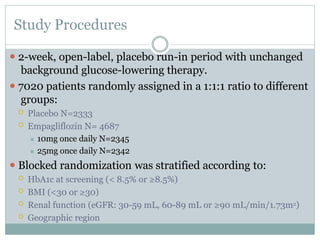
Study Procedures
⚫ 2-week,open-label, placebo run-in period with unchanged
background glucose-lowering therapy.
⚫ 7020 patients randomly assigned in a 1:1:1 ratio to different
groups:
Placebo N=2333
Empagliflozin N= 4687
⯍ 10mg once daily N=2345
⯍ 25mg once daily N=2342
⚫ Blocked randomization was stratified according to:
HbA1c at screening (< 8.5% or ≥8.5%)
BMI (<30 or ≥30)
Renal function (eGFR: 30-59 mL, 60-89 mL or ≥90 mL/min/1.73m2)
Geographic region
18.
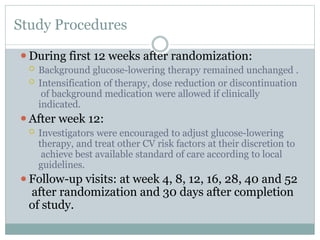
Study Procedures
⚫During first12 weeks after randomization:
Background glucose-lowering therapy remained unchanged .
Intensification of therapy, dose reduction or discontinuation
of background medication were allowed if clinically
indicated.
⚫After week 12:
Investigators were encouraged to adjust glucose-lowering
therapy, and treat other CV risk factors at their discretion to
achieve best available standard of care according to local
guidelines.
⚫Follow-up visits: at week 4, 8, 12, 16, 28, 40 and 52
after randomization and 30 days after completion
of study.
19.
Study Outcomes
⚫Primary outcome:composite of death from
cardiovascular causes, nonfatal MI (excluding silent
MI), or non fatal stroke.
⚫Key secondary outcome: composite of the primary
outcome plus hospitalization for unstable angina.
20.
Safety/Adverse Events
⚫Safety wasassessed on the basis of adverse events
occurred during and 7 days after the last dose.
⚫Key adverse events are:
Hypoglycemic events (plasma glucose ≤70mg/dL or events
requiring assistance).
Side effects: UTI, genital infection, volume depletion, acute
renal failure, bone fracture, DKA, and thromboembolic events.
21.
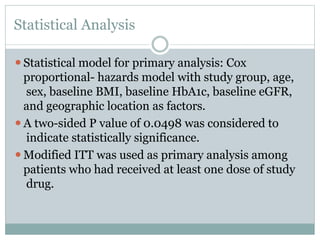
Statistical Analysis
⚫Statistical modelfor primary analysis: Cox
proportional- hazards model with study group, age,
sex, baseline BMI, baseline HbA1c, baseline eGFR,
and geographic location as factors.
⚫A two-sided P value of 0.0498 was considered to
indicate statistically significance.
⚫Modified ITT was used as primary analysis among
patients who had received at least one dose of study
drug.
22.
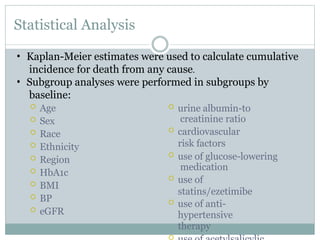
Statistical Analysis
Age
Sex
Race
Ethnicity
Region
HbA1c
BMI
BP
eGFR
urine albumin-to
creatinine ratio
cardiovascular
risk factors
use of glucose-lowering
medication
use of
statins/ezetimibe
use of anti-
hypertensive
therapy
• Kaplan-Meier estimates were used to calculate cumulative
incidence for death from any cause.
• Subgroup analyses were performed in subgroups by
baseline:
23.
Patient Population/Baseline Characteristics
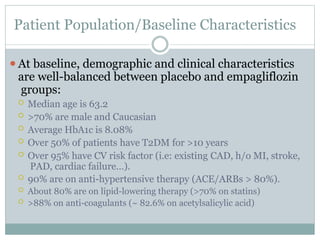
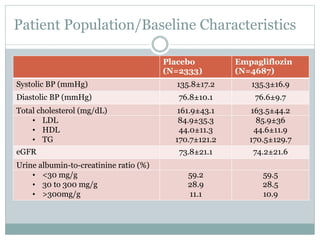
⚫Atbaseline, demographic and clinical characteristics
are well-balanced between placebo and empagliflozin
groups:
Median age is 63.2
>70% are male and Caucasian
Average HbA1c is 8.08%
Over 50% of patients have T2DM for >10 years
Over 95% have CV risk factor (i.e: existing CAD, h/o MI, stroke,
PAD, cardiac failure…).
90% are on anti-hypertensive therapy (ACE/ARBs > 80%).
About 80% are on lipid-lowering therapy (>70% on statins)
>88% on anti-coagulants (~ 82.6% on acetylsalicylic acid)
Results
⚫Overall, 97% ofpatients completed the study, 25.4%
prematurely discontinued the study drug.
⚫Reasons for premature discontinuation:
Adverse event
Refusal to continue, not due to adverse event
Non-compliance
Lost to f/u
Lack of efficacy
Other
⚫Final status was available for 99.2% of all patients.
⚫Median duration of treatment: 2.6 years.
⚫Median observation time: 3.1 years.
27.
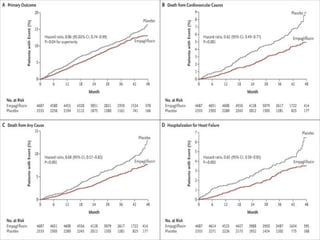
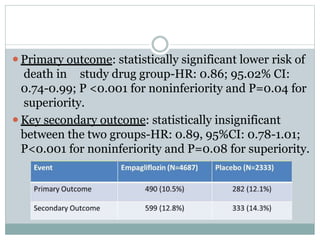
⚫Primary outcome: statisticallysignificant lower risk of
death in study drug group-HR: 0.86; 95.02% CI:
0.74-0.99; P <0.001 for noninferiority and P=0.04 for
superiority.
⚫Key secondary outcome: statistically insignificant
between the two groups-HR: 0.89, 95%CI: 0.78-1.01;
P<0.001 for noninferiority and P=0.08 for superiority.
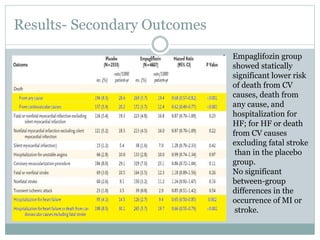
Results- Secondary Outcomes
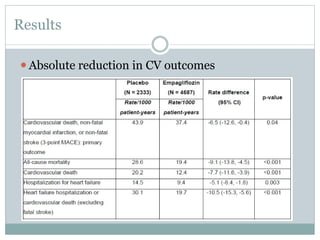
•Empaglifozin group
showed statically
significant lower risk
of death from CV
causes, death from
any cause, and
hospitalization for
HF; for HF or death
from CV causes
excluding fatal stroke
than in the placebo
group.
• No significant
between-group
differences in the
occurrence of MI or
stroke.
30.
Results
⚫No statistically significantdifferences in primary and
secondary outcomes for the 10-mg and 25-mg
groups versus placebo.
HR 0.85 (95% CI, 0.72-1.01; P=0.07) for the 10mg.
HR 0.86 (95% CI, 0.73-1.02; P=0.09) for the 25mg.
⚫In subgroup analyses:
Consistent benefit of empagliflozin versus placebo on death
from CV causes across all subgroups.
Some heterogeneity for the primary outcome in age, and
HbA1c subgroups.
31.
Results
⚫Glycemic control after12 weeks
Reduction of 0.54% points (95% CI, -0.58 to -0.49) in 10mg
group.
Reduction of 0.60% points (95%CI, -0.64 to -0.55) in 25mg
group.
⚫Cardiovascular risk factors
Empagliflozin was associated with small reductions in weight,
waist circumference, uric acid level, and BP.
Small increase in LDL and HDL cholesterol observed in the
study drug group.
32.
Results
⚫39 patients (41in the 10-mg group and 38 in the 25-
mg group) would need to be treated during a 3-year
period to prevent 1 death.
⚫Many patients did not reach their glycemic targets
At week 206, adjusted mean A1c for empagliflozin pooled
group is 7.81% and 8.16% for placebo group.
33.
Results
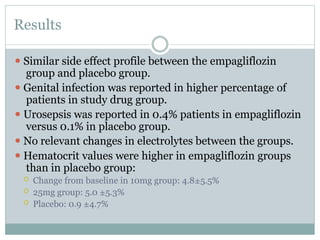
⚫ Similar sideeffect profile between the empagliflozin
group and placebo group.
⚫ Genital infection was reported in higher percentage of
patients in study drug group.
⚫ Urosepsis was reported in 0.4% patients in empagliflozin
versus 0.1% in placebo group.
⚫ No relevant changes in electrolytes between the groups.
⚫ Hematocrit values were higher in empagliflozin groups
than in placebo group:
Change from baseline in 10mg group: 4.8±5.5%
25mg group: 5.0 ±5.3%
Placebo: 0.9 ±4.7%
34.
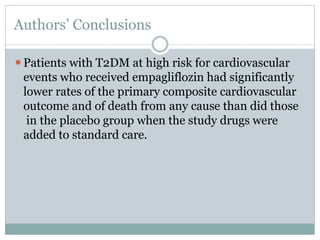
Authors’ Conclusions
⚫Patients withT2DM at high risk for cardiovascular
events who received empagliflozin had significantly
lower rates of the primary composite cardiovascular
outcome and of death from any cause than did those
in the placebo group when the study drugs were
added to standard care.
35.
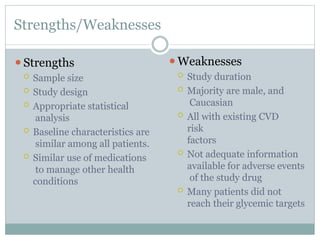
Strengths/Weaknesses
⚫Strengths
Sample size
Study design
Appropriate statistical
analysis
Baseline characteristics are
similar among all patients.
Similar use of medications
to manage other health
conditions
⚫Weaknesses
Study duration
Majority are male, and
Caucasian
All with existing CVD
risk
factors
Not adequate information
available for adverse events
of the study drug
Many patients did not
reach their glycemic targets
36.
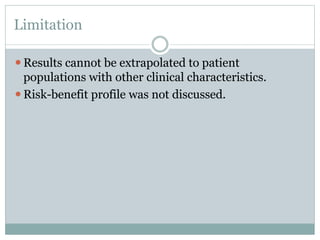
Limitation
⚫Results cannot beextrapolated to patient
populations with other clinical characteristics.
⚫Risk-benefit profile was not discussed.
37.
Implication
⚫May prove thatthe risk of cardiovascular death in
patients with T2DM and cardiovascular disease can
be modified.