MAR EPHRAEM COLLEGE OF ENGINEERING AND TECHNOLOGY
Department of Mechanical Engineering
ME6403 ENGINEERING METALLURGY ACADEMIC YEAR2019-20
Course file - ME8491 -ENGINEERING METALLURGY
Name of Course instructor A. JUDE FELIX
Email judefelix@marephraem.edu.in
Contact number +91-8903787202
COURSE CONTENT
The whole course is divided into 5 Units.
48 lecture hours.
ME6702 ENGINEERING METALLURGY L T P
UNITI ALLOY AND PHASE DIAGRAM 8 0 0
UNITII HEAT TREATMENT 10 0 0
UNITIII FERROUSAND NON FERROUSMETALS 10 0 0
UNITIV NON METALLICMATERIALS 9 0 0
UNITV MECHANICAL PROPERTIESANDTESTING 11 0 0
TOTAL 48 0 0
Prerequisitefor theprogram:
SEMESTERII– Material science
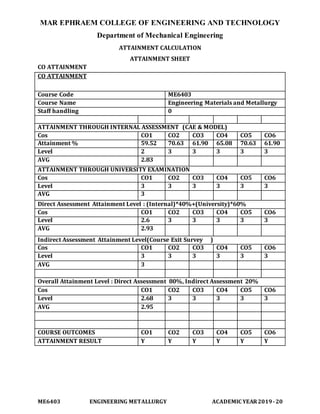
Courseoutcomes:
CO1 Explain alloys and phase diagram, Iron-Iron Carbon diagram and steel classification
CO2 Describe the effectof heat treatment processes.
CO3 Explain the effectof alloying elements on ferrous and non-ferrous metals
CO4 Summarize the propertiesandapplicationsof nonmetallicmaterials.
CO5 Explain the types of mechanical testing.
CO6 Describe fatigue and creep failure mechanisms
MAR EPHRAEM COLLEGE OF ENGINEERING AND TECHNOLOGY
Department of Mechanical Engineering
ME6403 ENGINEERING METALLURGY ACADEMIC YEAR2019-20
Programoutcomes:
POs Statements
PO1
EngineeringKnowledge:
Apply the knowledgeof mathematics, science, engineering fundamentals, and an
engineering specialization to the solution of complex engineering problems.
PO2
Problemanalysis:
Identify,formulate, review research literature, and analyze complex engineering
problem researching substantiated conclusions using first principles of mathematics,
natural sciences, and engineering sciences.
PO3
Design/developmentofsolutions:
Design solutions forcomplex engineering problems and design system components or
processes that meet the specified needs with appropriate consideration for the public
health and safety, and the cultural, societal, and environmental considerations.
PO4
Conductinvestigationsofcomplexproblems:
Use research-based knowledge and research methods including design of experiments,
analysis and interpretation of data, and synthesis of the information to provide valid
conclusions.
PO5
Moderntool usage:
Create, select, and apply appropriate techniques, resources, and modern engineering
and ITtools including prediction and modeling to complex engineering activities with
an understanding of the limitations.
PO6
Theengineerandsociety:
Apply reasoning informed by the contextual knowledge to assess societal, health, safety,
legal and cultural issues and the consequent responsibilities relevant to the professional
engineering practice.
PO7
Environmentandsustainability:
Understand the impact of the professional engineering solutions in societal and
environmental contexts, and demonstrate the knowledge of, and need for sustainable
development.
PO8
Ethics:
Apply ethical principles and commit to professional ethics and responsibilities and
norms of the engineering practice.
PO9
Individual andteam work:
Function effectively asan individual, and as a member or leader in diverse teams, and in
multidisciplinary settings.
PO10
Communication:
Communicate effectively oncomplex engineering activities with the engineering
community and with society at large, such as, being able to comprehend and write
effectivereports and design documentation, make effectivepresentations, and give and
MAR EPHRAEM COLLEGE OF ENGINEERING AND TECHNOLOGY
Department of Mechanical Engineering
ME6403 ENGINEERING METALLURGY ACADEMIC YEAR2019-20
receive clear instructions.
PO11
Project managementand finance:
Demonstrate knowledge and understanding of the engineering and management
principles and apply these to one’s ownwork,as a member and leader in a team, to
manage projects and in multidisciplinary environments.
PO12
Life-longlearning:
Recognize the need for, and have the preparation and ability to engage in independent
and life-long learning in the broadest context of technological change.
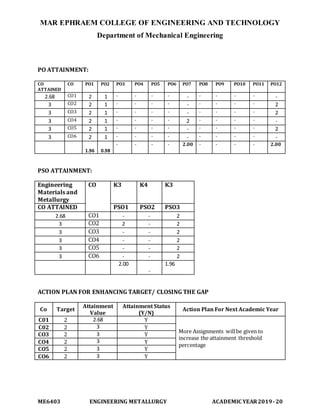
CO PO Mapping:
CO CL PO1 PO2 PO3 PO4 PO5 PO6 PO7 PO8 PO9 PO10 PO11 PO12
CO
1
U
2 1 - - - - - - - - - -
CO
2
U 2 1 - - - - - - - - - 2
CO
3
U
2 1 - - - - - - - - - 2
CO
4
U
2 1 - - - - 2 - - - - -
CO
5
U 2 1 - - - - - - - - - 2
CO
6
U 2 1 - - - - 0 - - - - -
Average 2.00 1.00 - - - - 2.00 - - - - 2.00
CO-PSO Mapping
CO PSO1 PSO 2 PSO 3
CO 1 - - 2
CO 2 2 - 2
CO 3 - - 2
CO 4 - - 2
CO 5 - - 2
CO 6 - - 2
Average 2.00 - 2.00
MAR EPHRAEM COLLEGE OF ENGINEERING AND TECHNOLOGY
Department of Mechanical Engineering
ME6403 ENGINEERING METALLURGY ACADEMIC YEAR2019-20
COURSE SYLLABUS:
Unit
No
Unit Title
Unit wise Syllabus
1 ALLOY AND PHASE
DIAGRAM
Constitution of alloys – Solid solutions, substitutional
and interstitial – phase diagrams, Isomorphous, eutectic,
eutectoid, peritectic, and peritectoid reactions, Iron –
carbon equilibrium diagram. Classification of steel and
cast Iron microstructure, properties and application
2 HEAT TREATMENT Definition – Full annealing, stress relief, recrystallisation
and spheroidising – normalising, hardening and
Tempering of steel. Isothermal transformation diagrams
– cooling curves superimposed on I.T. diagram CCR –
Hardenability, Jominy end quench test - Austempering,
martempering – case hardening, carburizing, Nitriding,
cyaniding, carbonitriding – Flame and Induction
hardening – Vacuum and Plasma hardening
3 FERROUSAND NON
FERROUSMETALS
Effect of alloying additions on steel- α and β stabilisers–
stainless and tool steels – HSLA, Maraging steels – Cast
Iron - Grey, white, malleable, spheroidal – alloy cast
irons, Copper and copper alloys – Brass, Bronze and
Cupronickel – Aluminium and Al-Cu – precipitation
strengthening treatment – Bearing alloys, Mg-alloys, Ni-
based super alloys and Titanium alloys...
4 NON METALLIC
MATERIALS
Polymers – types of polymer, commodity and
engineering polymers – Properties and applications of
various thermosetting and thermoplastic polymers (PP,
PS, PVC, PMMA, PET,PC, PA, ABS, PI, PAI, PPO,
PPS, PEEK, PTFE, Polymers – Urea and Phenol
formaldehydes)- Engineering Ceramics – Properties and
applications of Al2O3, SiC, Si3N4, PSZ and SIALON –
CompositesClassifications- Metal Matrix and FRP -
Applications of Composites..
5 MECHANICAL PROPERTIES
AND TESTING
Mechanisms of plastic deformation, slip and twinning –
Types of fracture – Testing of materials under tension,
compression and shear loads – Hardness tests (Brinell,
Vickers and Rockwell), hardness tests, Impact test lzod
and charpy, fatigue and creep failure mechanisms.
ASSESSMENT
DIRECT ASSESSMENT
1. CONTINUOUS INTERNALASSESSMENT (CIA):
 CAE 1
 CAE 2
 MODEL
MAR EPHRAEM COLLEGE OF ENGINEERING AND TECHNOLOGY
Department of Mechanical Engineering
ME6403 ENGINEERING METALLURGY ACADEMIC YEAR2019-20
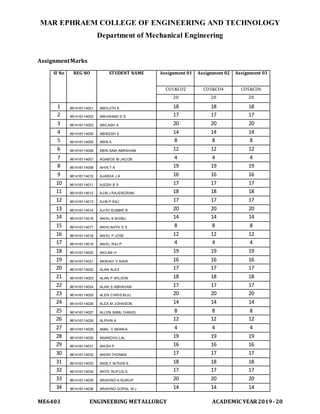
 ASSIGNMENT 1
 ASSIGNMENT 2
 ASSIGNMENT 3
2. SEMESTER END EXAMINATION (SEE)
INDIRECT ASSESSMENT
 COURSE EXIT SURVEY
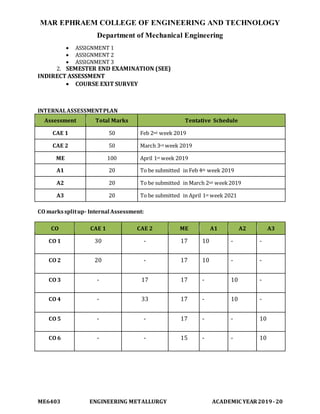
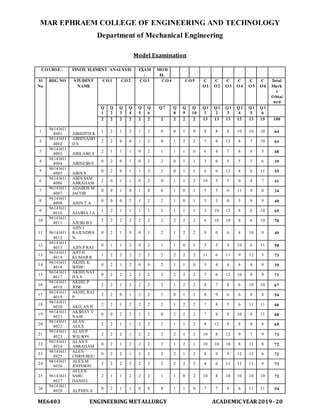
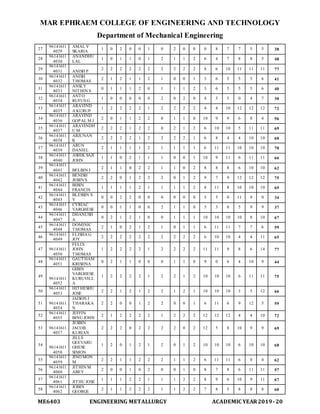
INTERNALASSESSMENTPLAN
Assessment Total Marks Tentative Schedule
CAE 1 50 Feb 2nd week 2019
CAE 2 50 March 3rd week 2019
ME 100 April 1st week 2019
A1 20 To be submitted in Feb 4th week 2019
A2 20 To be submitted in March 2nd week2019
A3 20 To be submitted in April 1st week 2021
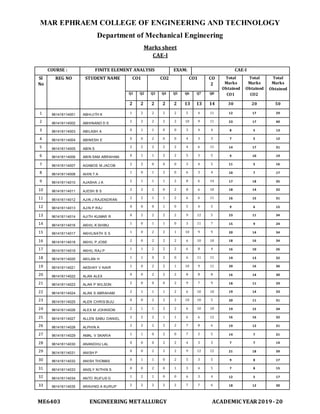
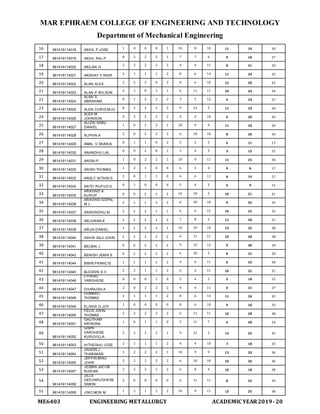
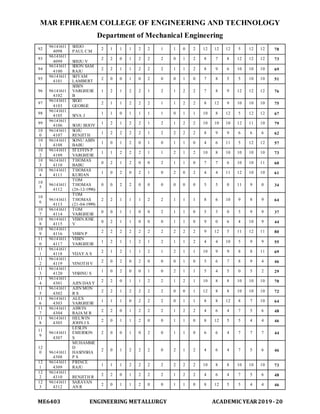
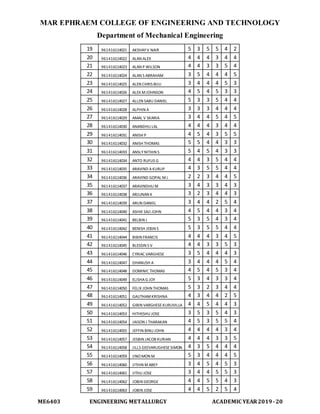
CO markssplitup- Internal Assessment:
CO CAE 1 CAE 2 ME A1 A2 A3
CO 1 30 - 17 10 - -
CO 2 20 - 17 10 - -
CO 3 - 17 17 - 10 -
CO 4 - 33 17 - 10 -
CO 5 - - 17 - - 10
CO 6 - - 15 - - 10
MAR EPHRAEM COLLEGE OF ENGINEERING AND TECHNOLOGY
Department of Mechanical Engineering
ME6403 ENGINEERING METALLURGY ACADEMIC YEAR2019-20
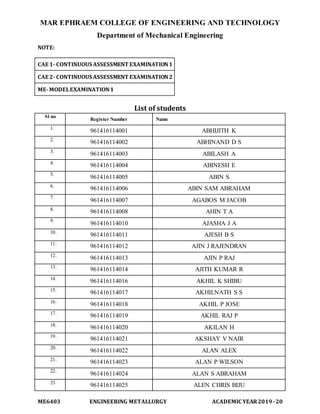
NOTE:
CAE 1- CONTINUOUS ASSESSMENT EXAMINATION1
CAE 2- CONTINUOUS ASSESSMENT EXAMINATION2
ME-MODELEXAMINATION1
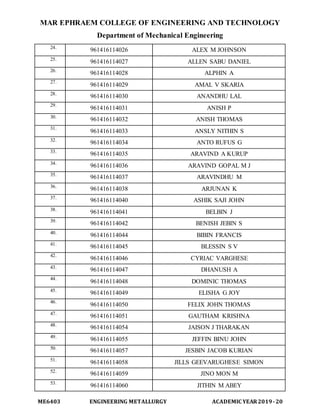
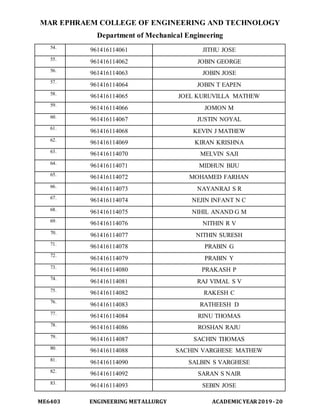
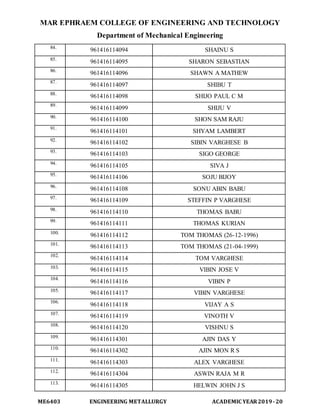
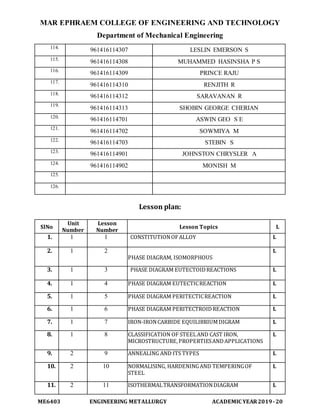
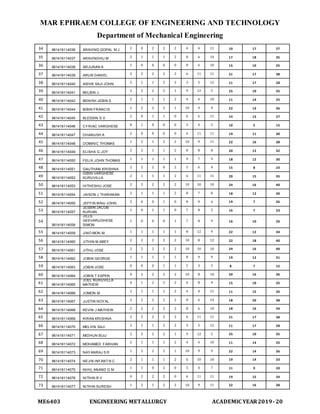
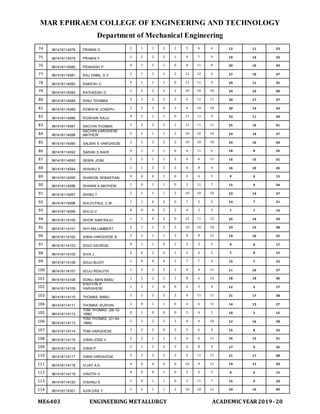
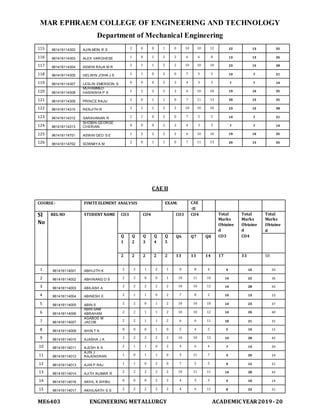
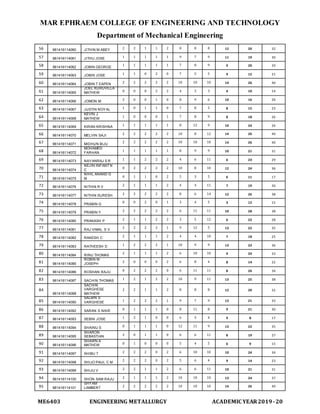
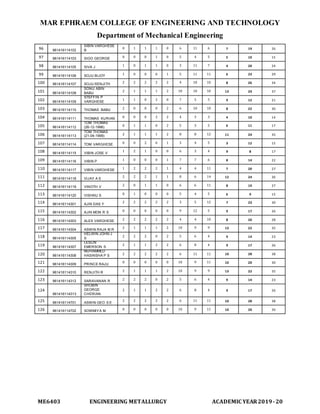
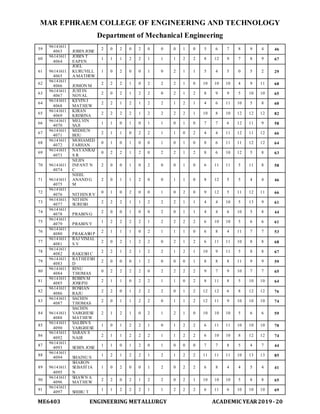
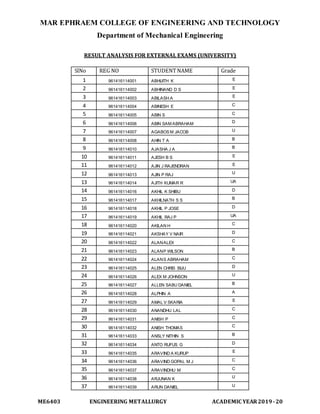
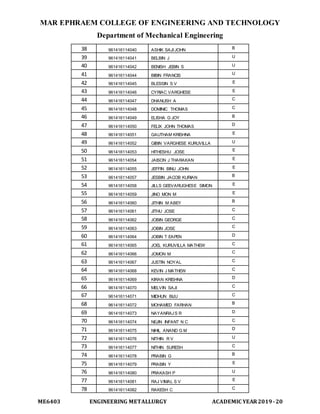
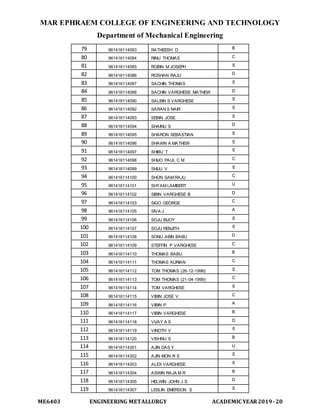
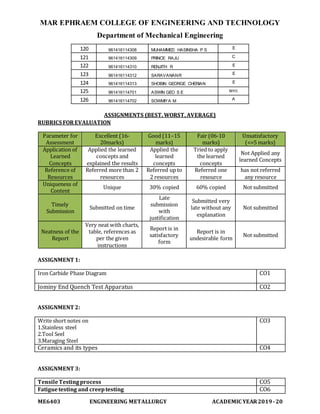
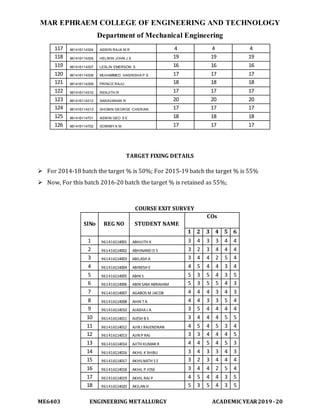
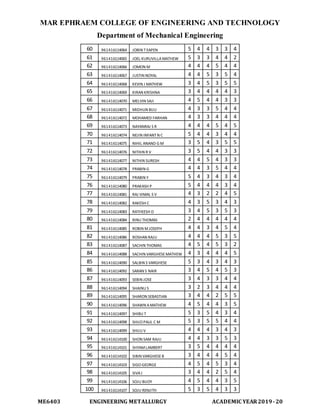
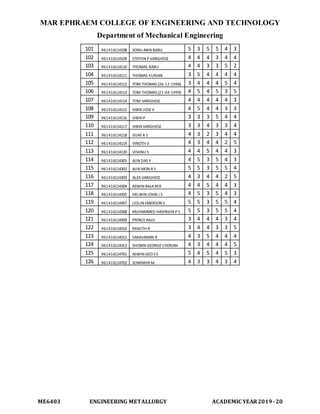
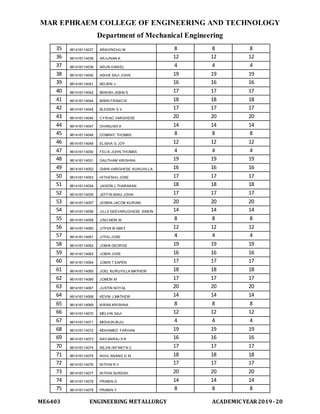
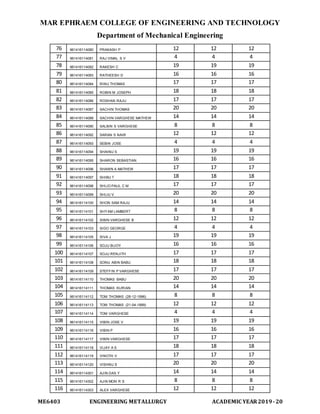
List of students
Sl no
Register Number Name
1.
961416114001 ABHIJITH K
2.
961416114002 ABHINAND D S
3.
961416114003 ABILASH A
4.
961416114004 ABINESH E
5.
961416114005 ABIN S
6.
961416114006 ABIN SAM ABRAHAM
7.
961416114007 AGABOS M JACOB
8.
961416114008 AHIN T A
9.
961416114010 AJASHA J A
10.
961416114011 AJESH B S
11.
961416114012 AJIN J RAJENDRAN
12.
961416114013 AJIN P RAJ
13.
961416114014 AJITH KUMAR R
14.
961416114016 AKHIL K SHIBU
15.
961416114017 AKHILNATH S S
16.
961416114018 AKHIL P JOSE
17.
961416114019 AKHIL RAJ P
18.
961416114020 AKILAN H
19.
961416114021 AKSHAY V NAIR
20.
961416114022 ALAN ALEX
21.
961416114023 ALAN P WILSON
22.
961416114024 ALAN S ABRAHAM
23.
961416114025 ALEN CHRIS BIJU
MAR EPHRAEM COLLEGE OF ENGINEERING AND TECHNOLOGY
Department of Mechanical Engineering
ME6403 ENGINEERING METALLURGY ACADEMIC YEAR2019-20
24.
961416114026 ALEX M JOHNSON
25.
961416114027 ALLEN SABU DANIEL
26.
961416114028 ALPHIN A
27.
961416114029 AMAL V SKARIA
28.
961416114030 ANANDHU LAL
29.
961416114031 ANISH P
30.
961416114032 ANISH THOMAS
31.
961416114033 ANSLY NITHIN S
32.
961416114034 ANTO RUFUS G
33.
961416114035 ARAVIND A KURUP
34.
961416114036 ARAVIND GOPAL M J
35.
961416114037 ARAVINDHU M
36.
961416114038 ARJUNAN K
37.
961416114040 ASHIK SAJI JOHN
38.
961416114041 BELBIN J
39.
961416114042 BENISH JEBIN S
40.
961416114044 BIBIN FRANCIS
41.
961416114045 BLESSIN S V
42.
961416114046 CYRIAC VARGHESE
43.
961416114047 DHANUSH A
44.
961416114048 DOMINIC THOMAS
45.
961416114049 ELISHA G JOY
46.
961416114050 FELIX JOHN THOMAS
47.
961416114051 GAUTHAM KRISHNA
48.
961416114054 JAISON J THARAKAN
49.
961416114055 JEFFIN BINU JOHN
50.
961416114057 JESBIN JACOB KURIAN
51.
961416114058 JILLS GEEVARUGHESE SIMON
52.
961416114059 JINO MON M
53.
961416114060 JITHIN M ABEY
MAR EPHRAEM COLLEGE OF ENGINEERING AND TECHNOLOGY
Department of Mechanical Engineering
ME6403 ENGINEERING METALLURGY ACADEMIC YEAR2019-20
54.
961416114061 JITHU JOSE
55.
961416114062 JOBIN GEORGE
56.
961416114063 JOBIN JOSE
57.
961416114064 JOBIN T EAPEN
58.
961416114065 JOEL KURUVILLA MATHEW
59.
961416114066 JOMON M
60.
961416114067 JUSTIN NOYAL
61.
961416114068 KEVIN J MATHEW
62.
961416114069 KIRAN KRISHNA
63.
961416114070 MELVIN SAJI
64.
961416114071 MIDHUN BIJU
65.
961416114072 MOHAMED FARHAN
66.
961416114073 NAYANRAJ S R
67.
961416114074 NEJIN INFANT N C
68.
961416114075 NIHIL ANAND G M
69.
961416114076 NITHIN R V
70.
961416114077 NITHIN SURESH
71.
961416114078 PRABIN G
72.
961416114079 PRABIN Y
73.
961416114080 PRAKASH P
74.
961416114081 RAJ VIMAL S V
75.
961416114082 RAKESH C
76.
961416114083 RATHEESH D
77.
961416114084 RINU THOMAS
78.
961416114086 ROSHAN RAJU
79.
961416114087 SACHIN THOMAS
80.
961416114088 SACHIN VARGHESE MATHEW
81.
961416114090 SALBIN S VARGHESE
82.
961416114092 SARAN S NAIR
83.
961416114093 SEBIN JOSE
MAR EPHRAEM COLLEGE OF ENGINEERING AND TECHNOLOGY
Department of Mechanical Engineering
ME6403 ENGINEERING METALLURGY ACADEMIC YEAR2019-20
84.
961416114094 SHAINU S
85.
961416114095 SHARON SEBASTIAN
86.
961416114096 SHAWN A MATHEW
87.
961416114097 SHIBU T
88.
961416114098 SHIJO PAUL C M
89.
961416114099 SHIJU V
90.
961416114100 SHON SAM RAJU
91.
961416114101 SHYAM LAMBERT
92.
961416114102 SIBIN VARGHESE B
93.
961416114103 SIGO GEORGE
94.
961416114105 SIVA J
95.
961416114106 SOJU BIJOY
96.
961416114108 SONU ABIN BABU
97.
961416114109 STEFFIN P VARGHESE
98.
961416114110 THOMAS BABU
99.
961416114111 THOMAS KURIAN
100.
961416114112 TOM THOMAS (26-12-1996)
101.
961416114113 TOM THOMAS (21-04-1999)
102.
961416114114 TOM VARGHESE
103.
961416114115 VIBIN JOSE V
104.
961416114116 VIBIN P
105.
961416114117 VIBIN VARGHESE
106.
961416114118 VIJAY A S
107.
961416114119 VINOTH V
108.
961416114120 VISHNU S
109.
961416114301 AJIN DAS Y
110.
961416114302 AJIN MON R S
111.
961416114303 ALEX VARGHESE
112.
961416114304 ASWIN RAJA M R
113.
961416114305 HELWIN JOHN J S
MAR EPHRAEM COLLEGE OF ENGINEERING AND TECHNOLOGY
Department of Mechanical Engineering
ME6403 ENGINEERING METALLURGY ACADEMIC YEAR2019-20
114.
961416114307 LESLIN EMERSON S
115.
961416114308 MUHAMMED HASINSHA P S
116.
961416114309 PRINCE RAJU
117.
961416114310 RENJITH R
118.
961416114312 SARAVANAN R
119.
961416114313 SHOBIN GEORGE CHERIAN
120.
961416114701 ASWIN GEO S E
121.
961416114702 SOWMIYA M
122.
961416114703 STEBIN S
123.
961416114901 JOHNSTON CHRYSLER A
124.
961416114902 MONISH M
125.
126.
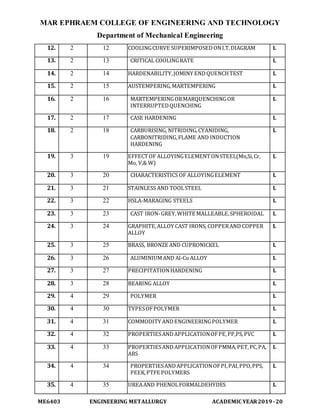
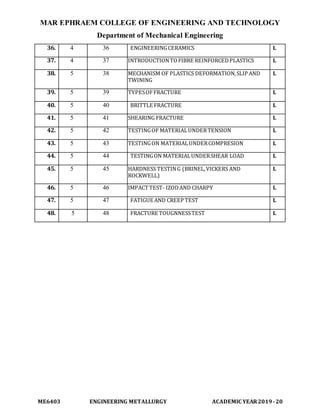
Lesson plan:
SlNo
Unit
Number
Lesson
Number
Lesson Topics L
1. 1 1 CONSTITUTIONOFALLOY L
2. 1 2
PHASE DIAGRAM, ISOMORPHOUS
L
3. 1 3 PHASE DIAGRAM EUTECTOIDREACTIONS L
4. 1 4 PHASE DIAGRAM EUTECTICREACTION L
5. 1 5 PHASE DIAGRAM PERITECTICREACTION L
6. 1 6 PHASE DIAGRAM PERITECTROIDREACTION L
7. 1 7 IRON-IRONCARBIDE EQUILIBRIUMDIGRAM L
8. 1 8 CLASSIFICATION OF STEELAND CAST IRON,
MICROSTRUCTURE,PROPERTIESANDAPPLICATIONS
L
9. 2 9 ANNEALING AND ITS TYPES L
10. 2 10 NORMALISING, HARDENINGAND TEMPERINGOF
STEEL
L
11. 2 11 ISOTHERMALTRANSFORMATIONDIAGRAM L
MAR EPHRAEM COLLEGE OF ENGINEERING AND TECHNOLOGY
Department of Mechanical Engineering
ME6403 ENGINEERING METALLURGY ACADEMIC YEAR2019-20
12. 2 12 COOLINGCURVE SUPERIMPOSEDONI.T.DIAGRAM L
13. 2 13 CRITICAL COOLINGRATE L
14. 2 14 HARDENABILITY,JOMINY ENDQUENCHTEST L
15. 2 15 AUSTEMPERING,MARTEMPERING L
16. 2 16 MARTEMPERINGORMARQUENCHINGOR
INTERRUPTEDQUENCHING
L
17. 2 17 CASE HARDENING L
18. 2 18 CARBURISING, NITRIDING,CYANIDING,
CARBONITRIDING,FLAME AND INDUCTION
HARDENING
L
19. 3 19 EFFECTOF ALLOYINGELEMENTONSTEEL(Mn,Si,Cr,
Mo, V,& W)
L
20. 3 20 CHARACTERISTICS OF ALLOYINGELEMENT L
21. 3 21 STAINLESS AND TOOLSTEEL L
22. 3 22 HSLA-MARAGING STEELS L
23. 3 23 CAST IRON-GREY,WHITE MALLEABLE,SPHEROIDAL L
24. 3 24 GRAPHITE,ALLOY CAST IRONS, COPPERAND COPPER
ALLOY
L
25. 3 25 BRASS, BRONZE AND CUPRONICKEL L
26. 3 26 ALUMINIUMAND Al-Cu ALLOY L
27. 3 27 PRECIPITATIONHARDENING L
28. 3 28 BEARING ALLOY L
29. 4 29 POLYMER L
30. 4 30 TYPESOFPOLYMER L
31. 4 31 COMMODITY ANDENGINEERINGPOLYMER L
32. 4 32 PROPERTIESANDAPPLICATIONOFPE,PP,PS,PVC L
33. 4 33 PROPERTIESAND APPLICATIONOFPMMA,PET,PC,PA,
ABS
L
34. 4 34 PROPERTIESANDAPPLICATIONOFPI,PAI,PPO,PPS,
PEEK,PTFE POLYMERS
L
35. 4 35 UREAAND PHENOLFORMALDEHYDES L
MAR EPHRAEM COLLEGE OF ENGINEERING AND TECHNOLOGY
Department of Mechanical Engineering
ME6403 ENGINEERING METALLURGY ACADEMIC YEAR2019-20
36. 4 36 ENGINEERINGCERAMICS L
37. 4 37 INTRODUCTIONTOFIBRE REINFORCEDPLASTICS L
38. 5 38 MECHANISM OF PLASTICS DEFORMATION,SLIP AND
TWINING
L
39. 5 39 TYPESOFFRACTURE L
40. 5 40 BRITTLE FRACTURE L
41. 5 41 SHEARING FRACTURE L
42. 5 42 TESTINGOF MATERIALUNDERTENSION L
43. 5 43 TESTINGON MATERIALUNDERCOMPRESION L
44. 5 44 TESTINGON MATERIALUNDERSHEAR LOAD L
45. 5 45 HARDNESS TESTING (BRINEL,VICKERS AND
ROCKWELL)
L
46. 5 46 IMPACTTEST- IZODAND CHARPY L
47. 5 47 FATIGUE AND CREEP TEST L
48. 5 48 FRACTURE TOUGNNESSTEST L
MAR EPHRAEM COLLEGE OF ENGINEERING AND TECHNOLOGY
Department of Mechanical Engineering
ME6403 ENGINEERING METALLURGY ACADEMIC YEAR2019-20
Course content
Lesson Title CONSTITUTION OF ALLOY
Lesson concept/
Points/Definitions
Constitution of Alloys
 An alloy is a mixture or metallic solid solution composed of two or
more elements.
 Alloying a metal is done by combining it with one or more other
metals or non-metals that often enhance its properties. For
example,steel is stronger than iron, its primary element.
 The term alloy is used to describe a mixture of atoms in which the
primary constituent is a metal. The primary metal is called the base,
the matrix, or the solvent. The secondary constituents are often
called solutes.
 A solvent is a substance that dissolves a solute (a chemically
different liquid, solid or gas), resulting in a solution.
 If there is a mixture of only two types of atoms, not counting
impurities, such as a copper-nickel alloy, then it is called a binary
alloy.
 If there are three types of atoms forming the mixture, such as iron,
nickel and chromium, then it is called a ternary alloy.
 An alloy with four constituents is a quaternary alloy, while a five-
part alloy is termed a quinary alloy.
 Because the percentage of each constituent can be varied, with any
mixture the entire range of possible variations is called a system.
Solid Solutions, Substitutional and Interstitial
 A solid solution is a solid-state solution of one or more solutes in
a solvent.
 When a molten metal is mixed with another substance, there are
two mechanisms that can cause an alloy to form, called atom
exchange and the interstitial mechanism.
 When the atoms are relatively similar in size, the atom exchange
MAR EPHRAEM COLLEGE OF ENGINEERING AND TECHNOLOGY
Department of Mechanical Engineering
ME6403 ENGINEERING METALLURGY ACADEMIC YEAR2019-20
method usually happens, where some of the atoms composing the
metallic crystals are substituted with atoms of the other constituent.
This is called a substitutional alloy.
Teaching
Methodology:
PPT - UNIT I- CONSTITUTION OF ALLOY AND PHASE DIAGRAM
Learning
Resource (page
number)
T2- (1 to 15)
R1- (10 to 12)
Lesson Title PHASE DIAGRAM,ISOMORPHOUS
Lesson concept/
Points/Definitions
Phase diagram is a diagram representing the limits of stability of the various phases
in a chemical system at equilibrium, with respect to variables such as composition
and temperature.
Common components of a phase diagram are lines of equilibrium or phase
boundaries, which refer to lines that mark conditions under which multiple phases
can coexist at equilibrium. Phase transitions occur along lines of equilibrium.
Triple points are points on phase diagrams where lines of equilibrium intersect.
Triple points mark conditions at which three different phases can coexist.
For example, the water phase diagram has a triple point corresponding to the single
temperature and pressure at which solid, liquid, and gaseous water can coexist in a
stable equilibrium.
The solidus is the temperature below which the substance is stable in the solid state.
The liquidus is the temperature above which the substance is stable in a liquid state.
There may be a gap between the solidus and liquidus; within the gap, the substance
consists of a mixture of crystals and liquid like a "slurry".
A slurry is a thin sloppy mud or cement or, in extended use, any fluid mixture of a
pulverized solid with a liquid (usually water), often used as a convenient way of
handling solids in bulk.
Slurries behave in some ways like thick fluids, flowing under gravity and being
capable of being pumped if not too thick.
The phase boundary which limits the bottom of the liquid field is called the liquidus
MAR EPHRAEM COLLEGE OF ENGINEERING AND TECHNOLOGY
Department of Mechanical Engineering
ME6403 ENGINEERING METALLURGY ACADEMIC YEAR2019-20
line.
The line giving the upper limit of the single phase solid field is called the solidus
line.
Isomorphous binary phase diagrams are found in a number of metallic and ceramic
systems. In the isomorphous systems, only one solid phase forms; the two
components in the system display complete solid solubility.
Typically, the isomorphous system has a liquid area, a solid area, and an area that is
a mixture of both liquid and solid. Typically, a binary isomorphous phase diagram
consists of two phase boundaries: the liquidus and the solidus.
Teaching
Methodology:
PPT - UNIT I- CONSTITUTION OF ALLOY AND PHASE DIAGRAM
Learning
Resource (page
number)
T1-23
R1- (4 to 5)
Lesson Title PHASE DIAGRAMS EUTECTOID REACTIONS
Lesson concept/
Points/Definitions
Definition: A eutectoid reaction is a three-phase reaction by which, on cooling, a
solid transforms into two other solid phases at the same time. If the bottom of a
single-phase solid field closes (and provided the adjacent two-phase fields are solid
also), it does so with a eutectoid point.
The eutectoid reaction describes the phase transformation of one solid into two
different solids.
In the Fe-C system, there is a eutectoid point at approximately 0.8wt% C, 723°C.
Eutectoid point – here, the three phases are in equilibrium. The compositions of
the two new phases are given by the ends of the line through the eutectoid point.
The phase just above the eutectoid temperature for plain carbon steels is known as
austenite or gamma.
The compositions of the two new phases are given by the ends of the tie-line
through the eutectoid point. The general eutectoid reaction is therefore:
Solid γ –> solid α + solid β
or using the names given to these phases:
Austenite –> ferrite + cementite (Fe3C)
The mechanism of eutectoid transformation must transform a single solid phase into
two others, both with compositions which differ from the original.
Taking the eutectoid decomposition of iron as an example, austenite containing
0.8% C changes into ferrite (iron containing almost no carbon) and cementite (Fe3C,
containing 25 at% carbon). Hence carbon atoms must diffuse together to form Fe3C,
leaving ferrite.
Nuclei of small plates of ferrite and cementite form at the grain boundaries of the
MAR EPHRAEM COLLEGE OF ENGINEERING AND TECHNOLOGY
Department of Mechanical Engineering
ME6403 ENGINEERING METALLURGY ACADEMIC YEAR2019-20
austenite, and carbon diffusion takes place on a very local scale just ahead of the
interface (schematic below). Thus, the plates grow, consuming the austenite as they
go, to form pearlite.
The eutectoid structure in iron has a special name: it is called pearlite (because it
has a pearly look).
Some commercial steels have a eutectoid composition - steel for railway track is an
example of a "pearlitic steel
Teaching
Methodology:
PPT - UNIT I- CONSTITUTION OF ALLOY AND PHASE DIAGRAM
Learning
Resource (page
number)
T1-(27-28) ; T2-(73-88)
R1- (10,13 to 26)
Lesson Title PHASE DIAGRAMS EUTECTIC REACTIONS
Lesson concept/
Points/Definition
s
A EUTECTIC REACTION is a three-phase reaction by which, on cooling, a liquid
transforms into two solid phases at the same time. It is a phase reaction, of course, but a
special one. If the bottom of a liquid-phase field closes with a V, the bottom of the V is
a eutectic point.
The lower limit of the single-phase liquid field formed by the intersection of two
liquidus lines is called the eutectic point.
A eutectic system is a mixture of chemical compounds or elements that has a single
multiple chemical composition that solidifies at a lower temperature than any other
composition made up of the same ingredients. This composition is known as
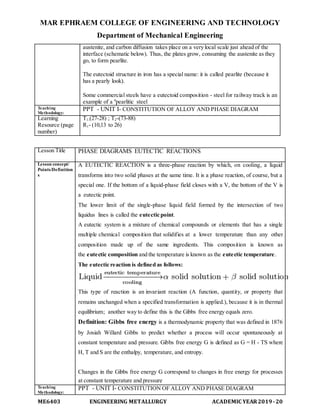
the eutectic composition and the temperature is known as the eutectic temperature.
The eutectic reaction is defined as follows:
This type of reaction is an invariant reaction (A function, quantity, or property that
remains unchanged when a specified transformation is applied.), because it is in thermal
equilibrium; another way to define this is the Gibbs free energy equals zero.
Definition: Gibbs free energy is a thermodynamic property that was defined in 1876
by Josiah Willard Gibbs to predict whether a process will occur spontaneously at
constant temperature and pressure. Gibbs free energy G is defined as G = H - TS where
H, T and S are the enthalpy, temperature, and entropy.
Changes in the Gibbs free energy G correspond to changes in free energy for processes
at constant temperature and pressure
Teaching
Methodology:
PPT - UNIT I- CONSTITUTION OF ALLOY AND PHASE DIAGRAM
MAR EPHRAEM COLLEGE OF ENGINEERING AND TECHNOLOGY
Department of Mechanical Engineering
ME6403 ENGINEERING METALLURGY ACADEMIC YEAR2019-20
Learning
Resource
(page number)
R4- (153,174)
Lesson Title PHASE DIAGRAMS PERITECTIC REACTIONS
Lesson concept/
Points/Definitions
Peritectic reaction where a solid phase reacts with a liquid phase to produce a new
solid phase.
Peritectic reaction is commonly present as part of more-complicated binary
diagrams, particularly if the melting points of the two components are quite different.
Peritectic reaction do not give rise to micro-constituents as the eutectic and eutectoid
reactions do.
The term “peritectic,” or “peritectic point,” is often used to designate the point of
intersection between the temperature lines on a phase diagram at the onset of
crystallization of two solid phases in equilibrium with a peritectic liquid.
Peritectic point - The point on a phase diagram where a reaction takes place between
a previously precipitated phase and the liquid to produce a new solid phase. When this
point is reached, the temperature must remain constant until the reaction has run to
completion.
A peritectic is also an invariant point.
Teaching
Methodology:
PPT - UNIT I- CONSTITUTION OF ALLOY AND PHASE DIAGRAM
Learning
Resource (page
number)
T1- (74 to 91); T2(16-36)
Lesson Title PHASE DIAGRAMS PERITECTROID REACTIONS
Lesson concept/
Points/Definitions
Peritectoid is a three-phase reaction similar to peritectic but occurs from
twosolid phases to one new solid phase (α + β = γ).
Peritectoid reactions do not give rise to micro-constituents as the eutectic
and eutectoid reactions do
Teaching
Methodology:
PPT - UNIT I- CONSTITUTION OF ALLOY AND PHASE DIAGRAM
Learning
Resource (page
number)
T1- (103 to 105) T2 (89-90)
Lesson Title IRON – IRON CARBIDE EQUILIBRIUM DIAGRAM.
Lesson concept/ Steels are the most complex and widely used engineering materials because
MAR EPHRAEM COLLEGE OF ENGINEERING AND TECHNOLOGY
Department of Mechanical Engineering
ME6403 ENGINEERING METALLURGY ACADEMIC YEAR2019-20
Points/Definitions of the abundance of iron in the earth’s crust, high melting temperature of
iron (1534°C), and wide range of mechanical properties and associated
microstructures produced by solid-state phase transformations by varying
the cooling rate from the austenitic condition.
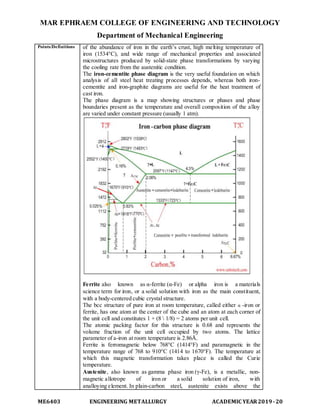
The iron-cementite phase diagram is the very useful foundation on which
analysis of all steel heat treating processes depends, whereas both iron-
cementite and iron-graphite diagrams are useful for the heat treatment of
cast iron.
The phase diagram is a map showing structures or phases and phase
boundaries present as the temperature and overall composition of the alloy
are varied under constant pressure (usually 1 atm).
Ferrite also known as α-ferrite (α-Fe) or alpha iron is a materials
science term for iron, or a solid solution with iron as the main constituent,
with a body-centered cubic crystal structure.
The bcc structure of pure iron at room temperature, called either α -iron or
ferrite, has one atom at the center of the cube and an atom at each corner of
the unit cell and constitutes 1 + (8  1/8) = 2 atoms per unit cell.
The atomic packing factor for this structure is 0.68 and represents the
volume fraction of the unit cell occupied by two atoms. The lattice
parameter of a-iron at room temperature is 2.86Å.
Ferrite is ferromagnetic below 768°C (1414°F) and paramagnetic in the
temperature range of 768 to 910°C (1414 to 1670°F). The temperature at
which this magnetic transformation takes place is called the Curie
temperature.
Austenite, also known as gamma phase iron (γ-Fe), is a metallic, non-
magnetic allotrope of iron or a solid solution of iron, with
analloying element. In plain-carbon steel, austenite exists above the
MAR EPHRAEM COLLEGE OF ENGINEERING AND TECHNOLOGY
Department of Mechanical Engineering
ME6403 ENGINEERING METALLURGY ACADEMIC YEAR2019-20
criticaleutectoid temperature of 1,000 K (1,300 °F); other alloys ofsteelhave
different eutectoid temperatures. It is named after Sir William Chandler
Roberts-Austen(1843–1902)
Austenite as well as other metals such as Al, Ni, Cu, Ag, Pt, and Au have the
close packed face-centered cubic (fcc) structure.
Delta Iron
The third phase that occurs in pure iron is δ-iron or ferrite with a bcc
structure, which is crystallographically similar to alpha-iron.
Delta-iron is stable at temperature between 1393 and 1534°C (2540 and
2793°F). Its lattice parameter is 2.89Å; it is also soft and ductile, and its
hardness and elongation are similar to those of ferrite and austenite in their
stable forms.
CRITICAL TEMPERATURES
There are three transformation temperatures, often referred to as critical
temperatures, which are of interest in heat treatment of steels.
The temperature A1 is the eutectoid temperature of 723°C in the binary
phase diagram which is the boundary between ferrite-cementite field and the
austenite-ferrite or austenite-cementite field.
Temperature A3 is the temperature at which α-iron transforms to γ-iron,
which, for pure iron, occurs at 910°C. The A3 line represents the boundary
between the ferrite-austenite and austenite fields.
Teaching
Methodology:
PPT - UNIT I- CONSTITUTION OF ALLOY AND PHASE DIAGRAM
Learning
Resource (page
number)
R41- (68to 69)
Lesson Title CLASSIFICATION OF STEEL AND CAST IRON
Lesson
concept/
Points/Definiti
ons
Steels can be classified by severaldifferent systems depending on
(1) The compositions, such as carbon, low-alloy, alloy, or stainless steels;
(2) The manufacturing methods, such as basic and acid open hearth, or electric furnace
methods;
(3) The finishing methods, such as hot rolling or cold rolling;
(4) The product shape,such as bar, plate, strip, tubing, or structural shape;
(5) The application, such as structural, spring, and high tensile steels;
(6) The deoxidation practice, such as killed, semikilled, capped, and rimmed steels;
(7) The microstructure, such as ferritic, pearlitic, and martensitic;
(8) The required strength level, as specified in ASTM Standards;
(9) Heat treatment, such as annealing, quenching and tempering, and thermomechanical
processing;
(10) Quality descriptors/classifications, such as forging quality and commercial quality
Stainless Steels. Stainless may be defined as complex alloy steels containing a minimum
of 10.5% Cr with or without other elements to produce austenitic, ferritic, duplex (ferritic-
austenitic), martensitic, and precipitation hardening grades.
Maraging Steels. Maraging steels are a specific class of low-carbon ultrahigh-strength
steels which derive their strength not from carbon but from precipitation of intermetallic
compounds.
CAST IRON CLASSIFICATIONS
There are six generic types of cast irons. In each type, there are several grades, such as (1)
white iron, (2) gray iron, (3) ductile iron, (4) compacted graphite iron, (5) malleable iron,
MAR EPHRAEM COLLEGE OF ENGINEERING AND TECHNOLOGY
Department of Mechanical Engineering
ME6403 ENGINEERING METALLURGY ACADEMIC YEAR2019-20
and (6) high-alloy irons.
White Cast Iron
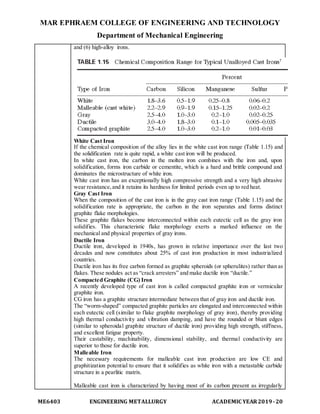
If the chemical composition of the alloy lies in the white cast iron range (Table 1.15) and
the solidification rate is quite rapid, a white cast iron will be produced.
In white cast iron, the carbon in the molten iron combines with the iron and, upon
solidification, forms iron carbide or cementite, which is a hard and brittle compound and
dominates the microstructure of white iron.
White cast iron has an exceptionally high compressive strength and a very high abrasive
wear resistance,and it retains its hardness for limited periods even up to red heat.
Gray Cast Iron
When the composition of the cast iron is in the gray cast iron range (Table 1.15) and the
solidification rate is appropriate, the carbon in the iron separates and forms distinct
graphite flake morphologies.
These graphite flakes become interconnected within each eutectic cell as the gray iron
solidifies. This characteristic flake morphology exerts a marked influence on the
mechanical and physical properties of gray irons.
Ductile Iron
Ductile iron, developed in 1940s, has grown in relative importance over the last two
decades and now constitutes about 25% of cast iron production in most industrialized
countries.
Ductile iron has its free carbon formed as graphite spheroids (or spherulites) rather than as
flakes. These nodules act as “crack arresters” and make ductile iron “ductile.”
Compacted Graphite (CG) Iron
A recently developed type of cast iron is called compacted graphite iron or vermicular
graphite iron.
CG iron has a graphite structure intermediate between that of gray iron and ductile iron.
The “worm-shaped” compacted graphite particles are elongated and interconnected within
each eutectic cell (similar to flake graphite morphology of gray iron), thereby providing
high thermal conductivity and vibration damping, and have the rounded or blunt edges
(similar to spheroidal graphite structure of ductile iron) providing high strength, stiffness,
and excellent fatigue property.
Their castability, machinability, dimensional stability, and thermal conductivity are
superior to those for ductile iron.
Malleable Iron
The necessary requirements for malleable cast iron production are low CE and
graphitization potential to ensure that it solidifies as white iron with a metastable carbide
structure in a pearlitic matrix.
Malleable cast iron is characterized by having most of its carbon present as irregularly
MAR EPHRAEM COLLEGE OF ENGINEERING AND TECHNOLOGY
Department of Mechanical Engineering
ME6403 ENGINEERING METALLURGY ACADEMIC YEAR2019-20
shaped nodules of graphite. This form of graphite is called temper carbon nodules (Type
III in ASTM Standard A247) because it is formed by the decomposition of Fe3C in the
solid state after an extended heat treatment of white cast iron of suitable composition in a
controlled atmosphere furnace to a temperature above the eutectoid temperature, usually
900°C (1650°F)
High-Alloy Iron
This group of cast irons includes high-alloy white irons, high-alloy gray irons, and high-
alloy ductile irons.
Usually, malleable irons are not highly alloyed because there is interference with the
malleabilizing process. CG irons have not been studied well in the highly alloyed
condition.
High-alloy irons are used in applications requiring high strength, hardness, and
hardenability or improved resistance to abrasive wear, heat, and chemical corrosion
properties and whenever special-purpose physical properties such as low thermal
expansion and nonmagnetic properties are in demand
Teaching
Methodology:
PPT - UNIT I- CONSTITUTION OF ALLOY AND PHASE DIAGRAM
Learning
Resource
(page
number)
T2- (93 to 101)
Lesson Title ANNEALING
Lesson concept/
Points/Definitions
Annealing is commonly used after casting, forging or rolling to soften
materials and minimise residual stresses, improve machinability, and
increase ductility by carefully controlling the microstructure.
There are several process variations that qualify as annealing
treatments:
 Full annealing is performed on steels by heating to a high
temperature (typically 830-950°C), then cooling slowly to
ambient temperature. Non-ferrous materials are softened and
refined by full annealing at temperatures appropriate for each
alloy.
 Isothermal/cyclic annealing is performed by heating steels to
the full annealing temperature, cooling to an intermediate
temperature (typically 550- 700°C) and soaking for a long
period to allow transformation to proceed slowly, followed by
cooling to ambient temperature.
 Inter-critical annealing is applied by heating steels to below
the full annealing temperature (typically 723- 910°C)
according to composition. A prolonged soak is followed by
cooling to ambient temperature.
 Subcritical annealing takes place at a temperature for steels of
typically 650 - 720°C, allowing a prolonged soak before
cooling to ambient temperature.
MAR EPHRAEM COLLEGE OF ENGINEERING AND TECHNOLOGY
Department of Mechanical Engineering
ME6403 ENGINEERING METALLURGY ACADEMIC YEAR2019-20
 Homogenisation annealing can be applied to both ferrous and
non-ferrous materials and is a prolonged high-temperature
soak intended to break down segregation in the material s
structure.
 Solution annealing is applied commonly to austenitic stainless
steels, typically at 1010-1150°C. With unstabilised grades, the
treatment must be followed by fast cooling or quenching. It is
applied as a softening process during manufacture or to
optimise corrosion resistance (e.g. after welding).
Full annealing is the process of slowly raising the temperature about
50 ºC (90 ºF) above the Austenitic temperature line A3 or line ACM in
the case of Hypoeutectoid steels (steels with < 0.77% Carbon) and 50
ºC (90 ºF) into the Austenite-Cementite region in the case of
Hypereutectoid steels (steels with > 0.77% Carbon). It is held at this
temperature for sufficient time for all the material to transform into
Austenite or Austenite-Cementite as the case may be. It is then slowly
cooled at the rate of about 20 ºC/hr (36 ºF/hr) in a furnace to about 50
ºC (90 ºF) into the Ferrite-Cementite range. At this point, it can be
cooled in room temperature air with natural convection.
Stress Relief Annealingl is used to reduce residual stresses in large
castings, welded parts and cold-formed parts. Such parts tend to have
stresses due to thermal cycling or work hardening. Parts are heated to
temperatures of up to 600 - 650 ºC (1112 - 1202 ºF), and held for an
extended time (about 1 hour or more) and then slowly cooled in still
air.
Spheroidization is an annealing process used for high carbon steels
(Carbon > 0.6%) that will be machined or cold formed subsequently.
This is done by one of the following ways:
1. Heat the part to a temperature just below the Ferrite-Austenite
line, line A1 or below the Austenite-Cementite line, essentially
below the 727 ºC (1340 ºF) line. Hold the temperature for a
prolonged time and follow by fairly slow cooling. Or
2. Cycle multiple times between temperatures slightly above and
slightly below the 727 ºC (1340 ºF) line, say for example
between 700 and 750 ºC (1292 - 1382 ºF), and slow cool. Or
3. For tool and alloy steels heat to 750 to 800 ºC (1382-1472 ºF)
and hold for several hours followed by slow cooling.
Teaching
Methodology:
PPT - UNIT II-HEAT TREATMENT
Learning
Resource (page
number)
R4- (44 to 48)
MAR EPHRAEM COLLEGE OF ENGINEERING AND TECHNOLOGY
Department of Mechanical Engineering
ME6403 ENGINEERING METALLURGY ACADEMIC YEAR2019-20
Lesson Title NORMALISING,HARDENINGAND TEMPERING
Lesson concept/
Points/Definitions
Normalising
Applied to some, but not all, engineering steels, normalising can
soften, harden or stress relieve a material, depending on its initial
state. The objective of the treatment is to counter the effects of prior
processes, such as casting, forging or rolling, by refining the existing
non-uniform structure into one which enhances
machinability/formability or, in certain product forms, meets final
mechanical property requirements.
A primary purpose is to condition the steel so that, after subsequent
shaping, a component responds satisfactorily to a hardening operation
(e.g. aiding dimensional stability).
Normalising consists of heating the suitable steel to a temperature
typically in the range 830-950°C (at or above the hardening
temperature of hardening steels, or above the carburising temperature
for carburising steels) and then cooling in air. Heating is usually
carried out in air, so subsequent machining or surface finishing is
required to remove scale or decarburised layers.
Hardening and Tempering
Changing the properties of metals by processes involves heating. It is
used to harden, soften, or modify other properties of materials that
have different structures at low and high temperatures.
The type of transformation depends on the temperature that the
material is heated to, how fast it is heated, how long it is kept heated,
what temperature it is first cooled to, and how fast it is cooled.
(Hardened and quenched)
Followed by a secondary heating stage of a much lower temperature
and a length of time it is held. (Tempering)
Every heat treatable material has specific temperature ranges for
hardening and quenching mediums long with tempering temperatures
to produce the mechanical properties or hardness's required for the
application it has been chosen.
After the hardening treatment is applied, steel is often harder than
needed and is too brittle for most practical uses. Also, severe internal
stresses are set up during the rapid cooling from the hardening
temperature. To relieve the internal stresses and reduce brittleness,
you should temper the steel after it is hardened. Tempering consists of
heating the steel to a specific temperature (below its hardening
temperature), holding it at that temperature for the required length of
time, and then cooling it, usually in still air. The resultant strength,
MAR EPHRAEM COLLEGE OF ENGINEERING AND TECHNOLOGY
Department of Mechanical Engineering
ME6403 ENGINEERING METALLURGY ACADEMIC YEAR2019-20
hardness, and ductility depend on the temperature to which the steel is
heated during the tempering process.
Teaching
Methodology:
PPT - UNIT II- HEAT TREATMENT
Learning
Resource (page
number)
T2- (132)
Lesson Title ISOTHERMAL TRANSFORMATION DIAGRAMS
Lesson concept/
Points/Definitions
Isothermal Transformation Diagrams
Isothermal transformation diagrams (also known as time-temperature-
transformation diagrams) are plots of temperature versus time (usually on
a logarithmic scale).
They are generated from percentage transformation-vs logarithm of time
measurements,and are useful for understanding the transformations of
an alloy steelthat is cooled isothermally.
An isothermal transformation diagram is only valid for one specific
composition of material, and only if the temperature is held constant during
the transformation, and strictly with rapid cooling to that temperature.
Though usually used to represent transformation kinetics for steels, they also
can be used to describe the kinetics of crystallization in ceramic or other
materials.
Time-temperature-precipitation diagrams and time-temperature-
embrittlement diagrams have also been used to represent kinetic changes in
steels.
Isothermal transformation (IT) diagram or the C-curve is associated with
mechanical properties, microconstituents/microstructures, and heat
treatments in carbon steels.
The rate of austenite transforms to a cementite and ferrite mixture can be
explained using the sigmoidal curve; this eutectoid transformation begins
and is represented by the pearlite start (Ps) curve. This transformation is
complete at pearlite finish (Pf )curve.
Nucleation requires an incubation time. The rate of nucleation increases and
the rate of microconstituent growth decreases as the temperature decreases
from the liquidus temperature.
As a result of the transformation, the microconstituents, Pearlite and Bainite,
form; Pearlite forms at higher temperatures and bainite at lower.
Austenite is slightly undercooled when quenched
below Eutectoid temperature. When given more time, stable
microconstituents can form: ferrite and cementite
Teaching
Methodology:
PPT - UNIT II- HEAT TREATMENT
Learning
Resource (page
number)
T2- (232 to 237)
Lesson Title COOLINGCURVES SUPERIMPOSEDON I.T. DIAGRAM,CCR
Lesson concept/
Points/Definitions
Critical Cooling Rate (CCR)
MAR EPHRAEM COLLEGE OF ENGINEERING AND TECHNOLOGY
Department of Mechanical Engineering
ME6403 ENGINEERING METALLURGY ACADEMIC YEAR2019-20
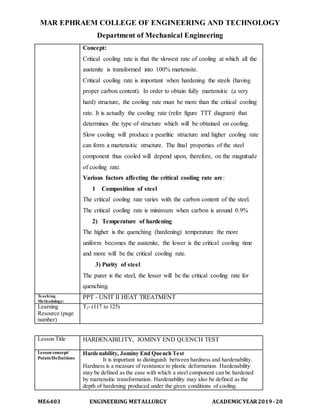
Concept:
Critical cooling rate is that the slowest rate of cooling at which all the
austenite is transformed into 100% martensite.
Critical cooling rate is important when hardening the steels (having
proper carbon content). In order to obtain fully martensitic (a very
hard) structure, the cooling rate must be more than the critical cooling
rate. It is actually the cooling rate (refer figure TTT diagram) that
determines the type of structure which will be obtained on cooling.
Slow cooling will produce a pearlitic structure and higher cooling rate
can form a martensitic structure. The final properties of the steel
component thus cooled will depend upon, therefore, on the magnitude
of cooling rate.
Various factors affecting the critical cooling rate are:
1 Composition of steel
The critical cooling rate varies with the carbon content of the steel.
The critical cooling rate is minimum when carbon is around 0.9%
2) Temperature of hardening
The higher is the quenching (hardening) temperature the more
uniform becomes the austenite, the lower is the critical cooling time
and more will be the critical cooling rate.
3) Purity of steel
The purer is the steel, the lesser will be the critical cooling rate for
quenching.
Teaching
Methodology:
PPT - UNIT II HEAT TREATMENT
Learning
Resource (page
number)
T2- (117 to 125)
Lesson Title HARDENABILITY, JOMINY END QUENCH TEST
Lesson concept/
Points/Definitions
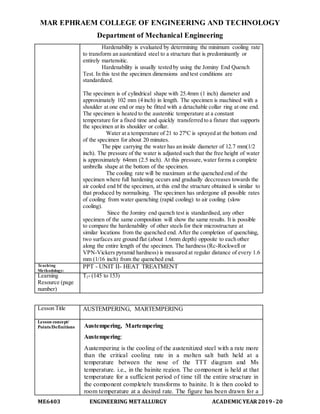
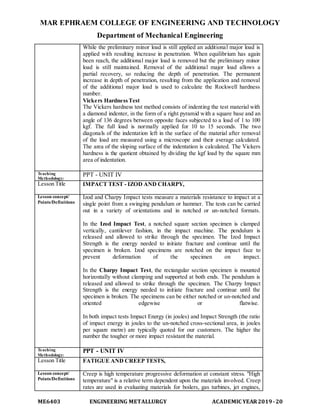
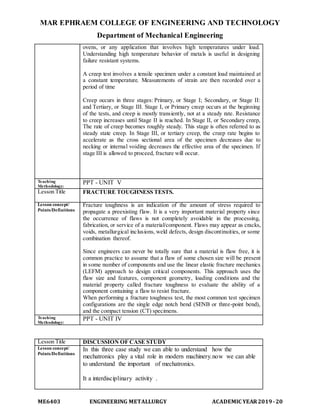
Hardenability, Jominy End Quench Test
It is important to distinguish between hardness and hardenability.
Hardness is a measure of resistance to plastic deformation. Hardenability
may be defined as the ease with which a steel component can be hardened
by martensitic transformation. Hardenability may also be defined as the
depth of hardening produced under the given conditions of cooling.
MAR EPHRAEM COLLEGE OF ENGINEERING AND TECHNOLOGY
Department of Mechanical Engineering
ME6403 ENGINEERING METALLURGY ACADEMIC YEAR2019-20
Hardenability is evaluated by determining the minimum cooling rate
to transform an austenitized steel to a structure that is predominantly or
entirely martensitic.
Hardenability is usually tested by using the Jominy End Quench
Test. In this test the specimen dimensions and test conditions are
standardized.
The specimen is of cylindrical shape with 25.4mm (1 inch) diameter and
approximately 102 mm (4 inch) in length. The specimen is machined with a
shoulder at one end or may be fitted with a detachable collar ring at one end.
The specimen is heated to the austenitic temperature at a constant
temperature for a fixed time and quickly transferred to a fixture that supports
the specimen at its shoulder or collar.
Water at a temperature of 21 to 270
C is sprayed at the bottom end
of the specimen for about 20 minutes.
The pipe carrying the water has an inside diameter of 12.7 mm(1/2
inch). The pressure of the water is adjusted such that the free height of water
is approximately 64mm (2.5 inch). At this pressure,water forms a complete
umbrella shape at the bottom of the specimen.
The cooling rate will be maximum at the quenched end of the
specimen where full hardening occurs and gradually deccreases towards the
air cooled end bf the specimen, at this end the structure obtained is similar to
that produced by normalising. The specimen has urdergone all possible rates
of cooling from water quenching (rapid cooling) to air cooling (slow
cooling).
Since the Jominy end quench test is standardised, any other
specimen of the same composition will show the same results. It is possible
to compare the hardenability of other steels for their microstructure at
similar locations from the quenched end. After the completion of quenching,
two surfaces are ground flat (about 1.6mm depth) opposite to each other
along the entire length of the specimen. The hardness (Rc-Rockwell or
VPN-Vickers pyramid hardness) is measured at regular distance of every 1.6
mm (1/16 inch) from the quenched end.
Teaching
Methodology:
PPT - UNIT II- HEAT TREATMENT
Learning
Resource (page
number)
T2- (145 to 153)
Lesson Title AUSTEMPERING, MARTEMPERING
Lesson concept/
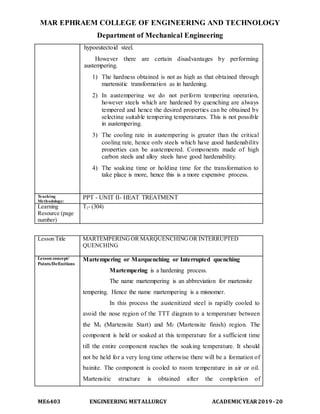
Points/Definitions Austempering, Martempering
Austempering:
Austempering is the cooling of the austenitized steel with a rate more
than the critical cooling rate in a molten salt bath held at a
temperature between the nose of the TTT diagram and Ms
temperature. i.e., in the bainite region. The component is held at that
temperature for a sufficient period of time till the entire structure in
the component completely transforms to bainite. It is then cooled to
room temperature at a desired rate. The figure has been drawn for a
MAR EPHRAEM COLLEGE OF ENGINEERING AND TECHNOLOGY
Department of Mechanical Engineering
ME6403 ENGINEERING METALLURGY ACADEMIC YEAR2019-20
hypoeutectoid steel.
However there are certain disadvantages by performing
austempering.
1) The hardness obtained is not as high as that obtained through
martensitic transformation as in hardening.
2) In austempering we do not perform tempering operation,
however steels which are hardened by quenching are always
tempered and hence the desired properties can be obtained by
selecting suitable tempering temperatures. This is not possible
in austempering.
3) The cooling rate in austempering is greater than the critical
cooling rate, hence only steels which have good hardenability
properties can be austempered. Components made of high
carbon steels and alloy steels have good hardenability.
4) The soaking time or holding time for the transformation to
take place is more, hence this is a more expensive process.
Teaching
Methodology:
PPT - UNIT II- HEAT TREATMENT
Learning
Resource (page
number)
T2- (304)
Lesson Title MARTEMPERINGOR MARQUENCHINGOR INTERRUPTED
QUENCHING
Lesson concept/
Points/Definitions
Martempering or Marquenching or Interrupted quenching
Martempering is a hardening process.
The name martempering is an abbreviation for martensite
tempering. Hence the name martempering is a misnomer.
In this process the austenitized steel is rapidly cooled to
avoid the nose region of the TTT diagram to a temperature between
the Ms (Martensite Start) and Mf (Martensite finish) region. The
component is held or soaked at this temperature for a sufficient time
till the entire component reaches the soaking temperature. It should
not be held for a very long time otherwise there will be a formation of
bainite. The component is cooled to room temperature in air or oil.
Martensitic structure is obtained after the completion of
MAR EPHRAEM COLLEGE OF ENGINEERING AND TECHNOLOGY
Department of Mechanical Engineering
ME6403 ENGINEERING METALLURGY ACADEMIC YEAR2019-20
transformation.
Teaching
Methodology:
PPT - UNIT II- HEAT TREATMENT
Learning
Resource (page
number)
R4- (155 to 163)
Lesson Title CASE HARDENING
Lesson concept/
Points/Definitions
Case Hardening
Case hardening / Surface hardening
In engineering practice it is often necessary for parts to have
a hard, wear resisting
skin (outer surface) with a tough impact resisting core (inner surface).
No carbon steels even alloy steels posses both the above requirements.
So some methods have been developed to obtain this combination and
are called surface hardening or case hardening processes.
Generally Usedcase hardening are:
Carburizing, Cyaniding, Nitriding, Carbo Nitriding, Flame hardening,
Induction hardening, Electron beam hardening, Laser beam
hardening, Metallic cementation and Boriding
Teaching
Methodology:
PPT - UNIT II- HEAT TREATMENT
Learning
Resource (page
number)
T2- (101,119)
Lesson Title CARBURISING,NITRIDING,CYANIDING, CARBONITRIDING,
FLAME AND INDUCTION HARDENING.
Lesson concept/
Points/Definitions
Carburising, Nitriding, Cyaniding, Carbonitriding, Flame and
Induction Hardening.
Carburizing
Carburizing is a process of enriching or saturating the surface layers
MAR EPHRAEM COLLEGE OF ENGINEERING AND TECHNOLOGY
Department of Mechanical Engineering
ME6403 ENGINEERING METALLURGY ACADEMIC YEAR2019-20
of steel with
Carbon. The depth of case obtained in components depends on the
time temperature, and type of carburizer used in the process.
There are three methods of carburizing namely
1) Pack or solid carburizing
2) Liquid carburizing (Liquid carburizing uses a molten potassium
cyanide salt
bath at a temp of 8500C and immersed in that bath)
3) Gas carburizing.
Pack carburizing or Solid carburizing
In this process components to be case hardened are packed
into a steel box along with carburizing and energizing mixture. The
mixture consists of a solid carburizer normally charcoal of 40 to
70%,barium carbonate of 20-25%, sodium carbonate of 3 to 12% (to
intensify the process) and CaCo3 of 3 to 5% (to prevent the carburizer
particles from caking). The box is covered and the lid is tightly sealed
with fire clay (to prevent the entry or escape of gases).
The box is then placed in a furnace and heated to a
temperature of 900 to 9800C for 6 to 72 hours. [The time depends on
case depth and temperature]. During heating the charcoal releases Co
gas which reacts with the metal and releases the desired carbon which
is absorbed in the austenite of the metal surface.
Gas carburizing
The parts to be gas carburized are kept in a tightly sealed
furnace chamber filled with a carburizing gas. Usually, the
carburizing gas is made to flow through the chambers at a given
speed. Any one of the saturated hydro carbons like methane (CH4),
ethane (C6H6),propane (C3H8) butane (C4H10) can be used for this
process. But Natural (having 96% CH4) is more commonly used. A
liquid hydrocarbon (Kerosene, benzene etc) is supplied drop wise into
the air tight furnace to activate the process.
Liquid carburizing
The process is suitable for case hardening small components. In this
both carbon and nitrogen are added to the steel surface. This is quite
similar to cyaniding. [except that the steel surface is higher in carbon
MAR EPHRAEM COLLEGE OF ENGINEERING AND TECHNOLOGY
Department of Mechanical Engineering
ME6403 ENGINEERING METALLURGY ACADEMIC YEAR2019-20
and lower in nitrogen ].
In this process steel parts are immersed for I to 2 hours in a molten
cyanide salt bath [20 to 50% sodium cyanide, 30 to 40% sodium
carbonate and 18 to 30% sodium chloride ] kept at a temperature of
900o to 950oC. Now both carbon and nitrogen are added to the surface
of steel; producing a harder case than by gas carburizing. Case depth
obtained in liquid carburizing is very small, i.e., from 0.08 to 1.0 mm.
Nitriding
Nitriding is the process of diffusion saturation of certain alloy
steel surface with nitrogen. Alloying elements in steels like Al, Cr, V
and Mo would form very hard nitrides when they combine with
nitrogen. This is the basic principal of nitriding.
Nitriding is done at 5000-6000C. The parts to be nitrided are placed in
a tightly closed box which is installed in a heating furnace. Gaseous
ammonia is supplied to the box at a definite flow rate. Now atomic
nitrogen is formed due to the dissociation of NH3 by the reaction
NH3 = 3H + N
The Nitrogen gets diffused in the metal and forms very hard nitrides.
Nitriding is employed to increase the hardness, wear resistance,
endurance limit and corrosion resistance of steels. The process is
suitable for link pins, shafts, pump components, etc.
Cyaniding
It is also called as liquid carbonitriding. Cyaniding is a process of
diffusion saturation of steel with carbon and nitrogen at the same
time. In this process the parts to be case hardened are immersed in a
bath of molten cyanide bath. [The bath contains 20 – 25% NaCN, 25-
50%Nacl, and 25-50%Na2Co3] which is at a temperature slightly
above AC1 range.
The time of holding depends on the depth of case. Similar to
liquid carburzing carbon and nitrogen are absorbed into the steel
surface. [Less carbon and more Nitrogen]. Cyanided layers have a
higher wear resistance, higher hardness and higher corrosion
resistance as compared to carburized layers. It also increases fatigue
strength. Case depth is upto 0.3mm
Cyanides are poisonous therefore the process should be
carried out in special rooms and with strict observance of safety rules.
MAR EPHRAEM COLLEGE OF ENGINEERING AND TECHNOLOGY
Department of Mechanical Engineering
ME6403 ENGINEERING METALLURGY ACADEMIC YEAR2019-20
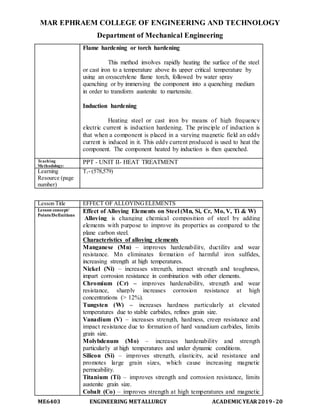
Flame hardening or torch hardening
This method involves rapidly heating the surface of the steel
or cast iron to a temperature above its upper critical temperature by
using an oxyacetylene flame torch, followed by water spray
quenching or by immersing the component into a quenching medium
in order to transform austenite to martensite.
Induction hardening
Heating steel or cast iron by means of high frequency
electric current is induction hardening. The principle of induction is
that when a component is placed in a varying magnetic field an eddy
current is induced in it. This eddy current produced is used to heat the
component. The component heated by induction is then quenched.
Teaching
Methodology:
PPT - UNIT II- HEAT TREATMENT
Learning
Resource (page
number)
T1- (578,579)
Lesson Title EFFECT OF ALLOYINGELEMENTS
Lesson concept/
Points/Definitions
Effect of Alloying Elements on Steel (Mn, Si, Cr, Mo, V, Ti & W)
Alloying is changing chemical composition of steel by adding
elements with purpose to improve its properties as compared to the
plane carbon steel.
Characteristics of alloying elements
Manganese (Mn) – improves hardenability, ductility and wear
resistance. Mn eliminates formation of harmful iron sulfides,
increasing strength at high temperatures.
Nickel (Ni) – increases strength, impact strength and toughness,
impart corrosion resistance in combination with other elements.
Chromium (Cr) – improves hardenability, strength and wear
resistance, sharply increases corrosion resistance at high
concentrations (> 12%).
Tungsten (W) – increases hardness particularly at elevated
temperatures due to stable carbides, refines grain size.
Vanadium (V) – increases strength, hardness, creep resistance and
impact resistance due to formation of hard vanadium carbides, limits
grain size.
Molybdenum (Mo) – increases hardenability and strength
particularly at high temperatures and under dynamic conditions.
Silicon (Si) – improves strength, elasticity, acid resistance and
promotes large grain sizes, which cause increasing magnetic
permeability.
Titanium (Ti) – improves strength and corrosion resistance, limits
austenite grain size.
Cobalt (Co) – improves strength at high temperatures and magnetic
MAR EPHRAEM COLLEGE OF ENGINEERING AND TECHNOLOGY
Department of Mechanical Engineering
ME6403 ENGINEERING METALLURGY ACADEMIC YEAR2019-20
permeability.
Zirconium (Zr) – increases strength and limits grain sizes.
Boron (B) – highly effective hardenability agent, improves
deformability and machinability.
Copper (Cu) – improves corrosion resistance.
Aluminum (Al) – deoxidizer, limits austenite grains growth
Teaching
Methodology:
PPT - UNIT III-FERROUS AND NON FERROUS
Learning
Resource (page
number)
T1- (162-166)
Lesson Title CHARACTERISTICS OF ALLOYINGELEMENTS
Lesson concept/
Points/Definitions
Effect of Alloying Elements on Steel (Mn, Si, Cr, Mo, V, Ti & W)
Alloying is changing chemical composition of steel by adding
elements with purpose to improve its properties as compared to the
plane carbon steel.
Characteristics of alloying elements
Manganese (Mn) – improves hardenability, ductility and wear
resistance. Mn eliminates formation of harmful iron sulfides,
increasing strength at high temperatures.
Nickel (Ni) – increases strength, impact strength and toughness,
impart corrosion resistance in combination with other elements.
Chromium (Cr) – improves hardenability, strength and wear
resistance, sharply increases corrosion resistance at high
concentrations (> 12%).
Tungsten (W) – increases hardness particularly at elevated
temperatures due to stable carbides, refines grain size.
Vanadium (V) – increases strength, hardness, creep resistance and
impact resistance due to formation of hard vanadium carbides, limits
grain size.
Molybdenum (Mo) – increases hardenability and strength
particularly at high temperatures and under dynamic conditions.
Silicon (Si) – improves strength, elasticity, acid resistance and
promotes large grain sizes, which cause increasing magnetic
permeability.
Titanium (Ti) – improves strength and corrosion resistance, limits
MAR EPHRAEM COLLEGE OF ENGINEERING AND TECHNOLOGY
Department of Mechanical Engineering
ME6403 ENGINEERING METALLURGY ACADEMIC YEAR2019-20
austenite grain size.
Cobalt (Co) – improves strength at high temperatures and magnetic
permeability.
Zirconium (Zr) – increases strength and limits grain sizes.
Boron (B) – highly effective hardenability agent, improves
deformability and machinability.
Copper (Cu) – improves corrosion resistance.
Aluminum (Al) – deoxidizer, limits austenite grains growth
Teaching
Methodology:
PPT - UNIT III-FERROUS AND NON FERROUS
Learning
Resource (page
number)
T2- (235to 237)
Lesson Title STAINLESS AND TOOL STEELS
Lesson concept/
Points/Definitions
Stainless and Tool Steels
In metallurgy, stainless steel, also known as inox
steel or inox from French "inoxydable", is defined as a steel alloy with
a minimum of 10.5%[1] to 11% chromium content by mass.
Stainless steel does not readily corrode, rust or stain with
water as ordinary steel does, but despite the name it is not fully stain-
proof, most notably under low oxygen, high salinity, or poor
circulation environments.[3] It is also called corrosion-resistant
steel or CRESwhen the alloy type and grade are not detailed,
particularly in the aviation industry. There are different grades and
surface finishes of stainless steel to suit the environment the alloy
must endure. Stainless steel is used where both the properties of steel
and resistance to corrosion are required.
Stainless steel differs from carbon steel by the amount
of chromium present. Unprotected carbon steel rusts readily when
exposed to air and moisture. This iron oxide film (the rust) is active
and accelerates corrosion by forming more iron oxide, and due to the
dissimilar size of the iron and iron oxide molecules (iron oxide is
larger) these tend to flake and fall away. Stainless steels contain
sufficient chromium to form a passive film of chromium oxide, which
prevents further surface corrosion and blocks corrosion from
spreading into the metal's internal structure, and due to the similar size
MAR EPHRAEM COLLEGE OF ENGINEERING AND TECHNOLOGY
Department of Mechanical Engineering
ME6403 ENGINEERING METALLURGY ACADEMIC YEAR2019-20
of the steel and oxide molecules they bond very strongly and remain
attached to the surface.[4]
Tool steel
Tool steel refers to a variety of carbon and alloy steels that
are particularly well-suited to be made into tools. Their suitability
comes from their distinctive hardness, resistance to abrasion, their
ability to hold a cutting edge, and/or their resistance to deformation at
elevated temperatures (red-hardness). Tool steel is generally used in
a heat-treated state. Many high carbon tool steels are also more
resistant to corrosion due to their higher ratios of elements such as
vanadium
With a carbon content between 0.7% and 1.5%, tool steels
are manufactured under carefully controlled conditions to produce the
required quality. The manganese content is often kept low to
minimize the possibility of cracking during water quenching.
However, proper heat treating of these steels is important for adequate
performance, and there are many suppliers who provide tooling
blanks intended for oil quenching.
Tool steels are made to a number of grades for different
applications. Choice of grade depends on, among other things,
whether a keen cutting edge is necessary, as in stamping dies, or
whether the tool has to withstand impact loading and service
conditions encountered with such hand tools as axes, pickaxes,
and quarrying implements. In general, the edge temperature under
expected use is an important determinant of both composition and
required heat treatment. The higher carbon grades are typically used
for such applications as stamping dies, metal cutting tools, etc.
Tool steels are also used for special applications
like injection molding because the resistance to abrasion is an
important criterion for a mold that will be used to produce hundreds
of thousands of parts.
Teaching
Methodology:
PPT - UNIT III-FERROUS AND NON FERROUS
Learning
Resource (page
number)
T2- (159 to 163)
Lesson Title HSLA - MARAGINGSTEELS
Lesson
concept/
HSLA - Maraging Steels
MAR EPHRAEM COLLEGE OF ENGINEERING AND TECHNOLOGY
Department of Mechanical Engineering
ME6403 ENGINEERING METALLURGY ACADEMIC YEAR2019-20
Points/Definiti
ons
High-strength low-alloy steel (HSLA) is a type of alloy steel that
provides better mechanical properties or greater resistance to corrosion
than carbon steel. HSLA steels vary from other steels in that they are not made to
meet a specific chemical composition but rather to specific mechanical properties.
They have a carbon content between 0.05–0.25% to retain formability
and weldability. Other alloying elements include up to 2.0% manganese and small
quantities
of copper, nickel, niobium, nitrogen, vanadium, chromium,molybdenum, titanium,
calcium, rare earth elements, or zirconium.[1][2] Copper, titanium, vanadium, and
niobium are added for strengthening purposes.[2] These elements are intended to
alter the microstructure of carbon steels, which is usually a ferrite-
pearliteaggregate, to produce a very fine dispersion of alloy carbides in an almost
pure ferrite matrix. This eliminates the toughness-reducing effect of a pearlitic
volume fraction yet maintains and increases the material's strength by refining the
grain size, which in the case of ferrite increases yield strength by 50% for every
halving of the mean grain diameter. Precipitation strengthening plays a minor role,
too. Their yield strengths can be anywhere between 250–590 megapascals
(36,000–86,000 psi). Because of their higher strength and toughness HSLA steels
usually require 25 to 30% more power to form, as compared to carbon steels.[2]
Copper, silicon, nickel, chromium, and phosphorus are added to
increase corrosion resistance. Zirconium, calcium, and rare earth elements are
added for sulfide-inclusion shape control which increases formability. These are
needed because most HSLA steels have directionally sensitive properties.
Formability and impact strength can vary significantly when tested longitudinally
and transversely to the grain. Bends that are parallel to the longitudinal grain are
more likely to crack around the outer edge because it experiences tensile loads.
This directional characteristic is substantially reduced in HSLA steels that have
been treated for sulfide shape control.[2]
They are used in cars, trucks, cranes, bridges, roller coasters and
other structures that are designed to handle large amounts of stressor need a good
strength-to-weight ratio.[2] HSLA steels are usually 20 to 30% lighter than a
carbon steel with the same strength.[3][4]
MAR EPHRAEM COLLEGE OF ENGINEERING AND TECHNOLOGY
Department of Mechanical Engineering
ME6403 ENGINEERING METALLURGY ACADEMIC YEAR2019-20
HSLA steels are also more resistant to rust than most carbon
steels because of their lack of pearlite – the fine layers of ferrite (almost pure iron)
and cementite in pearlite.[citation needed] HSLA steels usually have densities of around
7800 kg/m³.[5]
Maraging steels (a portmanteau of "martensitic" and "aging")
are steels (iron alloys) which are known for possessing superior strength and
toughness without losing malleability, although they cannot hold a good cutting
edge. Aging refers to the extended heat-treatment process. These steels are a
special class of low-carbon ultra-high-strength steels which derive their strength
not from carbon, but from precipitation of inter-metallic compounds. The principal
alloying element is 15 to 25 wt.% nickel.[1] Secondary alloying elements are added
to produce intermetallic precipitates, which include cobalt, molybdenum,
and titanium.[1] Original development was carried out on 20 and 25 wt.% Ni steels
to which small additions of Al, Ti, and Nb were made.
The common, non-stainless grades contain 17–19 wt.% nickel, 8–12 wt.% cobalt,
3–5 wt.% molybdenum, and 0.2–1.6 wt.% titanium. Addition of chromium
produces stainless grades resistant to corrosion. This also indirectly
increases hardenability as they require less nickel: high-chromium, high-nickel
steels are generally austenitic and unable to transform to martensite when heat
treated, while lower-nickel steels can transform to martensite. Alternative variants
of Ni-reduced maraging steels are based on alloys of Fe and Mn plus minor
additions of Al, Ni, and Ti where compositions between Fe-9wt.% Mn to Fe-
15wt.% Mn have been used. The Mn has a similar effect as Ni, i.e. it stabilizes the
austenite phase. Hence, depending on their Mn content, Fe-Mn maraging steels
can be fully martensitic after quenching them from the high temperature austenite
phase or they can contain retained austenite. The latter effect enables the design of
maraging-TRIP steels where TRIP stands for Transformation-Induced-Plasticity.[2]
Teaching
Methodology:
PPT - UNIT III-FERROUS AND NON FERROUS
Learning
Resource
(page
number)
T2- (303 to 304)
Lesson Title CAST IRONS - GREY, WHITE MALLEABLE, SPHEROIDAL
MAR EPHRAEM COLLEGE OF ENGINEERING AND TECHNOLOGY
Department of Mechanical Engineering
ME6403 ENGINEERING METALLURGY ACADEMIC YEAR2019-20
Lesson concept/
Points/Definitions
Cast Irons - Grey, White Malleable, Spheroidal
Cast iron is iron or a ferrous alloy which has been
heated until it liquefies, and is then poured into a mould to solidify. It
is usually made from pig iron. The alloy constituents affect its colour
when fractured: white cast iron has carbide impurities which allow
cracks to pass straight through. Grey cast iron, or grey iron, has
graphitic flakes which deflect a passing crack and initiate countless
new cracks as the material breaks.
Carbon (C) and silicon (Si) are the main alloying
elements, with the amount ranging from 2.1 to 4 wt% and 1 to 3 wt%,
respectively. Iron alloys with less carbon content are known as steel.
While this technically makes these base alloys ternary Fe-C-Si alloys,
the principle of cast iron solidification is understood from
the binary iron-carbon phase diagram. Since the compositions of most
cast irons are around the eutectic point of the iron-carbon system, the
melting temperatures closely correlate, usually ranging from 1,150 to
1,200 °C (2,102 to 2,192 °F), which is about 300 °C (572 °F) lower
than the melting point of pure iron.
Cast iron tends to be brittle, except for malleable cast
irons. With its relatively low melting point, good fluidity, castability,
excellent machinability, resistance to deformation and wear
resistance, cast irons have become an engineering material with a
wide range of applications and are used in pipes, machines
and automotive industry parts, such as cylinder heads (declining
usage), cylinder blocksand gearbox cases (declining usage). It is
resistant to destruction and weakening by oxidation (rust).
Grey cast iron is characterised by its graphitic
microstructure, which causes fractures of the material to have a grey
appearance. It is the most commonly used cast iron and the most
widely used cast material based on weight. Most cast irons have a
chemical composition of 2.5 to 4.0% carbon, 1 to 3% silicon, and the
remainder is iron. Grey cast iron has less tensile strength and shock
resistance than steel, but its compressive strength is comparable to
low and medium carbon steel.
It is the iron that displays white fractured surface due to
the presence of cementite. With a lower silicon content and faster
cooling, the carbon in white cast iron precipitates out of the melt as
the metastable phase cementite, Fe3C, rather than graphite. The
cementite which precipitates from the melt forms as relatively large
particles, usually in a eutectic mixture, where the other phase
is austenite (which on cooling might transform to martensite). These
MAR EPHRAEM COLLEGE OF ENGINEERING AND TECHNOLOGY
Department of Mechanical Engineering
ME6403 ENGINEERING METALLURGY ACADEMIC YEAR2019-20
eutectic carbides are much too large to provide precipitation
hardening (as in some steels, where cementite precipitates might
inhibit plastic deformation by impeding the movement
of dislocations through the ferrite matrix). Rather, they increase the
bulk hardness of the cast iron simply by virtue of their own very high
hardness and their substantial volume fraction, such that the bulk
hardness can be approximated by a rule of mixtures. In any case, they
offer hardness at the expense of toughness. Since carbide makes up a
large fraction of the material, white cast iron could reasonably be
classified as acermet. White iron is too brittle for use in many
structural components, but with good hardness and abrasion resistance
and relatively low cost, it finds use in such applications as the wear
surfaces (impeller and volute) of slurry pumps, shell liners and lifter
bars in ball mills and autogenous grinding mills, balls and rings
in coal pulverisers, and the teeth of abackhoe's digging bucket
(although cast medium-carbon martensitic steel is more common for
this application).
High-chromium white iron alloys allow massive castings
(for example, a 10-tonne impeller) to be sand cast, i.e., a high cooling
rate is not required, as well as providing impressive abrasion
resistance.
Malleable iron starts as a white iron casting that is then heat treated at
about 900 °C (1,650 °F). Graphite separates out much more slowly in
this case, so that surface tension has time to form it into spheroidal
particles rather than flakes. Due to their lower aspect ratio, spheroids
are relatively short and far from one another, and have a lower cross
section vis-a-vis a propagating crack or phonon. They also have blunt
boundaries, as opposed to flakes, which alleviates the stress
concentration problems faced by grey cast iron. In general, the
properties of malleable cast iron are more like mild steel. There is a
limit to how large a part can be cast in malleable iron, since it is made
from white cast iron.
A more recent development is nodular or ductile cast iron. Tiny
amounts of magnesium or cerium added to these alloys slow down the
growth of graphite precipitates by bonding to the edges of the graphite
planes. Along with careful control of other elements and timing, this
allows the carbon to separate as spheroidal particles as the material
solidifies. The properties are similar to malleable iron, but parts can
be cast with larger sections
Teaching
Methodology:
PPT - UNIT III-FERROUS AND NON FERROUS
Learning
Resource (page
number)
T2- (235)
MAR EPHRAEM COLLEGE OF ENGINEERING AND TECHNOLOGY
Department of Mechanical Engineering
ME6403 ENGINEERING METALLURGY ACADEMIC YEAR2019-20
Lesson Title GRAPHITE,ALLOY CAST IRONS,COPPER AND COPPER ALLOYS
Lesson concept/
Points/Definitions
Graphite, Alloy Cast Irons, Copper and Copper Alloys
Graphite is the most stable form of carbon under standard conditions.
Therefore, it is used in thermochemistry as the standard state for
defining the heat of formation of carbon compounds. Graphite may be
considered the highest grade of coal, just above anthracite and
alternatively called meta-anthracite, although it is not normally used
as fuel because it is difficult to ignite.
Cast iron containing alloying elements (usually nickel or chromium
or copper or molybdenum) to increase the strength or facilitate heat
treatment
Copper is a chemical element with the
symbol Cu (from Latin: cuprum) and atomic number 29. It is
a ductile metal with very high thermal and electrical conductivity.
Pure copper is soft and malleable; a freshly exposed surface has a
reddish-orange color. It is used as a conductor of heat and electricity,
a building material, and a constituent of various metal alloys.
Copper alloys are metal alloys that have copper as their principal
component. They have high resistance against corrosion. The best
known traditional types are bronze, where tinis a significant addition,
and brass, using zinc instead
Teaching
Methodology:
PPT - UNIT III-FERROUS AND NON FERROUS
Learning
Resource (page
number)
R4- (297-302)
Lesson Title Brass,Bronzeand Cupronickel
Lesson concept/
Points/Definitions
There are more than 400 copper alloys, each with a unique combination of
properties, to suit many applications, manufacturing processes and
environments.
Pure copper has the best electrical and thermal conductivity of any
commercial metal. Today, over half of the copper produced is used in
electrical and electronic applications and this leads to a convenient
classification of the types of copper into electrical (high conductivity) and
non-electrical (engineering).
Copper forms alloys more freely than most metals and with a wide range of
alloying elements to produce the following alloys:
Brass is the generic term for a range of copper-zinc alloys with differing
combinations of properties, including strength, machinability, ductility,
wear-resistance, hardness, colour, antimicrobial, electrical and thermal
conductivity, and corrosion-resistance.
Bronze alloys are made from copper and tin, and were the first to be
MAR EPHRAEM COLLEGE OF ENGINEERING AND TECHNOLOGY
Department of Mechanical Engineering
ME6403 ENGINEERING METALLURGY ACADEMIC YEAR2019-20
developed about four thousand years ago. They were so important that they
led to a period in time being named the Bronze Age.
Gunmetals are alloys of copper with tin, zinc and lead and have been used
for at least 2000 years due to their ease of casting and good strength and
corrosion resistance.
Copper-nickel alloys have excellent resistance to marine corrosion and
biofouling. The addition of nickel to copper improves strength and
corrosion resistance,but good ductility is retained.
Nickel silver alloys are made from copper, nickel and zinc, and can be
regarded as special brasses. They have an attractive silvery appearance rather
than the typical brassy colour.
Teaching
Methodology:
PPT - UNIT III
Learning
Resource (page
number)
T1- (146 to 148)
Lesson Title ALUMINUM AND AL-CU ALLOY
Lesson concept/
Points/Definitions
Aluminium (or aluminum) is a chemical element in the boron group with
symbol Al and atomic number 13. It is a silvery white, soft, ductile metal.
Aluminium is the third most abundant element (after oxygen and silicon),
and the most abundant metal, in theEarth's crust. It makes up about 8% by
weight of the Earth's solid surface. Aluminium metal is so chemically
reactive that native specimens are rare and limited to
extreme reducing environments. Instead, it is found combined in over 270
different minerals. The chief ore of aluminium is bauxite.
Aluminium is remarkable for the metal's low density and for its ability to
resist corrosion due to the phenomenon of passivation. Structural
components made from aluminium and its alloys are vital to
the aerospace industry and are important in other areas oftransportation and
structural materials. The most useful compounds of aluminium, at least on a
weight basis, are the oxides andsulfates.
Teaching
Methodology:
PPT - UNIT III
Learning
Resource (page
number)
R4- (76,77)
Lesson Title PRECIPITATIONHARDENING
MAR EPHRAEM COLLEGE OF ENGINEERING AND TECHNOLOGY
Department of Mechanical Engineering
ME6403 ENGINEERING METALLURGY ACADEMIC YEAR2019-20
Lesson concept/
Points/Definitions
Precipitation hardening, also called age hardening, is a heat
treatment technique used to increase the yield strength
of malleable materials, including most structural alloys of
aluminium, magnesium, nickel, titanium, and some stainless steels.
In superalloys, it is known to cause yield strength anomaly providing
excellent high temperature strength.
Precipitation hardening relies on changes in
solid solubility with temperature to produce fine particles of an
impurity phase, which impede the movement of dislocations, or defects in
a crystal's lattice. Since dislocations are often the dominant carriers
of plasticity, this serves to harden the material. The impurities play the same
role as the particle substances in particle-reinforced composite materials.
Just as the formation of ice in air can produce clouds, snow, or hail,
depending upon the thermal history of a given portion of the
atmosphere, precipitation in solids can produce many different sizes of
particles, which have radically different properties. Unlike
ordinary tempering, alloys must be kept at elevated temperature for hours to
allow precipitation to take place. This time delay is called aging.
Teaching
Methodology:
PPT - UNIT III
Learning
Resource (page
number)
R4-213;T2- (289)
Lesson Title BEARINGALLOYS.
Lesson concept/
Points/Definitions
Babbitt, also called Babbitt metal or bearing metal, is any of
severalalloys used for the bearing surface in a plain bearing.
The original Babbitt metal was invented in 1839 by Isaac
Babbitt[1] in Taunton, Massachusetts,USA.
Babbitt metal is most commonly used as a thin surface layer in a complex,
multi-metal structure, but its original use was as a cast-in-place bulk bearing
material. Babbitt metal is characterized by its resistance to galling. Babbitt
metal is soft and easily damaged, which suggests that it might be unsuitable
for a bearing surface. However, its structure is made up of small
hard crystals dispersed in a softer metal, which makes it a metal matrix
composite. As the bearing wears, the softer metal erodes somewhat, which
creates paths for lubricant between the hard high spots that provide the
actual bearing surface. When tin is used as the softer metal, friction causes
the tin to melt and function as a lubricant, which protects the bearing from
wear when other lubricants are absent.
Internal combustion engines use Babbitt metal which is primarily tin-based
because it can withstand cyclic loading. Lead-based Babbitt tends to work-
harden and develop cracks but it is suitable for constant-turning tools such as
sawblades.
MAR EPHRAEM COLLEGE OF ENGINEERING AND TECHNOLOGY
Department of Mechanical Engineering
ME6403 ENGINEERING METALLURGY ACADEMIC YEAR2019-20
Teaching
Methodology:
PPT - UNIT III
Learning
Resource (page
number)
T2- (305-307);R4-218
Lesson Title POLYMERS
Lesson concept/
Points/Definitions
A polymer is a large molecule (macromolecule) composed of
repeating structural units. These subunits are typically connected by
covalent chemical bonds. Although the term polymer is sometimes
taken to refer to plastics, it actually encompasses a large class of
natural and synthetic materials with a wide variety of properties.
Because of the extraordinary range of properties of polymeric
materials,[2] they play an essential and ubiquitous role in everyday
life.[3] This role ranges from familiar synthetic plastics and elastomers
to natural biopolymers such as nucleic acids and proteins that are
essential for life.
Natural polymeric materials such as shellac, amber, and natural rubber have
been used for centuries. A variety of other natural polymers exist, such as
cellulose, which is the main constituent of wood and paper. The list of
synthetic polymers includes synthetic rubber, Bakelite, neoprene, nylon,
PVC, polystyrene, polyethylene, polypropylene, polyacrylonitrile, PVB,
silicone, and many more.
Most commonly, the continuously linked backbone of a polymer used
for the preparation of plastics consists mainly of carbon atoms. A
simple example is polyethylene, whose repeating unit is based on
ethylene monomer. However, other structures do exist; for example,
elements such as silicon form familiar materials such as silicones,
examples being silly putty and waterproof plumbing sealant. Oxygen
is also commonly present in polymer backbones, such as those of
polyethylene glycol, polysaccharides (in glycosidic bonds), and DNA
(in phosphodiester bonds).
Polymers are studied in the fields of polymer chemistry, polymer physics,
and polymer science
Teaching
Methodology:
PPT - UNIT IV
Learning
Resource (page
number)
T1- (183)
Lesson Title TYPES OF POLYMER
Lesson concept/
Points/Definitions
Polymer science is a broad field that includes many types of materials
which incorporate long chain structures with many repeated units. One
MAR EPHRAEM COLLEGE OF ENGINEERING AND TECHNOLOGY
Department of Mechanical Engineering
ME6403 ENGINEERING METALLURGY ACADEMIC YEAR2019-20
useful way of categorising polymers for the requirements of electronic
assembly is by functional behaviour. In the strictest sense these categories
are not fixed, or even particularly precise, and you should be aware that
some materials can fit into more than one category:
Elastomers are flexible or ‘rubbery’ materials which can readily be
deformed, and return rapidly to almost their original shape and size once
released from stress, thus making them able to form reliable seals. Natural
and synthetic rubbers are common examples of elastomers
Plastics are materials which can be shaped or moulded under appropriate
conditions of temperature and pressure, and then hold their shape. In
contrast to elastomers, plastics have a greater stiffness and lack reversible
elasticity
Elastomers
ASTM D-156611 defines an elastomer as a ‘macromolecular material that
returns rapidly to approximately the initial dimensions and shape after
substantial deformation by a weak stress and release of the stress.’ Such
elongations typically exceed 100%.
Elastomers have three main functions in electronic assemblies:
to form an environmental seal
to provide mechanical strain relief
to give a means of conducting heat away from sources within the assembly.
Although used for many centuries in its raw form, a significant step forward
was made when Charles Goodyear succeeded in ‘vulcanising’ natural rubber
by heating it with sulphur to induce what is now understood to be cross-
linking. The significance of the great performance improvement resulting
from this treatment has led to the term ‘vulcanisation’ often being loosely
used to describe the cross-linking of any elastomer.
Elastomers consist of long chain-like molecules, linked together to form a
three dimensional network. Typically, an average of about 1 in 100
molecules are cross-linked: when this number rises to about 1 in 30, the
material becomes more rigid and brittle. Most elastomers are thermoset
materials, and cannot be remoulded, an exception being the class of
materials known as ‘thermoplastic elastomers’.
Plastics
‘Plastic’ is a term which can cover a wide range of polymer materials, all of
which can be moulded, for example to produce the body of a QFP
component, the casing for a computer keyboard, the hand set of a mobile
telephone or the encapsulant cover for a PLCC.
There are two main groups of plastic polymers, thermoplastics and
thermosets:
Thermoplastics
Thermoplastics are supplied fully polymerised and remain permanently
fusible, melting when exposed to sufficient heat, and potentially they can be
recycled and reused.
Examples of thermoplastics are polyethylene, poly(vinyl chloride),
polystyrene, nylon, cellulose acetate, acetal, polycarbonate, poly(methyl
methacrylate), and polypropylene.
Thermosets
A thermoset material is produced by a chemical reaction which has two
stages. The first results in the formation of long chain-like molecules similar
to those present in thermoplastics, but still capable of further reaction. This
MAR EPHRAEM COLLEGE OF ENGINEERING AND TECHNOLOGY
Department of Mechanical Engineering
ME6403 ENGINEERING METALLURGY ACADEMIC YEAR2019-20
second stage of inter-linking the long molecules takes place at the point of
use and often under the application of heat and pressure.
Since the cross-linking of the molecules is by strong chemical bonds,
thermoset materials are characteristically quite rigid and their mechanical
properties are not heat sensitive. Once cured, thermosets cannot again be
softened by applying heat: if excess heat is applied to these materials they
will char and degrade – as with eggs, once hard-boiled, they cannot be
softened! Examples of thermosets are phenol formaldehyde, melamine
formaldehyde, urea formaldehyde, epoxies, and some polyesters.
Adhesives
Adhesives can be classified by the method used for curing, and a number of
different mechanisms have been developed to suit different applications:
Anaerobic adhesives are single-component materials which cure at room
temperature when deprived of contact with oxygen. The curing component
in the adhesive will not react with the adhesive as long as it is in contact
with oxygen. The capillary action of this type of liquid adhesive carries it
into even the smallest gaps to fill the joint.
In ultraviolet curing adhesives, the chemicals which would initiate curing
are present, but are bound together and are inactive until exposed to UV
light. The degree of cure depends on the UV intensity, and in some
applications light may be physically blocked from reaching the polymer. In
order to resolve this ‘shadowing effect’ problem, UV curing adhesives may
have secondary curing activation systems, often using heat to ensure that the
cure is complete.
Adhesive types
The lack of a detailed understanding of the adhesion process has not
hindered progress in developing very strong adhesives for most materials.
The only problem is that the wide range of chemical structures makes it
impossible to produce an adhesive which is compatible with all polymers. It
is always prudent to check recommendations on suitable adhesives and
surface preparation with the material manufacturers.
There are two main classes of adhesive for polymeric materials:
Solvent adhesives, which may be either a pure solvent which attacks the
surfaces to be joined so that they fuse together, or a solvent containing some
of the adherend material. This approach is used for polymers such as
polystyrene and polymethyl methacrylate, the choice of solvent depending
on practical issues such as the rate of evaporation
Organic adhesives based on rubbers or polymeric materials, which may be
thermoplastic or thermosetting in nature.
The most versatile range of organic adhesives is that based on epoxy resins,
and these are particularly widespread in electronics, although they are
relatively expensive. The major advantages of epoxy adhesives are that:
They can be formulated to work well over a very wide temperature range
Epoxies have excellent resistance to moisture and chemicals
Shrinkage on cure is negligible, so that residual strains in the joint are small
Creep of the cured material is low
Epoxies can be cured at room or lower temperatures, although those cured at
elevated temperatures are stronger.
There are however,the disadvantages that:
Care is needed when handling uncured epoxy resins
The shelf life of some formulations is limited
MAR EPHRAEM COLLEGE OF ENGINEERING AND TECHNOLOGY
Department of Mechanical Engineering
ME6403 ENGINEERING METALLURGY ACADEMIC YEAR2019-20
High temperature strength can only be achieved by sacrificing ductility.
Epoxy adhesives are sold either as two-part adhesives, where the epoxy
resin is mixed with a catalyst just before use, or single-part materials, where
the catalyst is incorporated during manufacture. Single-part adhesives are
generally less reactive, needing to be heat-cured, and often require
refrigerated storage to increase storage life.
Other adhesives you may encounter are:
Nitrile rubber adhesives: usually copolymers of butadiene and acrylonitrile,
these are good adhesives in their own right, but also combine with phenolic
resins to produce very good structural adhesives
Resorcinol adhesives are particularly good for bonding thermosetting
plastics, but with a few exceptions (ABS, nylon, acrylic) are not suitable for
thermoplastics
‘Tailoring’ polymers
The range of polymer materials available is enormous, as slight changes in
the chemical make-up of the monomers or the conditions of polymerisation
can result in dramatic changes in the material characteristics of the end of
processed polymer.
Polyethylene is an example of a polymer which can be used in a wide
variety of applications because it can be produced with different forms and
structures. The first to be commercially exploited was called low density
polyethylene (LDPE), which is characterised by a high degree of branching,
which forces the molecules to be packed rather loosely. The resulting low
density material is soft and pliable and has applications ranging from plastic
bags and textiles to electrical insulation.
By contrast, high density (HDPE) or linear polyethylene demonstrates little
or no branching, so that the molecules are tightly packed and the plastic can
be used in applications where rigidity is important, such as plastic tubing
and bottle caps. Other forms of this material include high and ultra-high
molecular weight polyethylenes (HMW; UHMW), which are used in
applications where extremely tough and resilient materials are needed.
New materials can also be tailored by combining monomers with desirable
properties. In some cases, these combinations are just physically mixed
polymers, but more typically new ‘co-polymers’ are produced. Some types
have a random structure of the constituent monomers, others may have a
regular, repeating structure of the different materials:
A ‘block’ copolymer is made with blocks of monomers of the same type
A ‘graft’ copolymer has a main chain polymer built with one type of
monomer, and branches made up of other monomers.
Nylon is an example of a common ‘alternating copolymer’ with two
different monomers alternating along the chain. One useful material, which
is in fact a ‘terpolymer’, is ABS. This is a combination of three monomers:
acrylonitrile, butadiene and styrene,in varying proportions depending on the
application. A rigid but tough material, it is used for water pipes,
refrigerators and Lego bricks!
Teaching
Methodology:
PPT - UNIT IV
Learning
Resource (page
number)
T1- (347)
MAR EPHRAEM COLLEGE OF ENGINEERING AND TECHNOLOGY
Department of Mechanical Engineering
ME6403 ENGINEERING METALLURGY ACADEMIC YEAR2019-20
Lesson Title COMMODITY AND ENGINEERINGPOLYMERS
Lesson concept/
Points/Definitions
Commodity plastics are plastics that are used in high volume and wide range
of applications, such as film for packaging, photographic and magnetic tape,
clothing, beverage and trash containers and a variety of household products
where mechanical properties and service environments are not critical. Such
plastics exhibit relatively low mechanical properties and are of low cost. The
range of products includes Plates, Cups, Carrying Trays, Medical Trays,
Containers, Seeding Trays, Printed Material and other disposable items.
Examples of commodity plastics
are polyethylene, polypropylene, polystyrene, polyvinyl
chloride, polymethyl methacrylate, polyethylene terephthalate and more.
Engineering polymers are materials with exceptional mechanical properties
such as stiffness, toughness, and low creep that make them valuable in the
manufacture of structural products like gears, bearings, electronic devices,
and auto parts.
Teaching
Methodology:
PPT - UNIT IV
Learning
Resource (page
number)
R4- (70-72)
Lesson Title PROPERTIES AND APPLICATIONS OF PE,PP,PS,PVC
Lesson concept/
Points/Definitions
Plastics are also called synthetic resins and are broadly classified into two
categories: thermosetting resins and thermoplastic resins.
The thermosetting resins include phenolic resin and melamine resin, which
are thermally hardened and never become soft again. Thermoplastic resins
include PVC, polyethylene (PE), polystyrene (PS) and polypropylene (PP),
which can be re-softened by heating.
Teaching
Methodology:
PPT - UNIT IV
Learning
Resource (page
number)
T2- (158,159)
Lesson Title
Lesson concept/
Points/Definitions
Teaching
Methodology:
PPT - UNIT IV
Learning
Resource (page
number)
R4- (29,30)
Lesson Title PROPERTIES AND APPLICATIONS OF PMMA,PET,PC,PA,ABS
MAR EPHRAEM COLLEGE OF ENGINEERING AND TECHNOLOGY
Department of Mechanical Engineering
ME6403 ENGINEERING METALLURGY ACADEMIC YEAR2019-20
Lesson concept/
Points/Definitions
Extruded acrylic sheets are produced with extrusion technique. PMMA
comes out with changing of Monomer acrylic structure. PMMA is shaped as
sheet at extrusion lines. As long as machine allows, PMMA sheet is
produced as requested but there are a handful world standard sizes. It is
much lighter than glass. Also it is easy to handle and stack. Transparent
acrylic has % 92 light transmissions comparing to glass. PMMA has less
tolerance than cast acrylic sheet. Manufacturing process is obviously fast
• Perfect transparency
• High light transmission
• Good resistance to weather conditions
• High resistance to chemicals
• Wide temperature process range
• Protective film at both side
• Good impact strength
• Easy to process
• UV stability
Application
• Display systems
• Separators
• Bank equipment
• Vending machine
• Leaflet dispenser & card holder
• Indoor decoration
• Furniture
• Building materials
• Health sector
• Sales counter
Polyethylene terephthalate,(PET) thermoplastic polyester is a material
belonging to the family. Beverage, food and beverage containers, there are
application areas such as synthetic fiber. Heat processing, depending on
amorphous (transparent) and semi-crystalline (opaque and white) material is
available as Polethylene terephthalate construction
Most useful advantage is that it is completely recycle material. Unlike other
plastics, polymer chains, take the next use will lie in the former case.
Very high resistance to chemicals
• Excellent transparency
• Easy to fabricate
• Compatible with foodstuffs (not UV ver.)
• Excellent impact strength
• Good thermoforming properties
• Recycling
• Light weight compared to glass
Applications:
Health stuffs
• Separators
• Furniture
• Advertisement products
• Vacuuming
• Electronic devices
• Building materials
• Vending machines
MAR EPHRAEM COLLEGE OF ENGINEERING AND TECHNOLOGY
Department of Mechanical Engineering
ME6403 ENGINEERING METALLURGY ACADEMIC YEAR2019-20
• Packing
• Indoor & outdoor signs
Polycarbonate
It is an extruded high quality transparent polycarbonate sheet. It has a
superior impact strength at half the weight of glass. It has more than two
times impact strength of PET G and more than 10 times impact strength
of high impact PMMA. The product has an outstanding high clarity and
is more regularly replacing glass in exposed applications
In case of fire, it will melt and create a passage where heat and smoke
will be let out of the building. It will have no contribution to the growth
of a fire through flame spread
Outstanding high clarity
• Superior impact strength
• Light weight compared to glass
• Good fire behavior classification
• Easily screen printed
• Can easily be formed into gentle curves
• Excellent thermoforming properties
• Usable over a wide temperature range
Applications:
• Advertisement products
• Security equipments
• Indoor decoration
• Electronic equipments
• Medical materials
Acrylonitrile butadiene styrene or ABS with abbreviated names, products
manufactured via molding widely used in the polymer is a lightweight and
rigid. It is a thermoplastic sheet.
Easy to fabricate
• Resistance to chemicals
• Light weight compared to glass
• Recycling
• Impact strength
• Good thermoforming properties
Applications
• Automotive
• Toys
• Indoor and outdoor signs
• Vacuuming
• Health stuffs
• Vending machines
• Sales stands
• Furniture
MAR EPHRAEM COLLEGE OF ENGINEERING AND TECHNOLOGY
Department of Mechanical Engineering
ME6403 ENGINEERING METALLURGY ACADEMIC YEAR2019-20
• Electronic devices
Teaching
Methodology:
PPT - UNIT V-ISOPARAMETRIC FORMULATION
Learning
Resource (page
number)
R4- (44 to 51)
Lesson Title PROPERTIES AND APPLICATIONS OF PI, PAI, PPO,PPS, PEEK,PTFE
POLYMERS
Lesson concept/
Points/Definitions
Polycarbonate
It is an extruded high quality transparent polycarbonate sheet. It has a
superior impact strength at half the weight of glass. It has more than two
times impact strength of PET G and more than 10 times impact strength
of high impact PMMA. The product has an outstanding high clarity and
is more regularly replacing glass in exposed applications
In case of fire, it will melt and create a passage where heat and smoke
will be let out of the building. It will have no contribution to the growth
of a fire through flame spread
Outstanding high clarity
• Superior impact strength
• Light weight compared to glass
• Good fire behavior classification
• Easily screen printed
• Can easily be formed into gentle curves
• Excellent thermoforming properties
• Usable over a wide temperature range
Applications:
• Advertisement products
• Security equipments
• Indoor decoration
• Electronic equipments
• Medical materials
Acrylonitrile butadiene styrene or ABS with abbreviated names, products
manufactured via molding widely used in the polymer is a lightweight and
rigid. It is a thermoplastic sheet.
Easy to fabricate
• Resistance to chemicals
• Light weight compared to glass
• Recycling
• Impact strength
• Good thermoforming properties
Applications
•Automotive
•Toys
MAR EPHRAEM COLLEGE OF ENGINEERING AND TECHNOLOGY
Department of Mechanical Engineering
ME6403 ENGINEERING METALLURGY ACADEMIC YEAR2019-20
•Indoorandoutdoorsigns
•Vacuuming
•Health
•Vending
•Sales
• Electronic devices
Teaching
Methodology:
PPT - UNIT IV
Learning
Resource (page
number)
R4- (389-392)
Lesson Title UREA AND PHENOL FORMALDEHYDES
Lesson concept/
Points/Definitions
Ceramic materials whose characteristics have been specifically
optimised to suit the majority of industrial applications are used in
compliance with the requirements catalogue. They can resist
temperatures of up to 2500°C in furnace construction and burner
systems. Ceramic bearing casings in gas turbines operate with
minimal wear at speeds of several thousand revolutions per minute
and temperatures of about 1500 °C. Pumps with ceramic friction
bearings utilised in sea water desalination plants convey sea water
heavily contaminated with sand for years without exhibiting any
noticeable erosion or corrosion. Use of ceramic components in spark
plugs and as condensers or insulators still belongs to the most
important applications in terms of numbers. The variation spectrum of
these materials is best demonstrated in this area. While some
electrically insulate, others (supraconductors) conduct electrical
current with absolutely no resistance
Teaching
Methodology:
PPT - UNIT IV
Learning
Resource (page
number)
R4- (433-443)
Lesson Title ENGINEERINGCERAMICS
Lesson concept/
Points/Definitions
Engineering ceramics are structured and functional ceramics used in
applications differing from those employing classical utility ceramics
such as brick, clinker, ovenware, porcelain, sanitary ceramics or tiles.
However, the differentiation is not only made in terms of applications,
but also material. Clay and silicate ceramics are therefore considered
utility ceramics, while all others are oxidic, non-oxidic and mixed
ceramics such as aluminium oxide, zirconium oxide, silicon carbide or
lead zirconate titanate, just to mention a few, and designated
MAR EPHRAEM COLLEGE OF ENGINEERING AND TECHNOLOGY
Department of Mechanical Engineering
ME6403 ENGINEERING METALLURGY ACADEMIC YEAR2019-20
engineering or technical ceramics.
Ceramic materials whose characteristics have been specifically
optimised to suit the majority of industrial applications are used in
compliance with the requirements catalogue. They can resist
temperatures of up to 2500°C in furnace construction and burner
systems. Ceramic bearing casings in gas turbines operate with
minimal wear at speeds of several thousand revolutions per minute
and temperatures of about 1500 °C. Pumps with ceramic friction
bearings utilised in sea water desalination plants convey sea water
heavily contaminated with sand for years without exhibiting any
noticeable erosion or corrosion. Use of ceramic components in spark
plugs and as condensers or insulators still belongs to the most
important applications in terms of numbers. The variation spectrum of
these materials is best demonstrated in this area. While some
electrically insulate, others (supraconductors) conduct electrical
current with absolutely no resistance
Teaching
Methodology:
PPT - UNIT IV
Learning
Resource (page
number)
R4- (302)
Lesson Title INTRODUCTION TO FIBRE REINFORCED.
Lesson concept/
Points/Definitions
Fibre Reinforced Plastics (FRP) is the generic term for a uniquely versatile
family of composites used in everything from chemical plant to luxury
power boats. An FRP structure typically consists of an unsaturated polyester
(UP) resin applied to a mould in combination with reinforcement, most
commonly glass fibre, to form a part that is rigid, highly durable and low in
weight.
FRP provides an unrivalled combination of properties:
- Light weight
- High strength-to-weight ratio (kilo-for-kilo it’s stronger than steel)
- Design freedom
- High levels of stiffness
- Chemical resistance
- Good electrical insulating properties
- Retention of dimensional stability across a wide range of temperatures
Teaching
Methodology:
PPT - UNIT V
Lesson Title MECHANISM OF PLASTIC DEFORMATION, SLIP AND
TWINNING
Lesson concept/
Points/Definitions
Types of Mechanical Properties:
Elasticity
MAR EPHRAEM COLLEGE OF ENGINEERING AND TECHNOLOGY
Department of Mechanical Engineering
ME6403 ENGINEERING METALLURGY ACADEMIC YEAR2019-20
When a material has a load applied to it, the load causes the material to
deform. Elasticity is the ability of a material to return to its original shape
after the load is removed.
Plasticity
Plasticity is the ability of a material to deform permanently without breaking
or rupturing.
Ductility
Ductility is the property that enables a material to stretch, bend, or twist
without cracking or breaking. This property makes it possible for a material
to be drawn out into a thin wire.
Brittleness
Brittleness is the opposite of the property of plasticity. A brittle metal is one
that breaks or shatters before it deforms. White cast iron and glass are good
examples of brittle material. Generally, brittle metals are high in
compressive strength but low in tensile strength.
Malleability
Malleability is the property that enables a material to deform by compressive
forces without developing defects. A malleable material is one that can be
stamped, hammered, forged, pressed,or rolled into thin sheets.
Toughness
Toughness is the property that enables a material to withstand shock and to
be deformed without rupturing. Toughness may be considered as a
combination of strength and plasticity.
Strength
Strength is the property that enables a metal to resist deformation under
load.
Hardness
Hardness is the property of a material to resist permanent indentation.
Stiffness
Stiffness may be defined as the property of a metal by virtue of which it
resists deformation.
Resilience
Resilience may be defined as the property of a metal by virtue of which it
stores energy and resists shocks or impacts.
Creep
MAR EPHRAEM COLLEGE OF ENGINEERING AND TECHNOLOGY
Department of Mechanical Engineering
ME6403 ENGINEERING METALLURGY ACADEMIC YEAR2019-20
Creep may be defined as the property of a metal by virtue of which it
deforms continuously under a steady load.
Machinability
Machinability may be defined a the property of a metal, which indicates the
ease with which it can be cut or removed by cutting tools in various
machining operations such as turning, drilling, boring, milling etc.
Weldability
Weldability may be defined as the property of a metal, which indicates the
ease with which two similar or dissimilar metals are joined by fusion.
Formability or Workability
Formability may be defined as the property of a metal which indicates the
ease with which it can be formed into different shapes and sizes.
Elastic strength
The elastic strength of the metal is the value of load corresponding to
transition from
elastic to plastic range.
Plastic strength
The plastic strength of a material is the value of load corresponding to
plastic range
and rupture. It is also called ultimate strength.
Tensile strength
The tensile strength of a metal is the value of load applied to break it off by
pulling it outwards into two pieces. Mathematically, tensile stress,
= Maximum tensile load / Original cross - sectional area
Compressive strength
The compressive strength of a metal is the value of load applied to break it
off by
crushing. Mathematically, compressive stress,
= Maximum compressive load / Original cross - sectional area
Shear strength
The shear strength of a metal is the value of load applied tangentially to
shear it off
across the resisting section. Mathematically , shear stress
= Maximum tangential load / Original cross - sectional
MAR EPHRAEM COLLEGE OF ENGINEERING AND TECHNOLOGY
Department of Mechanical Engineering
ME6403 ENGINEERING METALLURGY ACADEMIC YEAR2019-20
Teaching
Methodology:
PPT - UNIT V
Learning
Resource (page
number)
R4- (302)
Lesson Title TYPES OF FRACTURE
Lesson concept/
Points/Definitions
Fracture
The separation of a solid body into two or more parts under the action of
stresses is
called “Fracture".
Fracture of a material by cracking may occur in many ways. They are;
I . Slow application of external loads (tension).
2. Rapid application of external load (Impact).
3. Repeated cyclic loading (Fatigue).
4. Time and temperature dependent failure under a constant load (creep).
Ductile fracture is preferred over brittle fracture for two main reasons
i) Brittle fracture occurs suddenly and without any warning.
ii) In the case of ductile fracture there is always plastic deformation and the
material yields for some time before it fractures and hence suitable
preventive measures can be taken.
Ductile fracture
There are two types of ductile fracture. In both the types plastic deformation
occurs before fracture, due to progressive deformation when necking begins.
The completely ductile material necks till the end of fracture where there is
100% reduction in area Such type of fracture is found in very soft
polycrystalline materials such as lead and pure gold at room temperature.
The other type of ductile fracture that occurs for most polycrystalline ductile
materials is popularly called the cup and cone fracture.
The fractured surface has a fibrous appearance. The fibrous appearance is
due to the presence of hard elongated fiber like phase in a soft matrix. For
example, wrought iron contains elongated hard inclusion in a ferrite matrix
and low carbon steel contains pearlite bands in a ferrite matrix. Due to
presence of the fibrous bands the material that has fractured shows a fibrous
appearance
Brittle fracture
The word brittle signifies minimum plastic deformation.
Brittle fracture occurs with minimum plastic deformation and without the
crack necking. once sets in, it propagates rapidly and fractures.
The direction of crack is nearly perpendicular to the direction of applied
tensile stress and the surface produced is relatively flat. fracture mechanism
for single crystals and polycrystals are the same.
Brittle fracture occurs by repeated breaking of atomic bonds along specific
crystallographic planes, such a process of breaking is called cleavage.
Cleavaging is like splitting a plane with a sharp wedge" (Similar to cutting
wood with a wedge shaped axe).
Brittle fracture can also occur along the grain boundaries, this type of
fracture is called intergranular fracture. The tendency for a material to brittle
fracture may be due to the following reasons.
i) Decreasing temperature. ii) Increasing strain rate. iii) Triaxial stress
conditions that is usually produced by a notch.
A brittle fracture shows a granular, shiny and a smooth appearance.
Shearing fracture
MAR EPHRAEM COLLEGE OF ENGINEERING AND TECHNOLOGY
Department of Mechanical Engineering
ME6403 ENGINEERING METALLURGY ACADEMIC YEAR2019-20
This is a type of ductile fracture but occurs without necking /
reduction in cross section at the region of failure. This type of failure
occurs in single crystal materials. The shearing fracture is by slip on
successive basal planes until finally the crystal separates by shear.
This type of failure mainly occurs in single crystal HCP structure
metals.
Teaching
Methodology:
PPT - UNIT V
Learning
Resource (page
number)
R4- (302)
Lesson Title BRITTLE FRACTURE
Lesson concept/
Points/Definitions
The word brittle signifies minimum plastic deformation.
Brittle fracture occurs with minimum plastic deformation and without the
crack necking. once sets in, it propagates rapidly and fractures.
The direction of crack is nearly perpendicular to the direction of applied
tensile stress and the surface produced is relatively flat. fracture mechanism
for single crystals and polycrystals are the same.
Brittle fracture occurs by repeated breaking of atomic bonds along specific
crystallographic planes, such a process of breaking is called cleavage.
Cleavaging is like splitting a plane with a sharp wedge" (Similar to cutting
wood with a wedge shaped axe).
Brittle fracture can also occur along the grain boundaries, this type of
fracture is called intergranular fracture. The tendency for a material to brittle
fracture may be due to the following reasons.
i) Decreasing temperature. ii) Increasing strain rate. iii) Triaxial stress
conditions that is usually produced by a notch.
A brittle fracture shows a granular, shiny and a smooth appearance.
Teaching
Methodology:
PPT - UNIT V
Learning
Resource (page
number)
R4- (302)
Lesson Title SHEARING FRACTURE
Lesson concept/
Points/Definitions
This is a type of ductile fracture but occurs without necking /
reduction in cross section at the region of failure. This type of
failure occurs in single crystal materials. The shearing fracture is
by slip on successive basal planes until finally the crystal
separates by shear. This type of failure mainly occurs in single
crystal HCP structure metals.
Teaching PPT - UNIT V
MAR EPHRAEM COLLEGE OF ENGINEERING AND TECHNOLOGY
Department of Mechanical Engineering
ME6403 ENGINEERING METALLURGY ACADEMIC YEAR2019-20
Methodology:
Learning
Resource (page
number)
R4- (302)
Lesson Title TESTING OF MATERIALS UNDERTENSION
Lesson concept/
Points/Definitions
A tensile test is a method for determining behavior of materials under axial
tensile loading. The tests are conducted by fixturing the specimen into the
test apparatus and then applying a force to the specimen by separating the
testing machine crossheads. The crosshead speed can be varied to control the
rate of strain in the test specimen.
Data from the test are used to determine tensile strength, yield strength, and
modulus of elasticity. Measurement of the specimen dimensions after testing
also provides reduction of area and elongation values to characterize the
ductility of the material.
Tensile tests can be performed on many materials, including metals, plastics,
fibers, adhesives, and rubbers. Testing can be performed at subambient and
elevated temperatures.
SAMPLE REQUIREMENTS
Standard tensile tests on metals and plastics are conducted on specially
prepared test specimens. These specimens can be machined cylindrical
samples or flat plate samples (dogbone). Test samples must have a specific
ratio of length to width or diameter in the test area (gage) to produce
repeatable results and comply with standard test method requirements.
Tubular products, fibers, and wires can be tensile tested at full size using
special fixtures that promote optimal gripping and failure location.
Teaching
Methodology:
PPT - UNIT V
Lesson Title TESTING OF MATERIALS UNDER COMPRESSION
Lesson concept/
Points/Definitions
A compression test is a method for determining the behavior of materials
under a compressive load. Compression tests are conducted by loading the
test specimen between two plates, and then applying a force to the specimen
by moving the crossheads together. During the test, the specimen is
compressed, and deformation versus the applied load is recorded. The
compression test is used to determine elastic limit, proportional limit, yield
point, yield strength, and (for some materials) compressive strength.
SAMPLE REQUIREMENTS
The most common specimen used for compression testing is a right
MAR EPHRAEM COLLEGE OF ENGINEERING AND TECHNOLOGY
Department of Mechanical Engineering
ME6403 ENGINEERING METALLURGY ACADEMIC YEAR2019-20
circular cylinder with flat ends. Other shapes may be used, however,
they require special fixtures to avoid buckling. Special configurations
for component testing or service simulations are dependent on the
specific test machine to be used.
Teaching
Methodology:
PPT - UNIT V
Lesson Title TESTING OF MATERIALS UNDER SHEAR LOADS
Lesson concept/
Points/Definitions
Many different loading schemes fall under the broad category of shear
testing. Most often performed on small coupons of metals, composites and
adhesives, these tests apply force or displacement until the specimen
fractures. Single lap, double lap, short beam shear and torsion are typical
configurations. All of these tests are designed to characterize materials under
shear loading by determining shear-stress/shear-strain curves and material
properties, including shear strengths and shear moduli.
Teaching
Methodology:
PPT - UNIT V
Lesson Title HARDNESS TESTS (BRINELL, VICKERS AND ROCKWELL),
Lesson concept/
Points/Definitions
Hardness
Hardness is the property of a material that enables it to resist plastic
deformation, usually by penetration. However, the term hardness may also
refer to resistance to bending, scratching, abrasion or cutting.
Measurement ofHardness:
Hardness is not an intrinsic material property dictated by precise definitions
in terms of fundamental units of mass, length and time. A hardness property
value is the result of a defined measurement procedure.
Hardness of materials has probably long been assessed by resistance to
scratching or cutting. An example would be material B scratches material C,
but not material A. Alternatively, material A scratches material B slightly
and scratches materialC heavily.
The Brinell Hardness Test
The Brinell hardness test method consists of indenting the test material with
a 10 mm diameter hardened steel or carbide ball subjected to a load of 3000
kg. For softer materials the load can be reduced to 1500 kg or 500 kg to
avoid excessive indentation. The full load is normally applied for 10 to 15
seconds in the case of iron and steel and for at least 30 seconds in the case of
other metals. The diameter of the indentation left in the test material is
measured with a low powered microscope. The Brinell harness number is
calculated by dividing the load applied by the surface area of the
indentation.
Rockwell Hardness Test
The Rockwell hardness test method consists of indenting the test material
with a diamond cone or hardened steel ball indenter. The indenter is forced
into the test material under a preliminary minor load F0 usually 10 kgf.
When equilibrium has been reached, an indicating device, which follows the
movements of the indenter and so responds to changes in depth of
penetration of the indenter is set to a datum position.
MAR EPHRAEM COLLEGE OF ENGINEERING AND TECHNOLOGY
Department of Mechanical Engineering
ME6403 ENGINEERING METALLURGY ACADEMIC YEAR2019-20
While the preliminary minor load is still applied an additional major load is
applied with resulting increase in penetration. When equilibrium has again
been reach, the additional major load is removed but the preliminary minor
load is still maintained. Removal of the additional major load allows a
partial recovery, so reducing the depth of penetration. The permanent
increase in depth of penetration, resulting from the application and removal
of the additional major load is used to calculate the Rockwell hardness
number.
Vickers HardnessTest
The Vickers hardness test method consists of indenting the test material with
a diamond indenter, in the form of a right pyramid with a square base and an
angle of 136 degrees between opposite faces subjected to a load of 1 to 100
kgf. The full load is normally applied for 10 to 15 seconds. The two
diagonals of the indentation left in the surface of the material after removal
of the load are measured using a microscope and their average calculated.
The area of the sloping surface of the indentation is calculated. The Vickers
hardness is the quotient obtained by dividing the kgf load by the square mm
area of indentation.
Teaching
Methodology:
PPT - UNIT IV
Lesson Title IMPACT TEST - IZOD AND CHARPY,
Lesson concept/
Points/Definitions
Izod and Charpy Impact tests measure a materials resistance to impact at a
single point from a swinging pendulum or hammer. The tests can be carried
out in a variety of orientations and in notched or un-notched formats.
In the Izod Impact Test, a notched square section specimen is clamped
vertically, cantilever fashion, in the impact machine. The pendulum is
released and allowed to strike through the specimen. The Izod Impact
Strength is the energy needed to initiate fracture and continue until the
specimen is broken. Izod specimens are notched on the impact face to
prevent deformation of the specimen on impact.
In the Charpy Impact Test, the rectangular section specimen is mounted
horizontally without clamping and supported at both ends. The pendulum is
released and allowed to strike through the specimen. The Charpy Impact
Strength is the energy needed to initiate fracture and continue until the
specimen is broken. The specimens can be either notched or un-notched and
oriented edgewise or flatwise.
In both impact tests Impact Energy (in joules) and Impact Strength (the ratio
of impact energy in joules to the un-notched cross-sectional area, in joules
per square metre) are typically quoted for our customers. The higher the
number the tougher or more impact resistant the material.
Teaching
Methodology:
PPT - UNIT IV
Lesson Title FATIGUE AND CREEP TESTS,
Lesson concept/
Points/Definitions
Creep is high temperature progressive deformation at constant stress. "High
temperature" is a relative term dependent upon the materials involved. Creep
rates are used in evaluating materials for boilers, gas turbines, jet engines,
MAR EPHRAEM COLLEGE OF ENGINEERING AND TECHNOLOGY
Department of Mechanical Engineering
ME6403 ENGINEERING METALLURGY ACADEMIC YEAR2019-20
ovens, or any application that involves high temperatures under load.
Understanding high temperature behavior of metals is useful in designing
failure resistant systems.
A creep test involves a tensile specimen under a constant load maintained at
a constant temperature. Measurements of strain are then recorded over a
period of time
Creep occurs in three stages: Primary, or Stage I; Secondary, or Stage II:
and Tertiary, or Stage III. Stage I, or Primary creep occurs at the beginning
of the tests, and creep is mostly transiently, not at a steady rate. Resistance
to creep increases until Stage II is reached. In Stage II, or Secondary creep,
The rate of creep becomes roughly steady. This stage is often referred to as
steady state creep. In Stage III, or tertiary creep, the creep rate begins to
accelerate as the cross sectional area of the specimen decreases due to
necking or internal voiding decreases the effective area of the specimen. If
stage III is allowed to proceed, fracture will occur.
Teaching
Methodology:
PPT - UNIT V
Lesson Title FRACTURE TOUGHNESS TESTS.
Lesson concept/
Points/Definitions
Fracture toughness is an indication of the amount of stress required to
propagate a preexisting flaw. It is a very important material property since
the occurrence of flaws is not completely avoidable in the processing,
fabrication, or service of a material/component. Flaws may appear as cracks,
voids, metallurgical inclusions, weld defects, design discontinuities, or some
combination thereof.
Since engineers can never be totally sure that a material is flaw free, it is
common practice to assume that a flaw of some chosen size will be present
in some number of components and use the linear elastic fracture mechanics
(LEFM) approach to design critical components. This approach uses the
flaw size and features, component geometry, loading conditions and the
material property called fracture toughness to evaluate the ability of a
component containing a flaw to resist fracture.
When performing a fracture toughness test, the most common test specimen
configurations are the single edge notch bend (SENB or three-point bend),
and the compact tension (CT) specimens.
Teaching
Methodology:
PPT - UNIT IV
Lesson Title DISCUSSION OF CASE STUDY
Lesson concept/
Points/Definitions
In this three case study we can able to understand how the
mechatronics play a vital role in modern machinery.now we can able
to understand the important of mechatronics.
It a interdisciplinary activity .
MAR EPHRAEM COLLEGE OF ENGINEERING AND TECHNOLOGY
Department of Mechanical Engineering
ME6403 ENGINEERING METALLURGY ACADEMIC YEAR2019-20
. ENGINE MANAGEMENT SYSTEM
In olden stage engine fully controlled by mechanical system.
Teaching
Methodology:
PPT - UNIT IV
Learning
Resource (page
number)
R4- (433-443)
MAR EPHRAEM COLLEGE OF ENGINEERING AND TECHNOLOGY
Department of Mechanical Engineering
ME6403 ENGINEERING METALLURGY ACADEMIC YEAR2019-20
Marks sheet
CAE-I
COURSE : FINITE ELEMENT ANALYSIS EXAM: CAE-I
Sl
No
REG NO STUDENT NAME CO1 CO2 CO1 CO
2
Total
Marks
Obtained
CO1
Total
Marks
Obtained
CO2
Total
Marks
Obtained
Q1 Q2 Q3 Q4 Q5 Q6 Q7 Q8
2 2 2 2 2 13 13 14 30 20 50
1 961416114001 ABHIJITH K 1 2 2 2 2 5 4 11 12 17 29
2 961416114002 ABHINAND D S
2 2 2 2 2 10 9 11 23 17 40
3 961416114003 ABILASH A 0 1 1 0 0 3 4 4 8 5 13
4 961416114004 ABINESH E 0 0 2 0 0 4 3 3 7 5 12
5 961416114005 ABIN S
2 2 2 2 2 4 6 11 14 17 31
6 961416114006 ABIN SAM ABRAHAM 0 1 1 2 2 5 3 5 9 10 19
7 961416114007 AGABOS M JACOB 2 2 0 0 0 3 4 5 11 5 16
8 961416114008 AHIN T A
1 0 1 2 0 6 3 4 10 7 17
9 961416114010 AJASHA J A 2 1 1 1 2 8 6 14 17 18 35
10 961416114011 AJESH B S 2 2 2 0 2 8 6 10 18 14 32
11 961416114012 AJIN J RAJENDRAN
2 2 1 1 2 6 6 11 16 15 31
12 961416114013 AJIN P RAJ 0 0 0 1 0 5 4 5 9 6 15
13 961416114014 AJITH KUMAR R 0 2 2 2 2 9 12 5 23 11 34
14 961416114016 AKHIL K SHIBU
1 0 1 1 0 3 11 7 15 9 24
15 961416114017 AKHILNATH S S 1 0 2 2 1 10 9 9 20 14 34
16 961416114018 AKHIL P JOSE 2 0 2 2 2 6 10 10 18 16 34
17 961416114019 AKHIL RAJ P
1 1 2 2 2 6 8 4 16 10 26
18 961416114020 AKILAN H 1 1 0 2 0 6 11 11 19 13 32
19 961416114021 AKSHAY V NAIR 1 0 2 2 1 10 9 11 20 16 36
20 961416114022 ALAN ALEX
0 0 2 2 2 8 8 8 16 14 30
21 961416114023 ALAN P WILSON 2 0 0 0 2 9 7 9 18 11 29
22 961416114024 ALAN S ABRAHAM 2 1 1 1 2 6 10 10 19 14 33
23 961416114025 ALEN CHRIS BIJU
0 0 2 2 2 10 10 5 20 11 31
24 961416114026 ALEX M JOHNSON 2 1 1 2 2 6 10 10 19 15 34
25 961416114027 ALLEN SABU DANIEL 2 2 2 1 1 6 6 12 16 16 32
26 961416114028 ALPHIN A
2 2 2 2 2 7 8 6 19 12 31
27 961416114029 AMAL V SKARIA 1 1 0 2 0 7 5 5 14 7 21
28 961416114030 ANANDHU LAL 0 0 0 2 2 4 3 3 7 7 14
29 961416114031 ANISH P
0 0 2 2 2 9 12 12 21 18 39
30 961416114032 ANISH THOMAS 0 1 1 0 2 5 3 5 9 8 17
31 961416114033 ANSLY NITHIN S 0 0 2 0 1 3 4 5 7 8 15
32 961416114034 ANTO RUFUS G
1 2 1 0 0 6 3 4 12 5 17
33 961416114035 ARAVIND A KURUP 2 2 2 2 2 7 7 6 18 12 30
MAR EPHRAEM COLLEGE OF ENGINEERING AND TECHNOLOGY
Department of Mechanical Engineering
ME6403 ENGINEERING METALLURGY ACADEMIC YEAR2019-20
34 961416114036 ARAVIND GOPAL M J 2 0 2 2 2 4 4 11 10 17 27
35 961416114037 ARAVINDHU M 2 1 1 1 2 8 6 14 17 18 35
36 961416114038 ARJUNAN K
1 0 0 0 0 8 6 10 15 10 25
37 961416114039 ARUN DANIEL 2 2 2 2 2 6 11 11 21 17 38
38 961416114040 ASHIK SAJI JOHN 2 1 1 2 2 3 5 12 11 17 28
39 961416114041 BELBIN J
2 2 2 2 1 9 12 5 25 10 35
40 961416114042 BENISH JEBIN S 2 1 1 1 2 4 4 10 11 14 25
41 961416114044 BIBIN FRANCIS 1 2 2 2 1 10 9 9 22 14 36
42 961416114045 BLESSIN S V
2 0 1 1 0 6 6 11 14 13 27
43 961416114046 CYRIAC VARGHESE 0 1 0 0 0 5 4 5 10 5 15
44 961416114047 DHANUSH A 2 0 0 0 0 6 11 11 19 11 30
45 961416114048 DOMINIC THOMAS
1 2 1 2 2 10 9 11 22 16 38
46 961416114049 ELISHA G JOY 2 2 1 1 2 8 8 8 20 12 32
47 961416114050 FELIX JOHN THOMAS 1 1 1 1 1 9 7 9 18 12 30
48 961416114051 GAUTHAM KRISHNA
2 2 2 0 2 5 6 4 15 8 23
49 961416114052
GIBIN VARGHESE
KURUVILLA
2 1 1 1 2 6 11 11 20 15 35
50 961416114053 HITHESHU JOSE 2 2 2 2 2 10 10 10 24 16 40
51 961416114054 JAISON J THARAKAN 2 1 1 1 2 8 7 8 18 12 30
52 961416114055 JEFFIN BINU JOHN 2 0 0 1 0 8 9 6 19 7 26
53 961416114057
JESBIN JACOB
KURIAN
1 0 1 1 0 7 8 5 16 7 23
54
961416114058
JILLS
GEEVARUGHESE
SIMON
1 0 0 0 1 7 8 9 16 10 26
55 961416114059 JINO MON M 1 1 1 1 1 8 12 9 22 12 34
56 961416114060 JITHIN M ABEY 2 2 2 2 2 10 8 12 22 18 40
57 961416114061 JITHU JOSE 2 2 2 2 2 10 10 10 24 16 40
58 961416114062 JOBIN GEORGE 1 1 1 1 1 8 9 9 19 12 31
59 961416114063 JOBIN JOSE 0 0 0 1 1 5 3 5 8 7 15
60 961416114064 JOBIN T EAPEN 0 2 2 2 2 10 8 10 20 16 36
61 961416114065
JOEL KURUVILLA
MATHEW
0 1 2 2 2 6 8 4 15 10 25
62 961416114066 JOMON M
2 1 1 1 2 4 4 11 11 15 26
63 961416114067 JUSTIN NOYAL 2 2 2 2 2 8 6 14 18 20 38
64 961416114068 KEVIN J MATHEW 2 2 2 2 2 8 6 10 18 16 34
65 961416114069 KIRAN KRISHNA
2 2 2 2 2 6 11 11 21 17 38
66 961416114070 MELVIN SAJI 2 1 1 2 2 3 5 12 11 17 28
67 961416114071 MIDHUN BIJU 2 2 2 2 1 9 12 5 25 10 35
68 961416114072 MOHAMED FARHAN
2 1 1 1 2 4 4 10 11 14 25
69 961416114073 NAYANRAJ S R 1 2 2 2 1 10 9 9 22 14 36
70 961416114074 NEJIN INFANT N C 2 1 1 1 2 6 10 10 19 14 33
71 961416114075 NIHIL ANAND G M
1 1 0 2 0 5 4 7 11 9 20
72 961416114076 NITHIN R V 0 2 2 2 0 6 11 11 19 15 34
73 961416114077 NITHIN SURESH 1 2 1 2 2 10 9 11 22 16 38
MAR EPHRAEM COLLEGE OF ENGINEERING AND TECHNOLOGY
Department of Mechanical Engineering
ME6403 ENGINEERING METALLURGY ACADEMIC YEAR2019-20
74 961416114078 PRABIN G 2 1 1 2 2 5 4 6 12 11 23
75 961416114079 PRABIN Y 1 2 2 2 1 9 7 9 19 14 33
76 961416114080 PRAKASH P
0 1 1 1 0 8 11 8 20 10 30
77 961416114081 RAJ VIMAL S V 2 1 1 1 2 12 12 6 27 10 37
78 961416114082 RAKESH C 0 1 1 1 0 12 11 9 24 11 35
79 961416114083 RATHEESH D
2 2 2 2 2 10 10 10 24 16 40
80 961416114084 RINU THOMAS 2 1 2 2 2 6 11 11 20 17 37
81 961416114085 ROBIN M JOSEPH 2 2 2 0 2 6 10 10 20 14 34
82 961416114086 ROSHAN RAJU
0 1 1 1 0 11 11 9 23 11 34
83 961416114087 SACHIN THOMAS 1 2 2 2 1 11 11 11 25 16 41
84 961416114088
SACHIN VARGHESE
MATHEW 2 1 1 1 2 10 10 10 23 14 37
85 961416114090 SALBIN S VARGHESE 2 2 2 2 2 10 10 10 24 16 40
86 961416114092 SARAN S NAIR 0 1 1 1 0 6 11 6 18 8 26
87 961416114093 SEBIN JOSE 2 2 1 1 2 6 6 11 16 15 31
88 961416114094 SHAINU S 1 1 2 2 2 6 8 4 16 10 26
89 961416114095 SHARON SEBASTIAN 0 0 0 1 0 5 4 5 9 6 15
90 961416114096 SHAWN A MATHEW 1 0 1 1 0 3 11 7 15 9 24
91 961416114097 SHIBU T 2 1 1 1 2 10 10 10 23 14 37
92 961416114098 SHIJO PAUL C M 1 1 0 2 0 7 5 5 14 7 21
93 961416114099 SHIJU V 0 0 0 2 2 4 3 3 7 7 14
94 961416114100 SHON SAM RAJU 1 1 0 2 0 12 11 12 25 14 39
95 961416114101 SHYAM LAMBERT 2 1 1 2 2 10 10 10 23 15 38
96 961416114102 SIBIN VARGHESE B 2 1 1 1 2 8 8 12 19 16 35
97 961416114103 SIGO GEORGE 0 1 1 0 2 5 3 5 9 8 17
98 961416114105 SIVA J 0 0 2 0 1 3 4 5 7 8 15
99 961416114106 SOJU BIJOY 1 0 0 0 1 7 7 6 15 7 22
100 961416114107 SOJU RENJITH 1 2 2 2 1 4 4 11 11 16 27
101 961416114108 SONU ABIN BABU 2 2 2 1 1 8 6 14 18 18 36
102 961416114109
STEFFIN P
VARGHESE
1 2 1 0 0 6 3 4 12 5 17
103 961416114110 THOMAS BABU
2 2 2 2 2 6 11 11 21 17 38
104 961416114111 THOMAS KURIAN 2 0 1 1 0 6 6 11 14 13 27
105 961416114112
TOM THOMAS (26-12-
1996) 0 1 0 0 0 5 4 5 10 5 15
106 961416114113
TOM THOMAS (21-04-
1999)
2 2 2 2 2 4 4 10 12 16 28
107 961416114114 TOM VARGHESE 2 2 2 0 2 5 6 4 15 8 23
108 961416114115 VIBIN JOSE V 2 2 1 1 2 6 6 11 16 15 31
109 961416114116 VIBIN P
2 1 1 2 2 6 8 4 17 9 26
110 961416114117 VIBIN VARGHESE 2 2 2 2 2 6 11 11 21 17 38
111 961416114118 VIJAY A S 0 0 0 0 0 10 9 11 19 11 30
112 961416114119 VINOTH V
0 0 0 1 0 5 4 5 9 6 15
113 961416114120 VISHNU S 1 0 1 1 0 3 11 7 15 9 24
114 961416114301 AJIN DAS Y 2 2 1 1 2 10 10 12 24 16 40
MAR EPHRAEM COLLEGE OF ENGINEERING AND TECHNOLOGY
Department of Mechanical Engineering
ME6403 ENGINEERING METALLURGY ACADEMIC YEAR2019-20
115 961416114302 AJIN MON R S 2 0 0 1 0 10 10 12 22 13 35
116 961416114303 ALEX VARGHESE 1 0 1 2 2 6 6 8 13 13 26
117 961416114304 ASWIN RAJA M R
2 1 1 2 2 10 10 10 23 15 38
118 961416114305 HELWIN JOHN J S 1 1 0 2 0 7 5 5 14 7 21
119 961416114307 LESLIN EMERSON S 0 0 0 2 2 4 3 3 7 7 14
120 961416114308
MUHAMMED
HASINSHA P S 1 2 2 2 2 6 10 10 19 16 35
121 961416114309 PRINCE RAJU 2 0 1 1 0 7 11 13 20 15 35
122 961416114310 RENJITH R 2 1 1 2 2 10 10 10 23 15 38
123 961416114312 SARAVANAN R 1 1 0 2 0 7 5 5 14 7 21
124 961416114313
SHOBIN GEORGE
CHERIAN 0 0 0 2 2 4 3 3 7 7 14
125 961416114701 ASWIN GEO S E 1 2 2 2 2 6 10 10 19 16 35
126 961416114702 SOWMIYA M
2 0 1 1 0 7 11 13 20 15 35
CAE II
COURSE: FINITEELEMENT ANALYSIS EXAM: CAE
-II
Sl
No
REG NO STUDENT NAME CO3 CO4 CO3 CO4 Total
Marks
Obtaine
d
CO3
Total
Marks
Obtaine
d
CO4
Total
Marks
Obtaine
d
Q
1
Q
2
Q
3
Q
4
Q
5
Q6 Q7 Q8
2 2 2 2 2 13 13 14 17 33 50
1 961416114001 ABHIJITH K 2 2 1 2 1 0 8 4 4 16 20
2 961416114002 ABHINAND D S 2 2 0 0 1 10 11 10 14 22 36
3 961416114003 ABILASH A
2 2 2 2 2 10 10 12 14 28 42
4 961416114004 ABINESH E 2 1 1 0 2 7 8 2 10 13 23
5 961416114005 ABIN S 2 2 0 1 2 10 10 10 14 23 37
6 961416114006
ABIN SAM
ABRAHAM 2 2 1 1 2 10 10 12 14 26 40
7 961416114007
AGABOS M
JACOB 2 2 1 1 2 6 6 11 10 21 31
8 961416114008 AHIN T A 0 0 0 1 0 5 4 5 5 10 15
9 961416114010 AJASHA J A
2 2 2 2 2 10 10 12 14 28 42
10 961416114011 AJESH B S 2 1 1 0 2 4 6 4 7 13 20
11 961416114012
AJIN J
RAJENDRAN 1 0 1 1 0 3 11 7 4 20 24
12 961416114013 AJIN P RAJ 1 1 0 2 0 7 5 5 9 12 21
13 961416114014 AJITH KUMAR R
2 2 2 2 2 10 11 11 14 28 42
14 961416114016 AKHIL K SHIBU 0 0 0 2 2 4 3 3 4 10 14
15 961416114017 AKHILNATH S S 2 2 2 2 2 4 6 11 8 23 31
MAR EPHRAEM COLLEGE OF ENGINEERING AND TECHNOLOGY
Department of Mechanical Engineering
ME6403 ENGINEERING METALLURGY ACADEMIC YEAR2019-20
16 961416114018 AKHIL P JOSE 1 0 0 0 1 10 8 10 11 19 30
17 961416114019 AKHIL RAJ P 0 2 2 2 1 7 7 6 9 18 27
18 961416114020 AKILAN H
2 2 2 2 2 4 4 11 8 21 29
19 961416114021 AKSHAY V NAIR 2 1 1 1 2 8 6 14 11 24 35
20 961416114022 ALAN ALEX 2 2 2 0 2 8 6 10 12 20 32
21 961416114023 ALAN P WILSON
2 2 0 1 1 6 11 11 10 24 34
22 961416114024
ALAN S
ABRAHAM
0 1 2 2 2 3 5 12 4 23 27
23 961416114025 ALEN CHRIS BIJU 0 2 2 2 2 9 12 5 11 23 34
24 961416114026
ALEX M
JOHNSON
0 2 2 2 2 4 4 10 6 20 26
25 961416114027
ALLEN SABU
DANIEL
1 0 2 2 1 10 9 9 11 23 34
26 961416114028 ALPHIN A 2 0 2 2 2 6 10 10 8 26 34
27 961416114029 AMAL V SKARIA 0 1 1 0 2 5 3 5 6 11 17
28 961416114030 ANANDHU LAL
0 0 2 0 1 3 4 5 3 12 15
29 961416114031 ANISH P 1 0 2 2 1 10 9 11 11 25 36
30 961416114032 ANISH THOMAS 1 2 1 0 0 6 3 4 9 8 17
31 961416114033 ANSLY NITHIN S
2 0 1 1 0 6 6 11 8 19 27
32 961416114034 ANTO RUFUS G 0 1 0 0 0 5 4 5 6 9 15
33 961416114035
ARAVIND A
KURUP 0 0 2 2 2 10 10 5 10 21 31
34 961416114036
ARAVIND GOPAL
M J 2 1 1 2 2 6 10 10 9 25 34
35 961416114037 ARAVINDHU M 2 2 2 1 1 6 6 12 10 22 32
36 961416114038 ARJUNAN K 2 2 2 2 2 7 8 6 11 20 31
37 961416114039 ARUN DANIEL 1 2 2 2 1 10 10 10 13 25 38
38 961416114040 ASHIK SAJI JOHN 2 2 2 2 2 6 11 11 10 28 38
39 961416114041 BELBIN J 0 0 2 2 2 9 12 12 9 30 39
40 961416114042 BENISH JEBIN S 0 2 2 2 2 6 10 5 8 21 29
41 961416114044 BIBIN FRANCIS 1 1 1 2 2 4 6 11 6 22 28
42 961416114045 BLESSIN S V 2 2 1 1 2 6 6 11 10 21 31
43 961416114046
CYRIAC
VARGHESE 0 0 0 1 0 5 4 5 5 10 15
44 961416114047 DHANUSH A 2 0 2 2 2 4 4 11 6 21 27
45 961416114048
DOMINIC
THOMAS
2 1 1 1 2 8 6 14 11 24 35
46 961416114049 ELISHA G JOY
1 0 0 0 0 8 6 10 9 16 25
47 961416114050
FELIX JOHN
THOMAS
2 2 2 2 2 6 11 11 10 28 38
48 961416114051
GAUTHAM
KRISHNA
1 0 1 1 0 3 11 7 4 20 24
49
961416114052
GIBIN
VARGHESE
KURUVILLA
2 2 2 2 1 9 12 5 13 22 35
50 961416114053 HITHESHU JOSE 2 1 1 1 2 4 4 10 7 18 25
51 961416114054
JAISON J
THARAKAN
1 2 2 2 1 10 9 9 13 23 36
52 961416114055
JEFFIN BINU
JOHN
2 2 2 2 2 6 10 10 10 26 36
53 961416114057
JESBIN JACOB
KURIAN
2 2 2 2 2 6 8 4 10 18 28
54
961416114058
JILLS
GEEVARUGHESE
SIMON
2 0 0 0 0 6 11 11 8 22 30
55 961416114059 JINO MON M 1 2 1 2 2 10 9 11 13 25 38
MAR EPHRAEM COLLEGE OF ENGINEERING AND TECHNOLOGY
Department of Mechanical Engineering
ME6403 ENGINEERING METALLURGY ACADEMIC YEAR2019-20
56 961416114060 JITHIN M ABEY 2 2 1 1 2 8 8 8 12 20 32
57 961416114061 JITHU JOSE 1 1 1 1 1 9 7 9 11 19 30
58 961416114062 JOBIN GEORGE
1 1 1 1 1 7 8 9 9 20 29
59 961416114063 JOBIN JOSE 1 1 0 2 0 7 5 5 9 12 21
60 961416114064 JOBIN T EAPEN 2 2 2 2 2 10 10 10 14 26 40
61 961416114065
JOEL KURUVILLA
MATHEW 0 0 0 2 2 4 3 3 4 10 14
62 961416114066 JOMON M 2 0 0 1 0 8 9 6 10 16 26
63 961416114067 JUSTIN NOYAL 1 0 1 1 0 7 8 5 8 15 23
64 961416114068
KEVIN J
MATHEW
1 0 0 0 1 7 8 9 8 18 26
65 961416114069 KIRAN KRISHNA 1 1 1 1 1 8 12 9 10 24 34
66 961416114070 MELVIN SAJI 2 2 2 2 2 10 8 12 14 26 40
67 961416114071 MIDHUN BIJU
2 2 2 2 2 10 10 10 14 26 40
68 961416114072
MOHAMED
FARHAN
1 1 1 1 1 8 9 9 10 21 31
69 961416114073 NAYANRAJ S R 1 1 2 2 2 4 6 11 6 23 29
70 961416114074
NEJIN INFANT N
C
0 2 2 2 2 10 8 10 12 24 36
71 961416114075
NIHIL ANAND G
M
0 1 1 0 2 5 3 5 6 11 17
72 961416114076 NITHIN R V 2 1 1 1 2 4 4 11 7 19 26
73 961416114077 NITHIN SURESH 2 2 2 2 2 8 6 14 12 26 38
74 961416114078 PRABIN G
0 0 2 0 1 3 4 5 3 12 15
75 961416114079 PRABIN Y 2 2 2 2 2 6 11 11 10 28 38
76 961416114080 PRAKASH P 2 1 1 2 2 3 5 12 6 22 28
77 961416114081 RAJ VIMAL S V
2 2 2 2 1 9 12 5 13 22 35
78 961416114082 RAKESH C 2 1 1 1 2 4 4 10 7 18 25
79 961416114083 RATHEESH D 1 2 2 2 1 10 9 9 13 23 36
80 961416114084 RINU THOMAS
2 1 1 1 2 6 10 10 9 24 33
81 961416114085
ROBIN M
JOSEPH
2 0 0 0 2 6 8 4 8 14 22
82 961416114086 ROSHAN RAJU 0 2 2 2 0 6 11 11 8 26 34
83 961416114087 SACHIN THOMAS 1 2 1 2 2 10 9 11 13 25 38
84
961416114088
SACHIN
VARGHESE
MATHEW
2 2 1 1 2 8 8 8 12 20 32
85 961416114090
SALBIN S
VARGHESE 1 2 2 2 1 9 7 9 12 21 33
86 961416114092 SARAN S NAIR 0 1 1 1 0 8 11 8 9 21 30
87 961416114093 SEBIN JOSE 1 2 1 0 0 6 3 4 9 8 17
88 961416114094 SHAINU S 0 1 1 1 0 12 11 9 13 22 35
89 961416114095
SHARON
SEBASTIAN 2 0 1 1 0 6 6 11 8 19 27
90 961416114096
SHAWN A
MATHEW 0 1 0 0 0 5 4 5 6 9 15
91 961416114097 SHIBU T 2 2 2 0 2 6 10 10 10 24 34
92 961416114098 SHIJO PAUL C M
2 2 2 0 2 5 6 4 9 14 23
93 961416114099 SHIJU V 2 2 1 1 2 6 6 11 10 21 31
94 961416114100 SHON SAM RAJU 2 1 1 1 2 10 10 10 13 24 37
95 961416114101
SHYAM
LAMBERT 2 2 2 2 2 10 10 10 14 26 40
MAR EPHRAEM COLLEGE OF ENGINEERING AND TECHNOLOGY
Department of Mechanical Engineering
ME6403 ENGINEERING METALLURGY ACADEMIC YEAR2019-20
96 961416114102
SIBIN VARGHESE
B
0 1 1 1 0 6 11 6 7 19 26
97 961416114103 SIGO GEORGE 0 0 0 1 0 5 4 5 5 10 15
98 961416114105 SIVA J 1 0 1 1 0 3 11 7 4 20 24
99 961416114106 SOJU BIJOY 1 0 0 0 1 5 11 11 6 23 29
100 961416114107 SOJU RENJITH 2 2 2 2 2 4 10 10 8 26 34
101 961416114108
SONU ABIN
BABU
2 1 1 1 2 10 10 10 13 24 37
102 961416114109
STEFFIN P
VARGHESE
1 1 0 2 0 7 5 5 9 12 21
103 961416114110 THOMAS BABU 2 0 0 0 2 6 10 10 8 22 30
104 961416114111 THOMAS KURIAN 0 0 0 2 2 4 3 3 4 10 14
105 961416114112
TOM THOMAS
(26-12-1996) 0 1 1 0 2 5 3 5 6 11 17
106 961416114113
TOM THOMAS
(21-04-1999) 2 1 1 1 2 8 8 12 11 24 35
107 961416114114 TOM VARGHESE 0 0 2 0 1 3 4 5 3 12 15
108 961416114115 VIBIN JOSE V
1 2 1 0 0 6 3 4 9 8 17
109 961416114116 VIBIN P 1 0 0 0 1 7 7 6 8 14 22
110 961416114117 VIBIN VARGHESE 1 2 2 2 1 4 4 11 7 20 27
111 961416114118 VIJAY A S
2 2 2 1 1 8 6 14 12 24 36
112 961416114119 VINOTH V 2 0 1 1 0 6 6 11 8 19 27
113 961416114120 VISHNU S 0 1 0 0 0 5 4 5 6 9 15
114 961416114301 AJIN DAS Y
2 2 2 2 2 3 5 12 7 23 30
115 961416114302 AJIN MON R S 0 0 0 0 0 9 12 5 9 17 26
116 961416114303 ALEX VARGHESE 2 2 2 2 2 4 4 10 8 20 28
117 961416114304 ASWIN RAJA M R
2 1 1 1 2 10 9 9 13 22 35
118 961416114305
HELWIN JOHN J
S
2 2 2 0 2 5 6 4 9 14 23
119 961416114307
LESLIN
EMERSON S
2 1 1 2 2 6 8 4 9 17 26
120 961416114308
MUHAMMED
HASINSHA P S 2 2 2 2 2 6 11 11 10 28 38
121 961416114309 PRINCE RAJU
0 0 0 0 0 10 9 11 10 20 30
122 961416114310 RENJITH R 2 1 1 1 2 10 9 9 13 22 35
123 961416114312 SARAVANAN R 2 2 2 0 2 5 6 4 9 14 23
124
961416114313
SHOBIN
GEORGE
CHERIAN
2 1 1 2 2 6 8 4 9 17 26
125 961416114701 ASWIN GEO S E
2 2 2 2 2 6 11 11 10 28 38
126 961416114702 SOWMIYA M 0 0 0 0 0 10 9 11 10 20 30
MAR EPHRAEM COLLEGE OF ENGINEERING AND TECHNOLOGY
Department of Mechanical Engineering
ME6403 ENGINEERING METALLURGY ACADEMIC YEAR2019-20
Model Examination
COURSE: FINITE ELEMENT ANALYSIS EXAM
:
MOD
EL
Sl
No
REG NO STUDENT
NAME
CO1 CO2 CO3 CO4 CO5 C
O1
C
O2
C
O3
C
O4
C
O5
C
O6
Total
Mark
s
Obtai
ned
Q
1
Q
2
Q
3
Q
4
Q
5
Q
6
Q7 Q
8
Q
9
Q
10
Q1
1
Q1
2
Q1
3
Q1
4
Q1
5
Q1
6
2 2 2 2 2 2 2 2 2 2 13 13 13 13 13 15 100
1
96141611
4001 ABHIJITH K
1 2 1 2 1 2 0 0 1 0 8 8 8 10 10 10 64
2
96141611
4002
ABHINAND
D S
2 2 0 0 1 2 0 1 2 2 7 8 12 8 7 10 64
3
96141611
4003 ABILASH A
2 1 1 1 0 2 1 1 1 0 6 4 7 8 8 5 48
4
96141611
4004 ABINESH E
0 2 0 1 0 2 2 0 1 1 3 6 5 5 5 6 39
5
96141611
4005 ABIN S
0 2 0 1 1 2 2 0 1 1 6 6 12 4 6 11 55
6
96141611
4006
ABIN SAM
ABRAHAM
2 0 1 1 0 2 0 1 1 2 10 5 5 0 4 7 41
7
96141611
4007
AGABOS M
JACOB
0 0 1 0 1 0 0 1 0 1 5 5 0 11 9 0 34
8
96141611
4008 AHIN T A
0 0 0 2 1 2 2 1 0 1 5 3 0 5 9 9 40
9
96141611
4010 AJASHA J A
1 2 1 1 1 1 2 1 1 1 3 10 12 8 6 14 65
10
96141611
4011 AJESH B S
2 2 2 2 2 2 2 2 2 2 6 10 10 8 6 10 70
11 96141611
4012
AJIN J
RAJENDRA
N
0 2 1 0 0 1 2 1 2 2 9 0 6 4 10 9 49
12
96141611
4013 AJIN P RAJ
0 1 1 2 0 2 1 1 0 1 5 5 4 10 6 11 50
13
96141611
4014
AJITH
KUMAR R
1 2 2 2 2 2 2 2 2 2 11 6 11 9 12 5 73
14
96141611
4016
AKHIL K
SHIBU
0 2 1 2 0 0 2 1 1 0 5 4 4 4 4 9 39
15
96141611
4017
AKHILNAT
H S S
0 2 2 2 2 2 2 2 2 2 7 6 12 10 9 9 71
16
96141611
4018
AKHIL P
JOSE
2 2 1 2 2 2 2 1 2 2 8 7 8 6 10 10 67
17
96141611
4019
AKHIL RAJ
P
2 2 0 1 2 2 2 0 1 1 8 9 6 6 8 4 54
18
96141611
4020 AKILAN H
2 2 1 2 2 2 2 1 2 2 7 8 5 6 11 11 66
19
96141611
4021
AKSHAY V
NAIR
0 0 2 2 2 2 0 2 2 2 7 8 9 10 9 11 68
20
96141611
4022
ALAN
ALEX
2 2 1 1 2 2 2 1 1 2 8 12 9 8 8 8 69
21
96141611
4023
ALAN P
WILSON
2 2 2 1 2 2 2 2 1 2 10 8 12 9 7 9 73
22
96141611
4024
ALAN S
ABRAHAM
0 2 1 2 2 2 2 1 2 1 10 10 10 8 11 8 72
23
96141611
4025
ALEN
CHRIS BIJU
0 2 2 1 2 2 2 2 1 2 8 9 9 12 12 6 72
24
96141611
4026
ALEX M
JOHNSON
2 2 2 2 2 2 2 2 2 2 4 6 11 12 11 9 73
25 96141611
4027
ALLEN
SABU
DANIEL
2 1 1 2 2 2 1 1 0 2 10 8 10 10 10 10 72
26
96141611
4028 ALPHIN A
0 2 1 1 0 0 0 1 1 0 7 7 6 6 11 11 54
MAR EPHRAEM COLLEGE OF ENGINEERING AND TECHNOLOGY
Department of Mechanical Engineering
ME6403 ENGINEERING METALLURGY ACADEMIC YEAR2019-20
27
96141611
4029
AMAL V
SKARIA
1 0 2 0 0 1 0 2 0 0 0 8 7 7 5 5 38
28
96141611
4030
ANANDHU
LAL
1 0 1 1 0 1 2 1 1 2 6 4 7 8 8 5 48
29
96141611
4031 ANISH P
2 2 2 2 2 2 2 2 2 2 8 6 10 11 11 11 77
30
96141611
4032
ANISH
THOMAS
2 1 2 1 1 2 1 0 0 1 3 6 5 5 5 6 41
31
96141611
4033
ANSLY
NITHIN S
0 1 1 1 2 0 1 1 1 2 3 6 5 5 5 6 40
32
96141611
4034
ANTO
RUFUS G
1 0 0 0 0 0 2 0 2 0 4 5 5 0 4 7 30
33
96141611
4035
ARAVIND
A KURUP
1 2 2 2 2 1 2 2 2 2 4 4 10 12 12 12 72
34
96141611
4036
ARAVIND
GOPAL M J
2 0 1 1 2 2 0 1 1 0 10 9 9 6 8 4 56
35
96141611
4037
ARAVINDH
U M
2 2 2 1 2 2 0 2 1 2 6 10 10 5 11 11 69
36
96141611
4038
ARJUNAN
K
2 2 2 2 1 2 2 2 2 1 6 8 4 4 10 10 60
37
96141611
4039
ARUN
DANIEL
2 1 1 1 1 2 1 1 1 1 6 11 11 10 10 10 70
38
96141611
4040
ASHIK SAJI
JOHN
1 1 0 2 1 1 1 0 0 1 10 9 11 6 11 11 66
39
96141611
4041 BELBIN J
2 1 1 0 2 2 1 1 0 2 8 8 8 6 10 10 62
40
96141611
4042
BENISH
JEBIN S
2 2 0 1 2 2 2 0 1 2 9 7 9 12 12 12 75
41
96141611
4044
BIBIN
FRANCIS
1 1 1 1 2 1 1 1 1 2 8 11 8 10 10 10 69
42
96141611
4045
BLESSIN S
V
0 0 2 2 0 0 0 0 0 0 5 5 0 11 9 0 34
43
96141611
4046
CYRIAC
VARGHESE
0 0 1 1 0 0 2 1 1 0 5 3 0 5 9 9 37
44
96141611
4047
DHANUSH
A
0 2 1 2 1 0 0 1 1 1 10 10 10 10 8 10 67
45
96141611
4048
DOMINIC
THOMAS
2 1 0 2 1 2 1 0 1 1 6 11 11 7 7 6 59
46
96141611
4049
ELISHA G
JOY
2 2 2 2 2 2 2 2 2 2 6 10 10 4 4 11 65
47 96141611
4050
FELIX
JOHN
THOMAS
1 2 2 2 2 1 2 2 2 2 11 11 9 8 6 14 77
48
96141611
4051
GAUTHAM
KRISHNA
0 2 1 1 0 0 0 1 1 0 9 0 6 4 10 9 44
49
96141611
4052
GIBIN
VARGHESE
KURUVILL
A
1 2 2 2 2 1 2 2 1 2 10 10 10 6 11 11 75
50
96141611
4053
HITHESHU
JOSE
2 2 1 2 1 2 2 1 2 1 10 10 10 3 5 12 66
51 96141611
4054
JAISON J
THARAKA
N
2 2 0 0 1 2 2 0 0 1 6 11 6 9 12 5 59
52
96141611
4055
JEFFIN
BINU JOHN
2 1 2 2 2 2 1 2 2 2 12 12 12 4 4 10 72
53 96141611
4057
JESBIN
JACOB
KURIAN
2 2 2 0 2 2 2 2 0 2 12 5 8 10 9 9 69
54
96141611
4058
JILLS
GEEVARU
GHESE
SIMON
1 2 0 1 2 1 2 0 1 2 10 10 10 6 10 10 68
55
96141611
4059
JINO MON
M
2 2 1 1 2 2 2 1 1 2 6 11 11 6 8 4 62
56
96141611
4060
JITHIN M
ABEY
2 0 0 1 0 2 0 0 1 0 8 7 8 6 11 11 57
57
96141611
4061 JITHU JOSE
1 1 1 2 2 1 1 1 2 2 8 9 6 10 9 11 67
58
96141611
4062
JOBIN
GEORGE
2 1 1 2 2 2 1 1 2 2 7 8 5 8 8 8 60
MAR EPHRAEM COLLEGE OF ENGINEERING AND TECHNOLOGY
Department of Mechanical Engineering
ME6403 ENGINEERING METALLURGY ACADEMIC YEAR2019-20
59
96141611
4063 JOBIN JOSE
2 0 2 0 2 0 0 0 1 0 5 6 7 8 9 4 46
60
96141611
4064
JOBIN T
EAPEN
1 1 1 2 2 1 1 1 2 2 8 12 9 7 8 9 67
61 96141611
4065
JOEL
KURUVILL
A MATHEW
1 0 2 0 0 1 0 2 1 1 5 4 5 0 5 2 29
62
96141611
4066 JOMON M
2 2 2 1 0 2 2 2 1 0 10 10 10 4 9 11 68
63
96141611
4067
JUSTIN
NOYAL
2 0 2 1 2 2 0 2 1 2 8 9 9 5 10 10 65
64
96141611
4068
KEVIN J
MATHEW
2 2 1 2 1 2 2 1 2 1 4 6 11 10 5 8 60
65
96141611
4069
KIRAN
KRISHNA
2 2 2 2 1 2 2 2 2 1 10 8 10 12 12 12 82
66
96141611
4070
MELVIN
SAJI
1 1 0 1 0 1 1 0 1 0 7 7 6 12 11 9 58
67
96141611
4071
MIDHUN
BIJU
2 1 1 0 2 2 1 1 0 2 4 4 11 12 11 12 66
68
96141611
4072
MOHAMED
FARHAN
0 1 0 1 0 0 1 0 1 0 8 6 11 11 12 12 64
69
96141611
4073
NAYANRAJ
S R
0 2 2 1 2 0 2 2 1 2 8 6 10 12 5 8 63
70 96141611
4074
NEJIN
INFANT N
C
2 0 0 1 0 2 0 0 1 0 6 11 11 5 11 8 58
71 96141611
4075
NIHIL
ANAND G
M
2 0 1 1 2 0 0 1 1 0 8 12 5 5 4 4 46
72
96141611
4076 NITHIN R V
0 1 0 2 0 0 1 0 2 0 9 12 5 11 12 11 66
73
96141611
4077
NITHIN
SURESH
2 2 2 1 1 2 2 2 1 1 4 4 10 5 13 9 61
74
96141611
4078 PRABIN G
2 0 0 1 0 0 2 0 1 1 4 4 6 10 5 8 44
75
96141611
4079 PRABIN Y
1 2 2 2 2 1 2 2 2 2 6 10 10 5 6 6 61
76
96141611
4080 PRAKASH P
2 1 1 1 0 2 1 1 1 0 6 8 4 11 7 7 53
77
96141611
4081
RAJ VIMAL
S V
2 0 2 1 2 2 0 2 1 2 6 11 11 10 8 8 68
78
96141611
4082 RAKESH C
2 2 1 2 1 2 2 1 2 1 10 9 11 5 8 8 67
79
96141611
4083
RATHEESH
D
2 0 0 0 1 2 0 0 0 1 8 8 8 11 9 9 59
80
96141611
4084
RINU
THOMAS
0 2 2 2 2 0 2 2 2 2 9 7 9 10 7 7 65
81
96141611
4085
ROBIN M
JOSEPH
2 1 1 0 2 2 1 1 0 2 8 11 8 5 10 10 64
82
96141611
4086
ROSHAN
RAJU
2 2 0 1 2 2 2 0 1 2 12 12 6 8 12 12 76
83
96141611
4087
SACHIN
THOMAS
2 0 1 1 2 2 0 1 1 2 12 11 9 10 10 10 74
84 96141611
4088
SACHIN
VARGHESE
MATHEW
2 1 2 1 0 2 1 2 1 0 10 10 10 5 6 6 59
85
96141611
4090
SALBIN S
VARGHESE
1 0 1 2 2 1 0 1 2 2 6 11 11 10 10 10 70
86
96141611
4092
SARAN S
NAIR
2 1 1 2 2 2 1 1 2 2 6 10 10 8 12 12 74
87
96141611
4093 SEBIN JOSE
1 1 0 1 2 0 1 0 0 0 7 7 8 5 4 7 44
88
96141611
4094 SHAINU S
1 2 1 2 2 1 2 1 2 2 11 11 11 10 13 13 85
89 96141611
4095
SHARON
SEBASTIA
N
1 0 2 0 0 1 2 0 2 2 6 8 4 4 5 4 41
90
96141611
4096
SHAWN A
MATHEW
2 2 0 2 1 2 2 0 2 1 10 10 10 5 8 8 65
91
96141611
4097 SHIBU T
1 1 2 2 2 1 1 2 2 2 6 11 6 10 10 10 69
MAR EPHRAEM COLLEGE OF ENGINEERING AND TECHNOLOGY
Department of Mechanical Engineering
ME6403 ENGINEERING METALLURGY ACADEMIC YEAR2019-20
92
96141611
4098
SHIJO
PAUL C M
2 1 1 1 2 2 1 1 0 2 12 12 12 5 12 12 78
93
96141611
4099 SHIJU V
2 2 0 1 2 2 2 0 1 2 8 7 8 12 12 12 73
94
96141611
4100
SHON SAM
RAJU
2 2 1 1 2 2 2 1 1 2 8 9 6 10 10 10 69
95
96141611
4101
SHYAM
LAMBERT
2 0 0 1 0 2 0 0 1 0 7 8 5 5 10 10 51
96 96141611
4102
SIBIN
VARGHESE
B
1 2 1 2 2 1 2 1 2 2 7 8 9 12 12 12 76
97
96141611
4103
SIGO
GEORGE
2 1 1 2 2 2 1 1 2 2 8 12 9 10 10 10 75
98
96141611
4105 SIVA J
1 1 0 1 1 1 1 0 1 1 10 8 12 5 12 12 67
99
96141611
4106 SOJU BIJOY
1 2 1 2 2 1 2 1 2 2 10 10 10 12 11 10 79
10
0
96141611
4107
SOJU
RENJITH
1 2 2 2 2 1 2 2 2 2 8 9 9 6 6 6 62
10
1
96141611
4108
SONU ABIN
BABU
1 0 1 2 0 1 0 1 1 0 4 6 11 5 12 12 57
10
2
96141611
4109
STEFFIN P
VARGHESE
1 1 2 2 2 1 1 2 1 2 10 8 10 10 10 10 73
10
3
96141611
4110
THOMAS
BABU
0 2 1 2 0 0 2 1 1 0 7 7 6 10 10 11 60
10
4
96141611
4111
THOMAS
KURIAN
1 0 2 0 2 1 0 2 0 2 4 4 11 12 10 10 61
10
5
96141611
4112
TOM
THOMAS
(26-12-1996)
0 0 2 2 0 0 0 0 0 0 5 5 0 11 9 0 34
10
6
96141611
4113
TOM
THOMAS
(21-04-1999)
2 2 1 1 1 2 2 1 1 1 8 6 10 9 8 9 64
10
7
96141611
4114
TOM
VARGHESE
0 0 1 1 0 0 2 1 1 0 5 3 0 5 9 9 37
10
8
96141611
4115
VIBIN JOSE
V
0 2 1 1 0 0 0 1 1 0 9 0 6 4 10 9 44
10
9
96141611
4116 VIBIN P
2 2 2 2 2 2 2 2 2 2 9 12 5 11 12 11 80
11
0
96141611
4117
VIBIN
VARGHESE
1 2 1 1 2 1 2 1 1 2 4 4 10 5 9 9 55
11
1
96141611
4118 VIJAY A S
2 1 2 1 1 2 1 2 1 1 10 9 9 8 8 11 69
11
2
96141611
4119 VINOTH V
2 0 2 0 2 0 0 0 1 0 5 6 7 8 9 4 46
11
3
96141611
4120 VISHNU S
1 0 2 0 0 1 0 2 1 1 5 4 5 0 5 2 29
11
4
96141611
4301 AJIN DAS Y
2 2 0 1 1 2 2 1 2 1 10 8 8 10 10 10 70
11
5
96141611
4302
AJIN MON
R S
2 2 1 2 2 2 2 0 0 1 12 8 8 10 10 10 72
11
6
96141611
4303
ALEX
VARGHESE
1 1 1 0 2 2 2 0 1 1 8 8 12 8 7 10 64
11
7
96141611
4304
ASWIN
RAJA M R
2 2 0 1 2 2 2 1 2 2 4 6 4 7 5 6 48
11
8
96141611
4305
HELWIN
JOHN J S
2 0 1 1 2 0 0 1 1 0 8 12 5 5 4 4 46
11
9
96141611
4307
LESLIN
EMERSON
S
2 0 0 1 0 2 0 1 1 0 6 6 4 7 7 7 44
12
0 96141611
4308
MUHAMME
D
HASINSHA
P S
2 0 1 2 2 2 0 2 1 2 4 6 4 7 5 6 46
12
1
96141611
4309
PRINCE
RAJU
1 1 1 2 2 2 2 2 2 2 10 8 8 10 10 10 73
12
2
96141611
4310 RENJITH R
2 2 0 1 2 2 2 1 2 2 4 6 4 7 5 6 48
12
3
96141611
4312
SARAVAN
AN R
2 0 1 1 2 0 0 1 1 0 8 12 5 5 4 4 46
MAR EPHRAEM COLLEGE OF ENGINEERING AND TECHNOLOGY
Department of Mechanical Engineering
ME6403 ENGINEERING METALLURGY ACADEMIC YEAR2019-20
12
4
96141611
4313
SHOBIN
GEORGE
CHERIAN
2 0 0 1 0 2 0 1 1 0 6 6 4 7 7 7 44
12
5
96141611
4701
ASWIN
GEO S E
2 0 1 2 2 2 0 2 1 2 4 6 4 7 5 6 46
12
6
96141611
4702
SOWMIYA
M
1 1 1 2 2 2 2 2 2 2 10 8 8 10 10 10 73
MAR EPHRAEM COLLEGE OF ENGINEERING AND TECHNOLOGY
Department of Mechanical Engineering
ME6403 ENGINEERING METALLURGY ACADEMIC YEAR2019-20
University Question papers
MAR EPHRAEM COLLEGE OF ENGINEERING AND TECHNOLOGY
Department of Mechanical Engineering
ME6403 ENGINEERING METALLURGY ACADEMIC YEAR2019-20
MAR EPHRAEM COLLEGE OF ENGINEERING AND TECHNOLOGY
Department of Mechanical Engineering
ME6403 ENGINEERING METALLURGY ACADEMIC YEAR2019-20
RESULT ANALYSIS FOR EXTERNAL EXAMS (UNIVERSITY)
SlNo REG NO STUDENTNAME Grade
1 961416114001 ABHIJITH K E
2 961416114002 ABHINAND D S E
3 961416114003 ABILASH A E
4 961416114004 ABINESH E C
5 961416114005 ABIN S C
6 961416114006 ABIN SAM ABRAHAM D
7 961416114007 AGABOS M JACOB U
8 961416114008 AHIN T A B
9 961416114010 AJASHA J A B
10 961416114011 AJESH B S E
11 961416114012 AJIN J RAJENDRAN E
12 961416114013 AJIN P RAJ U
13 961416114014 AJITH KUMAR R UA
14 961416114016 AKHIL K SHIBU D
15 961416114017 AKHILNATH S S B
16 961416114018 AKHIL P JOSE D
17 961416114019 AKHIL RAJ P UA
18 961416114020 AKILAN H C
19 961416114021 AKSHAY V NAIR D
20 961416114022 ALANALEX C
21 961416114023 ALANP WILSON B
22 961416114024 ALANS ABRAHAM C
23 961416114025 ALEN CHRIS BIJU D
24 961416114026 ALEX M JOHNSON U
25 961416114027 ALLEN SABU DANIEL B
26 961416114028 ALPHIN A A
27 961416114029 AMAL V SKARIA E
28 961416114030 ANANDHU LAL C
29 961416114031 ANISH P C
30 961416114032 ANISH THOMAS C
31 961416114033 ANSLY NITHIN S B
32 961416114034 ANTO RUFUS G D
33 961416114035 ARAVIND A KURUP E
34 961416114036 ARAVIND GOPAL M J C
35 961416114037 ARAVINDHU M C
36 961416114038 ARJUNAN K U
37 961416114039 ARUN DANIEL U
MAR EPHRAEM COLLEGE OF ENGINEERING AND TECHNOLOGY
Department of Mechanical Engineering
ME6403 ENGINEERING METALLURGY ACADEMIC YEAR2019-20
38 961416114040 ASHIK SAJI JOHN B
39 961416114041 BELBIN J U
40 961416114042 BENISH JEBIN S U
41 961416114044 BIBIN FRANCIS U
42 961416114045 BLESSIN S V E
43 961416114046 CYRIAC VARGHESE E
44 961416114047 DHANUSH A C
45 961416114048 DOMINIC THOMAS C
46 961416114049 ELISHA G JOY B
47 961416114050 FELIX JOHN THOMAS D
48 961416114051 GAUTHAM KRISHNA E
49 961416114052 GIBIN VARGHESE KURUVILLA U
50 961416114053 HITHESHU JOSE E
51 961416114054 JAISON J THARAKAN E
52 961416114055 JEFFIN BINU JOHN E
53 961416114057 JESBIN JACOB KURIAN B
54 961416114058 JILLS GEEVARUGHESE SIMON E
55 961416114059 JINO MON M E
56 961416114060 JITHIN M ABEY B
57 961416114061 JITHU JOSE C
58 961416114062 JOBIN GEORGE C
59 961416114063 JOBIN JOSE C
60 961416114064 JOBIN T EAPEN D
61 961416114065 JOEL KURUVILLA MATHEW C
62 961416114066 JOMON M C
63 961416114067 JUSTIN NOYAL C
64 961416114068 KEVIN J MATHEW C
65 961416114069 KIRAN KRISHNA D
66 961416114070 MELVIN SAJI C
67 961416114071 MIDHUN BIJU C
68 961416114072 MOHAMED FARHAN B
69 961416114073 NAYANRAJS R D
70 961416114074 NEJIN INFANT N C C
71 961416114075 NIHIL ANAND G M D
72 961416114076 NITHIN R V U
73 961416114077 NITHIN SURESH C
74 961416114078 PRABIN G B
75 961416114079 PRABIN Y E
76 961416114080 PRAKASH P U
77 961416114081 RAJ VIMAL S V E
78 961416114082 RAKESH C C
MAR EPHRAEM COLLEGE OF ENGINEERING AND TECHNOLOGY
Department of Mechanical Engineering
ME6403 ENGINEERING METALLURGY ACADEMIC YEAR2019-20
79 961416114083 RATHEESH D B
80 961416114084 RINU THOMAS C
81 961416114085 ROBIN M JOSEPH E
82 961416114086 ROSHAN RAJU D
83 961416114087 SACHIN THOMAS E
84 961416114088 SACHIN VARGHESE MATHEW D
85 961416114090 SALBIN S VARGHESE E
86 961416114092 SARAN S NAIR E
87 961416114093 SEBIN JOSE E
88 961416114094 SHAINU S D
89 961416114095 SHARON SEBASTIAN E
90 961416114096 SHAWN A MATHEW E
91 961416114097 SHIBU T E
92 961416114098 SHIJO PAUL C M C
93 961416114099 SHIJU V E
94 961416114100 SHON SAM RAJU C
95 961416114101 SHYAM LAMBERT U
96 961416114102 SIBIN VARGHESE B D
97 961416114103 SIGO GEORGE C
98 961416114105 SIVA J A
99 961416114106 SOJU BIJOY E
100 961416114107 SOJU RENJITH E
101 961416114108 SONU ABIN BABU D
102 961416114109 STEFFIN P VARGHESE C
103 961416114110 THOMAS BABU B
104 961416114111 THOMAS KURIAN C
105 961416114112 TOM THOMAS (26-12-1996) E
106 961416114113 TOM THOMAS (21-04-1999) C
107 961416114114 TOM VARGHESE E
108 961416114115 VIBIN JOSE V C
109 961416114116 VIBIN P A
110 961416114117 VIBIN VARGHESE B
111 961416114118 VIJAY A S D
112 961416114119 VINOTH V E
113 961416114120 VISHNU S B
114 961416114301 AJIN DAS Y U
115 961416114302 AJIN MON R S E
116 961416114303 ALEX VARGHESE E
117 961416114304 ASWIN RAJA M R B
118 961416114305 HELWIN JOHN J S D
119 961416114307 LESLIN EMERSON S E
MAR EPHRAEM COLLEGE OF ENGINEERING AND TECHNOLOGY
Department of Mechanical Engineering
ME6403 ENGINEERING METALLURGY ACADEMIC YEAR2019-20
120 961416114308 MUHAMMED HASINSHA P S E
121 961416114309 PRINCE RAJU C
122 961416114310 RENJITH R E
123 961416114312 SARAVANANR E
124 961416114313 SHOBIN GEORGE CHERIAN E
125 961416114701 ASWIN GEO S E WH1
126 961416114702 SOWMIYA M A
ASSIGNMENTS (BEST, WORST, AVERAGE)
RUBRICS FOREVALUATION
Parameter for
Assessment
Excellent (16-
20marks)
Good (11–15
marks)
Fair (06-10
marks)
Unsatisfactory
(<=5 marks)
Application of
Learned
Concepts
Applied the learned
concepts and
explained the results
Applied the
learned
concepts
Tried to apply
the learned
concepts
Not Applied any
learned Concepts
Reference of
Resources
Referred more than 2
resources
Referred up to
2 resources
Referred one
resource
has not referred
any resource
Uniqueness of
Content
Unique 30% copied 60% copied Not submitted
Timely
Submission
Submitted on time
Late
submission
with
justification
Submitted very
late without any
explanation
Not submitted
Neatness of the
Report
Very neat with charts,
table, references as
per the given
instructions
Report is in
satisfactory
form
Report is in
undesirable form
Not submitted
ASSIGNMENT 1:
Iron Carbide Phase Diagram CO1
Jominy End Quench Test Apparatus CO2
ASSIGNMENT 2:
Write short notes on
1.Stainless steel
2.Tool Seel
3.Maraging Steel
CO3
Ceramics and its types CO4
ASSIGNMENT 3:
TensileTestingprocess CO5
Fatiguetesting and creeptesting CO6
MAR EPHRAEM COLLEGE OF ENGINEERING AND TECHNOLOGY
Department of Mechanical Engineering
ME6403 ENGINEERING METALLURGY ACADEMIC YEAR2019-20
AssignmentMarks
Sl No REG NO STUDENT NAME Assignment 01 Assignment 02 Assignment 03
CO1&CO2 CO3&CO4 CO5&CO6
20 20 20
1 961416114001 ABHIJITH K 18 18 18
2 961416114002 ABHINAND D S 17 17 17
3 961416114003 ABILASH A 20 20 20
4 961416114004 ABINESH E 14 14 14
5 961416114005 ABIN S 8 8 8
6 961416114006 ABIN SAM ABRAHAM 12 12 12
7 961416114007 AGABOS M JACOB 4 4 4
8 961416114008 AHIN T A 19 19 19
9 961416114010 AJASHA J A 16 16 16
10 961416114011 AJESH B S 17 17 17
11 961416114012 AJIN J RAJENDRAN 18 18 18
12 961416114013 AJIN P RAJ 17 17 17
13 961416114014 AJITH KUMAR R 20 20 20
14 961416114016 AKHIL K SHIBU 14 14 14
15 961416114017 AKHILNATH S S 8 8 8
16 961416114018 AKHIL P JOSE 12 12 12
17 961416114019 AKHIL RAJ P 4 4 4
18 961416114020 AKILAN H 19 19 19
19 961416114021 AKSHAY V NAIR 16 16 16
20 961416114022 ALAN ALEX 17 17 17
21 961416114023 ALAN P WILSON 18 18 18
22 961416114024 ALAN S ABRAHAM 17 17 17
23 961416114025 ALEN CHRIS BIJU 20 20 20
24 961416114026 ALEX M JOHNSON 14 14 14
25 961416114027 ALLEN SABU DANIEL 8 8 8
26 961416114028 ALPHIN A 12 12 12
27 961416114029 AMAL V SKARIA 4 4 4
28 961416114030 ANANDHU LAL 19 19 19
29 961416114031 ANISH P 16 16 16
30 961416114032 ANISH THOMAS 17 17 17
31 961416114033 ANSLY NITHIN S 18 18 18
32 961416114034 ANTO RUFUS G 17 17 17
33 961416114035 ARAVIND A KURUP 20 20 20
34 961416114036 ARAVIND GOPAL M J 14 14 14
MAR EPHRAEM COLLEGE OF ENGINEERING AND TECHNOLOGY
Department of Mechanical Engineering
ME6403 ENGINEERING METALLURGY ACADEMIC YEAR2019-20
35 961416114037 ARAVINDHU M 8 8 8
36 961416114038 ARJUNAN K 12 12 12
37 961416114039 ARUN DANIEL 4 4 4
38 961416114040 ASHIK SAJI JOHN 19 19 19
39 961416114041 BELBIN J 16 16 16
40 961416114042 BENISH JEBIN S 17 17 17
41 961416114044 BIBIN FRANCIS 18 18 18
42 961416114045 BLESSIN S V 17 17 17
43 961416114046 CYRIAC VARGHESE 20 20 20
44 961416114047 DHANUSH A 14 14 14
45 961416114048 DOMINIC THOMAS 8 8 8
46 961416114049 ELISHA G JOY 12 12 12
47 961416114050 FELIX JOHN THOMAS 4 4 4
48 961416114051 GAUTHAM KRISHNA 19 19 19
49 961416114052 GIBIN VARGHESE KURUVILLA 16 16 16
50 961416114053 HITHESHU JOSE 17 17 17
51 961416114054 JAISON J THARAKAN 18 18 18
52 961416114055 JEFFIN BINU JOHN 17 17 17
53 961416114057 JESBIN JACOB KURIAN 20 20 20
54 961416114058 JILLS GEEVARUGHESE SIMON 14 14 14
55 961416114059 JINO MON M 8 8 8
56 961416114060 JITHIN M ABEY 12 12 12
57 961416114061 JITHU JOSE 4 4 4
58 961416114062 JOBIN GEORGE 19 19 19
59 961416114063 JOBIN JOSE 16 16 16
60 961416114064 JOBIN T EAPEN 17 17 17
61 961416114065 JOEL KURUVILLA MATHEW 18 18 18
62 961416114066 JOMON M 17 17 17
63 961416114067 JUSTIN NOYAL 20 20 20
64 961416114068 KEVIN J MATHEW 14 14 14
65 961416114069 KIRAN KRISHNA 8 8 8
66 961416114070 MELVIN SAJI 12 12 12
67 961416114071 MIDHUN BIJU 4 4 4
68 961416114072 MOHAMED FARHAN 19 19 19
69 961416114073 NAYANRAJ S R 16 16 16
70 961416114074 NEJIN INFANT N C 17 17 17
71 961416114075 NIHIL ANAND G M 18 18 18
72 961416114076 NITHIN R V 17 17 17
73 961416114077 NITHIN SURESH 20 20 20
74 961416114078 PRABIN G 14 14 14
75 961416114079 PRABIN Y 8 8 8
MAR EPHRAEM COLLEGE OF ENGINEERING AND TECHNOLOGY
Department of Mechanical Engineering
ME6403 ENGINEERING METALLURGY ACADEMIC YEAR2019-20
76 961416114080 PRAKASH P 12 12 12
77 961416114081 RAJ VIMAL S V 4 4 4
78 961416114082 RAKESH C 19 19 19
79 961416114083 RATHEESH D 16 16 16
80 961416114084 RINU THOMAS 17 17 17
81 961416114085 ROBIN M JOSEPH 18 18 18
82 961416114086 ROSHAN RAJU 17 17 17
83 961416114087 SACHIN THOMAS 20 20 20
84 961416114088 SACHIN VARGHESE MATHEW 14 14 14
85 961416114090 SALBIN S VARGHESE 8 8 8
86 961416114092 SARAN S NAIR 12 12 12
87 961416114093 SEBIN JOSE 4 4 4
88 961416114094 SHAINU S 19 19 19
89 961416114095 SHARON SEBASTIAN 16 16 16
90 961416114096 SHAWN A MATHEW 17 17 17
91 961416114097 SHIBU T 18 18 18
92 961416114098 SHIJO PAUL C M 17 17 17
93 961416114099 SHIJU V 20 20 20
94 961416114100 SHON SAM RAJU 14 14 14
95 961416114101 SHYAM LAMBERT 8 8 8
96 961416114102 SIBIN VARGHESE B 12 12 12
97 961416114103 SIGO GEORGE 4 4 4
98 961416114105 SIVA J 19 19 19
99 961416114106 SOJU BIJOY 16 16 16
100 961416114107 SOJU RENJITH 17 17 17
101 961416114108 SONU ABIN BABU 18 18 18
102 961416114109 STEFFIN P VARGHESE 17 17 17
103 961416114110 THOMAS BABU 20 20 20
104 961416114111 THOMAS KURIAN 14 14 14
105 961416114112 TOM THOMAS (26-12-1996) 8 8 8
106 961416114113 TOM THOMAS (21-04-1999) 12 12 12
107 961416114114 TOM VARGHESE 4 4 4
108 961416114115 VIBIN JOSE V 19 19 19
109 961416114116 VIBIN P 16 16 16
110 961416114117 VIBIN VARGHESE 17 17 17
111 961416114118 VIJAY A S 18 18 18
112 961416114119 VINOTH V 17 17 17
113 961416114120 VISHNU S 20 20 20
114 961416114301 AJIN DAS Y 14 14 14
115 961416114302 AJIN MON R S 8 8 8
116 961416114303 ALEX VARGHESE 12 12 12
MAR EPHRAEM COLLEGE OF ENGINEERING AND TECHNOLOGY
Department of Mechanical Engineering
ME6403 ENGINEERING METALLURGY ACADEMIC YEAR2019-20
117 961416114304 ASWIN RAJA M R 4 4 4
118 961416114305 HELWIN JOHN J S 19 19 19
119 961416114307 LESLIN EMERSON S 16 16 16
120 961416114308 MUHAMMED HASINSHA P S 17 17 17
121 961416114309 PRINCE RAJU 18 18 18
122 961416114310 RENJITH R 17 17 17
123 961416114312 SARAVANAN R 20 20 20
124 961416114313 SHOBIN GEORGE CHERIAN 17 17 17
125 961416114701 ASWIN GEO S E 18 18 18
126 961416114702 SOWMIYA M 17 17 17
TARGET FIXING DETAILS
 For 2014-18 batch the target % is 50%; For 2015-19 batch the target % is 55%
 Now, For this batch 2016-20 batch the target % is retained as 55%;
COURSE EXIT SURVEY
SlNo REG NO STUDENT NAME
COs
1 2 3 4 5 6
1 961416114001 ABHIJITH K 3 4 3 3 4 4
2 961416114002 ABHINAND D S 3 2 3 4 4 4
3 961416114003 ABILASH A 3 4 4 2 5 4
4 961416114004 ABINESH E 4 5 4 4 3 4
5 961416114005 ABIN S 5 3 5 4 3 5
6 961416114006 ABIN SAM ABRAHAM 5 3 5 5 4 3
7 961416114007 AGABOS M JACOB 4 4 4 3 4 3
8 961416114008 AHIN TA 4 4 3 3 5 4
9 961416114010 AJASHAJ A 3 5 4 4 4 4
10 961416114011 AJESH B S 3 4 4 4 5 5
11 961416114012 AJIN J RAJENDRAN 4 5 4 5 3 4
12 961416114013 AJIN P RAJ 3 3 4 4 4 5
13 961416114014 AJITH KUMAR R 4 4 5 4 5 3
14 961416114016 AKHIL K SHIBU 3 4 3 3 4 3
15 961416114017 AKHILNATH S S 3 2 3 4 4 4
16 961416114018 AKHIL P JOSE 3 4 4 2 5 4
17 961416114019 AKHIL RAJ P 4 5 4 4 3 5
18 961416114020 AKILAN H 5 3 5 4 3 5
MAR EPHRAEM COLLEGE OF ENGINEERING AND TECHNOLOGY
Department of Mechanical Engineering
ME6403 ENGINEERING METALLURGY ACADEMIC YEAR2019-20
19 961416114021 AKSHAYV NAIR 5 3 5 5 4 2
20 961416114022 ALAN ALEX 4 4 4 3 4 4
21 961416114023 ALAN P WILSON 4 4 3 3 5 4
22 961416114024 ALAN S ABRAHAM 3 5 4 4 4 5
23 961416114025 ALEN CHRIS BIJU 3 4 4 4 5 3
24 961416114026 ALEX MJOHNSON 4 5 4 5 3 3
25 961416114027 ALLEN SABU DANIEL 5 3 3 5 4 4
26 961416114028 ALPHIN A 3 3 3 4 4 4
27 961416114029 AMAL V SKARIA 3 4 4 5 4 5
28 961416114030 ANANDHU LAL 4 4 4 3 4 4
29 961416114031 ANISH P 4 5 4 3 5 5
30 961416114032 ANISH THOMAS 5 5 4 4 3 3
31 961416114033 ANSLYNITHIN S 5 4 5 4 3 3
32 961416114034 ANTO RUFUS G 4 4 3 5 4 4
33 961416114035 ARAVIND AKURUP 4 3 5 5 4 4
34 961416114036 ARAVIND GOPAL MJ 2 2 3 4 4 5
35 961416114037 ARAVINDHU M 3 4 3 3 4 3
36 961416114038 ARJUNAN K 3 2 3 4 4 3
37 961416114039 ARUN DANIEL 3 4 4 2 5 4
38 961416114040 ASHIK SAJI JOHN 4 5 4 4 3 4
39 961416114041 BELBIN J 5 3 5 4 3 4
40 961416114042 BENISH JEBIN S 5 3 5 5 4 4
41 961416114044 BIBIN FRANCIS 4 4 4 3 4 5
42 961416114045 BLESSIN S V 4 4 3 3 5 3
43 961416114046 CYRIAC VARGHESE 3 5 4 4 4 3
44 961416114047 DHANUSH A 3 4 4 4 5 4
45 961416114048 DOMINIC THOMAS 4 5 4 5 3 4
46 961416114049 ELISHAG JOY 5 3 4 3 3 4
47 961416114050 FELIX JOHN THOMAS 5 3 2 3 4 4
48 961416114051 GAUTHAMKRISHNA 4 3 4 4 2 5
49 961416114052 GIBIN VARGHESEKURUVILLA 4 4 5 4 4 3
50 961416114053 HITHESHU JOSE 3 5 3 5 4 3
51 961416114054 JAISON J THARAKAN 4 5 3 5 5 4
52 961416114055 JEFFIN BINU JOHN 4 4 4 4 3 4
53 961416114057 JESBIN JACOB KURIAN 4 4 4 3 3 5
54 961416114058 JILLS GEEVARUGHESESIMON 4 3 5 4 4 4
55 961416114059 JINO MON M 5 3 4 4 4 5
56 961416114060 JITHIN MABEY 3 4 5 4 5 3
57 961416114061 JITHU JOSE 3 4 4 5 5 3
58 961416114062 JOBIN GEORGE 4 4 5 5 4 3
59 961416114063 JOBIN JOSE 4 4 5 2 5 4
MAR EPHRAEM COLLEGE OF ENGINEERING AND TECHNOLOGY
Department of Mechanical Engineering
ME6403 ENGINEERING METALLURGY ACADEMIC YEAR2019-20
60 961416114064 JOBIN TEAPEN 5 4 4 3 3 4
61 961416114065 JOEL KURUVILLAMATHEW 5 3 3 4 4 2
62 961416114066 JOMON M 4 4 4 5 4 4
63 961416114067 JUSTIN NOYAL 4 4 5 3 5 4
64 961416114068 KEVIN J MATHEW 3 4 5 3 5 5
65 961416114069 KIRAN KRISHNA 3 4 4 4 4 3
66 961416114070 MELVIN SAJI 4 5 4 4 3 3
67 961416114071 MIDHUN BIJU 4 3 3 5 4 4
68 961416114072 MOHAMED FARHAN 4 3 3 4 4 4
69 961416114073 NAYANRAJ S R 4 4 4 5 4 5
70 961416114074 NEJIN INFANTN C 5 4 4 3 4 4
71 961416114075 NIHIL ANAND G M 3 5 4 3 5 5
72 961416114076 NITHIN R V 3 5 4 4 3 3
73 961416114077 NITHIN SURESH 4 4 5 4 3 3
74 961416114078 PRABIN G 4 4 3 5 4 4
75 961416114079 PRABIN Y 5 4 3 4 3 4
76 961416114080 PRAKASH P 5 4 4 4 3 4
77 961416114081 RAJ VIMAL S V 4 3 2 2 4 5
78 961416114082 RAKESH C 4 3 5 3 4 3
79 961416114083 RATHEESH D 3 4 5 3 5 3
80 961416114084 RINU THOMAS 2 4 4 4 4 4
81 961416114085 ROBIN MJOSEPH 4 4 3 4 5 4
82 961416114086 ROSHAN RAJU 4 4 4 5 3 5
83 961416114087 SACHIN THOMAS 4 5 4 5 3 2
84 961416114088 SACHIN VARGHESEMATHEW 4 3 4 4 4 5
85 961416114090 SALBIN S VARGHESE 5 3 4 3 4 3
86 961416114092 SARAN S NAIR 3 4 5 4 5 3
87 961416114093 SEBIN JOSE 3 4 3 3 4 4
88 961416114094 SHAINU S 3 2 3 4 4 4
89 961416114095 SHARON SEBASTIAN 3 4 4 2 5 5
90 961416114096 SHAWN AMATHEW 4 5 4 4 3 5
91 961416114097 SHIBU T 5 3 5 4 3 4
92 961416114098 SHIJO PAUL C M 5 3 5 5 4 4
93 961416114099 SHIJU V 4 4 4 3 4 3
94 961416114100 SHON SAM RAJU 4 4 3 3 5 3
95 961416114101 SHYAMLAMBERT 3 5 4 4 4 4
96 961416114102 SIBIN VARGHESEB 3 4 4 4 5 4
97 961416114103 SIGO GEORGE 4 5 4 5 3 4
98 961416114105 SIVAJ 3 4 4 2 5 4
99 961416114106 SOJU BIJOY 4 5 4 4 3 5
100 961416114107 SOJU RENJITH 5 3 5 4 3 3
MAR EPHRAEM COLLEGE OF ENGINEERING AND TECHNOLOGY
Department of Mechanical Engineering
ME6403 ENGINEERING METALLURGY ACADEMIC YEAR2019-20
101 961416114108 SONU ABIN BABU 5 3 5 5 4 3
102 961416114109 STEFFIN P VARGHESE 4 4 4 3 4 4
103 961416114110 THOMAS BABU 4 4 3 3 5 2
104 961416114111 THOMAS KURIAN 3 5 4 4 4 4
105 961416114112 TOM THOMAS (26-12-1996) 3 4 4 4 5 4
106 961416114113 TOM THOMAS (21-04-1999) 4 5 4 5 3 5
107 961416114114 TOM VARGHESE 4 4 4 4 4 3
108 961416114115 VIBIN JOSEV 4 5 4 4 3 3
109 961416114116 VIBIN P 3 3 3 5 4 4
110 961416114117 VIBIN VARGHESE 3 3 4 3 3 4
111 961416114118 VIJAYA S 4 3 2 3 4 4
112 961416114119 VINOTH V 4 3 4 4 2 5
113 961416114120 VISHNU S 4 4 5 4 4 3
114 961416114301 AJIN DAS Y 4 5 3 5 4 3
115 961416114302 AJIN MON R S 5 5 3 5 5 4
116 961416114303 ALEX VARGHESE 4 3 4 4 2 5
117 961416114304 ASWIN RAJAMR 4 4 5 4 4 3
118 961416114305 HELWIN JOHN J S 4 5 3 5 4 3
119 961416114307 LESLIN EMERSON S 5 5 3 5 5 4
120 961416114308 MUHAMMED HASINSHAP S 5 5 3 5 5 4
121 961416114309 PRINCERAJU 3 4 4 4 3 4
122 961416114310 RENJITH R 3 4 4 3 3 5
123 961416114312 SARAVANAN R 4 3 5 4 4 4
124 961416114313 SHOBIN GEORGECHERIAN 4 3 4 4 4 5
125 961416114701 ASWIN GEO S E 5 4 5 4 5 3
126 961416114702 SOWMIYAM 4 3 3 4 3 4
MAR EPHRAEM COLLEGE OF ENGINEERING AND TECHNOLOGY
Department of Mechanical Engineering
ME6403 ENGINEERING METALLURGY ACADEMIC YEAR2019-20
ATTAINMENT CALCULATION
ATTAINMENT SHEET
CO ATTAINMENT
CO ATTAINMENT
Course Code ME6403
Course Name Engineering Materials and Metallurgy
Staff handling 0
ATTAINMENT THROUGH INTERNAL ASSESSMENT (CAE & MODEL)
Cos CO1 CO2 CO3 CO4 CO5 CO6
Attainment % 59.52 70.63 61.90 65.08 70.63 61.90
Level 2 3 3 3 3 3
AVG 2.83
ATTAINMENT THROUGH UNIVERSITY EXAMINATION
Cos CO1 CO2 CO3 CO4 CO5 CO6
Level 3 3 3 3 3 3
AVG 3
Direct Assessment Attainment Level : (Internal)*40%+(University)*60%
Cos CO1 CO2 CO3 CO4 CO5 CO6
Level 2.6 3 3 3 3 3
AVG 2.93
Indirect Assessment Attainment Level(Course Exit Survey )
Cos CO1 CO2 CO3 CO4 CO5 CO6
Level 3 3 3 3 3 3
AVG 3
Overall Attainment Level : Direct Assessment 80%, Indirect Assessment 20%
Cos CO1 CO2 CO3 CO4 CO5 CO6
Level 2.68 3 3 3 3 3
AVG 2.95
COURSE OUTCOMES CO1 CO2 CO3 CO4 CO5 CO6
ATTAINMENT RESULT Y Y Y Y Y Y
MAR EPHRAEM COLLEGE OF ENGINEERING AND TECHNOLOGY
Department of Mechanical Engineering
ME6403 ENGINEERING METALLURGY ACADEMIC YEAR2019-20
PO ATTAINMENT:
CO
ATTAINED
CO PO1 PO2 PO3 PO4 PO5 PO6 PO7 PO8 PO9 PO10 PO11 PO12
2.68 CO1 2 1 - - - - - - - - - -
3 CO2 2 1 - - - - - - - - - 2
3 CO3 2 1 - - - - - - - - - 2
3 CO4 2 1 - - - - 2 - - - - -
3 CO5 2 1 - - - - - - - - - 2
3 CO6 2 1 - - - - - - - - - -
1.96 0.98
- - - - 2.00 - - - - 2.00
PSO ATTAINMENT:
Engineering
Materials and
Metallurgy
CO K3 K4 K3
CO ATTAINED PSO1 PSO2 PSO3
2.68 CO1 - - 2
3 CO2 2 - 2
3 CO3 - - 2
3 CO4 - - 2
3 CO5 - - 2
3 CO6 - - 2
2.00
-
1.96
ACTION PLAN FOR ENHANCING TARGET/ CLOSING THE GAP
Co Target
Attainment
Value
Attainment Status
(Y/N)
Action Plan For Next Academic Year
C01 2 2.68 Y
More Assignments willbe given to
increase the attainment threshold
percentage
C02 2 3 Y
CO3 2 3 Y
CO4 2 3 Y
CO5 2 3 Y
CO6 2 3 Y

EMM COURSE FILE UPDATED.docx

  • 1.
    MAR EPHRAEM COLLEGEOF ENGINEERING AND TECHNOLOGY Department of Mechanical Engineering ME6403 ENGINEERING METALLURGY ACADEMIC YEAR2019-20 Course file - ME8491 -ENGINEERING METALLURGY Name of Course instructor A. JUDE FELIX Email judefelix@marephraem.edu.in Contact number +91-8903787202 COURSE CONTENT The whole course is divided into 5 Units. 48 lecture hours. ME6702 ENGINEERING METALLURGY L T P UNITI ALLOY AND PHASE DIAGRAM 8 0 0 UNITII HEAT TREATMENT 10 0 0 UNITIII FERROUSAND NON FERROUSMETALS 10 0 0 UNITIV NON METALLICMATERIALS 9 0 0 UNITV MECHANICAL PROPERTIESANDTESTING 11 0 0 TOTAL 48 0 0 Prerequisitefor theprogram: SEMESTERII– Material science Courseoutcomes: CO1 Explain alloys and phase diagram, Iron-Iron Carbon diagram and steel classification CO2 Describe the effectof heat treatment processes. CO3 Explain the effectof alloying elements on ferrous and non-ferrous metals CO4 Summarize the propertiesandapplicationsof nonmetallicmaterials. CO5 Explain the types of mechanical testing. CO6 Describe fatigue and creep failure mechanisms
  • 2.
    MAR EPHRAEM COLLEGEOF ENGINEERING AND TECHNOLOGY Department of Mechanical Engineering ME6403 ENGINEERING METALLURGY ACADEMIC YEAR2019-20 Programoutcomes: POs Statements PO1 EngineeringKnowledge: Apply the knowledgeof mathematics, science, engineering fundamentals, and an engineering specialization to the solution of complex engineering problems. PO2 Problemanalysis: Identify,formulate, review research literature, and analyze complex engineering problem researching substantiated conclusions using first principles of mathematics, natural sciences, and engineering sciences. PO3 Design/developmentofsolutions: Design solutions forcomplex engineering problems and design system components or processes that meet the specified needs with appropriate consideration for the public health and safety, and the cultural, societal, and environmental considerations. PO4 Conductinvestigationsofcomplexproblems: Use research-based knowledge and research methods including design of experiments, analysis and interpretation of data, and synthesis of the information to provide valid conclusions. PO5 Moderntool usage: Create, select, and apply appropriate techniques, resources, and modern engineering and ITtools including prediction and modeling to complex engineering activities with an understanding of the limitations. PO6 Theengineerandsociety: Apply reasoning informed by the contextual knowledge to assess societal, health, safety, legal and cultural issues and the consequent responsibilities relevant to the professional engineering practice. PO7 Environmentandsustainability: Understand the impact of the professional engineering solutions in societal and environmental contexts, and demonstrate the knowledge of, and need for sustainable development. PO8 Ethics: Apply ethical principles and commit to professional ethics and responsibilities and norms of the engineering practice. PO9 Individual andteam work: Function effectively asan individual, and as a member or leader in diverse teams, and in multidisciplinary settings. PO10 Communication: Communicate effectively oncomplex engineering activities with the engineering community and with society at large, such as, being able to comprehend and write effectivereports and design documentation, make effectivepresentations, and give and
  • 3.
    MAR EPHRAEM COLLEGEOF ENGINEERING AND TECHNOLOGY Department of Mechanical Engineering ME6403 ENGINEERING METALLURGY ACADEMIC YEAR2019-20 receive clear instructions. PO11 Project managementand finance: Demonstrate knowledge and understanding of the engineering and management principles and apply these to one’s ownwork,as a member and leader in a team, to manage projects and in multidisciplinary environments. PO12 Life-longlearning: Recognize the need for, and have the preparation and ability to engage in independent and life-long learning in the broadest context of technological change. CO PO Mapping: CO CL PO1 PO2 PO3 PO4 PO5 PO6 PO7 PO8 PO9 PO10 PO11 PO12 CO 1 U 2 1 - - - - - - - - - - CO 2 U 2 1 - - - - - - - - - 2 CO 3 U 2 1 - - - - - - - - - 2 CO 4 U 2 1 - - - - 2 - - - - - CO 5 U 2 1 - - - - - - - - - 2 CO 6 U 2 1 - - - - 0 - - - - - Average 2.00 1.00 - - - - 2.00 - - - - 2.00 CO-PSO Mapping CO PSO1 PSO 2 PSO 3 CO 1 - - 2 CO 2 2 - 2 CO 3 - - 2 CO 4 - - 2 CO 5 - - 2 CO 6 - - 2 Average 2.00 - 2.00
  • 4.
    MAR EPHRAEM COLLEGEOF ENGINEERING AND TECHNOLOGY Department of Mechanical Engineering ME6403 ENGINEERING METALLURGY ACADEMIC YEAR2019-20 COURSE SYLLABUS: Unit No Unit Title Unit wise Syllabus 1 ALLOY AND PHASE DIAGRAM Constitution of alloys – Solid solutions, substitutional and interstitial – phase diagrams, Isomorphous, eutectic, eutectoid, peritectic, and peritectoid reactions, Iron – carbon equilibrium diagram. Classification of steel and cast Iron microstructure, properties and application 2 HEAT TREATMENT Definition – Full annealing, stress relief, recrystallisation and spheroidising – normalising, hardening and Tempering of steel. Isothermal transformation diagrams – cooling curves superimposed on I.T. diagram CCR – Hardenability, Jominy end quench test - Austempering, martempering – case hardening, carburizing, Nitriding, cyaniding, carbonitriding – Flame and Induction hardening – Vacuum and Plasma hardening 3 FERROUSAND NON FERROUSMETALS Effect of alloying additions on steel- α and β stabilisers– stainless and tool steels – HSLA, Maraging steels – Cast Iron - Grey, white, malleable, spheroidal – alloy cast irons, Copper and copper alloys – Brass, Bronze and Cupronickel – Aluminium and Al-Cu – precipitation strengthening treatment – Bearing alloys, Mg-alloys, Ni- based super alloys and Titanium alloys... 4 NON METALLIC MATERIALS Polymers – types of polymer, commodity and engineering polymers – Properties and applications of various thermosetting and thermoplastic polymers (PP, PS, PVC, PMMA, PET,PC, PA, ABS, PI, PAI, PPO, PPS, PEEK, PTFE, Polymers – Urea and Phenol formaldehydes)- Engineering Ceramics – Properties and applications of Al2O3, SiC, Si3N4, PSZ and SIALON – CompositesClassifications- Metal Matrix and FRP - Applications of Composites.. 5 MECHANICAL PROPERTIES AND TESTING Mechanisms of plastic deformation, slip and twinning – Types of fracture – Testing of materials under tension, compression and shear loads – Hardness tests (Brinell, Vickers and Rockwell), hardness tests, Impact test lzod and charpy, fatigue and creep failure mechanisms. ASSESSMENT DIRECT ASSESSMENT 1. CONTINUOUS INTERNALASSESSMENT (CIA):  CAE 1  CAE 2  MODEL
  • 5.
    MAR EPHRAEM COLLEGEOF ENGINEERING AND TECHNOLOGY Department of Mechanical Engineering ME6403 ENGINEERING METALLURGY ACADEMIC YEAR2019-20  ASSIGNMENT 1  ASSIGNMENT 2  ASSIGNMENT 3 2. SEMESTER END EXAMINATION (SEE) INDIRECT ASSESSMENT  COURSE EXIT SURVEY INTERNALASSESSMENTPLAN Assessment Total Marks Tentative Schedule CAE 1 50 Feb 2nd week 2019 CAE 2 50 March 3rd week 2019 ME 100 April 1st week 2019 A1 20 To be submitted in Feb 4th week 2019 A2 20 To be submitted in March 2nd week2019 A3 20 To be submitted in April 1st week 2021 CO markssplitup- Internal Assessment: CO CAE 1 CAE 2 ME A1 A2 A3 CO 1 30 - 17 10 - - CO 2 20 - 17 10 - - CO 3 - 17 17 - 10 - CO 4 - 33 17 - 10 - CO 5 - - 17 - - 10 CO 6 - - 15 - - 10
  • 6.
    MAR EPHRAEM COLLEGEOF ENGINEERING AND TECHNOLOGY Department of Mechanical Engineering ME6403 ENGINEERING METALLURGY ACADEMIC YEAR2019-20 NOTE: CAE 1- CONTINUOUS ASSESSMENT EXAMINATION1 CAE 2- CONTINUOUS ASSESSMENT EXAMINATION2 ME-MODELEXAMINATION1 List of students Sl no Register Number Name 1. 961416114001 ABHIJITH K 2. 961416114002 ABHINAND D S 3. 961416114003 ABILASH A 4. 961416114004 ABINESH E 5. 961416114005 ABIN S 6. 961416114006 ABIN SAM ABRAHAM 7. 961416114007 AGABOS M JACOB 8. 961416114008 AHIN T A 9. 961416114010 AJASHA J A 10. 961416114011 AJESH B S 11. 961416114012 AJIN J RAJENDRAN 12. 961416114013 AJIN P RAJ 13. 961416114014 AJITH KUMAR R 14. 961416114016 AKHIL K SHIBU 15. 961416114017 AKHILNATH S S 16. 961416114018 AKHIL P JOSE 17. 961416114019 AKHIL RAJ P 18. 961416114020 AKILAN H 19. 961416114021 AKSHAY V NAIR 20. 961416114022 ALAN ALEX 21. 961416114023 ALAN P WILSON 22. 961416114024 ALAN S ABRAHAM 23. 961416114025 ALEN CHRIS BIJU
  • 7.
    MAR EPHRAEM COLLEGEOF ENGINEERING AND TECHNOLOGY Department of Mechanical Engineering ME6403 ENGINEERING METALLURGY ACADEMIC YEAR2019-20 24. 961416114026 ALEX M JOHNSON 25. 961416114027 ALLEN SABU DANIEL 26. 961416114028 ALPHIN A 27. 961416114029 AMAL V SKARIA 28. 961416114030 ANANDHU LAL 29. 961416114031 ANISH P 30. 961416114032 ANISH THOMAS 31. 961416114033 ANSLY NITHIN S 32. 961416114034 ANTO RUFUS G 33. 961416114035 ARAVIND A KURUP 34. 961416114036 ARAVIND GOPAL M J 35. 961416114037 ARAVINDHU M 36. 961416114038 ARJUNAN K 37. 961416114040 ASHIK SAJI JOHN 38. 961416114041 BELBIN J 39. 961416114042 BENISH JEBIN S 40. 961416114044 BIBIN FRANCIS 41. 961416114045 BLESSIN S V 42. 961416114046 CYRIAC VARGHESE 43. 961416114047 DHANUSH A 44. 961416114048 DOMINIC THOMAS 45. 961416114049 ELISHA G JOY 46. 961416114050 FELIX JOHN THOMAS 47. 961416114051 GAUTHAM KRISHNA 48. 961416114054 JAISON J THARAKAN 49. 961416114055 JEFFIN BINU JOHN 50. 961416114057 JESBIN JACOB KURIAN 51. 961416114058 JILLS GEEVARUGHESE SIMON 52. 961416114059 JINO MON M 53. 961416114060 JITHIN M ABEY
  • 8.
    MAR EPHRAEM COLLEGEOF ENGINEERING AND TECHNOLOGY Department of Mechanical Engineering ME6403 ENGINEERING METALLURGY ACADEMIC YEAR2019-20 54. 961416114061 JITHU JOSE 55. 961416114062 JOBIN GEORGE 56. 961416114063 JOBIN JOSE 57. 961416114064 JOBIN T EAPEN 58. 961416114065 JOEL KURUVILLA MATHEW 59. 961416114066 JOMON M 60. 961416114067 JUSTIN NOYAL 61. 961416114068 KEVIN J MATHEW 62. 961416114069 KIRAN KRISHNA 63. 961416114070 MELVIN SAJI 64. 961416114071 MIDHUN BIJU 65. 961416114072 MOHAMED FARHAN 66. 961416114073 NAYANRAJ S R 67. 961416114074 NEJIN INFANT N C 68. 961416114075 NIHIL ANAND G M 69. 961416114076 NITHIN R V 70. 961416114077 NITHIN SURESH 71. 961416114078 PRABIN G 72. 961416114079 PRABIN Y 73. 961416114080 PRAKASH P 74. 961416114081 RAJ VIMAL S V 75. 961416114082 RAKESH C 76. 961416114083 RATHEESH D 77. 961416114084 RINU THOMAS 78. 961416114086 ROSHAN RAJU 79. 961416114087 SACHIN THOMAS 80. 961416114088 SACHIN VARGHESE MATHEW 81. 961416114090 SALBIN S VARGHESE 82. 961416114092 SARAN S NAIR 83. 961416114093 SEBIN JOSE
  • 9.
    MAR EPHRAEM COLLEGEOF ENGINEERING AND TECHNOLOGY Department of Mechanical Engineering ME6403 ENGINEERING METALLURGY ACADEMIC YEAR2019-20 84. 961416114094 SHAINU S 85. 961416114095 SHARON SEBASTIAN 86. 961416114096 SHAWN A MATHEW 87. 961416114097 SHIBU T 88. 961416114098 SHIJO PAUL C M 89. 961416114099 SHIJU V 90. 961416114100 SHON SAM RAJU 91. 961416114101 SHYAM LAMBERT 92. 961416114102 SIBIN VARGHESE B 93. 961416114103 SIGO GEORGE 94. 961416114105 SIVA J 95. 961416114106 SOJU BIJOY 96. 961416114108 SONU ABIN BABU 97. 961416114109 STEFFIN P VARGHESE 98. 961416114110 THOMAS BABU 99. 961416114111 THOMAS KURIAN 100. 961416114112 TOM THOMAS (26-12-1996) 101. 961416114113 TOM THOMAS (21-04-1999) 102. 961416114114 TOM VARGHESE 103. 961416114115 VIBIN JOSE V 104. 961416114116 VIBIN P 105. 961416114117 VIBIN VARGHESE 106. 961416114118 VIJAY A S 107. 961416114119 VINOTH V 108. 961416114120 VISHNU S 109. 961416114301 AJIN DAS Y 110. 961416114302 AJIN MON R S 111. 961416114303 ALEX VARGHESE 112. 961416114304 ASWIN RAJA M R 113. 961416114305 HELWIN JOHN J S
  • 10.
    MAR EPHRAEM COLLEGEOF ENGINEERING AND TECHNOLOGY Department of Mechanical Engineering ME6403 ENGINEERING METALLURGY ACADEMIC YEAR2019-20 114. 961416114307 LESLIN EMERSON S 115. 961416114308 MUHAMMED HASINSHA P S 116. 961416114309 PRINCE RAJU 117. 961416114310 RENJITH R 118. 961416114312 SARAVANAN R 119. 961416114313 SHOBIN GEORGE CHERIAN 120. 961416114701 ASWIN GEO S E 121. 961416114702 SOWMIYA M 122. 961416114703 STEBIN S 123. 961416114901 JOHNSTON CHRYSLER A 124. 961416114902 MONISH M 125. 126. Lesson plan: SlNo Unit Number Lesson Number Lesson Topics L 1. 1 1 CONSTITUTIONOFALLOY L 2. 1 2 PHASE DIAGRAM, ISOMORPHOUS L 3. 1 3 PHASE DIAGRAM EUTECTOIDREACTIONS L 4. 1 4 PHASE DIAGRAM EUTECTICREACTION L 5. 1 5 PHASE DIAGRAM PERITECTICREACTION L 6. 1 6 PHASE DIAGRAM PERITECTROIDREACTION L 7. 1 7 IRON-IRONCARBIDE EQUILIBRIUMDIGRAM L 8. 1 8 CLASSIFICATION OF STEELAND CAST IRON, MICROSTRUCTURE,PROPERTIESANDAPPLICATIONS L 9. 2 9 ANNEALING AND ITS TYPES L 10. 2 10 NORMALISING, HARDENINGAND TEMPERINGOF STEEL L 11. 2 11 ISOTHERMALTRANSFORMATIONDIAGRAM L
  • 11.
    MAR EPHRAEM COLLEGEOF ENGINEERING AND TECHNOLOGY Department of Mechanical Engineering ME6403 ENGINEERING METALLURGY ACADEMIC YEAR2019-20 12. 2 12 COOLINGCURVE SUPERIMPOSEDONI.T.DIAGRAM L 13. 2 13 CRITICAL COOLINGRATE L 14. 2 14 HARDENABILITY,JOMINY ENDQUENCHTEST L 15. 2 15 AUSTEMPERING,MARTEMPERING L 16. 2 16 MARTEMPERINGORMARQUENCHINGOR INTERRUPTEDQUENCHING L 17. 2 17 CASE HARDENING L 18. 2 18 CARBURISING, NITRIDING,CYANIDING, CARBONITRIDING,FLAME AND INDUCTION HARDENING L 19. 3 19 EFFECTOF ALLOYINGELEMENTONSTEEL(Mn,Si,Cr, Mo, V,& W) L 20. 3 20 CHARACTERISTICS OF ALLOYINGELEMENT L 21. 3 21 STAINLESS AND TOOLSTEEL L 22. 3 22 HSLA-MARAGING STEELS L 23. 3 23 CAST IRON-GREY,WHITE MALLEABLE,SPHEROIDAL L 24. 3 24 GRAPHITE,ALLOY CAST IRONS, COPPERAND COPPER ALLOY L 25. 3 25 BRASS, BRONZE AND CUPRONICKEL L 26. 3 26 ALUMINIUMAND Al-Cu ALLOY L 27. 3 27 PRECIPITATIONHARDENING L 28. 3 28 BEARING ALLOY L 29. 4 29 POLYMER L 30. 4 30 TYPESOFPOLYMER L 31. 4 31 COMMODITY ANDENGINEERINGPOLYMER L 32. 4 32 PROPERTIESANDAPPLICATIONOFPE,PP,PS,PVC L 33. 4 33 PROPERTIESAND APPLICATIONOFPMMA,PET,PC,PA, ABS L 34. 4 34 PROPERTIESANDAPPLICATIONOFPI,PAI,PPO,PPS, PEEK,PTFE POLYMERS L 35. 4 35 UREAAND PHENOLFORMALDEHYDES L
  • 12.
    MAR EPHRAEM COLLEGEOF ENGINEERING AND TECHNOLOGY Department of Mechanical Engineering ME6403 ENGINEERING METALLURGY ACADEMIC YEAR2019-20 36. 4 36 ENGINEERINGCERAMICS L 37. 4 37 INTRODUCTIONTOFIBRE REINFORCEDPLASTICS L 38. 5 38 MECHANISM OF PLASTICS DEFORMATION,SLIP AND TWINING L 39. 5 39 TYPESOFFRACTURE L 40. 5 40 BRITTLE FRACTURE L 41. 5 41 SHEARING FRACTURE L 42. 5 42 TESTINGOF MATERIALUNDERTENSION L 43. 5 43 TESTINGON MATERIALUNDERCOMPRESION L 44. 5 44 TESTINGON MATERIALUNDERSHEAR LOAD L 45. 5 45 HARDNESS TESTING (BRINEL,VICKERS AND ROCKWELL) L 46. 5 46 IMPACTTEST- IZODAND CHARPY L 47. 5 47 FATIGUE AND CREEP TEST L 48. 5 48 FRACTURE TOUGNNESSTEST L
  • 13.
    MAR EPHRAEM COLLEGEOF ENGINEERING AND TECHNOLOGY Department of Mechanical Engineering ME6403 ENGINEERING METALLURGY ACADEMIC YEAR2019-20 Course content Lesson Title CONSTITUTION OF ALLOY Lesson concept/ Points/Definitions Constitution of Alloys  An alloy is a mixture or metallic solid solution composed of two or more elements.  Alloying a metal is done by combining it with one or more other metals or non-metals that often enhance its properties. For example,steel is stronger than iron, its primary element.  The term alloy is used to describe a mixture of atoms in which the primary constituent is a metal. The primary metal is called the base, the matrix, or the solvent. The secondary constituents are often called solutes.  A solvent is a substance that dissolves a solute (a chemically different liquid, solid or gas), resulting in a solution.  If there is a mixture of only two types of atoms, not counting impurities, such as a copper-nickel alloy, then it is called a binary alloy.  If there are three types of atoms forming the mixture, such as iron, nickel and chromium, then it is called a ternary alloy.  An alloy with four constituents is a quaternary alloy, while a five- part alloy is termed a quinary alloy.  Because the percentage of each constituent can be varied, with any mixture the entire range of possible variations is called a system. Solid Solutions, Substitutional and Interstitial  A solid solution is a solid-state solution of one or more solutes in a solvent.  When a molten metal is mixed with another substance, there are two mechanisms that can cause an alloy to form, called atom exchange and the interstitial mechanism.  When the atoms are relatively similar in size, the atom exchange
  • 14.
    MAR EPHRAEM COLLEGEOF ENGINEERING AND TECHNOLOGY Department of Mechanical Engineering ME6403 ENGINEERING METALLURGY ACADEMIC YEAR2019-20 method usually happens, where some of the atoms composing the metallic crystals are substituted with atoms of the other constituent. This is called a substitutional alloy. Teaching Methodology: PPT - UNIT I- CONSTITUTION OF ALLOY AND PHASE DIAGRAM Learning Resource (page number) T2- (1 to 15) R1- (10 to 12) Lesson Title PHASE DIAGRAM,ISOMORPHOUS Lesson concept/ Points/Definitions Phase diagram is a diagram representing the limits of stability of the various phases in a chemical system at equilibrium, with respect to variables such as composition and temperature. Common components of a phase diagram are lines of equilibrium or phase boundaries, which refer to lines that mark conditions under which multiple phases can coexist at equilibrium. Phase transitions occur along lines of equilibrium. Triple points are points on phase diagrams where lines of equilibrium intersect. Triple points mark conditions at which three different phases can coexist. For example, the water phase diagram has a triple point corresponding to the single temperature and pressure at which solid, liquid, and gaseous water can coexist in a stable equilibrium. The solidus is the temperature below which the substance is stable in the solid state. The liquidus is the temperature above which the substance is stable in a liquid state. There may be a gap between the solidus and liquidus; within the gap, the substance consists of a mixture of crystals and liquid like a "slurry". A slurry is a thin sloppy mud or cement or, in extended use, any fluid mixture of a pulverized solid with a liquid (usually water), often used as a convenient way of handling solids in bulk. Slurries behave in some ways like thick fluids, flowing under gravity and being capable of being pumped if not too thick. The phase boundary which limits the bottom of the liquid field is called the liquidus
  • 15.
    MAR EPHRAEM COLLEGEOF ENGINEERING AND TECHNOLOGY Department of Mechanical Engineering ME6403 ENGINEERING METALLURGY ACADEMIC YEAR2019-20 line. The line giving the upper limit of the single phase solid field is called the solidus line. Isomorphous binary phase diagrams are found in a number of metallic and ceramic systems. In the isomorphous systems, only one solid phase forms; the two components in the system display complete solid solubility. Typically, the isomorphous system has a liquid area, a solid area, and an area that is a mixture of both liquid and solid. Typically, a binary isomorphous phase diagram consists of two phase boundaries: the liquidus and the solidus. Teaching Methodology: PPT - UNIT I- CONSTITUTION OF ALLOY AND PHASE DIAGRAM Learning Resource (page number) T1-23 R1- (4 to 5) Lesson Title PHASE DIAGRAMS EUTECTOID REACTIONS Lesson concept/ Points/Definitions Definition: A eutectoid reaction is a three-phase reaction by which, on cooling, a solid transforms into two other solid phases at the same time. If the bottom of a single-phase solid field closes (and provided the adjacent two-phase fields are solid also), it does so with a eutectoid point. The eutectoid reaction describes the phase transformation of one solid into two different solids. In the Fe-C system, there is a eutectoid point at approximately 0.8wt% C, 723°C. Eutectoid point – here, the three phases are in equilibrium. The compositions of the two new phases are given by the ends of the line through the eutectoid point. The phase just above the eutectoid temperature for plain carbon steels is known as austenite or gamma. The compositions of the two new phases are given by the ends of the tie-line through the eutectoid point. The general eutectoid reaction is therefore: Solid γ –> solid α + solid β or using the names given to these phases: Austenite –> ferrite + cementite (Fe3C) The mechanism of eutectoid transformation must transform a single solid phase into two others, both with compositions which differ from the original. Taking the eutectoid decomposition of iron as an example, austenite containing 0.8% C changes into ferrite (iron containing almost no carbon) and cementite (Fe3C, containing 25 at% carbon). Hence carbon atoms must diffuse together to form Fe3C, leaving ferrite. Nuclei of small plates of ferrite and cementite form at the grain boundaries of the
  • 16.
    MAR EPHRAEM COLLEGEOF ENGINEERING AND TECHNOLOGY Department of Mechanical Engineering ME6403 ENGINEERING METALLURGY ACADEMIC YEAR2019-20 austenite, and carbon diffusion takes place on a very local scale just ahead of the interface (schematic below). Thus, the plates grow, consuming the austenite as they go, to form pearlite. The eutectoid structure in iron has a special name: it is called pearlite (because it has a pearly look). Some commercial steels have a eutectoid composition - steel for railway track is an example of a "pearlitic steel Teaching Methodology: PPT - UNIT I- CONSTITUTION OF ALLOY AND PHASE DIAGRAM Learning Resource (page number) T1-(27-28) ; T2-(73-88) R1- (10,13 to 26) Lesson Title PHASE DIAGRAMS EUTECTIC REACTIONS Lesson concept/ Points/Definition s A EUTECTIC REACTION is a three-phase reaction by which, on cooling, a liquid transforms into two solid phases at the same time. It is a phase reaction, of course, but a special one. If the bottom of a liquid-phase field closes with a V, the bottom of the V is a eutectic point. The lower limit of the single-phase liquid field formed by the intersection of two liquidus lines is called the eutectic point. A eutectic system is a mixture of chemical compounds or elements that has a single multiple chemical composition that solidifies at a lower temperature than any other composition made up of the same ingredients. This composition is known as the eutectic composition and the temperature is known as the eutectic temperature. The eutectic reaction is defined as follows: This type of reaction is an invariant reaction (A function, quantity, or property that remains unchanged when a specified transformation is applied.), because it is in thermal equilibrium; another way to define this is the Gibbs free energy equals zero. Definition: Gibbs free energy is a thermodynamic property that was defined in 1876 by Josiah Willard Gibbs to predict whether a process will occur spontaneously at constant temperature and pressure. Gibbs free energy G is defined as G = H - TS where H, T and S are the enthalpy, temperature, and entropy. Changes in the Gibbs free energy G correspond to changes in free energy for processes at constant temperature and pressure Teaching Methodology: PPT - UNIT I- CONSTITUTION OF ALLOY AND PHASE DIAGRAM
  • 17.
    MAR EPHRAEM COLLEGEOF ENGINEERING AND TECHNOLOGY Department of Mechanical Engineering ME6403 ENGINEERING METALLURGY ACADEMIC YEAR2019-20 Learning Resource (page number) R4- (153,174) Lesson Title PHASE DIAGRAMS PERITECTIC REACTIONS Lesson concept/ Points/Definitions Peritectic reaction where a solid phase reacts with a liquid phase to produce a new solid phase. Peritectic reaction is commonly present as part of more-complicated binary diagrams, particularly if the melting points of the two components are quite different. Peritectic reaction do not give rise to micro-constituents as the eutectic and eutectoid reactions do. The term “peritectic,” or “peritectic point,” is often used to designate the point of intersection between the temperature lines on a phase diagram at the onset of crystallization of two solid phases in equilibrium with a peritectic liquid. Peritectic point - The point on a phase diagram where a reaction takes place between a previously precipitated phase and the liquid to produce a new solid phase. When this point is reached, the temperature must remain constant until the reaction has run to completion. A peritectic is also an invariant point. Teaching Methodology: PPT - UNIT I- CONSTITUTION OF ALLOY AND PHASE DIAGRAM Learning Resource (page number) T1- (74 to 91); T2(16-36) Lesson Title PHASE DIAGRAMS PERITECTROID REACTIONS Lesson concept/ Points/Definitions Peritectoid is a three-phase reaction similar to peritectic but occurs from twosolid phases to one new solid phase (α + β = γ). Peritectoid reactions do not give rise to micro-constituents as the eutectic and eutectoid reactions do Teaching Methodology: PPT - UNIT I- CONSTITUTION OF ALLOY AND PHASE DIAGRAM Learning Resource (page number) T1- (103 to 105) T2 (89-90) Lesson Title IRON – IRON CARBIDE EQUILIBRIUM DIAGRAM. Lesson concept/ Steels are the most complex and widely used engineering materials because
  • 18.
    MAR EPHRAEM COLLEGEOF ENGINEERING AND TECHNOLOGY Department of Mechanical Engineering ME6403 ENGINEERING METALLURGY ACADEMIC YEAR2019-20 Points/Definitions of the abundance of iron in the earth’s crust, high melting temperature of iron (1534°C), and wide range of mechanical properties and associated microstructures produced by solid-state phase transformations by varying the cooling rate from the austenitic condition. The iron-cementite phase diagram is the very useful foundation on which analysis of all steel heat treating processes depends, whereas both iron- cementite and iron-graphite diagrams are useful for the heat treatment of cast iron. The phase diagram is a map showing structures or phases and phase boundaries present as the temperature and overall composition of the alloy are varied under constant pressure (usually 1 atm). Ferrite also known as α-ferrite (α-Fe) or alpha iron is a materials science term for iron, or a solid solution with iron as the main constituent, with a body-centered cubic crystal structure. The bcc structure of pure iron at room temperature, called either α -iron or ferrite, has one atom at the center of the cube and an atom at each corner of the unit cell and constitutes 1 + (8 1/8) = 2 atoms per unit cell. The atomic packing factor for this structure is 0.68 and represents the volume fraction of the unit cell occupied by two atoms. The lattice parameter of a-iron at room temperature is 2.86Å. Ferrite is ferromagnetic below 768°C (1414°F) and paramagnetic in the temperature range of 768 to 910°C (1414 to 1670°F). The temperature at which this magnetic transformation takes place is called the Curie temperature. Austenite, also known as gamma phase iron (γ-Fe), is a metallic, non- magnetic allotrope of iron or a solid solution of iron, with analloying element. In plain-carbon steel, austenite exists above the
  • 19.
    MAR EPHRAEM COLLEGEOF ENGINEERING AND TECHNOLOGY Department of Mechanical Engineering ME6403 ENGINEERING METALLURGY ACADEMIC YEAR2019-20 criticaleutectoid temperature of 1,000 K (1,300 °F); other alloys ofsteelhave different eutectoid temperatures. It is named after Sir William Chandler Roberts-Austen(1843–1902) Austenite as well as other metals such as Al, Ni, Cu, Ag, Pt, and Au have the close packed face-centered cubic (fcc) structure. Delta Iron The third phase that occurs in pure iron is δ-iron or ferrite with a bcc structure, which is crystallographically similar to alpha-iron. Delta-iron is stable at temperature between 1393 and 1534°C (2540 and 2793°F). Its lattice parameter is 2.89Å; it is also soft and ductile, and its hardness and elongation are similar to those of ferrite and austenite in their stable forms. CRITICAL TEMPERATURES There are three transformation temperatures, often referred to as critical temperatures, which are of interest in heat treatment of steels. The temperature A1 is the eutectoid temperature of 723°C in the binary phase diagram which is the boundary between ferrite-cementite field and the austenite-ferrite or austenite-cementite field. Temperature A3 is the temperature at which α-iron transforms to γ-iron, which, for pure iron, occurs at 910°C. The A3 line represents the boundary between the ferrite-austenite and austenite fields. Teaching Methodology: PPT - UNIT I- CONSTITUTION OF ALLOY AND PHASE DIAGRAM Learning Resource (page number) R41- (68to 69) Lesson Title CLASSIFICATION OF STEEL AND CAST IRON Lesson concept/ Points/Definiti ons Steels can be classified by severaldifferent systems depending on (1) The compositions, such as carbon, low-alloy, alloy, or stainless steels; (2) The manufacturing methods, such as basic and acid open hearth, or electric furnace methods; (3) The finishing methods, such as hot rolling or cold rolling; (4) The product shape,such as bar, plate, strip, tubing, or structural shape; (5) The application, such as structural, spring, and high tensile steels; (6) The deoxidation practice, such as killed, semikilled, capped, and rimmed steels; (7) The microstructure, such as ferritic, pearlitic, and martensitic; (8) The required strength level, as specified in ASTM Standards; (9) Heat treatment, such as annealing, quenching and tempering, and thermomechanical processing; (10) Quality descriptors/classifications, such as forging quality and commercial quality Stainless Steels. Stainless may be defined as complex alloy steels containing a minimum of 10.5% Cr with or without other elements to produce austenitic, ferritic, duplex (ferritic- austenitic), martensitic, and precipitation hardening grades. Maraging Steels. Maraging steels are a specific class of low-carbon ultrahigh-strength steels which derive their strength not from carbon but from precipitation of intermetallic compounds. CAST IRON CLASSIFICATIONS There are six generic types of cast irons. In each type, there are several grades, such as (1) white iron, (2) gray iron, (3) ductile iron, (4) compacted graphite iron, (5) malleable iron,
  • 20.
    MAR EPHRAEM COLLEGEOF ENGINEERING AND TECHNOLOGY Department of Mechanical Engineering ME6403 ENGINEERING METALLURGY ACADEMIC YEAR2019-20 and (6) high-alloy irons. White Cast Iron If the chemical composition of the alloy lies in the white cast iron range (Table 1.15) and the solidification rate is quite rapid, a white cast iron will be produced. In white cast iron, the carbon in the molten iron combines with the iron and, upon solidification, forms iron carbide or cementite, which is a hard and brittle compound and dominates the microstructure of white iron. White cast iron has an exceptionally high compressive strength and a very high abrasive wear resistance,and it retains its hardness for limited periods even up to red heat. Gray Cast Iron When the composition of the cast iron is in the gray cast iron range (Table 1.15) and the solidification rate is appropriate, the carbon in the iron separates and forms distinct graphite flake morphologies. These graphite flakes become interconnected within each eutectic cell as the gray iron solidifies. This characteristic flake morphology exerts a marked influence on the mechanical and physical properties of gray irons. Ductile Iron Ductile iron, developed in 1940s, has grown in relative importance over the last two decades and now constitutes about 25% of cast iron production in most industrialized countries. Ductile iron has its free carbon formed as graphite spheroids (or spherulites) rather than as flakes. These nodules act as “crack arresters” and make ductile iron “ductile.” Compacted Graphite (CG) Iron A recently developed type of cast iron is called compacted graphite iron or vermicular graphite iron. CG iron has a graphite structure intermediate between that of gray iron and ductile iron. The “worm-shaped” compacted graphite particles are elongated and interconnected within each eutectic cell (similar to flake graphite morphology of gray iron), thereby providing high thermal conductivity and vibration damping, and have the rounded or blunt edges (similar to spheroidal graphite structure of ductile iron) providing high strength, stiffness, and excellent fatigue property. Their castability, machinability, dimensional stability, and thermal conductivity are superior to those for ductile iron. Malleable Iron The necessary requirements for malleable cast iron production are low CE and graphitization potential to ensure that it solidifies as white iron with a metastable carbide structure in a pearlitic matrix. Malleable cast iron is characterized by having most of its carbon present as irregularly
  • 21.
    MAR EPHRAEM COLLEGEOF ENGINEERING AND TECHNOLOGY Department of Mechanical Engineering ME6403 ENGINEERING METALLURGY ACADEMIC YEAR2019-20 shaped nodules of graphite. This form of graphite is called temper carbon nodules (Type III in ASTM Standard A247) because it is formed by the decomposition of Fe3C in the solid state after an extended heat treatment of white cast iron of suitable composition in a controlled atmosphere furnace to a temperature above the eutectoid temperature, usually 900°C (1650°F) High-Alloy Iron This group of cast irons includes high-alloy white irons, high-alloy gray irons, and high- alloy ductile irons. Usually, malleable irons are not highly alloyed because there is interference with the malleabilizing process. CG irons have not been studied well in the highly alloyed condition. High-alloy irons are used in applications requiring high strength, hardness, and hardenability or improved resistance to abrasive wear, heat, and chemical corrosion properties and whenever special-purpose physical properties such as low thermal expansion and nonmagnetic properties are in demand Teaching Methodology: PPT - UNIT I- CONSTITUTION OF ALLOY AND PHASE DIAGRAM Learning Resource (page number) T2- (93 to 101) Lesson Title ANNEALING Lesson concept/ Points/Definitions Annealing is commonly used after casting, forging or rolling to soften materials and minimise residual stresses, improve machinability, and increase ductility by carefully controlling the microstructure. There are several process variations that qualify as annealing treatments:  Full annealing is performed on steels by heating to a high temperature (typically 830-950°C), then cooling slowly to ambient temperature. Non-ferrous materials are softened and refined by full annealing at temperatures appropriate for each alloy.  Isothermal/cyclic annealing is performed by heating steels to the full annealing temperature, cooling to an intermediate temperature (typically 550- 700°C) and soaking for a long period to allow transformation to proceed slowly, followed by cooling to ambient temperature.  Inter-critical annealing is applied by heating steels to below the full annealing temperature (typically 723- 910°C) according to composition. A prolonged soak is followed by cooling to ambient temperature.  Subcritical annealing takes place at a temperature for steels of typically 650 - 720°C, allowing a prolonged soak before cooling to ambient temperature.
  • 22.
    MAR EPHRAEM COLLEGEOF ENGINEERING AND TECHNOLOGY Department of Mechanical Engineering ME6403 ENGINEERING METALLURGY ACADEMIC YEAR2019-20  Homogenisation annealing can be applied to both ferrous and non-ferrous materials and is a prolonged high-temperature soak intended to break down segregation in the material s structure.  Solution annealing is applied commonly to austenitic stainless steels, typically at 1010-1150°C. With unstabilised grades, the treatment must be followed by fast cooling or quenching. It is applied as a softening process during manufacture or to optimise corrosion resistance (e.g. after welding). Full annealing is the process of slowly raising the temperature about 50 ºC (90 ºF) above the Austenitic temperature line A3 or line ACM in the case of Hypoeutectoid steels (steels with < 0.77% Carbon) and 50 ºC (90 ºF) into the Austenite-Cementite region in the case of Hypereutectoid steels (steels with > 0.77% Carbon). It is held at this temperature for sufficient time for all the material to transform into Austenite or Austenite-Cementite as the case may be. It is then slowly cooled at the rate of about 20 ºC/hr (36 ºF/hr) in a furnace to about 50 ºC (90 ºF) into the Ferrite-Cementite range. At this point, it can be cooled in room temperature air with natural convection. Stress Relief Annealingl is used to reduce residual stresses in large castings, welded parts and cold-formed parts. Such parts tend to have stresses due to thermal cycling or work hardening. Parts are heated to temperatures of up to 600 - 650 ºC (1112 - 1202 ºF), and held for an extended time (about 1 hour or more) and then slowly cooled in still air. Spheroidization is an annealing process used for high carbon steels (Carbon > 0.6%) that will be machined or cold formed subsequently. This is done by one of the following ways: 1. Heat the part to a temperature just below the Ferrite-Austenite line, line A1 or below the Austenite-Cementite line, essentially below the 727 ºC (1340 ºF) line. Hold the temperature for a prolonged time and follow by fairly slow cooling. Or 2. Cycle multiple times between temperatures slightly above and slightly below the 727 ºC (1340 ºF) line, say for example between 700 and 750 ºC (1292 - 1382 ºF), and slow cool. Or 3. For tool and alloy steels heat to 750 to 800 ºC (1382-1472 ºF) and hold for several hours followed by slow cooling. Teaching Methodology: PPT - UNIT II-HEAT TREATMENT Learning Resource (page number) R4- (44 to 48)
  • 23.
    MAR EPHRAEM COLLEGEOF ENGINEERING AND TECHNOLOGY Department of Mechanical Engineering ME6403 ENGINEERING METALLURGY ACADEMIC YEAR2019-20 Lesson Title NORMALISING,HARDENINGAND TEMPERING Lesson concept/ Points/Definitions Normalising Applied to some, but not all, engineering steels, normalising can soften, harden or stress relieve a material, depending on its initial state. The objective of the treatment is to counter the effects of prior processes, such as casting, forging or rolling, by refining the existing non-uniform structure into one which enhances machinability/formability or, in certain product forms, meets final mechanical property requirements. A primary purpose is to condition the steel so that, after subsequent shaping, a component responds satisfactorily to a hardening operation (e.g. aiding dimensional stability). Normalising consists of heating the suitable steel to a temperature typically in the range 830-950°C (at or above the hardening temperature of hardening steels, or above the carburising temperature for carburising steels) and then cooling in air. Heating is usually carried out in air, so subsequent machining or surface finishing is required to remove scale or decarburised layers. Hardening and Tempering Changing the properties of metals by processes involves heating. It is used to harden, soften, or modify other properties of materials that have different structures at low and high temperatures. The type of transformation depends on the temperature that the material is heated to, how fast it is heated, how long it is kept heated, what temperature it is first cooled to, and how fast it is cooled. (Hardened and quenched) Followed by a secondary heating stage of a much lower temperature and a length of time it is held. (Tempering) Every heat treatable material has specific temperature ranges for hardening and quenching mediums long with tempering temperatures to produce the mechanical properties or hardness's required for the application it has been chosen. After the hardening treatment is applied, steel is often harder than needed and is too brittle for most practical uses. Also, severe internal stresses are set up during the rapid cooling from the hardening temperature. To relieve the internal stresses and reduce brittleness, you should temper the steel after it is hardened. Tempering consists of heating the steel to a specific temperature (below its hardening temperature), holding it at that temperature for the required length of time, and then cooling it, usually in still air. The resultant strength,
  • 24.
    MAR EPHRAEM COLLEGEOF ENGINEERING AND TECHNOLOGY Department of Mechanical Engineering ME6403 ENGINEERING METALLURGY ACADEMIC YEAR2019-20 hardness, and ductility depend on the temperature to which the steel is heated during the tempering process. Teaching Methodology: PPT - UNIT II- HEAT TREATMENT Learning Resource (page number) T2- (132) Lesson Title ISOTHERMAL TRANSFORMATION DIAGRAMS Lesson concept/ Points/Definitions Isothermal Transformation Diagrams Isothermal transformation diagrams (also known as time-temperature- transformation diagrams) are plots of temperature versus time (usually on a logarithmic scale). They are generated from percentage transformation-vs logarithm of time measurements,and are useful for understanding the transformations of an alloy steelthat is cooled isothermally. An isothermal transformation diagram is only valid for one specific composition of material, and only if the temperature is held constant during the transformation, and strictly with rapid cooling to that temperature. Though usually used to represent transformation kinetics for steels, they also can be used to describe the kinetics of crystallization in ceramic or other materials. Time-temperature-precipitation diagrams and time-temperature- embrittlement diagrams have also been used to represent kinetic changes in steels. Isothermal transformation (IT) diagram or the C-curve is associated with mechanical properties, microconstituents/microstructures, and heat treatments in carbon steels. The rate of austenite transforms to a cementite and ferrite mixture can be explained using the sigmoidal curve; this eutectoid transformation begins and is represented by the pearlite start (Ps) curve. This transformation is complete at pearlite finish (Pf )curve. Nucleation requires an incubation time. The rate of nucleation increases and the rate of microconstituent growth decreases as the temperature decreases from the liquidus temperature. As a result of the transformation, the microconstituents, Pearlite and Bainite, form; Pearlite forms at higher temperatures and bainite at lower. Austenite is slightly undercooled when quenched below Eutectoid temperature. When given more time, stable microconstituents can form: ferrite and cementite Teaching Methodology: PPT - UNIT II- HEAT TREATMENT Learning Resource (page number) T2- (232 to 237) Lesson Title COOLINGCURVES SUPERIMPOSEDON I.T. DIAGRAM,CCR Lesson concept/ Points/Definitions Critical Cooling Rate (CCR)
  • 25.
    MAR EPHRAEM COLLEGEOF ENGINEERING AND TECHNOLOGY Department of Mechanical Engineering ME6403 ENGINEERING METALLURGY ACADEMIC YEAR2019-20 Concept: Critical cooling rate is that the slowest rate of cooling at which all the austenite is transformed into 100% martensite. Critical cooling rate is important when hardening the steels (having proper carbon content). In order to obtain fully martensitic (a very hard) structure, the cooling rate must be more than the critical cooling rate. It is actually the cooling rate (refer figure TTT diagram) that determines the type of structure which will be obtained on cooling. Slow cooling will produce a pearlitic structure and higher cooling rate can form a martensitic structure. The final properties of the steel component thus cooled will depend upon, therefore, on the magnitude of cooling rate. Various factors affecting the critical cooling rate are: 1 Composition of steel The critical cooling rate varies with the carbon content of the steel. The critical cooling rate is minimum when carbon is around 0.9% 2) Temperature of hardening The higher is the quenching (hardening) temperature the more uniform becomes the austenite, the lower is the critical cooling time and more will be the critical cooling rate. 3) Purity of steel The purer is the steel, the lesser will be the critical cooling rate for quenching. Teaching Methodology: PPT - UNIT II HEAT TREATMENT Learning Resource (page number) T2- (117 to 125) Lesson Title HARDENABILITY, JOMINY END QUENCH TEST Lesson concept/ Points/Definitions Hardenability, Jominy End Quench Test It is important to distinguish between hardness and hardenability. Hardness is a measure of resistance to plastic deformation. Hardenability may be defined as the ease with which a steel component can be hardened by martensitic transformation. Hardenability may also be defined as the depth of hardening produced under the given conditions of cooling.
  • 26.
    MAR EPHRAEM COLLEGEOF ENGINEERING AND TECHNOLOGY Department of Mechanical Engineering ME6403 ENGINEERING METALLURGY ACADEMIC YEAR2019-20 Hardenability is evaluated by determining the minimum cooling rate to transform an austenitized steel to a structure that is predominantly or entirely martensitic. Hardenability is usually tested by using the Jominy End Quench Test. In this test the specimen dimensions and test conditions are standardized. The specimen is of cylindrical shape with 25.4mm (1 inch) diameter and approximately 102 mm (4 inch) in length. The specimen is machined with a shoulder at one end or may be fitted with a detachable collar ring at one end. The specimen is heated to the austenitic temperature at a constant temperature for a fixed time and quickly transferred to a fixture that supports the specimen at its shoulder or collar. Water at a temperature of 21 to 270 C is sprayed at the bottom end of the specimen for about 20 minutes. The pipe carrying the water has an inside diameter of 12.7 mm(1/2 inch). The pressure of the water is adjusted such that the free height of water is approximately 64mm (2.5 inch). At this pressure,water forms a complete umbrella shape at the bottom of the specimen. The cooling rate will be maximum at the quenched end of the specimen where full hardening occurs and gradually deccreases towards the air cooled end bf the specimen, at this end the structure obtained is similar to that produced by normalising. The specimen has urdergone all possible rates of cooling from water quenching (rapid cooling) to air cooling (slow cooling). Since the Jominy end quench test is standardised, any other specimen of the same composition will show the same results. It is possible to compare the hardenability of other steels for their microstructure at similar locations from the quenched end. After the completion of quenching, two surfaces are ground flat (about 1.6mm depth) opposite to each other along the entire length of the specimen. The hardness (Rc-Rockwell or VPN-Vickers pyramid hardness) is measured at regular distance of every 1.6 mm (1/16 inch) from the quenched end. Teaching Methodology: PPT - UNIT II- HEAT TREATMENT Learning Resource (page number) T2- (145 to 153) Lesson Title AUSTEMPERING, MARTEMPERING Lesson concept/ Points/Definitions Austempering, Martempering Austempering: Austempering is the cooling of the austenitized steel with a rate more than the critical cooling rate in a molten salt bath held at a temperature between the nose of the TTT diagram and Ms temperature. i.e., in the bainite region. The component is held at that temperature for a sufficient period of time till the entire structure in the component completely transforms to bainite. It is then cooled to room temperature at a desired rate. The figure has been drawn for a
  • 27.
    MAR EPHRAEM COLLEGEOF ENGINEERING AND TECHNOLOGY Department of Mechanical Engineering ME6403 ENGINEERING METALLURGY ACADEMIC YEAR2019-20 hypoeutectoid steel. However there are certain disadvantages by performing austempering. 1) The hardness obtained is not as high as that obtained through martensitic transformation as in hardening. 2) In austempering we do not perform tempering operation, however steels which are hardened by quenching are always tempered and hence the desired properties can be obtained by selecting suitable tempering temperatures. This is not possible in austempering. 3) The cooling rate in austempering is greater than the critical cooling rate, hence only steels which have good hardenability properties can be austempered. Components made of high carbon steels and alloy steels have good hardenability. 4) The soaking time or holding time for the transformation to take place is more, hence this is a more expensive process. Teaching Methodology: PPT - UNIT II- HEAT TREATMENT Learning Resource (page number) T2- (304) Lesson Title MARTEMPERINGOR MARQUENCHINGOR INTERRUPTED QUENCHING Lesson concept/ Points/Definitions Martempering or Marquenching or Interrupted quenching Martempering is a hardening process. The name martempering is an abbreviation for martensite tempering. Hence the name martempering is a misnomer. In this process the austenitized steel is rapidly cooled to avoid the nose region of the TTT diagram to a temperature between the Ms (Martensite Start) and Mf (Martensite finish) region. The component is held or soaked at this temperature for a sufficient time till the entire component reaches the soaking temperature. It should not be held for a very long time otherwise there will be a formation of bainite. The component is cooled to room temperature in air or oil. Martensitic structure is obtained after the completion of
  • 28.
    MAR EPHRAEM COLLEGEOF ENGINEERING AND TECHNOLOGY Department of Mechanical Engineering ME6403 ENGINEERING METALLURGY ACADEMIC YEAR2019-20 transformation. Teaching Methodology: PPT - UNIT II- HEAT TREATMENT Learning Resource (page number) R4- (155 to 163) Lesson Title CASE HARDENING Lesson concept/ Points/Definitions Case Hardening Case hardening / Surface hardening In engineering practice it is often necessary for parts to have a hard, wear resisting skin (outer surface) with a tough impact resisting core (inner surface). No carbon steels even alloy steels posses both the above requirements. So some methods have been developed to obtain this combination and are called surface hardening or case hardening processes. Generally Usedcase hardening are: Carburizing, Cyaniding, Nitriding, Carbo Nitriding, Flame hardening, Induction hardening, Electron beam hardening, Laser beam hardening, Metallic cementation and Boriding Teaching Methodology: PPT - UNIT II- HEAT TREATMENT Learning Resource (page number) T2- (101,119) Lesson Title CARBURISING,NITRIDING,CYANIDING, CARBONITRIDING, FLAME AND INDUCTION HARDENING. Lesson concept/ Points/Definitions Carburising, Nitriding, Cyaniding, Carbonitriding, Flame and Induction Hardening. Carburizing Carburizing is a process of enriching or saturating the surface layers
  • 29.
    MAR EPHRAEM COLLEGEOF ENGINEERING AND TECHNOLOGY Department of Mechanical Engineering ME6403 ENGINEERING METALLURGY ACADEMIC YEAR2019-20 of steel with Carbon. The depth of case obtained in components depends on the time temperature, and type of carburizer used in the process. There are three methods of carburizing namely 1) Pack or solid carburizing 2) Liquid carburizing (Liquid carburizing uses a molten potassium cyanide salt bath at a temp of 8500C and immersed in that bath) 3) Gas carburizing. Pack carburizing or Solid carburizing In this process components to be case hardened are packed into a steel box along with carburizing and energizing mixture. The mixture consists of a solid carburizer normally charcoal of 40 to 70%,barium carbonate of 20-25%, sodium carbonate of 3 to 12% (to intensify the process) and CaCo3 of 3 to 5% (to prevent the carburizer particles from caking). The box is covered and the lid is tightly sealed with fire clay (to prevent the entry or escape of gases). The box is then placed in a furnace and heated to a temperature of 900 to 9800C for 6 to 72 hours. [The time depends on case depth and temperature]. During heating the charcoal releases Co gas which reacts with the metal and releases the desired carbon which is absorbed in the austenite of the metal surface. Gas carburizing The parts to be gas carburized are kept in a tightly sealed furnace chamber filled with a carburizing gas. Usually, the carburizing gas is made to flow through the chambers at a given speed. Any one of the saturated hydro carbons like methane (CH4), ethane (C6H6),propane (C3H8) butane (C4H10) can be used for this process. But Natural (having 96% CH4) is more commonly used. A liquid hydrocarbon (Kerosene, benzene etc) is supplied drop wise into the air tight furnace to activate the process. Liquid carburizing The process is suitable for case hardening small components. In this both carbon and nitrogen are added to the steel surface. This is quite similar to cyaniding. [except that the steel surface is higher in carbon
  • 30.
    MAR EPHRAEM COLLEGEOF ENGINEERING AND TECHNOLOGY Department of Mechanical Engineering ME6403 ENGINEERING METALLURGY ACADEMIC YEAR2019-20 and lower in nitrogen ]. In this process steel parts are immersed for I to 2 hours in a molten cyanide salt bath [20 to 50% sodium cyanide, 30 to 40% sodium carbonate and 18 to 30% sodium chloride ] kept at a temperature of 900o to 950oC. Now both carbon and nitrogen are added to the surface of steel; producing a harder case than by gas carburizing. Case depth obtained in liquid carburizing is very small, i.e., from 0.08 to 1.0 mm. Nitriding Nitriding is the process of diffusion saturation of certain alloy steel surface with nitrogen. Alloying elements in steels like Al, Cr, V and Mo would form very hard nitrides when they combine with nitrogen. This is the basic principal of nitriding. Nitriding is done at 5000-6000C. The parts to be nitrided are placed in a tightly closed box which is installed in a heating furnace. Gaseous ammonia is supplied to the box at a definite flow rate. Now atomic nitrogen is formed due to the dissociation of NH3 by the reaction NH3 = 3H + N The Nitrogen gets diffused in the metal and forms very hard nitrides. Nitriding is employed to increase the hardness, wear resistance, endurance limit and corrosion resistance of steels. The process is suitable for link pins, shafts, pump components, etc. Cyaniding It is also called as liquid carbonitriding. Cyaniding is a process of diffusion saturation of steel with carbon and nitrogen at the same time. In this process the parts to be case hardened are immersed in a bath of molten cyanide bath. [The bath contains 20 – 25% NaCN, 25- 50%Nacl, and 25-50%Na2Co3] which is at a temperature slightly above AC1 range. The time of holding depends on the depth of case. Similar to liquid carburzing carbon and nitrogen are absorbed into the steel surface. [Less carbon and more Nitrogen]. Cyanided layers have a higher wear resistance, higher hardness and higher corrosion resistance as compared to carburized layers. It also increases fatigue strength. Case depth is upto 0.3mm Cyanides are poisonous therefore the process should be carried out in special rooms and with strict observance of safety rules.
  • 31.
    MAR EPHRAEM COLLEGEOF ENGINEERING AND TECHNOLOGY Department of Mechanical Engineering ME6403 ENGINEERING METALLURGY ACADEMIC YEAR2019-20 Flame hardening or torch hardening This method involves rapidly heating the surface of the steel or cast iron to a temperature above its upper critical temperature by using an oxyacetylene flame torch, followed by water spray quenching or by immersing the component into a quenching medium in order to transform austenite to martensite. Induction hardening Heating steel or cast iron by means of high frequency electric current is induction hardening. The principle of induction is that when a component is placed in a varying magnetic field an eddy current is induced in it. This eddy current produced is used to heat the component. The component heated by induction is then quenched. Teaching Methodology: PPT - UNIT II- HEAT TREATMENT Learning Resource (page number) T1- (578,579) Lesson Title EFFECT OF ALLOYINGELEMENTS Lesson concept/ Points/Definitions Effect of Alloying Elements on Steel (Mn, Si, Cr, Mo, V, Ti & W) Alloying is changing chemical composition of steel by adding elements with purpose to improve its properties as compared to the plane carbon steel. Characteristics of alloying elements Manganese (Mn) – improves hardenability, ductility and wear resistance. Mn eliminates formation of harmful iron sulfides, increasing strength at high temperatures. Nickel (Ni) – increases strength, impact strength and toughness, impart corrosion resistance in combination with other elements. Chromium (Cr) – improves hardenability, strength and wear resistance, sharply increases corrosion resistance at high concentrations (> 12%). Tungsten (W) – increases hardness particularly at elevated temperatures due to stable carbides, refines grain size. Vanadium (V) – increases strength, hardness, creep resistance and impact resistance due to formation of hard vanadium carbides, limits grain size. Molybdenum (Mo) – increases hardenability and strength particularly at high temperatures and under dynamic conditions. Silicon (Si) – improves strength, elasticity, acid resistance and promotes large grain sizes, which cause increasing magnetic permeability. Titanium (Ti) – improves strength and corrosion resistance, limits austenite grain size. Cobalt (Co) – improves strength at high temperatures and magnetic
  • 32.
    MAR EPHRAEM COLLEGEOF ENGINEERING AND TECHNOLOGY Department of Mechanical Engineering ME6403 ENGINEERING METALLURGY ACADEMIC YEAR2019-20 permeability. Zirconium (Zr) – increases strength and limits grain sizes. Boron (B) – highly effective hardenability agent, improves deformability and machinability. Copper (Cu) – improves corrosion resistance. Aluminum (Al) – deoxidizer, limits austenite grains growth Teaching Methodology: PPT - UNIT III-FERROUS AND NON FERROUS Learning Resource (page number) T1- (162-166) Lesson Title CHARACTERISTICS OF ALLOYINGELEMENTS Lesson concept/ Points/Definitions Effect of Alloying Elements on Steel (Mn, Si, Cr, Mo, V, Ti & W) Alloying is changing chemical composition of steel by adding elements with purpose to improve its properties as compared to the plane carbon steel. Characteristics of alloying elements Manganese (Mn) – improves hardenability, ductility and wear resistance. Mn eliminates formation of harmful iron sulfides, increasing strength at high temperatures. Nickel (Ni) – increases strength, impact strength and toughness, impart corrosion resistance in combination with other elements. Chromium (Cr) – improves hardenability, strength and wear resistance, sharply increases corrosion resistance at high concentrations (> 12%). Tungsten (W) – increases hardness particularly at elevated temperatures due to stable carbides, refines grain size. Vanadium (V) – increases strength, hardness, creep resistance and impact resistance due to formation of hard vanadium carbides, limits grain size. Molybdenum (Mo) – increases hardenability and strength particularly at high temperatures and under dynamic conditions. Silicon (Si) – improves strength, elasticity, acid resistance and promotes large grain sizes, which cause increasing magnetic permeability. Titanium (Ti) – improves strength and corrosion resistance, limits
  • 33.
    MAR EPHRAEM COLLEGEOF ENGINEERING AND TECHNOLOGY Department of Mechanical Engineering ME6403 ENGINEERING METALLURGY ACADEMIC YEAR2019-20 austenite grain size. Cobalt (Co) – improves strength at high temperatures and magnetic permeability. Zirconium (Zr) – increases strength and limits grain sizes. Boron (B) – highly effective hardenability agent, improves deformability and machinability. Copper (Cu) – improves corrosion resistance. Aluminum (Al) – deoxidizer, limits austenite grains growth Teaching Methodology: PPT - UNIT III-FERROUS AND NON FERROUS Learning Resource (page number) T2- (235to 237) Lesson Title STAINLESS AND TOOL STEELS Lesson concept/ Points/Definitions Stainless and Tool Steels In metallurgy, stainless steel, also known as inox steel or inox from French "inoxydable", is defined as a steel alloy with a minimum of 10.5%[1] to 11% chromium content by mass. Stainless steel does not readily corrode, rust or stain with water as ordinary steel does, but despite the name it is not fully stain- proof, most notably under low oxygen, high salinity, or poor circulation environments.[3] It is also called corrosion-resistant steel or CRESwhen the alloy type and grade are not detailed, particularly in the aviation industry. There are different grades and surface finishes of stainless steel to suit the environment the alloy must endure. Stainless steel is used where both the properties of steel and resistance to corrosion are required. Stainless steel differs from carbon steel by the amount of chromium present. Unprotected carbon steel rusts readily when exposed to air and moisture. This iron oxide film (the rust) is active and accelerates corrosion by forming more iron oxide, and due to the dissimilar size of the iron and iron oxide molecules (iron oxide is larger) these tend to flake and fall away. Stainless steels contain sufficient chromium to form a passive film of chromium oxide, which prevents further surface corrosion and blocks corrosion from spreading into the metal's internal structure, and due to the similar size
  • 34.
    MAR EPHRAEM COLLEGEOF ENGINEERING AND TECHNOLOGY Department of Mechanical Engineering ME6403 ENGINEERING METALLURGY ACADEMIC YEAR2019-20 of the steel and oxide molecules they bond very strongly and remain attached to the surface.[4] Tool steel Tool steel refers to a variety of carbon and alloy steels that are particularly well-suited to be made into tools. Their suitability comes from their distinctive hardness, resistance to abrasion, their ability to hold a cutting edge, and/or their resistance to deformation at elevated temperatures (red-hardness). Tool steel is generally used in a heat-treated state. Many high carbon tool steels are also more resistant to corrosion due to their higher ratios of elements such as vanadium With a carbon content between 0.7% and 1.5%, tool steels are manufactured under carefully controlled conditions to produce the required quality. The manganese content is often kept low to minimize the possibility of cracking during water quenching. However, proper heat treating of these steels is important for adequate performance, and there are many suppliers who provide tooling blanks intended for oil quenching. Tool steels are made to a number of grades for different applications. Choice of grade depends on, among other things, whether a keen cutting edge is necessary, as in stamping dies, or whether the tool has to withstand impact loading and service conditions encountered with such hand tools as axes, pickaxes, and quarrying implements. In general, the edge temperature under expected use is an important determinant of both composition and required heat treatment. The higher carbon grades are typically used for such applications as stamping dies, metal cutting tools, etc. Tool steels are also used for special applications like injection molding because the resistance to abrasion is an important criterion for a mold that will be used to produce hundreds of thousands of parts. Teaching Methodology: PPT - UNIT III-FERROUS AND NON FERROUS Learning Resource (page number) T2- (159 to 163) Lesson Title HSLA - MARAGINGSTEELS Lesson concept/ HSLA - Maraging Steels
  • 35.
    MAR EPHRAEM COLLEGEOF ENGINEERING AND TECHNOLOGY Department of Mechanical Engineering ME6403 ENGINEERING METALLURGY ACADEMIC YEAR2019-20 Points/Definiti ons High-strength low-alloy steel (HSLA) is a type of alloy steel that provides better mechanical properties or greater resistance to corrosion than carbon steel. HSLA steels vary from other steels in that they are not made to meet a specific chemical composition but rather to specific mechanical properties. They have a carbon content between 0.05–0.25% to retain formability and weldability. Other alloying elements include up to 2.0% manganese and small quantities of copper, nickel, niobium, nitrogen, vanadium, chromium,molybdenum, titanium, calcium, rare earth elements, or zirconium.[1][2] Copper, titanium, vanadium, and niobium are added for strengthening purposes.[2] These elements are intended to alter the microstructure of carbon steels, which is usually a ferrite- pearliteaggregate, to produce a very fine dispersion of alloy carbides in an almost pure ferrite matrix. This eliminates the toughness-reducing effect of a pearlitic volume fraction yet maintains and increases the material's strength by refining the grain size, which in the case of ferrite increases yield strength by 50% for every halving of the mean grain diameter. Precipitation strengthening plays a minor role, too. Their yield strengths can be anywhere between 250–590 megapascals (36,000–86,000 psi). Because of their higher strength and toughness HSLA steels usually require 25 to 30% more power to form, as compared to carbon steels.[2] Copper, silicon, nickel, chromium, and phosphorus are added to increase corrosion resistance. Zirconium, calcium, and rare earth elements are added for sulfide-inclusion shape control which increases formability. These are needed because most HSLA steels have directionally sensitive properties. Formability and impact strength can vary significantly when tested longitudinally and transversely to the grain. Bends that are parallel to the longitudinal grain are more likely to crack around the outer edge because it experiences tensile loads. This directional characteristic is substantially reduced in HSLA steels that have been treated for sulfide shape control.[2] They are used in cars, trucks, cranes, bridges, roller coasters and other structures that are designed to handle large amounts of stressor need a good strength-to-weight ratio.[2] HSLA steels are usually 20 to 30% lighter than a carbon steel with the same strength.[3][4]
  • 36.
    MAR EPHRAEM COLLEGEOF ENGINEERING AND TECHNOLOGY Department of Mechanical Engineering ME6403 ENGINEERING METALLURGY ACADEMIC YEAR2019-20 HSLA steels are also more resistant to rust than most carbon steels because of their lack of pearlite – the fine layers of ferrite (almost pure iron) and cementite in pearlite.[citation needed] HSLA steels usually have densities of around 7800 kg/m³.[5] Maraging steels (a portmanteau of "martensitic" and "aging") are steels (iron alloys) which are known for possessing superior strength and toughness without losing malleability, although they cannot hold a good cutting edge. Aging refers to the extended heat-treatment process. These steels are a special class of low-carbon ultra-high-strength steels which derive their strength not from carbon, but from precipitation of inter-metallic compounds. The principal alloying element is 15 to 25 wt.% nickel.[1] Secondary alloying elements are added to produce intermetallic precipitates, which include cobalt, molybdenum, and titanium.[1] Original development was carried out on 20 and 25 wt.% Ni steels to which small additions of Al, Ti, and Nb were made. The common, non-stainless grades contain 17–19 wt.% nickel, 8–12 wt.% cobalt, 3–5 wt.% molybdenum, and 0.2–1.6 wt.% titanium. Addition of chromium produces stainless grades resistant to corrosion. This also indirectly increases hardenability as they require less nickel: high-chromium, high-nickel steels are generally austenitic and unable to transform to martensite when heat treated, while lower-nickel steels can transform to martensite. Alternative variants of Ni-reduced maraging steels are based on alloys of Fe and Mn plus minor additions of Al, Ni, and Ti where compositions between Fe-9wt.% Mn to Fe- 15wt.% Mn have been used. The Mn has a similar effect as Ni, i.e. it stabilizes the austenite phase. Hence, depending on their Mn content, Fe-Mn maraging steels can be fully martensitic after quenching them from the high temperature austenite phase or they can contain retained austenite. The latter effect enables the design of maraging-TRIP steels where TRIP stands for Transformation-Induced-Plasticity.[2] Teaching Methodology: PPT - UNIT III-FERROUS AND NON FERROUS Learning Resource (page number) T2- (303 to 304) Lesson Title CAST IRONS - GREY, WHITE MALLEABLE, SPHEROIDAL
  • 37.
    MAR EPHRAEM COLLEGEOF ENGINEERING AND TECHNOLOGY Department of Mechanical Engineering ME6403 ENGINEERING METALLURGY ACADEMIC YEAR2019-20 Lesson concept/ Points/Definitions Cast Irons - Grey, White Malleable, Spheroidal Cast iron is iron or a ferrous alloy which has been heated until it liquefies, and is then poured into a mould to solidify. It is usually made from pig iron. The alloy constituents affect its colour when fractured: white cast iron has carbide impurities which allow cracks to pass straight through. Grey cast iron, or grey iron, has graphitic flakes which deflect a passing crack and initiate countless new cracks as the material breaks. Carbon (C) and silicon (Si) are the main alloying elements, with the amount ranging from 2.1 to 4 wt% and 1 to 3 wt%, respectively. Iron alloys with less carbon content are known as steel. While this technically makes these base alloys ternary Fe-C-Si alloys, the principle of cast iron solidification is understood from the binary iron-carbon phase diagram. Since the compositions of most cast irons are around the eutectic point of the iron-carbon system, the melting temperatures closely correlate, usually ranging from 1,150 to 1,200 °C (2,102 to 2,192 °F), which is about 300 °C (572 °F) lower than the melting point of pure iron. Cast iron tends to be brittle, except for malleable cast irons. With its relatively low melting point, good fluidity, castability, excellent machinability, resistance to deformation and wear resistance, cast irons have become an engineering material with a wide range of applications and are used in pipes, machines and automotive industry parts, such as cylinder heads (declining usage), cylinder blocksand gearbox cases (declining usage). It is resistant to destruction and weakening by oxidation (rust). Grey cast iron is characterised by its graphitic microstructure, which causes fractures of the material to have a grey appearance. It is the most commonly used cast iron and the most widely used cast material based on weight. Most cast irons have a chemical composition of 2.5 to 4.0% carbon, 1 to 3% silicon, and the remainder is iron. Grey cast iron has less tensile strength and shock resistance than steel, but its compressive strength is comparable to low and medium carbon steel. It is the iron that displays white fractured surface due to the presence of cementite. With a lower silicon content and faster cooling, the carbon in white cast iron precipitates out of the melt as the metastable phase cementite, Fe3C, rather than graphite. The cementite which precipitates from the melt forms as relatively large particles, usually in a eutectic mixture, where the other phase is austenite (which on cooling might transform to martensite). These
  • 38.
    MAR EPHRAEM COLLEGEOF ENGINEERING AND TECHNOLOGY Department of Mechanical Engineering ME6403 ENGINEERING METALLURGY ACADEMIC YEAR2019-20 eutectic carbides are much too large to provide precipitation hardening (as in some steels, where cementite precipitates might inhibit plastic deformation by impeding the movement of dislocations through the ferrite matrix). Rather, they increase the bulk hardness of the cast iron simply by virtue of their own very high hardness and their substantial volume fraction, such that the bulk hardness can be approximated by a rule of mixtures. In any case, they offer hardness at the expense of toughness. Since carbide makes up a large fraction of the material, white cast iron could reasonably be classified as acermet. White iron is too brittle for use in many structural components, but with good hardness and abrasion resistance and relatively low cost, it finds use in such applications as the wear surfaces (impeller and volute) of slurry pumps, shell liners and lifter bars in ball mills and autogenous grinding mills, balls and rings in coal pulverisers, and the teeth of abackhoe's digging bucket (although cast medium-carbon martensitic steel is more common for this application). High-chromium white iron alloys allow massive castings (for example, a 10-tonne impeller) to be sand cast, i.e., a high cooling rate is not required, as well as providing impressive abrasion resistance. Malleable iron starts as a white iron casting that is then heat treated at about 900 °C (1,650 °F). Graphite separates out much more slowly in this case, so that surface tension has time to form it into spheroidal particles rather than flakes. Due to their lower aspect ratio, spheroids are relatively short and far from one another, and have a lower cross section vis-a-vis a propagating crack or phonon. They also have blunt boundaries, as opposed to flakes, which alleviates the stress concentration problems faced by grey cast iron. In general, the properties of malleable cast iron are more like mild steel. There is a limit to how large a part can be cast in malleable iron, since it is made from white cast iron. A more recent development is nodular or ductile cast iron. Tiny amounts of magnesium or cerium added to these alloys slow down the growth of graphite precipitates by bonding to the edges of the graphite planes. Along with careful control of other elements and timing, this allows the carbon to separate as spheroidal particles as the material solidifies. The properties are similar to malleable iron, but parts can be cast with larger sections Teaching Methodology: PPT - UNIT III-FERROUS AND NON FERROUS Learning Resource (page number) T2- (235)
  • 39.
    MAR EPHRAEM COLLEGEOF ENGINEERING AND TECHNOLOGY Department of Mechanical Engineering ME6403 ENGINEERING METALLURGY ACADEMIC YEAR2019-20 Lesson Title GRAPHITE,ALLOY CAST IRONS,COPPER AND COPPER ALLOYS Lesson concept/ Points/Definitions Graphite, Alloy Cast Irons, Copper and Copper Alloys Graphite is the most stable form of carbon under standard conditions. Therefore, it is used in thermochemistry as the standard state for defining the heat of formation of carbon compounds. Graphite may be considered the highest grade of coal, just above anthracite and alternatively called meta-anthracite, although it is not normally used as fuel because it is difficult to ignite. Cast iron containing alloying elements (usually nickel or chromium or copper or molybdenum) to increase the strength or facilitate heat treatment Copper is a chemical element with the symbol Cu (from Latin: cuprum) and atomic number 29. It is a ductile metal with very high thermal and electrical conductivity. Pure copper is soft and malleable; a freshly exposed surface has a reddish-orange color. It is used as a conductor of heat and electricity, a building material, and a constituent of various metal alloys. Copper alloys are metal alloys that have copper as their principal component. They have high resistance against corrosion. The best known traditional types are bronze, where tinis a significant addition, and brass, using zinc instead Teaching Methodology: PPT - UNIT III-FERROUS AND NON FERROUS Learning Resource (page number) R4- (297-302) Lesson Title Brass,Bronzeand Cupronickel Lesson concept/ Points/Definitions There are more than 400 copper alloys, each with a unique combination of properties, to suit many applications, manufacturing processes and environments. Pure copper has the best electrical and thermal conductivity of any commercial metal. Today, over half of the copper produced is used in electrical and electronic applications and this leads to a convenient classification of the types of copper into electrical (high conductivity) and non-electrical (engineering). Copper forms alloys more freely than most metals and with a wide range of alloying elements to produce the following alloys: Brass is the generic term for a range of copper-zinc alloys with differing combinations of properties, including strength, machinability, ductility, wear-resistance, hardness, colour, antimicrobial, electrical and thermal conductivity, and corrosion-resistance. Bronze alloys are made from copper and tin, and were the first to be
  • 40.
    MAR EPHRAEM COLLEGEOF ENGINEERING AND TECHNOLOGY Department of Mechanical Engineering ME6403 ENGINEERING METALLURGY ACADEMIC YEAR2019-20 developed about four thousand years ago. They were so important that they led to a period in time being named the Bronze Age. Gunmetals are alloys of copper with tin, zinc and lead and have been used for at least 2000 years due to their ease of casting and good strength and corrosion resistance. Copper-nickel alloys have excellent resistance to marine corrosion and biofouling. The addition of nickel to copper improves strength and corrosion resistance,but good ductility is retained. Nickel silver alloys are made from copper, nickel and zinc, and can be regarded as special brasses. They have an attractive silvery appearance rather than the typical brassy colour. Teaching Methodology: PPT - UNIT III Learning Resource (page number) T1- (146 to 148) Lesson Title ALUMINUM AND AL-CU ALLOY Lesson concept/ Points/Definitions Aluminium (or aluminum) is a chemical element in the boron group with symbol Al and atomic number 13. It is a silvery white, soft, ductile metal. Aluminium is the third most abundant element (after oxygen and silicon), and the most abundant metal, in theEarth's crust. It makes up about 8% by weight of the Earth's solid surface. Aluminium metal is so chemically reactive that native specimens are rare and limited to extreme reducing environments. Instead, it is found combined in over 270 different minerals. The chief ore of aluminium is bauxite. Aluminium is remarkable for the metal's low density and for its ability to resist corrosion due to the phenomenon of passivation. Structural components made from aluminium and its alloys are vital to the aerospace industry and are important in other areas oftransportation and structural materials. The most useful compounds of aluminium, at least on a weight basis, are the oxides andsulfates. Teaching Methodology: PPT - UNIT III Learning Resource (page number) R4- (76,77) Lesson Title PRECIPITATIONHARDENING
  • 41.
    MAR EPHRAEM COLLEGEOF ENGINEERING AND TECHNOLOGY Department of Mechanical Engineering ME6403 ENGINEERING METALLURGY ACADEMIC YEAR2019-20 Lesson concept/ Points/Definitions Precipitation hardening, also called age hardening, is a heat treatment technique used to increase the yield strength of malleable materials, including most structural alloys of aluminium, magnesium, nickel, titanium, and some stainless steels. In superalloys, it is known to cause yield strength anomaly providing excellent high temperature strength. Precipitation hardening relies on changes in solid solubility with temperature to produce fine particles of an impurity phase, which impede the movement of dislocations, or defects in a crystal's lattice. Since dislocations are often the dominant carriers of plasticity, this serves to harden the material. The impurities play the same role as the particle substances in particle-reinforced composite materials. Just as the formation of ice in air can produce clouds, snow, or hail, depending upon the thermal history of a given portion of the atmosphere, precipitation in solids can produce many different sizes of particles, which have radically different properties. Unlike ordinary tempering, alloys must be kept at elevated temperature for hours to allow precipitation to take place. This time delay is called aging. Teaching Methodology: PPT - UNIT III Learning Resource (page number) R4-213;T2- (289) Lesson Title BEARINGALLOYS. Lesson concept/ Points/Definitions Babbitt, also called Babbitt metal or bearing metal, is any of severalalloys used for the bearing surface in a plain bearing. The original Babbitt metal was invented in 1839 by Isaac Babbitt[1] in Taunton, Massachusetts,USA. Babbitt metal is most commonly used as a thin surface layer in a complex, multi-metal structure, but its original use was as a cast-in-place bulk bearing material. Babbitt metal is characterized by its resistance to galling. Babbitt metal is soft and easily damaged, which suggests that it might be unsuitable for a bearing surface. However, its structure is made up of small hard crystals dispersed in a softer metal, which makes it a metal matrix composite. As the bearing wears, the softer metal erodes somewhat, which creates paths for lubricant between the hard high spots that provide the actual bearing surface. When tin is used as the softer metal, friction causes the tin to melt and function as a lubricant, which protects the bearing from wear when other lubricants are absent. Internal combustion engines use Babbitt metal which is primarily tin-based because it can withstand cyclic loading. Lead-based Babbitt tends to work- harden and develop cracks but it is suitable for constant-turning tools such as sawblades.
  • 42.
    MAR EPHRAEM COLLEGEOF ENGINEERING AND TECHNOLOGY Department of Mechanical Engineering ME6403 ENGINEERING METALLURGY ACADEMIC YEAR2019-20 Teaching Methodology: PPT - UNIT III Learning Resource (page number) T2- (305-307);R4-218 Lesson Title POLYMERS Lesson concept/ Points/Definitions A polymer is a large molecule (macromolecule) composed of repeating structural units. These subunits are typically connected by covalent chemical bonds. Although the term polymer is sometimes taken to refer to plastics, it actually encompasses a large class of natural and synthetic materials with a wide variety of properties. Because of the extraordinary range of properties of polymeric materials,[2] they play an essential and ubiquitous role in everyday life.[3] This role ranges from familiar synthetic plastics and elastomers to natural biopolymers such as nucleic acids and proteins that are essential for life. Natural polymeric materials such as shellac, amber, and natural rubber have been used for centuries. A variety of other natural polymers exist, such as cellulose, which is the main constituent of wood and paper. The list of synthetic polymers includes synthetic rubber, Bakelite, neoprene, nylon, PVC, polystyrene, polyethylene, polypropylene, polyacrylonitrile, PVB, silicone, and many more. Most commonly, the continuously linked backbone of a polymer used for the preparation of plastics consists mainly of carbon atoms. A simple example is polyethylene, whose repeating unit is based on ethylene monomer. However, other structures do exist; for example, elements such as silicon form familiar materials such as silicones, examples being silly putty and waterproof plumbing sealant. Oxygen is also commonly present in polymer backbones, such as those of polyethylene glycol, polysaccharides (in glycosidic bonds), and DNA (in phosphodiester bonds). Polymers are studied in the fields of polymer chemistry, polymer physics, and polymer science Teaching Methodology: PPT - UNIT IV Learning Resource (page number) T1- (183) Lesson Title TYPES OF POLYMER Lesson concept/ Points/Definitions Polymer science is a broad field that includes many types of materials which incorporate long chain structures with many repeated units. One
  • 43.
    MAR EPHRAEM COLLEGEOF ENGINEERING AND TECHNOLOGY Department of Mechanical Engineering ME6403 ENGINEERING METALLURGY ACADEMIC YEAR2019-20 useful way of categorising polymers for the requirements of electronic assembly is by functional behaviour. In the strictest sense these categories are not fixed, or even particularly precise, and you should be aware that some materials can fit into more than one category: Elastomers are flexible or ‘rubbery’ materials which can readily be deformed, and return rapidly to almost their original shape and size once released from stress, thus making them able to form reliable seals. Natural and synthetic rubbers are common examples of elastomers Plastics are materials which can be shaped or moulded under appropriate conditions of temperature and pressure, and then hold their shape. In contrast to elastomers, plastics have a greater stiffness and lack reversible elasticity Elastomers ASTM D-156611 defines an elastomer as a ‘macromolecular material that returns rapidly to approximately the initial dimensions and shape after substantial deformation by a weak stress and release of the stress.’ Such elongations typically exceed 100%. Elastomers have three main functions in electronic assemblies: to form an environmental seal to provide mechanical strain relief to give a means of conducting heat away from sources within the assembly. Although used for many centuries in its raw form, a significant step forward was made when Charles Goodyear succeeded in ‘vulcanising’ natural rubber by heating it with sulphur to induce what is now understood to be cross- linking. The significance of the great performance improvement resulting from this treatment has led to the term ‘vulcanisation’ often being loosely used to describe the cross-linking of any elastomer. Elastomers consist of long chain-like molecules, linked together to form a three dimensional network. Typically, an average of about 1 in 100 molecules are cross-linked: when this number rises to about 1 in 30, the material becomes more rigid and brittle. Most elastomers are thermoset materials, and cannot be remoulded, an exception being the class of materials known as ‘thermoplastic elastomers’. Plastics ‘Plastic’ is a term which can cover a wide range of polymer materials, all of which can be moulded, for example to produce the body of a QFP component, the casing for a computer keyboard, the hand set of a mobile telephone or the encapsulant cover for a PLCC. There are two main groups of plastic polymers, thermoplastics and thermosets: Thermoplastics Thermoplastics are supplied fully polymerised and remain permanently fusible, melting when exposed to sufficient heat, and potentially they can be recycled and reused. Examples of thermoplastics are polyethylene, poly(vinyl chloride), polystyrene, nylon, cellulose acetate, acetal, polycarbonate, poly(methyl methacrylate), and polypropylene. Thermosets A thermoset material is produced by a chemical reaction which has two stages. The first results in the formation of long chain-like molecules similar to those present in thermoplastics, but still capable of further reaction. This
  • 44.
    MAR EPHRAEM COLLEGEOF ENGINEERING AND TECHNOLOGY Department of Mechanical Engineering ME6403 ENGINEERING METALLURGY ACADEMIC YEAR2019-20 second stage of inter-linking the long molecules takes place at the point of use and often under the application of heat and pressure. Since the cross-linking of the molecules is by strong chemical bonds, thermoset materials are characteristically quite rigid and their mechanical properties are not heat sensitive. Once cured, thermosets cannot again be softened by applying heat: if excess heat is applied to these materials they will char and degrade – as with eggs, once hard-boiled, they cannot be softened! Examples of thermosets are phenol formaldehyde, melamine formaldehyde, urea formaldehyde, epoxies, and some polyesters. Adhesives Adhesives can be classified by the method used for curing, and a number of different mechanisms have been developed to suit different applications: Anaerobic adhesives are single-component materials which cure at room temperature when deprived of contact with oxygen. The curing component in the adhesive will not react with the adhesive as long as it is in contact with oxygen. The capillary action of this type of liquid adhesive carries it into even the smallest gaps to fill the joint. In ultraviolet curing adhesives, the chemicals which would initiate curing are present, but are bound together and are inactive until exposed to UV light. The degree of cure depends on the UV intensity, and in some applications light may be physically blocked from reaching the polymer. In order to resolve this ‘shadowing effect’ problem, UV curing adhesives may have secondary curing activation systems, often using heat to ensure that the cure is complete. Adhesive types The lack of a detailed understanding of the adhesion process has not hindered progress in developing very strong adhesives for most materials. The only problem is that the wide range of chemical structures makes it impossible to produce an adhesive which is compatible with all polymers. It is always prudent to check recommendations on suitable adhesives and surface preparation with the material manufacturers. There are two main classes of adhesive for polymeric materials: Solvent adhesives, which may be either a pure solvent which attacks the surfaces to be joined so that they fuse together, or a solvent containing some of the adherend material. This approach is used for polymers such as polystyrene and polymethyl methacrylate, the choice of solvent depending on practical issues such as the rate of evaporation Organic adhesives based on rubbers or polymeric materials, which may be thermoplastic or thermosetting in nature. The most versatile range of organic adhesives is that based on epoxy resins, and these are particularly widespread in electronics, although they are relatively expensive. The major advantages of epoxy adhesives are that: They can be formulated to work well over a very wide temperature range Epoxies have excellent resistance to moisture and chemicals Shrinkage on cure is negligible, so that residual strains in the joint are small Creep of the cured material is low Epoxies can be cured at room or lower temperatures, although those cured at elevated temperatures are stronger. There are however,the disadvantages that: Care is needed when handling uncured epoxy resins The shelf life of some formulations is limited
  • 45.
    MAR EPHRAEM COLLEGEOF ENGINEERING AND TECHNOLOGY Department of Mechanical Engineering ME6403 ENGINEERING METALLURGY ACADEMIC YEAR2019-20 High temperature strength can only be achieved by sacrificing ductility. Epoxy adhesives are sold either as two-part adhesives, where the epoxy resin is mixed with a catalyst just before use, or single-part materials, where the catalyst is incorporated during manufacture. Single-part adhesives are generally less reactive, needing to be heat-cured, and often require refrigerated storage to increase storage life. Other adhesives you may encounter are: Nitrile rubber adhesives: usually copolymers of butadiene and acrylonitrile, these are good adhesives in their own right, but also combine with phenolic resins to produce very good structural adhesives Resorcinol adhesives are particularly good for bonding thermosetting plastics, but with a few exceptions (ABS, nylon, acrylic) are not suitable for thermoplastics ‘Tailoring’ polymers The range of polymer materials available is enormous, as slight changes in the chemical make-up of the monomers or the conditions of polymerisation can result in dramatic changes in the material characteristics of the end of processed polymer. Polyethylene is an example of a polymer which can be used in a wide variety of applications because it can be produced with different forms and structures. The first to be commercially exploited was called low density polyethylene (LDPE), which is characterised by a high degree of branching, which forces the molecules to be packed rather loosely. The resulting low density material is soft and pliable and has applications ranging from plastic bags and textiles to electrical insulation. By contrast, high density (HDPE) or linear polyethylene demonstrates little or no branching, so that the molecules are tightly packed and the plastic can be used in applications where rigidity is important, such as plastic tubing and bottle caps. Other forms of this material include high and ultra-high molecular weight polyethylenes (HMW; UHMW), which are used in applications where extremely tough and resilient materials are needed. New materials can also be tailored by combining monomers with desirable properties. In some cases, these combinations are just physically mixed polymers, but more typically new ‘co-polymers’ are produced. Some types have a random structure of the constituent monomers, others may have a regular, repeating structure of the different materials: A ‘block’ copolymer is made with blocks of monomers of the same type A ‘graft’ copolymer has a main chain polymer built with one type of monomer, and branches made up of other monomers. Nylon is an example of a common ‘alternating copolymer’ with two different monomers alternating along the chain. One useful material, which is in fact a ‘terpolymer’, is ABS. This is a combination of three monomers: acrylonitrile, butadiene and styrene,in varying proportions depending on the application. A rigid but tough material, it is used for water pipes, refrigerators and Lego bricks! Teaching Methodology: PPT - UNIT IV Learning Resource (page number) T1- (347)
  • 46.
    MAR EPHRAEM COLLEGEOF ENGINEERING AND TECHNOLOGY Department of Mechanical Engineering ME6403 ENGINEERING METALLURGY ACADEMIC YEAR2019-20 Lesson Title COMMODITY AND ENGINEERINGPOLYMERS Lesson concept/ Points/Definitions Commodity plastics are plastics that are used in high volume and wide range of applications, such as film for packaging, photographic and magnetic tape, clothing, beverage and trash containers and a variety of household products where mechanical properties and service environments are not critical. Such plastics exhibit relatively low mechanical properties and are of low cost. The range of products includes Plates, Cups, Carrying Trays, Medical Trays, Containers, Seeding Trays, Printed Material and other disposable items. Examples of commodity plastics are polyethylene, polypropylene, polystyrene, polyvinyl chloride, polymethyl methacrylate, polyethylene terephthalate and more. Engineering polymers are materials with exceptional mechanical properties such as stiffness, toughness, and low creep that make them valuable in the manufacture of structural products like gears, bearings, electronic devices, and auto parts. Teaching Methodology: PPT - UNIT IV Learning Resource (page number) R4- (70-72) Lesson Title PROPERTIES AND APPLICATIONS OF PE,PP,PS,PVC Lesson concept/ Points/Definitions Plastics are also called synthetic resins and are broadly classified into two categories: thermosetting resins and thermoplastic resins. The thermosetting resins include phenolic resin and melamine resin, which are thermally hardened and never become soft again. Thermoplastic resins include PVC, polyethylene (PE), polystyrene (PS) and polypropylene (PP), which can be re-softened by heating. Teaching Methodology: PPT - UNIT IV Learning Resource (page number) T2- (158,159) Lesson Title Lesson concept/ Points/Definitions Teaching Methodology: PPT - UNIT IV Learning Resource (page number) R4- (29,30) Lesson Title PROPERTIES AND APPLICATIONS OF PMMA,PET,PC,PA,ABS
  • 47.
    MAR EPHRAEM COLLEGEOF ENGINEERING AND TECHNOLOGY Department of Mechanical Engineering ME6403 ENGINEERING METALLURGY ACADEMIC YEAR2019-20 Lesson concept/ Points/Definitions Extruded acrylic sheets are produced with extrusion technique. PMMA comes out with changing of Monomer acrylic structure. PMMA is shaped as sheet at extrusion lines. As long as machine allows, PMMA sheet is produced as requested but there are a handful world standard sizes. It is much lighter than glass. Also it is easy to handle and stack. Transparent acrylic has % 92 light transmissions comparing to glass. PMMA has less tolerance than cast acrylic sheet. Manufacturing process is obviously fast • Perfect transparency • High light transmission • Good resistance to weather conditions • High resistance to chemicals • Wide temperature process range • Protective film at both side • Good impact strength • Easy to process • UV stability Application • Display systems • Separators • Bank equipment • Vending machine • Leaflet dispenser & card holder • Indoor decoration • Furniture • Building materials • Health sector • Sales counter Polyethylene terephthalate,(PET) thermoplastic polyester is a material belonging to the family. Beverage, food and beverage containers, there are application areas such as synthetic fiber. Heat processing, depending on amorphous (transparent) and semi-crystalline (opaque and white) material is available as Polethylene terephthalate construction Most useful advantage is that it is completely recycle material. Unlike other plastics, polymer chains, take the next use will lie in the former case. Very high resistance to chemicals • Excellent transparency • Easy to fabricate • Compatible with foodstuffs (not UV ver.) • Excellent impact strength • Good thermoforming properties • Recycling • Light weight compared to glass Applications: Health stuffs • Separators • Furniture • Advertisement products • Vacuuming • Electronic devices • Building materials • Vending machines
  • 48.
    MAR EPHRAEM COLLEGEOF ENGINEERING AND TECHNOLOGY Department of Mechanical Engineering ME6403 ENGINEERING METALLURGY ACADEMIC YEAR2019-20 • Packing • Indoor & outdoor signs Polycarbonate It is an extruded high quality transparent polycarbonate sheet. It has a superior impact strength at half the weight of glass. It has more than two times impact strength of PET G and more than 10 times impact strength of high impact PMMA. The product has an outstanding high clarity and is more regularly replacing glass in exposed applications In case of fire, it will melt and create a passage where heat and smoke will be let out of the building. It will have no contribution to the growth of a fire through flame spread Outstanding high clarity • Superior impact strength • Light weight compared to glass • Good fire behavior classification • Easily screen printed • Can easily be formed into gentle curves • Excellent thermoforming properties • Usable over a wide temperature range Applications: • Advertisement products • Security equipments • Indoor decoration • Electronic equipments • Medical materials Acrylonitrile butadiene styrene or ABS with abbreviated names, products manufactured via molding widely used in the polymer is a lightweight and rigid. It is a thermoplastic sheet. Easy to fabricate • Resistance to chemicals • Light weight compared to glass • Recycling • Impact strength • Good thermoforming properties Applications • Automotive • Toys • Indoor and outdoor signs • Vacuuming • Health stuffs • Vending machines • Sales stands • Furniture
  • 49.
    MAR EPHRAEM COLLEGEOF ENGINEERING AND TECHNOLOGY Department of Mechanical Engineering ME6403 ENGINEERING METALLURGY ACADEMIC YEAR2019-20 • Electronic devices Teaching Methodology: PPT - UNIT V-ISOPARAMETRIC FORMULATION Learning Resource (page number) R4- (44 to 51) Lesson Title PROPERTIES AND APPLICATIONS OF PI, PAI, PPO,PPS, PEEK,PTFE POLYMERS Lesson concept/ Points/Definitions Polycarbonate It is an extruded high quality transparent polycarbonate sheet. It has a superior impact strength at half the weight of glass. It has more than two times impact strength of PET G and more than 10 times impact strength of high impact PMMA. The product has an outstanding high clarity and is more regularly replacing glass in exposed applications In case of fire, it will melt and create a passage where heat and smoke will be let out of the building. It will have no contribution to the growth of a fire through flame spread Outstanding high clarity • Superior impact strength • Light weight compared to glass • Good fire behavior classification • Easily screen printed • Can easily be formed into gentle curves • Excellent thermoforming properties • Usable over a wide temperature range Applications: • Advertisement products • Security equipments • Indoor decoration • Electronic equipments • Medical materials Acrylonitrile butadiene styrene or ABS with abbreviated names, products manufactured via molding widely used in the polymer is a lightweight and rigid. It is a thermoplastic sheet. Easy to fabricate • Resistance to chemicals • Light weight compared to glass • Recycling • Impact strength • Good thermoforming properties Applications •Automotive •Toys
  • 50.
    MAR EPHRAEM COLLEGEOF ENGINEERING AND TECHNOLOGY Department of Mechanical Engineering ME6403 ENGINEERING METALLURGY ACADEMIC YEAR2019-20 •Indoorandoutdoorsigns •Vacuuming •Health •Vending •Sales • Electronic devices Teaching Methodology: PPT - UNIT IV Learning Resource (page number) R4- (389-392) Lesson Title UREA AND PHENOL FORMALDEHYDES Lesson concept/ Points/Definitions Ceramic materials whose characteristics have been specifically optimised to suit the majority of industrial applications are used in compliance with the requirements catalogue. They can resist temperatures of up to 2500°C in furnace construction and burner systems. Ceramic bearing casings in gas turbines operate with minimal wear at speeds of several thousand revolutions per minute and temperatures of about 1500 °C. Pumps with ceramic friction bearings utilised in sea water desalination plants convey sea water heavily contaminated with sand for years without exhibiting any noticeable erosion or corrosion. Use of ceramic components in spark plugs and as condensers or insulators still belongs to the most important applications in terms of numbers. The variation spectrum of these materials is best demonstrated in this area. While some electrically insulate, others (supraconductors) conduct electrical current with absolutely no resistance Teaching Methodology: PPT - UNIT IV Learning Resource (page number) R4- (433-443) Lesson Title ENGINEERINGCERAMICS Lesson concept/ Points/Definitions Engineering ceramics are structured and functional ceramics used in applications differing from those employing classical utility ceramics such as brick, clinker, ovenware, porcelain, sanitary ceramics or tiles. However, the differentiation is not only made in terms of applications, but also material. Clay and silicate ceramics are therefore considered utility ceramics, while all others are oxidic, non-oxidic and mixed ceramics such as aluminium oxide, zirconium oxide, silicon carbide or lead zirconate titanate, just to mention a few, and designated
  • 51.
    MAR EPHRAEM COLLEGEOF ENGINEERING AND TECHNOLOGY Department of Mechanical Engineering ME6403 ENGINEERING METALLURGY ACADEMIC YEAR2019-20 engineering or technical ceramics. Ceramic materials whose characteristics have been specifically optimised to suit the majority of industrial applications are used in compliance with the requirements catalogue. They can resist temperatures of up to 2500°C in furnace construction and burner systems. Ceramic bearing casings in gas turbines operate with minimal wear at speeds of several thousand revolutions per minute and temperatures of about 1500 °C. Pumps with ceramic friction bearings utilised in sea water desalination plants convey sea water heavily contaminated with sand for years without exhibiting any noticeable erosion or corrosion. Use of ceramic components in spark plugs and as condensers or insulators still belongs to the most important applications in terms of numbers. The variation spectrum of these materials is best demonstrated in this area. While some electrically insulate, others (supraconductors) conduct electrical current with absolutely no resistance Teaching Methodology: PPT - UNIT IV Learning Resource (page number) R4- (302) Lesson Title INTRODUCTION TO FIBRE REINFORCED. Lesson concept/ Points/Definitions Fibre Reinforced Plastics (FRP) is the generic term for a uniquely versatile family of composites used in everything from chemical plant to luxury power boats. An FRP structure typically consists of an unsaturated polyester (UP) resin applied to a mould in combination with reinforcement, most commonly glass fibre, to form a part that is rigid, highly durable and low in weight. FRP provides an unrivalled combination of properties: - Light weight - High strength-to-weight ratio (kilo-for-kilo it’s stronger than steel) - Design freedom - High levels of stiffness - Chemical resistance - Good electrical insulating properties - Retention of dimensional stability across a wide range of temperatures Teaching Methodology: PPT - UNIT V Lesson Title MECHANISM OF PLASTIC DEFORMATION, SLIP AND TWINNING Lesson concept/ Points/Definitions Types of Mechanical Properties: Elasticity
  • 52.
    MAR EPHRAEM COLLEGEOF ENGINEERING AND TECHNOLOGY Department of Mechanical Engineering ME6403 ENGINEERING METALLURGY ACADEMIC YEAR2019-20 When a material has a load applied to it, the load causes the material to deform. Elasticity is the ability of a material to return to its original shape after the load is removed. Plasticity Plasticity is the ability of a material to deform permanently without breaking or rupturing. Ductility Ductility is the property that enables a material to stretch, bend, or twist without cracking or breaking. This property makes it possible for a material to be drawn out into a thin wire. Brittleness Brittleness is the opposite of the property of plasticity. A brittle metal is one that breaks or shatters before it deforms. White cast iron and glass are good examples of brittle material. Generally, brittle metals are high in compressive strength but low in tensile strength. Malleability Malleability is the property that enables a material to deform by compressive forces without developing defects. A malleable material is one that can be stamped, hammered, forged, pressed,or rolled into thin sheets. Toughness Toughness is the property that enables a material to withstand shock and to be deformed without rupturing. Toughness may be considered as a combination of strength and plasticity. Strength Strength is the property that enables a metal to resist deformation under load. Hardness Hardness is the property of a material to resist permanent indentation. Stiffness Stiffness may be defined as the property of a metal by virtue of which it resists deformation. Resilience Resilience may be defined as the property of a metal by virtue of which it stores energy and resists shocks or impacts. Creep
  • 53.
    MAR EPHRAEM COLLEGEOF ENGINEERING AND TECHNOLOGY Department of Mechanical Engineering ME6403 ENGINEERING METALLURGY ACADEMIC YEAR2019-20 Creep may be defined as the property of a metal by virtue of which it deforms continuously under a steady load. Machinability Machinability may be defined a the property of a metal, which indicates the ease with which it can be cut or removed by cutting tools in various machining operations such as turning, drilling, boring, milling etc. Weldability Weldability may be defined as the property of a metal, which indicates the ease with which two similar or dissimilar metals are joined by fusion. Formability or Workability Formability may be defined as the property of a metal which indicates the ease with which it can be formed into different shapes and sizes. Elastic strength The elastic strength of the metal is the value of load corresponding to transition from elastic to plastic range. Plastic strength The plastic strength of a material is the value of load corresponding to plastic range and rupture. It is also called ultimate strength. Tensile strength The tensile strength of a metal is the value of load applied to break it off by pulling it outwards into two pieces. Mathematically, tensile stress, = Maximum tensile load / Original cross - sectional area Compressive strength The compressive strength of a metal is the value of load applied to break it off by crushing. Mathematically, compressive stress, = Maximum compressive load / Original cross - sectional area Shear strength The shear strength of a metal is the value of load applied tangentially to shear it off across the resisting section. Mathematically , shear stress = Maximum tangential load / Original cross - sectional
  • 54.
    MAR EPHRAEM COLLEGEOF ENGINEERING AND TECHNOLOGY Department of Mechanical Engineering ME6403 ENGINEERING METALLURGY ACADEMIC YEAR2019-20 Teaching Methodology: PPT - UNIT V Learning Resource (page number) R4- (302) Lesson Title TYPES OF FRACTURE Lesson concept/ Points/Definitions Fracture The separation of a solid body into two or more parts under the action of stresses is called “Fracture". Fracture of a material by cracking may occur in many ways. They are; I . Slow application of external loads (tension). 2. Rapid application of external load (Impact). 3. Repeated cyclic loading (Fatigue). 4. Time and temperature dependent failure under a constant load (creep). Ductile fracture is preferred over brittle fracture for two main reasons i) Brittle fracture occurs suddenly and without any warning. ii) In the case of ductile fracture there is always plastic deformation and the material yields for some time before it fractures and hence suitable preventive measures can be taken. Ductile fracture There are two types of ductile fracture. In both the types plastic deformation occurs before fracture, due to progressive deformation when necking begins. The completely ductile material necks till the end of fracture where there is 100% reduction in area Such type of fracture is found in very soft polycrystalline materials such as lead and pure gold at room temperature. The other type of ductile fracture that occurs for most polycrystalline ductile materials is popularly called the cup and cone fracture. The fractured surface has a fibrous appearance. The fibrous appearance is due to the presence of hard elongated fiber like phase in a soft matrix. For example, wrought iron contains elongated hard inclusion in a ferrite matrix and low carbon steel contains pearlite bands in a ferrite matrix. Due to presence of the fibrous bands the material that has fractured shows a fibrous appearance Brittle fracture The word brittle signifies minimum plastic deformation. Brittle fracture occurs with minimum plastic deformation and without the crack necking. once sets in, it propagates rapidly and fractures. The direction of crack is nearly perpendicular to the direction of applied tensile stress and the surface produced is relatively flat. fracture mechanism for single crystals and polycrystals are the same. Brittle fracture occurs by repeated breaking of atomic bonds along specific crystallographic planes, such a process of breaking is called cleavage. Cleavaging is like splitting a plane with a sharp wedge" (Similar to cutting wood with a wedge shaped axe). Brittle fracture can also occur along the grain boundaries, this type of fracture is called intergranular fracture. The tendency for a material to brittle fracture may be due to the following reasons. i) Decreasing temperature. ii) Increasing strain rate. iii) Triaxial stress conditions that is usually produced by a notch. A brittle fracture shows a granular, shiny and a smooth appearance. Shearing fracture
  • 55.
    MAR EPHRAEM COLLEGEOF ENGINEERING AND TECHNOLOGY Department of Mechanical Engineering ME6403 ENGINEERING METALLURGY ACADEMIC YEAR2019-20 This is a type of ductile fracture but occurs without necking / reduction in cross section at the region of failure. This type of failure occurs in single crystal materials. The shearing fracture is by slip on successive basal planes until finally the crystal separates by shear. This type of failure mainly occurs in single crystal HCP structure metals. Teaching Methodology: PPT - UNIT V Learning Resource (page number) R4- (302) Lesson Title BRITTLE FRACTURE Lesson concept/ Points/Definitions The word brittle signifies minimum plastic deformation. Brittle fracture occurs with minimum plastic deformation and without the crack necking. once sets in, it propagates rapidly and fractures. The direction of crack is nearly perpendicular to the direction of applied tensile stress and the surface produced is relatively flat. fracture mechanism for single crystals and polycrystals are the same. Brittle fracture occurs by repeated breaking of atomic bonds along specific crystallographic planes, such a process of breaking is called cleavage. Cleavaging is like splitting a plane with a sharp wedge" (Similar to cutting wood with a wedge shaped axe). Brittle fracture can also occur along the grain boundaries, this type of fracture is called intergranular fracture. The tendency for a material to brittle fracture may be due to the following reasons. i) Decreasing temperature. ii) Increasing strain rate. iii) Triaxial stress conditions that is usually produced by a notch. A brittle fracture shows a granular, shiny and a smooth appearance. Teaching Methodology: PPT - UNIT V Learning Resource (page number) R4- (302) Lesson Title SHEARING FRACTURE Lesson concept/ Points/Definitions This is a type of ductile fracture but occurs without necking / reduction in cross section at the region of failure. This type of failure occurs in single crystal materials. The shearing fracture is by slip on successive basal planes until finally the crystal separates by shear. This type of failure mainly occurs in single crystal HCP structure metals. Teaching PPT - UNIT V
  • 56.
    MAR EPHRAEM COLLEGEOF ENGINEERING AND TECHNOLOGY Department of Mechanical Engineering ME6403 ENGINEERING METALLURGY ACADEMIC YEAR2019-20 Methodology: Learning Resource (page number) R4- (302) Lesson Title TESTING OF MATERIALS UNDERTENSION Lesson concept/ Points/Definitions A tensile test is a method for determining behavior of materials under axial tensile loading. The tests are conducted by fixturing the specimen into the test apparatus and then applying a force to the specimen by separating the testing machine crossheads. The crosshead speed can be varied to control the rate of strain in the test specimen. Data from the test are used to determine tensile strength, yield strength, and modulus of elasticity. Measurement of the specimen dimensions after testing also provides reduction of area and elongation values to characterize the ductility of the material. Tensile tests can be performed on many materials, including metals, plastics, fibers, adhesives, and rubbers. Testing can be performed at subambient and elevated temperatures. SAMPLE REQUIREMENTS Standard tensile tests on metals and plastics are conducted on specially prepared test specimens. These specimens can be machined cylindrical samples or flat plate samples (dogbone). Test samples must have a specific ratio of length to width or diameter in the test area (gage) to produce repeatable results and comply with standard test method requirements. Tubular products, fibers, and wires can be tensile tested at full size using special fixtures that promote optimal gripping and failure location. Teaching Methodology: PPT - UNIT V Lesson Title TESTING OF MATERIALS UNDER COMPRESSION Lesson concept/ Points/Definitions A compression test is a method for determining the behavior of materials under a compressive load. Compression tests are conducted by loading the test specimen between two plates, and then applying a force to the specimen by moving the crossheads together. During the test, the specimen is compressed, and deformation versus the applied load is recorded. The compression test is used to determine elastic limit, proportional limit, yield point, yield strength, and (for some materials) compressive strength. SAMPLE REQUIREMENTS The most common specimen used for compression testing is a right
  • 57.
    MAR EPHRAEM COLLEGEOF ENGINEERING AND TECHNOLOGY Department of Mechanical Engineering ME6403 ENGINEERING METALLURGY ACADEMIC YEAR2019-20 circular cylinder with flat ends. Other shapes may be used, however, they require special fixtures to avoid buckling. Special configurations for component testing or service simulations are dependent on the specific test machine to be used. Teaching Methodology: PPT - UNIT V Lesson Title TESTING OF MATERIALS UNDER SHEAR LOADS Lesson concept/ Points/Definitions Many different loading schemes fall under the broad category of shear testing. Most often performed on small coupons of metals, composites and adhesives, these tests apply force or displacement until the specimen fractures. Single lap, double lap, short beam shear and torsion are typical configurations. All of these tests are designed to characterize materials under shear loading by determining shear-stress/shear-strain curves and material properties, including shear strengths and shear moduli. Teaching Methodology: PPT - UNIT V Lesson Title HARDNESS TESTS (BRINELL, VICKERS AND ROCKWELL), Lesson concept/ Points/Definitions Hardness Hardness is the property of a material that enables it to resist plastic deformation, usually by penetration. However, the term hardness may also refer to resistance to bending, scratching, abrasion or cutting. Measurement ofHardness: Hardness is not an intrinsic material property dictated by precise definitions in terms of fundamental units of mass, length and time. A hardness property value is the result of a defined measurement procedure. Hardness of materials has probably long been assessed by resistance to scratching or cutting. An example would be material B scratches material C, but not material A. Alternatively, material A scratches material B slightly and scratches materialC heavily. The Brinell Hardness Test The Brinell hardness test method consists of indenting the test material with a 10 mm diameter hardened steel or carbide ball subjected to a load of 3000 kg. For softer materials the load can be reduced to 1500 kg or 500 kg to avoid excessive indentation. The full load is normally applied for 10 to 15 seconds in the case of iron and steel and for at least 30 seconds in the case of other metals. The diameter of the indentation left in the test material is measured with a low powered microscope. The Brinell harness number is calculated by dividing the load applied by the surface area of the indentation. Rockwell Hardness Test The Rockwell hardness test method consists of indenting the test material with a diamond cone or hardened steel ball indenter. The indenter is forced into the test material under a preliminary minor load F0 usually 10 kgf. When equilibrium has been reached, an indicating device, which follows the movements of the indenter and so responds to changes in depth of penetration of the indenter is set to a datum position.
  • 58.
    MAR EPHRAEM COLLEGEOF ENGINEERING AND TECHNOLOGY Department of Mechanical Engineering ME6403 ENGINEERING METALLURGY ACADEMIC YEAR2019-20 While the preliminary minor load is still applied an additional major load is applied with resulting increase in penetration. When equilibrium has again been reach, the additional major load is removed but the preliminary minor load is still maintained. Removal of the additional major load allows a partial recovery, so reducing the depth of penetration. The permanent increase in depth of penetration, resulting from the application and removal of the additional major load is used to calculate the Rockwell hardness number. Vickers HardnessTest The Vickers hardness test method consists of indenting the test material with a diamond indenter, in the form of a right pyramid with a square base and an angle of 136 degrees between opposite faces subjected to a load of 1 to 100 kgf. The full load is normally applied for 10 to 15 seconds. The two diagonals of the indentation left in the surface of the material after removal of the load are measured using a microscope and their average calculated. The area of the sloping surface of the indentation is calculated. The Vickers hardness is the quotient obtained by dividing the kgf load by the square mm area of indentation. Teaching Methodology: PPT - UNIT IV Lesson Title IMPACT TEST - IZOD AND CHARPY, Lesson concept/ Points/Definitions Izod and Charpy Impact tests measure a materials resistance to impact at a single point from a swinging pendulum or hammer. The tests can be carried out in a variety of orientations and in notched or un-notched formats. In the Izod Impact Test, a notched square section specimen is clamped vertically, cantilever fashion, in the impact machine. The pendulum is released and allowed to strike through the specimen. The Izod Impact Strength is the energy needed to initiate fracture and continue until the specimen is broken. Izod specimens are notched on the impact face to prevent deformation of the specimen on impact. In the Charpy Impact Test, the rectangular section specimen is mounted horizontally without clamping and supported at both ends. The pendulum is released and allowed to strike through the specimen. The Charpy Impact Strength is the energy needed to initiate fracture and continue until the specimen is broken. The specimens can be either notched or un-notched and oriented edgewise or flatwise. In both impact tests Impact Energy (in joules) and Impact Strength (the ratio of impact energy in joules to the un-notched cross-sectional area, in joules per square metre) are typically quoted for our customers. The higher the number the tougher or more impact resistant the material. Teaching Methodology: PPT - UNIT IV Lesson Title FATIGUE AND CREEP TESTS, Lesson concept/ Points/Definitions Creep is high temperature progressive deformation at constant stress. "High temperature" is a relative term dependent upon the materials involved. Creep rates are used in evaluating materials for boilers, gas turbines, jet engines,
  • 59.
    MAR EPHRAEM COLLEGEOF ENGINEERING AND TECHNOLOGY Department of Mechanical Engineering ME6403 ENGINEERING METALLURGY ACADEMIC YEAR2019-20 ovens, or any application that involves high temperatures under load. Understanding high temperature behavior of metals is useful in designing failure resistant systems. A creep test involves a tensile specimen under a constant load maintained at a constant temperature. Measurements of strain are then recorded over a period of time Creep occurs in three stages: Primary, or Stage I; Secondary, or Stage II: and Tertiary, or Stage III. Stage I, or Primary creep occurs at the beginning of the tests, and creep is mostly transiently, not at a steady rate. Resistance to creep increases until Stage II is reached. In Stage II, or Secondary creep, The rate of creep becomes roughly steady. This stage is often referred to as steady state creep. In Stage III, or tertiary creep, the creep rate begins to accelerate as the cross sectional area of the specimen decreases due to necking or internal voiding decreases the effective area of the specimen. If stage III is allowed to proceed, fracture will occur. Teaching Methodology: PPT - UNIT V Lesson Title FRACTURE TOUGHNESS TESTS. Lesson concept/ Points/Definitions Fracture toughness is an indication of the amount of stress required to propagate a preexisting flaw. It is a very important material property since the occurrence of flaws is not completely avoidable in the processing, fabrication, or service of a material/component. Flaws may appear as cracks, voids, metallurgical inclusions, weld defects, design discontinuities, or some combination thereof. Since engineers can never be totally sure that a material is flaw free, it is common practice to assume that a flaw of some chosen size will be present in some number of components and use the linear elastic fracture mechanics (LEFM) approach to design critical components. This approach uses the flaw size and features, component geometry, loading conditions and the material property called fracture toughness to evaluate the ability of a component containing a flaw to resist fracture. When performing a fracture toughness test, the most common test specimen configurations are the single edge notch bend (SENB or three-point bend), and the compact tension (CT) specimens. Teaching Methodology: PPT - UNIT IV Lesson Title DISCUSSION OF CASE STUDY Lesson concept/ Points/Definitions In this three case study we can able to understand how the mechatronics play a vital role in modern machinery.now we can able to understand the important of mechatronics. It a interdisciplinary activity .
  • 60.
    MAR EPHRAEM COLLEGEOF ENGINEERING AND TECHNOLOGY Department of Mechanical Engineering ME6403 ENGINEERING METALLURGY ACADEMIC YEAR2019-20 . ENGINE MANAGEMENT SYSTEM In olden stage engine fully controlled by mechanical system. Teaching Methodology: PPT - UNIT IV Learning Resource (page number) R4- (433-443)
  • 61.
    MAR EPHRAEM COLLEGEOF ENGINEERING AND TECHNOLOGY Department of Mechanical Engineering ME6403 ENGINEERING METALLURGY ACADEMIC YEAR2019-20 Marks sheet CAE-I COURSE : FINITE ELEMENT ANALYSIS EXAM: CAE-I Sl No REG NO STUDENT NAME CO1 CO2 CO1 CO 2 Total Marks Obtained CO1 Total Marks Obtained CO2 Total Marks Obtained Q1 Q2 Q3 Q4 Q5 Q6 Q7 Q8 2 2 2 2 2 13 13 14 30 20 50 1 961416114001 ABHIJITH K 1 2 2 2 2 5 4 11 12 17 29 2 961416114002 ABHINAND D S 2 2 2 2 2 10 9 11 23 17 40 3 961416114003 ABILASH A 0 1 1 0 0 3 4 4 8 5 13 4 961416114004 ABINESH E 0 0 2 0 0 4 3 3 7 5 12 5 961416114005 ABIN S 2 2 2 2 2 4 6 11 14 17 31 6 961416114006 ABIN SAM ABRAHAM 0 1 1 2 2 5 3 5 9 10 19 7 961416114007 AGABOS M JACOB 2 2 0 0 0 3 4 5 11 5 16 8 961416114008 AHIN T A 1 0 1 2 0 6 3 4 10 7 17 9 961416114010 AJASHA J A 2 1 1 1 2 8 6 14 17 18 35 10 961416114011 AJESH B S 2 2 2 0 2 8 6 10 18 14 32 11 961416114012 AJIN J RAJENDRAN 2 2 1 1 2 6 6 11 16 15 31 12 961416114013 AJIN P RAJ 0 0 0 1 0 5 4 5 9 6 15 13 961416114014 AJITH KUMAR R 0 2 2 2 2 9 12 5 23 11 34 14 961416114016 AKHIL K SHIBU 1 0 1 1 0 3 11 7 15 9 24 15 961416114017 AKHILNATH S S 1 0 2 2 1 10 9 9 20 14 34 16 961416114018 AKHIL P JOSE 2 0 2 2 2 6 10 10 18 16 34 17 961416114019 AKHIL RAJ P 1 1 2 2 2 6 8 4 16 10 26 18 961416114020 AKILAN H 1 1 0 2 0 6 11 11 19 13 32 19 961416114021 AKSHAY V NAIR 1 0 2 2 1 10 9 11 20 16 36 20 961416114022 ALAN ALEX 0 0 2 2 2 8 8 8 16 14 30 21 961416114023 ALAN P WILSON 2 0 0 0 2 9 7 9 18 11 29 22 961416114024 ALAN S ABRAHAM 2 1 1 1 2 6 10 10 19 14 33 23 961416114025 ALEN CHRIS BIJU 0 0 2 2 2 10 10 5 20 11 31 24 961416114026 ALEX M JOHNSON 2 1 1 2 2 6 10 10 19 15 34 25 961416114027 ALLEN SABU DANIEL 2 2 2 1 1 6 6 12 16 16 32 26 961416114028 ALPHIN A 2 2 2 2 2 7 8 6 19 12 31 27 961416114029 AMAL V SKARIA 1 1 0 2 0 7 5 5 14 7 21 28 961416114030 ANANDHU LAL 0 0 0 2 2 4 3 3 7 7 14 29 961416114031 ANISH P 0 0 2 2 2 9 12 12 21 18 39 30 961416114032 ANISH THOMAS 0 1 1 0 2 5 3 5 9 8 17 31 961416114033 ANSLY NITHIN S 0 0 2 0 1 3 4 5 7 8 15 32 961416114034 ANTO RUFUS G 1 2 1 0 0 6 3 4 12 5 17 33 961416114035 ARAVIND A KURUP 2 2 2 2 2 7 7 6 18 12 30
  • 62.
    MAR EPHRAEM COLLEGEOF ENGINEERING AND TECHNOLOGY Department of Mechanical Engineering ME6403 ENGINEERING METALLURGY ACADEMIC YEAR2019-20 34 961416114036 ARAVIND GOPAL M J 2 0 2 2 2 4 4 11 10 17 27 35 961416114037 ARAVINDHU M 2 1 1 1 2 8 6 14 17 18 35 36 961416114038 ARJUNAN K 1 0 0 0 0 8 6 10 15 10 25 37 961416114039 ARUN DANIEL 2 2 2 2 2 6 11 11 21 17 38 38 961416114040 ASHIK SAJI JOHN 2 1 1 2 2 3 5 12 11 17 28 39 961416114041 BELBIN J 2 2 2 2 1 9 12 5 25 10 35 40 961416114042 BENISH JEBIN S 2 1 1 1 2 4 4 10 11 14 25 41 961416114044 BIBIN FRANCIS 1 2 2 2 1 10 9 9 22 14 36 42 961416114045 BLESSIN S V 2 0 1 1 0 6 6 11 14 13 27 43 961416114046 CYRIAC VARGHESE 0 1 0 0 0 5 4 5 10 5 15 44 961416114047 DHANUSH A 2 0 0 0 0 6 11 11 19 11 30 45 961416114048 DOMINIC THOMAS 1 2 1 2 2 10 9 11 22 16 38 46 961416114049 ELISHA G JOY 2 2 1 1 2 8 8 8 20 12 32 47 961416114050 FELIX JOHN THOMAS 1 1 1 1 1 9 7 9 18 12 30 48 961416114051 GAUTHAM KRISHNA 2 2 2 0 2 5 6 4 15 8 23 49 961416114052 GIBIN VARGHESE KURUVILLA 2 1 1 1 2 6 11 11 20 15 35 50 961416114053 HITHESHU JOSE 2 2 2 2 2 10 10 10 24 16 40 51 961416114054 JAISON J THARAKAN 2 1 1 1 2 8 7 8 18 12 30 52 961416114055 JEFFIN BINU JOHN 2 0 0 1 0 8 9 6 19 7 26 53 961416114057 JESBIN JACOB KURIAN 1 0 1 1 0 7 8 5 16 7 23 54 961416114058 JILLS GEEVARUGHESE SIMON 1 0 0 0 1 7 8 9 16 10 26 55 961416114059 JINO MON M 1 1 1 1 1 8 12 9 22 12 34 56 961416114060 JITHIN M ABEY 2 2 2 2 2 10 8 12 22 18 40 57 961416114061 JITHU JOSE 2 2 2 2 2 10 10 10 24 16 40 58 961416114062 JOBIN GEORGE 1 1 1 1 1 8 9 9 19 12 31 59 961416114063 JOBIN JOSE 0 0 0 1 1 5 3 5 8 7 15 60 961416114064 JOBIN T EAPEN 0 2 2 2 2 10 8 10 20 16 36 61 961416114065 JOEL KURUVILLA MATHEW 0 1 2 2 2 6 8 4 15 10 25 62 961416114066 JOMON M 2 1 1 1 2 4 4 11 11 15 26 63 961416114067 JUSTIN NOYAL 2 2 2 2 2 8 6 14 18 20 38 64 961416114068 KEVIN J MATHEW 2 2 2 2 2 8 6 10 18 16 34 65 961416114069 KIRAN KRISHNA 2 2 2 2 2 6 11 11 21 17 38 66 961416114070 MELVIN SAJI 2 1 1 2 2 3 5 12 11 17 28 67 961416114071 MIDHUN BIJU 2 2 2 2 1 9 12 5 25 10 35 68 961416114072 MOHAMED FARHAN 2 1 1 1 2 4 4 10 11 14 25 69 961416114073 NAYANRAJ S R 1 2 2 2 1 10 9 9 22 14 36 70 961416114074 NEJIN INFANT N C 2 1 1 1 2 6 10 10 19 14 33 71 961416114075 NIHIL ANAND G M 1 1 0 2 0 5 4 7 11 9 20 72 961416114076 NITHIN R V 0 2 2 2 0 6 11 11 19 15 34 73 961416114077 NITHIN SURESH 1 2 1 2 2 10 9 11 22 16 38
  • 63.
    MAR EPHRAEM COLLEGEOF ENGINEERING AND TECHNOLOGY Department of Mechanical Engineering ME6403 ENGINEERING METALLURGY ACADEMIC YEAR2019-20 74 961416114078 PRABIN G 2 1 1 2 2 5 4 6 12 11 23 75 961416114079 PRABIN Y 1 2 2 2 1 9 7 9 19 14 33 76 961416114080 PRAKASH P 0 1 1 1 0 8 11 8 20 10 30 77 961416114081 RAJ VIMAL S V 2 1 1 1 2 12 12 6 27 10 37 78 961416114082 RAKESH C 0 1 1 1 0 12 11 9 24 11 35 79 961416114083 RATHEESH D 2 2 2 2 2 10 10 10 24 16 40 80 961416114084 RINU THOMAS 2 1 2 2 2 6 11 11 20 17 37 81 961416114085 ROBIN M JOSEPH 2 2 2 0 2 6 10 10 20 14 34 82 961416114086 ROSHAN RAJU 0 1 1 1 0 11 11 9 23 11 34 83 961416114087 SACHIN THOMAS 1 2 2 2 1 11 11 11 25 16 41 84 961416114088 SACHIN VARGHESE MATHEW 2 1 1 1 2 10 10 10 23 14 37 85 961416114090 SALBIN S VARGHESE 2 2 2 2 2 10 10 10 24 16 40 86 961416114092 SARAN S NAIR 0 1 1 1 0 6 11 6 18 8 26 87 961416114093 SEBIN JOSE 2 2 1 1 2 6 6 11 16 15 31 88 961416114094 SHAINU S 1 1 2 2 2 6 8 4 16 10 26 89 961416114095 SHARON SEBASTIAN 0 0 0 1 0 5 4 5 9 6 15 90 961416114096 SHAWN A MATHEW 1 0 1 1 0 3 11 7 15 9 24 91 961416114097 SHIBU T 2 1 1 1 2 10 10 10 23 14 37 92 961416114098 SHIJO PAUL C M 1 1 0 2 0 7 5 5 14 7 21 93 961416114099 SHIJU V 0 0 0 2 2 4 3 3 7 7 14 94 961416114100 SHON SAM RAJU 1 1 0 2 0 12 11 12 25 14 39 95 961416114101 SHYAM LAMBERT 2 1 1 2 2 10 10 10 23 15 38 96 961416114102 SIBIN VARGHESE B 2 1 1 1 2 8 8 12 19 16 35 97 961416114103 SIGO GEORGE 0 1 1 0 2 5 3 5 9 8 17 98 961416114105 SIVA J 0 0 2 0 1 3 4 5 7 8 15 99 961416114106 SOJU BIJOY 1 0 0 0 1 7 7 6 15 7 22 100 961416114107 SOJU RENJITH 1 2 2 2 1 4 4 11 11 16 27 101 961416114108 SONU ABIN BABU 2 2 2 1 1 8 6 14 18 18 36 102 961416114109 STEFFIN P VARGHESE 1 2 1 0 0 6 3 4 12 5 17 103 961416114110 THOMAS BABU 2 2 2 2 2 6 11 11 21 17 38 104 961416114111 THOMAS KURIAN 2 0 1 1 0 6 6 11 14 13 27 105 961416114112 TOM THOMAS (26-12- 1996) 0 1 0 0 0 5 4 5 10 5 15 106 961416114113 TOM THOMAS (21-04- 1999) 2 2 2 2 2 4 4 10 12 16 28 107 961416114114 TOM VARGHESE 2 2 2 0 2 5 6 4 15 8 23 108 961416114115 VIBIN JOSE V 2 2 1 1 2 6 6 11 16 15 31 109 961416114116 VIBIN P 2 1 1 2 2 6 8 4 17 9 26 110 961416114117 VIBIN VARGHESE 2 2 2 2 2 6 11 11 21 17 38 111 961416114118 VIJAY A S 0 0 0 0 0 10 9 11 19 11 30 112 961416114119 VINOTH V 0 0 0 1 0 5 4 5 9 6 15 113 961416114120 VISHNU S 1 0 1 1 0 3 11 7 15 9 24 114 961416114301 AJIN DAS Y 2 2 1 1 2 10 10 12 24 16 40
  • 64.
    MAR EPHRAEM COLLEGEOF ENGINEERING AND TECHNOLOGY Department of Mechanical Engineering ME6403 ENGINEERING METALLURGY ACADEMIC YEAR2019-20 115 961416114302 AJIN MON R S 2 0 0 1 0 10 10 12 22 13 35 116 961416114303 ALEX VARGHESE 1 0 1 2 2 6 6 8 13 13 26 117 961416114304 ASWIN RAJA M R 2 1 1 2 2 10 10 10 23 15 38 118 961416114305 HELWIN JOHN J S 1 1 0 2 0 7 5 5 14 7 21 119 961416114307 LESLIN EMERSON S 0 0 0 2 2 4 3 3 7 7 14 120 961416114308 MUHAMMED HASINSHA P S 1 2 2 2 2 6 10 10 19 16 35 121 961416114309 PRINCE RAJU 2 0 1 1 0 7 11 13 20 15 35 122 961416114310 RENJITH R 2 1 1 2 2 10 10 10 23 15 38 123 961416114312 SARAVANAN R 1 1 0 2 0 7 5 5 14 7 21 124 961416114313 SHOBIN GEORGE CHERIAN 0 0 0 2 2 4 3 3 7 7 14 125 961416114701 ASWIN GEO S E 1 2 2 2 2 6 10 10 19 16 35 126 961416114702 SOWMIYA M 2 0 1 1 0 7 11 13 20 15 35 CAE II COURSE: FINITEELEMENT ANALYSIS EXAM: CAE -II Sl No REG NO STUDENT NAME CO3 CO4 CO3 CO4 Total Marks Obtaine d CO3 Total Marks Obtaine d CO4 Total Marks Obtaine d Q 1 Q 2 Q 3 Q 4 Q 5 Q6 Q7 Q8 2 2 2 2 2 13 13 14 17 33 50 1 961416114001 ABHIJITH K 2 2 1 2 1 0 8 4 4 16 20 2 961416114002 ABHINAND D S 2 2 0 0 1 10 11 10 14 22 36 3 961416114003 ABILASH A 2 2 2 2 2 10 10 12 14 28 42 4 961416114004 ABINESH E 2 1 1 0 2 7 8 2 10 13 23 5 961416114005 ABIN S 2 2 0 1 2 10 10 10 14 23 37 6 961416114006 ABIN SAM ABRAHAM 2 2 1 1 2 10 10 12 14 26 40 7 961416114007 AGABOS M JACOB 2 2 1 1 2 6 6 11 10 21 31 8 961416114008 AHIN T A 0 0 0 1 0 5 4 5 5 10 15 9 961416114010 AJASHA J A 2 2 2 2 2 10 10 12 14 28 42 10 961416114011 AJESH B S 2 1 1 0 2 4 6 4 7 13 20 11 961416114012 AJIN J RAJENDRAN 1 0 1 1 0 3 11 7 4 20 24 12 961416114013 AJIN P RAJ 1 1 0 2 0 7 5 5 9 12 21 13 961416114014 AJITH KUMAR R 2 2 2 2 2 10 11 11 14 28 42 14 961416114016 AKHIL K SHIBU 0 0 0 2 2 4 3 3 4 10 14 15 961416114017 AKHILNATH S S 2 2 2 2 2 4 6 11 8 23 31
  • 65.
    MAR EPHRAEM COLLEGEOF ENGINEERING AND TECHNOLOGY Department of Mechanical Engineering ME6403 ENGINEERING METALLURGY ACADEMIC YEAR2019-20 16 961416114018 AKHIL P JOSE 1 0 0 0 1 10 8 10 11 19 30 17 961416114019 AKHIL RAJ P 0 2 2 2 1 7 7 6 9 18 27 18 961416114020 AKILAN H 2 2 2 2 2 4 4 11 8 21 29 19 961416114021 AKSHAY V NAIR 2 1 1 1 2 8 6 14 11 24 35 20 961416114022 ALAN ALEX 2 2 2 0 2 8 6 10 12 20 32 21 961416114023 ALAN P WILSON 2 2 0 1 1 6 11 11 10 24 34 22 961416114024 ALAN S ABRAHAM 0 1 2 2 2 3 5 12 4 23 27 23 961416114025 ALEN CHRIS BIJU 0 2 2 2 2 9 12 5 11 23 34 24 961416114026 ALEX M JOHNSON 0 2 2 2 2 4 4 10 6 20 26 25 961416114027 ALLEN SABU DANIEL 1 0 2 2 1 10 9 9 11 23 34 26 961416114028 ALPHIN A 2 0 2 2 2 6 10 10 8 26 34 27 961416114029 AMAL V SKARIA 0 1 1 0 2 5 3 5 6 11 17 28 961416114030 ANANDHU LAL 0 0 2 0 1 3 4 5 3 12 15 29 961416114031 ANISH P 1 0 2 2 1 10 9 11 11 25 36 30 961416114032 ANISH THOMAS 1 2 1 0 0 6 3 4 9 8 17 31 961416114033 ANSLY NITHIN S 2 0 1 1 0 6 6 11 8 19 27 32 961416114034 ANTO RUFUS G 0 1 0 0 0 5 4 5 6 9 15 33 961416114035 ARAVIND A KURUP 0 0 2 2 2 10 10 5 10 21 31 34 961416114036 ARAVIND GOPAL M J 2 1 1 2 2 6 10 10 9 25 34 35 961416114037 ARAVINDHU M 2 2 2 1 1 6 6 12 10 22 32 36 961416114038 ARJUNAN K 2 2 2 2 2 7 8 6 11 20 31 37 961416114039 ARUN DANIEL 1 2 2 2 1 10 10 10 13 25 38 38 961416114040 ASHIK SAJI JOHN 2 2 2 2 2 6 11 11 10 28 38 39 961416114041 BELBIN J 0 0 2 2 2 9 12 12 9 30 39 40 961416114042 BENISH JEBIN S 0 2 2 2 2 6 10 5 8 21 29 41 961416114044 BIBIN FRANCIS 1 1 1 2 2 4 6 11 6 22 28 42 961416114045 BLESSIN S V 2 2 1 1 2 6 6 11 10 21 31 43 961416114046 CYRIAC VARGHESE 0 0 0 1 0 5 4 5 5 10 15 44 961416114047 DHANUSH A 2 0 2 2 2 4 4 11 6 21 27 45 961416114048 DOMINIC THOMAS 2 1 1 1 2 8 6 14 11 24 35 46 961416114049 ELISHA G JOY 1 0 0 0 0 8 6 10 9 16 25 47 961416114050 FELIX JOHN THOMAS 2 2 2 2 2 6 11 11 10 28 38 48 961416114051 GAUTHAM KRISHNA 1 0 1 1 0 3 11 7 4 20 24 49 961416114052 GIBIN VARGHESE KURUVILLA 2 2 2 2 1 9 12 5 13 22 35 50 961416114053 HITHESHU JOSE 2 1 1 1 2 4 4 10 7 18 25 51 961416114054 JAISON J THARAKAN 1 2 2 2 1 10 9 9 13 23 36 52 961416114055 JEFFIN BINU JOHN 2 2 2 2 2 6 10 10 10 26 36 53 961416114057 JESBIN JACOB KURIAN 2 2 2 2 2 6 8 4 10 18 28 54 961416114058 JILLS GEEVARUGHESE SIMON 2 0 0 0 0 6 11 11 8 22 30 55 961416114059 JINO MON M 1 2 1 2 2 10 9 11 13 25 38
  • 66.
    MAR EPHRAEM COLLEGEOF ENGINEERING AND TECHNOLOGY Department of Mechanical Engineering ME6403 ENGINEERING METALLURGY ACADEMIC YEAR2019-20 56 961416114060 JITHIN M ABEY 2 2 1 1 2 8 8 8 12 20 32 57 961416114061 JITHU JOSE 1 1 1 1 1 9 7 9 11 19 30 58 961416114062 JOBIN GEORGE 1 1 1 1 1 7 8 9 9 20 29 59 961416114063 JOBIN JOSE 1 1 0 2 0 7 5 5 9 12 21 60 961416114064 JOBIN T EAPEN 2 2 2 2 2 10 10 10 14 26 40 61 961416114065 JOEL KURUVILLA MATHEW 0 0 0 2 2 4 3 3 4 10 14 62 961416114066 JOMON M 2 0 0 1 0 8 9 6 10 16 26 63 961416114067 JUSTIN NOYAL 1 0 1 1 0 7 8 5 8 15 23 64 961416114068 KEVIN J MATHEW 1 0 0 0 1 7 8 9 8 18 26 65 961416114069 KIRAN KRISHNA 1 1 1 1 1 8 12 9 10 24 34 66 961416114070 MELVIN SAJI 2 2 2 2 2 10 8 12 14 26 40 67 961416114071 MIDHUN BIJU 2 2 2 2 2 10 10 10 14 26 40 68 961416114072 MOHAMED FARHAN 1 1 1 1 1 8 9 9 10 21 31 69 961416114073 NAYANRAJ S R 1 1 2 2 2 4 6 11 6 23 29 70 961416114074 NEJIN INFANT N C 0 2 2 2 2 10 8 10 12 24 36 71 961416114075 NIHIL ANAND G M 0 1 1 0 2 5 3 5 6 11 17 72 961416114076 NITHIN R V 2 1 1 1 2 4 4 11 7 19 26 73 961416114077 NITHIN SURESH 2 2 2 2 2 8 6 14 12 26 38 74 961416114078 PRABIN G 0 0 2 0 1 3 4 5 3 12 15 75 961416114079 PRABIN Y 2 2 2 2 2 6 11 11 10 28 38 76 961416114080 PRAKASH P 2 1 1 2 2 3 5 12 6 22 28 77 961416114081 RAJ VIMAL S V 2 2 2 2 1 9 12 5 13 22 35 78 961416114082 RAKESH C 2 1 1 1 2 4 4 10 7 18 25 79 961416114083 RATHEESH D 1 2 2 2 1 10 9 9 13 23 36 80 961416114084 RINU THOMAS 2 1 1 1 2 6 10 10 9 24 33 81 961416114085 ROBIN M JOSEPH 2 0 0 0 2 6 8 4 8 14 22 82 961416114086 ROSHAN RAJU 0 2 2 2 0 6 11 11 8 26 34 83 961416114087 SACHIN THOMAS 1 2 1 2 2 10 9 11 13 25 38 84 961416114088 SACHIN VARGHESE MATHEW 2 2 1 1 2 8 8 8 12 20 32 85 961416114090 SALBIN S VARGHESE 1 2 2 2 1 9 7 9 12 21 33 86 961416114092 SARAN S NAIR 0 1 1 1 0 8 11 8 9 21 30 87 961416114093 SEBIN JOSE 1 2 1 0 0 6 3 4 9 8 17 88 961416114094 SHAINU S 0 1 1 1 0 12 11 9 13 22 35 89 961416114095 SHARON SEBASTIAN 2 0 1 1 0 6 6 11 8 19 27 90 961416114096 SHAWN A MATHEW 0 1 0 0 0 5 4 5 6 9 15 91 961416114097 SHIBU T 2 2 2 0 2 6 10 10 10 24 34 92 961416114098 SHIJO PAUL C M 2 2 2 0 2 5 6 4 9 14 23 93 961416114099 SHIJU V 2 2 1 1 2 6 6 11 10 21 31 94 961416114100 SHON SAM RAJU 2 1 1 1 2 10 10 10 13 24 37 95 961416114101 SHYAM LAMBERT 2 2 2 2 2 10 10 10 14 26 40
  • 67.
    MAR EPHRAEM COLLEGEOF ENGINEERING AND TECHNOLOGY Department of Mechanical Engineering ME6403 ENGINEERING METALLURGY ACADEMIC YEAR2019-20 96 961416114102 SIBIN VARGHESE B 0 1 1 1 0 6 11 6 7 19 26 97 961416114103 SIGO GEORGE 0 0 0 1 0 5 4 5 5 10 15 98 961416114105 SIVA J 1 0 1 1 0 3 11 7 4 20 24 99 961416114106 SOJU BIJOY 1 0 0 0 1 5 11 11 6 23 29 100 961416114107 SOJU RENJITH 2 2 2 2 2 4 10 10 8 26 34 101 961416114108 SONU ABIN BABU 2 1 1 1 2 10 10 10 13 24 37 102 961416114109 STEFFIN P VARGHESE 1 1 0 2 0 7 5 5 9 12 21 103 961416114110 THOMAS BABU 2 0 0 0 2 6 10 10 8 22 30 104 961416114111 THOMAS KURIAN 0 0 0 2 2 4 3 3 4 10 14 105 961416114112 TOM THOMAS (26-12-1996) 0 1 1 0 2 5 3 5 6 11 17 106 961416114113 TOM THOMAS (21-04-1999) 2 1 1 1 2 8 8 12 11 24 35 107 961416114114 TOM VARGHESE 0 0 2 0 1 3 4 5 3 12 15 108 961416114115 VIBIN JOSE V 1 2 1 0 0 6 3 4 9 8 17 109 961416114116 VIBIN P 1 0 0 0 1 7 7 6 8 14 22 110 961416114117 VIBIN VARGHESE 1 2 2 2 1 4 4 11 7 20 27 111 961416114118 VIJAY A S 2 2 2 1 1 8 6 14 12 24 36 112 961416114119 VINOTH V 2 0 1 1 0 6 6 11 8 19 27 113 961416114120 VISHNU S 0 1 0 0 0 5 4 5 6 9 15 114 961416114301 AJIN DAS Y 2 2 2 2 2 3 5 12 7 23 30 115 961416114302 AJIN MON R S 0 0 0 0 0 9 12 5 9 17 26 116 961416114303 ALEX VARGHESE 2 2 2 2 2 4 4 10 8 20 28 117 961416114304 ASWIN RAJA M R 2 1 1 1 2 10 9 9 13 22 35 118 961416114305 HELWIN JOHN J S 2 2 2 0 2 5 6 4 9 14 23 119 961416114307 LESLIN EMERSON S 2 1 1 2 2 6 8 4 9 17 26 120 961416114308 MUHAMMED HASINSHA P S 2 2 2 2 2 6 11 11 10 28 38 121 961416114309 PRINCE RAJU 0 0 0 0 0 10 9 11 10 20 30 122 961416114310 RENJITH R 2 1 1 1 2 10 9 9 13 22 35 123 961416114312 SARAVANAN R 2 2 2 0 2 5 6 4 9 14 23 124 961416114313 SHOBIN GEORGE CHERIAN 2 1 1 2 2 6 8 4 9 17 26 125 961416114701 ASWIN GEO S E 2 2 2 2 2 6 11 11 10 28 38 126 961416114702 SOWMIYA M 0 0 0 0 0 10 9 11 10 20 30
  • 68.
    MAR EPHRAEM COLLEGEOF ENGINEERING AND TECHNOLOGY Department of Mechanical Engineering ME6403 ENGINEERING METALLURGY ACADEMIC YEAR2019-20 Model Examination COURSE: FINITE ELEMENT ANALYSIS EXAM : MOD EL Sl No REG NO STUDENT NAME CO1 CO2 CO3 CO4 CO5 C O1 C O2 C O3 C O4 C O5 C O6 Total Mark s Obtai ned Q 1 Q 2 Q 3 Q 4 Q 5 Q 6 Q7 Q 8 Q 9 Q 10 Q1 1 Q1 2 Q1 3 Q1 4 Q1 5 Q1 6 2 2 2 2 2 2 2 2 2 2 13 13 13 13 13 15 100 1 96141611 4001 ABHIJITH K 1 2 1 2 1 2 0 0 1 0 8 8 8 10 10 10 64 2 96141611 4002 ABHINAND D S 2 2 0 0 1 2 0 1 2 2 7 8 12 8 7 10 64 3 96141611 4003 ABILASH A 2 1 1 1 0 2 1 1 1 0 6 4 7 8 8 5 48 4 96141611 4004 ABINESH E 0 2 0 1 0 2 2 0 1 1 3 6 5 5 5 6 39 5 96141611 4005 ABIN S 0 2 0 1 1 2 2 0 1 1 6 6 12 4 6 11 55 6 96141611 4006 ABIN SAM ABRAHAM 2 0 1 1 0 2 0 1 1 2 10 5 5 0 4 7 41 7 96141611 4007 AGABOS M JACOB 0 0 1 0 1 0 0 1 0 1 5 5 0 11 9 0 34 8 96141611 4008 AHIN T A 0 0 0 2 1 2 2 1 0 1 5 3 0 5 9 9 40 9 96141611 4010 AJASHA J A 1 2 1 1 1 1 2 1 1 1 3 10 12 8 6 14 65 10 96141611 4011 AJESH B S 2 2 2 2 2 2 2 2 2 2 6 10 10 8 6 10 70 11 96141611 4012 AJIN J RAJENDRA N 0 2 1 0 0 1 2 1 2 2 9 0 6 4 10 9 49 12 96141611 4013 AJIN P RAJ 0 1 1 2 0 2 1 1 0 1 5 5 4 10 6 11 50 13 96141611 4014 AJITH KUMAR R 1 2 2 2 2 2 2 2 2 2 11 6 11 9 12 5 73 14 96141611 4016 AKHIL K SHIBU 0 2 1 2 0 0 2 1 1 0 5 4 4 4 4 9 39 15 96141611 4017 AKHILNAT H S S 0 2 2 2 2 2 2 2 2 2 7 6 12 10 9 9 71 16 96141611 4018 AKHIL P JOSE 2 2 1 2 2 2 2 1 2 2 8 7 8 6 10 10 67 17 96141611 4019 AKHIL RAJ P 2 2 0 1 2 2 2 0 1 1 8 9 6 6 8 4 54 18 96141611 4020 AKILAN H 2 2 1 2 2 2 2 1 2 2 7 8 5 6 11 11 66 19 96141611 4021 AKSHAY V NAIR 0 0 2 2 2 2 0 2 2 2 7 8 9 10 9 11 68 20 96141611 4022 ALAN ALEX 2 2 1 1 2 2 2 1 1 2 8 12 9 8 8 8 69 21 96141611 4023 ALAN P WILSON 2 2 2 1 2 2 2 2 1 2 10 8 12 9 7 9 73 22 96141611 4024 ALAN S ABRAHAM 0 2 1 2 2 2 2 1 2 1 10 10 10 8 11 8 72 23 96141611 4025 ALEN CHRIS BIJU 0 2 2 1 2 2 2 2 1 2 8 9 9 12 12 6 72 24 96141611 4026 ALEX M JOHNSON 2 2 2 2 2 2 2 2 2 2 4 6 11 12 11 9 73 25 96141611 4027 ALLEN SABU DANIEL 2 1 1 2 2 2 1 1 0 2 10 8 10 10 10 10 72 26 96141611 4028 ALPHIN A 0 2 1 1 0 0 0 1 1 0 7 7 6 6 11 11 54
  • 69.
    MAR EPHRAEM COLLEGEOF ENGINEERING AND TECHNOLOGY Department of Mechanical Engineering ME6403 ENGINEERING METALLURGY ACADEMIC YEAR2019-20 27 96141611 4029 AMAL V SKARIA 1 0 2 0 0 1 0 2 0 0 0 8 7 7 5 5 38 28 96141611 4030 ANANDHU LAL 1 0 1 1 0 1 2 1 1 2 6 4 7 8 8 5 48 29 96141611 4031 ANISH P 2 2 2 2 2 2 2 2 2 2 8 6 10 11 11 11 77 30 96141611 4032 ANISH THOMAS 2 1 2 1 1 2 1 0 0 1 3 6 5 5 5 6 41 31 96141611 4033 ANSLY NITHIN S 0 1 1 1 2 0 1 1 1 2 3 6 5 5 5 6 40 32 96141611 4034 ANTO RUFUS G 1 0 0 0 0 0 2 0 2 0 4 5 5 0 4 7 30 33 96141611 4035 ARAVIND A KURUP 1 2 2 2 2 1 2 2 2 2 4 4 10 12 12 12 72 34 96141611 4036 ARAVIND GOPAL M J 2 0 1 1 2 2 0 1 1 0 10 9 9 6 8 4 56 35 96141611 4037 ARAVINDH U M 2 2 2 1 2 2 0 2 1 2 6 10 10 5 11 11 69 36 96141611 4038 ARJUNAN K 2 2 2 2 1 2 2 2 2 1 6 8 4 4 10 10 60 37 96141611 4039 ARUN DANIEL 2 1 1 1 1 2 1 1 1 1 6 11 11 10 10 10 70 38 96141611 4040 ASHIK SAJI JOHN 1 1 0 2 1 1 1 0 0 1 10 9 11 6 11 11 66 39 96141611 4041 BELBIN J 2 1 1 0 2 2 1 1 0 2 8 8 8 6 10 10 62 40 96141611 4042 BENISH JEBIN S 2 2 0 1 2 2 2 0 1 2 9 7 9 12 12 12 75 41 96141611 4044 BIBIN FRANCIS 1 1 1 1 2 1 1 1 1 2 8 11 8 10 10 10 69 42 96141611 4045 BLESSIN S V 0 0 2 2 0 0 0 0 0 0 5 5 0 11 9 0 34 43 96141611 4046 CYRIAC VARGHESE 0 0 1 1 0 0 2 1 1 0 5 3 0 5 9 9 37 44 96141611 4047 DHANUSH A 0 2 1 2 1 0 0 1 1 1 10 10 10 10 8 10 67 45 96141611 4048 DOMINIC THOMAS 2 1 0 2 1 2 1 0 1 1 6 11 11 7 7 6 59 46 96141611 4049 ELISHA G JOY 2 2 2 2 2 2 2 2 2 2 6 10 10 4 4 11 65 47 96141611 4050 FELIX JOHN THOMAS 1 2 2 2 2 1 2 2 2 2 11 11 9 8 6 14 77 48 96141611 4051 GAUTHAM KRISHNA 0 2 1 1 0 0 0 1 1 0 9 0 6 4 10 9 44 49 96141611 4052 GIBIN VARGHESE KURUVILL A 1 2 2 2 2 1 2 2 1 2 10 10 10 6 11 11 75 50 96141611 4053 HITHESHU JOSE 2 2 1 2 1 2 2 1 2 1 10 10 10 3 5 12 66 51 96141611 4054 JAISON J THARAKA N 2 2 0 0 1 2 2 0 0 1 6 11 6 9 12 5 59 52 96141611 4055 JEFFIN BINU JOHN 2 1 2 2 2 2 1 2 2 2 12 12 12 4 4 10 72 53 96141611 4057 JESBIN JACOB KURIAN 2 2 2 0 2 2 2 2 0 2 12 5 8 10 9 9 69 54 96141611 4058 JILLS GEEVARU GHESE SIMON 1 2 0 1 2 1 2 0 1 2 10 10 10 6 10 10 68 55 96141611 4059 JINO MON M 2 2 1 1 2 2 2 1 1 2 6 11 11 6 8 4 62 56 96141611 4060 JITHIN M ABEY 2 0 0 1 0 2 0 0 1 0 8 7 8 6 11 11 57 57 96141611 4061 JITHU JOSE 1 1 1 2 2 1 1 1 2 2 8 9 6 10 9 11 67 58 96141611 4062 JOBIN GEORGE 2 1 1 2 2 2 1 1 2 2 7 8 5 8 8 8 60
  • 70.
    MAR EPHRAEM COLLEGEOF ENGINEERING AND TECHNOLOGY Department of Mechanical Engineering ME6403 ENGINEERING METALLURGY ACADEMIC YEAR2019-20 59 96141611 4063 JOBIN JOSE 2 0 2 0 2 0 0 0 1 0 5 6 7 8 9 4 46 60 96141611 4064 JOBIN T EAPEN 1 1 1 2 2 1 1 1 2 2 8 12 9 7 8 9 67 61 96141611 4065 JOEL KURUVILL A MATHEW 1 0 2 0 0 1 0 2 1 1 5 4 5 0 5 2 29 62 96141611 4066 JOMON M 2 2 2 1 0 2 2 2 1 0 10 10 10 4 9 11 68 63 96141611 4067 JUSTIN NOYAL 2 0 2 1 2 2 0 2 1 2 8 9 9 5 10 10 65 64 96141611 4068 KEVIN J MATHEW 2 2 1 2 1 2 2 1 2 1 4 6 11 10 5 8 60 65 96141611 4069 KIRAN KRISHNA 2 2 2 2 1 2 2 2 2 1 10 8 10 12 12 12 82 66 96141611 4070 MELVIN SAJI 1 1 0 1 0 1 1 0 1 0 7 7 6 12 11 9 58 67 96141611 4071 MIDHUN BIJU 2 1 1 0 2 2 1 1 0 2 4 4 11 12 11 12 66 68 96141611 4072 MOHAMED FARHAN 0 1 0 1 0 0 1 0 1 0 8 6 11 11 12 12 64 69 96141611 4073 NAYANRAJ S R 0 2 2 1 2 0 2 2 1 2 8 6 10 12 5 8 63 70 96141611 4074 NEJIN INFANT N C 2 0 0 1 0 2 0 0 1 0 6 11 11 5 11 8 58 71 96141611 4075 NIHIL ANAND G M 2 0 1 1 2 0 0 1 1 0 8 12 5 5 4 4 46 72 96141611 4076 NITHIN R V 0 1 0 2 0 0 1 0 2 0 9 12 5 11 12 11 66 73 96141611 4077 NITHIN SURESH 2 2 2 1 1 2 2 2 1 1 4 4 10 5 13 9 61 74 96141611 4078 PRABIN G 2 0 0 1 0 0 2 0 1 1 4 4 6 10 5 8 44 75 96141611 4079 PRABIN Y 1 2 2 2 2 1 2 2 2 2 6 10 10 5 6 6 61 76 96141611 4080 PRAKASH P 2 1 1 1 0 2 1 1 1 0 6 8 4 11 7 7 53 77 96141611 4081 RAJ VIMAL S V 2 0 2 1 2 2 0 2 1 2 6 11 11 10 8 8 68 78 96141611 4082 RAKESH C 2 2 1 2 1 2 2 1 2 1 10 9 11 5 8 8 67 79 96141611 4083 RATHEESH D 2 0 0 0 1 2 0 0 0 1 8 8 8 11 9 9 59 80 96141611 4084 RINU THOMAS 0 2 2 2 2 0 2 2 2 2 9 7 9 10 7 7 65 81 96141611 4085 ROBIN M JOSEPH 2 1 1 0 2 2 1 1 0 2 8 11 8 5 10 10 64 82 96141611 4086 ROSHAN RAJU 2 2 0 1 2 2 2 0 1 2 12 12 6 8 12 12 76 83 96141611 4087 SACHIN THOMAS 2 0 1 1 2 2 0 1 1 2 12 11 9 10 10 10 74 84 96141611 4088 SACHIN VARGHESE MATHEW 2 1 2 1 0 2 1 2 1 0 10 10 10 5 6 6 59 85 96141611 4090 SALBIN S VARGHESE 1 0 1 2 2 1 0 1 2 2 6 11 11 10 10 10 70 86 96141611 4092 SARAN S NAIR 2 1 1 2 2 2 1 1 2 2 6 10 10 8 12 12 74 87 96141611 4093 SEBIN JOSE 1 1 0 1 2 0 1 0 0 0 7 7 8 5 4 7 44 88 96141611 4094 SHAINU S 1 2 1 2 2 1 2 1 2 2 11 11 11 10 13 13 85 89 96141611 4095 SHARON SEBASTIA N 1 0 2 0 0 1 2 0 2 2 6 8 4 4 5 4 41 90 96141611 4096 SHAWN A MATHEW 2 2 0 2 1 2 2 0 2 1 10 10 10 5 8 8 65 91 96141611 4097 SHIBU T 1 1 2 2 2 1 1 2 2 2 6 11 6 10 10 10 69
  • 71.
    MAR EPHRAEM COLLEGEOF ENGINEERING AND TECHNOLOGY Department of Mechanical Engineering ME6403 ENGINEERING METALLURGY ACADEMIC YEAR2019-20 92 96141611 4098 SHIJO PAUL C M 2 1 1 1 2 2 1 1 0 2 12 12 12 5 12 12 78 93 96141611 4099 SHIJU V 2 2 0 1 2 2 2 0 1 2 8 7 8 12 12 12 73 94 96141611 4100 SHON SAM RAJU 2 2 1 1 2 2 2 1 1 2 8 9 6 10 10 10 69 95 96141611 4101 SHYAM LAMBERT 2 0 0 1 0 2 0 0 1 0 7 8 5 5 10 10 51 96 96141611 4102 SIBIN VARGHESE B 1 2 1 2 2 1 2 1 2 2 7 8 9 12 12 12 76 97 96141611 4103 SIGO GEORGE 2 1 1 2 2 2 1 1 2 2 8 12 9 10 10 10 75 98 96141611 4105 SIVA J 1 1 0 1 1 1 1 0 1 1 10 8 12 5 12 12 67 99 96141611 4106 SOJU BIJOY 1 2 1 2 2 1 2 1 2 2 10 10 10 12 11 10 79 10 0 96141611 4107 SOJU RENJITH 1 2 2 2 2 1 2 2 2 2 8 9 9 6 6 6 62 10 1 96141611 4108 SONU ABIN BABU 1 0 1 2 0 1 0 1 1 0 4 6 11 5 12 12 57 10 2 96141611 4109 STEFFIN P VARGHESE 1 1 2 2 2 1 1 2 1 2 10 8 10 10 10 10 73 10 3 96141611 4110 THOMAS BABU 0 2 1 2 0 0 2 1 1 0 7 7 6 10 10 11 60 10 4 96141611 4111 THOMAS KURIAN 1 0 2 0 2 1 0 2 0 2 4 4 11 12 10 10 61 10 5 96141611 4112 TOM THOMAS (26-12-1996) 0 0 2 2 0 0 0 0 0 0 5 5 0 11 9 0 34 10 6 96141611 4113 TOM THOMAS (21-04-1999) 2 2 1 1 1 2 2 1 1 1 8 6 10 9 8 9 64 10 7 96141611 4114 TOM VARGHESE 0 0 1 1 0 0 2 1 1 0 5 3 0 5 9 9 37 10 8 96141611 4115 VIBIN JOSE V 0 2 1 1 0 0 0 1 1 0 9 0 6 4 10 9 44 10 9 96141611 4116 VIBIN P 2 2 2 2 2 2 2 2 2 2 9 12 5 11 12 11 80 11 0 96141611 4117 VIBIN VARGHESE 1 2 1 1 2 1 2 1 1 2 4 4 10 5 9 9 55 11 1 96141611 4118 VIJAY A S 2 1 2 1 1 2 1 2 1 1 10 9 9 8 8 11 69 11 2 96141611 4119 VINOTH V 2 0 2 0 2 0 0 0 1 0 5 6 7 8 9 4 46 11 3 96141611 4120 VISHNU S 1 0 2 0 0 1 0 2 1 1 5 4 5 0 5 2 29 11 4 96141611 4301 AJIN DAS Y 2 2 0 1 1 2 2 1 2 1 10 8 8 10 10 10 70 11 5 96141611 4302 AJIN MON R S 2 2 1 2 2 2 2 0 0 1 12 8 8 10 10 10 72 11 6 96141611 4303 ALEX VARGHESE 1 1 1 0 2 2 2 0 1 1 8 8 12 8 7 10 64 11 7 96141611 4304 ASWIN RAJA M R 2 2 0 1 2 2 2 1 2 2 4 6 4 7 5 6 48 11 8 96141611 4305 HELWIN JOHN J S 2 0 1 1 2 0 0 1 1 0 8 12 5 5 4 4 46 11 9 96141611 4307 LESLIN EMERSON S 2 0 0 1 0 2 0 1 1 0 6 6 4 7 7 7 44 12 0 96141611 4308 MUHAMME D HASINSHA P S 2 0 1 2 2 2 0 2 1 2 4 6 4 7 5 6 46 12 1 96141611 4309 PRINCE RAJU 1 1 1 2 2 2 2 2 2 2 10 8 8 10 10 10 73 12 2 96141611 4310 RENJITH R 2 2 0 1 2 2 2 1 2 2 4 6 4 7 5 6 48 12 3 96141611 4312 SARAVAN AN R 2 0 1 1 2 0 0 1 1 0 8 12 5 5 4 4 46
  • 72.
    MAR EPHRAEM COLLEGEOF ENGINEERING AND TECHNOLOGY Department of Mechanical Engineering ME6403 ENGINEERING METALLURGY ACADEMIC YEAR2019-20 12 4 96141611 4313 SHOBIN GEORGE CHERIAN 2 0 0 1 0 2 0 1 1 0 6 6 4 7 7 7 44 12 5 96141611 4701 ASWIN GEO S E 2 0 1 2 2 2 0 2 1 2 4 6 4 7 5 6 46 12 6 96141611 4702 SOWMIYA M 1 1 1 2 2 2 2 2 2 2 10 8 8 10 10 10 73
  • 73.
    MAR EPHRAEM COLLEGEOF ENGINEERING AND TECHNOLOGY Department of Mechanical Engineering ME6403 ENGINEERING METALLURGY ACADEMIC YEAR2019-20 University Question papers
  • 74.
    MAR EPHRAEM COLLEGEOF ENGINEERING AND TECHNOLOGY Department of Mechanical Engineering ME6403 ENGINEERING METALLURGY ACADEMIC YEAR2019-20
  • 75.
    MAR EPHRAEM COLLEGEOF ENGINEERING AND TECHNOLOGY Department of Mechanical Engineering ME6403 ENGINEERING METALLURGY ACADEMIC YEAR2019-20 RESULT ANALYSIS FOR EXTERNAL EXAMS (UNIVERSITY) SlNo REG NO STUDENTNAME Grade 1 961416114001 ABHIJITH K E 2 961416114002 ABHINAND D S E 3 961416114003 ABILASH A E 4 961416114004 ABINESH E C 5 961416114005 ABIN S C 6 961416114006 ABIN SAM ABRAHAM D 7 961416114007 AGABOS M JACOB U 8 961416114008 AHIN T A B 9 961416114010 AJASHA J A B 10 961416114011 AJESH B S E 11 961416114012 AJIN J RAJENDRAN E 12 961416114013 AJIN P RAJ U 13 961416114014 AJITH KUMAR R UA 14 961416114016 AKHIL K SHIBU D 15 961416114017 AKHILNATH S S B 16 961416114018 AKHIL P JOSE D 17 961416114019 AKHIL RAJ P UA 18 961416114020 AKILAN H C 19 961416114021 AKSHAY V NAIR D 20 961416114022 ALANALEX C 21 961416114023 ALANP WILSON B 22 961416114024 ALANS ABRAHAM C 23 961416114025 ALEN CHRIS BIJU D 24 961416114026 ALEX M JOHNSON U 25 961416114027 ALLEN SABU DANIEL B 26 961416114028 ALPHIN A A 27 961416114029 AMAL V SKARIA E 28 961416114030 ANANDHU LAL C 29 961416114031 ANISH P C 30 961416114032 ANISH THOMAS C 31 961416114033 ANSLY NITHIN S B 32 961416114034 ANTO RUFUS G D 33 961416114035 ARAVIND A KURUP E 34 961416114036 ARAVIND GOPAL M J C 35 961416114037 ARAVINDHU M C 36 961416114038 ARJUNAN K U 37 961416114039 ARUN DANIEL U
  • 76.
    MAR EPHRAEM COLLEGEOF ENGINEERING AND TECHNOLOGY Department of Mechanical Engineering ME6403 ENGINEERING METALLURGY ACADEMIC YEAR2019-20 38 961416114040 ASHIK SAJI JOHN B 39 961416114041 BELBIN J U 40 961416114042 BENISH JEBIN S U 41 961416114044 BIBIN FRANCIS U 42 961416114045 BLESSIN S V E 43 961416114046 CYRIAC VARGHESE E 44 961416114047 DHANUSH A C 45 961416114048 DOMINIC THOMAS C 46 961416114049 ELISHA G JOY B 47 961416114050 FELIX JOHN THOMAS D 48 961416114051 GAUTHAM KRISHNA E 49 961416114052 GIBIN VARGHESE KURUVILLA U 50 961416114053 HITHESHU JOSE E 51 961416114054 JAISON J THARAKAN E 52 961416114055 JEFFIN BINU JOHN E 53 961416114057 JESBIN JACOB KURIAN B 54 961416114058 JILLS GEEVARUGHESE SIMON E 55 961416114059 JINO MON M E 56 961416114060 JITHIN M ABEY B 57 961416114061 JITHU JOSE C 58 961416114062 JOBIN GEORGE C 59 961416114063 JOBIN JOSE C 60 961416114064 JOBIN T EAPEN D 61 961416114065 JOEL KURUVILLA MATHEW C 62 961416114066 JOMON M C 63 961416114067 JUSTIN NOYAL C 64 961416114068 KEVIN J MATHEW C 65 961416114069 KIRAN KRISHNA D 66 961416114070 MELVIN SAJI C 67 961416114071 MIDHUN BIJU C 68 961416114072 MOHAMED FARHAN B 69 961416114073 NAYANRAJS R D 70 961416114074 NEJIN INFANT N C C 71 961416114075 NIHIL ANAND G M D 72 961416114076 NITHIN R V U 73 961416114077 NITHIN SURESH C 74 961416114078 PRABIN G B 75 961416114079 PRABIN Y E 76 961416114080 PRAKASH P U 77 961416114081 RAJ VIMAL S V E 78 961416114082 RAKESH C C
  • 77.
    MAR EPHRAEM COLLEGEOF ENGINEERING AND TECHNOLOGY Department of Mechanical Engineering ME6403 ENGINEERING METALLURGY ACADEMIC YEAR2019-20 79 961416114083 RATHEESH D B 80 961416114084 RINU THOMAS C 81 961416114085 ROBIN M JOSEPH E 82 961416114086 ROSHAN RAJU D 83 961416114087 SACHIN THOMAS E 84 961416114088 SACHIN VARGHESE MATHEW D 85 961416114090 SALBIN S VARGHESE E 86 961416114092 SARAN S NAIR E 87 961416114093 SEBIN JOSE E 88 961416114094 SHAINU S D 89 961416114095 SHARON SEBASTIAN E 90 961416114096 SHAWN A MATHEW E 91 961416114097 SHIBU T E 92 961416114098 SHIJO PAUL C M C 93 961416114099 SHIJU V E 94 961416114100 SHON SAM RAJU C 95 961416114101 SHYAM LAMBERT U 96 961416114102 SIBIN VARGHESE B D 97 961416114103 SIGO GEORGE C 98 961416114105 SIVA J A 99 961416114106 SOJU BIJOY E 100 961416114107 SOJU RENJITH E 101 961416114108 SONU ABIN BABU D 102 961416114109 STEFFIN P VARGHESE C 103 961416114110 THOMAS BABU B 104 961416114111 THOMAS KURIAN C 105 961416114112 TOM THOMAS (26-12-1996) E 106 961416114113 TOM THOMAS (21-04-1999) C 107 961416114114 TOM VARGHESE E 108 961416114115 VIBIN JOSE V C 109 961416114116 VIBIN P A 110 961416114117 VIBIN VARGHESE B 111 961416114118 VIJAY A S D 112 961416114119 VINOTH V E 113 961416114120 VISHNU S B 114 961416114301 AJIN DAS Y U 115 961416114302 AJIN MON R S E 116 961416114303 ALEX VARGHESE E 117 961416114304 ASWIN RAJA M R B 118 961416114305 HELWIN JOHN J S D 119 961416114307 LESLIN EMERSON S E
  • 78.
    MAR EPHRAEM COLLEGEOF ENGINEERING AND TECHNOLOGY Department of Mechanical Engineering ME6403 ENGINEERING METALLURGY ACADEMIC YEAR2019-20 120 961416114308 MUHAMMED HASINSHA P S E 121 961416114309 PRINCE RAJU C 122 961416114310 RENJITH R E 123 961416114312 SARAVANANR E 124 961416114313 SHOBIN GEORGE CHERIAN E 125 961416114701 ASWIN GEO S E WH1 126 961416114702 SOWMIYA M A ASSIGNMENTS (BEST, WORST, AVERAGE) RUBRICS FOREVALUATION Parameter for Assessment Excellent (16- 20marks) Good (11–15 marks) Fair (06-10 marks) Unsatisfactory (<=5 marks) Application of Learned Concepts Applied the learned concepts and explained the results Applied the learned concepts Tried to apply the learned concepts Not Applied any learned Concepts Reference of Resources Referred more than 2 resources Referred up to 2 resources Referred one resource has not referred any resource Uniqueness of Content Unique 30% copied 60% copied Not submitted Timely Submission Submitted on time Late submission with justification Submitted very late without any explanation Not submitted Neatness of the Report Very neat with charts, table, references as per the given instructions Report is in satisfactory form Report is in undesirable form Not submitted ASSIGNMENT 1: Iron Carbide Phase Diagram CO1 Jominy End Quench Test Apparatus CO2 ASSIGNMENT 2: Write short notes on 1.Stainless steel 2.Tool Seel 3.Maraging Steel CO3 Ceramics and its types CO4 ASSIGNMENT 3: TensileTestingprocess CO5 Fatiguetesting and creeptesting CO6
  • 79.
    MAR EPHRAEM COLLEGEOF ENGINEERING AND TECHNOLOGY Department of Mechanical Engineering ME6403 ENGINEERING METALLURGY ACADEMIC YEAR2019-20 AssignmentMarks Sl No REG NO STUDENT NAME Assignment 01 Assignment 02 Assignment 03 CO1&CO2 CO3&CO4 CO5&CO6 20 20 20 1 961416114001 ABHIJITH K 18 18 18 2 961416114002 ABHINAND D S 17 17 17 3 961416114003 ABILASH A 20 20 20 4 961416114004 ABINESH E 14 14 14 5 961416114005 ABIN S 8 8 8 6 961416114006 ABIN SAM ABRAHAM 12 12 12 7 961416114007 AGABOS M JACOB 4 4 4 8 961416114008 AHIN T A 19 19 19 9 961416114010 AJASHA J A 16 16 16 10 961416114011 AJESH B S 17 17 17 11 961416114012 AJIN J RAJENDRAN 18 18 18 12 961416114013 AJIN P RAJ 17 17 17 13 961416114014 AJITH KUMAR R 20 20 20 14 961416114016 AKHIL K SHIBU 14 14 14 15 961416114017 AKHILNATH S S 8 8 8 16 961416114018 AKHIL P JOSE 12 12 12 17 961416114019 AKHIL RAJ P 4 4 4 18 961416114020 AKILAN H 19 19 19 19 961416114021 AKSHAY V NAIR 16 16 16 20 961416114022 ALAN ALEX 17 17 17 21 961416114023 ALAN P WILSON 18 18 18 22 961416114024 ALAN S ABRAHAM 17 17 17 23 961416114025 ALEN CHRIS BIJU 20 20 20 24 961416114026 ALEX M JOHNSON 14 14 14 25 961416114027 ALLEN SABU DANIEL 8 8 8 26 961416114028 ALPHIN A 12 12 12 27 961416114029 AMAL V SKARIA 4 4 4 28 961416114030 ANANDHU LAL 19 19 19 29 961416114031 ANISH P 16 16 16 30 961416114032 ANISH THOMAS 17 17 17 31 961416114033 ANSLY NITHIN S 18 18 18 32 961416114034 ANTO RUFUS G 17 17 17 33 961416114035 ARAVIND A KURUP 20 20 20 34 961416114036 ARAVIND GOPAL M J 14 14 14
  • 80.
    MAR EPHRAEM COLLEGEOF ENGINEERING AND TECHNOLOGY Department of Mechanical Engineering ME6403 ENGINEERING METALLURGY ACADEMIC YEAR2019-20 35 961416114037 ARAVINDHU M 8 8 8 36 961416114038 ARJUNAN K 12 12 12 37 961416114039 ARUN DANIEL 4 4 4 38 961416114040 ASHIK SAJI JOHN 19 19 19 39 961416114041 BELBIN J 16 16 16 40 961416114042 BENISH JEBIN S 17 17 17 41 961416114044 BIBIN FRANCIS 18 18 18 42 961416114045 BLESSIN S V 17 17 17 43 961416114046 CYRIAC VARGHESE 20 20 20 44 961416114047 DHANUSH A 14 14 14 45 961416114048 DOMINIC THOMAS 8 8 8 46 961416114049 ELISHA G JOY 12 12 12 47 961416114050 FELIX JOHN THOMAS 4 4 4 48 961416114051 GAUTHAM KRISHNA 19 19 19 49 961416114052 GIBIN VARGHESE KURUVILLA 16 16 16 50 961416114053 HITHESHU JOSE 17 17 17 51 961416114054 JAISON J THARAKAN 18 18 18 52 961416114055 JEFFIN BINU JOHN 17 17 17 53 961416114057 JESBIN JACOB KURIAN 20 20 20 54 961416114058 JILLS GEEVARUGHESE SIMON 14 14 14 55 961416114059 JINO MON M 8 8 8 56 961416114060 JITHIN M ABEY 12 12 12 57 961416114061 JITHU JOSE 4 4 4 58 961416114062 JOBIN GEORGE 19 19 19 59 961416114063 JOBIN JOSE 16 16 16 60 961416114064 JOBIN T EAPEN 17 17 17 61 961416114065 JOEL KURUVILLA MATHEW 18 18 18 62 961416114066 JOMON M 17 17 17 63 961416114067 JUSTIN NOYAL 20 20 20 64 961416114068 KEVIN J MATHEW 14 14 14 65 961416114069 KIRAN KRISHNA 8 8 8 66 961416114070 MELVIN SAJI 12 12 12 67 961416114071 MIDHUN BIJU 4 4 4 68 961416114072 MOHAMED FARHAN 19 19 19 69 961416114073 NAYANRAJ S R 16 16 16 70 961416114074 NEJIN INFANT N C 17 17 17 71 961416114075 NIHIL ANAND G M 18 18 18 72 961416114076 NITHIN R V 17 17 17 73 961416114077 NITHIN SURESH 20 20 20 74 961416114078 PRABIN G 14 14 14 75 961416114079 PRABIN Y 8 8 8
  • 81.
    MAR EPHRAEM COLLEGEOF ENGINEERING AND TECHNOLOGY Department of Mechanical Engineering ME6403 ENGINEERING METALLURGY ACADEMIC YEAR2019-20 76 961416114080 PRAKASH P 12 12 12 77 961416114081 RAJ VIMAL S V 4 4 4 78 961416114082 RAKESH C 19 19 19 79 961416114083 RATHEESH D 16 16 16 80 961416114084 RINU THOMAS 17 17 17 81 961416114085 ROBIN M JOSEPH 18 18 18 82 961416114086 ROSHAN RAJU 17 17 17 83 961416114087 SACHIN THOMAS 20 20 20 84 961416114088 SACHIN VARGHESE MATHEW 14 14 14 85 961416114090 SALBIN S VARGHESE 8 8 8 86 961416114092 SARAN S NAIR 12 12 12 87 961416114093 SEBIN JOSE 4 4 4 88 961416114094 SHAINU S 19 19 19 89 961416114095 SHARON SEBASTIAN 16 16 16 90 961416114096 SHAWN A MATHEW 17 17 17 91 961416114097 SHIBU T 18 18 18 92 961416114098 SHIJO PAUL C M 17 17 17 93 961416114099 SHIJU V 20 20 20 94 961416114100 SHON SAM RAJU 14 14 14 95 961416114101 SHYAM LAMBERT 8 8 8 96 961416114102 SIBIN VARGHESE B 12 12 12 97 961416114103 SIGO GEORGE 4 4 4 98 961416114105 SIVA J 19 19 19 99 961416114106 SOJU BIJOY 16 16 16 100 961416114107 SOJU RENJITH 17 17 17 101 961416114108 SONU ABIN BABU 18 18 18 102 961416114109 STEFFIN P VARGHESE 17 17 17 103 961416114110 THOMAS BABU 20 20 20 104 961416114111 THOMAS KURIAN 14 14 14 105 961416114112 TOM THOMAS (26-12-1996) 8 8 8 106 961416114113 TOM THOMAS (21-04-1999) 12 12 12 107 961416114114 TOM VARGHESE 4 4 4 108 961416114115 VIBIN JOSE V 19 19 19 109 961416114116 VIBIN P 16 16 16 110 961416114117 VIBIN VARGHESE 17 17 17 111 961416114118 VIJAY A S 18 18 18 112 961416114119 VINOTH V 17 17 17 113 961416114120 VISHNU S 20 20 20 114 961416114301 AJIN DAS Y 14 14 14 115 961416114302 AJIN MON R S 8 8 8 116 961416114303 ALEX VARGHESE 12 12 12
  • 82.
    MAR EPHRAEM COLLEGEOF ENGINEERING AND TECHNOLOGY Department of Mechanical Engineering ME6403 ENGINEERING METALLURGY ACADEMIC YEAR2019-20 117 961416114304 ASWIN RAJA M R 4 4 4 118 961416114305 HELWIN JOHN J S 19 19 19 119 961416114307 LESLIN EMERSON S 16 16 16 120 961416114308 MUHAMMED HASINSHA P S 17 17 17 121 961416114309 PRINCE RAJU 18 18 18 122 961416114310 RENJITH R 17 17 17 123 961416114312 SARAVANAN R 20 20 20 124 961416114313 SHOBIN GEORGE CHERIAN 17 17 17 125 961416114701 ASWIN GEO S E 18 18 18 126 961416114702 SOWMIYA M 17 17 17 TARGET FIXING DETAILS  For 2014-18 batch the target % is 50%; For 2015-19 batch the target % is 55%  Now, For this batch 2016-20 batch the target % is retained as 55%; COURSE EXIT SURVEY SlNo REG NO STUDENT NAME COs 1 2 3 4 5 6 1 961416114001 ABHIJITH K 3 4 3 3 4 4 2 961416114002 ABHINAND D S 3 2 3 4 4 4 3 961416114003 ABILASH A 3 4 4 2 5 4 4 961416114004 ABINESH E 4 5 4 4 3 4 5 961416114005 ABIN S 5 3 5 4 3 5 6 961416114006 ABIN SAM ABRAHAM 5 3 5 5 4 3 7 961416114007 AGABOS M JACOB 4 4 4 3 4 3 8 961416114008 AHIN TA 4 4 3 3 5 4 9 961416114010 AJASHAJ A 3 5 4 4 4 4 10 961416114011 AJESH B S 3 4 4 4 5 5 11 961416114012 AJIN J RAJENDRAN 4 5 4 5 3 4 12 961416114013 AJIN P RAJ 3 3 4 4 4 5 13 961416114014 AJITH KUMAR R 4 4 5 4 5 3 14 961416114016 AKHIL K SHIBU 3 4 3 3 4 3 15 961416114017 AKHILNATH S S 3 2 3 4 4 4 16 961416114018 AKHIL P JOSE 3 4 4 2 5 4 17 961416114019 AKHIL RAJ P 4 5 4 4 3 5 18 961416114020 AKILAN H 5 3 5 4 3 5
  • 83.
    MAR EPHRAEM COLLEGEOF ENGINEERING AND TECHNOLOGY Department of Mechanical Engineering ME6403 ENGINEERING METALLURGY ACADEMIC YEAR2019-20 19 961416114021 AKSHAYV NAIR 5 3 5 5 4 2 20 961416114022 ALAN ALEX 4 4 4 3 4 4 21 961416114023 ALAN P WILSON 4 4 3 3 5 4 22 961416114024 ALAN S ABRAHAM 3 5 4 4 4 5 23 961416114025 ALEN CHRIS BIJU 3 4 4 4 5 3 24 961416114026 ALEX MJOHNSON 4 5 4 5 3 3 25 961416114027 ALLEN SABU DANIEL 5 3 3 5 4 4 26 961416114028 ALPHIN A 3 3 3 4 4 4 27 961416114029 AMAL V SKARIA 3 4 4 5 4 5 28 961416114030 ANANDHU LAL 4 4 4 3 4 4 29 961416114031 ANISH P 4 5 4 3 5 5 30 961416114032 ANISH THOMAS 5 5 4 4 3 3 31 961416114033 ANSLYNITHIN S 5 4 5 4 3 3 32 961416114034 ANTO RUFUS G 4 4 3 5 4 4 33 961416114035 ARAVIND AKURUP 4 3 5 5 4 4 34 961416114036 ARAVIND GOPAL MJ 2 2 3 4 4 5 35 961416114037 ARAVINDHU M 3 4 3 3 4 3 36 961416114038 ARJUNAN K 3 2 3 4 4 3 37 961416114039 ARUN DANIEL 3 4 4 2 5 4 38 961416114040 ASHIK SAJI JOHN 4 5 4 4 3 4 39 961416114041 BELBIN J 5 3 5 4 3 4 40 961416114042 BENISH JEBIN S 5 3 5 5 4 4 41 961416114044 BIBIN FRANCIS 4 4 4 3 4 5 42 961416114045 BLESSIN S V 4 4 3 3 5 3 43 961416114046 CYRIAC VARGHESE 3 5 4 4 4 3 44 961416114047 DHANUSH A 3 4 4 4 5 4 45 961416114048 DOMINIC THOMAS 4 5 4 5 3 4 46 961416114049 ELISHAG JOY 5 3 4 3 3 4 47 961416114050 FELIX JOHN THOMAS 5 3 2 3 4 4 48 961416114051 GAUTHAMKRISHNA 4 3 4 4 2 5 49 961416114052 GIBIN VARGHESEKURUVILLA 4 4 5 4 4 3 50 961416114053 HITHESHU JOSE 3 5 3 5 4 3 51 961416114054 JAISON J THARAKAN 4 5 3 5 5 4 52 961416114055 JEFFIN BINU JOHN 4 4 4 4 3 4 53 961416114057 JESBIN JACOB KURIAN 4 4 4 3 3 5 54 961416114058 JILLS GEEVARUGHESESIMON 4 3 5 4 4 4 55 961416114059 JINO MON M 5 3 4 4 4 5 56 961416114060 JITHIN MABEY 3 4 5 4 5 3 57 961416114061 JITHU JOSE 3 4 4 5 5 3 58 961416114062 JOBIN GEORGE 4 4 5 5 4 3 59 961416114063 JOBIN JOSE 4 4 5 2 5 4
  • 84.
    MAR EPHRAEM COLLEGEOF ENGINEERING AND TECHNOLOGY Department of Mechanical Engineering ME6403 ENGINEERING METALLURGY ACADEMIC YEAR2019-20 60 961416114064 JOBIN TEAPEN 5 4 4 3 3 4 61 961416114065 JOEL KURUVILLAMATHEW 5 3 3 4 4 2 62 961416114066 JOMON M 4 4 4 5 4 4 63 961416114067 JUSTIN NOYAL 4 4 5 3 5 4 64 961416114068 KEVIN J MATHEW 3 4 5 3 5 5 65 961416114069 KIRAN KRISHNA 3 4 4 4 4 3 66 961416114070 MELVIN SAJI 4 5 4 4 3 3 67 961416114071 MIDHUN BIJU 4 3 3 5 4 4 68 961416114072 MOHAMED FARHAN 4 3 3 4 4 4 69 961416114073 NAYANRAJ S R 4 4 4 5 4 5 70 961416114074 NEJIN INFANTN C 5 4 4 3 4 4 71 961416114075 NIHIL ANAND G M 3 5 4 3 5 5 72 961416114076 NITHIN R V 3 5 4 4 3 3 73 961416114077 NITHIN SURESH 4 4 5 4 3 3 74 961416114078 PRABIN G 4 4 3 5 4 4 75 961416114079 PRABIN Y 5 4 3 4 3 4 76 961416114080 PRAKASH P 5 4 4 4 3 4 77 961416114081 RAJ VIMAL S V 4 3 2 2 4 5 78 961416114082 RAKESH C 4 3 5 3 4 3 79 961416114083 RATHEESH D 3 4 5 3 5 3 80 961416114084 RINU THOMAS 2 4 4 4 4 4 81 961416114085 ROBIN MJOSEPH 4 4 3 4 5 4 82 961416114086 ROSHAN RAJU 4 4 4 5 3 5 83 961416114087 SACHIN THOMAS 4 5 4 5 3 2 84 961416114088 SACHIN VARGHESEMATHEW 4 3 4 4 4 5 85 961416114090 SALBIN S VARGHESE 5 3 4 3 4 3 86 961416114092 SARAN S NAIR 3 4 5 4 5 3 87 961416114093 SEBIN JOSE 3 4 3 3 4 4 88 961416114094 SHAINU S 3 2 3 4 4 4 89 961416114095 SHARON SEBASTIAN 3 4 4 2 5 5 90 961416114096 SHAWN AMATHEW 4 5 4 4 3 5 91 961416114097 SHIBU T 5 3 5 4 3 4 92 961416114098 SHIJO PAUL C M 5 3 5 5 4 4 93 961416114099 SHIJU V 4 4 4 3 4 3 94 961416114100 SHON SAM RAJU 4 4 3 3 5 3 95 961416114101 SHYAMLAMBERT 3 5 4 4 4 4 96 961416114102 SIBIN VARGHESEB 3 4 4 4 5 4 97 961416114103 SIGO GEORGE 4 5 4 5 3 4 98 961416114105 SIVAJ 3 4 4 2 5 4 99 961416114106 SOJU BIJOY 4 5 4 4 3 5 100 961416114107 SOJU RENJITH 5 3 5 4 3 3
  • 85.
    MAR EPHRAEM COLLEGEOF ENGINEERING AND TECHNOLOGY Department of Mechanical Engineering ME6403 ENGINEERING METALLURGY ACADEMIC YEAR2019-20 101 961416114108 SONU ABIN BABU 5 3 5 5 4 3 102 961416114109 STEFFIN P VARGHESE 4 4 4 3 4 4 103 961416114110 THOMAS BABU 4 4 3 3 5 2 104 961416114111 THOMAS KURIAN 3 5 4 4 4 4 105 961416114112 TOM THOMAS (26-12-1996) 3 4 4 4 5 4 106 961416114113 TOM THOMAS (21-04-1999) 4 5 4 5 3 5 107 961416114114 TOM VARGHESE 4 4 4 4 4 3 108 961416114115 VIBIN JOSEV 4 5 4 4 3 3 109 961416114116 VIBIN P 3 3 3 5 4 4 110 961416114117 VIBIN VARGHESE 3 3 4 3 3 4 111 961416114118 VIJAYA S 4 3 2 3 4 4 112 961416114119 VINOTH V 4 3 4 4 2 5 113 961416114120 VISHNU S 4 4 5 4 4 3 114 961416114301 AJIN DAS Y 4 5 3 5 4 3 115 961416114302 AJIN MON R S 5 5 3 5 5 4 116 961416114303 ALEX VARGHESE 4 3 4 4 2 5 117 961416114304 ASWIN RAJAMR 4 4 5 4 4 3 118 961416114305 HELWIN JOHN J S 4 5 3 5 4 3 119 961416114307 LESLIN EMERSON S 5 5 3 5 5 4 120 961416114308 MUHAMMED HASINSHAP S 5 5 3 5 5 4 121 961416114309 PRINCERAJU 3 4 4 4 3 4 122 961416114310 RENJITH R 3 4 4 3 3 5 123 961416114312 SARAVANAN R 4 3 5 4 4 4 124 961416114313 SHOBIN GEORGECHERIAN 4 3 4 4 4 5 125 961416114701 ASWIN GEO S E 5 4 5 4 5 3 126 961416114702 SOWMIYAM 4 3 3 4 3 4
  • 86.
    MAR EPHRAEM COLLEGEOF ENGINEERING AND TECHNOLOGY Department of Mechanical Engineering ME6403 ENGINEERING METALLURGY ACADEMIC YEAR2019-20 ATTAINMENT CALCULATION ATTAINMENT SHEET CO ATTAINMENT CO ATTAINMENT Course Code ME6403 Course Name Engineering Materials and Metallurgy Staff handling 0 ATTAINMENT THROUGH INTERNAL ASSESSMENT (CAE & MODEL) Cos CO1 CO2 CO3 CO4 CO5 CO6 Attainment % 59.52 70.63 61.90 65.08 70.63 61.90 Level 2 3 3 3 3 3 AVG 2.83 ATTAINMENT THROUGH UNIVERSITY EXAMINATION Cos CO1 CO2 CO3 CO4 CO5 CO6 Level 3 3 3 3 3 3 AVG 3 Direct Assessment Attainment Level : (Internal)*40%+(University)*60% Cos CO1 CO2 CO3 CO4 CO5 CO6 Level 2.6 3 3 3 3 3 AVG 2.93 Indirect Assessment Attainment Level(Course Exit Survey ) Cos CO1 CO2 CO3 CO4 CO5 CO6 Level 3 3 3 3 3 3 AVG 3 Overall Attainment Level : Direct Assessment 80%, Indirect Assessment 20% Cos CO1 CO2 CO3 CO4 CO5 CO6 Level 2.68 3 3 3 3 3 AVG 2.95 COURSE OUTCOMES CO1 CO2 CO3 CO4 CO5 CO6 ATTAINMENT RESULT Y Y Y Y Y Y
  • 87.
    MAR EPHRAEM COLLEGEOF ENGINEERING AND TECHNOLOGY Department of Mechanical Engineering ME6403 ENGINEERING METALLURGY ACADEMIC YEAR2019-20 PO ATTAINMENT: CO ATTAINED CO PO1 PO2 PO3 PO4 PO5 PO6 PO7 PO8 PO9 PO10 PO11 PO12 2.68 CO1 2 1 - - - - - - - - - - 3 CO2 2 1 - - - - - - - - - 2 3 CO3 2 1 - - - - - - - - - 2 3 CO4 2 1 - - - - 2 - - - - - 3 CO5 2 1 - - - - - - - - - 2 3 CO6 2 1 - - - - - - - - - - 1.96 0.98 - - - - 2.00 - - - - 2.00 PSO ATTAINMENT: Engineering Materials and Metallurgy CO K3 K4 K3 CO ATTAINED PSO1 PSO2 PSO3 2.68 CO1 - - 2 3 CO2 2 - 2 3 CO3 - - 2 3 CO4 - - 2 3 CO5 - - 2 3 CO6 - - 2 2.00 - 1.96 ACTION PLAN FOR ENHANCING TARGET/ CLOSING THE GAP Co Target Attainment Value Attainment Status (Y/N) Action Plan For Next Academic Year C01 2 2.68 Y More Assignments willbe given to increase the attainment threshold percentage C02 2 3 Y CO3 2 3 Y CO4 2 3 Y CO5 2 3 Y CO6 2 3 Y