NBA- ORIENTATION FOR
STUDENTS
KPRIET Vision Mission
• Vision
• To become a premier institute of academic excellence by imparting
technical, intellectual and professional skills to students for meeting
the diverse needs of industry, society, the nation and the world at
large
• Mission
• Commitment to offer value-based education and enhancement of
practical skills.
• Continuous assessment of teaching and learning processes through
scholarly activities.
• Enriching research and innovation activities in collaboration with
industry and institutes of repute.
• Ensuring the academic processes to uphold culture, ethics and
social responsibilities.
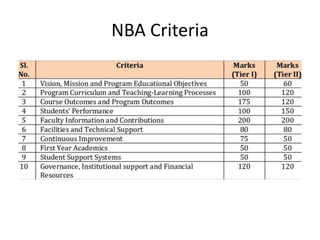
NBA Criteria
BLOOMS TAXONOMY
Bloom's Taxonomy is a hierarchical framework that classifies educational
objectives into cognitive categories. It was developed by Benjamin Bloom and
a group of educational psychologists in 1956.
The taxonomy is designed to help educators and instructional designers
understand and organize the different levels of cognitive skills that students
use and demonstrate in the learning process.
POs
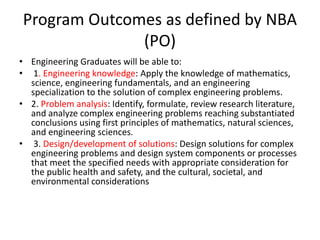
Program Outcomes as defined by NBA
(PO)
• Engineering Graduates will be able to:
• 1. Engineering knowledge: Apply the knowledge of mathematics,
science, engineering fundamentals, and an engineering
specialization to the solution of complex engineering problems.
• 2. Problem analysis: Identify, formulate, review research literature,
and analyze complex engineering problems reaching substantiated
conclusions using first principles of mathematics, natural sciences,
and engineering sciences.
• 3. Design/development of solutions: Design solutions for complex
engineering problems and design system components or processes
that meet the specified needs with appropriate consideration for
the public health and safety, and the cultural, societal, and
environmental considerations
• 4.Conduct investigations of complex problems: Use research-based
knowledge and research methods including design of experiments,
analysis and interpretation of data, and synthesis of the information to
provide valid conclusions.
• 5. Modern tool usage: Create, select, and apply appropriate techniques,
resources, and modern engineering and IT tools including prediction and
modeling to complex engineering activities with an understanding of the
limitations.
• 6. The engineer and society: Apply reasoning informed by the contextual
knowledge to assess societal, health, safety, legal and cultural issues and
the consequent responsibilities relevant to the professional engineering
practice.
• 7. Environment and sustainability: Understand the impact of the
professional engineering solutions in societal and environmental contexts,
and demonstrate the knowledge of, and need for sustainable
development.
• 8.Ethics: Apply ethical principles and commit to professional ethics and
responsibilities and norms of the engineering practice.
• 9. Individual and team work: Function effectively as an individual, and as a
member or leader in diverse teams, and in multidisciplinary settings.
• 10. Communication: Communicate effectively on complex engineering
activities with the engineering community and with society at large, such
as, being able to comprehend and write effective reports and design
documentation, make effective presentations, and give and receive clear
instructions.
• 11. Project management and finance: Demonstrate knowledge and
understanding of the engineering and management principles and apply
these to one’s own work, as a member and leader in a team, to manage
projects and in multidisciplinary environments.
• 12. Life-long learning: Recognize the need for, and have the preparation
and ability to engage in independent and life-long learning in the broadest
context of technological change.
U21CY101- Engineering Chemistry
Course outcomes
• Upon completion of the course, the student will be able to
• CO1: Apply the principles of water technology in treatment
of industrial and domestic water and estimate the various
constituents of industrial water
• CO2: Describe the principles and applications of
electrochemical cells, fuel cells and solar cells
• CO3: Outline the different types of corrosion processes and
preventive methods adopted in industries
• CO4: Explain the analysis and calorific value of different
types of fuels
• CO5: Classify the polymers and their engineering
applications.
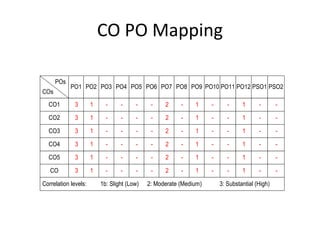
CO PO Mapping
POs
COs
PO1 PO2 PO3 PO4 PO5 PO6 PO7 PO8 PO9 PO10 PO11 PO12 PSO1 PSO2
CO1 3 1 - - - - 2 - 1 - - 1 - -
CO2 3 1 - - - - 2 - 1 - - 1 - -
CO3 3 1 - - - - 2 - 1 - - 1 - -
CO4 3 1 - - - - 2 - 1 - - 1 - -
CO5 3 1 - - - - 2 - 1 - - 1 - -
CO 3 1 - - - - 2 - 1 - - 1 - -
Correlation levels: 1b: Slight (Low) 2: Moderate (Medium) 3: Substantial (High)
• Program educational objectives are the broad
statements that describe the career and
professional accomplishments that the
program is preparing graduates to achieve.
• Program Specific Outcomes (PSOs ): These are
statements that defines outcomes of a.
program which make students realize the fact
that the knowledge and techniques learnt in
this course has direct implication for the
betterment of society and its sustainability.

NBA ppt.pptx

  • 1.
  • 2.
    KPRIET Vision Mission •Vision • To become a premier institute of academic excellence by imparting technical, intellectual and professional skills to students for meeting the diverse needs of industry, society, the nation and the world at large • Mission • Commitment to offer value-based education and enhancement of practical skills. • Continuous assessment of teaching and learning processes through scholarly activities. • Enriching research and innovation activities in collaboration with industry and institutes of repute. • Ensuring the academic processes to uphold culture, ethics and social responsibilities.
  • 3.
  • 4.
    BLOOMS TAXONOMY Bloom's Taxonomyis a hierarchical framework that classifies educational objectives into cognitive categories. It was developed by Benjamin Bloom and a group of educational psychologists in 1956. The taxonomy is designed to help educators and instructional designers understand and organize the different levels of cognitive skills that students use and demonstrate in the learning process.
  • 6.
  • 7.
    Program Outcomes asdefined by NBA (PO) • Engineering Graduates will be able to: • 1. Engineering knowledge: Apply the knowledge of mathematics, science, engineering fundamentals, and an engineering specialization to the solution of complex engineering problems. • 2. Problem analysis: Identify, formulate, review research literature, and analyze complex engineering problems reaching substantiated conclusions using first principles of mathematics, natural sciences, and engineering sciences. • 3. Design/development of solutions: Design solutions for complex engineering problems and design system components or processes that meet the specified needs with appropriate consideration for the public health and safety, and the cultural, societal, and environmental considerations
  • 8.
    • 4.Conduct investigationsof complex problems: Use research-based knowledge and research methods including design of experiments, analysis and interpretation of data, and synthesis of the information to provide valid conclusions. • 5. Modern tool usage: Create, select, and apply appropriate techniques, resources, and modern engineering and IT tools including prediction and modeling to complex engineering activities with an understanding of the limitations. • 6. The engineer and society: Apply reasoning informed by the contextual knowledge to assess societal, health, safety, legal and cultural issues and the consequent responsibilities relevant to the professional engineering practice. • 7. Environment and sustainability: Understand the impact of the professional engineering solutions in societal and environmental contexts, and demonstrate the knowledge of, and need for sustainable development.
  • 9.
    • 8.Ethics: Applyethical principles and commit to professional ethics and responsibilities and norms of the engineering practice. • 9. Individual and team work: Function effectively as an individual, and as a member or leader in diverse teams, and in multidisciplinary settings. • 10. Communication: Communicate effectively on complex engineering activities with the engineering community and with society at large, such as, being able to comprehend and write effective reports and design documentation, make effective presentations, and give and receive clear instructions. • 11. Project management and finance: Demonstrate knowledge and understanding of the engineering and management principles and apply these to one’s own work, as a member and leader in a team, to manage projects and in multidisciplinary environments. • 12. Life-long learning: Recognize the need for, and have the preparation and ability to engage in independent and life-long learning in the broadest context of technological change.
  • 10.
    U21CY101- Engineering Chemistry Courseoutcomes • Upon completion of the course, the student will be able to • CO1: Apply the principles of water technology in treatment of industrial and domestic water and estimate the various constituents of industrial water • CO2: Describe the principles and applications of electrochemical cells, fuel cells and solar cells • CO3: Outline the different types of corrosion processes and preventive methods adopted in industries • CO4: Explain the analysis and calorific value of different types of fuels • CO5: Classify the polymers and their engineering applications.
  • 11.
    CO PO Mapping POs COs PO1PO2 PO3 PO4 PO5 PO6 PO7 PO8 PO9 PO10 PO11 PO12 PSO1 PSO2 CO1 3 1 - - - - 2 - 1 - - 1 - - CO2 3 1 - - - - 2 - 1 - - 1 - - CO3 3 1 - - - - 2 - 1 - - 1 - - CO4 3 1 - - - - 2 - 1 - - 1 - - CO5 3 1 - - - - 2 - 1 - - 1 - - CO 3 1 - - - - 2 - 1 - - 1 - - Correlation levels: 1b: Slight (Low) 2: Moderate (Medium) 3: Substantial (High)
  • 12.
    • Program educationalobjectives are the broad statements that describe the career and professional accomplishments that the program is preparing graduates to achieve.
  • 13.
    • Program SpecificOutcomes (PSOs ): These are statements that defines outcomes of a. program which make students realize the fact that the knowledge and techniques learnt in this course has direct implication for the betterment of society and its sustainability.