Embracing Open Source:
Practice and Experience from Alibaba

               Wensong Zhang
                Alibaba Group
The 11th Northeast Asia OSS Promotion Forum
                 2012.11.13
                                              1
Agenda


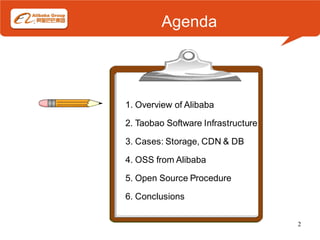
1. Overview of Alibaba

2. Taobao Software Infrastructure

3. Cases: Storage, CDN & DB

4. OSS from Alibaba

5. Open Source Procedure

6. Conclusions

                                    2
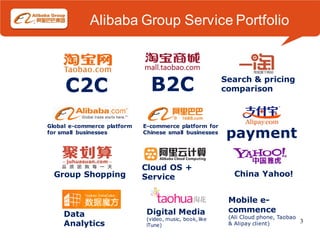
Alibaba Group Service Portfolio


     C2C                       B2C                        Search & pricing
                                                          comparison


Global e-commerce platform   E-commerce platform for
for small businesses         Chinese small businesses
                                                           payment

                             Cloud OS +
  Group Shopping             Service                         China Yahoo!


                                                           Mobile e-
                              Digital Media                commence
     Data                                                  (Ali Cloud phone, Taobao
                              (video, music, book, like
     Analytics                iTune)                       & Alipay client)         3
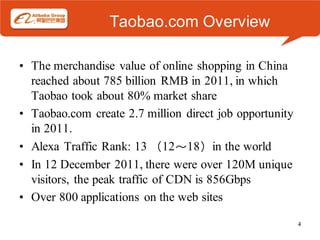
Taobao.com Overview

• The merchandise value of online shopping in China
  reached about 785 billion RMB in 2011, in which
  Taobao took about 80% market share
• Taobao.com create 2.7 million direct job opportunity
  in 2011.
• Alexa Traffic Rank: 13 (12~18)in the world
• In 12 December 2011, there were over 120M unique
  visitors, the peak traffic of CDN is 856Gbps
• Over 800 applications on the web sites

                                                         4
Agenda


1. Overview of Alibaba

2. Taobao Software Infrastructure

3. Cases: Storage, CDN & DB

4. OSS from Alibaba

5. Open Source Procedure

6. Conclusions

                                    5
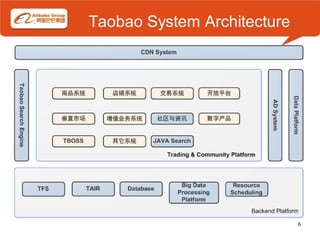
Taobao System Architecture


                             6
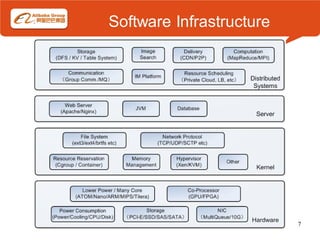
Software Infrastructure


                          7
Major Software

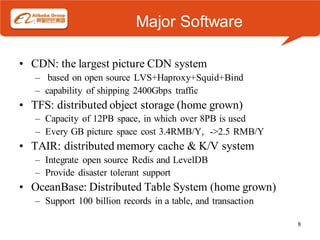
• CDN: the largest picture CDN system
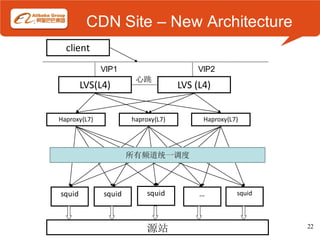
   – based on open source LVS+Haproxy+Squid+Bind
   – capability of shipping 2400Gbps traffic
• TFS: distributed object storage (home grown)
   – Capacity of 12PB space, in which over 8PB is used
   – Every GB picture space cost 3.4RMB/Y, ->2.5 RMB/Y
• TAIR: distributed memory cache & K/V system
   – Integrate open source Redis and LevelDB
   – Provide disaster tolerant support
• OceanBase: Distributed Table System (home grown)
   – Support 100 billion records in a table, and transaction

                                                               8
Major Software(2)

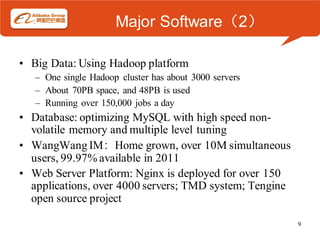
• Big Data: Using Hadoop platform
   – One single Hadoop cluster has about 3000 servers
   – About 70PB space, and 48PB is used
   – Running over 150,000 jobs a day
• Database: optimizing MySQL with high speed non-
  volatile memory and multiple level tuning
• WangWang IM:Home grown, over 10M simultaneous
  users, 99.97% available in 2011
• Web Server Platform: Nginx is deployed for over 150
  applications, over 4000 servers; TMD system; Tengine
  open source project

                                                         9
Major Software(3)

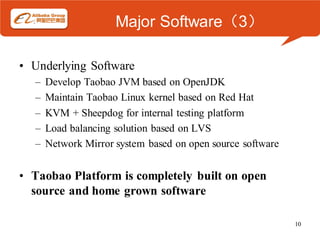
• Underlying Software
  –   Develop Taobao JVM based on OpenJDK
  –   Maintain Taobao Linux kernel based on Red Hat
  –   KVM + Sheepdog for internal testing platform
  –   Load balancing solution based on LVS
  –   Network Mirror system based on open source software


• Taobao Platform is completely built on open
  source and home grown software

                                                            10
Agenda


1. Overview of Alibaba

2. Taobao Software Infrastructure

3. Cases: Storage, CDN & DB

4. OSS from Alibaba

5. Open Source Procedure

6. Conclusions

                                    11
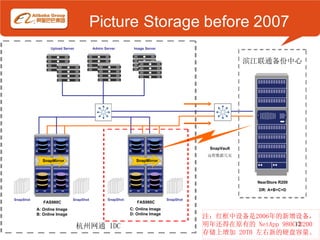
Picture Storage before 2007
                 Upload Server          Admin Server        Image Server


                                                                                                     滨江联通备份中心


                                                                                         SnapVault
                                                                                         远程数据冗灾
             SnapMirror                                       SnapMirror


                                                                                                       NearStore R200
                                                                                                       DR: A+B+C+D

SnapShot                     SnapShot           SnapShot                     SnapShot
              FAS980C                                         FAS980C
           A: Online Image                                 C: Online Image
                                                           D: Online Image
           B: Online Image
                                                                                        注:红框中设备是2006年的新增设备,
                                 杭州网通 IDC                                               明年还得在原有的 NetApp 980C/R200
                                                                                                            12
                                                                                        存储上增加 20TB 左右新的硬盘容量。
System Requirement

• System requirements
    Data safety is becoming more and more important
    Data is tripled every year
• Commercial storage products could not meet
  requirements any more
    There is no optimization for little object
    The number of files is too huge to support
    The number of network connections reach its limit
    The cost is too high, 10T NAS cost over 1M RMB at that time
    There is no grantee in disaster tolerance

                                                                   13
TFS 1.0

• June 2007
  –   TFS(Taobao File System)1.0 went to production
  –   Distributed storage for massive small objects
  –   200 PC Servers(146G*6 SAS 15K Raid5)
  –   File Number: several billions
  –   Deployed: 140TB
  –   Used: 50TB


                                                      14
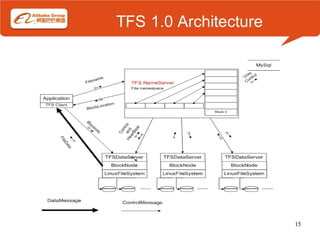
TFS 1.0 Architecture


                       15
TFS1.0 Features

•    Master-backup Name Servers and multiple Data Servers
•    Data Server runs on Linux servers with directly attached
•    Each block is 64M in size
•    Filename (Object ID) contains metadata information,
    in order to keep metadata extremely small in Name
    Servers
    •   E.g. T2auNFXXBaXXXXXXXX_!!140680281.jpg include its
        block_no and object_no.
•   Each block can have multiple copies.
•   Use ext3 file system to store block
                                                                16
TFS 1.3

• June 2009
  TFS(Taobao File System)1.3 on production
• TFS Cluster(2010.8.22)
   440台PC Server (300G*12 SAS 15K RPM) + 30台PC
    Server (600G*12 SAS 15K RPM)
   File Number: tens of billions
   Deployed: 1800 TB
   Used: 995TB
   Name Server only uses 217MB memory for metadata


                                                      17
TFS Development

• TFS was released in open source in September 2010
• TFS 2.0 has already been used in production
  – Support large files
  – Support directory using external MySQL
  – Add resource center for QoS
• Onging
  – Performance tuning, and cost saving
  – Hybrid storage(SSD/SATA), object migration
  – Implementing Erasure Coding

                                                      18
Agenda


1. Overview of Alibaba
2. Taobao Software Infrastructure

3. Cases: Storage, CDN & DB

4. OSS from Alibaba

5. Open Source Procedure

6. Conclusions

                                    19
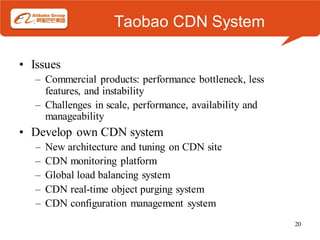
Taobao CDN System

• Issues
   – Commercial products: performance bottleneck, less
     features, and instability
   – Challenges in scale, performance, availability and
     manageability
• Develop own CDN system
   –   New architecture and tuning on CDN site
   –   CDN monitoring platform
   –   Global load balancing system
   –   CDN real-time object purging system
   –   CDN configuration management system
                                                          20
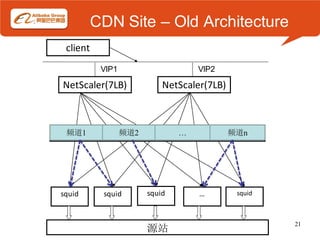
CDN Site – Old Architecture
 client
           VIP1                     VIP2

NetScaler(7LB)              NetScaler(7LB)


 频道1              频道2   频道      …            频道n


squid      squid        squid       …         squid


                                                      21
                        源站
CDN Site – New Architecture
  client
              VIP1                       VIP2
                       心跳
        LVS(L4)                     LVS (L4)


Haproxy(L7)           haproxy(L7)         Haproxy(L7)


                      所有频道统一调度


squid         squid        squid         …          squid


                           源站                               22
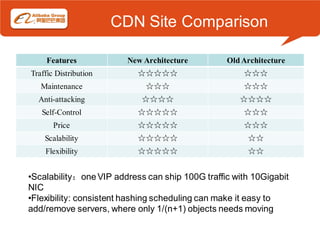
CDN Site Comparison

     Features            New Architecture        Old Architecture
Traffic Distribution       ☆☆☆☆☆                     ☆☆☆
   Maintenance               ☆☆☆                     ☆☆☆
  Anti-attacking            ☆☆☆☆                    ☆☆☆☆
   Self-Control            ☆☆☆☆☆                     ☆☆☆
       Price               ☆☆☆☆☆                     ☆☆☆
    Scalability            ☆☆☆☆☆                      ☆☆
    Flexibility            ☆☆☆☆☆                      ☆☆


•Scalability:one VIP address can ship 100G traffic with 10Gigabit
NIC
•Flexibility: consistent hashing scheduling can make it easy to
add/remove servers, where only 1/(n+1) objects needs moving
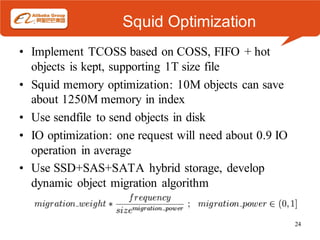
Squid Optimization
• Implement TCOSS based on COSS, FIFO + hot
  objects is kept, supporting 1T size file
• Squid memory optimization: 10M objects can save
  about 1250M memory in index
• Use sendfile to send objects in disk
• IO optimization: one request will need about 0.9 IO
  operation in average
• Use SSD+SAS+SATA hybrid storage, develop
  dynamic object migration algorithm


                                                        24
Agenda


1. Overview of Alibaba

2. Taobao Software Infrastructure

3. Cases: Storage, CDN & DB

4. OSS from Alibaba

5. Open Source Procedure

6. Conclusions

                                    25
Commercial DB Solutions

• IOE= IBM + Oracle + EMC
• Advantages:
  – Stable, and having a lot of features
  – Rich tools for operation
• Disadvantages:
  – License royalty is expensive, hardware cost is high
  – Centralized architecture, not scalable
  – Software black box


                                                          26
MySQL Development

• 2008: Using MySQL in non-critical applications
• 2010: Building MySQL development team
   – Combining High-speed non-volatile memory and multiple
     layer system optimization
   – TDDL data sharding middleware was getting mature
   – Some core applications started to migrate to MySQL
• 2011: all core databases were migrated to MySQL
   – UIC and IC Databases have MySQL 16*2 cluster each
   – Transaction Center Database: MySQL 16*2 cost is near
     4M RMB (IOE is over 20M RMB), TPS was increased
     from 9000 to 128K                                       27
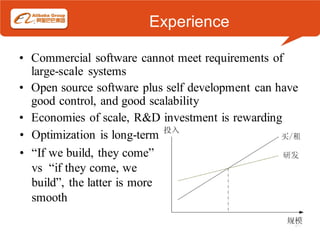
Experience

• Commercial software cannot meet requirements of
  large-scale systems
• Open source software plus self development can have
  good control, and good scalability
• Economies of scale, R&D investment is rewarding
• Optimization is long-term
• “If we build, they come”
  vs “if they come, we
  build”, the latter is more
  smooth

                                                    28
Agenda


1. Overview of Alibaba

2. Taobao Software Infrastructure

3. Cases: Storage, CDN & DB

4. OSS from Alibaba

5. Open Source Procedure

6. Conclusions

                                    29
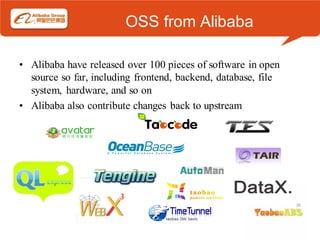
OSS from Alibaba

• Alibaba have released over 100 pieces of software in open
  source so far, including frontend, backend, database, file
  system, hardware, and so on
• Alibaba also contribute changes back to upstream


                                                               30
TFS

• Taobao File System
• http://tfs.taobao.org
• Distributed Object Storage System
   –   Optimized for small files/objects
   –   High Availability, Reliability
   –   Big Data, and high concurrency
   –   Lost cost
   –   Linear scalability
Tair

• Taobao Pairs
• http://tair.taobao.org
• Distributed K/V storage system
   – Auto disaster-tolerance
   – Support memory-cache and persistence
   – Support multiple storage engine for different applications
      • Mdb
      • Redis
      • LevelDB
      •…
OceanBase

• Distributed database system
• http://oceanbase.taobao.org
• Features
   –   Support 100 billion records in one table
   –   Support database transactions
   –   Support linear scalability
   –   Compatible with MySQL protocol
   –   Proven in many Taobao big data applications
KISSY

• A powerful JavaScript framework
• http://docs.kissyui.com
• Features
  –   Modularization
  –   Extensible
  –   Full features
  –   Rich components
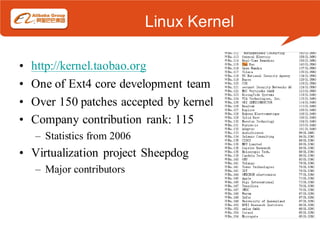
Linux Kernel

•   http://kernel.taobao.org
•   One of Ext4 core development team
•   Over 150 patches accepted by kernel
•   Company contribution rank: 115
    – Statistics from 2006
• Virtualization project Sheepdog
    – Major contributors
Hadoop

• Maintaining own version of Hadoop, including
  HDFS, MapReduce, Hbase and Hive, supporting Pig
  and Mahout from eco-system。
• Hadoop official Chinese document translation
• Hive
  – Contributed over 20 patches, about mutli-distinct
    aggregation, JDBC interface and authentication etc.
• HBase
  – Contributed about 47 patches
  – Short the recovery time of HBase
MySQL

• Maintaining own branch of MySQL
  – Performance improvement
  – New features
• http://mysql.taobao.org
• About 3000 MySQL servers
• Working with Oracle, Percona and Mariadb, having
  good cooperation.
• Signed OCA with Oracle, over 20 patches were
  accepted.
JVM

• Tuning OpenJDK VM
  – Performance improvement
  – Customize JVM from Taobao application requirements
• The deployment of own JVM version is 14% in 2011,
  will reach 100% in taobao.com and tmall.com in
  2012.
• Contributed 16 general patches to Oracle JVM
• Contributed developers to Oracle JVM core team as
  well :)
WebX

• A Powerful Java Web Framework
• http://www.openwebx.org/
• Features
  – Based on Java Servlet API
  – Good extensibility
  – Reliability is proved in large-scale web sites
FastJSON

• A very efficient JSON library written in Java
• http://code.alibabatech.com/wiki/display/FastJSON/H
  ome
• From the 3rd party testing report, FastJSON is faster
  than Jackson, Gson, JSON-Lib and Hessian
• Ease to use
• Easy to extend
Druid

• The best JDBC connection pool written in Java
• https://github.com/AlibabaTech/druid/wiki
• Features
   –   SQL Monitoring / Web-Spring-SQL Monitoring
   –   Filter-Chain mechanism
   –   Support monitoring statistics and log
   –   Prevent from SQL injection attack
   –   Resolve the memory issue of Oracle PSCache
Dubbo

• A distributed service framework empowers
  applications with service import/export capability and
  high performance RPC
• http://code.alibabatech.com/wiki/display/dubbo
• Features:
   –   Remote service invocation
   –   Dynamic service discovery
   –   Load-balancing/failover/clustering capabilities.
   –   Event publish/subscription
Tengine

• A web server based on Nginx
• http://tengine.taobao.org
• Features:
  –   Dynamic loadable module support
  –   Input filter mechanism
  –   Javascript / CSS comb
  –   Health checking on backend servers
  –   Support pipe and syslog logging and sampling
  –   Monitoring load to protect system
  –   Features for ease use and maintenance
SeaJS

• A Module Loader for the Web
• http://seajs.org
• Features:
  – SeaJS pursue simple and nature coding style
  – Good maintenance for JS code
Arale

• An open, simple, easy-to-use JS class based on SeaJS
• http://aralejs.org
• Features:
   – A simple and consistent coding style
   – Components
QLExpress

• A lightweight script engine
• http://code.taobao.org/p/QLExpress/wiki/index/
• Features:
   – Support standard Java syntax
   – Support self defined operator, operator overloading,
     function definition, macro definition, data delay loading
   – Compile and execution for performance
   – Used in a lot of systems in Taobao, and outside too.
TBSchedule

• A job scheduler for tasks running in JVM among multiple
  hosts
• http://code.taobao.org/p/tbschedule/wiki/index/
• Features
   – Job can be dynamically created, stopped, and run on
      multiple servers
   – Configure time period for task execution
   – A unified control console, which can adjust parameters
   – One simple interface
   – Used in a lot of systems in Taobao, and outside too.
Tsar

• Monitoring and data collection tool for operation
• http://tsar.taobao.org
• Feature
   –   Simple, ease to deploy, stable, low overhead
   –   Modularization design, easy to add more modules
   –   Support real-time data collection and display
   –   Can work with Nagios, and send alert messages
TProfiler

• A Java performance analysis tool, widely used in
  Taobao production systems
• http://github.com/taobao/tprofiler
• Features:
   – Support analyzing and sampling
   – Record method execution time and times
   – Generate hot methods and analysis report
TimeTunnel

• Real-time data transmission platform based on thrift
• http://timetunnel.taobao.org
• Features:
   –   High performance
   –   Real time
   –   Sequential
   –   Reliable
   –   High available
   –   Easy to extend
TaoKeeper

• ZooKeeper monitor
• http://code.taobao.org/p/taokeeper/src/
• Features
   – Monitor ZooKeeper connection numbers, watcher numbers,
     node numbers
   – Can set threshold for monitoring alerts
   – Can generate daily/weekly monitoring report
   – Can check current status of machines
MetaQ

• Java Massaging middleware
• http://metaq.taobao.org/
• Features:
  – High performance, TPS can reach 45000 with 2Kbytes
    message on Gigabit ethernet
  – Support ordered messages
  – Support message filtering
  – Support transaction in message consumption at consumer
    side
  – Support distributed deployment
TDDL

• TDDL(Taobao Distributed Data Layer) is a
  distributed data access engine for data shreding
• https://github.com/taobao/tb_tddl
• Features:
   – Data access routing
   – Support one write and multiple read
   – Easy to extend, and auto data migration
Automan

• An auto testing framework
• http://code.taobao.org/p/AutoMan/wiki/index/
• Features:
   – Design based on Page-Model, separate “element lookup”
     and “component operation”
   – Easy to use and maintain
Toast

• An auto-test job scheduling platform
• http://toast.taobao.org
• Features:
   – A general-purpose scheduling platform
   – Support timed run, and manual run
   – Provide monitoring and management on testing machines
SQLAutoReview

• A SQL auto-auditing tool
• http://code.taobao.org/p/sqlautoreview/src/
• Features:
   – Parse SQL statement from SQLMap
   – Build create index script for every SQL statement
   – Merge all create index script with exist indexes on these
     tables
Diamond

• A persistent configuration management center
• http://code.taobao.org/p/diamond/wiki/index/
• Features
   – Simple
      • HTTP interface to get configuration
   – Reliable
      • Multiple level protect and disaster-tolerance support
      • Reliable notification on configuration update, to ensure
        client to get the latest data
Lower Power Server
     • Each NODE has 3 HDDs
     • 24 x 2.5” SATA/SSD
     • 2U 8 nodes
        – Hot pluggable
        – Lower power comsuption
        – Lower cost
     • Server node configuration:
        – Intel® Atom™ D525 with 2 cores
        – Intel® ICH9R Chipset
        – 4GB memory DDR23 800MHZ SO-DIMM
          w/o ECC
        – LAN: Intel 82574L 2*1GB
        – HDD:
            •   1* SSD 80G ,
            •    2* 2.5” SATA 500GB
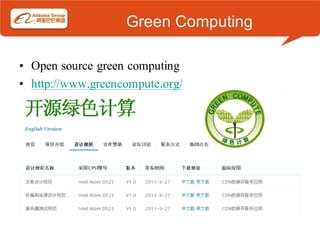
Green Computing

• Open source green computing
• http://www.greencompute.org/
Agenda


1. Overview of Alibaba

2. Taobao Software Infrastructure

3. Cases: Storage, CDN & DB

4. OSS from Alibaba

5. Open Source Procedure

6. Conclusions

                                    60
Open Source Committee

• Found Alibaba Open Source Committee with ten
  persons, who is from
  – Developers mainly
  – Lawyer
  – Security analysis
• The goal of Alibaba Open Source Committee is to
  help promote open source
  – Ensure open source procedure
  – Give advice on open source
Alibaba Open Source Procedur

• Engineers initiate open source request
• Need approval from their manager and the head of
  big division
• Security analysis team will check document and code
  for any security issues
• Alibaba Open Source Committee record this software
  in open source list
• Offer advices on open source license issue
• Host project on Taocode and also synchronize it to
  github
Encourage Open Source

• Accomplishment in open source project is the best
  encouragement to engineers.
• Host internal open source meetings from time to time,
  for sharing and brain storming.
• Reward excellent open source projects.


                                                      63
Open Source Licenses

• GPL vs. BSD vs. MIT vs. Apache
   – GPL is better to guarantee development of open source
     project
• Alibaba’s consideration on licenses
   – Most projects choose GPL。
   – Some libraries use BSD or Apache license
   – Some just follow the license from upstream
• Alibaba Group is the copyright owner
   – (C) 2007-2012 Alibaba Group Holding Limited
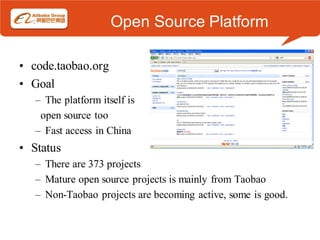
Open Source Platform

• code.taobao.org
• Goal
   – The platform itself is
    open source too
   – Fast access in China
• Status
   – There are 373 projects
   – Mature open source projects is mainly from Taobao
   – Non-Taobao projects are becoming active, some is good.
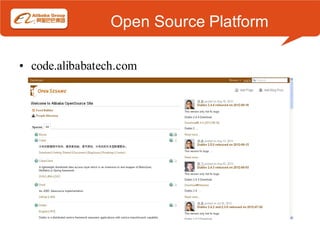
Open Source Platform

• code.alibabatech.com
Agenda


1. Overview of Alibaba

2. Taobao Software Infrastructure

3. Cases: Storage, CDN & DB

4. OSS from Alibaba

5. Open Source Procedure

6. Conclusions

                                    67
From Engineer Side

• Alibaba engineers gain some benefits from doing
  open source projects
   – More accomplishment
   – Working with more developers and hackers, good for skill
     improvement
   – Getting more users
   – Make a longer lifecycle of their code
   – Happy to see how their code is used in different ways
From Company Side

• Improve software quality through open source
   – More user requirements and feedbacks
   – More users tesing and bug reports
   – Patches from external developers
• Receive industry recognition on technology capability
  and open spirit
   – Engineers have strong sense of identity
   – Attracting more talents to join Alibaba
Conclusion

• Alibaba Group is the beneficiary of open source
  system, and actively participate in building open
  source eco-system.
• Hope that the company can accumulate better
  reputation, and attract more talents to meet the greater
  technical challenges in the future.
• Alibaba Group hopes to do more technology
  innovation with the industry in a more open manner.


                                                         70
Q&A


 Q&A
Thanks


           71

Embracing Open Source: Practice and Experience from Alibaba

  • 1.
    Embracing Open Source: Practiceand Experience from Alibaba Wensong Zhang Alibaba Group The 11th Northeast Asia OSS Promotion Forum 2012.11.13 1
  • 2.
    Agenda 1. Overview ofAlibaba 2. Taobao Software Infrastructure 3. Cases: Storage, CDN & DB 4. OSS from Alibaba 5. Open Source Procedure 6. Conclusions 2
  • 3.
    Alibaba Group ServicePortfolio C2C B2C Search & pricing comparison Global e-commerce platform E-commerce platform for for small businesses Chinese small businesses payment Cloud OS + Group Shopping Service China Yahoo! Mobile e- Digital Media commence Data (Ali Cloud phone, Taobao (video, music, book, like Analytics iTune) & Alipay client) 3
  • 4.
    Taobao.com Overview • Themerchandise value of online shopping in China reached about 785 billion RMB in 2011, in which Taobao took about 80% market share • Taobao.com create 2.7 million direct job opportunity in 2011. • Alexa Traffic Rank: 13 (12~18)in the world • In 12 December 2011, there were over 120M unique visitors, the peak traffic of CDN is 856Gbps • Over 800 applications on the web sites 4
  • 5.
    Agenda 1. Overview ofAlibaba 2. Taobao Software Infrastructure 3. Cases: Storage, CDN & DB 4. OSS from Alibaba 5. Open Source Procedure 6. Conclusions 5
  • 6.
  • 7.
  • 8.
    Major Software • CDN:the largest picture CDN system – based on open source LVS+Haproxy+Squid+Bind – capability of shipping 2400Gbps traffic • TFS: distributed object storage (home grown) – Capacity of 12PB space, in which over 8PB is used – Every GB picture space cost 3.4RMB/Y, ->2.5 RMB/Y • TAIR: distributed memory cache & K/V system – Integrate open source Redis and LevelDB – Provide disaster tolerant support • OceanBase: Distributed Table System (home grown) – Support 100 billion records in a table, and transaction 8
  • 9.
    Major Software(2) • BigData: Using Hadoop platform – One single Hadoop cluster has about 3000 servers – About 70PB space, and 48PB is used – Running over 150,000 jobs a day • Database: optimizing MySQL with high speed non- volatile memory and multiple level tuning • WangWang IM:Home grown, over 10M simultaneous users, 99.97% available in 2011 • Web Server Platform: Nginx is deployed for over 150 applications, over 4000 servers; TMD system; Tengine open source project 9
  • 10.
    Major Software(3) • UnderlyingSoftware – Develop Taobao JVM based on OpenJDK – Maintain Taobao Linux kernel based on Red Hat – KVM + Sheepdog for internal testing platform – Load balancing solution based on LVS – Network Mirror system based on open source software • Taobao Platform is completely built on open source and home grown software 10
  • 11.
    Agenda 1. Overview ofAlibaba 2. Taobao Software Infrastructure 3. Cases: Storage, CDN & DB 4. OSS from Alibaba 5. Open Source Procedure 6. Conclusions 11
  • 12.
    Picture Storage before2007 Upload Server Admin Server Image Server 滨江联通备份中心 SnapVault 远程数据冗灾 SnapMirror SnapMirror NearStore R200 DR: A+B+C+D SnapShot SnapShot SnapShot SnapShot FAS980C FAS980C A: Online Image C: Online Image D: Online Image B: Online Image 注:红框中设备是2006年的新增设备, 杭州网通 IDC 明年还得在原有的 NetApp 980C/R200 12 存储上增加 20TB 左右新的硬盘容量。
  • 13.
    System Requirement • Systemrequirements  Data safety is becoming more and more important  Data is tripled every year • Commercial storage products could not meet requirements any more  There is no optimization for little object  The number of files is too huge to support  The number of network connections reach its limit  The cost is too high, 10T NAS cost over 1M RMB at that time  There is no grantee in disaster tolerance 13
  • 14.
    TFS 1.0 • June2007 – TFS(Taobao File System)1.0 went to production – Distributed storage for massive small objects – 200 PC Servers(146G*6 SAS 15K Raid5) – File Number: several billions – Deployed: 140TB – Used: 50TB 14
  • 15.
  • 16.
    TFS1.0 Features • Master-backup Name Servers and multiple Data Servers • Data Server runs on Linux servers with directly attached • Each block is 64M in size • Filename (Object ID) contains metadata information, in order to keep metadata extremely small in Name Servers • E.g. T2auNFXXBaXXXXXXXX_!!140680281.jpg include its block_no and object_no. • Each block can have multiple copies. • Use ext3 file system to store block 16
  • 17.
    TFS 1.3 • June2009 TFS(Taobao File System)1.3 on production • TFS Cluster(2010.8.22)  440台PC Server (300G*12 SAS 15K RPM) + 30台PC Server (600G*12 SAS 15K RPM)  File Number: tens of billions  Deployed: 1800 TB  Used: 995TB  Name Server only uses 217MB memory for metadata 17
  • 18.
    TFS Development • TFSwas released in open source in September 2010 • TFS 2.0 has already been used in production – Support large files – Support directory using external MySQL – Add resource center for QoS • Onging – Performance tuning, and cost saving – Hybrid storage(SSD/SATA), object migration – Implementing Erasure Coding 18
  • 19.
    Agenda 1. Overview ofAlibaba 2. Taobao Software Infrastructure 3. Cases: Storage, CDN & DB 4. OSS from Alibaba 5. Open Source Procedure 6. Conclusions 19
  • 20.
    Taobao CDN System •Issues – Commercial products: performance bottleneck, less features, and instability – Challenges in scale, performance, availability and manageability • Develop own CDN system – New architecture and tuning on CDN site – CDN monitoring platform – Global load balancing system – CDN real-time object purging system – CDN configuration management system 20
  • 21.
    CDN Site –Old Architecture client VIP1 VIP2 NetScaler(7LB) NetScaler(7LB) 频道1 频道2 频道 … 频道n squid squid squid … squid 21 源站
  • 22.
    CDN Site –New Architecture client VIP1 VIP2 心跳 LVS(L4) LVS (L4) Haproxy(L7) haproxy(L7) Haproxy(L7) 所有频道统一调度 squid squid squid … squid 源站 22
  • 23.
    CDN Site Comparison Features New Architecture Old Architecture Traffic Distribution ☆☆☆☆☆ ☆☆☆ Maintenance ☆☆☆ ☆☆☆ Anti-attacking ☆☆☆☆ ☆☆☆☆ Self-Control ☆☆☆☆☆ ☆☆☆ Price ☆☆☆☆☆ ☆☆☆ Scalability ☆☆☆☆☆ ☆☆ Flexibility ☆☆☆☆☆ ☆☆ •Scalability:one VIP address can ship 100G traffic with 10Gigabit NIC •Flexibility: consistent hashing scheduling can make it easy to add/remove servers, where only 1/(n+1) objects needs moving
  • 24.
    Squid Optimization • ImplementTCOSS based on COSS, FIFO + hot objects is kept, supporting 1T size file • Squid memory optimization: 10M objects can save about 1250M memory in index • Use sendfile to send objects in disk • IO optimization: one request will need about 0.9 IO operation in average • Use SSD+SAS+SATA hybrid storage, develop dynamic object migration algorithm 24
  • 25.
    Agenda 1. Overview ofAlibaba 2. Taobao Software Infrastructure 3. Cases: Storage, CDN & DB 4. OSS from Alibaba 5. Open Source Procedure 6. Conclusions 25
  • 26.
    Commercial DB Solutions •IOE= IBM + Oracle + EMC • Advantages: – Stable, and having a lot of features – Rich tools for operation • Disadvantages: – License royalty is expensive, hardware cost is high – Centralized architecture, not scalable – Software black box 26
  • 27.
    MySQL Development • 2008:Using MySQL in non-critical applications • 2010: Building MySQL development team – Combining High-speed non-volatile memory and multiple layer system optimization – TDDL data sharding middleware was getting mature – Some core applications started to migrate to MySQL • 2011: all core databases were migrated to MySQL – UIC and IC Databases have MySQL 16*2 cluster each – Transaction Center Database: MySQL 16*2 cost is near 4M RMB (IOE is over 20M RMB), TPS was increased from 9000 to 128K 27
  • 28.
    Experience • Commercial softwarecannot meet requirements of large-scale systems • Open source software plus self development can have good control, and good scalability • Economies of scale, R&D investment is rewarding • Optimization is long-term • “If we build, they come” vs “if they come, we build”, the latter is more smooth 28
  • 29.
    Agenda 1. Overview ofAlibaba 2. Taobao Software Infrastructure 3. Cases: Storage, CDN & DB 4. OSS from Alibaba 5. Open Source Procedure 6. Conclusions 29
  • 30.
    OSS from Alibaba •Alibaba have released over 100 pieces of software in open source so far, including frontend, backend, database, file system, hardware, and so on • Alibaba also contribute changes back to upstream 30
  • 31.
    TFS • Taobao FileSystem • http://tfs.taobao.org • Distributed Object Storage System – Optimized for small files/objects – High Availability, Reliability – Big Data, and high concurrency – Lost cost – Linear scalability
  • 32.
    Tair • Taobao Pairs •http://tair.taobao.org • Distributed K/V storage system – Auto disaster-tolerance – Support memory-cache and persistence – Support multiple storage engine for different applications • Mdb • Redis • LevelDB •…
  • 33.
    OceanBase • Distributed databasesystem • http://oceanbase.taobao.org • Features – Support 100 billion records in one table – Support database transactions – Support linear scalability – Compatible with MySQL protocol – Proven in many Taobao big data applications
  • 34.
    KISSY • A powerfulJavaScript framework • http://docs.kissyui.com • Features – Modularization – Extensible – Full features – Rich components
  • 35.
    Linux Kernel • http://kernel.taobao.org • One of Ext4 core development team • Over 150 patches accepted by kernel • Company contribution rank: 115 – Statistics from 2006 • Virtualization project Sheepdog – Major contributors
  • 36.
    Hadoop • Maintaining ownversion of Hadoop, including HDFS, MapReduce, Hbase and Hive, supporting Pig and Mahout from eco-system。 • Hadoop official Chinese document translation • Hive – Contributed over 20 patches, about mutli-distinct aggregation, JDBC interface and authentication etc. • HBase – Contributed about 47 patches – Short the recovery time of HBase
  • 37.
    MySQL • Maintaining ownbranch of MySQL – Performance improvement – New features • http://mysql.taobao.org • About 3000 MySQL servers • Working with Oracle, Percona and Mariadb, having good cooperation. • Signed OCA with Oracle, over 20 patches were accepted.
  • 38.
    JVM • Tuning OpenJDKVM – Performance improvement – Customize JVM from Taobao application requirements • The deployment of own JVM version is 14% in 2011, will reach 100% in taobao.com and tmall.com in 2012. • Contributed 16 general patches to Oracle JVM • Contributed developers to Oracle JVM core team as well :)
  • 39.
    WebX • A PowerfulJava Web Framework • http://www.openwebx.org/ • Features – Based on Java Servlet API – Good extensibility – Reliability is proved in large-scale web sites
  • 40.
    FastJSON • A veryefficient JSON library written in Java • http://code.alibabatech.com/wiki/display/FastJSON/H ome • From the 3rd party testing report, FastJSON is faster than Jackson, Gson, JSON-Lib and Hessian • Ease to use • Easy to extend
  • 41.
    Druid • The bestJDBC connection pool written in Java • https://github.com/AlibabaTech/druid/wiki • Features – SQL Monitoring / Web-Spring-SQL Monitoring – Filter-Chain mechanism – Support monitoring statistics and log – Prevent from SQL injection attack – Resolve the memory issue of Oracle PSCache
  • 42.
    Dubbo • A distributedservice framework empowers applications with service import/export capability and high performance RPC • http://code.alibabatech.com/wiki/display/dubbo • Features: – Remote service invocation – Dynamic service discovery – Load-balancing/failover/clustering capabilities. – Event publish/subscription
  • 43.
    Tengine • A webserver based on Nginx • http://tengine.taobao.org • Features: – Dynamic loadable module support – Input filter mechanism – Javascript / CSS comb – Health checking on backend servers – Support pipe and syslog logging and sampling – Monitoring load to protect system – Features for ease use and maintenance
  • 44.
    SeaJS • A ModuleLoader for the Web • http://seajs.org • Features: – SeaJS pursue simple and nature coding style – Good maintenance for JS code
  • 45.
    Arale • An open,simple, easy-to-use JS class based on SeaJS • http://aralejs.org • Features: – A simple and consistent coding style – Components
  • 46.
    QLExpress • A lightweightscript engine • http://code.taobao.org/p/QLExpress/wiki/index/ • Features: – Support standard Java syntax – Support self defined operator, operator overloading, function definition, macro definition, data delay loading – Compile and execution for performance – Used in a lot of systems in Taobao, and outside too.
  • 47.
    TBSchedule • A jobscheduler for tasks running in JVM among multiple hosts • http://code.taobao.org/p/tbschedule/wiki/index/ • Features – Job can be dynamically created, stopped, and run on multiple servers – Configure time period for task execution – A unified control console, which can adjust parameters – One simple interface – Used in a lot of systems in Taobao, and outside too.
  • 48.
    Tsar • Monitoring anddata collection tool for operation • http://tsar.taobao.org • Feature – Simple, ease to deploy, stable, low overhead – Modularization design, easy to add more modules – Support real-time data collection and display – Can work with Nagios, and send alert messages
  • 49.
    TProfiler • A Javaperformance analysis tool, widely used in Taobao production systems • http://github.com/taobao/tprofiler • Features: – Support analyzing and sampling – Record method execution time and times – Generate hot methods and analysis report
  • 50.
    TimeTunnel • Real-time datatransmission platform based on thrift • http://timetunnel.taobao.org • Features: – High performance – Real time – Sequential – Reliable – High available – Easy to extend
  • 51.
    TaoKeeper • ZooKeeper monitor •http://code.taobao.org/p/taokeeper/src/ • Features – Monitor ZooKeeper connection numbers, watcher numbers, node numbers – Can set threshold for monitoring alerts – Can generate daily/weekly monitoring report – Can check current status of machines
  • 52.
    MetaQ • Java Massagingmiddleware • http://metaq.taobao.org/ • Features: – High performance, TPS can reach 45000 with 2Kbytes message on Gigabit ethernet – Support ordered messages – Support message filtering – Support transaction in message consumption at consumer side – Support distributed deployment
  • 53.
    TDDL • TDDL(Taobao DistributedData Layer) is a distributed data access engine for data shreding • https://github.com/taobao/tb_tddl • Features: – Data access routing – Support one write and multiple read – Easy to extend, and auto data migration
  • 54.
    Automan • An autotesting framework • http://code.taobao.org/p/AutoMan/wiki/index/ • Features: – Design based on Page-Model, separate “element lookup” and “component operation” – Easy to use and maintain
  • 55.
    Toast • An auto-testjob scheduling platform • http://toast.taobao.org • Features: – A general-purpose scheduling platform – Support timed run, and manual run – Provide monitoring and management on testing machines
  • 56.
    SQLAutoReview • A SQLauto-auditing tool • http://code.taobao.org/p/sqlautoreview/src/ • Features: – Parse SQL statement from SQLMap – Build create index script for every SQL statement – Merge all create index script with exist indexes on these tables
  • 57.
    Diamond • A persistentconfiguration management center • http://code.taobao.org/p/diamond/wiki/index/ • Features – Simple • HTTP interface to get configuration – Reliable • Multiple level protect and disaster-tolerance support • Reliable notification on configuration update, to ensure client to get the latest data
  • 58.
    Lower Power Server • Each NODE has 3 HDDs • 24 x 2.5” SATA/SSD • 2U 8 nodes – Hot pluggable – Lower power comsuption – Lower cost • Server node configuration: – Intel® Atom™ D525 with 2 cores – Intel® ICH9R Chipset – 4GB memory DDR23 800MHZ SO-DIMM w/o ECC – LAN: Intel 82574L 2*1GB – HDD: • 1* SSD 80G , • 2* 2.5” SATA 500GB
  • 59.
    Green Computing • Opensource green computing • http://www.greencompute.org/
  • 60.
    Agenda 1. Overview ofAlibaba 2. Taobao Software Infrastructure 3. Cases: Storage, CDN & DB 4. OSS from Alibaba 5. Open Source Procedure 6. Conclusions 60
  • 61.
    Open Source Committee •Found Alibaba Open Source Committee with ten persons, who is from – Developers mainly – Lawyer – Security analysis • The goal of Alibaba Open Source Committee is to help promote open source – Ensure open source procedure – Give advice on open source
  • 62.
    Alibaba Open SourceProcedur • Engineers initiate open source request • Need approval from their manager and the head of big division • Security analysis team will check document and code for any security issues • Alibaba Open Source Committee record this software in open source list • Offer advices on open source license issue • Host project on Taocode and also synchronize it to github
  • 63.
    Encourage Open Source •Accomplishment in open source project is the best encouragement to engineers. • Host internal open source meetings from time to time, for sharing and brain storming. • Reward excellent open source projects. 63
  • 64.
    Open Source Licenses •GPL vs. BSD vs. MIT vs. Apache – GPL is better to guarantee development of open source project • Alibaba’s consideration on licenses – Most projects choose GPL。 – Some libraries use BSD or Apache license – Some just follow the license from upstream • Alibaba Group is the copyright owner – (C) 2007-2012 Alibaba Group Holding Limited
  • 65.
    Open Source Platform •code.taobao.org • Goal – The platform itself is open source too – Fast access in China • Status – There are 373 projects – Mature open source projects is mainly from Taobao – Non-Taobao projects are becoming active, some is good.
  • 66.
    Open Source Platform •code.alibabatech.com
  • 67.
    Agenda 1. Overview ofAlibaba 2. Taobao Software Infrastructure 3. Cases: Storage, CDN & DB 4. OSS from Alibaba 5. Open Source Procedure 6. Conclusions 67
  • 68.
    From Engineer Side •Alibaba engineers gain some benefits from doing open source projects – More accomplishment – Working with more developers and hackers, good for skill improvement – Getting more users – Make a longer lifecycle of their code – Happy to see how their code is used in different ways
  • 69.
    From Company Side •Improve software quality through open source – More user requirements and feedbacks – More users tesing and bug reports – Patches from external developers • Receive industry recognition on technology capability and open spirit – Engineers have strong sense of identity – Attracting more talents to join Alibaba
  • 70.
    Conclusion • Alibaba Groupis the beneficiary of open source system, and actively participate in building open source eco-system. • Hope that the company can accumulate better reputation, and attract more talents to meet the greater technical challenges in the future. • Alibaba Group hopes to do more technology innovation with the industry in a more open manner. 70
  • 71.