Embrace  Uncertainty Strategies for on-time delivery in an uncertain world Jeff Patton [email_address] www.AgileProductDesign.com
XP circa 2000  and questioning what you think you know
XcrumP towards an Agile Unified Process? hmm…
process rigor  or rigor mortis?
a common problem,  and three strategies to deal with it
The stories you are about to hear are made up.  Only the names have been left unchanged to offend the innocent.
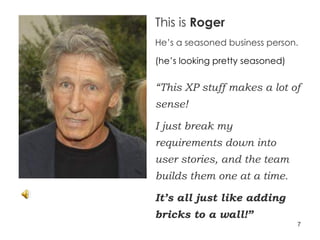
This is  Roger He’s a seasoned business person. (he’s looking pretty seasoned) “ This XP stuff makes a lot of sense!  I just break my requirements down into user stories, and the team builds them one at a time.  It’s all just like adding bricks to a wall!”
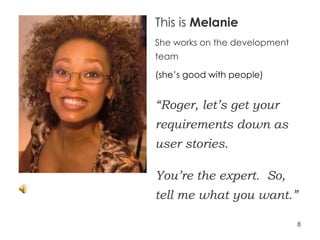
This is  Melanie She works on the development team (she’s good with people) “ Roger, let’s get your requirements down as user stories.  You’re the expert.  So, tell me what you want.”
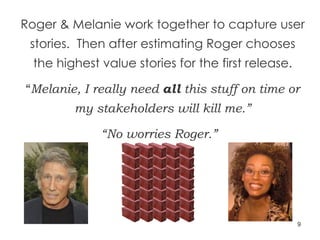
Roger & Melanie work together to capture user stories.  Then after estimating Roger chooses the highest value stories for the first release. “ Melanie, I really need  all  this stuff on time or my stakeholders will kill me.” “ No worries Roger.”
Roger learns to use a burn-down chart to monitor the progress of Melanie and her team
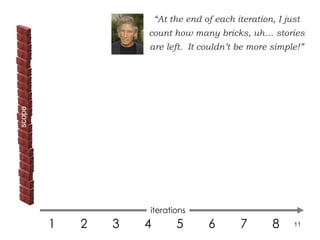
“ At the end of each iteration, I just count how many bricks, uh… stories are left.  It couldn’t be more simple!” 1 2 3 4 5 6 7 8 iterations scope
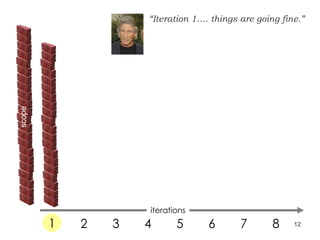
“ Iteration 1…. things are going fine.” 1 2 3 4 5 6 7 8 1 iterations scope
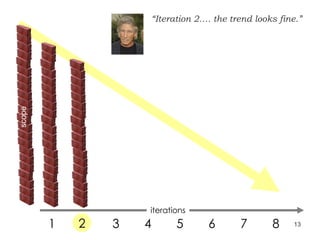
“ Iteration 2…. the trend looks fine.” 1 2 3 4 5 6 7 8 2 iterations scope
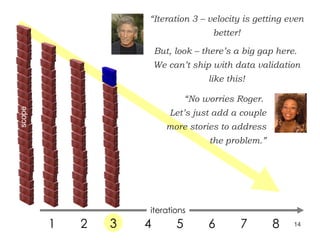
“ Iteration 3 – velocity is getting even better! But, look – there’s a big gap here.  We can’t ship with data validation like this! 1 2 3 4 5 6 7 8 3 “ No worries Roger.  Let’s just add a couple more stories to address the problem.” iterations scope
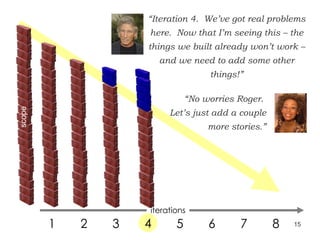
“ Iteration 4.  We’ve got real problems here.  Now that I’m seeing this – the things we built already won’t work – and we need to add some other things!” 1 2 3 4 5 6 7 8 4 “ No worries Roger.  Let’s just add a couple more stories.” iterations scope
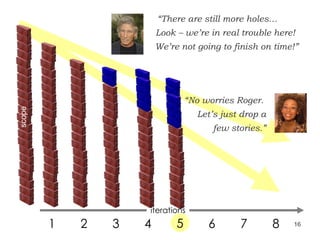
“ There are still more holes…  Look – we’re in real trouble here!  We’re not going to finish on time!” 1 2 3 4 5 6 7 8 5 “ No worries Roger.  Let’s just drop a few stories.” iterations scope
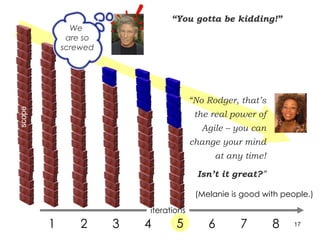
“ You gotta be kidding!” 1 2 3 4 5 6 7 8 5 “ No Rodger, that’s the real power of Agile – you can change your mind at any time! Isn’t it great? ” (Melanie is good with people.) We  are so screwed iterations scope
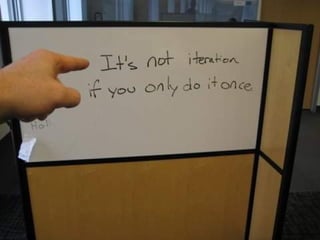
Roger’s made a common mistake in working within an Agile approach He’s forgotten what  iterate  means
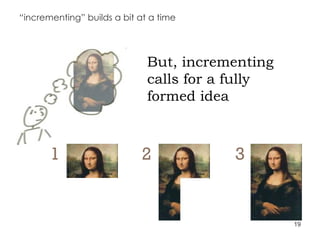
“ incrementing” builds a bit at a time   1 2 3 But, incrementing calls for a fully formed idea
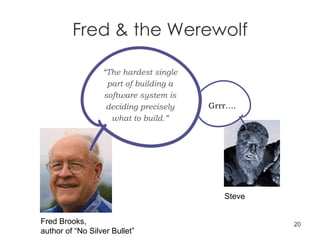
Fred & the Werewolf Grrr…. Fred Brooks,  author of “No Silver Bullet” Steve “ The hardest single part of building a software system is deciding precisely what to build.”
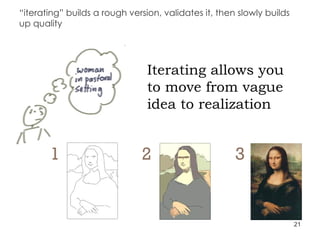
“ iterating” builds a rough version, validates it, then slowly builds up quality 1 2 3 Iterating allows you to move from vague idea to realization
But, why would Roger not understand that?
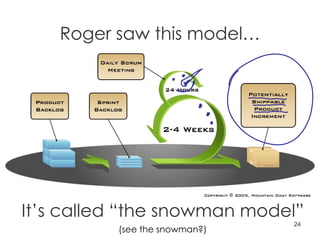
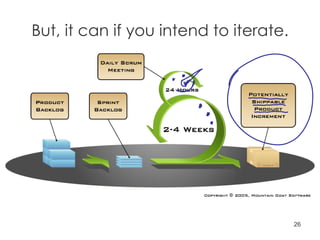
Roger saw this model… It’s called “the snowman model” (see the snowman?)
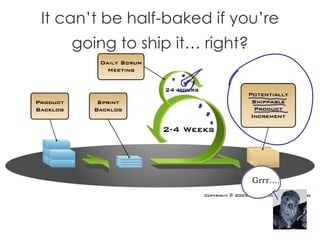
It can’t be half-baked if you’re going to ship it… right? Grrr….
But, it can if you intend to iterate.
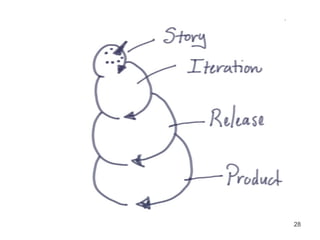
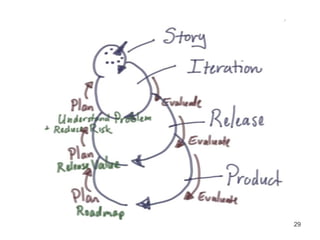
It’s not Rogers fault he didn’t think about iteration… the snowman is missing a couple balls
YAGRI You Aint Gunna Release It
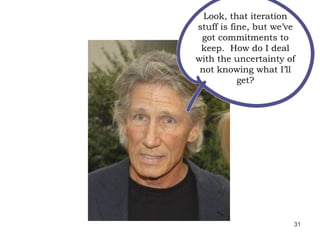
Look, that iteration stuff is fine, but we’ve got commitments to keep.  How do I deal with the uncertainty of not knowing what I’ll get?
Roger’s got a point Software is often a line item in a larger plan.  Failing a release date may put that bigger plan at risk  (Failing the release date may put Roger’s career at risk)
It seems logical that we need to know what we want in order to estimate its construction and get it on schedule, right? But we know that we can’t  really  know… Grrr….
Planning for iteration might have helped Roger, but that still doesn’t solve Roger’s fear of uncertainty
Here are three strategies that might help
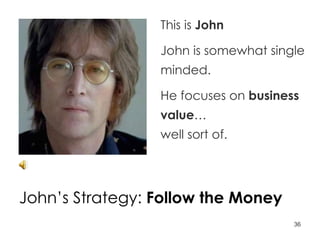
This is  John John is somewhat single minded. He focuses on  business value …  well sort of. John’s Strategy:  Follow the Money
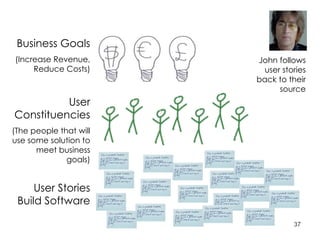
Business Goals (Increase Revenue, Reduce Costs) User Constituencies (The people that will use some solution to meet business goals) User Stories Build Software John follows user stories back to their source
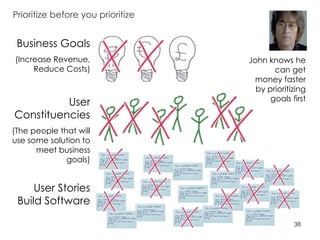
Prioritize before you prioritize Business Goals (Increase Revenue, Reduce Costs) User Constituencies (The people that will use some solution to meet business goals) User Stories Build Software John knows he can get money faster by prioritizing goals first
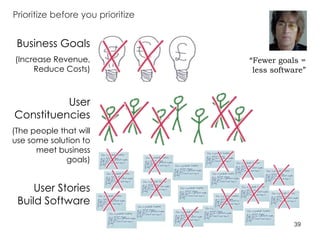
Prioritize before you prioritize Business Goals (Increase Revenue, Reduce Costs) User Constituencies (The people that will use some solution to meet business goals) User Stories Build Software “ Fewer goals = less software”
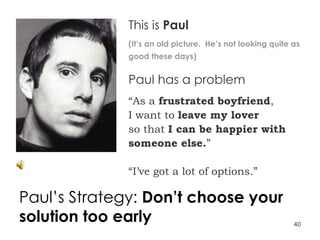
Paul’s Strategy:  Don’t choose your solution too early This is  Paul (It’s an old picture.  He’s not looking quite as good these days) Paul has a problem “ As a  frustrated boyfriend ,  I want to  leave my lover so that  I can be happier with someone else. ” “ I’ve got a lot of options.”
Paul defers writing user stories that describe software features till the last responsible moment. Instead, he writes users stories about the users and what they need to accomplish. When working with Melanie to estimate, he discusses all the ways – sometimes as many as 50 – that the user can satisfy their goals.
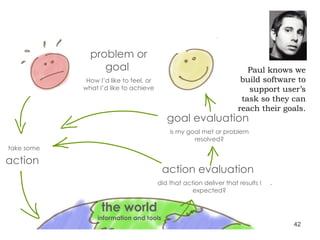
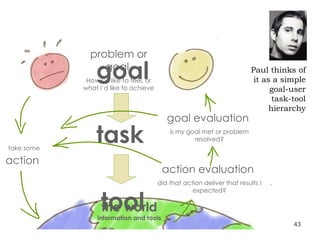
problem or goal  How I’d like to feel, or what I’d like to achieve take some action   action evaluation  did that action deliver that results I expected? goal evaluation  is my goal met or problem resolved? the world information and tools Paul knows we build software to support user’s task so they can reach their goals.
problem or goal  How I’d like to feel, or what I’d like to achieve take some action   action evaluation  did that action deliver that results I expected? goal evaluation  is my goal met or problem resolved? the world information and tools Paul thinks of it as a simple goal-user task-tool hierarchy goal task tool
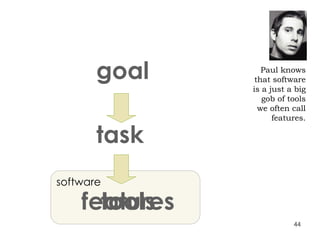
software tools features Paul knows that software is a just a big gob of tools we often call features. goal task tool
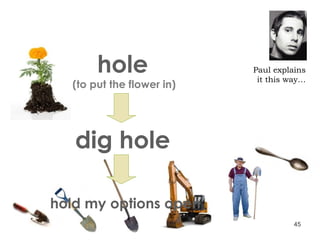
Paul explains it this way… hole (to put the flower in) dig hole hold my options open
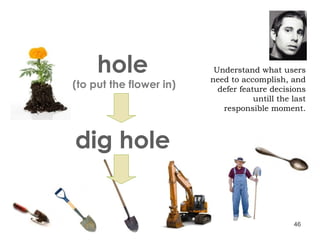
Understand what users need to accomplish, and defer feature decisions untill the last responsible moment. hole (to put the flower in) dig hole
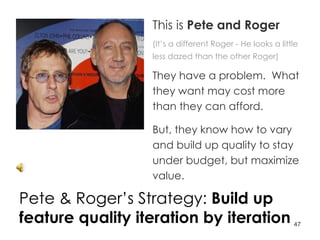
Pete & Roger’s Strategy:  Build up feature quality iteration by iteration This is  Pete and Roger (It’s a different Roger - He looks a little less dazed than the other Roger) They have a problem.  What they want may cost more than they can afford.  But, they know how to vary and build up quality to stay under budget, but maximize value.
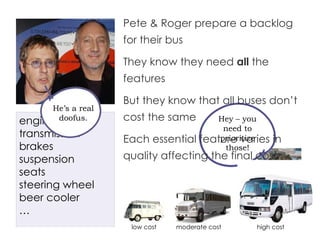
engine transmission brakes suspension seats steering wheel beer cooler …  Hey – you need to prioritize those! He’s a real doofus. low cost moderate cost high cost Pete & Roger prepare a backlog for their bus They know they need  all  the features But they know that all buses don’t cost the same Each essential feature varies in quality affecting the final cost
Pete and Roger have a handy heuristic for slicing up quality Necessity:  what minimal characteristics are necessary for this feature?  Flexibility:  what would make this feature useful in more situations?  Safety:  what would make this feature safer for me to use?  Comfort, Luxury, and Performance:  what would make this feature more desirable to use?
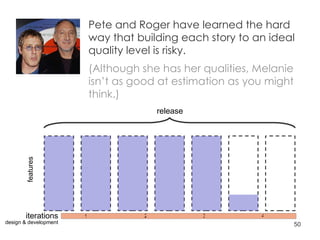
iterations design & development features Pete and Roger have learned the hard way that building each story to an ideal quality level is risky.  (Although she has her qualities, Melanie isn’t as good at estimation as you might think.) 1 2 3 4 release
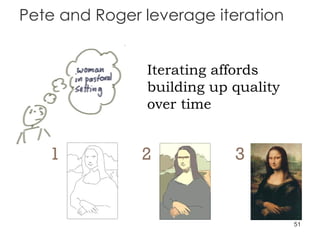
Pete and Roger leverage iteration 1 2 3 Iterating affords building up quality over time
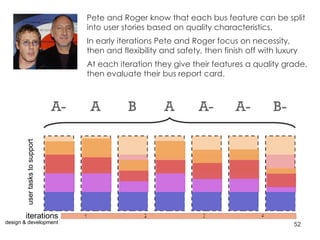
iterations design & development user tasks to support Pete and Roger know that each bus feature can be split into user stories based on quality characteristics. In early iterations Pete and Roger focus on necessity, then and flexibility and safety, then finish off with luxury At each iteration they give their features a quality grade, then evaluate their bus report card. 1 2 3 4 release D D D D D I I B- C C- D D D D A- B B- B B B B- A- A B A A- A- B-
Let’s review what our characters have learned today.
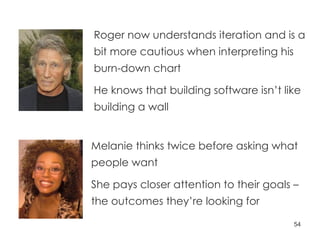
Melanie thinks twice before asking what people want She pays closer attention to their goals – the outcomes they’re looking for Roger now understands iteration and is a bit more cautious when interpreting his burn-down chart He knows that building software isn’t like building a wall
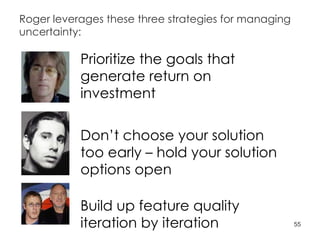
Roger leverages these three strategies for managing uncertainty: Prioritize the goals that generate return on investment Don’t choose your solution too early – hold your solution options open Build up feature quality iteration by iteration
It’s best not to be too certain about specifically what you’re building It’s Johnny’s wisdom that speaks clearly to this…
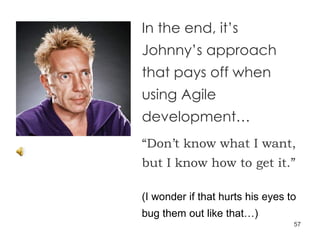
Question common practice Trust your instincts (I wonder if that hurts his eyes to bug them out like that…) In the end, it’s Johnny’s approach that pays off when using Agile development… “ Don’t know what I want, but I know how to get it.”
Embrace  Uncertainty  Strategies for on-time delivery in an uncertain world  Jeff Patton [email_address] www.AgileProductDesign.com

Embrace Uncertainty

  • 1.
    Embrace UncertaintyStrategies for on-time delivery in an uncertain world Jeff Patton [email_address] www.AgileProductDesign.com
  • 2.
    XP circa 2000 and questioning what you think you know
  • 3.
    XcrumP towards anAgile Unified Process? hmm…
  • 4.
    process rigor or rigor mortis?
  • 5.
    a common problem, and three strategies to deal with it
  • 6.
    The stories youare about to hear are made up. Only the names have been left unchanged to offend the innocent.
  • 7.
    This is Roger He’s a seasoned business person. (he’s looking pretty seasoned) “ This XP stuff makes a lot of sense! I just break my requirements down into user stories, and the team builds them one at a time. It’s all just like adding bricks to a wall!”
  • 8.
    This is Melanie She works on the development team (she’s good with people) “ Roger, let’s get your requirements down as user stories. You’re the expert. So, tell me what you want.”
  • 9.
    Roger & Melaniework together to capture user stories. Then after estimating Roger chooses the highest value stories for the first release. “ Melanie, I really need all this stuff on time or my stakeholders will kill me.” “ No worries Roger.”
  • 10.
    Roger learns touse a burn-down chart to monitor the progress of Melanie and her team
  • 11.
    “ At theend of each iteration, I just count how many bricks, uh… stories are left. It couldn’t be more simple!” 1 2 3 4 5 6 7 8 iterations scope
  • 12.
    “ Iteration 1….things are going fine.” 1 2 3 4 5 6 7 8 1 iterations scope
  • 13.
    “ Iteration 2….the trend looks fine.” 1 2 3 4 5 6 7 8 2 iterations scope
  • 14.
    “ Iteration 3– velocity is getting even better! But, look – there’s a big gap here. We can’t ship with data validation like this! 1 2 3 4 5 6 7 8 3 “ No worries Roger. Let’s just add a couple more stories to address the problem.” iterations scope
  • 15.
    “ Iteration 4. We’ve got real problems here. Now that I’m seeing this – the things we built already won’t work – and we need to add some other things!” 1 2 3 4 5 6 7 8 4 “ No worries Roger. Let’s just add a couple more stories.” iterations scope
  • 16.
    “ There arestill more holes… Look – we’re in real trouble here! We’re not going to finish on time!” 1 2 3 4 5 6 7 8 5 “ No worries Roger. Let’s just drop a few stories.” iterations scope
  • 17.
    “ You gottabe kidding!” 1 2 3 4 5 6 7 8 5 “ No Rodger, that’s the real power of Agile – you can change your mind at any time! Isn’t it great? ” (Melanie is good with people.) We are so screwed iterations scope
  • 18.
    Roger’s made acommon mistake in working within an Agile approach He’s forgotten what iterate means
  • 19.
    “ incrementing” buildsa bit at a time 1 2 3 But, incrementing calls for a fully formed idea
  • 20.
    Fred & theWerewolf Grrr…. Fred Brooks, author of “No Silver Bullet” Steve “ The hardest single part of building a software system is deciding precisely what to build.”
  • 21.
    “ iterating” buildsa rough version, validates it, then slowly builds up quality 1 2 3 Iterating allows you to move from vague idea to realization
  • 23.
    But, why wouldRoger not understand that?
  • 24.
    Roger saw thismodel… It’s called “the snowman model” (see the snowman?)
  • 25.
    It can’t behalf-baked if you’re going to ship it… right? Grrr….
  • 26.
    But, it canif you intend to iterate.
  • 27.
    It’s not Rogersfault he didn’t think about iteration… the snowman is missing a couple balls
  • 30.
    YAGRI You AintGunna Release It
  • 31.
    Look, that iterationstuff is fine, but we’ve got commitments to keep. How do I deal with the uncertainty of not knowing what I’ll get?
  • 32.
    Roger’s got apoint Software is often a line item in a larger plan. Failing a release date may put that bigger plan at risk (Failing the release date may put Roger’s career at risk)
  • 33.
    It seems logicalthat we need to know what we want in order to estimate its construction and get it on schedule, right? But we know that we can’t really know… Grrr….
  • 34.
    Planning for iterationmight have helped Roger, but that still doesn’t solve Roger’s fear of uncertainty
  • 35.
    Here are threestrategies that might help
  • 36.
    This is John John is somewhat single minded. He focuses on business value … well sort of. John’s Strategy: Follow the Money
  • 37.
    Business Goals (IncreaseRevenue, Reduce Costs) User Constituencies (The people that will use some solution to meet business goals) User Stories Build Software John follows user stories back to their source
  • 38.
    Prioritize before youprioritize Business Goals (Increase Revenue, Reduce Costs) User Constituencies (The people that will use some solution to meet business goals) User Stories Build Software John knows he can get money faster by prioritizing goals first
  • 39.
    Prioritize before youprioritize Business Goals (Increase Revenue, Reduce Costs) User Constituencies (The people that will use some solution to meet business goals) User Stories Build Software “ Fewer goals = less software”
  • 40.
    Paul’s Strategy: Don’t choose your solution too early This is Paul (It’s an old picture. He’s not looking quite as good these days) Paul has a problem “ As a frustrated boyfriend , I want to leave my lover so that I can be happier with someone else. ” “ I’ve got a lot of options.”
  • 41.
    Paul defers writinguser stories that describe software features till the last responsible moment. Instead, he writes users stories about the users and what they need to accomplish. When working with Melanie to estimate, he discusses all the ways – sometimes as many as 50 – that the user can satisfy their goals.
  • 42.
    problem or goal How I’d like to feel, or what I’d like to achieve take some action action evaluation did that action deliver that results I expected? goal evaluation is my goal met or problem resolved? the world information and tools Paul knows we build software to support user’s task so they can reach their goals.
  • 43.
    problem or goal How I’d like to feel, or what I’d like to achieve take some action action evaluation did that action deliver that results I expected? goal evaluation is my goal met or problem resolved? the world information and tools Paul thinks of it as a simple goal-user task-tool hierarchy goal task tool
  • 44.
    software tools featuresPaul knows that software is a just a big gob of tools we often call features. goal task tool
  • 45.
    Paul explains itthis way… hole (to put the flower in) dig hole hold my options open
  • 46.
    Understand what usersneed to accomplish, and defer feature decisions untill the last responsible moment. hole (to put the flower in) dig hole
  • 47.
    Pete & Roger’sStrategy: Build up feature quality iteration by iteration This is Pete and Roger (It’s a different Roger - He looks a little less dazed than the other Roger) They have a problem. What they want may cost more than they can afford. But, they know how to vary and build up quality to stay under budget, but maximize value.
  • 48.
    engine transmission brakessuspension seats steering wheel beer cooler … Hey – you need to prioritize those! He’s a real doofus. low cost moderate cost high cost Pete & Roger prepare a backlog for their bus They know they need all the features But they know that all buses don’t cost the same Each essential feature varies in quality affecting the final cost
  • 49.
    Pete and Rogerhave a handy heuristic for slicing up quality Necessity: what minimal characteristics are necessary for this feature? Flexibility: what would make this feature useful in more situations? Safety: what would make this feature safer for me to use? Comfort, Luxury, and Performance: what would make this feature more desirable to use?
  • 50.
    iterations design &development features Pete and Roger have learned the hard way that building each story to an ideal quality level is risky. (Although she has her qualities, Melanie isn’t as good at estimation as you might think.) 1 2 3 4 release
  • 51.
    Pete and Rogerleverage iteration 1 2 3 Iterating affords building up quality over time
  • 52.
    iterations design &development user tasks to support Pete and Roger know that each bus feature can be split into user stories based on quality characteristics. In early iterations Pete and Roger focus on necessity, then and flexibility and safety, then finish off with luxury At each iteration they give their features a quality grade, then evaluate their bus report card. 1 2 3 4 release D D D D D I I B- C C- D D D D A- B B- B B B B- A- A B A A- A- B-
  • 53.
    Let’s review whatour characters have learned today.
  • 54.
    Melanie thinks twicebefore asking what people want She pays closer attention to their goals – the outcomes they’re looking for Roger now understands iteration and is a bit more cautious when interpreting his burn-down chart He knows that building software isn’t like building a wall
  • 55.
    Roger leverages thesethree strategies for managing uncertainty: Prioritize the goals that generate return on investment Don’t choose your solution too early – hold your solution options open Build up feature quality iteration by iteration
  • 56.
    It’s best notto be too certain about specifically what you’re building It’s Johnny’s wisdom that speaks clearly to this…
  • 57.
    Question common practiceTrust your instincts (I wonder if that hurts his eyes to bug them out like that…) In the end, it’s Johnny’s approach that pays off when using Agile development… “ Don’t know what I want, but I know how to get it.”
  • 58.
    Embrace Uncertainty Strategies for on-time delivery in an uncertain world Jeff Patton [email_address] www.AgileProductDesign.com

Editor's Notes

  • #2 Incremental Releases Users & Stakeholders Will Love Jeff Patton, jpatton@acm.org