TECHNICAL WRITIING
&
PRESENTATIONS SKILLS
E-mail writing
Luqman Ahmad
Iqra Riasat
E-Mail
2
E-Mail stands for electronic mail
Method of exchange messages between the people over the internet by using electronic device
E-Mail Address
3
• User name
• Mail address
The address of E-Mail is divided into two
parts
Example
4
Arslanahmad779 gmail.com
User name Mail address
Arslanahmad779@gmail.com
@
This symbol is used to connect the user name and the mail address
• The cost of sending electronic message is nominal.
• The message can send or receive instantly.
• We can attach sound, video And images to e-mail and send to any
anyone.
• We can read, print, Forward, reply or delete the received messages
Advantages
5
• E-Mail responses require more than to respond other messages
app like Whatsapp
• The lack of personal touch.
• E-Mail can cause misunderstanding
• E-Mail messages can contain viruses
• E-Mail messages became scam
• Time consuming
6
Disadvantages
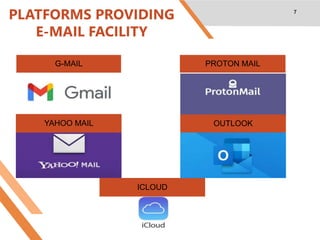
PLATFORMS PROVIDING
E-MAIL FACILITY
7
G-MAIL PROTON MAIL
OUTLOOK
YAHOO MAIL
ICLOUD
8
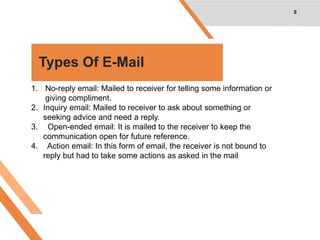
1. No-reply email: Mailed to receiver for telling some information or
giving compliment.
2. Inquiry email: Mailed to receiver to ask about something or
seeking advice and need a reply.
3. Open-ended email: It is mailed to the receiver to keep the
communication open for future reference.
4. Action email: In this form of email, the receiver is not bound to
reply but had to take some actions as asked in the mail
Types Of E-Mail
1. Your email address
2. Subject line
3. Email Opening
4. Email body
5. Email ending
6. Email Sign off
7. Email signature/footer
Elements of professional
email writing
Professional email
address
Your email address is oftentimes out of your
control. If you’re working for a company or operate
under the umbrella of a brand your email address
will likely include the company or brand name
domain.
Subject lines
Your subject line will be the single most important
element in your formal email writing. It is the first
thing your recipient will see and unless you
convince her then and there that your email is
safe, relevant, and high priority (in that order) it
may never be opened. If this happens, any effort
you put into the rest of the email elements will go
to waste.
Email Opening
The next most important way to hook a recipient
into your email is by writing a strong email
opening line. Like your subject line, the email
opening is mostly used as another filtering stage
for most people. If it fails to meet the promise
made in the subject line, your readers will ditch.
Email body
The body of your email is where you get into your
main message. Whether you’re composing an
email to establish a new business connection or
just following up on a meeting, the body of your
email should be detailed enough that the reader
isn’t confused, but also brief and to the point. No
one wants to sit and read a long-winded email
when they have dozens of other unattended
messages in their inbox.
Email ending
After you’ve addressed all your main points in the
body of your email, you’ll want to end it with a
respectful and brief salutation. You can either
invite your recipient to reach out for more
questions, wish them success, or ask a question.
It all depends on the motive for your email.
Email sign-off
When closing your email, you’ll want to choose a
suitable email sign-off. There are different sign-
offs you can use for each occasion, such as “best
regards,” “sincerely,” or “with love,” but you
obviously wouldn’t want to send the last one to
your manager.
Email
signature/footer
Your email signature (or footer) is your wave of
goodbye. The way you do this can affect the
impression you’ve made up to this point. If you
make this moment memorable, organized, and
aesthetic you can get some extra credit and a
positive attitude from your reader.
email.pptx

email.pptx

  • 1.
    TECHNICAL WRITIING & PRESENTATIONS SKILLS E-mailwriting Luqman Ahmad Iqra Riasat
  • 2.
    E-Mail 2 E-Mail stands forelectronic mail Method of exchange messages between the people over the internet by using electronic device
  • 3.
    E-Mail Address 3 • Username • Mail address The address of E-Mail is divided into two parts
  • 4.
    Example 4 Arslanahmad779 gmail.com User nameMail address Arslanahmad779@gmail.com @ This symbol is used to connect the user name and the mail address
  • 5.
    • The costof sending electronic message is nominal. • The message can send or receive instantly. • We can attach sound, video And images to e-mail and send to any anyone. • We can read, print, Forward, reply or delete the received messages Advantages 5
  • 6.
    • E-Mail responsesrequire more than to respond other messages app like Whatsapp • The lack of personal touch. • E-Mail can cause misunderstanding • E-Mail messages can contain viruses • E-Mail messages became scam • Time consuming 6 Disadvantages
  • 7.
    PLATFORMS PROVIDING E-MAIL FACILITY 7 G-MAILPROTON MAIL OUTLOOK YAHOO MAIL ICLOUD
  • 8.
    8 1. No-reply email:Mailed to receiver for telling some information or giving compliment. 2. Inquiry email: Mailed to receiver to ask about something or seeking advice and need a reply. 3. Open-ended email: It is mailed to the receiver to keep the communication open for future reference. 4. Action email: In this form of email, the receiver is not bound to reply but had to take some actions as asked in the mail Types Of E-Mail
  • 9.
    1. Your emailaddress 2. Subject line 3. Email Opening 4. Email body 5. Email ending 6. Email Sign off 7. Email signature/footer Elements of professional email writing
  • 10.
    Professional email address Your emailaddress is oftentimes out of your control. If you’re working for a company or operate under the umbrella of a brand your email address will likely include the company or brand name domain.
  • 11.
    Subject lines Your subjectline will be the single most important element in your formal email writing. It is the first thing your recipient will see and unless you convince her then and there that your email is safe, relevant, and high priority (in that order) it may never be opened. If this happens, any effort you put into the rest of the email elements will go to waste.
  • 12.
    Email Opening The nextmost important way to hook a recipient into your email is by writing a strong email opening line. Like your subject line, the email opening is mostly used as another filtering stage for most people. If it fails to meet the promise made in the subject line, your readers will ditch.
  • 13.
    Email body The bodyof your email is where you get into your main message. Whether you’re composing an email to establish a new business connection or just following up on a meeting, the body of your email should be detailed enough that the reader isn’t confused, but also brief and to the point. No one wants to sit and read a long-winded email when they have dozens of other unattended messages in their inbox.
  • 14.
    Email ending After you’veaddressed all your main points in the body of your email, you’ll want to end it with a respectful and brief salutation. You can either invite your recipient to reach out for more questions, wish them success, or ask a question. It all depends on the motive for your email.
  • 15.
    Email sign-off When closingyour email, you’ll want to choose a suitable email sign-off. There are different sign- offs you can use for each occasion, such as “best regards,” “sincerely,” or “with love,” but you obviously wouldn’t want to send the last one to your manager.
  • 16.
    Email signature/footer Your email signature(or footer) is your wave of goodbye. The way you do this can affect the impression you’ve made up to this point. If you make this moment memorable, organized, and aesthetic you can get some extra credit and a positive attitude from your reader.