E-mail Security:
S/MIME and PGP
Email security protocols
 The two schemes that provide security services on email are:
 S/MIME (Secure/ Multipurpose Internet Mail Extension)
 PGP (Pretty Good Privacy)
Standard for email service: RFC 822
 Describes the standard for e-mail format.
 Overall structure is very simple
 Message = Envelope + Content
- Envelope: Whatever information is required to accomplish
transmission and delivery
- Content: The message body
Limitations of RFC 822
• Cannot be used to transmit:
– Executable files
– Images
– Audio files, etc.
• Text character set limited to ASCII.
• Transfer size is also limited.
MIME (Multipurpose Internet Mail Extension)
• Extension to RFC 822 framework
• MIME specification includes following elements:
– Defines new message header fields
– A number of content format are there to support
multimedia email
– Content Transfer encodings are defined
S/MIME
S/MIME (Secure/MIME)
 Originally developed by RSA Data Security Inc.
 Build on top two Public Key Cryptography Standards:
 "PKCS #7: Cryptographic Message Syntax”
 "PKCS #10: Certification Request Syntax“
 Commercially very successful.
 Application not limited to e-mail. Any protocol that
transports MIME objects can leverage these services
such as HTTP.
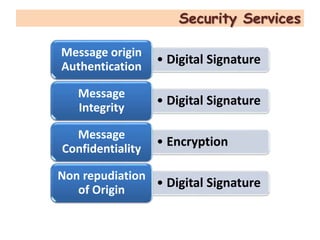
Security Services
• Digital Signature
Message origin
Authentication
• Digital Signature
Message
Integrity
• Encryption
Message
Confidentiality
• Digital Signature
Non repudiation
of Origin
S/MIME services
• enveloped data (application/pkcs7-mime; smime-type = enveloped-data)
– standard digital envelop
• signed data (application/pkcs7-mime; smime-type = signed-data)
– standard digital signature
– content + signature is encoded using base64 encoding
• clear-signed data (multipart/signed)
– standard digital signature
– only the signature is encoded using base64
– recipient without S/MIME capability can read the message
but cannot verify the signature
• signed and enveloped data
– signed and encrypted items may be nested in any order
S/MIME functions (Signed Data)
 Select a message digest algorithm (SHA or MD5)
 Compute message digest of the content to be signed.
 Sign message digest with signer’s private key.
 Prepare a block called SignerInfo that contains signer’s public
key certificate, an identifier for Message Digest algorithm, an
identifier for algorithm used to sign message digest.

E-mail Security.ppt

  • 1.
  • 2.
    Email security protocols The two schemes that provide security services on email are:  S/MIME (Secure/ Multipurpose Internet Mail Extension)  PGP (Pretty Good Privacy)
  • 3.
    Standard for emailservice: RFC 822  Describes the standard for e-mail format.  Overall structure is very simple  Message = Envelope + Content - Envelope: Whatever information is required to accomplish transmission and delivery - Content: The message body
  • 4.
    Limitations of RFC822 • Cannot be used to transmit: – Executable files – Images – Audio files, etc. • Text character set limited to ASCII. • Transfer size is also limited.
  • 5.
    MIME (Multipurpose InternetMail Extension) • Extension to RFC 822 framework • MIME specification includes following elements: – Defines new message header fields – A number of content format are there to support multimedia email – Content Transfer encodings are defined
  • 6.
  • 7.
    S/MIME (Secure/MIME)  Originallydeveloped by RSA Data Security Inc.  Build on top two Public Key Cryptography Standards:  "PKCS #7: Cryptographic Message Syntax”  "PKCS #10: Certification Request Syntax“  Commercially very successful.  Application not limited to e-mail. Any protocol that transports MIME objects can leverage these services such as HTTP.
  • 8.
    Security Services • DigitalSignature Message origin Authentication • Digital Signature Message Integrity • Encryption Message Confidentiality • Digital Signature Non repudiation of Origin
  • 9.
    S/MIME services • envelopeddata (application/pkcs7-mime; smime-type = enveloped-data) – standard digital envelop • signed data (application/pkcs7-mime; smime-type = signed-data) – standard digital signature – content + signature is encoded using base64 encoding • clear-signed data (multipart/signed) – standard digital signature – only the signature is encoded using base64 – recipient without S/MIME capability can read the message but cannot verify the signature • signed and enveloped data – signed and encrypted items may be nested in any order
  • 10.
    S/MIME functions (SignedData)  Select a message digest algorithm (SHA or MD5)  Compute message digest of the content to be signed.  Sign message digest with signer’s private key.  Prepare a block called SignerInfo that contains signer’s public key certificate, an identifier for Message Digest algorithm, an identifier for algorithm used to sign message digest.