Introduction to Event Management
Unit-1
TYBBA
Lecture-1
An event is a unique moment in time that is commemorated / observed
to satisfy specific needs. It is something noteworthy that happens
according to a set plan involving networking of a multi media package
to achieve an objective.
Events are synonymous with occurrences, happenings, incidents,
occasions and experiences. While sometimes events occur on their
own, events may also occur as planned activities directed towards
attainment of a defined goal or objective.
Definition of Event
According to Philip Kotler,
“events are defined as occurrences to communicate particular messages
to target audience.”
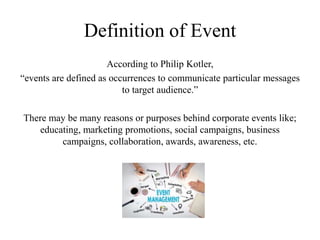
There may be many reasons or purposes behind corporate events like;
educating, marketing promotions, social campaigns, business
campaigns, collaboration, awards, awareness, etc.
Be it Apple’s iPhone launch show,
new smartphone launch event at
World Mobile Congress,
entertainment events or trade
shows & exhibitions, every
company wants to showcase its
products & services with an
impressive manner.
Characteristics of Events
• Events offer a unique, once in a life experience.
• Events are aimed at fulfilment of certain aims and objectives.
• Events are specific occurrences with a shorter life span when
compared to projects.
• Events involve a substantial and huge requirement of funds and
management of scarce resources.
• Events require judicious planning and involve all important
managerial functions.
• Events involve facing an environment of risks and uncertainties.
What is Event Management?
• Event management is an application of project management to the
creation development and execution of events.
• It is the planning and management of an event or activity.
• It involves studying the intricacies of the brand, identifying the
target audience, devising the event concept, planning the logistics
and coordinating the technical aspects before actually executing the
moralities of the proposed event.
• Event management requires strong organizational communication,
negotiation, budgeting and creative skills.
Five C's of Event Management
1.Conceptualizing
• This is the first “C” involved in event management.
• The event manager understands from the client the specific reason
for which an event is being planned.
• This enables the team to come up with a suitable theme or concept
around which the event is to be centred.
• The theme should be conceptualized keeping in mind the event
objective, target audience, the tentative venue,media to be used etc.
Five C's of Event Management
2.Costing
• Costing involves the preparation of budgets, cost estimates and the
sources of acquiring funds.
• Creating a provision for risk coverage and managing uncertainties is
also done.
3.Canvassing
• Canvassing activities involve networking and advertising to generate
the required mileage for the success of the event, with the ultimate
objective of raising funds and obtaining sponsorships for the
conducting of the event.
Five C's of Event Management
4.Customising
• Customisation of an event focuses on client satisfaction.
• Reinforcing client requirements towards objective fulfilment and
ensuring that it has a blend of creativity and suitability to match
changing trends and tastes of clients.
• Involves a customised approach, tailor made specifically for an
event to be successful in engaging the target audience and satisfying
the client requirement.
5.Carrying Out, Culmination and Control
• This phase involves the actual execution of plans.
• It includes all those set of activities and operations that lead to event
execution and fulfilment of the event objective.

EM-1.pptx

  • 1.
    Introduction to EventManagement Unit-1 TYBBA Lecture-1
  • 2.
    An event isa unique moment in time that is commemorated / observed to satisfy specific needs. It is something noteworthy that happens according to a set plan involving networking of a multi media package to achieve an objective. Events are synonymous with occurrences, happenings, incidents, occasions and experiences. While sometimes events occur on their own, events may also occur as planned activities directed towards attainment of a defined goal or objective.
  • 3.
    Definition of Event Accordingto Philip Kotler, “events are defined as occurrences to communicate particular messages to target audience.” There may be many reasons or purposes behind corporate events like; educating, marketing promotions, social campaigns, business campaigns, collaboration, awards, awareness, etc.
  • 4.
    Be it Apple’siPhone launch show, new smartphone launch event at World Mobile Congress, entertainment events or trade shows & exhibitions, every company wants to showcase its products & services with an impressive manner.
  • 5.
    Characteristics of Events •Events offer a unique, once in a life experience. • Events are aimed at fulfilment of certain aims and objectives. • Events are specific occurrences with a shorter life span when compared to projects. • Events involve a substantial and huge requirement of funds and management of scarce resources. • Events require judicious planning and involve all important managerial functions. • Events involve facing an environment of risks and uncertainties.
  • 6.
    What is EventManagement? • Event management is an application of project management to the creation development and execution of events. • It is the planning and management of an event or activity. • It involves studying the intricacies of the brand, identifying the target audience, devising the event concept, planning the logistics and coordinating the technical aspects before actually executing the moralities of the proposed event. • Event management requires strong organizational communication, negotiation, budgeting and creative skills.
  • 7.
    Five C's ofEvent Management 1.Conceptualizing • This is the first “C” involved in event management. • The event manager understands from the client the specific reason for which an event is being planned. • This enables the team to come up with a suitable theme or concept around which the event is to be centred. • The theme should be conceptualized keeping in mind the event objective, target audience, the tentative venue,media to be used etc.
  • 8.
    Five C's ofEvent Management 2.Costing • Costing involves the preparation of budgets, cost estimates and the sources of acquiring funds. • Creating a provision for risk coverage and managing uncertainties is also done. 3.Canvassing • Canvassing activities involve networking and advertising to generate the required mileage for the success of the event, with the ultimate objective of raising funds and obtaining sponsorships for the conducting of the event.
  • 9.
    Five C's ofEvent Management 4.Customising • Customisation of an event focuses on client satisfaction. • Reinforcing client requirements towards objective fulfilment and ensuring that it has a blend of creativity and suitability to match changing trends and tastes of clients. • Involves a customised approach, tailor made specifically for an event to be successful in engaging the target audience and satisfying the client requirement. 5.Carrying Out, Culmination and Control • This phase involves the actual execution of plans. • It includes all those set of activities and operations that lead to event execution and fulfilment of the event objective.