ELUTE
Essential Libraries and Utilities of
Text Engineering
Tian-Jian Jiang
Why bother?
Since we already have...
(lib)TaBE
• Traditional Chinese Word Segmentation
• with Big5 encoding
• Traditional Chinese Syllable-to-Word Conversion
• with Big5 encoding
• for bo-po-mo-fo transcription system
1999 - 2001?1999 - 2001?
How about...
libchewing
• Now hacking for
• UTF-8 encoding
• Pinyin transcription system
• and looking for
• an alternative algorithm
• a better dictionary
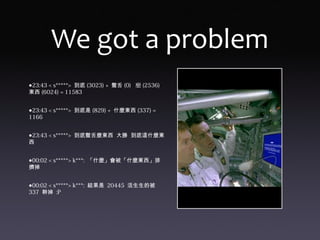
We got a problem
•23:43 < s*****> 到底 (3023) + 螫舌 (0) 麼 (2536)
東西 (6024) = 11583
•23:43 < s*****> 到底是 (829) + 什麼東西 (337) =
1166
•23:43 < s*****> 到底螫舌麼東西 大勝 到底這什麼東
西
•00:02 < s*****> k***: 「什麼」會被「什麼東西」排
擠掉
•00:02 < s*****> k***: 結果是 20445 活生生的被
337 幹掉 :P
Word Segmentation
Review
Heuristic Rules*
• Maximum matching -- Simple vs. Complex: 下雨天真正討厭
• 下雨 天真 正 討厭 vs. 下雨天 真正 討厭
• Maximum average word length
• 國際化
• Minimum variance of word lengths
• 研究 生命 起源
• Maximum degree of morphemic freedom of single-character word
• 主要 是 因為
* Refer to MMSEG by C. H. Tsai: http://technology.chtsai.org/mmseg/
Graphical Models
• Markov chain family
• Statistical Language Model (SLM)
• Hidden Markov Model (HMM)
• Exponential models
• Maximum Entropy (ME)
• Conditional Random Fields (CRF)
• Applications
• Probabilistic Context-Free Grammar (PCFG) Parser
• Head-driven Phrase Structure Grammar (HPSG) Parser
• Link Grammar Parser
What is a language model?
A probability distribution
over surface patterns of texts.
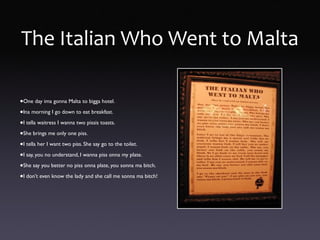
The Italian Who Went to Malta
•One day ima gonna Malta to bigga hotel.
•Ina morning I go down to eat breakfast.
•I tella waitress I wanna two pissis toasts.
•She brings me only one piss.
•I tella her I want two piss. She say go to the toilet.
•I say, you no understand, I wanna piss onna my plate.
•She say you better no piss onna plate, you sonna ma bitch.
•I don’t even know the lady and she call me sonna ma bitch!
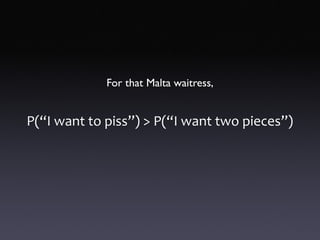
P(“I want to piss”) > P(“I want two pieces”)
For that Malta waitress,
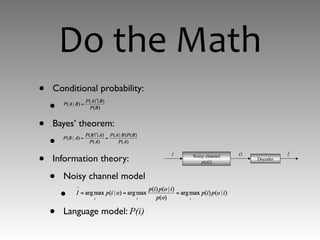
Do the Math
• Conditional probability:
•
• Bayes’ theorem:
•
• Information theory:
• Noisy channel model
•
• Language model: P(i)
Noisy channel
p(o|i)
Decoder
I O Î
Shannon’s Game
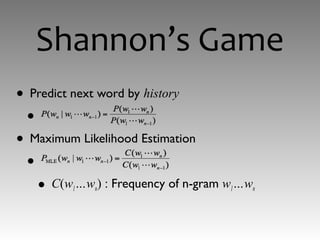
• Predict next word by history
•
• Maximum Likelihood Estimation
•
• C(w1…wn) : Frequency of n-gram w1…wn
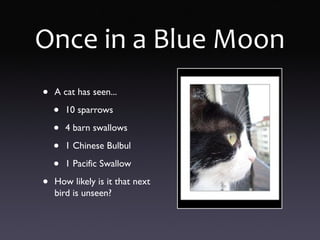
Once in a Blue Moon
• A cat has seen...
• 10 sparrows
• 4 barn swallows
• 1 Chinese Bulbul
• 1 Pacific Swallow
• How likely is it that next
bird is unseen?
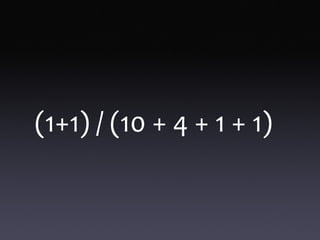
(1+1) / (10 + 4 + 1 + 1)
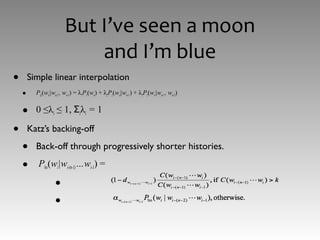
But I’ve seen a moon
and I’m blue
• Simple linear interpolation
• PLi(wn|wn-2 , wn-1) = λ1P1(wn) + λ2P2(wn|wn-1) + λ3P2(wn|wn-1 , wn-2)
• 0 ≤λi ≤ 1, Σiλi = 1
• Katz’s backing-off
• Back-off through progressively shorter histories.
• Pbo(wi|wi-(n-1)…wi-1) =
•
•
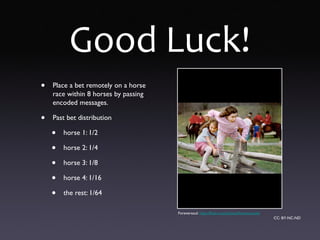
Good Luck!
• Place a bet remotely on a horse
race within 8 horses by passing
encoded messages.
• Past bet distribution
• horse 1: 1/2
• horse 2: 1/4
• horse 3: 1/8
• horse 4: 1/16
• the rest: 1/64
Foreversoul: http://flickr.com/photos/foreversouls/
CC: BY-NC-ND
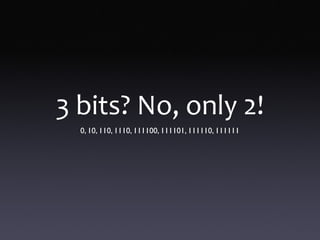
3 bits? No, only 2!
0, 10, 110, 1110, 111100, 111101, 111110, 111111
Alright, let’s ELUTE
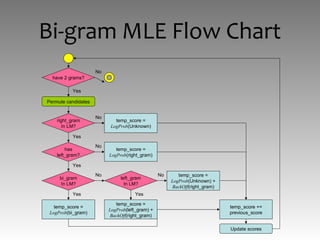
Bi-gram MLE Flow Chart
Permute candidates
right_gram
In LM?
has
left_gram?
bi_gram
In LM?
left_gram
In LM?
temp_score =
LogProb(right_gram)
temp_score =
LogProb(bi_gram)
temp_score =
LogProb(left_gram) +
BackOff(right_gram)
temp_score =
LogProb(Unknown) +
BackOff(right_gram)
temp_score =
LogProb(Unknown)
Update scores
temp_score +=
previous_score
have 2 grams?
Yes
Yes
Yes
Yes Yes
No
No
No
No No
INPUT input_syllables; len = Length(input_syllables); Load(language_model);
scores[len + 1]; tracks[len + 1]; words[len + 1];
FOR i = 0 TO len
scores[i] = 0.0; tracks[i] = -1; words[i] = "";
FOR index = 1 TO len
best_score = 0.0; best_prefix = -1; best_word = "";
FOR prefix = index - 1 TO 0
right_grams[] = Homophones(Substring(input_syllabes, prefix, index - prefix));
FOR EACH right_gram IN right_grams[]
IF right_gram IN language_model
left = tracks[prefix];
IF left >= 0 AND left != prefix
left_grams[] = Homophones(Substring(input_syllables, left, prefix - left));
FOR EACH left_gram IN left_grams[]
temp_score = 0.0;
bigram = left_gram + " " + right_gram;
IF bigram IN language_model
bigram_score = LogProb(bigram);
temp_score += bigram_score;
ELSE IF left_gram IN language_model
bigram_backoff = LogProb(left_gram) + BackOff(right_gram);
temp_score += bigram_backoff;
ELSE
temp_score += LogProb(Unknown) + BackOff(right_gram);
temp_score += scores[prefix];
Scoring
ELSE
temp_score = LogProb(right_gram);
Scoring
ELSE
temp_score = LogProb(Unknown) + scores[prefix];
Scoring
scores[index] = best_score; tracks[index] = best_prefix_index; words[index] = best_prefix;
IF tracks[index] == -1
tracks[index] = index - 1;
boundary = len; output_words = "";
WHILE boundary > 0
output_words = words[boundary] + output_words;
boundary = tracks[boundary];
RETURN output_words;
SUBROUTINE Scoring
IF best_score == 0.0 OR temp_score > best_score
best_score = temp_score;
best_prefix = prefix;
best_word = right_gram;
Bi-gram Syllable-to-Word
Show me the…
William’s Requests
And My Suggestions
• Convenient API
• Plain text I/O (in UTF-8)
• More linguistic information
• Algorithm: CRF
• Corpus: we needYOU!
• Flexible to different applications
• Composite, Iterator, and Adapter Patterns
• IDL support
• SWIG
• Open Source
• Open Corpus, too
Thank YOU

ELUTE

  • 1.
    ELUTE Essential Libraries andUtilities of Text Engineering Tian-Jian Jiang
  • 2.
    Why bother? Since wealready have...
  • 3.
    (lib)TaBE • Traditional ChineseWord Segmentation • with Big5 encoding • Traditional Chinese Syllable-to-Word Conversion • with Big5 encoding • for bo-po-mo-fo transcription system
  • 4.
  • 5.
  • 6.
    libchewing • Now hackingfor • UTF-8 encoding • Pinyin transcription system • and looking for • an alternative algorithm • a better dictionary
  • 7.
    We got aproblem •23:43 < s*****> 到底 (3023) + 螫舌 (0) 麼 (2536) 東西 (6024) = 11583 •23:43 < s*****> 到底是 (829) + 什麼東西 (337) = 1166 •23:43 < s*****> 到底螫舌麼東西 大勝 到底這什麼東 西 •00:02 < s*****> k***: 「什麼」會被「什麼東西」排 擠掉 •00:02 < s*****> k***: 結果是 20445 活生生的被 337 幹掉 :P
  • 8.
  • 9.
    Heuristic Rules* • Maximummatching -- Simple vs. Complex: 下雨天真正討厭 • 下雨 天真 正 討厭 vs. 下雨天 真正 討厭 • Maximum average word length • 國際化 • Minimum variance of word lengths • 研究 生命 起源 • Maximum degree of morphemic freedom of single-character word • 主要 是 因為 * Refer to MMSEG by C. H. Tsai: http://technology.chtsai.org/mmseg/
  • 10.
    Graphical Models • Markovchain family • Statistical Language Model (SLM) • Hidden Markov Model (HMM) • Exponential models • Maximum Entropy (ME) • Conditional Random Fields (CRF) • Applications • Probabilistic Context-Free Grammar (PCFG) Parser • Head-driven Phrase Structure Grammar (HPSG) Parser • Link Grammar Parser
  • 11.
    What is alanguage model?
  • 12.
    A probability distribution oversurface patterns of texts.
  • 13.
    The Italian WhoWent to Malta •One day ima gonna Malta to bigga hotel. •Ina morning I go down to eat breakfast. •I tella waitress I wanna two pissis toasts. •She brings me only one piss. •I tella her I want two piss. She say go to the toilet. •I say, you no understand, I wanna piss onna my plate. •She say you better no piss onna plate, you sonna ma bitch. •I don’t even know the lady and she call me sonna ma bitch!
  • 14.
    P(“I want topiss”) > P(“I want two pieces”) For that Malta waitress,
  • 15.
    Do the Math •Conditional probability: • • Bayes’ theorem: • • Information theory: • Noisy channel model • • Language model: P(i) Noisy channel p(o|i) Decoder I O Î
  • 16.
    Shannon’s Game • Predictnext word by history • • Maximum Likelihood Estimation • • C(w1…wn) : Frequency of n-gram w1…wn
  • 17.
    Once in aBlue Moon • A cat has seen... • 10 sparrows • 4 barn swallows • 1 Chinese Bulbul • 1 Pacific Swallow • How likely is it that next bird is unseen?
  • 18.
    (1+1) / (10+ 4 + 1 + 1)
  • 19.
    But I’ve seena moon and I’m blue • Simple linear interpolation • PLi(wn|wn-2 , wn-1) = λ1P1(wn) + λ2P2(wn|wn-1) + λ3P2(wn|wn-1 , wn-2) • 0 ≤λi ≤ 1, Σiλi = 1 • Katz’s backing-off • Back-off through progressively shorter histories. • Pbo(wi|wi-(n-1)…wi-1) = • •
  • 20.
    Good Luck! • Placea bet remotely on a horse race within 8 horses by passing encoded messages. • Past bet distribution • horse 1: 1/2 • horse 2: 1/4 • horse 3: 1/8 • horse 4: 1/16 • the rest: 1/64 Foreversoul: http://flickr.com/photos/foreversouls/ CC: BY-NC-ND
  • 21.
    3 bits? No,only 2! 0, 10, 110, 1110, 111100, 111101, 111110, 111111
  • 22.
  • 23.
    Bi-gram MLE FlowChart Permute candidates right_gram In LM? has left_gram? bi_gram In LM? left_gram In LM? temp_score = LogProb(right_gram) temp_score = LogProb(bi_gram) temp_score = LogProb(left_gram) + BackOff(right_gram) temp_score = LogProb(Unknown) + BackOff(right_gram) temp_score = LogProb(Unknown) Update scores temp_score += previous_score have 2 grams? Yes Yes Yes Yes Yes No No No No No
  • 24.
    INPUT input_syllables; len= Length(input_syllables); Load(language_model); scores[len + 1]; tracks[len + 1]; words[len + 1]; FOR i = 0 TO len scores[i] = 0.0; tracks[i] = -1; words[i] = ""; FOR index = 1 TO len best_score = 0.0; best_prefix = -1; best_word = ""; FOR prefix = index - 1 TO 0 right_grams[] = Homophones(Substring(input_syllabes, prefix, index - prefix)); FOR EACH right_gram IN right_grams[] IF right_gram IN language_model left = tracks[prefix]; IF left >= 0 AND left != prefix left_grams[] = Homophones(Substring(input_syllables, left, prefix - left)); FOR EACH left_gram IN left_grams[] temp_score = 0.0; bigram = left_gram + " " + right_gram; IF bigram IN language_model bigram_score = LogProb(bigram); temp_score += bigram_score; ELSE IF left_gram IN language_model bigram_backoff = LogProb(left_gram) + BackOff(right_gram); temp_score += bigram_backoff; ELSE temp_score += LogProb(Unknown) + BackOff(right_gram); temp_score += scores[prefix]; Scoring ELSE temp_score = LogProb(right_gram); Scoring ELSE temp_score = LogProb(Unknown) + scores[prefix]; Scoring scores[index] = best_score; tracks[index] = best_prefix_index; words[index] = best_prefix; IF tracks[index] == -1 tracks[index] = index - 1; boundary = len; output_words = ""; WHILE boundary > 0 output_words = words[boundary] + output_words; boundary = tracks[boundary]; RETURN output_words; SUBROUTINE Scoring IF best_score == 0.0 OR temp_score > best_score best_score = temp_score; best_prefix = prefix; best_word = right_gram; Bi-gram Syllable-to-Word
  • 25.
  • 26.
  • 27.
    And My Suggestions •Convenient API • Plain text I/O (in UTF-8) • More linguistic information • Algorithm: CRF • Corpus: we needYOU! • Flexible to different applications • Composite, Iterator, and Adapter Patterns • IDL support • SWIG • Open Source • Open Corpus, too
  • 28.

Editor's Notes

  • #10 Maximum matching can also be “backward.” Consider that if we try to diff and merge forward/backward maximum matching results...
  • #14 Since we are not native speakers of English, it’s also a problem to us. Oh, we got a problem, again!
  • #16 Shannon’s noisy channel was modeled for a real world problem in Bell Lab. It cares about not only error rates of “decoding” but also efficiencies of “encoding.” This matches Zipf’s Law naturally. Zipf’s Law, however, is EXPERIMENTAL, not theoretical.
  • #22 In average, cross-entropy represents bit rates of encoding for noisy channel, and perplexity means branch (candidate) numbers. 8 horses are equally likely: 000, 001, 010, 011, 100, 101, 110, 111 8 horses are biased: 0, 10, 110, 1110, 111100, 111101, 111110, 111111.