Resources Major
Components
Planned Activities Short Term Outcomes
At The End of the Program
1.1 Eligible Students
5th
grade students receiving
string instrument instruction as
a standard component of
Mitchell Elementary music
curriculum.
1.2 Resources
• Children
• Musical instruments and
resources
• School music teacher
• U-M School of Music,
Theatre & Dance (SMTD)
music instructors and
instructor interns
• SMTD instructors have
experience in El Sistema
• U-M School of Social Work
(SSW) graduate students
• Parent and community
support
• Performance audiences
• Elementary school
• Safe environment
• Professional development
• Transportation by bus
• Afternoon snacks
1.3 Funding
• U-M Third Century Initiative
1.4 Partners
• Ann Arbor Public Schools
• U of M SMTD
• U of M SSW
• U of M School of
Education
3.1 Instruction planning time
3.2 Four days per week of music
instruction October-April
3.3 Group lessons provided by
SMTD graduate students
• Violin/Viola Instructor
• Cello Instructor
3.4 Principal and Music Teacher
offer support and instruction
with student participation,
supervision, and family
connections
3.5 Transportation home by bus
3.6 Instructors plan all student,
guest, civic & performances
3.7 4 music performances held at
Mitchell Elementary
3.8 Program performance finale
hosted at U-M April 22nd
3.9 Guest musical performances
3.10 Students attends community
musical performances
3.11 SMTD students provide
music instruction using an
emergent curriculum
3.12 SMTD uses a train-the-
trainer model
3.13 Instructors and trainees serve
as role models for students
3.14 Bus parents to attend student
performances
3.15 Parents ensure students
attend the program
3.16 SMTD will capture the
community buzz through
media publications
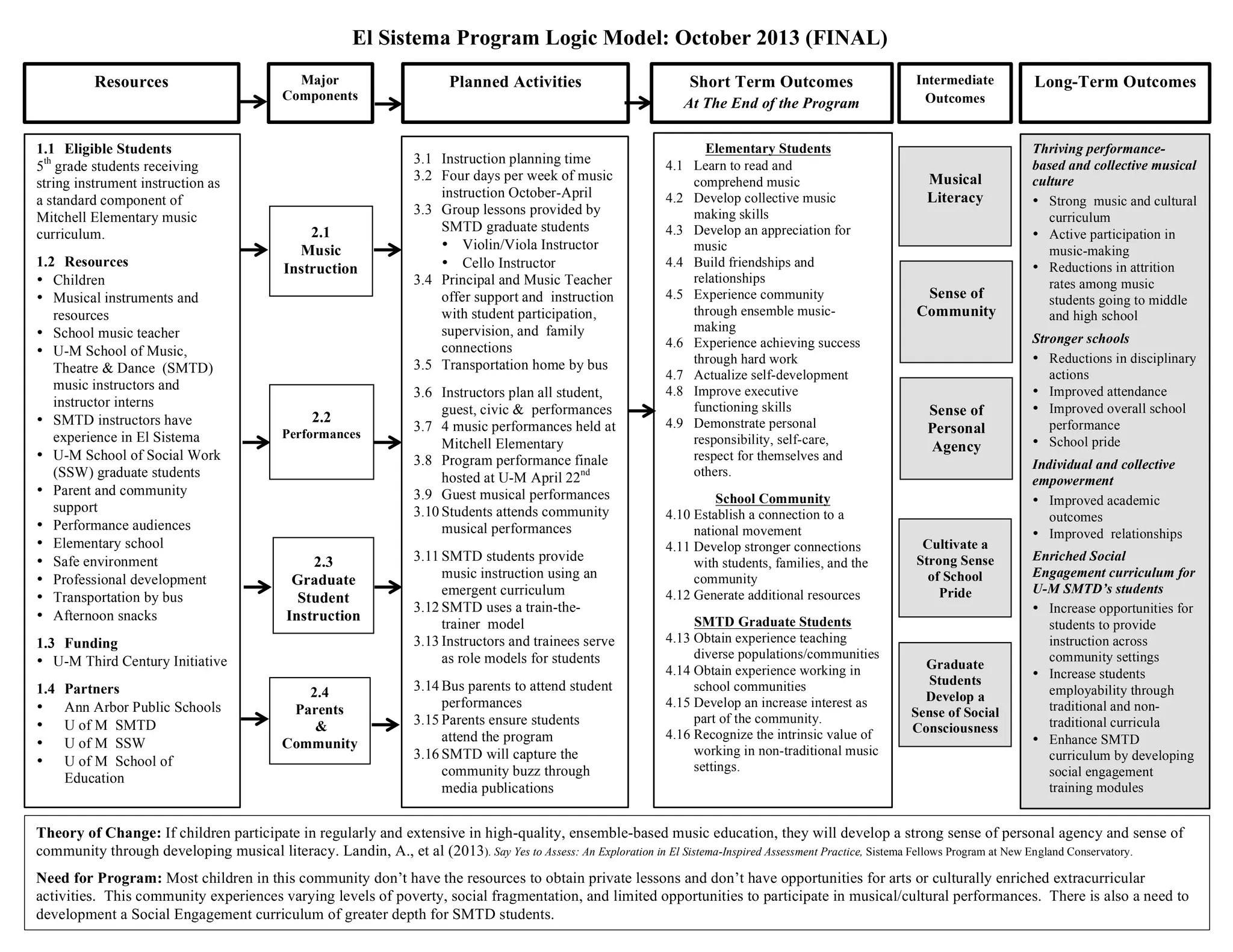
Theory of Change: If children participate in regularly and extensive in high-quality, ensemble-based music education, they will develop a strong sense of personal agency and sense of
community through developing musical literacy. Landin, A., et al (2013). Say Yes to Assess: An Exploration in El Sistema-Inspired Assessment Practice, Sistema Fellows Program at New England Conservatory.
Need for Program: Most children in this community don’t have the resources to obtain private lessons and don’t have opportunities for arts or culturally enriched extracurricular
activities. This community experiences varying levels of poverty, social fragmentation, and limited opportunities to participate in musical/cultural performances. There is also a need to
development a Social Engagement curriculum of greater depth for SMTD students.
El Sistema Program Logic Model: October 2013 (FINAL)
	
Elementary Students
4.1 Learn to read and
comprehend music
4.2 Develop collective music
making skills
4.3 Develop an appreciation for
music
4.4 Build friendships and
relationships
4.5 Experience community
through ensemble music-
making
4.6 Experience achieving success
through hard work
4.7 Actualize self-development
4.8 Improve executive
functioning skills
4.9 Demonstrate personal
responsibility, self-care,
respect for themselves and
others.
School Community
4.10 Establish a connection to a
national movement
4.11 Develop stronger connections
with students, families, and the
community
4.12 Generate additional resources
SMTD Graduate Students
4.13 Obtain experience teaching
diverse populations/communities
4.14 Obtain experience working in
school communities
4.15 Develop an increase interest as
part of the community.
4.16 Recognize the intrinsic value of
working in non-traditional music
settings.
Long-Term Outcomes
Thriving performance-
based and collective musical
culture
• Strong music and cultural
curriculum
• Active participation in
music-making
• Reductions in attrition
rates among music
students going to middle
and high school
Stronger schools
• Reductions in disciplinary
actions
• Improved attendance
• Improved overall school
performance
• School pride
Individual and collective
empowerment
• Improved academic
outcomes
• Improved relationships
Enriched Social
Engagement curriculum for
U-M SMTD’s students
• Increase opportunities for
students to provide
instruction across
community settings
• Increase students
employability through
traditional and non-
traditional curricula
• Enhance SMTD
curriculum by developing
social engagement
training modules 	
Intermediate
Outcomes
2.2
Performances
2.4
Parents
&
Community
2.3
Graduate
Student
Instruction
2.1
Music
Instruction
Graduate
Students
Develop a
Sense of Social
Consciousness
Sense of
Personal
Agency
Sense of
Community
Musical
Literacy
Cultivate a
Strong Sense
of School
Pride

El+Sistema_Intervention Logic_Model+Final-2

  • 1.
    Resources Major Components Planned ActivitiesShort Term Outcomes At The End of the Program 1.1 Eligible Students 5th grade students receiving string instrument instruction as a standard component of Mitchell Elementary music curriculum. 1.2 Resources • Children • Musical instruments and resources • School music teacher • U-M School of Music, Theatre & Dance (SMTD) music instructors and instructor interns • SMTD instructors have experience in El Sistema • U-M School of Social Work (SSW) graduate students • Parent and community support • Performance audiences • Elementary school • Safe environment • Professional development • Transportation by bus • Afternoon snacks 1.3 Funding • U-M Third Century Initiative 1.4 Partners • Ann Arbor Public Schools • U of M SMTD • U of M SSW • U of M School of Education 3.1 Instruction planning time 3.2 Four days per week of music instruction October-April 3.3 Group lessons provided by SMTD graduate students • Violin/Viola Instructor • Cello Instructor 3.4 Principal and Music Teacher offer support and instruction with student participation, supervision, and family connections 3.5 Transportation home by bus 3.6 Instructors plan all student, guest, civic & performances 3.7 4 music performances held at Mitchell Elementary 3.8 Program performance finale hosted at U-M April 22nd 3.9 Guest musical performances 3.10 Students attends community musical performances 3.11 SMTD students provide music instruction using an emergent curriculum 3.12 SMTD uses a train-the- trainer model 3.13 Instructors and trainees serve as role models for students 3.14 Bus parents to attend student performances 3.15 Parents ensure students attend the program 3.16 SMTD will capture the community buzz through media publications Theory of Change: If children participate in regularly and extensive in high-quality, ensemble-based music education, they will develop a strong sense of personal agency and sense of community through developing musical literacy. Landin, A., et al (2013). Say Yes to Assess: An Exploration in El Sistema-Inspired Assessment Practice, Sistema Fellows Program at New England Conservatory. Need for Program: Most children in this community don’t have the resources to obtain private lessons and don’t have opportunities for arts or culturally enriched extracurricular activities. This community experiences varying levels of poverty, social fragmentation, and limited opportunities to participate in musical/cultural performances. There is also a need to development a Social Engagement curriculum of greater depth for SMTD students. El Sistema Program Logic Model: October 2013 (FINAL) Elementary Students 4.1 Learn to read and comprehend music 4.2 Develop collective music making skills 4.3 Develop an appreciation for music 4.4 Build friendships and relationships 4.5 Experience community through ensemble music- making 4.6 Experience achieving success through hard work 4.7 Actualize self-development 4.8 Improve executive functioning skills 4.9 Demonstrate personal responsibility, self-care, respect for themselves and others. School Community 4.10 Establish a connection to a national movement 4.11 Develop stronger connections with students, families, and the community 4.12 Generate additional resources SMTD Graduate Students 4.13 Obtain experience teaching diverse populations/communities 4.14 Obtain experience working in school communities 4.15 Develop an increase interest as part of the community. 4.16 Recognize the intrinsic value of working in non-traditional music settings. Long-Term Outcomes Thriving performance- based and collective musical culture • Strong music and cultural curriculum • Active participation in music-making • Reductions in attrition rates among music students going to middle and high school Stronger schools • Reductions in disciplinary actions • Improved attendance • Improved overall school performance • School pride Individual and collective empowerment • Improved academic outcomes • Improved relationships Enriched Social Engagement curriculum for U-M SMTD’s students • Increase opportunities for students to provide instruction across community settings • Increase students employability through traditional and non- traditional curricula • Enhance SMTD curriculum by developing social engagement training modules Intermediate Outcomes 2.2 Performances 2.4 Parents & Community 2.3 Graduate Student Instruction 2.1 Music Instruction Graduate Students Develop a Sense of Social Consciousness Sense of Personal Agency Sense of Community Musical Literacy Cultivate a Strong Sense of School Pride