Presented by:
RODOLF JOHN T. RODRIGUEZ, PhD
EPS - CLMD, DepEd Region IX
Upskilling of Region and Division
Reading Supervisors/Coordinators
on the Early Language Literacy
and Numeracy (ELLN) with Focus
on the Science of Reading (SOR)
DEPARTMENT OF EDUCATION
Presented by:
RODOLF JOHN T. RODRIGUEZ, PhD
EPS - CLMD, DepEd Region IX
Upskilling of Region and Division Reading Supervisors/Coordinators on the Early
Language Literacy and Numeracy (ELLN) with Focus on the Science of Reading (SOR)
2
Session 6:
Vocabulary Development
Rodolf John T. Rodriguez, PhD
Education Program Supervisor
CLMD, DepEd Region IX
DEPARTMENT OF EDUCATION
Presented by:
RODOLF JOHN T. RODRIGUEZ, PhD
EPS - CLMD, DepEd Region IX
TERMINAL OBJECTIVE
3
At the end of the
session, the participants should be
able to deepen their understanding
of developing vocabulary according
to learner’s level.
DEPARTMENT OF EDUCATION
Presented by:
RODOLF JOHN T. RODRIGUEZ, PhD
EPS - CLMD, DepEd Region IX
ENABLING OBJECTIVES
4
Identify other tools and
strategies in unlocking of words
and concepts; and
4
Write a work plan
focusing on developing the
vocabulary skills of learners
5
DEPARTMENT OF EDUCATION
Presented by:
RODOLF JOHN T. RODRIGUEZ, PhD
EPS - CLMD, DepEd Region IX
ENABLING OBJECTIVES
5
Describe the importance of
vocabulary development;
1
Explain the nature and
principles of vocabulary development
strategies;
Discuss the principles that
underpin the assessment of vocabulary;
3
2
Presented by:
RODOLF JOHN T. RODRIGUEZ, PhD
EPS - CLMD, DepEd Region IX
I. Activity
True or False
Presented by:
RODOLF JOHN T. RODRIGUEZ, PhD
EPS - CLMD, DepEd Region IX
IS THE STATEMENT TRUE OR FALSE?
Red – FALSE
Green – TRUE
This Photo by Unknown Author is licensed under CC BY-NC
Presented by:
RODOLF JOHN T. RODRIGUEZ, PhD
EPS - CLMD, DepEd Region IX
IS THE STATEMENT TRUE OR FALSE?
1. Communicative approach
does not emphasize vocabulary
building.
The learner gets ample
opportunities and knows the
social meaning of language
Source: (Long and Richards, 2007)
Presented by:
RODOLF JOHN T. RODRIGUEZ, PhD
EPS - CLMD, DepEd Region IX
IS THE STATEMENT TRUE OR FALSE?
2. A person who wants to learn a
vocabulary will have to learn new
sounds and new structures.
Each language has its own
system of vocabulary, and sound
system of language differs from
language to language depending upon
the culture to which a language belongs.
Source: (Long and Richards, 2007)
Presented by:
RODOLF JOHN T. RODRIGUEZ, PhD
EPS - CLMD, DepEd Region IX
IS THE STATEMENT TRUE OR FALSE?
3. In the teaching of reading,
vocabulary should be
uncontrolled.
Vocabulary should be
kept under control. Vocabulary should
be taught and practiced only in the
context of real situations so that
meaning will be clarified and
reinforced. Source: (Long and Richards, 2007)
Presented by:
RODOLF JOHN T. RODRIGUEZ, PhD
EPS - CLMD, DepEd Region IX
IS THE STATEMENT TRUE OR FALSE?
4. Most of the strategies practiced in
teaching beginning reading are focusing on
the vocabulary development.
Vocabulary is the smallest unit
learners need to know in order to use the
target language properly. Learners must
attain a certain level of vocabulary knowledge
in order to understand the written and spoken
forms of the target language.
(Source: Ngan-ha, 2007; Deighton, 1971; Kurniawan, 2009; Milton,
2008; Seville, 1976).
Presented by:
RODOLF JOHN T. RODRIGUEZ, PhD
EPS - CLMD, DepEd Region IX
IS THE STATEMENT TRUE OR FALSE?
5. Vocabulary is the first and
foremost important step in
language development.
In a classroom where students
are not finding themselves comfortable
with L2, language learning can be
made interactive and interesting with
the introduction of appropriate
vocabulary exercises.Source: (Long and Richards, 2007)
Presented by:
RODOLF JOHN T. RODRIGUEZ, PhD
EPS - CLMD, DepEd Region IX
IS THE STATEMENT TRUE OR FALSE?
6. Teacher Aisha Lizza of Diplahan Central
Elementary School teaches vocabulary items
primarily by translation. She imparts either a
list of words with their translation at the
lesson's beginning or the content's
translation with new terms or glossaries at
the very end.
Presented by:
RODOLF JOHN T. RODRIGUEZ, PhD
EPS - CLMD, DepEd Region IX
IS THE STATEMENT TRUE OR FALSE?
This is an erroneous practice as it leads to
a state of confusion for the learners. On the
teaching skills of vocabulary items, Frisby
(1957) commented that all the books we use
are based on limited vocabularies. It is
important that teachers know the principles
which underlie vocabulary selection.”
(Source: Frisby (1957)
Presented by:
RODOLF JOHN T. RODRIGUEZ, PhD
EPS - CLMD, DepEd Region IX
IS THE STATEMENT TRUE OR FALSE?
7. Sir Sam lets his students listen to the
word in isolation and a sentence. The
students will hear it correctly with two or
three repetitions if they have mastered
the word sounds.
(Source: (Robert Lado: 121)
Presented by:
RODOLF JOHN T. RODRIGUEZ, PhD
EPS - CLMD, DepEd Region IX
IS THE STATEMENT TRUE OR FALSE?
Careful listening to the
words may be a good option in teaching
vocabulary items in a heterogenic
classroom. Slow pronunciation without
distortion will help. Breaking the word
into parts and building up to the whole
word will also be helpful.
(Source: (Robert Lado: 121)
Presented by:
RODOLF JOHN T. RODRIGUEZ, PhD
EPS - CLMD, DepEd Region IX
IS THE STATEMENT TRUE OR FALSE?
8. Teacher Roa Francisco uses selected and integrated
vocabulary activities. She teaches vocabulary
development depending on the learners’ ability, level of
understanding, and interest. Moreover, Teacher Roa
enriches the vocabulary bank of her pupils on a gradual
basis. As a result, her students have shown keen
interest and enthusiasm in finding, learning, and
understanding new work. Is Teacher Roa an effective
teacher in developing the vocabulary of students?
(Source: (Robert Lado: 121)
Presented by:
RODOLF JOHN T. RODRIGUEZ, PhD
EPS - CLMD, DepEd Region IX
IS THE STATEMENT TRUE OR FALSE?
Although, there is no
surefire remedy or method to enhance
vocabulary in a day or two but
vocabulary activities can be integrated
upon the ability and level of
understanding and interest of learners.
Source: (Long and Richards, 2007)
Presented by:
RODOLF JOHN T. RODRIGUEZ, PhD
EPS - CLMD, DepEd Region IX
II. Analysis
1. Which of the statements/situations were aligned
with your schema about vocabulary development?
Why do you say so?
2. Did you need clarification with your answers from
the activity? How did you manage to arrive at the
correct answer?
3. If you were to give one principle or characteristic
that a teacher has to consider in teaching vocabulary,
what is it, and why is it essential?
Presented by:
RODOLF JOHN T. RODRIGUEZ, PhD
EPS - CLMD, DepEd Region IX
III. Abstraction
LATIN MEDIEVAL LATIN
vocabulum vocabularius
ENGLISH
vocabulary
vocable
A. Etymology of
Presented by:
RODOLF JOHN T. RODRIGUEZ, PhD
EPS - CLMD, DepEd Region IX
Defining Vocabulary
A vocabulary is a set of
familiar words within a person’s
language. It is developed with
age. It serves useful and
fundamental tool for
communication and acquiring
knowledge.
Presented by:
RODOLF JOHN T. RODRIGUEZ, PhD
EPS - CLMD, DepEd Region IX
Defining Vocabulary
The term ‘vocabulary’ is defined as
'the body of words used in a particular
language'. It is also called ‘wordstock’,
‘lexicon’, and ‘lexis’. Vocabulary consists
of the words we understand when we
hear or read them and words we speak or
write.
Presented by:
RODOLF JOHN T. RODRIGUEZ, PhD
EPS - CLMD, DepEd Region IX
Presented by:
RODOLF JOHN T. RODRIGUEZ, PhD
EPS - CLMD, DepEd Region IX
2k-3k
words
a year
Students add these words a
year to their reading vocabularies.
This means that they learn from six
to eight new words each day—an
enormous achievement.
Source: Promoting Vocabulary Development:
Components of Effective Vocabulary Instruction,
Texas Reading Initiative (2000)
THINK ABOUT THIS…
Presented by:
RODOLF JOHN T. RODRIGUEZ, PhD
EPS - CLMD, DepEd Region IX
The Importance of Vocabulary
Source: (Heibert and Kamil, 2007)
Beginning
readers use their
oral vocabulary
to make sense of
the words they
see in print.
Knowing words
and language
usage are basic
to success in
school and in
society.
Word
empowerment
enables
individuals to
speak, read, and
write with
confidence and
effectiveness.
A large
vocabulary is an
asset to readers;
those who know
many words are
more likely to
comprehend what
they read.
Presented by:
RODOLF JOHN T. RODRIGUEZ, PhD
EPS - CLMD, DepEd Region IX
The vocabulary size is a
strong predictor of reading
comprehension.
(Source: (Heibert and Kamil, 2007)
The fact is…
Presented by:
RODOLF JOHN T. RODRIGUEZ, PhD
EPS - CLMD, DepEd Region IX
Presented by:
RODOLF JOHN T. RODRIGUEZ, PhD
EPS - CLMD, DepEd Region IX
D. Vocabulary Learning
Most of the strategies
practiced are usually
focusing on the vocabulary
learning because it is the
smallest unit learners need
to know to use the target
language properly
(Ngan-ha, 2007; Deighton, 1971;
Kurniawan, 2009; Milton, 2008;
Seville, 1976).
Learners must attain a
certain level of vocabulary
knowledge in order to
understand the written
and spoken forms of the
target language
(Ngan-ha, 2007).
Vocabulary is ‘the core
component of all the
language skills’. Thus
failure to gain an
adequate vocabulary
can give negative
consequences to
communication,
(Long and Richards,
2007).
Presented by:
RODOLF JOHN T. RODRIGUEZ, PhD
EPS - CLMD, DepEd Region IX
Presented by:
RODOLF JOHN T. RODRIGUEZ, PhD
EPS - CLMD, DepEd Region IX
5,000 -
10,000
words
The number of
vocabulary learners know
when they enter
Kindergarten.
Source: (Quick & Essay, 2020)
THINK ABOUT THIS…
Presented by:
RODOLF JOHN T. RODRIGUEZ, PhD
EPS - CLMD, DepEd Region IX
Presented by:
RODOLF JOHN T. RODRIGUEZ, PhD
EPS - CLMD, DepEd Region IX
It’s
COLLAB TIME!
Presented by:
RODOLF JOHN T. RODRIGUEZ, PhD
EPS - CLMD, DepEd Region IX
Presented by:
RODOLF JOHN T. RODRIGUEZ, PhD
EPS - CLMD, DepEd Region IX
Directions: Match
the principles with
the description.
Presented by:
RODOLF JOHN T. RODRIGUEZ, PhD
EPS - CLMD, DepEd Region IX
Presented by:
RODOLF JOHN T. RODRIGUEZ, PhD
EPS - CLMD, DepEd Region IX
D.1 Vocabulary Teaching and Learning Principles
• Selecting appropriate words is the most
important principle in teaching and
learning vocabulary.
Principle 1: Select
Appropriate Words
• Vocabulary acquisition will be more effective
when a particular word is learned based on
several aspects, (Kieran A. File, 2000).
Principle 2:
Focus on Different
Aspects of Words
Presented by:
RODOLF JOHN T. RODRIGUEZ, PhD
EPS - CLMD, DepEd Region IX
Presented by:
RODOLF JOHN T. RODRIGUEZ, PhD
EPS - CLMD, DepEd Region IX
D.1 Vocabulary Teaching and Learning Principles
• Learners should not be expected to use new
words in activities that require them to know
every aspect of the words, (Barcroft, 2004).
Principle 3: Progress from
Less Demanding to More
Demanding Vocabulary-
related Activities
• Teachers should limit the explanation of
meaning of the new words to just the basic
meaning, as to avoid confusion and
misunderstanding from learners of the new
language.
Principle 4: Limit Forced
Semantic Elaboration
during the Initial Stages of
Learning New Words
Presented by:
RODOLF JOHN T. RODRIGUEZ, PhD
EPS - CLMD, DepEd Region IX
Presented by:
RODOLF JOHN T. RODRIGUEZ, PhD
EPS - CLMD, DepEd Region IX
D.1 Vocabulary Teaching and Learning Principles
• Vocabulary teaching and learning should be
interesting and enjoyable as to keep motivation
high while encouraging students to develop
strategies that they can continue to use once they
leave the classroom.
Principle 5:
Encourage Interest
among Students
during Learning
Process
• Vocabulary can be taught better
through the use of contextual cues.
Principle 6:
Accommodate Use
of Contextual Cues
Presented by:
RODOLF JOHN T. RODRIGUEZ, PhD
EPS - CLMD, DepEd Region IX
Presented by:
RODOLF JOHN T. RODRIGUEZ, PhD
EPS - CLMD, DepEd Region IX
D.1 Vocabulary Teaching and Learning Principles
• A dictionary is one of the important
references in learning new words,
especially for new learners.
Principle 7: Expose
Learners to the Use
of Dictionary
• The more frequently language learners are
exposed to a particular vocabulary, the
more likely they are to remember it.
Principle 8: Exercise
Repetition by
Introducing Words
Frequently inside the
Module
Presented by:
RODOLF JOHN T. RODRIGUEZ, PhD
EPS - CLMD, DepEd Region IX
Presented by:
RODOLF JOHN T. RODRIGUEZ, PhD
EPS - CLMD, DepEd Region IX
D.1 Vocabulary Teaching and Learning Principles
• Mayer and Wittrock state (as cited in
Hogben, 1996), the more effectively the to-
be-learned material is elaborated during
acquisition, the more readily it will be
recalled by the learners.
Principle 9: Promote
Deliberate Vocabulary
Acquisition
• Instead of just sticking to the conventional teaching methods
like reading textbook, referring to a dictionary for meaning
or memorizing new words, teachers could use their
imagination to encourage learners to learn new words in
different types of activities.
Principle 10: Expose
Learners with Exercises
and Activities Other
than Memorizing Words
Presented by:
RODOLF JOHN T. RODRIGUEZ, PhD
EPS - CLMD, DepEd Region IX
Presented by:
RODOLF JOHN T. RODRIGUEZ, PhD
EPS - CLMD, DepEd Region IX
50,000
words
The number of
vocabulary students know
when they graduate high
school.
Source: (Quick & Essay, 2020)
THINK ABOUT THIS…
Presented by:
RODOLF JOHN T. RODRIGUEZ, PhD
EPS - CLMD, DepEd Region IX
E. Reading Assessment
Which skill should we assess?
What should we assess?
Presented by:
RODOLF JOHN T. RODRIGUEZ, PhD
EPS - CLMD, DepEd Region IX
Isolate skills in reading
assessment
Divide reading proficiency roughly into:
⮲Language Comprehension
⮲Word Recognition
(Scarborough, 2001)
Presented by:
RODOLF JOHN T. RODRIGUEZ, PhD
EPS - CLMD, DepEd Region IX
Presented by:
RODOLF JOHN T. RODRIGUEZ, PhD
EPS - CLMD, DepEd Region IX
Presented by:
RODOLF JOHN T. RODRIGUEZ, PhD
EPS - CLMD, DepEd Region IX
F. Vocabulary Development Strategies
f.1. Rebus
f.6. Identifying or
using context clues
f.3. Word
Pyramid
f.4. Word
Hunt
f.2.1 Root words
f.2.2 Prefix or suffix
f.2. Morphology/
Word Part Clues
f.5. C-Blending
Race
f.7. Graphic
Organizers
Presented by:
RODOLF JOHN T. RODRIGUEZ, PhD
EPS - CLMD, DepEd Region IX
F.1 Rebus Rhymes
A representation of words in
the form of pictures or symbols,
often presented as a puzzle.
Presented by:
RODOLF JOHN T. RODRIGUEZ, PhD
EPS - CLMD, DepEd Region IX
Hickory Dickory Dock
The ________ ran up the _______
The _______ struck ______ and ______ he ran
Hickory, dickory dock
The ________ looked at the _______
The _________ struck _______ and away she flew
Hickory, dickory dock
Rebus 1
Presented by:
RODOLF JOHN T. RODRIGUEZ, PhD
EPS - CLMD, DepEd Region IX
Hickory Dickory Dock
The ran up the clock
The struck and he ran
Hickory, dickory dock
The looked at the
The struck and away she
flew
Hickory, dickory dock
Rebus 1
Hickory Dickory Dock
The mouse ran up the clock
The clock struck one and down he ran
Hickory, dickory dock
The bird looked at the clock
The clock struck two and away she flew
Hickory, dickory dock
Presented by:
RODOLF JOHN T. RODRIGUEZ, PhD
EPS - CLMD, DepEd Region IX
To the Market
To the market mother goes.
To buy some big, brown _____________.
Yellow _______ and green ________.
Leafy _________ and fresh __________ .
Long __________ and round ______________.
Juicy __________ and bitter ______________ .
Rebus 2
Presented by:
RODOLF JOHN T. RODRIGUEZ, PhD
EPS - CLMD, DepEd Region IX
To the Market
To the market mother goes
To buy some big, brown .
Yellow and green .
Leafy and fresh .
Long and round .
Juicy and bitter
.
Rebus 2
To the Market
To the market mother goes.
To buy some big, brown potatoes.
Yellow mango and green mango.
Leafy kangkong and fresh pechay.
Long beans and round
watermelon.
Juicy orange and bitter ampalaya.
Presented by:
RODOLF JOHN T. RODRIGUEZ, PhD
EPS - CLMD, DepEd Region IX
I Like School
I like to go to school .
I ride the _______ to _______ .
My _______ helps me at ________ .
I sit at my _________ at ____________ .
I like my _____________ to read ____________.
I like to __________ at ________ .
I have ___________ at _____________ .
It is fun to _____________ at ___________ .
Rebus 3
Presented by:
RODOLF JOHN T. RODRIGUEZ, PhD
EPS - CLMD, DepEd Region IX
I Like School
I like to go to school .
I ride the to .
My helps me at .
I sit at my at .
I like my to read
.
I like to at .
I have at .
It is fun to at .
Rebus 3
I Like School
I like to go to school.
I ride the bus to school.
My teacher helps me at school.
I sit at my desk at school.
I like my teacher to read books.
I like to write at school.
I have crayons at school.
It is fun to draw at school.
Presented by:
RODOLF JOHN T. RODRIGUEZ, PhD
EPS - CLMD, DepEd Region IX
F.2 Using Morphology/Word Part Clues
Morpheme...
is the name for meaningful word parts that readers
can identify and put together to determine the meaning
of unfamiliar word. Knowledge of morphemes and
morphology, or word structure plays a valuable role in
word learning from context
.
Presented by:
RODOLF JOHN T. RODRIGUEZ, PhD
EPS - CLMD, DepEd Region IX
Morphology…
is the study of word formation, including the
origin and function of inflections, or changes made
to words to show such things as tense, case or
number
.
Examples
:
look – looks, looked, looking
sad – sadly, sadness
Using Morphology/Word Part Clues
Presented by:
RODOLF JOHN T. RODRIGUEZ, PhD
EPS - CLMD, DepEd Region IX
Morphology/Word Part Clues
Prefixes
Prefixes meaning English Words
un unfinished
co copilot
in, im, il, ir Illegal, immoral,
inconsiderate, irresponsible
dis disappear
en enclose
micro microscope
post posttest
A presence of a prefix requires a reader to attend to it immediately. Prefixes tend
to be spelled consistently and have a clear lexical meaning, which makes prefix
instruction and learning straightforward and useful.
Presented by:
RODOLF JOHN T. RODRIGUEZ, PhD
EPS - CLMD, DepEd Region IX
Morphology/Word Part Clues
Prefixes
Prefixes meaning English Words
un not unfinished
co with copilot
In, im, il, ir not, without Illegal, immoral, inconsiderate,
irresponsible
dis not disappear
en put into enclose
micro small microscope
post after posttest
A presence of a prefix requires a reader to attend to it immediately.
Prefixes tend to be spelled consistently and have a clear lexical meaning, which
makes prefix instruction and learning straightforward and useful.
Presented by:
RODOLF JOHN T. RODRIGUEZ, PhD
EPS - CLMD, DepEd Region IX
Morphology/Word Part Clues
Suffixes
Suffix Meaning English Words
able, ible portable, legible
ac, ic cardiac., aquatic,
itious/icious delicious, ambitious,
eer, er, or mountaineer, teacher, advisor
ism socialism, commercialism
ist dentist, realist
tic, fic terrific, fantastic
ful hopeful, useful
holic shopaholic
The most frequently occurring suffixes in English are
inflectional endings.
Presented by:
RODOLF JOHN T. RODRIGUEZ, PhD
EPS - CLMD, DepEd Region IX
Morphology/Word Part Clues
Suffixes
Suffix Meaning English Words
able, ible capable of portable, legible
ac, ic like, pertaining to cardiac., aquatic,
itious/icious full of delicious, ambitious,
eer, er, or person who mountaineer, teacher, advisor
ism A distinctive doctrine, cause, or theory progressivism, behaviorism
ist doer dentist, realist
tic, fic making, doing terrific, fantastic
ful full of hopeful, useful
holic love, addiction alcoholic
The most frequently occurring suffixes in English are inflectional endings.
Presented by:
RODOLF JOHN T. RODRIGUEZ, PhD
EPS - CLMD, DepEd Region IX
Morphology/Word Part Clues
Suffixes
The suffix -ly changes an adjective into an adverb.
Adverb = Adjective + Suffix
badly bad + ly
smooth smooth + ly
loud loud + ly
friend friend + ly
world world + ly
love love + ly
wrong wrong + ly
world world + ly
patient patient + ly
promptly prompt + ly
Presented by:
RODOLF JOHN T. RODRIGUEZ, PhD
EPS - CLMD, DepEd Region IX
F.3 Word Pyramid
This is a fun and challenging puzzle that usually starts with
a word at the base of the pyramid. The next word will be
one letter shorter than the base until the topmost letter/s
is/are left. The words must create an anagram of the
existing letters
.
A N
A N T
A
I N
I N K
I
Presented by:
RODOLF JOHN T. RODRIGUEZ, PhD
EPS - CLMD, DepEd Region IX
Word Pyramid 1
A R M Y T I M E
Word Pyramid
Presented by:
RODOLF JOHN T. RODRIGUEZ, PhD
EPS - CLMD, DepEd Region IX
Word Pyramid 1
A M
A R M
A R M
A
Y
I T
T I E
T I M
I
E
Word Pyramid
Presented by:
RODOLF JOHN T. RODRIGUEZ, PhD
EPS - CLMD, DepEd Region IX
Word Pyramid 2
Word Pyramid
N A K A T A Y O
Presented by:
RODOLF JOHN T. RODRIGUEZ, PhD
EPS - CLMD, DepEd Region IX
Word Pyramid 2
A Y
K A Y
A K A Y
A A K A Y
N A K A Y A
A
Word Pyramid
N A K A T A Y
N A K A T A Y
O
Presented by:
RODOLF JOHN T. RODRIGUEZ, PhD
EPS - CLMD, DepEd Region IX
Word Pyramid 3
Word Pyramid
S A L I T A N
Presented by:
RODOLF JOHN T. RODRIGUEZ, PhD
EPS - CLMD, DepEd Region IX
Word Pyramid 3
A L
A L I
S A L I
S A L I T
S A L I T A
A
Word Pyramid
S A L I T A N
Presented by:
RODOLF JOHN T. RODRIGUEZ, PhD
EPS - CLMD, DepEd Region IX
L I G A M E N T S
Word Pyramid 4
Word Pyramid
Presented by:
RODOLF JOHN T. RODRIGUEZ, PhD
EPS - CLMD, DepEd Region IX
A T
A T E
M A T E
M E A N T
L A M E N T
M A N T L E S
A I L M E N T S
L I G A M E N T S
Word Pyramid 4
Word Pyramid
Presented by:
RODOLF JOHN T. RODRIGUEZ, PhD
EPS - CLMD, DepEd Region IX
Word Pyramid
Activity 1
In 5 minutes…..
* Form groups of five.
* Make a pyramid of your own.
Presented by:
RODOLF JOHN T. RODRIGUEZ, PhD
EPS - CLMD, DepEd Region IX
Word Pyramid 5
New Year
Chinese New Year
during Chinese New Year
envelopes during Chinese New Year
lucky envelopes during Chinese New Year
get lucky envelopes during Chinese New Year
kids get lucky envelopes during Chinese New Year
and kids get lucky envelopes during Chinese New Year
Adults and kids get lucky envelopes during Chinese New Year
Year
Word Pyramid
Presented by:
RODOLF JOHN T. RODRIGUEZ, PhD
EPS - CLMD, DepEd Region IX
F.4 Word Hunt
This is a vocabulary building activity
that will allow learners to develop thinking
skills. From the given long word, the
students are going to form as many shorter
words according to the letters available.
Presented by:
RODOLF JOHN T. RODRIGUEZ, PhD
EPS - CLMD, DepEd Region IX
Word Hunt
• Procedure:
– Give a fairly long word printed on a manila paper.
– Make sure that the word contains 2 to 3 vowels.
– Give a signal when the player has to write down as
many words according to the letters available in the
given word.
– It may be best to allow young children to use proper
names, plurals or verb ending in “s” since they still have
limited vocabulary.
Presented by:
RODOLF JOHN T. RODRIGUEZ, PhD
EPS - CLMD, DepEd Region IX
Word Hunt 1
leader
lad
red
eel
read
dare
dear
ear
lead
deal
led
are deer
Presented by:
RODOLF JOHN T. RODRIGUEZ, PhD
EPS - CLMD, DepEd Region IX
In 5 minutes…..
Hunt as many words as you can in the
word…
TEACHER
Word Hunt
Presented by:
RODOLF JOHN T. RODRIGUEZ, PhD
EPS - CLMD, DepEd Region IX
Word Hunt 2
teacher
tear
tea
teach
chat reach
rat react
rate
act heat cheer
hat ache cheat
cat tree crate
her
create
care
car
Presented by:
RODOLF JOHN T. RODRIGUEZ, PhD
EPS - CLMD, DepEd Region IX
Presented by:
RODOLF JOHN T. RODRIGUEZ, PhD
EPS - CLMD, DepEd Region IX
F.5 IDENTIFYING OR USING CONTEXT CLUES
Context clues are hints found within a
sentence, paragraph, or passage that a
reader can use to understand the meanings
of new or unfamiliar words.
Presented by:
RODOLF JOHN T. RODRIGUEZ, PhD
EPS - CLMD, DepEd Region IX
Presented by:
RODOLF JOHN T. RODRIGUEZ, PhD
EPS - CLMD, DepEd Region IX
F.5.1. DEFINITION / DESCRIPTION CLUE
Examples:
a. His emaciation, that is, his skeleton-like
appearance, was frightening to see.
“Skeleton-like appearance” is the definition of
“emaciation.”
b. Fluoroscopy, examination with a fluoroscope,
has become a common practice.
The commas before and after “examination
with a fluoroscope” point out the definition of
“fluoroscopy.”
Presented by:
RODOLF JOHN T. RODRIGUEZ, PhD
EPS - CLMD, DepEd Region IX
Presented by:
RODOLF JOHN T. RODRIGUEZ, PhD
EPS - CLMD, DepEd Region IX
F.5.2. EXAMPLE CLUES
Examples:
a. Piscatorial creatures, such as flounder,
salmon, and trout, live in the coldest parts of the
ocean.
“Piscatorial” obviously refers to fish.
b. Celestial bodies, including the sun, moon,
and stars, have fascinated man through the
centuries.
Presented by:
RODOLF JOHN T. RODRIGUEZ, PhD
EPS - CLMD, DepEd Region IX
Presented by:
RODOLF JOHN T. RODRIGUEZ, PhD
EPS - CLMD, DepEd Region IX
F.5.3. SYNONYM RESTATEMENT CLUE
Examples:
a. Flooded with spotlights – the focus of all
attention – the new Ms. Pagadian began her year-long
reign. She was the cynosure of all eyes for the rest of
the evening.
“Cynosure” means “the focus of all attention.”
b. The mountain pass was a tortuous road,
winding and twisting like a snake around the trees of
the mountainside.
“Tortuous” means “winding and twisting.”
Presented by:
RODOLF JOHN T. RODRIGUEZ, PhD
EPS - CLMD, DepEd Region IX
Presented by:
RODOLF JOHN T. RODRIGUEZ, PhD
EPS - CLMD, DepEd Region IX
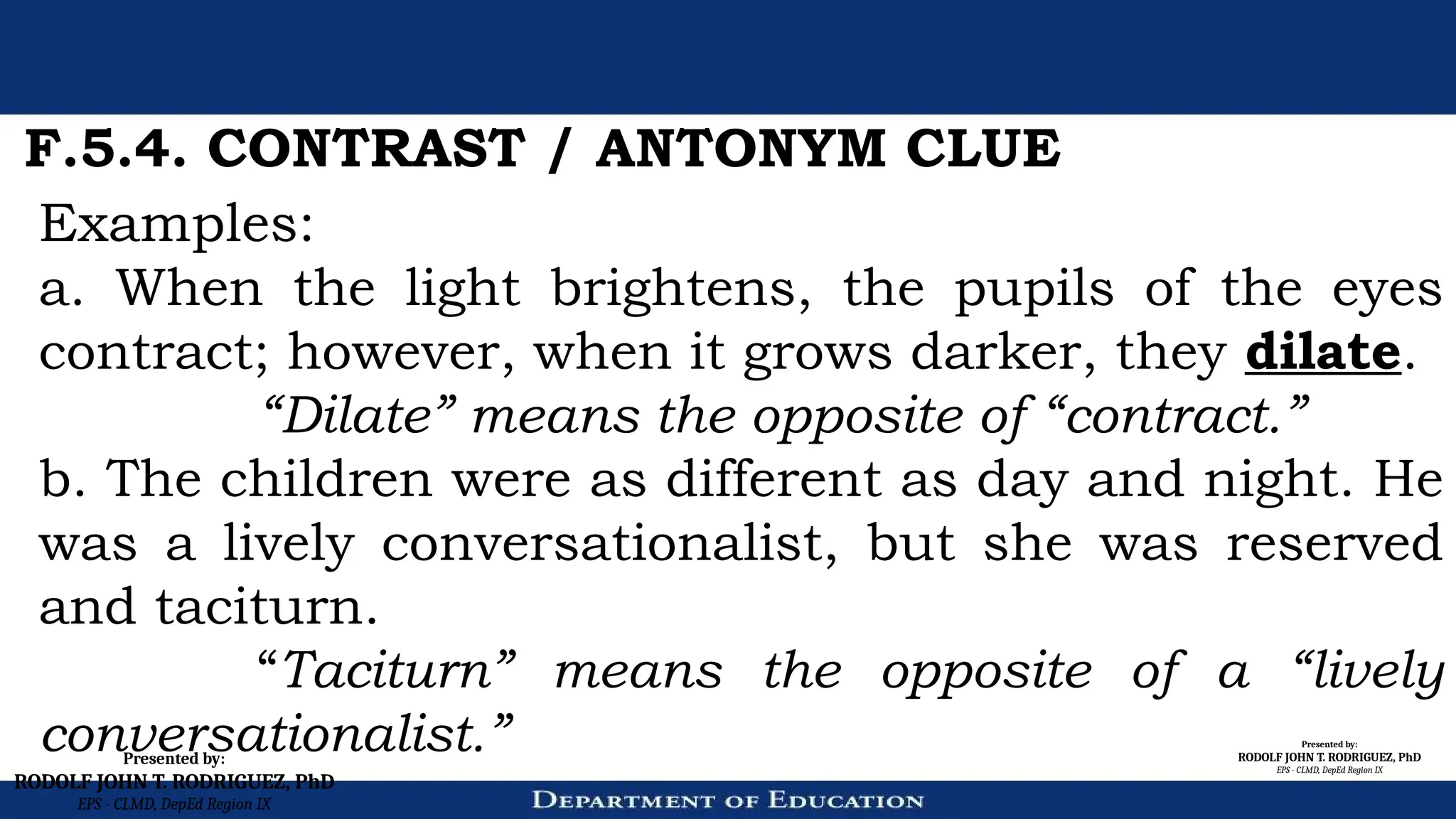
F.5.4. CONTRAST / ANTONYM CLUE
Examples:
a. When the light brightens, the pupils of the eyes
contract; however, when it grows darker, they dilate.
“Dilate” means the opposite of “contract.”
b. The children were as different as day and night. He
was a lively conversationalist, but she was reserved
and taciturn.
“Taciturn” means the opposite of a “lively
conversationalist.”
Presented by:
RODOLF JOHN T. RODRIGUEZ, PhD
EPS - CLMD, DepEd Region IX
Presented by:
RODOLF JOHN T. RODRIGUEZ, PhD
EPS - CLMD, DepEd Region IX
F.5.5. MOOD / TONE CLUE
Examples:
a. The lugubrious wails of the gypsies matched the
dreary whistling of the wind in the all but-
deserted cemetery.
“Lugubrious,” which means “sorrowful,” fits
into the mood set by the words “wails,” “dreary,” and
“deserted cemetery.”
Presented by:
RODOLF JOHN T. RODRIGUEZ, PhD
EPS - CLMD, DepEd Region IX
Presented by:
RODOLF JOHN T. RODRIGUEZ, PhD
EPS - CLMD, DepEd Region IX
F.5.6. EXPERIENCE CLUE
Examples:
a. During those first bewildering weeks, the thoughts of a
college freshman drift back to high school where he
was “in,” knew everyone, and felt at home. A feeling of
nostalgia sweeps over him.
b. She walked away from her closet and quickly slipped a
jersey over her head. She smoothed it into place over
her hips, added a belt, glanced at the mirror, and left
for work.
Presented by:
RODOLF JOHN T. RODRIGUEZ, PhD
EPS - CLMD, DepEd Region IX
Presented by:
RODOLF JOHN T. RODRIGUEZ, PhD
EPS - CLMD, DepEd Region IX
F.5.7. ANALYSIS OR STRUCTURE CLUE
Examples:
a. The story is incredible.
The root cred means “to believe,’ and the prefix in
means “not.” Therefore, if a story is incredible, it is
unbelievable.
b. The somnambulist had to be locked in his bedroom
at night for his own safety.
If a reader knows the meaning of ambular (walk)
and somn (sleep) and sees the sentence, the reader may
realize that a “somnambulist” is a sleepwalker.
Presented by:
RODOLF JOHN T. RODRIGUEZ, PhD
EPS - CLMD, DepEd Region IX
Presented by:
RODOLF JOHN T. RODRIGUEZ, PhD
EPS - CLMD, DepEd Region IX
F.5.8. INFERENCE CLUE
Examples:
a. She told her friend, “I’m through with blind
dates forever. What a dull evening! I was
bored every minute. The conversation was
absolutely vapid.”
“Vapid” means “uninteresting.”
Presented by:
RODOLF JOHN T. RODRIGUEZ, PhD
EPS - CLMD, DepEd Region IX
Presented by:
RODOLF JOHN T. RODRIGUEZ, PhD
EPS - CLMD, DepEd Region IX
F.5.9. CAUSE AND EFFECT CLUE
Examples:
a. She wanted to impress all her dinner guests
with the food she served, so she carefully
studied the necessary culinary arts.
“Culinary” means “food preparation.”
Presented by:
RODOLF JOHN T. RODRIGUEZ, PhD
EPS - CLMD, DepEd Region IX
F.5 C-Blending
Race
This is a vocabulary
building activity that allows
learners to think and increase
word attack skills.
Presented by:
RODOLF JOHN T. RODRIGUEZ, PhD
EPS - CLMD, DepEd Region IX
Presented by:
RODOLF JOHN T. RODRIGUEZ, PhD
EPS - CLMD, DepEd Region IX
dr st fl sm
LET’S TRY THIS.
Presented by:
RODOLF JOHN T. RODRIGUEZ, PhD
EPS - CLMD, DepEd Region IX
F.6 Graphic Organizer
⚫is an instructional tool used to illustrate a prior knowledge about
the topic.
Examples
a. Word Web
b. Cause and Effect
c. Chain of Events d.
Outline
e. Main Idea and Supporting Details f. Sequence & Cycles
g. Story Organizer h.
ABC Chart
Presented by:
RODOLF JOHN T. RODRIGUEZ, PhD
EPS - CLMD, DepEd Region IX
Presented by:
RODOLF JOHN T. RODRIGUEZ, PhD
EPS - CLMD, DepEd Region IX
Word Web
woman
she
cook
storyteller
guide
Graphic Organizer 1
Presented by:
RODOLF JOHN T. RODRIGUEZ, PhD
EPS - CLMD, DepEd Region IX
Presented by:
RODOLF JOHN T. RODRIGUEZ, PhD
EPS - CLMD, DepEd Region IX
Cause and Effect
CAUSE/hinugdan EFFECT/ resulta/epekto
Wala magtuon. Wala makapasar.
Si papa nagtrabaho ug tarong.
Gikapoy siya
pagkagabii.
The books in the school were
washed out by the flood.
The
children do not have
books to read.
Graphic Organizer 2
Presented by:
RODOLF JOHN T. RODRIGUEZ, PhD
EPS - CLMD, DepEd Region IX
Presented by:
RODOLF JOHN T. RODRIGUEZ, PhD
EPS - CLMD, DepEd Region IX
Chain of Events
Title of the Story
Event 1 Event 2 Event 3
Graphic Organizer 3
Presented by:
RODOLF JOHN T. RODRIGUEZ, PhD
EPS - CLMD, DepEd Region IX
Presented by:
RODOLF JOHN T. RODRIGUEZ, PhD
EPS - CLMD, DepEd Region IX
Graphic Organizer 4
Outline
Title
Beginning
_______________
_______________
_______________
_______________
_______________
Middle
_______________
_______________
_______________
_______________
_______________
Ending
_______________
_______________
_______________
_______________
_______________
Presented by:
RODOLF JOHN T. RODRIGUEZ, PhD
EPS - CLMD, DepEd Region IX
Presented by:
RODOLF JOHN T. RODRIGUEZ, PhD
EPS - CLMD, DepEd Region IX
Graphic Organizer 5
Main Idea & Supporting Details
Title
Supporting Details
_______________
_______________
_______________
_______________
Supporting Details
_______________
_______________
_______________
_______________
Supporting Details
_______________
_______________
_______________
_______________
Paragraph 1
Main Idea
Paragraph 2
Main Idea
Paragraph 3
Main Idea
Presented by:
RODOLF JOHN T. RODRIGUEZ, PhD
EPS - CLMD, DepEd Region IX
Presented by:
RODOLF JOHN T. RODRIGUEZ, PhD
EPS - CLMD, DepEd Region IX
Sequence & Cycles
Graphic Organizer 6
Presented by:
RODOLF JOHN T. RODRIGUEZ, PhD
EPS - CLMD, DepEd Region IX
Presented by:
RODOLF JOHN T. RODRIGUEZ, PhD
EPS - CLMD, DepEd Region IX
Graphic Organizer 7
Semantic Mapping
Presented by:
RODOLF JOHN T. RODRIGUEZ, PhD
EPS - CLMD, DepEd Region IX
Presented by:
RODOLF JOHN T. RODRIGUEZ, PhD
EPS - CLMD, DepEd Region IX
Graphic Organizer 7
Semantic Mapping
Presented by:
RODOLF JOHN T. RODRIGUEZ, PhD
EPS - CLMD, DepEd Region IX
Presented by:
RODOLF JOHN T. RODRIGUEZ, PhD
EPS - CLMD, DepEd Region IX
Graphic Organizer 8
Directions: Complete the chart by writing down nouns that
start with the given letters.
A N
B O
C P
D Q
E R
F S
G T
H U
I V
J W
K X
L Y
M Z
Chart
Presented by:
RODOLF JOHN T. RODRIGUEZ, PhD
EPS - CLMD, DepEd Region IX
Presented by:
RODOLF JOHN T. RODRIGUEZ, PhD
EPS - CLMD, DepEd Region IX
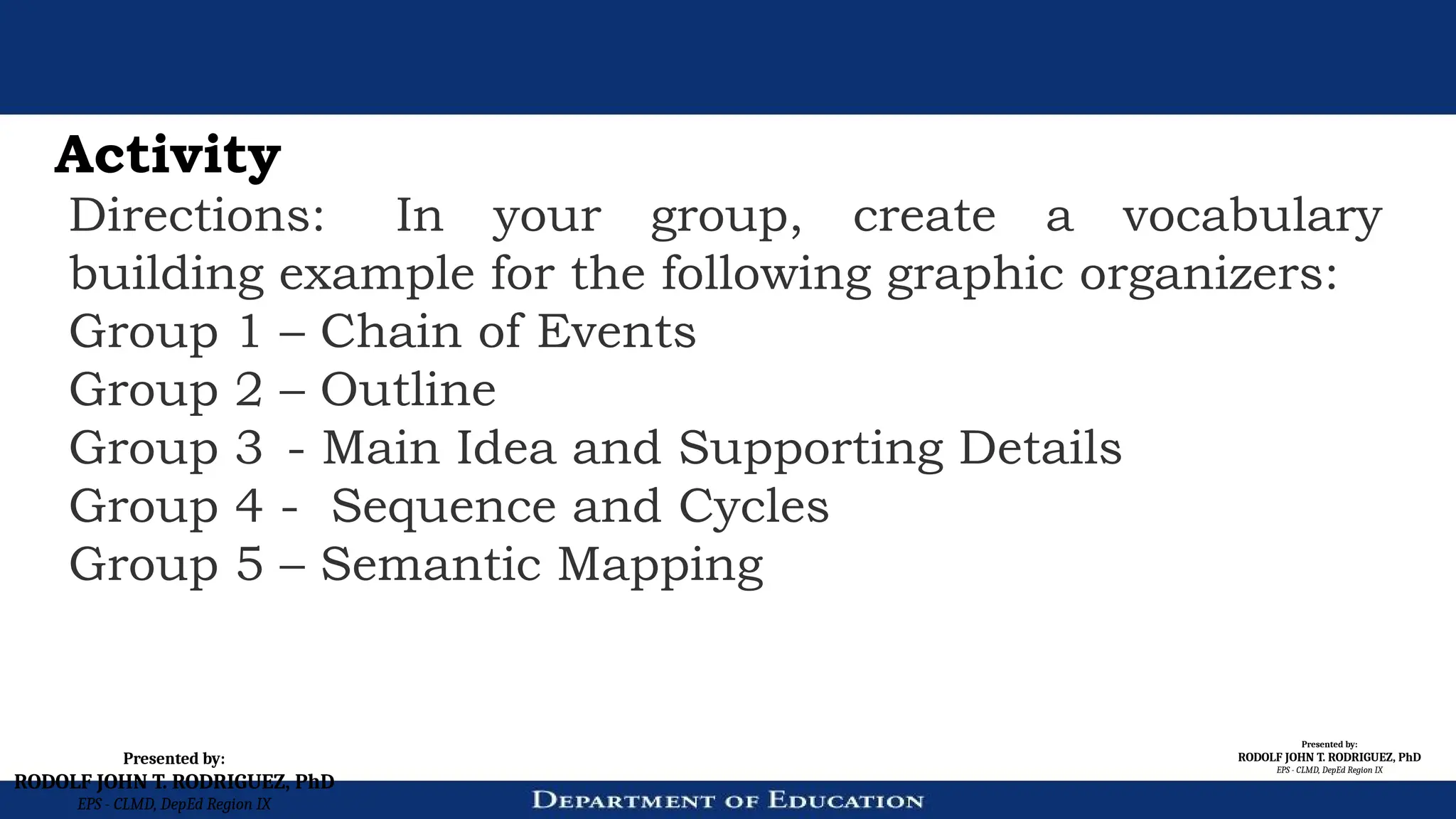
Activity
Directions: In your group, create a vocabulary
building example for the following graphic organizers:
Group 1 – Chain of Events
Group 2 – Outline
Group 3 - Main Idea and Supporting Details
Group 4 - Sequence and Cycles
Group 5 – Semantic Mapping
Presented by:
RODOLF JOHN T. RODRIGUEZ, PhD
EPS - CLMD, DepEd Region IX
Presented by:
RODOLF JOHN T. RODRIGUEZ, PhD
EPS - CLMD, DepEd Region IX
Frayer Model
The Frayer Model is a graphic organizer for
building student vocabulary. This technique
requires students to define target vocabulary and
apply their knowledge by giving its definition,
generating examples and non-examples,
providing characteristics, and/or drawing a
picture to illustrate the meaning of the word.
It was first developed by Dorothy Frayer.
Graphic Organizer 9
Presented by:
RODOLF JOHN T. RODRIGUEZ, PhD
EPS - CLMD, DepEd Region IX
Presented by:
RODOLF JOHN T. RODRIGUEZ, PhD
EPS - CLMD, DepEd Region IX
Presented by:
RODOLF JOHN T. RODRIGUEZ, PhD
EPS - CLMD, DepEd Region IX
Presented by:
RODOLF JOHN T. RODRIGUEZ, PhD
EPS - CLMD, DepEd Region IX
Presented by:
RODOLF JOHN T. RODRIGUEZ, PhD
EPS - CLMD, DepEd Region IX
Presented by:
RODOLF JOHN T. RODRIGUEZ, PhD
EPS - CLMD, DepEd Region IX
Frayer Model
Presented by:
RODOLF JOHN T. RODRIGUEZ, PhD
EPS - CLMD, DepEd Region IX
Presented by:
RODOLF JOHN T. RODRIGUEZ, PhD
EPS - CLMD, DepEd Region IX
Activity
Directions: In your group, create a vocabulary
building example using a Frayer Model for the
following concepts:
Group 1 – Oral Language
Group 2 – Phonemic Awareness
Group 3 – Phonics
Group 4 – Fluency
Group 5 – Comprehension
Presented by:
RODOLF JOHN T. RODRIGUEZ, PhD
EPS - CLMD, DepEd Region IX
F.8 Word Wall
Presented by:
RODOLF JOHN T. RODRIGUEZ, PhD
EPS - CLMD, DepEd Region IX
Word Wall
Presented by:
RODOLF JOHN T. RODRIGUEZ, PhD
EPS - CLMD, DepEd Region IX
G. Informal Assessment
Presented by:
RODOLF JOHN T. RODRIGUEZ, PhD
EPS - CLMD, DepEd Region IX
Presented by:
RODOLF JOHN T. RODRIGUEZ, PhD
EPS - CLMD, DepEd Region IX
1.Lucid
2.Vociferous
3.Impudent
4.Cryptic
5.Impeccable
Directions: Vote with your fingers to indicate how
much you know about the key vocabulary. Use the
Vocabulary High Five Rating Scale.
6.Lethargic
7.Xenophobia
8.Benign
9.Bivouac
10.Lacquer
G. INFORMAL ASSESSMENT
Presented by:
RODOLF JOHN T. RODRIGUEZ, PhD
EPS - CLMD, DepEd Region IX
Presented by:
RODOLF JOHN T. RODRIGUEZ, PhD
EPS - CLMD, DepEd Region IX
G. INFORMAL ASSESSMENT
Presented by:
RODOLF JOHN T. RODRIGUEZ, PhD
EPS - CLMD, DepEd Region IX
Metacognitive Awareness
Inventory on Vocabulary
Development
LET’S DO THIS.
Presented by:
RODOLF JOHN T. RODRIGUEZ, PhD
EPS - CLMD, DepEd Region IX
LET’S KNOW YOUR SCORES
“TRUE” = 1 point
“FALSE” = 0 point
Presented by:
RODOLF JOHN T. RODRIGUEZ, PhD
EPS - CLMD, DepEd Region IX
SUM IT UP
1-3
4-6
7-9
10-12
13-15
16-18
19-21
22-24
Presented by:
RODOLF JOHN T. RODRIGUEZ, PhD
EPS - CLMD, DepEd Region IX
1-3 – Declarative Knowledge
4-6 – Procedural Knowledge
7-9 – Conditional Knowledge
10-12 – Planning
13-15 – Comprehension Monitoring
16-18 – Information Management Strategies
19-21 – Debugging Strategies
22-24 – Evaluation
Presented by:
RODOLF JOHN T. RODRIGUEZ, PhD
EPS - CLMD, DepEd Region IX
Presented by:
RODOLF JOHN T. RODRIGUEZ, PhD
EPS - CLMD, DepEd Region IX
H. MARZANO'S SIX STEPS TO EFFECTIVE VOCABULARY
INSTRUCTION
Academic vocabulary is the vocabulary
critical to understanding the concepts being
taught in class. Marzano (2005) stresses that
in all subject areas explicit vocabulary
instruction is necessary and outlines a six step
process that can help students learn critical
subject specific vocabulary.
Presented by:
RODOLF JOHN T. RODRIGUEZ, PhD
EPS - CLMD, DepEd Region IX
Presented by:
RODOLF JOHN T. RODRIGUEZ, PhD
EPS - CLMD, DepEd Region IX
H. MARZANO'S SIX STEPS TO EFFECTIVE VOCABULARY
INSTRUCTION
Step One:
The teacher gives a friendly, informal description, explanation
or example of the new vocabulary term.
• Provide students with information about the vocabulary
term.
• Create pictures or use video and computer images as a
source of information.
• Describe your own mental picture of the word.
• Use current events and other media to connect the term to
something familiar.
• Have students share what they already know and use this
knowledge as a foundation for more learning
(Marzano, R.J. & Pickering, D.J. Building Academic Vocabulary, 2005)
Presented by:
RODOLF JOHN T. RODRIGUEZ, PhD
EPS - CLMD, DepEd Region IX
Presented by:
RODOLF JOHN T. RODRIGUEZ, PhD
EPS - CLMD, DepEd Region IX
H. MARZANO'S SIX STEPS TO EFFECTIVE VOCABULARY
INSTRUCTION
Step Two:
Students give a description, explanation or example of the new
term in his/her own words.
• Students record their explanation
• Remind students to not copy and only use their own words.
• Monitor to determine if any confusion still exists and correct
misunderstandings with further explanation and example
(Marzano, R.J. & Pickering, D.J. Building Academic Vocabulary, 2005)
Presented by:
RODOLF JOHN T. RODRIGUEZ, PhD
EPS - CLMD, DepEd Region IX
Presented by:
RODOLF JOHN T. RODRIGUEZ, PhD
EPS - CLMD, DepEd Region IX
H. MARZANO'S SIX STEPS TO EFFECTIVE VOCABULARY
INSTRUCTION
Step Three:
Students create a non linguistic representation of the
word.
• Provide students with non linguistic methods to record the
vocabulary term
• Students can work in pairs or groups to create a non
linguistic representation e.g. picture, symbol, cartoon,
dramatization or play pictionary, charades, etc.
• Have students record their visuals and share their ideas.
• Continue to identify and clear up any misunderstandings
about the new terms if necessary
(Marzano, R.J. & Pickering, D.J. Building Academic Vocabulary, 2005)
Presented by:
RODOLF JOHN T. RODRIGUEZ, PhD
EPS - CLMD, DepEd Region IX
Presented by:
RODOLF JOHN T. RODRIGUEZ, PhD
EPS - CLMD, DepEd Region IX
H. MARZANO'S SIX STEPS TO EFFECTIVE VOCABULARY
INSTRUCTION
Step Four:
Students engage in activities to deepen their knowledge of the
new word.
• Have students list related words.
• Highlight any prefixes and suffixes that will help them
remember the word.
• Identify antonyms and synonyms.
• Discuss similarities and differences of two terms.
• Compare how the vocabulary term is used across subject
areas and discuss and note any common confusions.
• Have students record this information
(Marzano, R.J. & Pickering, D.J. Building Academic Vocabulary, 2005)
Presented by:
RODOLF JOHN T. RODRIGUEZ, PhD
EPS - CLMD, DepEd Region IX
Presented by:
RODOLF JOHN T. RODRIGUEZ, PhD
EPS - CLMD, DepEd Region IX
H. MARZANO'S SIX STEPS TO EFFECTIVE VOCABULARY
INSTRUCTION
Step Five:
Students discuss the new word with one another.
• Students think, pair and share their ideas by comparing
explanations, describing and explaining drawings and
discussing any new information they have learned, etc.
• Students can make revisions to their own work and add to
their vocabulary explanation and visual if necessary.
• Continue to identify and clear up any misunderstandings
about the new terms if necessary
(Marzano, R.J. & Pickering, D.J. Building Academic Vocabulary, 2005)
Presented by:
RODOLF JOHN T. RODRIGUEZ, PhD
EPS - CLMD, DepEd Region IX
Presented by:
RODOLF JOHN T. RODRIGUEZ, PhD
EPS - CLMD, DepEd Region IX
H. MARZANO'S SIX STEPS TO EFFECTIVE VOCABULARY
INSTRUCTION
Step Six:
Students play games to reinforce and review new vocabulary.
• Develop deep understanding of academic vocabulary terms by engaging
students in weekly review activities. For example students can play
taboo, dominoes, wordo, pictionary, charades, word sorts, bingo,
crosswords, hangman, card games, etc. (Contact the NBSS for
powerpoint templates of games).
• Have students create and play their own vocabulary games and
activities.
• After activities students can continue to make corrections, additions
and changes to their explanation and visual.
(Marzano, R.J. & Pickering, D.J. Building Academic Vocabulary, 2005)
Presented by:
RODOLF JOHN T. RODRIGUEZ, PhD
EPS - CLMD, DepEd Region IX
Conclusion
An efficient language teacher can use selected
vocabulary activities or can use integrated activities.
All these depend upon the ability, level of
understanding, and interest of the learners. There is
no sure fire remedy or method to enhance vocabulary
in a day or two. A student's vocabulary bank can be
enriched on a gradual basis and one should always
show keen interest and enthusiasm in finding,
learning and understanding new words.
Presented by:
RODOLF JOHN T. RODRIGUEZ, PhD
EPS - CLMD, DepEd Region IX
Thank You!
Do you have any questions?
Please message me at
rodolfjohn.rodriguez001@deped.gov.ph
Rodolf John T. Rodriguez, PhD
Education Program Supervisor
CLMD, DepEd Region IX
Rodriguez RJ Rodriguez RJ @iamrodolfjohn
Presented by:
RODOLF JOHN T. RODRIGUEZ, PhD
EPS - CLMD, DepEd Region IX
IV. Application
Directions: Make a workplan on vocabulary development
applying the type of reading approaches for learners listed below.
Provide the objective/s of the workplan.
a. Developmental (an approach given to leaners performing
according to what is expected in the grade level)
b. Functional / Enrichment (a reading approach in the content
areas, i.e., special math, campus journalism, science…)
c. Remediation (an approach for learners below grade level
expectations)
d. Recreatory (an approach for pleasure, extensive reading)
e. Enhancement (an approach for advanced learners or
learners’ reading proficiency is a grade level higher)
Presented by:
RODOLF JOHN T. RODRIGUEZ, PhD
EPS - CLMD, DepEd Region IX
Making a learner a reader is a
shared responsibility.
Presented by:
RODOLF JOHN T. RODRIGUEZ, PhD
EPS - CLMD, DepEd Region IX
Presented by:
RODOLF JOHN T. RODRIGUEZ, PhD
EPS - CLMD, DepEd Region IX

ELLN SEMINAR Vocabulary Development.ppsm.pptx

  • 1.
    Presented by: RODOLF JOHNT. RODRIGUEZ, PhD EPS - CLMD, DepEd Region IX Upskilling of Region and Division Reading Supervisors/Coordinators on the Early Language Literacy and Numeracy (ELLN) with Focus on the Science of Reading (SOR)
  • 2.
    DEPARTMENT OF EDUCATION Presentedby: RODOLF JOHN T. RODRIGUEZ, PhD EPS - CLMD, DepEd Region IX Upskilling of Region and Division Reading Supervisors/Coordinators on the Early Language Literacy and Numeracy (ELLN) with Focus on the Science of Reading (SOR) 2 Session 6: Vocabulary Development Rodolf John T. Rodriguez, PhD Education Program Supervisor CLMD, DepEd Region IX
  • 3.
    DEPARTMENT OF EDUCATION Presentedby: RODOLF JOHN T. RODRIGUEZ, PhD EPS - CLMD, DepEd Region IX TERMINAL OBJECTIVE 3 At the end of the session, the participants should be able to deepen their understanding of developing vocabulary according to learner’s level.
  • 4.
    DEPARTMENT OF EDUCATION Presentedby: RODOLF JOHN T. RODRIGUEZ, PhD EPS - CLMD, DepEd Region IX ENABLING OBJECTIVES 4 Identify other tools and strategies in unlocking of words and concepts; and 4 Write a work plan focusing on developing the vocabulary skills of learners 5
  • 5.
    DEPARTMENT OF EDUCATION Presentedby: RODOLF JOHN T. RODRIGUEZ, PhD EPS - CLMD, DepEd Region IX ENABLING OBJECTIVES 5 Describe the importance of vocabulary development; 1 Explain the nature and principles of vocabulary development strategies; Discuss the principles that underpin the assessment of vocabulary; 3 2
  • 6.
    Presented by: RODOLF JOHNT. RODRIGUEZ, PhD EPS - CLMD, DepEd Region IX I. Activity True or False
  • 7.
    Presented by: RODOLF JOHNT. RODRIGUEZ, PhD EPS - CLMD, DepEd Region IX IS THE STATEMENT TRUE OR FALSE? Red – FALSE Green – TRUE This Photo by Unknown Author is licensed under CC BY-NC
  • 8.
    Presented by: RODOLF JOHNT. RODRIGUEZ, PhD EPS - CLMD, DepEd Region IX IS THE STATEMENT TRUE OR FALSE? 1. Communicative approach does not emphasize vocabulary building. The learner gets ample opportunities and knows the social meaning of language Source: (Long and Richards, 2007)
  • 9.
    Presented by: RODOLF JOHNT. RODRIGUEZ, PhD EPS - CLMD, DepEd Region IX IS THE STATEMENT TRUE OR FALSE? 2. A person who wants to learn a vocabulary will have to learn new sounds and new structures. Each language has its own system of vocabulary, and sound system of language differs from language to language depending upon the culture to which a language belongs. Source: (Long and Richards, 2007)
  • 10.
    Presented by: RODOLF JOHNT. RODRIGUEZ, PhD EPS - CLMD, DepEd Region IX IS THE STATEMENT TRUE OR FALSE? 3. In the teaching of reading, vocabulary should be uncontrolled. Vocabulary should be kept under control. Vocabulary should be taught and practiced only in the context of real situations so that meaning will be clarified and reinforced. Source: (Long and Richards, 2007)
  • 11.
    Presented by: RODOLF JOHNT. RODRIGUEZ, PhD EPS - CLMD, DepEd Region IX IS THE STATEMENT TRUE OR FALSE? 4. Most of the strategies practiced in teaching beginning reading are focusing on the vocabulary development. Vocabulary is the smallest unit learners need to know in order to use the target language properly. Learners must attain a certain level of vocabulary knowledge in order to understand the written and spoken forms of the target language. (Source: Ngan-ha, 2007; Deighton, 1971; Kurniawan, 2009; Milton, 2008; Seville, 1976).
  • 12.
    Presented by: RODOLF JOHNT. RODRIGUEZ, PhD EPS - CLMD, DepEd Region IX IS THE STATEMENT TRUE OR FALSE? 5. Vocabulary is the first and foremost important step in language development. In a classroom where students are not finding themselves comfortable with L2, language learning can be made interactive and interesting with the introduction of appropriate vocabulary exercises.Source: (Long and Richards, 2007)
  • 13.
    Presented by: RODOLF JOHNT. RODRIGUEZ, PhD EPS - CLMD, DepEd Region IX IS THE STATEMENT TRUE OR FALSE? 6. Teacher Aisha Lizza of Diplahan Central Elementary School teaches vocabulary items primarily by translation. She imparts either a list of words with their translation at the lesson's beginning or the content's translation with new terms or glossaries at the very end.
  • 14.
    Presented by: RODOLF JOHNT. RODRIGUEZ, PhD EPS - CLMD, DepEd Region IX IS THE STATEMENT TRUE OR FALSE? This is an erroneous practice as it leads to a state of confusion for the learners. On the teaching skills of vocabulary items, Frisby (1957) commented that all the books we use are based on limited vocabularies. It is important that teachers know the principles which underlie vocabulary selection.” (Source: Frisby (1957)
  • 15.
    Presented by: RODOLF JOHNT. RODRIGUEZ, PhD EPS - CLMD, DepEd Region IX IS THE STATEMENT TRUE OR FALSE? 7. Sir Sam lets his students listen to the word in isolation and a sentence. The students will hear it correctly with two or three repetitions if they have mastered the word sounds. (Source: (Robert Lado: 121)
  • 16.
    Presented by: RODOLF JOHNT. RODRIGUEZ, PhD EPS - CLMD, DepEd Region IX IS THE STATEMENT TRUE OR FALSE? Careful listening to the words may be a good option in teaching vocabulary items in a heterogenic classroom. Slow pronunciation without distortion will help. Breaking the word into parts and building up to the whole word will also be helpful. (Source: (Robert Lado: 121)
  • 17.
    Presented by: RODOLF JOHNT. RODRIGUEZ, PhD EPS - CLMD, DepEd Region IX IS THE STATEMENT TRUE OR FALSE? 8. Teacher Roa Francisco uses selected and integrated vocabulary activities. She teaches vocabulary development depending on the learners’ ability, level of understanding, and interest. Moreover, Teacher Roa enriches the vocabulary bank of her pupils on a gradual basis. As a result, her students have shown keen interest and enthusiasm in finding, learning, and understanding new work. Is Teacher Roa an effective teacher in developing the vocabulary of students? (Source: (Robert Lado: 121)
  • 18.
    Presented by: RODOLF JOHNT. RODRIGUEZ, PhD EPS - CLMD, DepEd Region IX IS THE STATEMENT TRUE OR FALSE? Although, there is no surefire remedy or method to enhance vocabulary in a day or two but vocabulary activities can be integrated upon the ability and level of understanding and interest of learners. Source: (Long and Richards, 2007)
  • 19.
    Presented by: RODOLF JOHNT. RODRIGUEZ, PhD EPS - CLMD, DepEd Region IX II. Analysis 1. Which of the statements/situations were aligned with your schema about vocabulary development? Why do you say so? 2. Did you need clarification with your answers from the activity? How did you manage to arrive at the correct answer? 3. If you were to give one principle or characteristic that a teacher has to consider in teaching vocabulary, what is it, and why is it essential?
  • 20.
    Presented by: RODOLF JOHNT. RODRIGUEZ, PhD EPS - CLMD, DepEd Region IX III. Abstraction LATIN MEDIEVAL LATIN vocabulum vocabularius ENGLISH vocabulary vocable A. Etymology of
  • 21.
    Presented by: RODOLF JOHNT. RODRIGUEZ, PhD EPS - CLMD, DepEd Region IX Defining Vocabulary A vocabulary is a set of familiar words within a person’s language. It is developed with age. It serves useful and fundamental tool for communication and acquiring knowledge.
  • 22.
    Presented by: RODOLF JOHNT. RODRIGUEZ, PhD EPS - CLMD, DepEd Region IX Defining Vocabulary The term ‘vocabulary’ is defined as 'the body of words used in a particular language'. It is also called ‘wordstock’, ‘lexicon’, and ‘lexis’. Vocabulary consists of the words we understand when we hear or read them and words we speak or write.
  • 23.
    Presented by: RODOLF JOHNT. RODRIGUEZ, PhD EPS - CLMD, DepEd Region IX Presented by: RODOLF JOHN T. RODRIGUEZ, PhD EPS - CLMD, DepEd Region IX 2k-3k words a year Students add these words a year to their reading vocabularies. This means that they learn from six to eight new words each day—an enormous achievement. Source: Promoting Vocabulary Development: Components of Effective Vocabulary Instruction, Texas Reading Initiative (2000) THINK ABOUT THIS…
  • 24.
    Presented by: RODOLF JOHNT. RODRIGUEZ, PhD EPS - CLMD, DepEd Region IX The Importance of Vocabulary Source: (Heibert and Kamil, 2007) Beginning readers use their oral vocabulary to make sense of the words they see in print. Knowing words and language usage are basic to success in school and in society. Word empowerment enables individuals to speak, read, and write with confidence and effectiveness. A large vocabulary is an asset to readers; those who know many words are more likely to comprehend what they read.
  • 25.
    Presented by: RODOLF JOHNT. RODRIGUEZ, PhD EPS - CLMD, DepEd Region IX The vocabulary size is a strong predictor of reading comprehension. (Source: (Heibert and Kamil, 2007) The fact is…
  • 26.
    Presented by: RODOLF JOHNT. RODRIGUEZ, PhD EPS - CLMD, DepEd Region IX Presented by: RODOLF JOHN T. RODRIGUEZ, PhD EPS - CLMD, DepEd Region IX D. Vocabulary Learning Most of the strategies practiced are usually focusing on the vocabulary learning because it is the smallest unit learners need to know to use the target language properly (Ngan-ha, 2007; Deighton, 1971; Kurniawan, 2009; Milton, 2008; Seville, 1976). Learners must attain a certain level of vocabulary knowledge in order to understand the written and spoken forms of the target language (Ngan-ha, 2007). Vocabulary is ‘the core component of all the language skills’. Thus failure to gain an adequate vocabulary can give negative consequences to communication, (Long and Richards, 2007).
  • 27.
    Presented by: RODOLF JOHNT. RODRIGUEZ, PhD EPS - CLMD, DepEd Region IX Presented by: RODOLF JOHN T. RODRIGUEZ, PhD EPS - CLMD, DepEd Region IX 5,000 - 10,000 words The number of vocabulary learners know when they enter Kindergarten. Source: (Quick & Essay, 2020) THINK ABOUT THIS…
  • 28.
    Presented by: RODOLF JOHNT. RODRIGUEZ, PhD EPS - CLMD, DepEd Region IX Presented by: RODOLF JOHN T. RODRIGUEZ, PhD EPS - CLMD, DepEd Region IX It’s COLLAB TIME!
  • 29.
    Presented by: RODOLF JOHNT. RODRIGUEZ, PhD EPS - CLMD, DepEd Region IX Presented by: RODOLF JOHN T. RODRIGUEZ, PhD EPS - CLMD, DepEd Region IX Directions: Match the principles with the description.
  • 30.
    Presented by: RODOLF JOHNT. RODRIGUEZ, PhD EPS - CLMD, DepEd Region IX Presented by: RODOLF JOHN T. RODRIGUEZ, PhD EPS - CLMD, DepEd Region IX D.1 Vocabulary Teaching and Learning Principles • Selecting appropriate words is the most important principle in teaching and learning vocabulary. Principle 1: Select Appropriate Words • Vocabulary acquisition will be more effective when a particular word is learned based on several aspects, (Kieran A. File, 2000). Principle 2: Focus on Different Aspects of Words
  • 31.
    Presented by: RODOLF JOHNT. RODRIGUEZ, PhD EPS - CLMD, DepEd Region IX Presented by: RODOLF JOHN T. RODRIGUEZ, PhD EPS - CLMD, DepEd Region IX D.1 Vocabulary Teaching and Learning Principles • Learners should not be expected to use new words in activities that require them to know every aspect of the words, (Barcroft, 2004). Principle 3: Progress from Less Demanding to More Demanding Vocabulary- related Activities • Teachers should limit the explanation of meaning of the new words to just the basic meaning, as to avoid confusion and misunderstanding from learners of the new language. Principle 4: Limit Forced Semantic Elaboration during the Initial Stages of Learning New Words
  • 32.
    Presented by: RODOLF JOHNT. RODRIGUEZ, PhD EPS - CLMD, DepEd Region IX Presented by: RODOLF JOHN T. RODRIGUEZ, PhD EPS - CLMD, DepEd Region IX D.1 Vocabulary Teaching and Learning Principles • Vocabulary teaching and learning should be interesting and enjoyable as to keep motivation high while encouraging students to develop strategies that they can continue to use once they leave the classroom. Principle 5: Encourage Interest among Students during Learning Process • Vocabulary can be taught better through the use of contextual cues. Principle 6: Accommodate Use of Contextual Cues
  • 33.
    Presented by: RODOLF JOHNT. RODRIGUEZ, PhD EPS - CLMD, DepEd Region IX Presented by: RODOLF JOHN T. RODRIGUEZ, PhD EPS - CLMD, DepEd Region IX D.1 Vocabulary Teaching and Learning Principles • A dictionary is one of the important references in learning new words, especially for new learners. Principle 7: Expose Learners to the Use of Dictionary • The more frequently language learners are exposed to a particular vocabulary, the more likely they are to remember it. Principle 8: Exercise Repetition by Introducing Words Frequently inside the Module
  • 34.
    Presented by: RODOLF JOHNT. RODRIGUEZ, PhD EPS - CLMD, DepEd Region IX Presented by: RODOLF JOHN T. RODRIGUEZ, PhD EPS - CLMD, DepEd Region IX D.1 Vocabulary Teaching and Learning Principles • Mayer and Wittrock state (as cited in Hogben, 1996), the more effectively the to- be-learned material is elaborated during acquisition, the more readily it will be recalled by the learners. Principle 9: Promote Deliberate Vocabulary Acquisition • Instead of just sticking to the conventional teaching methods like reading textbook, referring to a dictionary for meaning or memorizing new words, teachers could use their imagination to encourage learners to learn new words in different types of activities. Principle 10: Expose Learners with Exercises and Activities Other than Memorizing Words
  • 35.
    Presented by: RODOLF JOHNT. RODRIGUEZ, PhD EPS - CLMD, DepEd Region IX Presented by: RODOLF JOHN T. RODRIGUEZ, PhD EPS - CLMD, DepEd Region IX 50,000 words The number of vocabulary students know when they graduate high school. Source: (Quick & Essay, 2020) THINK ABOUT THIS…
  • 36.
    Presented by: RODOLF JOHNT. RODRIGUEZ, PhD EPS - CLMD, DepEd Region IX E. Reading Assessment Which skill should we assess? What should we assess?
  • 37.
    Presented by: RODOLF JOHNT. RODRIGUEZ, PhD EPS - CLMD, DepEd Region IX Isolate skills in reading assessment Divide reading proficiency roughly into: ⮲Language Comprehension ⮲Word Recognition (Scarborough, 2001)
  • 38.
    Presented by: RODOLF JOHNT. RODRIGUEZ, PhD EPS - CLMD, DepEd Region IX Presented by: RODOLF JOHN T. RODRIGUEZ, PhD EPS - CLMD, DepEd Region IX
  • 39.
    Presented by: RODOLF JOHNT. RODRIGUEZ, PhD EPS - CLMD, DepEd Region IX F. Vocabulary Development Strategies f.1. Rebus f.6. Identifying or using context clues f.3. Word Pyramid f.4. Word Hunt f.2.1 Root words f.2.2 Prefix or suffix f.2. Morphology/ Word Part Clues f.5. C-Blending Race f.7. Graphic Organizers
  • 40.
    Presented by: RODOLF JOHNT. RODRIGUEZ, PhD EPS - CLMD, DepEd Region IX F.1 Rebus Rhymes A representation of words in the form of pictures or symbols, often presented as a puzzle.
  • 41.
    Presented by: RODOLF JOHNT. RODRIGUEZ, PhD EPS - CLMD, DepEd Region IX Hickory Dickory Dock The ________ ran up the _______ The _______ struck ______ and ______ he ran Hickory, dickory dock Hickory, dickory dock The ________ looked at the _______ The _________ struck _______ and away she flew Hickory, dickory dock Rebus 1
  • 42.
    Presented by: RODOLF JOHNT. RODRIGUEZ, PhD EPS - CLMD, DepEd Region IX Hickory Dickory Dock Hickory Dickory Dock The ran up the clock The struck and he ran Hickory, dickory dock Hickory, dickory dock The looked at the The struck and away she flew Hickory, dickory dock Rebus 1 Hickory Dickory Dock Hickory Dickory Dock The mouse ran up the clock The clock struck one and down he ran Hickory, dickory dock Hickory, dickory dock The bird looked at the clock The clock struck two and away she flew Hickory, dickory dock
  • 43.
    Presented by: RODOLF JOHNT. RODRIGUEZ, PhD EPS - CLMD, DepEd Region IX To the Market To the market mother goes. To buy some big, brown _____________. Yellow _______ and green ________. Leafy _________ and fresh __________ . Long __________ and round ______________. Juicy __________ and bitter ______________ . Rebus 2
  • 44.
    Presented by: RODOLF JOHNT. RODRIGUEZ, PhD EPS - CLMD, DepEd Region IX To the Market To the market mother goes To buy some big, brown . Yellow and green . Leafy and fresh . Long and round . Juicy and bitter . Rebus 2 To the Market To the market mother goes. To buy some big, brown potatoes. Yellow mango and green mango. Leafy kangkong and fresh pechay. Long beans and round watermelon. Juicy orange and bitter ampalaya.
  • 45.
    Presented by: RODOLF JOHNT. RODRIGUEZ, PhD EPS - CLMD, DepEd Region IX I Like School I like to go to school . I ride the _______ to _______ . My _______ helps me at ________ . I sit at my _________ at ____________ . I like my _____________ to read ____________. I like to __________ at ________ . I have ___________ at _____________ . It is fun to _____________ at ___________ . Rebus 3
  • 46.
    Presented by: RODOLF JOHNT. RODRIGUEZ, PhD EPS - CLMD, DepEd Region IX I Like School I like to go to school . I ride the to . My helps me at . I sit at my at . I like my to read . I like to at . I have at . It is fun to at . Rebus 3 I Like School I like to go to school. I ride the bus to school. My teacher helps me at school. I sit at my desk at school. I like my teacher to read books. I like to write at school. I have crayons at school. It is fun to draw at school.
  • 47.
    Presented by: RODOLF JOHNT. RODRIGUEZ, PhD EPS - CLMD, DepEd Region IX F.2 Using Morphology/Word Part Clues Morpheme... is the name for meaningful word parts that readers can identify and put together to determine the meaning of unfamiliar word. Knowledge of morphemes and morphology, or word structure plays a valuable role in word learning from context .
  • 48.
    Presented by: RODOLF JOHNT. RODRIGUEZ, PhD EPS - CLMD, DepEd Region IX Morphology… is the study of word formation, including the origin and function of inflections, or changes made to words to show such things as tense, case or number . Examples : look – looks, looked, looking sad – sadly, sadness Using Morphology/Word Part Clues
  • 49.
    Presented by: RODOLF JOHNT. RODRIGUEZ, PhD EPS - CLMD, DepEd Region IX Morphology/Word Part Clues Prefixes Prefixes meaning English Words un unfinished co copilot in, im, il, ir Illegal, immoral, inconsiderate, irresponsible dis disappear en enclose micro microscope post posttest A presence of a prefix requires a reader to attend to it immediately. Prefixes tend to be spelled consistently and have a clear lexical meaning, which makes prefix instruction and learning straightforward and useful.
  • 50.
    Presented by: RODOLF JOHNT. RODRIGUEZ, PhD EPS - CLMD, DepEd Region IX Morphology/Word Part Clues Prefixes Prefixes meaning English Words un not unfinished co with copilot In, im, il, ir not, without Illegal, immoral, inconsiderate, irresponsible dis not disappear en put into enclose micro small microscope post after posttest A presence of a prefix requires a reader to attend to it immediately. Prefixes tend to be spelled consistently and have a clear lexical meaning, which makes prefix instruction and learning straightforward and useful.
  • 51.
    Presented by: RODOLF JOHNT. RODRIGUEZ, PhD EPS - CLMD, DepEd Region IX Morphology/Word Part Clues Suffixes Suffix Meaning English Words able, ible portable, legible ac, ic cardiac., aquatic, itious/icious delicious, ambitious, eer, er, or mountaineer, teacher, advisor ism socialism, commercialism ist dentist, realist tic, fic terrific, fantastic ful hopeful, useful holic shopaholic The most frequently occurring suffixes in English are inflectional endings.
  • 52.
    Presented by: RODOLF JOHNT. RODRIGUEZ, PhD EPS - CLMD, DepEd Region IX Morphology/Word Part Clues Suffixes Suffix Meaning English Words able, ible capable of portable, legible ac, ic like, pertaining to cardiac., aquatic, itious/icious full of delicious, ambitious, eer, er, or person who mountaineer, teacher, advisor ism A distinctive doctrine, cause, or theory progressivism, behaviorism ist doer dentist, realist tic, fic making, doing terrific, fantastic ful full of hopeful, useful holic love, addiction alcoholic The most frequently occurring suffixes in English are inflectional endings.
  • 53.
    Presented by: RODOLF JOHNT. RODRIGUEZ, PhD EPS - CLMD, DepEd Region IX Morphology/Word Part Clues Suffixes The suffix -ly changes an adjective into an adverb. Adverb = Adjective + Suffix badly bad + ly smooth smooth + ly loud loud + ly friend friend + ly world world + ly love love + ly wrong wrong + ly world world + ly patient patient + ly promptly prompt + ly
  • 54.
    Presented by: RODOLF JOHNT. RODRIGUEZ, PhD EPS - CLMD, DepEd Region IX F.3 Word Pyramid This is a fun and challenging puzzle that usually starts with a word at the base of the pyramid. The next word will be one letter shorter than the base until the topmost letter/s is/are left. The words must create an anagram of the existing letters . A N A N T A I N I N K I
  • 55.
    Presented by: RODOLF JOHNT. RODRIGUEZ, PhD EPS - CLMD, DepEd Region IX Word Pyramid 1 A R M Y T I M E Word Pyramid
  • 56.
    Presented by: RODOLF JOHNT. RODRIGUEZ, PhD EPS - CLMD, DepEd Region IX Word Pyramid 1 A M A R M A R M A Y I T T I E T I M I E Word Pyramid
  • 57.
    Presented by: RODOLF JOHNT. RODRIGUEZ, PhD EPS - CLMD, DepEd Region IX Word Pyramid 2 Word Pyramid N A K A T A Y O
  • 58.
    Presented by: RODOLF JOHNT. RODRIGUEZ, PhD EPS - CLMD, DepEd Region IX Word Pyramid 2 A Y K A Y A K A Y A A K A Y N A K A Y A A Word Pyramid N A K A T A Y N A K A T A Y O
  • 59.
    Presented by: RODOLF JOHNT. RODRIGUEZ, PhD EPS - CLMD, DepEd Region IX Word Pyramid 3 Word Pyramid S A L I T A N
  • 60.
    Presented by: RODOLF JOHNT. RODRIGUEZ, PhD EPS - CLMD, DepEd Region IX Word Pyramid 3 A L A L I S A L I S A L I T S A L I T A A Word Pyramid S A L I T A N
  • 61.
    Presented by: RODOLF JOHNT. RODRIGUEZ, PhD EPS - CLMD, DepEd Region IX L I G A M E N T S Word Pyramid 4 Word Pyramid
  • 62.
    Presented by: RODOLF JOHNT. RODRIGUEZ, PhD EPS - CLMD, DepEd Region IX A T A T E M A T E M E A N T L A M E N T M A N T L E S A I L M E N T S L I G A M E N T S Word Pyramid 4 Word Pyramid
  • 63.
    Presented by: RODOLF JOHNT. RODRIGUEZ, PhD EPS - CLMD, DepEd Region IX Word Pyramid Activity 1 In 5 minutes….. * Form groups of five. * Make a pyramid of your own.
  • 64.
    Presented by: RODOLF JOHNT. RODRIGUEZ, PhD EPS - CLMD, DepEd Region IX Word Pyramid 5 New Year Chinese New Year during Chinese New Year envelopes during Chinese New Year lucky envelopes during Chinese New Year get lucky envelopes during Chinese New Year kids get lucky envelopes during Chinese New Year and kids get lucky envelopes during Chinese New Year Adults and kids get lucky envelopes during Chinese New Year Year Word Pyramid
  • 65.
    Presented by: RODOLF JOHNT. RODRIGUEZ, PhD EPS - CLMD, DepEd Region IX F.4 Word Hunt This is a vocabulary building activity that will allow learners to develop thinking skills. From the given long word, the students are going to form as many shorter words according to the letters available.
  • 66.
    Presented by: RODOLF JOHNT. RODRIGUEZ, PhD EPS - CLMD, DepEd Region IX Word Hunt • Procedure: – Give a fairly long word printed on a manila paper. – Make sure that the word contains 2 to 3 vowels. – Give a signal when the player has to write down as many words according to the letters available in the given word. – It may be best to allow young children to use proper names, plurals or verb ending in “s” since they still have limited vocabulary.
  • 67.
    Presented by: RODOLF JOHNT. RODRIGUEZ, PhD EPS - CLMD, DepEd Region IX Word Hunt 1 leader lad red eel read dare dear ear lead deal led are deer
  • 68.
    Presented by: RODOLF JOHNT. RODRIGUEZ, PhD EPS - CLMD, DepEd Region IX In 5 minutes….. Hunt as many words as you can in the word… TEACHER Word Hunt
  • 69.
    Presented by: RODOLF JOHNT. RODRIGUEZ, PhD EPS - CLMD, DepEd Region IX Word Hunt 2 teacher tear tea teach chat reach rat react rate act heat cheer hat ache cheat cat tree crate her create care car
  • 70.
    Presented by: RODOLF JOHNT. RODRIGUEZ, PhD EPS - CLMD, DepEd Region IX Presented by: RODOLF JOHN T. RODRIGUEZ, PhD EPS - CLMD, DepEd Region IX F.5 IDENTIFYING OR USING CONTEXT CLUES Context clues are hints found within a sentence, paragraph, or passage that a reader can use to understand the meanings of new or unfamiliar words.
  • 71.
    Presented by: RODOLF JOHNT. RODRIGUEZ, PhD EPS - CLMD, DepEd Region IX Presented by: RODOLF JOHN T. RODRIGUEZ, PhD EPS - CLMD, DepEd Region IX F.5.1. DEFINITION / DESCRIPTION CLUE Examples: a. His emaciation, that is, his skeleton-like appearance, was frightening to see. “Skeleton-like appearance” is the definition of “emaciation.” b. Fluoroscopy, examination with a fluoroscope, has become a common practice. The commas before and after “examination with a fluoroscope” point out the definition of “fluoroscopy.”
  • 72.
    Presented by: RODOLF JOHNT. RODRIGUEZ, PhD EPS - CLMD, DepEd Region IX Presented by: RODOLF JOHN T. RODRIGUEZ, PhD EPS - CLMD, DepEd Region IX F.5.2. EXAMPLE CLUES Examples: a. Piscatorial creatures, such as flounder, salmon, and trout, live in the coldest parts of the ocean. “Piscatorial” obviously refers to fish. b. Celestial bodies, including the sun, moon, and stars, have fascinated man through the centuries.
  • 73.
    Presented by: RODOLF JOHNT. RODRIGUEZ, PhD EPS - CLMD, DepEd Region IX Presented by: RODOLF JOHN T. RODRIGUEZ, PhD EPS - CLMD, DepEd Region IX F.5.3. SYNONYM RESTATEMENT CLUE Examples: a. Flooded with spotlights – the focus of all attention – the new Ms. Pagadian began her year-long reign. She was the cynosure of all eyes for the rest of the evening. “Cynosure” means “the focus of all attention.” b. The mountain pass was a tortuous road, winding and twisting like a snake around the trees of the mountainside. “Tortuous” means “winding and twisting.”
  • 74.
    Presented by: RODOLF JOHNT. RODRIGUEZ, PhD EPS - CLMD, DepEd Region IX Presented by: RODOLF JOHN T. RODRIGUEZ, PhD EPS - CLMD, DepEd Region IX F.5.4. CONTRAST / ANTONYM CLUE Examples: a. When the light brightens, the pupils of the eyes contract; however, when it grows darker, they dilate. “Dilate” means the opposite of “contract.” b. The children were as different as day and night. He was a lively conversationalist, but she was reserved and taciturn. “Taciturn” means the opposite of a “lively conversationalist.”
  • 75.
    Presented by: RODOLF JOHNT. RODRIGUEZ, PhD EPS - CLMD, DepEd Region IX Presented by: RODOLF JOHN T. RODRIGUEZ, PhD EPS - CLMD, DepEd Region IX F.5.5. MOOD / TONE CLUE Examples: a. The lugubrious wails of the gypsies matched the dreary whistling of the wind in the all but- deserted cemetery. “Lugubrious,” which means “sorrowful,” fits into the mood set by the words “wails,” “dreary,” and “deserted cemetery.”
  • 76.
    Presented by: RODOLF JOHNT. RODRIGUEZ, PhD EPS - CLMD, DepEd Region IX Presented by: RODOLF JOHN T. RODRIGUEZ, PhD EPS - CLMD, DepEd Region IX F.5.6. EXPERIENCE CLUE Examples: a. During those first bewildering weeks, the thoughts of a college freshman drift back to high school where he was “in,” knew everyone, and felt at home. A feeling of nostalgia sweeps over him. b. She walked away from her closet and quickly slipped a jersey over her head. She smoothed it into place over her hips, added a belt, glanced at the mirror, and left for work.
  • 77.
    Presented by: RODOLF JOHNT. RODRIGUEZ, PhD EPS - CLMD, DepEd Region IX Presented by: RODOLF JOHN T. RODRIGUEZ, PhD EPS - CLMD, DepEd Region IX F.5.7. ANALYSIS OR STRUCTURE CLUE Examples: a. The story is incredible. The root cred means “to believe,’ and the prefix in means “not.” Therefore, if a story is incredible, it is unbelievable. b. The somnambulist had to be locked in his bedroom at night for his own safety. If a reader knows the meaning of ambular (walk) and somn (sleep) and sees the sentence, the reader may realize that a “somnambulist” is a sleepwalker.
  • 78.
    Presented by: RODOLF JOHNT. RODRIGUEZ, PhD EPS - CLMD, DepEd Region IX Presented by: RODOLF JOHN T. RODRIGUEZ, PhD EPS - CLMD, DepEd Region IX F.5.8. INFERENCE CLUE Examples: a. She told her friend, “I’m through with blind dates forever. What a dull evening! I was bored every minute. The conversation was absolutely vapid.” “Vapid” means “uninteresting.”
  • 79.
    Presented by: RODOLF JOHNT. RODRIGUEZ, PhD EPS - CLMD, DepEd Region IX Presented by: RODOLF JOHN T. RODRIGUEZ, PhD EPS - CLMD, DepEd Region IX F.5.9. CAUSE AND EFFECT CLUE Examples: a. She wanted to impress all her dinner guests with the food she served, so she carefully studied the necessary culinary arts. “Culinary” means “food preparation.”
  • 80.
    Presented by: RODOLF JOHNT. RODRIGUEZ, PhD EPS - CLMD, DepEd Region IX F.5 C-Blending Race This is a vocabulary building activity that allows learners to think and increase word attack skills.
  • 81.
    Presented by: RODOLF JOHNT. RODRIGUEZ, PhD EPS - CLMD, DepEd Region IX Presented by: RODOLF JOHN T. RODRIGUEZ, PhD EPS - CLMD, DepEd Region IX dr st fl sm LET’S TRY THIS.
  • 82.
    Presented by: RODOLF JOHNT. RODRIGUEZ, PhD EPS - CLMD, DepEd Region IX F.6 Graphic Organizer ⚫is an instructional tool used to illustrate a prior knowledge about the topic. Examples a. Word Web b. Cause and Effect c. Chain of Events d. Outline e. Main Idea and Supporting Details f. Sequence & Cycles g. Story Organizer h. ABC Chart
  • 83.
    Presented by: RODOLF JOHNT. RODRIGUEZ, PhD EPS - CLMD, DepEd Region IX Presented by: RODOLF JOHN T. RODRIGUEZ, PhD EPS - CLMD, DepEd Region IX Word Web woman she cook storyteller guide Graphic Organizer 1
  • 84.
    Presented by: RODOLF JOHNT. RODRIGUEZ, PhD EPS - CLMD, DepEd Region IX Presented by: RODOLF JOHN T. RODRIGUEZ, PhD EPS - CLMD, DepEd Region IX Cause and Effect CAUSE/hinugdan EFFECT/ resulta/epekto Wala magtuon. Wala makapasar. Si papa nagtrabaho ug tarong. Gikapoy siya pagkagabii. The books in the school were washed out by the flood. The children do not have books to read. Graphic Organizer 2
  • 85.
    Presented by: RODOLF JOHNT. RODRIGUEZ, PhD EPS - CLMD, DepEd Region IX Presented by: RODOLF JOHN T. RODRIGUEZ, PhD EPS - CLMD, DepEd Region IX Chain of Events Title of the Story Event 1 Event 2 Event 3 Graphic Organizer 3
  • 86.
    Presented by: RODOLF JOHNT. RODRIGUEZ, PhD EPS - CLMD, DepEd Region IX Presented by: RODOLF JOHN T. RODRIGUEZ, PhD EPS - CLMD, DepEd Region IX Graphic Organizer 4 Outline Title Beginning _______________ _______________ _______________ _______________ _______________ Middle _______________ _______________ _______________ _______________ _______________ Ending _______________ _______________ _______________ _______________ _______________
  • 87.
    Presented by: RODOLF JOHNT. RODRIGUEZ, PhD EPS - CLMD, DepEd Region IX Presented by: RODOLF JOHN T. RODRIGUEZ, PhD EPS - CLMD, DepEd Region IX Graphic Organizer 5 Main Idea & Supporting Details Title Supporting Details _______________ _______________ _______________ _______________ Supporting Details _______________ _______________ _______________ _______________ Supporting Details _______________ _______________ _______________ _______________ Paragraph 1 Main Idea Paragraph 2 Main Idea Paragraph 3 Main Idea
  • 88.
    Presented by: RODOLF JOHNT. RODRIGUEZ, PhD EPS - CLMD, DepEd Region IX Presented by: RODOLF JOHN T. RODRIGUEZ, PhD EPS - CLMD, DepEd Region IX Sequence & Cycles Graphic Organizer 6
  • 89.
    Presented by: RODOLF JOHNT. RODRIGUEZ, PhD EPS - CLMD, DepEd Region IX Presented by: RODOLF JOHN T. RODRIGUEZ, PhD EPS - CLMD, DepEd Region IX Graphic Organizer 7 Semantic Mapping
  • 90.
    Presented by: RODOLF JOHNT. RODRIGUEZ, PhD EPS - CLMD, DepEd Region IX Presented by: RODOLF JOHN T. RODRIGUEZ, PhD EPS - CLMD, DepEd Region IX Graphic Organizer 7 Semantic Mapping
  • 91.
    Presented by: RODOLF JOHNT. RODRIGUEZ, PhD EPS - CLMD, DepEd Region IX Presented by: RODOLF JOHN T. RODRIGUEZ, PhD EPS - CLMD, DepEd Region IX Graphic Organizer 8 Directions: Complete the chart by writing down nouns that start with the given letters. A N B O C P D Q E R F S G T H U I V J W K X L Y M Z Chart
  • 92.
    Presented by: RODOLF JOHNT. RODRIGUEZ, PhD EPS - CLMD, DepEd Region IX Presented by: RODOLF JOHN T. RODRIGUEZ, PhD EPS - CLMD, DepEd Region IX Activity Directions: In your group, create a vocabulary building example for the following graphic organizers: Group 1 – Chain of Events Group 2 – Outline Group 3 - Main Idea and Supporting Details Group 4 - Sequence and Cycles Group 5 – Semantic Mapping
  • 93.
    Presented by: RODOLF JOHNT. RODRIGUEZ, PhD EPS - CLMD, DepEd Region IX Presented by: RODOLF JOHN T. RODRIGUEZ, PhD EPS - CLMD, DepEd Region IX Frayer Model The Frayer Model is a graphic organizer for building student vocabulary. This technique requires students to define target vocabulary and apply their knowledge by giving its definition, generating examples and non-examples, providing characteristics, and/or drawing a picture to illustrate the meaning of the word. It was first developed by Dorothy Frayer. Graphic Organizer 9
  • 94.
    Presented by: RODOLF JOHNT. RODRIGUEZ, PhD EPS - CLMD, DepEd Region IX Presented by: RODOLF JOHN T. RODRIGUEZ, PhD EPS - CLMD, DepEd Region IX
  • 95.
    Presented by: RODOLF JOHNT. RODRIGUEZ, PhD EPS - CLMD, DepEd Region IX Presented by: RODOLF JOHN T. RODRIGUEZ, PhD EPS - CLMD, DepEd Region IX
  • 96.
    Presented by: RODOLF JOHNT. RODRIGUEZ, PhD EPS - CLMD, DepEd Region IX Presented by: RODOLF JOHN T. RODRIGUEZ, PhD EPS - CLMD, DepEd Region IX Frayer Model
  • 97.
    Presented by: RODOLF JOHNT. RODRIGUEZ, PhD EPS - CLMD, DepEd Region IX Presented by: RODOLF JOHN T. RODRIGUEZ, PhD EPS - CLMD, DepEd Region IX Activity Directions: In your group, create a vocabulary building example using a Frayer Model for the following concepts: Group 1 – Oral Language Group 2 – Phonemic Awareness Group 3 – Phonics Group 4 – Fluency Group 5 – Comprehension
  • 98.
    Presented by: RODOLF JOHNT. RODRIGUEZ, PhD EPS - CLMD, DepEd Region IX F.8 Word Wall
  • 99.
    Presented by: RODOLF JOHNT. RODRIGUEZ, PhD EPS - CLMD, DepEd Region IX Word Wall
  • 100.
    Presented by: RODOLF JOHNT. RODRIGUEZ, PhD EPS - CLMD, DepEd Region IX G. Informal Assessment
  • 101.
    Presented by: RODOLF JOHNT. RODRIGUEZ, PhD EPS - CLMD, DepEd Region IX Presented by: RODOLF JOHN T. RODRIGUEZ, PhD EPS - CLMD, DepEd Region IX 1.Lucid 2.Vociferous 3.Impudent 4.Cryptic 5.Impeccable Directions: Vote with your fingers to indicate how much you know about the key vocabulary. Use the Vocabulary High Five Rating Scale. 6.Lethargic 7.Xenophobia 8.Benign 9.Bivouac 10.Lacquer G. INFORMAL ASSESSMENT
  • 102.
    Presented by: RODOLF JOHNT. RODRIGUEZ, PhD EPS - CLMD, DepEd Region IX Presented by: RODOLF JOHN T. RODRIGUEZ, PhD EPS - CLMD, DepEd Region IX G. INFORMAL ASSESSMENT
  • 103.
    Presented by: RODOLF JOHNT. RODRIGUEZ, PhD EPS - CLMD, DepEd Region IX Metacognitive Awareness Inventory on Vocabulary Development LET’S DO THIS.
  • 104.
    Presented by: RODOLF JOHNT. RODRIGUEZ, PhD EPS - CLMD, DepEd Region IX LET’S KNOW YOUR SCORES “TRUE” = 1 point “FALSE” = 0 point
  • 105.
    Presented by: RODOLF JOHNT. RODRIGUEZ, PhD EPS - CLMD, DepEd Region IX SUM IT UP 1-3 4-6 7-9 10-12 13-15 16-18 19-21 22-24
  • 106.
    Presented by: RODOLF JOHNT. RODRIGUEZ, PhD EPS - CLMD, DepEd Region IX 1-3 – Declarative Knowledge 4-6 – Procedural Knowledge 7-9 – Conditional Knowledge 10-12 – Planning 13-15 – Comprehension Monitoring 16-18 – Information Management Strategies 19-21 – Debugging Strategies 22-24 – Evaluation
  • 107.
    Presented by: RODOLF JOHNT. RODRIGUEZ, PhD EPS - CLMD, DepEd Region IX Presented by: RODOLF JOHN T. RODRIGUEZ, PhD EPS - CLMD, DepEd Region IX H. MARZANO'S SIX STEPS TO EFFECTIVE VOCABULARY INSTRUCTION Academic vocabulary is the vocabulary critical to understanding the concepts being taught in class. Marzano (2005) stresses that in all subject areas explicit vocabulary instruction is necessary and outlines a six step process that can help students learn critical subject specific vocabulary.
  • 108.
    Presented by: RODOLF JOHNT. RODRIGUEZ, PhD EPS - CLMD, DepEd Region IX Presented by: RODOLF JOHN T. RODRIGUEZ, PhD EPS - CLMD, DepEd Region IX H. MARZANO'S SIX STEPS TO EFFECTIVE VOCABULARY INSTRUCTION Step One: The teacher gives a friendly, informal description, explanation or example of the new vocabulary term. • Provide students with information about the vocabulary term. • Create pictures or use video and computer images as a source of information. • Describe your own mental picture of the word. • Use current events and other media to connect the term to something familiar. • Have students share what they already know and use this knowledge as a foundation for more learning (Marzano, R.J. & Pickering, D.J. Building Academic Vocabulary, 2005)
  • 109.
    Presented by: RODOLF JOHNT. RODRIGUEZ, PhD EPS - CLMD, DepEd Region IX Presented by: RODOLF JOHN T. RODRIGUEZ, PhD EPS - CLMD, DepEd Region IX H. MARZANO'S SIX STEPS TO EFFECTIVE VOCABULARY INSTRUCTION Step Two: Students give a description, explanation or example of the new term in his/her own words. • Students record their explanation • Remind students to not copy and only use their own words. • Monitor to determine if any confusion still exists and correct misunderstandings with further explanation and example (Marzano, R.J. & Pickering, D.J. Building Academic Vocabulary, 2005)
  • 110.
    Presented by: RODOLF JOHNT. RODRIGUEZ, PhD EPS - CLMD, DepEd Region IX Presented by: RODOLF JOHN T. RODRIGUEZ, PhD EPS - CLMD, DepEd Region IX H. MARZANO'S SIX STEPS TO EFFECTIVE VOCABULARY INSTRUCTION Step Three: Students create a non linguistic representation of the word. • Provide students with non linguistic methods to record the vocabulary term • Students can work in pairs or groups to create a non linguistic representation e.g. picture, symbol, cartoon, dramatization or play pictionary, charades, etc. • Have students record their visuals and share their ideas. • Continue to identify and clear up any misunderstandings about the new terms if necessary (Marzano, R.J. & Pickering, D.J. Building Academic Vocabulary, 2005)
  • 111.
    Presented by: RODOLF JOHNT. RODRIGUEZ, PhD EPS - CLMD, DepEd Region IX Presented by: RODOLF JOHN T. RODRIGUEZ, PhD EPS - CLMD, DepEd Region IX H. MARZANO'S SIX STEPS TO EFFECTIVE VOCABULARY INSTRUCTION Step Four: Students engage in activities to deepen their knowledge of the new word. • Have students list related words. • Highlight any prefixes and suffixes that will help them remember the word. • Identify antonyms and synonyms. • Discuss similarities and differences of two terms. • Compare how the vocabulary term is used across subject areas and discuss and note any common confusions. • Have students record this information (Marzano, R.J. & Pickering, D.J. Building Academic Vocabulary, 2005)
  • 112.
    Presented by: RODOLF JOHNT. RODRIGUEZ, PhD EPS - CLMD, DepEd Region IX Presented by: RODOLF JOHN T. RODRIGUEZ, PhD EPS - CLMD, DepEd Region IX H. MARZANO'S SIX STEPS TO EFFECTIVE VOCABULARY INSTRUCTION Step Five: Students discuss the new word with one another. • Students think, pair and share their ideas by comparing explanations, describing and explaining drawings and discussing any new information they have learned, etc. • Students can make revisions to their own work and add to their vocabulary explanation and visual if necessary. • Continue to identify and clear up any misunderstandings about the new terms if necessary (Marzano, R.J. & Pickering, D.J. Building Academic Vocabulary, 2005)
  • 113.
    Presented by: RODOLF JOHNT. RODRIGUEZ, PhD EPS - CLMD, DepEd Region IX Presented by: RODOLF JOHN T. RODRIGUEZ, PhD EPS - CLMD, DepEd Region IX H. MARZANO'S SIX STEPS TO EFFECTIVE VOCABULARY INSTRUCTION Step Six: Students play games to reinforce and review new vocabulary. • Develop deep understanding of academic vocabulary terms by engaging students in weekly review activities. For example students can play taboo, dominoes, wordo, pictionary, charades, word sorts, bingo, crosswords, hangman, card games, etc. (Contact the NBSS for powerpoint templates of games). • Have students create and play their own vocabulary games and activities. • After activities students can continue to make corrections, additions and changes to their explanation and visual. (Marzano, R.J. & Pickering, D.J. Building Academic Vocabulary, 2005)
  • 114.
    Presented by: RODOLF JOHNT. RODRIGUEZ, PhD EPS - CLMD, DepEd Region IX Conclusion An efficient language teacher can use selected vocabulary activities or can use integrated activities. All these depend upon the ability, level of understanding, and interest of the learners. There is no sure fire remedy or method to enhance vocabulary in a day or two. A student's vocabulary bank can be enriched on a gradual basis and one should always show keen interest and enthusiasm in finding, learning and understanding new words.
  • 115.
    Presented by: RODOLF JOHNT. RODRIGUEZ, PhD EPS - CLMD, DepEd Region IX Thank You! Do you have any questions? Please message me at rodolfjohn.rodriguez001@deped.gov.ph Rodolf John T. Rodriguez, PhD Education Program Supervisor CLMD, DepEd Region IX Rodriguez RJ Rodriguez RJ @iamrodolfjohn
  • 116.
    Presented by: RODOLF JOHNT. RODRIGUEZ, PhD EPS - CLMD, DepEd Region IX IV. Application Directions: Make a workplan on vocabulary development applying the type of reading approaches for learners listed below. Provide the objective/s of the workplan. a. Developmental (an approach given to leaners performing according to what is expected in the grade level) b. Functional / Enrichment (a reading approach in the content areas, i.e., special math, campus journalism, science…) c. Remediation (an approach for learners below grade level expectations) d. Recreatory (an approach for pleasure, extensive reading) e. Enhancement (an approach for advanced learners or learners’ reading proficiency is a grade level higher)
  • 117.
    Presented by: RODOLF JOHNT. RODRIGUEZ, PhD EPS - CLMD, DepEd Region IX Making a learner a reader is a shared responsibility.
  • 118.
    Presented by: RODOLF JOHNT. RODRIGUEZ, PhD EPS - CLMD, DepEd Region IX Presented by: RODOLF JOHN T. RODRIGUEZ, PhD EPS - CLMD, DepEd Region IX

Editor's Notes

  • #26 In learning new language, learners would apply as many strategies as possible in order to master the target language in the shortest time possible.
  • #70 A reader must be aware that many words have several possible meanings. Only by being sensitive to the circumstances in which a word is used can the reader decide upon an appropriate definition to fit the context. A reader should rely on context clues when an obvious clue to meaning is provided, or when only a general sense of the meaning is needed for the reader’s purposes. Context clues should not be relied upon when a precise meaning is required, when clues suggest several possible definitions, when nearby words are unfamiliar, and when the unknown word is a common one that will be needed again; in these cases, a dictionary should be consulted.
  • #103 Developed by Schraw and Dennison in 1990…Let us know your scores