Download as PDF, PPTX

![Les variables
Erlang :
• /^(?:_[a-zA-Z0-9_]|[A-Z])[a-zA-Z0-9_]*$/
• single assignment
Elixir :
• /^(?:_[a-zA-Z0-9_]|[a-z])[a-zA-Z0-9_]*$/
• re assignment](https://image.slidesharecdn.com/elixir-parisrb-131008152110-phpapp02/85/Elixir-Paris-rb-4-320.jpg)
![Erlang :
1> A = [1, 2, 3].
[1, 2, 3]
2> A = [4, 5, 6].
** exception error: no match of right hand side value [4,5,6]
Elixir :
iex(1)> a = [1, 2, 3]
[1, 2, 3]
iex(2)> a = [4, 5, 6]
[4, 5, 6]
Les variables](https://image.slidesharecdn.com/elixir-parisrb-131008152110-phpapp02/85/Elixir-Paris-rb-5-320.jpg)
![iex(1)> a = [1, 2, 3]
[1, 2, 3]
iex(2)> [b, c, d] = a
[1, 2, 3]
iex(3)> b
1
iex(4)> c
2
iex(4)> d
3](https://image.slidesharecdn.com/elixir-parisrb-131008152110-phpapp02/85/Elixir-Paris-rb-6-320.jpg)
![iex(1)> a = [1, 2, 3]
[1, 2, 3]
iex(2)> [b | tail] = a
[1, 2, 3]
iex(3)> b
1
iex(4)> tail
[2, 3]](https://image.slidesharecdn.com/elixir-parisrb-131008152110-phpapp02/85/Elixir-Paris-rb-7-320.jpg)
![atomes
:an_atom
:"an atom!"
booléens
true
false
listes [104,101,108,108,111] = ‘hello’
tuples {1, :tuple, ‘de’, "données"}](https://image.slidesharecdn.com/elixir-parisrb-131008152110-phpapp02/85/Elixir-Paris-rb-8-320.jpg)
![fonctions
my_fun = fn(x) -> x*x end
my_fun.(3)
regex %r/erlang|elixir/
range [1..10]
hash
[key1: "value1", key2: 3, ...]
[{"Une clé", "sa valeur»}, ...]](https://image.slidesharecdn.com/elixir-parisrb-131008152110-phpapp02/85/Elixir-Paris-rb-9-320.jpg)
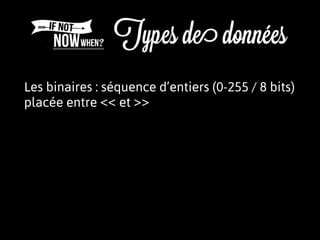
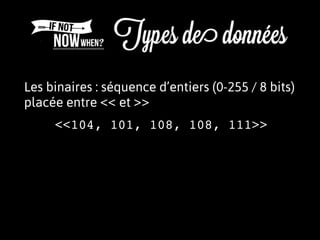
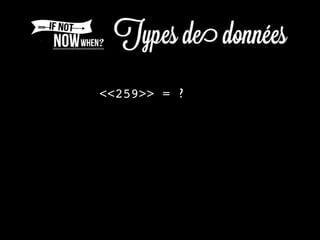
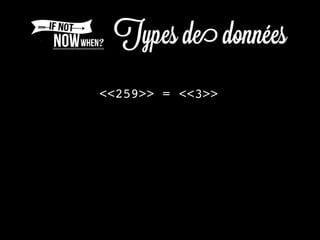
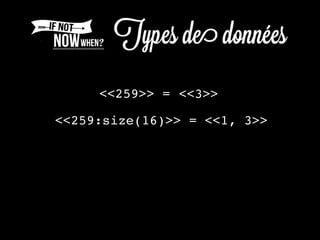
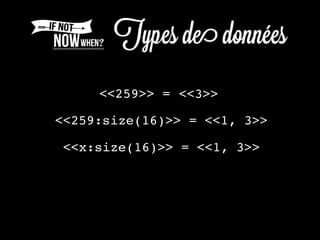
![Les binaires : séquence d’entiers (0-255 / 8 bits)
placée entre << et >>
<<[104, 101, 108, 108, 111]>>
<<104, 101, 108, 108, 111>>](https://image.slidesharecdn.com/elixir-parisrb-131008152110-phpapp02/85/Elixir-Paris-rb-12-320.jpg)
![Les binaires : séquence d’entiers (0-255 / 8 bits)
placée entre << et >>
<<[104, 101, 108, 108, 111]>>
<<'hello'>>
<<104, 101, 108, 108, 111>>](https://image.slidesharecdn.com/elixir-parisrb-131008152110-phpapp02/85/Elixir-Paris-rb-13-320.jpg)
![Les binaires : séquence d’entiers (0-255 / 8 bits)
placée entre << et >>
<<[104, 101, 108, 108, 111]>>
<<'hello'>>
"hello"
<<104, 101, 108, 108, 111>>](https://image.slidesharecdn.com/elixir-parisrb-131008152110-phpapp02/85/Elixir-Paris-rb-14-320.jpg)

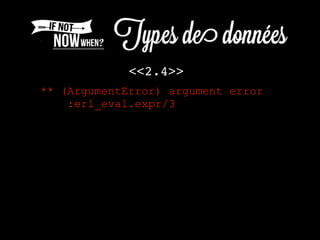
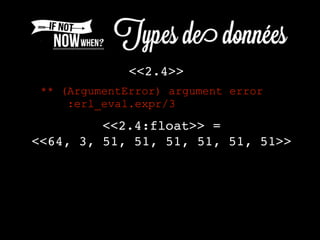
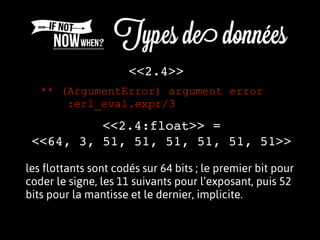
![binary, bits, bitstring, bytes, float,
integer, utf8, utf16, utf32
signed, unsigned
iex(1)> <<f::float, i::[size(32), signed]>> = <<64, 6, 102,
102, 102, 102, 102, 102, 255, 255, 254, 195>>
<<64, 6, 102, 102, 102, 102, 102, 102, 255, 255, 254, 195>>
iex(2)> f
2.8
iex(3)> i
-317](https://image.slidesharecdn.com/elixir-parisrb-131008152110-phpapp02/85/Elixir-Paris-rb-23-320.jpg)
![defmodule Test do
def circle(t) do
[x|tail] = t
tail ++ [x]
end
end
Test.circle [1, 2, 3]
# => [2, 3, 1]](https://image.slidesharecdn.com/elixir-parisrb-131008152110-phpapp02/85/Elixir-Paris-rb-24-320.jpg)
![defmodule Test do
def circle(t) do
[x|tail] = t
tail ++ [x]
end
end
Test.circle "123"
** (MatchError) no match of right
hand side value: "123"](https://image.slidesharecdn.com/elixir-parisrb-131008152110-phpapp02/85/Elixir-Paris-rb-25-320.jpg)
![defmodule Test do
def circle(t) when is_list(t) do
[x|tail] = t
tail ++ [x]
end
end
Test.circle [1, 2, 3]
# => [2, 3, 1]](https://image.slidesharecdn.com/elixir-parisrb-131008152110-phpapp02/85/Elixir-Paris-rb-26-320.jpg)
![defmodule Test do
def circle(t) when is_list(t) do
[x|tail] = t
tail ++ [x]
end
end
Test.circle "123"
** (FunctionClauseError) no function
clause matching in Test.circle/1](https://image.slidesharecdn.com/elixir-parisrb-131008152110-phpapp02/85/Elixir-Paris-rb-27-320.jpg)
![defmodule Test do
def circle([x|tail]) do
tail ++ [x]
end
end
Test.circle [1, 2, 3]
# => [2, 3, 1]](https://image.slidesharecdn.com/elixir-parisrb-131008152110-phpapp02/85/Elixir-Paris-rb-28-320.jpg)
![defmodule Test do
def circle([x|tail]) do
tail ++ [x]
end
end
Test.circle "123"
** (FunctionClauseError) no function
clause matching in Test.circle/1](https://image.slidesharecdn.com/elixir-parisrb-131008152110-phpapp02/85/Elixir-Paris-rb-29-320.jpg)
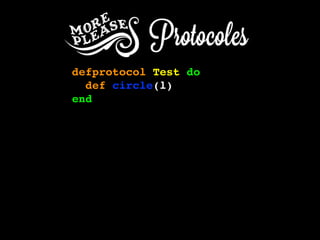
![defprotocol Test do
def circle(l)
end
defimpl Test, for: List do
def circle(l) do
[x|tail] = l
tail ++ [x]
end
end](https://image.slidesharecdn.com/elixir-parisrb-131008152110-phpapp02/85/Elixir-Paris-rb-31-320.jpg)
![defprotocol Test do
def circle(l)
end
defimpl Test, for: List do
def circle(l) do
[x|tail] = l
tail ++ [x]
end
end
Test.circle([1, 2, 3])
#=> [2, 3, 1]](https://image.slidesharecdn.com/elixir-parisrb-131008152110-phpapp02/85/Elixir-Paris-rb-32-320.jpg)
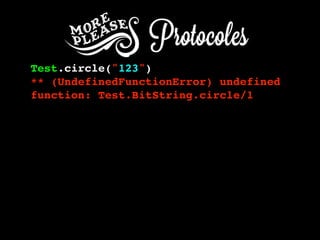
![Test.circle("123")
** (UndefinedFunctionError) undefined
function: Test.BitString.circle/1
defimpl Test, for: BitString do
def circle(l) do
[x|tail] = String.to_char_list!(l)
list_to_bitstring(tail ++ [x])
end
end](https://image.slidesharecdn.com/elixir-parisrb-131008152110-phpapp02/85/Elixir-Paris-rb-34-320.jpg)
![Test.circle("123")
** (UndefinedFunctionError) undefined
function: Test.BitString.circle/1
defimpl Test, for: BitString do
def circle(l) do
[x|tail] = String.to_char_list!(l)
list_to_bitstring(tail ++ [x])
end
end
Test.circle("123")
#=> "231"](https://image.slidesharecdn.com/elixir-parisrb-131008152110-phpapp02/85/Elixir-Paris-rb-35-320.jpg)
![|>
x = [1, 2, 3, 4]
x = Enum.filter(x, fn(e) -> rem(e, 2) == 0 end)
x = Enum.reduce(x, 0, fn(e, r) -> e + r end)](https://image.slidesharecdn.com/elixir-parisrb-131008152110-phpapp02/85/Elixir-Paris-rb-38-320.jpg)
![|>
x = [1, 2, 3, 4]
x = Enum.filter(x, fn(e) -> rem(e, 2) == 0 end)
x = Enum.reduce(x, 0, fn(e, r) -> e + r end)
x = [1, 2, 3, 4]
|> Enum.filter(fn(e) -> rem(e, 2) == 0 end)
|> Enum.reduce(0, fn(e, r) -> e + r end)](https://image.slidesharecdn.com/elixir-parisrb-131008152110-phpapp02/85/Elixir-Paris-rb-39-320.jpg)
![|>
x = [1, 2, 3, 4]
x = Enum.filter(x, fn(e) -> rem(e, 2) == 0 end)
x = Enum.reduce(x, 0, fn(e, r) -> e + r end)
x = [1, 2, 3, 4]
|> Enum.filter(fn(e) -> rem(e, 2) == 0 end)
|> Enum.reduce(0, fn(e, r) -> e + r end)
x = [1, 2, 3, 4]
|> Enum.filter(&(rem(&1, 2) == 0))
|> Enum.reduce(0, &(&1 + &2))](https://image.slidesharecdn.com/elixir-parisrb-131008152110-phpapp02/85/Elixir-Paris-rb-40-320.jpg)





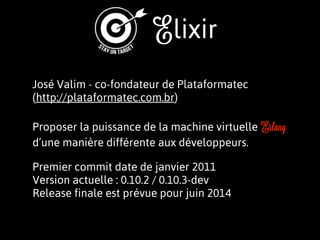
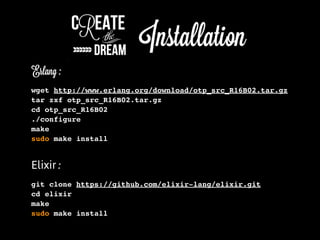
This document provides an overview of Elixir and its relationship to Erlang. It discusses how Elixir was created to expose Erlang's powerful virtual machine to developers in a different way. It then covers topics like installing Elixir and Erlang, variables and their differences between the languages, data types like binaries and protocols.


![5G Explained! A High Level Overview [Introduction]](https://cdn.slidesharecdn.com/ss_thumbnails/5gexplainedahighleveloverview-260119165306-cc137a3e-thumbnail.jpg?width=640&height=640&fit=bounds)


