ELIMINATION ROUND
ICT CHALLENGE
INSTRUCTIONS
• The Quiz Bee consists of [number] rounds, which include:
• Easy Round [multiple-choice questions, timed]
• Average Round
• Difficult Round
• Timing:
• Each participant will have [time limit, e.g., 10 seconds] to answer each question.
• The time limit for each round may vary—please pay attention to the
announcements.
• Answering Questions:
• All questions will be displayed on the screen or read aloud by the Quiz Master.
• Participants must write their answers clearly or speak up when instructed to do
so.
Instructions
• Correct answers will earn number points.
• Incorrect answers may result in no points, or in some rounds, a deduction
of number points.
• The participant with the highest score at the end of all rounds will be
declared the winner.
• Types of Questions:
• The questions may come in the form of Multiple Choice, True/False,
Fill in the Blanks, or Open-Ended Questions.
Rules for Participants:
• Conduct:
• Keep your focus on the competition. Distractions or disruptive behavior may result in
disqualification.
• No communication with other participants, audience members, or coaches during the quiz.
• Participants are not allowed to use any electronic devices, books, or notes during the quiz.
• Clarifications:
• If you do not understand the question, you may request a clarification. However, this must be done
before answering.
• The Quiz Master will provide clarification, if necessary, but the original wording of the question
stands.
• Disqualification:
• If a participant is found cheating or violating any rules, they will be immediately disqualified from the
competition.
• Winning:
• The participant with the highest score at the end of all rounds will be the winner.
ICT
ICT CHALLENGE
EASY
ROUND 1-5 ITEMS
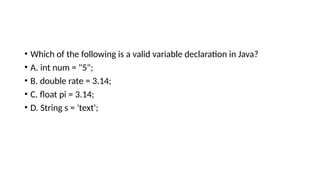
• Which of the following is a valid variable declaration in Java?
• A. int num = "5";
• B. double rate = 3.14;
• C. float pi = 3.14;
• D. String s = 'text';
• Answer: B. double rate = 3.14;
• What is the correct syntax of the main method in a Java program?
A. public static void Main(String[] args)
B. public void static main(String args[])
C. public static void main(String[] args)
D. static public void main(String args)
• Answer: C. public static void main(String[] args)
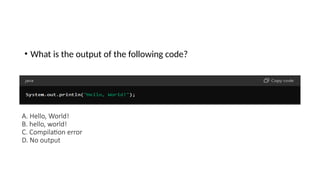
A. Hello, World!
B. hello, world!
C. Compilation error
D. No output
• What is the output of the following code?
• Answer: A. Hello, World!
• Which of the following is used to write a single-line comment in Java?
• A. # This is a comment
• B. /* This is a comment */
• C. // This is a comment
• D. <!-- This is a comment -->
• Answer: C. // This is a comment
AVERAGE ROUND
ICT CHALLENGE
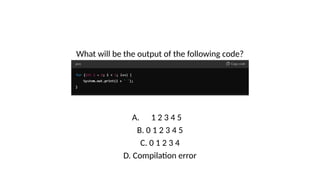
What will be the output of the following code?
A. 1 2 3 4 5
B. 0 1 2 3 4 5
C. 0 1 2 3 4
D. Compilation error
• Answer: C. 0 1 2 3 4Explanation: The loop starts from i = 0 and
continues until i < 5. Therefore, it prints 0 to 4 (exclusive of 5).
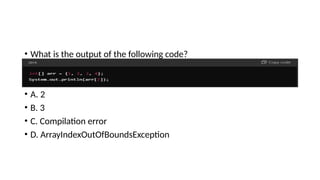
• What is the output of the following code?
•
• A. 2
• B. 3
• C. Compilation error
• D. ArrayIndexOutOfBoundsException
• Answer: B. 3Explanation: Arrays in Java are zero-indexed, so arr[2]
accesses the third element, which is 3.
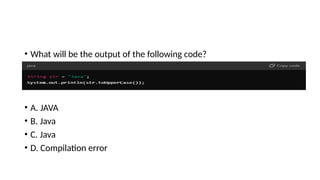
• What will be the output of the following code?
• A. JAVA
• B. Java
• C. Java
• D. Compilation error
• nswer: A. JAVAExplanation: The toUpperCase() method converts all
characters in the string to uppercase.
• Which of the following is true about a try-catch block in Java?
• A. A try block must always be followed by a catch block.
• B. A try block can be followed by either a catch or a finally block.
• C. A try block must always be followed by both catch and finally
blocks.
• D. A catch block can exist without a try block
• Answer: B. A try block can be followed by either a catch or a finally
block.Explanation: A try block must have at least one accompanying
catch or finally block to handle exceptions or execute cleanup code.
• Which statement about Java methods is correct?
• A. Methods must always return a value.
• B. Methods can be overloaded.
• C. The return statement is optional for methods with a return type.
• D. Methods cannot have the same name in a class.
• Answer: B. Methods can be overloaded.
Explanation: Method overloading allows multiple methods in a class
with the same name but different parameter lists. A method must
return a value if it has a return type, and methods can have the same
name as long as their parameter lists differ.
DIFFICULT ROUND
ROUND 1-5 ITEMS
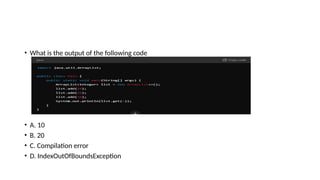
• What is the output of the following code
• A. 10
• B. 20
• C. Compilation error
• D. IndexOutOfBoundsException
• Answer: B. 20Explanation: The get() method retrieves the element at
the specified index. Since the list is zero-indexed, list.get(1) accesses
the second element, which is 20.
• Which of the following is the correct way to create a thread in Java?
• A. By extending the Runnable interface
• B. By implementing the Thread class
• C. By extending the Thread class or implementing the Runnable
interface
• D. Java does not support multithreading
• Answer: C. By extending the Thread class or implementing the
Runnable interfaceExplanation: In Java, threads can be created by
either extending the Thread class or implementing the Runnable
interface and passing it to a Thread object.
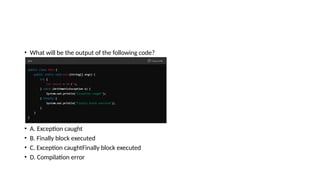
• What will be the output of the following code?
• A. Exception caught
• B. Finally block executed
• C. Exception caughtFinally block executed
• D. Compilation error
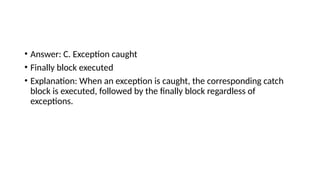
• Answer: C. Exception caught
• Finally block executed
• Explanation: When an exception is caught, the corresponding catch
block is executed, followed by the finally block regardless of
exceptions.
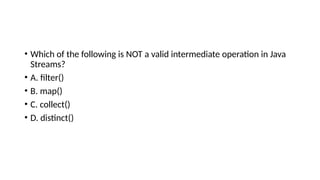
• Which of the following is NOT a valid intermediate operation in Java
Streams?
• A. filter()
• B. map()
• C. collect()
• D. distinct()
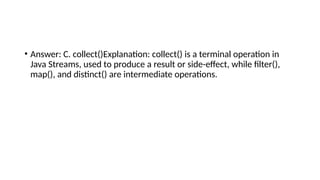
• Answer: C. collect()Explanation: collect() is a terminal operation in
Java Streams, used to produce a result or side-effect, while filter(),
map(), and distinct() are intermediate operations.
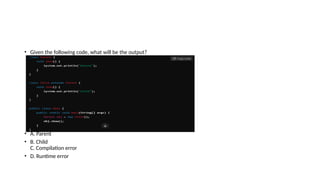
• Given the following code, what will be the output?
• A. Parent
• B. Child
C. Compilation error
• D. Runtime error
• Answer: B. ChildExplanation: The method call obj.show() exhibits
runtime polymorphism. Since obj refers to a Child instance, the
show() method of the Child class is invoked.

ELIMINATION ROUND for ISAAL game plan.pptx

  • 1.
  • 2.
    INSTRUCTIONS • The QuizBee consists of [number] rounds, which include: • Easy Round [multiple-choice questions, timed] • Average Round • Difficult Round • Timing: • Each participant will have [time limit, e.g., 10 seconds] to answer each question. • The time limit for each round may vary—please pay attention to the announcements. • Answering Questions: • All questions will be displayed on the screen or read aloud by the Quiz Master. • Participants must write their answers clearly or speak up when instructed to do so.
  • 3.
    Instructions • Correct answerswill earn number points. • Incorrect answers may result in no points, or in some rounds, a deduction of number points. • The participant with the highest score at the end of all rounds will be declared the winner. • Types of Questions: • The questions may come in the form of Multiple Choice, True/False, Fill in the Blanks, or Open-Ended Questions.
  • 4.
    Rules for Participants: •Conduct: • Keep your focus on the competition. Distractions or disruptive behavior may result in disqualification. • No communication with other participants, audience members, or coaches during the quiz. • Participants are not allowed to use any electronic devices, books, or notes during the quiz. • Clarifications: • If you do not understand the question, you may request a clarification. However, this must be done before answering. • The Quiz Master will provide clarification, if necessary, but the original wording of the question stands. • Disqualification: • If a participant is found cheating or violating any rules, they will be immediately disqualified from the competition. • Winning: • The participant with the highest score at the end of all rounds will be the winner.
  • 5.
  • 6.
  • 7.
    • Which ofthe following is a valid variable declaration in Java? • A. int num = "5"; • B. double rate = 3.14; • C. float pi = 3.14; • D. String s = 'text';
  • 8.
    • Answer: B.double rate = 3.14;
  • 9.
    • What isthe correct syntax of the main method in a Java program? A. public static void Main(String[] args) B. public void static main(String args[]) C. public static void main(String[] args) D. static public void main(String args)
  • 10.
    • Answer: C.public static void main(String[] args)
  • 11.
    A. Hello, World! B.hello, world! C. Compilation error D. No output • What is the output of the following code?
  • 12.
    • Answer: A.Hello, World!
  • 13.
    • Which ofthe following is used to write a single-line comment in Java? • A. # This is a comment • B. /* This is a comment */ • C. // This is a comment • D. <!-- This is a comment -->
  • 14.
    • Answer: C.// This is a comment
  • 15.
  • 16.
    What will bethe output of the following code? A. 1 2 3 4 5 B. 0 1 2 3 4 5 C. 0 1 2 3 4 D. Compilation error
  • 17.
    • Answer: C.0 1 2 3 4Explanation: The loop starts from i = 0 and continues until i < 5. Therefore, it prints 0 to 4 (exclusive of 5).
  • 18.
    • What isthe output of the following code? • • A. 2 • B. 3 • C. Compilation error • D. ArrayIndexOutOfBoundsException
  • 19.
    • Answer: B.3Explanation: Arrays in Java are zero-indexed, so arr[2] accesses the third element, which is 3.
  • 20.
    • What willbe the output of the following code? • A. JAVA • B. Java • C. Java • D. Compilation error
  • 21.
    • nswer: A.JAVAExplanation: The toUpperCase() method converts all characters in the string to uppercase.
  • 22.
    • Which ofthe following is true about a try-catch block in Java? • A. A try block must always be followed by a catch block. • B. A try block can be followed by either a catch or a finally block. • C. A try block must always be followed by both catch and finally blocks. • D. A catch block can exist without a try block
  • 23.
    • Answer: B.A try block can be followed by either a catch or a finally block.Explanation: A try block must have at least one accompanying catch or finally block to handle exceptions or execute cleanup code.
  • 24.
    • Which statementabout Java methods is correct? • A. Methods must always return a value. • B. Methods can be overloaded. • C. The return statement is optional for methods with a return type. • D. Methods cannot have the same name in a class.
  • 25.
    • Answer: B.Methods can be overloaded. Explanation: Method overloading allows multiple methods in a class with the same name but different parameter lists. A method must return a value if it has a return type, and methods can have the same name as long as their parameter lists differ.
  • 26.
  • 27.
    • What isthe output of the following code • A. 10 • B. 20 • C. Compilation error • D. IndexOutOfBoundsException
  • 28.
    • Answer: B.20Explanation: The get() method retrieves the element at the specified index. Since the list is zero-indexed, list.get(1) accesses the second element, which is 20.
  • 29.
    • Which ofthe following is the correct way to create a thread in Java? • A. By extending the Runnable interface • B. By implementing the Thread class • C. By extending the Thread class or implementing the Runnable interface • D. Java does not support multithreading
  • 30.
    • Answer: C.By extending the Thread class or implementing the Runnable interfaceExplanation: In Java, threads can be created by either extending the Thread class or implementing the Runnable interface and passing it to a Thread object.
  • 31.
    • What willbe the output of the following code? • A. Exception caught • B. Finally block executed • C. Exception caughtFinally block executed • D. Compilation error
  • 32.
    • Answer: C.Exception caught • Finally block executed • Explanation: When an exception is caught, the corresponding catch block is executed, followed by the finally block regardless of exceptions.
  • 33.
    • Which ofthe following is NOT a valid intermediate operation in Java Streams? • A. filter() • B. map() • C. collect() • D. distinct()
  • 34.
    • Answer: C.collect()Explanation: collect() is a terminal operation in Java Streams, used to produce a result or side-effect, while filter(), map(), and distinct() are intermediate operations.
  • 35.
    • Given thefollowing code, what will be the output? • A. Parent • B. Child C. Compilation error • D. Runtime error
  • 36.
    • Answer: B.ChildExplanation: The method call obj.show() exhibits runtime polymorphism. Since obj refers to a Child instance, the show() method of the Child class is invoked.