ELEMENTS OF WRITING
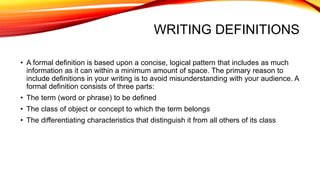
WRITING DEFINITIONS
• A formal definition is based upon a concise, logical pattern that includes as much
information as it can within a minimum amount of space. The primary reason to
include definitions in your writing is to avoid misunderstanding with your audience. A
formal definition consists of three parts:
• The term (word or phrase) to be defined
• The class of object or concept to which the term belongs
• The differentiating characteristics that distinguish it from all others of its class
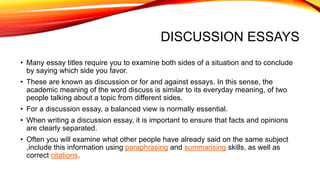
DISCUSSION ESSAYS
• Many essay titles require you to examine both sides of a situation and to conclude
by saying which side you favor.
• These are known as discussion or for and against essays. In this sense, the
academic meaning of the word discuss is similar to its everyday meaning, of two
people talking about a topic from different sides.
• For a discussion essay, a balanced view is normally essential.
• When writing a discussion essay, it is important to ensure that facts and opinions
are clearly separated.
• Often you will examine what other people have already said on the same subject
,include this information using paraphrasing and summarising skills, as well as
correct citations.
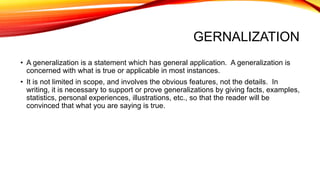
GERNALIZATION
• A generalization is a statement which has general application. A generalization is
concerned with what is true or applicable in most instances.
• It is not limited in scope, and involves the obvious features, not the details. In
writing, it is necessary to support or prove generalizations by giving facts, examples,
statistics, personal experiences, illustrations, etc., so that the reader will be
convinced that what you are saying is true.
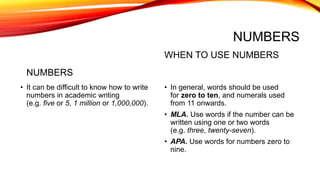
NUMBERS
NUMBERS
• It can be difficult to know how to write
numbers in academic writing
(e.g. five or 5, 1 million or 1,000,000).
WHEN TO USE NUMBERS
• In general, words should be used
for zero to ten, and numerals used
from 11 onwards.
• MLA. Use words if the number can be
written using one or two words
(e.g. three, twenty-seven).
• APA. Use words for numbers zero to
nine.
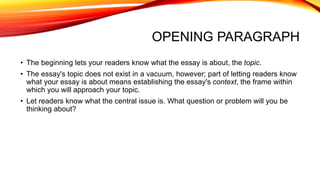
OPENING PARAGRAPH
• The beginning lets your readers know what the essay is about, the topic.
• The essay's topic does not exist in a vacuum, however; part of letting readers know
what your essay is about means establishing the essay's context, the frame within
which you will approach your topic.
• Let readers know what the central issue is. What question or problem will you be
thinking about?
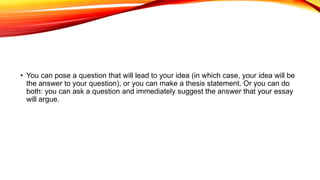
• You can pose a question that will lead to your idea (in which case, your idea will be
the answer to your question), or you can make a thesis statement. Or you can do
both: you can ask a question and immediately suggest the answer that your essay
will argue.
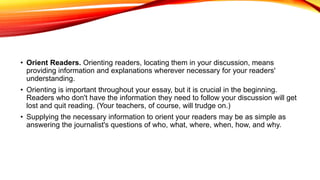
• Orient Readers. Orienting readers, locating them in your discussion, means
providing information and explanations wherever necessary for your readers'
understanding.
• Orienting is important throughout your essay, but it is crucial in the beginning.
Readers who don't have the information they need to follow your discussion will get
lost and quit reading. (Your teachers, of course, will trudge on.)
• Supplying the necessary information to orient your readers may be as simple as
answering the journalist's questions of who, what, where, when, how, and why.
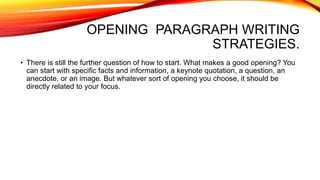
OPENING PARAGRAPH WRITING
STRATEGIES.
• There is still the further question of how to start. What makes a good opening? You
can start with specific facts and information, a keynote quotation, a question, an
anecdote, or an image. But whatever sort of opening you choose, it should be
directly related to your focus.
TWO WAYS OF WRITING AN
INTRODUCTORY PARAGRAPH
• The history-of-the-world (or long-distance) opening, which aims to establish a
context for the essay by getting a long running start: "Ever since the
dawn of civilized life, societies have struggled to
reconcile the need for change with the need for
order."
• What are we talking about here, political revolution or a new brand of soft drink? Get
to it.
• The funnel opening (a variation on the same theme), which starts with something
broad and general and "funnels" its way down to a specific topic.
ASSIGNMENT

Elements of writing.pptx

  • 1.
  • 2.
    WRITING DEFINITIONS • Aformal definition is based upon a concise, logical pattern that includes as much information as it can within a minimum amount of space. The primary reason to include definitions in your writing is to avoid misunderstanding with your audience. A formal definition consists of three parts: • The term (word or phrase) to be defined • The class of object or concept to which the term belongs • The differentiating characteristics that distinguish it from all others of its class
  • 3.
    DISCUSSION ESSAYS • Manyessay titles require you to examine both sides of a situation and to conclude by saying which side you favor. • These are known as discussion or for and against essays. In this sense, the academic meaning of the word discuss is similar to its everyday meaning, of two people talking about a topic from different sides. • For a discussion essay, a balanced view is normally essential. • When writing a discussion essay, it is important to ensure that facts and opinions are clearly separated. • Often you will examine what other people have already said on the same subject ,include this information using paraphrasing and summarising skills, as well as correct citations.
  • 4.
    GERNALIZATION • A generalizationis a statement which has general application. A generalization is concerned with what is true or applicable in most instances. • It is not limited in scope, and involves the obvious features, not the details. In writing, it is necessary to support or prove generalizations by giving facts, examples, statistics, personal experiences, illustrations, etc., so that the reader will be convinced that what you are saying is true.
  • 5.
    NUMBERS NUMBERS • It canbe difficult to know how to write numbers in academic writing (e.g. five or 5, 1 million or 1,000,000). WHEN TO USE NUMBERS • In general, words should be used for zero to ten, and numerals used from 11 onwards. • MLA. Use words if the number can be written using one or two words (e.g. three, twenty-seven). • APA. Use words for numbers zero to nine.
  • 6.
    OPENING PARAGRAPH • Thebeginning lets your readers know what the essay is about, the topic. • The essay's topic does not exist in a vacuum, however; part of letting readers know what your essay is about means establishing the essay's context, the frame within which you will approach your topic. • Let readers know what the central issue is. What question or problem will you be thinking about?
  • 7.
    • You canpose a question that will lead to your idea (in which case, your idea will be the answer to your question), or you can make a thesis statement. Or you can do both: you can ask a question and immediately suggest the answer that your essay will argue.
  • 8.
    • Orient Readers.Orienting readers, locating them in your discussion, means providing information and explanations wherever necessary for your readers' understanding. • Orienting is important throughout your essay, but it is crucial in the beginning. Readers who don't have the information they need to follow your discussion will get lost and quit reading. (Your teachers, of course, will trudge on.) • Supplying the necessary information to orient your readers may be as simple as answering the journalist's questions of who, what, where, when, how, and why.
  • 9.
    OPENING PARAGRAPH WRITING STRATEGIES. •There is still the further question of how to start. What makes a good opening? You can start with specific facts and information, a keynote quotation, a question, an anecdote, or an image. But whatever sort of opening you choose, it should be directly related to your focus.
  • 10.
    TWO WAYS OFWRITING AN INTRODUCTORY PARAGRAPH • The history-of-the-world (or long-distance) opening, which aims to establish a context for the essay by getting a long running start: "Ever since the dawn of civilized life, societies have struggled to reconcile the need for change with the need for order." • What are we talking about here, political revolution or a new brand of soft drink? Get to it.
  • 11.
    • The funnelopening (a variation on the same theme), which starts with something broad and general and "funnels" its way down to a specific topic.
  • 12.