Records Management
Electronic Retention
Records Management
                       Mission


To manage the systematic
control of the creation,
maintenance, use, and
disposition of records
regardless of physical form
at ECSU in order to achieve
adequate and proper
documentation of the policies
and transactions of the university.
RECORDS MANAGEMENT:
              AUTHORITY


The Department of Cultural Resources has
been directed by North Carolina General
Statutes 121-4 (s) and 132 -8 to conduct a
records management program.
RECORDS MANAGEMENT:
                Electronic Records


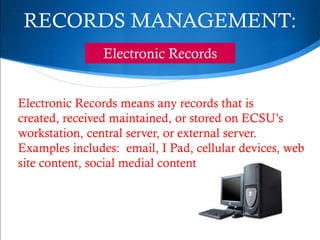
Electronic Records means any records that is
created, received maintained, or stored on ECSU’s
workstation, central server, or external server.
Examples includes: email, I Pad, cellular devices, web
site content, social medial content.
RECORDS MANAGEMENT:
                Electronic Records


Universities are required to comply with all
Department of Cultural Resources records
management directive with regard to Electronic
Records including The University of North
Carolina, General Records Retention and Disposition
Schedule, April 2007.
RECORDS MANAGEMENT:
             Electronic Records


The Department of Cultural Resources requires
Information Technology Services to perform
regular e-mail system backup.
Additionally, emails systems should be responsive
to E-discoveries.
Questions and Comments?
Contact Information

Jean Bischoff                  Pernell Bartlett
Room 216 GR Little Library     Room 214 GR Little Library
jbbischoff@mail.ecsu.edu       pdbartlett@mail.ecsu.edu
335-3647                       335-8537

Electronic records retention

  • 1.
  • 2.
    Records Management Mission To manage the systematic control of the creation, maintenance, use, and disposition of records regardless of physical form at ECSU in order to achieve adequate and proper documentation of the policies and transactions of the university.
  • 3.
    RECORDS MANAGEMENT: AUTHORITY The Department of Cultural Resources has been directed by North Carolina General Statutes 121-4 (s) and 132 -8 to conduct a records management program.
  • 4.
    RECORDS MANAGEMENT: Electronic Records Electronic Records means any records that is created, received maintained, or stored on ECSU’s workstation, central server, or external server. Examples includes: email, I Pad, cellular devices, web site content, social medial content.
  • 5.
    RECORDS MANAGEMENT: Electronic Records Universities are required to comply with all Department of Cultural Resources records management directive with regard to Electronic Records including The University of North Carolina, General Records Retention and Disposition Schedule, April 2007.
  • 6.
    RECORDS MANAGEMENT: Electronic Records The Department of Cultural Resources requires Information Technology Services to perform regular e-mail system backup. Additionally, emails systems should be responsive to E-discoveries.
  • 7.
  • 8.
    Contact Information Jean Bischoff Pernell Bartlett Room 216 GR Little Library Room 214 GR Little Library jbbischoff@mail.ecsu.edu pdbartlett@mail.ecsu.edu 335-3647 335-8537

Editor's Notes

  • #5 Called “Institutional Records Management”, ECSU follows the Guidelines established by the General Administration in 2007 defining what are “Public Records” and how universities are to retain, store, and dispose of them. Each campus academic and administrative unit has a unique set of record series which they deal with on a daily basis. The records management activities of University Archives center around assisting departmental staff with creating planning documents to assure their compliance with UNC-GA guidelines and overseeing that the University carries out its legal duties regarding “Public Records”.
  • #6 Preserving our unique historical photos, manuscripts, publications, blueprints and artifacts is daccomplished in many ways. Some items are rehoused in acid-free enclosures, while others are cleaned and stored in archival boxes. Digitization is the primary format we currently use to both save and make photos, yearbooks, catalogs and school newspapers available.
  • #7 Preserving our unique historical photos, manuscripts, publications, blueprints and artifacts is accomplished in many ways. Some items are rehoused in acid-free enclosures, while others are cleaned and stored in archival boxes. Digitization is the primary format we currently use to both save and make photos, yearbooks, catalogs and school newspapers available.