Enhancing Rail Madad Website
Mini Project 2A
TE-IT
Guided By : Prof. Stella J.
Assistant Professor, Department of Information Technology
3/27/2023 1
Nitish Jha Harsh Kalim
Smit Makwana Vijay Kandala
Group Members
1
2
🞂 Problem Statement
🞂 Literature
🞂 Technical Approach
🞂 Work Flow
🞂 Challenges
🞂 Conclusion & Future Work
Summary/Index
3
 Challenges in the Current System:
In today’s [specific system], users face challenges such as long delays in
processing requests, frequent human errors, and an overall lack of efficiency.
These problems slow down operations and lead to user frustration.
There is also a lack of real-time information, meaning users and staff have to
manually follow up on issues, causing further delays.
 Our Solution:
To tackle these challenges, we are developing a system that integrates AI and
automation. This will streamline the process, ensuring faster, more accurate issue
resolution and minimizing the need for human intervention.
 Key Benefits:
• Real-time updates will provide instant notifications to users.
• Issues will be automatically categorized and routed to the correct team,
ensuring no delays.
• By reducing manual handling, we will minimize human errors and increase
overall system efficiency.
Problem Statement
4
Literature/Survey
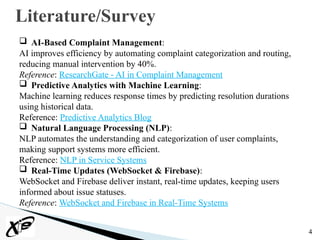
 AI-Based Complaint Management:
AI improves efficiency by automating complaint categorization and routing,
reducing manual intervention by 40%.
Reference: ResearchGate - AI in Complaint Management
 Predictive Analytics with Machine Learning:
Machine learning reduces response times by predicting resolution durations
using historical data.
Reference: Predictive Analytics Blog
 Natural Language Processing (NLP):
NLP automates the understanding and categorization of user complaints,
making support systems more efficient.
Reference: NLP in Service Systems
 Real-Time Updates (WebSocket & Firebase):
WebSocket and Firebase deliver instant, real-time updates, keeping users
informed about issue statuses.
Reference: WebSocket and Firebase in Real-Time Systems
5
Technical Approach
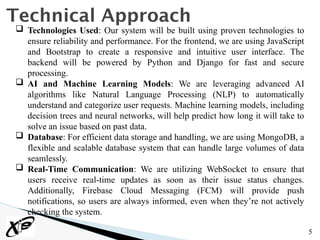
 Technologies Used: Our system will be built using proven technologies to
ensure reliability and performance. For the frontend, we are using JavaScript
and Bootstrap to create a responsive and intuitive user interface. The
backend will be powered by Python and Django for fast and secure
processing.
 AI and Machine Learning Models: We are leveraging advanced AI
algorithms like Natural Language Processing (NLP) to automatically
understand and categorize user requests. Machine learning models, including
decision trees and neural networks, will help predict how long it will take to
solve an issue based on past data.
 Database: For efficient data storage and handling, we are using MongoDB, a
flexible and scalable database system that can handle large volumes of data
seamlessly.
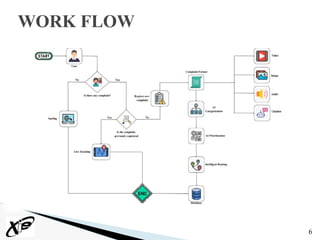
 Real-Time Communication: We are utilizing WebSocket to ensure that
users receive real-time updates as soon as their issue status changes.
Additionally, Firebase Cloud Messaging (FCM) will provide push
notifications, so users are always informed, even when they’re not actively
checking the system.
6
WORK FLOW
7
Challenges
 Data Quality:
One of the main challenges is ensuring that the data used by our AI
models is accurate and up-to-date. To address this, we will implement
data validation processes and continuous monitoring.
 System Integration:
Integrating the new system with existing infrastructure can be complex,
especially in older environments. Our strategy includes thorough
testing and collaboration with IT teams to ensure seamless integration.
 Conclusion & Future Work:
In conclusion, our project addresses key inefficiencies in the
current system by introducing automation and AI-based decision
making. With real-time tracking and improved issue resolution
times, we expect to significantly enhance both user satisfaction
and operational efficiency.
 Future Enhancements:
o Moving forward, we plan to explore deeper AI integrations,
such as predictive maintenance and IoT-based monitoring to
anticipate issues before they arise.
o We also aim to gather user feedback and continuously improve
the system, making it even more responsive and efficient.
8
Conclusion
9
RESEARCH AND REFERENCES
 REFERENCES
• https://railmadad.indianrailways.gov.in/madad/final/home.jsp
• https://www.railway-technology.com/news/indian-railways-digit
ises-complaint-management-system/?cf-view
 RESEARCH
• https://www.qwak.com/post/considering-feasibility-desirability-and-
viability-when-developing-ai-products
• https://medium.com/@jainvidip/understanding-decision-trees-1ba0e
f5f6bb4
• https://www.slingshotapp.io/blog/predictive-analytics
10
Thank You

ElectroManagementSystemscaajjdhdhdhdhdhdhdhh

  • 1.
    Enhancing Rail MadadWebsite Mini Project 2A TE-IT Guided By : Prof. Stella J. Assistant Professor, Department of Information Technology 3/27/2023 1 Nitish Jha Harsh Kalim Smit Makwana Vijay Kandala Group Members 1
  • 2.
    2 🞂 Problem Statement 🞂Literature 🞂 Technical Approach 🞂 Work Flow 🞂 Challenges 🞂 Conclusion & Future Work Summary/Index
  • 3.
    3  Challenges inthe Current System: In today’s [specific system], users face challenges such as long delays in processing requests, frequent human errors, and an overall lack of efficiency. These problems slow down operations and lead to user frustration. There is also a lack of real-time information, meaning users and staff have to manually follow up on issues, causing further delays.  Our Solution: To tackle these challenges, we are developing a system that integrates AI and automation. This will streamline the process, ensuring faster, more accurate issue resolution and minimizing the need for human intervention.  Key Benefits: • Real-time updates will provide instant notifications to users. • Issues will be automatically categorized and routed to the correct team, ensuring no delays. • By reducing manual handling, we will minimize human errors and increase overall system efficiency. Problem Statement
  • 4.
    4 Literature/Survey  AI-Based ComplaintManagement: AI improves efficiency by automating complaint categorization and routing, reducing manual intervention by 40%. Reference: ResearchGate - AI in Complaint Management  Predictive Analytics with Machine Learning: Machine learning reduces response times by predicting resolution durations using historical data. Reference: Predictive Analytics Blog  Natural Language Processing (NLP): NLP automates the understanding and categorization of user complaints, making support systems more efficient. Reference: NLP in Service Systems  Real-Time Updates (WebSocket & Firebase): WebSocket and Firebase deliver instant, real-time updates, keeping users informed about issue statuses. Reference: WebSocket and Firebase in Real-Time Systems
  • 5.
    5 Technical Approach  TechnologiesUsed: Our system will be built using proven technologies to ensure reliability and performance. For the frontend, we are using JavaScript and Bootstrap to create a responsive and intuitive user interface. The backend will be powered by Python and Django for fast and secure processing.  AI and Machine Learning Models: We are leveraging advanced AI algorithms like Natural Language Processing (NLP) to automatically understand and categorize user requests. Machine learning models, including decision trees and neural networks, will help predict how long it will take to solve an issue based on past data.  Database: For efficient data storage and handling, we are using MongoDB, a flexible and scalable database system that can handle large volumes of data seamlessly.  Real-Time Communication: We are utilizing WebSocket to ensure that users receive real-time updates as soon as their issue status changes. Additionally, Firebase Cloud Messaging (FCM) will provide push notifications, so users are always informed, even when they’re not actively checking the system.
  • 6.
  • 7.
    7 Challenges  Data Quality: Oneof the main challenges is ensuring that the data used by our AI models is accurate and up-to-date. To address this, we will implement data validation processes and continuous monitoring.  System Integration: Integrating the new system with existing infrastructure can be complex, especially in older environments. Our strategy includes thorough testing and collaboration with IT teams to ensure seamless integration.
  • 8.
     Conclusion &Future Work: In conclusion, our project addresses key inefficiencies in the current system by introducing automation and AI-based decision making. With real-time tracking and improved issue resolution times, we expect to significantly enhance both user satisfaction and operational efficiency.  Future Enhancements: o Moving forward, we plan to explore deeper AI integrations, such as predictive maintenance and IoT-based monitoring to anticipate issues before they arise. o We also aim to gather user feedback and continuously improve the system, making it even more responsive and efficient. 8 Conclusion
  • 9.
    9 RESEARCH AND REFERENCES REFERENCES • https://railmadad.indianrailways.gov.in/madad/final/home.jsp • https://www.railway-technology.com/news/indian-railways-digit ises-complaint-management-system/?cf-view  RESEARCH • https://www.qwak.com/post/considering-feasibility-desirability-and- viability-when-developing-ai-products • https://medium.com/@jainvidip/understanding-decision-trees-1ba0e f5f6bb4 • https://www.slingshotapp.io/blog/predictive-analytics
  • 10.