MAHENDRA ENGINEERING COLLEGE
(Autonomous)
Name of the College : MAHENDRA ENGINEERING COLLEGE
Name of the Team : TECH TREK
Name of the Team Leader : HARINI N
Name of the Department : CSE
Problem Statement : AI- POWERED TRAFFIC MANAGEMENT SYSTEM: Develop
areal time traffic monitoring and optimization system using AI.
Date : 21/02/2025
CATCH ‘25 – Hackathon
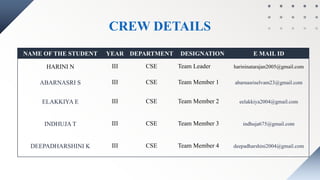
CREW DETAILS
NAME OF THE STUDENT YEAR DEPARTMENT DESIGNATION E MAIL ID
HARINI N III CSE Team Leader harininatarajan2005@gmail.com
ABARNASRI S III CSE Team Member 1 abarnasriselvam23@gmail.com
ELAKKIYA E III CSE Team Member 2 eelakkiya2004@gmail.com
INDHUJA T III CSE Team Member 3 indhuja675@gmail.com
DEEPADHARSHINI K III CSE Team Member 4 deepadharshini2004@gmail.com
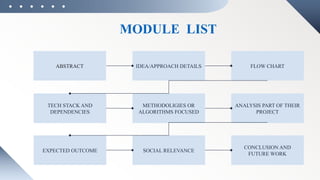
ABSTRACT IDEA/APPROACH DETAILS FLOW CHART
TECH STACK AND
DEPENDENCIES
ANALYSIS PART OF THEIR
PROJECT
METHODOLIGIES OR
ALGORITHMS FOCUSED
MODULE LIST
EXPECTED OUTCOME
CONCLUSION AND
FUTURE WORK
SOCIAL RELEVANCE
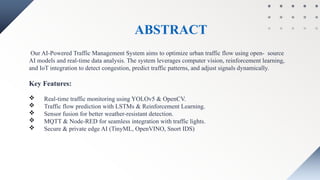
ABSTRACT
Our AI-Powered Traffic Management System aims to optimize urban traffic flow using open- source
AI models and real-time data analysis. The system leverages computer vision, reinforcement learning,
and IoT integration to detect congestion, predict traffic patterns, and adjust signals dynamically.
Key Features:
 Real-time traffic monitoring using YOLOv5 & OpenCV.
 Traffic flow prediction with LSTMs & Reinforcement Learning.
 Sensor fusion for better weather-resistant detection.
 MQTT & Node-RED for seamless integration with traffic lights.
 Secure & private edge AI (TinyML, OpenVINO, Snort IDS)
IDEA/APPROACH DETAILS
Problem: Existing traffic systems face high costs, privacy concerns, and inefficiency.
Approach: Develop a low-cost AI-powered adaptive system using open-source software.
How It Works:
1. Capture real-time traffic data from cameras, sensors, and crowdsourced sources.
2. AI analyzes vehicle count, congestion levels, and unexpected events.
3. The system dynamically adjusts signals and suggests optimized routes.
4. Traffic authorities access a dashboard for monitoring & decision-making.
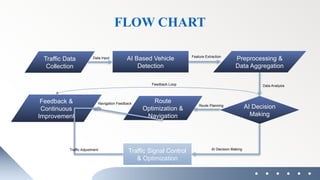
FLOW CHART
Traffic Data
Collection
AI Based Vehicle
Detection
Preprocessing &
Data Aggregation
AI Decision
Making
Feedback &
Continuous
Improvement
Route
Optimization &
Navigation
Traffic Signal Control
& Optimization
Data Input Feature Extraction
Data Analysis
Route Planning
Navigation Feedback
AI Decision Making
Traffic Adjustment
Feedback Loop
METHODOLIGIES OR
ALGORITHMS FOCUSED
 Computer Vision (YOLOv5 + OpenCV): Detects vehicles & congestion levels.
 Reinforcement Learning (Stable-Baselines3): Adaptive signal control.
 LSTMs (TensorFlow/PyTorch): Traffic pattern prediction.
 Sensor Fusion (ROS + TinyML): Handles bad weather conditions.
 SUMO (Simulation of Urban Mobility): AI model testing in a virtual city.
ANALYSIS OF THE PROJECT
Strengths:
 Low-cost solution using free open-source software
 Privacy-focused – processes data locally on edge devices
 Adaptable AI system – Reinforcement Learning improves over time
 Works with existing traffic infrastructure (easy to integrate via MQTT)
Challenges & Solutions:
 Challenge: Low visibility in fog → Solution: Sensor Fusion with radar + AI
 Challenge: High processing power required → Solution: Optimize models using OpenVINO &
ONNX .
EXPECTED OUTCOME
 Real-time traffic management with AI-powered dynamic signal control.
 Live traffic dashboard for authorities with congestion & rerouting data.
 Accident & anomaly detection with automatic alerts.
 Weather-aware AI traffic predictions for better planning.
SOCIAL RELEVANCE
 Reduces Traffic Congestion: Optimized signals decrease waiting time.
 Saves Fuel & Reduces Pollution: Less idling leads to lower emissions.
 Enhances Road Safety: AI detects & responds to accidents in real-time.
 Reduces Government Expenses: Uses existing infrastructure with free AI models.
CONCLUSION AND FUTURE WORK
Conclusion:
Our AI-powered traffic management system provides a cost-effective, adaptive, and privacy-
focused solution for smart cities. It reduces congestion, improves road safety, and integrates seamlessly
with existing infrastructure.
Future Work:
🔹 AI-powered pedestrian safety detection
🔹 Integration with emergency vehicle routing systems
🔹 Machine learning models for long-term traffic pattern analysis
THANK YOU !

AI powered traffic management system.pptx

  • 1.
    MAHENDRA ENGINEERING COLLEGE (Autonomous) Nameof the College : MAHENDRA ENGINEERING COLLEGE Name of the Team : TECH TREK Name of the Team Leader : HARINI N Name of the Department : CSE Problem Statement : AI- POWERED TRAFFIC MANAGEMENT SYSTEM: Develop areal time traffic monitoring and optimization system using AI. Date : 21/02/2025 CATCH ‘25 – Hackathon
  • 2.
    CREW DETAILS NAME OFTHE STUDENT YEAR DEPARTMENT DESIGNATION E MAIL ID HARINI N III CSE Team Leader harininatarajan2005@gmail.com ABARNASRI S III CSE Team Member 1 abarnasriselvam23@gmail.com ELAKKIYA E III CSE Team Member 2 eelakkiya2004@gmail.com INDHUJA T III CSE Team Member 3 indhuja675@gmail.com DEEPADHARSHINI K III CSE Team Member 4 deepadharshini2004@gmail.com
  • 3.
    ABSTRACT IDEA/APPROACH DETAILSFLOW CHART TECH STACK AND DEPENDENCIES ANALYSIS PART OF THEIR PROJECT METHODOLIGIES OR ALGORITHMS FOCUSED MODULE LIST EXPECTED OUTCOME CONCLUSION AND FUTURE WORK SOCIAL RELEVANCE
  • 4.
    ABSTRACT Our AI-Powered TrafficManagement System aims to optimize urban traffic flow using open- source AI models and real-time data analysis. The system leverages computer vision, reinforcement learning, and IoT integration to detect congestion, predict traffic patterns, and adjust signals dynamically. Key Features:  Real-time traffic monitoring using YOLOv5 & OpenCV.  Traffic flow prediction with LSTMs & Reinforcement Learning.  Sensor fusion for better weather-resistant detection.  MQTT & Node-RED for seamless integration with traffic lights.  Secure & private edge AI (TinyML, OpenVINO, Snort IDS)
  • 5.
    IDEA/APPROACH DETAILS Problem: Existingtraffic systems face high costs, privacy concerns, and inefficiency. Approach: Develop a low-cost AI-powered adaptive system using open-source software. How It Works: 1. Capture real-time traffic data from cameras, sensors, and crowdsourced sources. 2. AI analyzes vehicle count, congestion levels, and unexpected events. 3. The system dynamically adjusts signals and suggests optimized routes. 4. Traffic authorities access a dashboard for monitoring & decision-making.
  • 6.
    FLOW CHART Traffic Data Collection AIBased Vehicle Detection Preprocessing & Data Aggregation AI Decision Making Feedback & Continuous Improvement Route Optimization & Navigation Traffic Signal Control & Optimization Data Input Feature Extraction Data Analysis Route Planning Navigation Feedback AI Decision Making Traffic Adjustment Feedback Loop
  • 7.
    METHODOLIGIES OR ALGORITHMS FOCUSED Computer Vision (YOLOv5 + OpenCV): Detects vehicles & congestion levels.  Reinforcement Learning (Stable-Baselines3): Adaptive signal control.  LSTMs (TensorFlow/PyTorch): Traffic pattern prediction.  Sensor Fusion (ROS + TinyML): Handles bad weather conditions.  SUMO (Simulation of Urban Mobility): AI model testing in a virtual city.
  • 8.
    ANALYSIS OF THEPROJECT Strengths:  Low-cost solution using free open-source software  Privacy-focused – processes data locally on edge devices  Adaptable AI system – Reinforcement Learning improves over time  Works with existing traffic infrastructure (easy to integrate via MQTT) Challenges & Solutions:  Challenge: Low visibility in fog → Solution: Sensor Fusion with radar + AI  Challenge: High processing power required → Solution: Optimize models using OpenVINO & ONNX .
  • 9.
    EXPECTED OUTCOME  Real-timetraffic management with AI-powered dynamic signal control.  Live traffic dashboard for authorities with congestion & rerouting data.  Accident & anomaly detection with automatic alerts.  Weather-aware AI traffic predictions for better planning.
  • 10.
    SOCIAL RELEVANCE  ReducesTraffic Congestion: Optimized signals decrease waiting time.  Saves Fuel & Reduces Pollution: Less idling leads to lower emissions.  Enhances Road Safety: AI detects & responds to accidents in real-time.  Reduces Government Expenses: Uses existing infrastructure with free AI models.
  • 11.
    CONCLUSION AND FUTUREWORK Conclusion: Our AI-powered traffic management system provides a cost-effective, adaptive, and privacy- focused solution for smart cities. It reduces congestion, improves road safety, and integrates seamlessly with existing infrastructure. Future Work: 🔹 AI-powered pedestrian safety detection 🔹 Integration with emergency vehicle routing systems 🔹 Machine learning models for long-term traffic pattern analysis
  • 12.