LESSON OBJECTIVES
A. Differentiatethe tenets of electromagnetic
induction based on Faraday’s Law and Lenz’s
law;
B. Identify the different applications of
electromagnetic induction;
C. Explain comprehensively how electric motors
and generators work; and,
D. Demonstrate the laws of electromagnetic
induction through science experiment.
3.
Introduction
• Electromagnetic inductionis
the process in which a
changing magnetic field (or a
conductor moving through it)
produces an electromotive
force (emf) in a conductor
and when the conductor is
part of a complete circuit, this
emf can drive a current.
4.
Introduction
• Electromagnetic inductionhas
found many applications,
including electrical components
such as:
a) inductors
b) transformers
c) electric motors and generators
5.
History of Electromagnetic
Induction
•In 1831, after Ørsted discovered that electricity can
cause magnetism. Michael Faraday (1791–1867), an
English scientist, successfully observed electromagnetic
induction by introducing a magnet into a coil of copper
wire, producing a deflection in the galvanometer needle.
This allowed him to formulate Faraday’s law of
electromagnetic induction.
galvanometer
6.
Introduction
• MICHAEL FARADAY
-discoveredthe electromagnetic
induction, using some of the works
of Hans Christian Oersted. His work
started at first using different
combinations of wires and magnetic
strengths and currents, but it wasn't
until he tried moving the wires that
he got any success.
8.
FARADAY’S EXPERIMENT
When youincrease the magnetic field, there is an
increase in the electric current. Any change in
the magnetic field will change the magnetic flux,
causing electromagnetic induction.
Another way to increase the magnetic flux is to increase
the area where the magnetic field acts perpendicularly. By
adding more loops, we create a bigger change in the
magnetic flux. This will bring a greater induced current.
FINDINGS:
9.
FARADAY’S EXPERIMENT
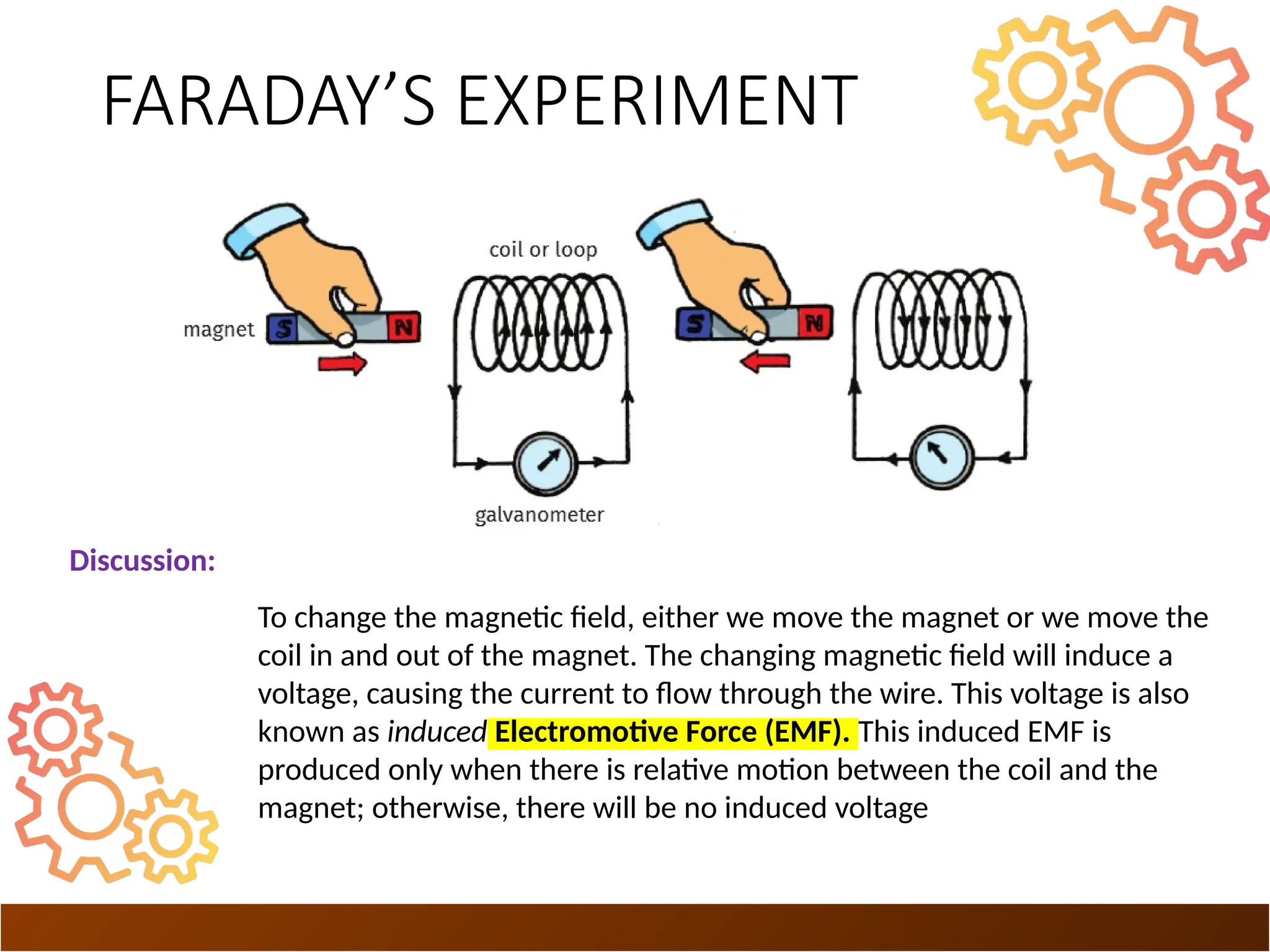
To changethe magnetic field, either we move the magnet or we move the
coil in and out of the magnet. The changing magnetic field will induce a
voltage, causing the current to flow through the wire. This voltage is also
known as induced Electromotive Force (EMF). This induced EMF is
produced only when there is relative motion between the coil and the
magnet; otherwise, there will be no induced voltage
Discussion:
10.
Ways to Increasethe Magnetic field
(based from Faraday’s experiment)
1.) Use a Stronger Magnet
- A magnet with a higher magnetic field strength
increases the magnetic flux through the coil.
- This leads to a greater change in flux when moved, inducing a
stronger current.
2.) Move the Magnet Faster
- The faster the magnet is moved relative to the coil, the
greater the rate of change of magnetic flux.
3.) Increase the Number of Coil Turns
11.
Principles of
ELECTROMAGNETIC INDUCTION
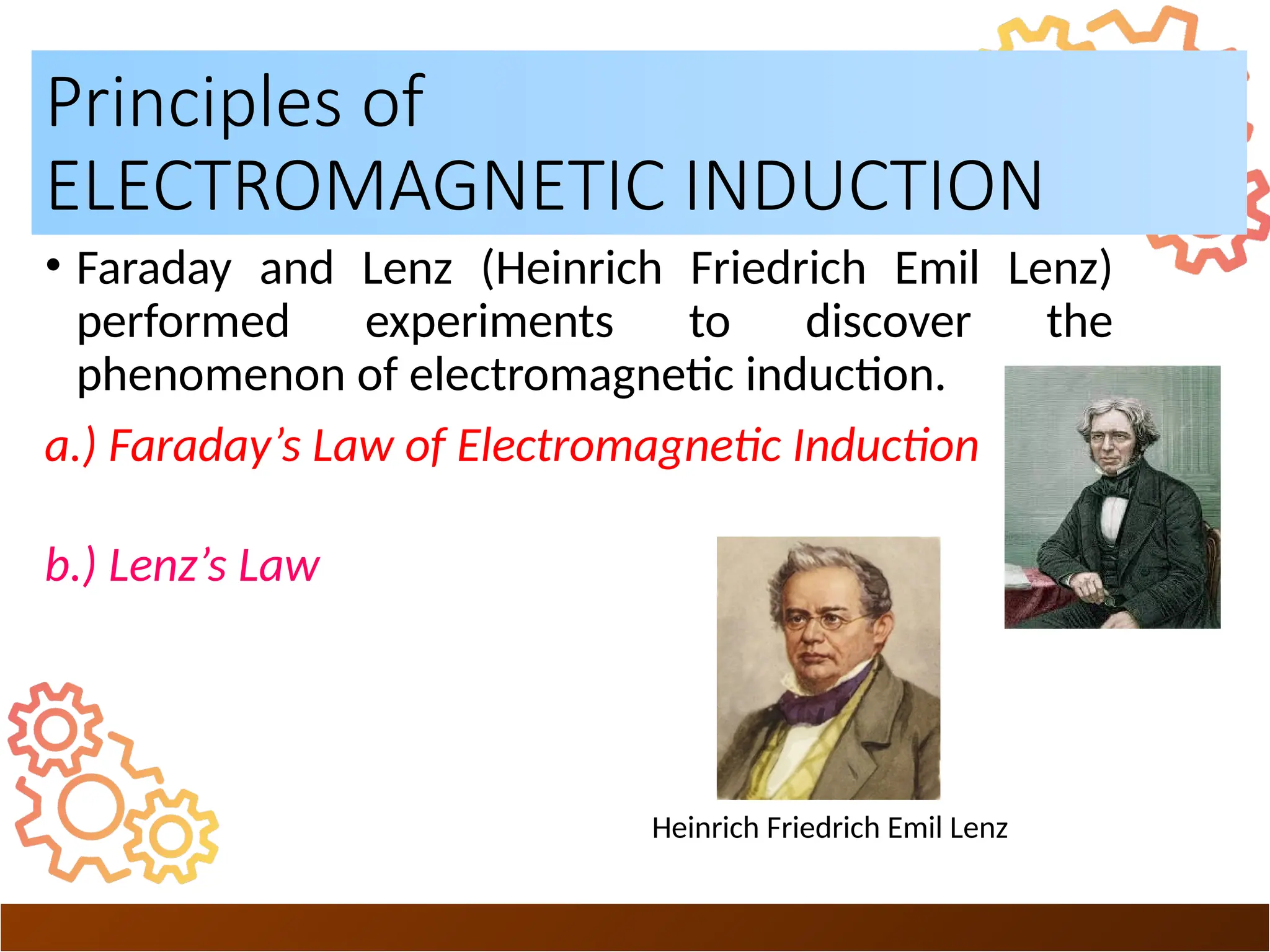
•Faraday and Lenz (Heinrich Friedrich Emil Lenz)
performed experiments to discover the
phenomenon of electromagnetic induction.
a.) Faraday’s Law of Electromagnetic Induction
b.) Lenz’s Law
Heinrich Friedrich Emil Lenz
12.
Faraday’s Law
• MichaelFaraday’s law of electromagnetic induction
states that “an electromotive force (emf) is induced
in a circuit when the magnetic flux through that
circuit changes”
In this law, it is not only the change in the
magnetic field that can produce an electric
current but also the area where the magnetic
field is perpendicularly applied. This law is
denoted by: wherein the magnetic flux (ϕB) is the
result of magnetic field B being
perpendicular to magnetic field A. If the
magnetic flux changes, then
electromagnetic induction occurs.
13.
What is MagneticFlux?
• Magnetic flux (often denoted as ) is the quantity
of magnetic field (B) passing through a given
surface.
• Flux is a general term associated with a field that
is bound by a certain area.
So Magnetic Flux is any area that
has a magnetic field passing
through it.
The SI unit of magnetic flux is the weber (Wb).
1 Wb = 1 T·m² (tesla × square metre)
14.
Lenz’s Law
• Formulatedby Heinrich Friedrich Emil
Lenz
• The direction of the emf and thus the
current is given by Lenz’s law.
• states that the “direction of the current is
induced in a conductor by a changing
magnetic field, such that the magnetic
field created by the induced current
opposes the initial changing magnetic field
that produced it”
• It is the most convenient method to
determine the direction of the induced
current.
15.
Lenz’s Law
• Lenz’sLaw is part of Faraday’s Law and can help you
determine the direction of the current provided
you know HOW the flux is changing.
Q. What is/are the essential difference/s
between Lenz’s Law and Faraday’s law
16.
Material: ½ CW
•Explain the difference between Faraday’s Law and
Lenz’s law using the Venn Diagram.
Faraday’s Law Lenz’s law
Similarity
Difference/s
Difference/s
17.
Differentiating
Aspect Faraday’s LawLenz’s Law
Primary concern
Magnitude of induced
emf due to changing
flux.
Direction of induced
current/emf it opposes
the change in flux.
Quantitative vs
qualitative
Quantitative (gives
formula for emf)
Qualitative (describes
direction)
Purpose in induction
phenomena
Tells us how much emf
is induced when flux
changes.
Tells us which way the
induced current will
flow so that it opposes
the cause.
Q. What is/are the essential
difference/s between Lenz’s Law and
Faraday’s law
19.
YOUR TURN!
TRUE? ORFALSE?
Changing the magnetic flux cannot
produced electromotive forces (emf).
FALSE.
According to Michael Faraday’s law, a changing
magnetic flux does produce an electromotive force
(emf).
1.) LOUDSPEAKER
• Ituses the principle of
electromagnetic
induction to produce
sound waves.
• Components:
• Cone
• Electromagnet
• permanent magnet
22.
1.) LOUDSPEAKER
• Whenan electrical current is
induced in the wire, the
electromagnet produces a
magnetic field and interacts
with the permanent magnet.
• This interaction is similar to a
repulsive force, causing the
electromagnet to move
forward or backward.
23.
1.) LOUDSPEAKER
• Thecone is connected to the electromagnet by a
flexible material. The motion created by the
electromagnet produces the sound vibrations that
we hear.
24.
2.) ELECTRIC MOTOR
•An electric motor is a device that converts
electrical energy to mechanical energy by applying
the principle of electromagnetic induction.
2.) ELECTRIC MOTOR
•A simple motor is composed of:
1. armature (the rotating coil),
2. permanent magnet (source of magnetic field)
3. brushes that carry the current to the commutator
4. commutator (reverses the current), and a source of
electric current. armature
29.
How ELECTRIC MOTORworks?
• In principle, when a current is induced into the wire, the wires produce
a magnetic field. This is now an electromagnet. When a permanent
magnet is brought into the system, the interaction of the permanent
magnet and electromagnets creates a rotational motion to the
armature. As long as the current is continuous, the armature continues
to rotate, producing mechanical energy. This rotational motion
produces different kinds of movements in most kinds of equipment such
as fans and moving toys.
Electrical Energy Mechanical Energy
30.
3.) Hard Discs/Drives
•Hard drives are devices used to store information.
The first hard drive was developed by the
International Business Machines (IBM) Corporation
in 1953.
• The drive stores information using magnetism.
31.
3.) Hard Discs/Drives
•Basic parts of hard drives:
a.) magnetic disc or platter to store the information
b.) spindle to rotate the magnetic discs
c.) read/write heads that add data or information on the platters. The platters are
made up of magnetic materials that are divided into billions of parts called bits. These
bits or areas can be independently magnetized (to store a 1) or demagnetized (to
store a 0). The storing of information uses the binary system. The drive reads only 1
and 0.
32.
How hard discs/drives
work?
Whenthe drive starts to store information, the spindle rotates the magnetic disk
on the precise location of the space where the information should be stored. then the
read/write arms locate this bit and store the information there. The identification
of the free part or bit is determined through electromagnetic interplay.
33.
FORMATIVE ASSESSMENT
Material: 1whole
A. Identify if the following statement is TRUE or FALSE
(CAPITALIZED FORM)
1.) When the magnetic flux through a loop changes, an emf is
induced in that loop.
2.) The induced emf always acts so as to oppose the change in
flux that causes it.
3.) A constant magnetic field through a stationary loop will
induce a current.
4.) The direction of induced current is given by Lenz’s law.
5.) An electric motor converts mechanical energy to electrical
energy.
34.
FORMATIVE ASSESSMENT
B. Tablecompletion
Instruction: Differentiate the following into 3-4
sentences respectively.
Generator Electric Motor
Answer: Answer:
Faraday’s law Lenz’s law
Answer: Answer:
35.
FORMATIVE ASSESSMENT
Material: 1whole
A. Identify if the following statement is TRUE or FALSE (CAPITALIZED
FORM)
1.) When the magnetic flux through a loop changes, an emf is induced in that
loop.
2.) The induced emf always acts so as to oppose the change in flux that causes it.
3.) A constant magnetic field through a stationary loop will induce a current.
4.) The direction of induced current is given by Lenz’s law.
5.) An electric motor converts mechanical energy to electrical energy. FALSE
TRUE
FALSE
TRUE
TRUE
36.
Question
• How doesan electric motor differ from a
generator?
A generator, however, works in reverse, because the generator
uses mechanical energy to produce electrical energy.
Mechanical Energy Electrical Energy
ELECTRIC GENERATOR
• Anelectric generator is a device that converts
mechanical energy to electrical energy through
electromagnetic induction.
• Unlike electric motors, generators operate
induction in reverse where motion pushes the
electrons through the wire to conduct electricity.
Parts of theGenerator
• SHAFT- which is connected to the motor or the
propellers responsible for the mechanical input.
• STATOR- which is a stationary magnetic field with
copper windings.
• ARMATURE- which spins inside the stator to create
electromagnetic induction; and
• COMMUTATOR - which collects electricity and
sends it to the brushes,
• BRUSHES- which in turn send the current outside.
• An ACgenerator is an
electric generator that
converts mechanical energy
into electrical energy in the
form of alternative emf or
alternating current (AC).
• A DC generator converts
mechanical energy into
direct current (DC) output.
• The energy alteration
process uses the principle of
energetically induced
electromotive force.
44.
Efficiency & cost
Generallyhigh
efficiency for large
scale; initial cost may
be higher.
Lower efficiency in
large scale; simpler
units may cost less
initially but higher
maintenance.
AC generator DC generator
45.
Typical use cases
Largepower plants, grid
supply, high-voltage
generation.
Smaller scale, battery
charging.
AC generator DC generator
DC generators are limited for high
voltage due to commutator/brush
issues and the lack of an easy
transformer type step up, thus they
‐ ‐
are more practical for lower voltage
‐
or local applications.
AC generators are favored for
high voltage generation because
‐
they avoid severe
commutation/brush problems at
high voltage.
46.
Video watching
• Tracehow hydroelectric power plants work for
electrical energy production.
MATERIALS TO BRINGNEXT WEEK
TUESDAY (NOV.---, 2025)
PER GROUP
2 meters of 1 mm of wire
Battery
4 Magnets (Circular and as size as battery’s cross
sectional view)
Grocery Cartoon , folder, bottle caps
Glue gun with Stick glue, Thread
Pliers, cutter, designs
49.
Expected Output
Designs areoptional: You can
include figures, crystal ball, etc
Wire/Thread
Guide Questions
1.How does the placement of the magnet below the battery affect the magnetic field interacting with the wire loop, and
how does this help the loop spin like a carousel?
2.What shape and balance should the wire loop have so it can rotate smoothly around the battery when current flows
through it?
3.How does the connection between the battery terminals and the wire create an intermittent current that allows
continuous spinning instead of the wire getting stuck?
Cartoon (Based) Rationale about simple electric
motor and electromagnetic
induction
"Invisible Force Challenge:Move
the Can without Touching It!"
Instruction: inflate the balloon with air and rub it to
someone’s hair or clothes and introduce it to
aluminum can.
Rolling must start here
Finish
Aluminum can
Start
Winner: +20 points
(lesson check)
PART 1: TRUEor FALSE
1. A changing magnetic field can induce an
electric current in a conductor.
2. A stationary magnetic field can induce
current even if the conductor is not
moving.
3. Faraday’s Law states that the induced EMF
is proportional to the rate of change of
magnetic flux.
56.
PART 1: TRUEor FALSE
4. Lenz’s Law explains the direction of the induced
current.
5. The induced current always supports the change
in magnetic flux that produces it.
6. Electromagnetic induction is the principle behind
electric generators.
57.
PART 1: TRUEor FALSE
7. A coil with more turns will generally produce a
stronger induced EMF, all else being equal.
8. Electromagnetic induction cannot occur in a
closed conducting loop.
9. Moving a magnet faster through a coil produces a
larger induced EMF.
10. Induced current only occurs when the magnet
and coil are connected to an external power
source.
58.
PART 2: Arrangethe following steps of the
hydroelectric power plant process in the
correct order.
1. The spinning turbine drives the generator, and electromagnetic
induction produces electrical energy that is then regulated by
control systems.
2. Water is stored in the reservoir, and the intake structure allows a
controlled amount of water to enter the hydropower system.
3. Transformers increase the voltage for efficient transmission, and the
electricity is sent through power lines for distribution to homes and
industries.
4. The water travels down the penstock, where gates and valves
regulate the flow and increase the water pressure as it moves
downward.
5. The high-pressure water strikes the blades of the turbine and causes
it to spin, which converts the water’s energy into mechanical energy.
PART 1: TRUEor FALSE
1. A changing magnetic field can induce an
electric current in a conductor.
2. A stationary magnetic field can induce
current even if the conductor is not
moving.
3. Faraday’s Law states that the induced EMF
is proportional to the rate of change of
magnetic flux.
True
False
True
62.
PART 1: TRUEor FALSE
4. Lenz’s Law explains the direction of the induced
current.
5. The induced current always supports the change
in magnetic flux that produces it.
6. Electromagnetic induction is the principle behind
electric generators.
True
False (It opposes the change)
True
63.
PART 1: TRUEor FALSE
7. A coil with more turns will generally produce a
stronger induced EMF, all else being equal.
8. Electromagnetic induction cannot occur in a
closed conducting loop.
9. Moving a magnet faster through a coil produces a
larger induced EMF.
10. Induced current only occurs when the magnet
and coil are connected to an external power
source.
True
False
True
False
64.
PART 2: ANSWER
1.Water is stored in the reservoir, and the intake structure allows a
controlled amount of water to enter the hydropower system.
2. The water travels down the penstock, where gates and valves regulate
the flow and increase the water pressure as it moves downward.
3. The high-pressure water strikes the blades of the turbine and causes it
to spin, which converts the water’s energy into mechanical energy.
4. The spinning turbine drives the generator, and electromagnetic
induction produces electrical energy that is then regulated by control
systems.
5. Transformers increase the voltage for efficient transmission, and the
electricity is sent through power lines for distribution to homes and
industries.
65.
PART 3:Enumeration
1-3: Componentsof an loudspeaker
answer:
1. Cone
2. Electromagnet
3. permanent magnet
4-7: Provide the 4 major Parts of an electric motor
answer:
1. Armature
2. Commutator
3. Brushes
4. Permanent magnet
Application
• Eddy currentbalances
• Metal detectors
• Eddy current dynamometers
• Braking systems on train
• AC generators
• Card readers
• Microphones
70.
Electromagnetic Induction Useful
Applications
•AC Generators use Faraday’s law to produce
rotation and thus convert electrical and magnetic
energy into rotational kinetic energy.
• This idea can be used to run all kinds of motors.
Since the current in the coil is AC, it is turning on
and off thus creating a CHANGING magnetic field of
its own. Its own magnetic field interferes with the
shown magnetic field to produce rotation.
• the magnitudeof the induced emf in the conductor
is equal to the rate of change of magnetic flux
linked to the conductor
• electromagnetic induction, the EMF induced in the
conductor is equal to the rate of change of flux
linkage
73.
Eddy Current
• Eddycurrents are loops of electrical current
induced within conductors by a changing magnetic
field in the conductor according to Faraday’s law of
induction. Eddy currents flow in closed loops within
conductors, in planes perpendicular to the
magnetic field.
74.
• Induced electromotiveforce is produced in the coil
when there is a change in the magnetic flux linked
with that coil. Eddy currents are named so because
the current looks like eddies or whirlpools. When a
conductor is placed in the changing magnetic field,
the induced current in the conductor is termed as
Eddy current
76.
Dynamo
• A dynamois an electrical generator that utilizes a
commutator to generate direct current.
• Dynamo is a device that converts mechanical
energy into electrical energy.
• Dynamos were the first electrical generators
utilized just to supply power to industry, as well as
they served as the platform for several subsequent
electric-power conversion types of equipment, such
as the alternating-current (AC) alternator, electric
motor, as well as a rotary converter.
77.
Working of Dynamo:
•The image below shows a basic dynamo with such a
coil constructed of conducting wires that are
positioned between the North pole and South pole of
two permanent magnets.
• Whenever the coil is to be motionless, no voltage is
produced. The magnetic field changes as the coil spins,
causing a voltage to be generated within the coil.
79.
• The leftside of the coil travels from the North pole of such
a left magnet during the first half of the revolution. The
coil travels from the South pole of the right magnet
throughout the second part of the revolution.
• There are two conceivable polarities throughout these
rounds:
• Positive
• Negative
• An alternating voltage is a difference between their
polarities.
80.
Inductive resistance
• Inductivereactance, generally reactance, is the
resistance of an inductive circuit.
• It is termed reactance since it fluctuates slightly
from the resistance provided through any
equipment or gadget. It is denoted by “
• ”.
• The SI unit of inductive resistance is Ohm
Editor's Notes
#3 if you have a loop of wire and the magnetic field through that loop changes (either by moving the magnet, moving the loop, or varying the strength of the magnetic field), a voltage is induced in that loop.
#4 if you have a loop of wire and the magnetic field through that loop changes (either by moving the magnet, moving the loop, or varying the strength of the magnetic field), a voltage is induced in that loop.
#14 Faraday's Law quantifies the magnitude of the induced electromotive force (EMF) from a changing magnetic field, while Lenz's Law specifies the direction of the induced current, stating that it will oppose the change in magnetic flux that created it
#30 The term “hard disk” emphasizes the “disk” part (the media) more than the “drive” mechanism.
If you’re buying/storage spec’ing: you can safely treat “hard drive” = “hard disk drive” (HDD) in most cases.
If you want precision (for technical writing, engineering, etc): you might distinguish between “disk (media)” and “drive (mechanism)”.
#45 AC generators are favored for high‐voltage generation because they:
Integrate easily with step‐up transformer systems.
Avoid severe commutation/brush problems at high voltage.
Feed into AC transmission systems where high voltage is beneficial.
DC generators are limited for high voltage due to commutator/brush issues and the lack of an easy transformer‐type step‐up, thus they are more practical for lower‐voltage or local applications.